TERESA JARAMILLO BENÉITEZ
With just over 5 million people, Finland is one of Europe's richest and most successful nations. 
One of the secrets of Finland's success is a high level of public investment in education and training. Finland's education system is one of the best in the world.
 
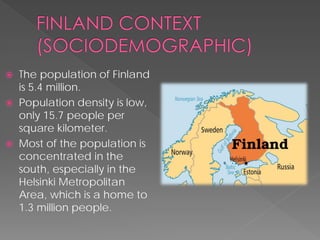
The population of Finland is 5.4 million. 
 
Population density is low, only 15.7 people per square kilometer. 
 
Most of the population is concentrated in the south, especially in the Helsinki Metropolitan Area, which is a home to 1.3 million people.
 
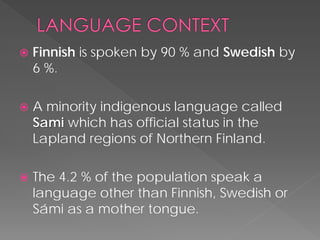
Finnishis spoken by 90 % and Swedishby 6 %. 
 
A minority indigenous language called Samiwhich has official status in the Lapland regions of Northern Finland. 
 
The 4.2 % of the population speak a language other than Finnish, Swedish or Sámi as a mother tongue.
 
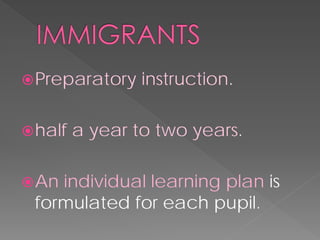
Preparatory instruction. 
 
half a year to two years. 
 
An individual learning plan is formulated for each pupil.
 
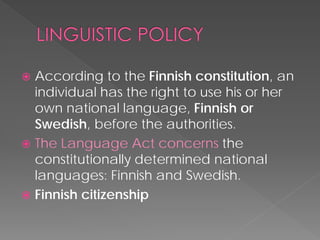
According to the Finnish constitution, an individual has the right to use his or her own national language, Finnish or Swedish, before the authorities. 
 
The Language Act concerns the constitutionally determined national languages: Finnish and Swedish. 
 
Finnish citizenship
 
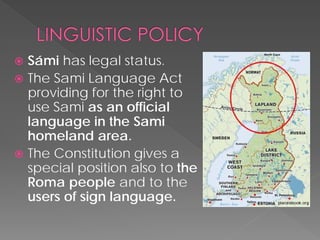
Sámi has legal status. 
 
TheSami Language Act providing for the right to use Sami as an official language in the Sami homeland area. 
 
The Constitution gives a special position also to the Roma people and to the users of sign language.
 
Since 1991 the municipalities, schools and teachers can use a foreign language to teach any subject as in CLIL 
 
In the newly (1999) re-codifiedFinnish Constitutionwere guaranteed the rights of the Swedish-speaking populationby a specialLanguage Act, which, together with some special laws, provides for equality in the official use of the native language and access to education and public careers.
 
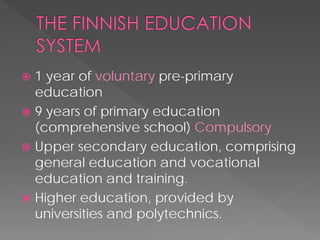
1 year of voluntarypre-primary education 
 
9 years of primary education (comprehensive school) Compulsory 
 
Upper secondary education, comprising general education and vocational education and training. 
 
Higher education, provided by universities and polytechnics.
 
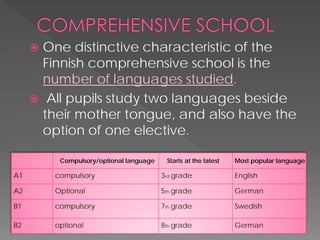
One distinctive characteristic of the Finnish comprehensive school is the number of languages studied. 
 
All pupils study two languages beside their mother tongue, and also have the option of one elective. 
Compulsory/optionallanguage 
Starts atthelatest 
Mostpopular language 
A1 
compulsory 
3rdgrade 
English 
A2 
Optional 
5thgrade 
German 
B1 
compulsory 
7thgrade 
Swedish 
B2 
optional 
8thgrade 
German
The main objectivesof the programmeare: 
 
Improve the level of foreign-language students. 
 
Promote the confidence of the students getting motivate them and encourage them to study more to be able to handle another language. 
 
Provide a challenge to teachers wishing to teach in another language for any reason. 
 
Facilitate educational institutions to receive foreign students, to promote the exchange of students and teachers and to respond to the current internationalization of the education.
 
The number of Finnish schools that implement bilingual education has remained quite stable (4-8%). 
 
The majority of the Finnish schools provide teaching in English and Finnish, and their common goal is for the students to learn Englishnot only during their foreign language classes but also during classes where content is taught through the medium of English.
 
CLIL education is voluntaryin Finland. 
 
Is offer in comprehensive school. (9-16 years) 
 
Different Finnish schools offer CLIL education at least in Swedish, English, German, Russian, French, and Spanish.
 
CLIL in Finland involves a number of vehicular languages. 
 
The most common subjects taught in Englishin comprehensive schools (and upper secondary schools are: 
Environmental science, mathematics, 
visual arts, geography, biology, music, physical education, religion, chemistry, crafts, physics.
 
In CLIL teaching, the key issue is to have competent language skillsfor the teaching context. 
 
self-confidence. 
 
Native English speakers are not automatically better CLIL teachers. 
 
Level 5 general language test "Language proficiency".
 
Immersion is unique among bilingual education methods as it is traditionally a foreign or second language learning method for speakers of the majority language.
The age at which the students begin the immersion 
Age groups : 
 
Early immersion (begins during early childhood) 
 
Middle/delayed immersion (begins ages 8 to 10) 
 
Late immersion (begins during teenage years).
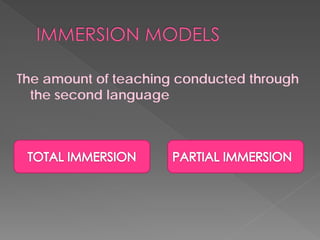
The amount of teaching conducted through the second language
Beyond these differences according to the age of students and the amount of L2 instruction. 
CATEGORIES: 
Heritage language immersion 
double-immersion 
dual immersion
 
Performance in reading literacy is still high in Finland by international standards. Finland’s average score came in 6 place among all participating countries. 
 
Finland’s proficiency in scientific literacy, Finland ranked in 5 place among all participating countries. 
 
Finland’s national average in mathematical literacy has fallen by 25 points since the PISA 2003 assessment.
 
Finlandhas a complexeducationsystem. 
 
Two compulsory languages during their school years, and many have studied more than two. 
 
Immigrant pupils are integrated into Finnish or Swedish classes in order to make them feel part of the school community 
 
Teacher’scurriculumflexibility. Theyare free to choose their concrete methods. 
 
High network of CLIL schools

Finland

  • 1.
  • 2.
    With just over5 million people, Finland is one of Europe's richest and most successful nations. One of the secrets of Finland's success is a high level of public investment in education and training. Finland's education system is one of the best in the world.
  • 3.
     The populationof Finland is 5.4 million.  Population density is low, only 15.7 people per square kilometer.  Most of the population is concentrated in the south, especially in the Helsinki Metropolitan Area, which is a home to 1.3 million people.
  • 5.
     Finnishis spokenby 90 % and Swedishby 6 %.  A minority indigenous language called Samiwhich has official status in the Lapland regions of Northern Finland.  The 4.2 % of the population speak a language other than Finnish, Swedish or Sámi as a mother tongue.
  • 6.
     Preparatory instruction.  half a year to two years.  An individual learning plan is formulated for each pupil.
  • 7.
     According tothe Finnish constitution, an individual has the right to use his or her own national language, Finnish or Swedish, before the authorities.  The Language Act concerns the constitutionally determined national languages: Finnish and Swedish.  Finnish citizenship
  • 8.
     Sámi haslegal status.  TheSami Language Act providing for the right to use Sami as an official language in the Sami homeland area.  The Constitution gives a special position also to the Roma people and to the users of sign language.
  • 9.
     Since 1991the municipalities, schools and teachers can use a foreign language to teach any subject as in CLIL  In the newly (1999) re-codifiedFinnish Constitutionwere guaranteed the rights of the Swedish-speaking populationby a specialLanguage Act, which, together with some special laws, provides for equality in the official use of the native language and access to education and public careers.
  • 10.
     1 yearof voluntarypre-primary education  9 years of primary education (comprehensive school) Compulsory  Upper secondary education, comprising general education and vocational education and training.  Higher education, provided by universities and polytechnics.
  • 11.
     One distinctivecharacteristic of the Finnish comprehensive school is the number of languages studied.  All pupils study two languages beside their mother tongue, and also have the option of one elective. Compulsory/optionallanguage Starts atthelatest Mostpopular language A1 compulsory 3rdgrade English A2 Optional 5thgrade German B1 compulsory 7thgrade Swedish B2 optional 8thgrade German
  • 12.
    The main objectivesofthe programmeare:  Improve the level of foreign-language students.  Promote the confidence of the students getting motivate them and encourage them to study more to be able to handle another language.  Provide a challenge to teachers wishing to teach in another language for any reason.  Facilitate educational institutions to receive foreign students, to promote the exchange of students and teachers and to respond to the current internationalization of the education.
  • 13.
     The numberof Finnish schools that implement bilingual education has remained quite stable (4-8%).  The majority of the Finnish schools provide teaching in English and Finnish, and their common goal is for the students to learn Englishnot only during their foreign language classes but also during classes where content is taught through the medium of English.
  • 14.
     CLIL educationis voluntaryin Finland.  Is offer in comprehensive school. (9-16 years)  Different Finnish schools offer CLIL education at least in Swedish, English, German, Russian, French, and Spanish.
  • 15.
     CLIL inFinland involves a number of vehicular languages.  The most common subjects taught in Englishin comprehensive schools (and upper secondary schools are: Environmental science, mathematics, visual arts, geography, biology, music, physical education, religion, chemistry, crafts, physics.
  • 16.
     In CLILteaching, the key issue is to have competent language skillsfor the teaching context.  self-confidence.  Native English speakers are not automatically better CLIL teachers.  Level 5 general language test "Language proficiency".
  • 17.
     Immersion isunique among bilingual education methods as it is traditionally a foreign or second language learning method for speakers of the majority language.
  • 18.
    The age atwhich the students begin the immersion Age groups :  Early immersion (begins during early childhood)  Middle/delayed immersion (begins ages 8 to 10)  Late immersion (begins during teenage years).
  • 19.
    The amount ofteaching conducted through the second language
  • 20.
    Beyond these differencesaccording to the age of students and the amount of L2 instruction. CATEGORIES: Heritage language immersion double-immersion dual immersion
  • 21.
     Performance inreading literacy is still high in Finland by international standards. Finland’s average score came in 6 place among all participating countries.  Finland’s proficiency in scientific literacy, Finland ranked in 5 place among all participating countries.  Finland’s national average in mathematical literacy has fallen by 25 points since the PISA 2003 assessment.
  • 22.
     Finlandhas acomplexeducationsystem.  Two compulsory languages during their school years, and many have studied more than two.  Immigrant pupils are integrated into Finnish or Swedish classes in order to make them feel part of the school community  Teacher’scurriculumflexibility. Theyare free to choose their concrete methods.  High network of CLIL schools