Static, Modal and Harmonic Analysis
of a Helical Compression Spring
By - Pratham Modi, Aditya Shah, Athar Hussain
Introduction:
● The topic for our mini project for our FEM lab is titled “Static, Modal and
Harmonic analysis of a Helical Compression Spring”.
● We have designed and modeled the spring referring to the case study of a
Three-wheeled vehicle suspension spring.
● This project aims to provide a detailed analysis of the helical spring using FEM
and contribute to the advancement of the engineering field by improving the
design and performance of such helical spring-based systems.
Literary review summary:
● Helical springs are widely used in various engineering applications due to their ability to
store and release energy.They are made out of a wire with a specific number of turns
and diameter that has been wound into a helix shape.
● When an external load is applied to a helical spring, it undergoes deformation and compresses
or extends along the axis of the coil. This deformation causes the spring to store potential
energy that can be released when the load is removed.
● In FEM, the spring is modeled as a 3D structure composed of a series of finite elements. The
external load is applied to the model, and the software calculates the deformation, stress, and
strain of each element. Using Modal and Harmonic Analysis, we can get the frequencies in
which spring can work and its shape during that particular frequency.
The model as designed in Fusion 360:
The Dimensions and Properties of the spring:
● Inner diameter: 40mm
● Outer diameter: 56mm
● Mean diameter: 48mm
● Wire diameter: 8mm
● C=D/d = 6
● Total length: 210mm
● Solid length: 100mm
● Material used in the spring: ASTM A227 (cold-drawn spring steel)
● Young’s Modulus: 196.50 GPa
● Poisson’s ratio: 0.25
● Shear Modulus: 78.60 GPa
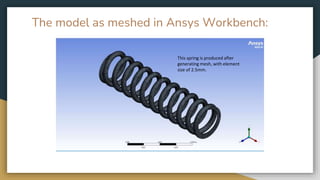
The model as meshed in Ansys Workbench:
This spring is produced after
generating mesh, with element
size of 2.5mm.
Static Structural analysis:
● A typical spring system of a TWV experiences a weight of 405kg (including a driver
and three passengers) but for safety purposes 500kg is assumed to be
concentrated at the vehicle’s centre of gravity.
● The single spring in the front and the two springs in the rear suspension are
thought to evenly distribute the entire weight.Therefore, the front suspension
spring is under a weight of about 167 kg.
● After applying 1667 N of remote force on the spring and fixing one free end in the
software, we get the following results:
The spring experiences
maximum deformation of
0.0269mm at this end.
This end is a
fixed support.
Total Deformation diagram of the spring
This side experiences
low stress levels.
This region experiences high stress
levels of 8.807e8 Pa (near the fixed
end.
The force is applied
in this direction.
Equivalent Stress diagram of the Spring
Modal Analysis:
● Modal analysis is used to identify, analyse and resolve potential
resonance and vibration issues and optimise the system design to
minimize such issues.
● After performing Modal Analysis for our model, we got a
frequency range of 14.54Hz to 193.24Hz for 10 nodes whose total
deformation was carried out and out of which we found 8 to be
useful for the real case scenario:
Mode 1: Rigid Body
mode
Mode 3:
bending mode
Mode 4:
torsional mode
Mode 5: coupled
bending-torsional mode
Mode 6: Flap
mode
Mode 7: Shear
mode
Mode 8: Twist-
bend mode
Mode 10: Curvature
mode
Harmonic Structural Analysis:
● When a spring is compressed or stretched, it exerts a harmonic force that is
proportional to the amount of compression or stretching. The study of harmonic
forces is important in many areas of science and engineering, including physics,
mechanics, acoustics, and signal processing.
● Here, from the research papers regarding the harmonic force acting on the springs,
we founded out how the spring behaves under harmonic force of frequency
between 0.5Hz to 80Hz (as is in real-life case study) and force of 1667N.
Total Deformation Diagram: Equivalent Stress Diagram:
The Spring experiences high
harmonic deflections in this
region.
The spring experiences
harmonic stresses in the
inner region.
Results and analysis:
● The Static Structural analysis revealed that the maximum stress was located at the
middle and lower portion of the spring, and the stress was well within the yield
strength of the material. The deformation of the spring was also within the
acceptable range, and it did not exceed the maximum permissible value.
● The analysis revealed that the first three natural frequencies of the suspension
spring were 14.549Hz, 80.44Hz, and 185.36Hz. The corresponding mode shapes
showed that the suspension spring underwent predominantly bending
deformation.
● The analysis revealed that the maximum amplitude of the displacement occurred
at the natural frequency of the spring. This indicated that the spring was
susceptible to resonance at the natural frequency. However, the analysis also
showed that the amplitude of the displacement was within the acceptable range.
Thank you!

Finite element Methods engg Project.pptx

  • 1.
    Static, Modal andHarmonic Analysis of a Helical Compression Spring By - Pratham Modi, Aditya Shah, Athar Hussain
  • 2.
    Introduction: ● The topicfor our mini project for our FEM lab is titled “Static, Modal and Harmonic analysis of a Helical Compression Spring”. ● We have designed and modeled the spring referring to the case study of a Three-wheeled vehicle suspension spring. ● This project aims to provide a detailed analysis of the helical spring using FEM and contribute to the advancement of the engineering field by improving the design and performance of such helical spring-based systems.
  • 3.
    Literary review summary: ●Helical springs are widely used in various engineering applications due to their ability to store and release energy.They are made out of a wire with a specific number of turns and diameter that has been wound into a helix shape. ● When an external load is applied to a helical spring, it undergoes deformation and compresses or extends along the axis of the coil. This deformation causes the spring to store potential energy that can be released when the load is removed. ● In FEM, the spring is modeled as a 3D structure composed of a series of finite elements. The external load is applied to the model, and the software calculates the deformation, stress, and strain of each element. Using Modal and Harmonic Analysis, we can get the frequencies in which spring can work and its shape during that particular frequency.
  • 4.
    The model asdesigned in Fusion 360:
  • 5.
    The Dimensions andProperties of the spring: ● Inner diameter: 40mm ● Outer diameter: 56mm ● Mean diameter: 48mm ● Wire diameter: 8mm ● C=D/d = 6 ● Total length: 210mm ● Solid length: 100mm ● Material used in the spring: ASTM A227 (cold-drawn spring steel) ● Young’s Modulus: 196.50 GPa ● Poisson’s ratio: 0.25 ● Shear Modulus: 78.60 GPa
  • 6.
    The model asmeshed in Ansys Workbench: This spring is produced after generating mesh, with element size of 2.5mm.
  • 7.
    Static Structural analysis: ●A typical spring system of a TWV experiences a weight of 405kg (including a driver and three passengers) but for safety purposes 500kg is assumed to be concentrated at the vehicle’s centre of gravity. ● The single spring in the front and the two springs in the rear suspension are thought to evenly distribute the entire weight.Therefore, the front suspension spring is under a weight of about 167 kg. ● After applying 1667 N of remote force on the spring and fixing one free end in the software, we get the following results:
  • 8.
    The spring experiences maximumdeformation of 0.0269mm at this end. This end is a fixed support. Total Deformation diagram of the spring
  • 9.
    This side experiences lowstress levels. This region experiences high stress levels of 8.807e8 Pa (near the fixed end. The force is applied in this direction. Equivalent Stress diagram of the Spring
  • 10.
    Modal Analysis: ● Modalanalysis is used to identify, analyse and resolve potential resonance and vibration issues and optimise the system design to minimize such issues. ● After performing Modal Analysis for our model, we got a frequency range of 14.54Hz to 193.24Hz for 10 nodes whose total deformation was carried out and out of which we found 8 to be useful for the real case scenario:
  • 11.
    Mode 1: RigidBody mode Mode 3: bending mode Mode 4: torsional mode Mode 5: coupled bending-torsional mode
  • 12.
    Mode 6: Flap mode Mode7: Shear mode Mode 8: Twist- bend mode Mode 10: Curvature mode
  • 13.
    Harmonic Structural Analysis: ●When a spring is compressed or stretched, it exerts a harmonic force that is proportional to the amount of compression or stretching. The study of harmonic forces is important in many areas of science and engineering, including physics, mechanics, acoustics, and signal processing. ● Here, from the research papers regarding the harmonic force acting on the springs, we founded out how the spring behaves under harmonic force of frequency between 0.5Hz to 80Hz (as is in real-life case study) and force of 1667N.
  • 14.
    Total Deformation Diagram:Equivalent Stress Diagram: The Spring experiences high harmonic deflections in this region. The spring experiences harmonic stresses in the inner region.
  • 15.
    Results and analysis: ●The Static Structural analysis revealed that the maximum stress was located at the middle and lower portion of the spring, and the stress was well within the yield strength of the material. The deformation of the spring was also within the acceptable range, and it did not exceed the maximum permissible value. ● The analysis revealed that the first three natural frequencies of the suspension spring were 14.549Hz, 80.44Hz, and 185.36Hz. The corresponding mode shapes showed that the suspension spring underwent predominantly bending deformation. ● The analysis revealed that the maximum amplitude of the displacement occurred at the natural frequency of the spring. This indicated that the spring was susceptible to resonance at the natural frequency. However, the analysis also showed that the amplitude of the displacement was within the acceptable range.
  • 16.