International Research Journal of Engineering and Technology (IRJET) e-ISSN: 2395-0056
Volume: 05 Issue: 11 | Nov 2018 www.irjet.net p-ISSN: 2395-0072
Material Optimization of Shock Absorber Spring
Rajat Bedekar1, Pankaj Mhatre2, Ashish Ingle3, Snehal Gharat4, Pramod Suryavanshi5
1,2,3,4Students, Department of Mechanical Engineering, Bharati Vidyapeeth College of Engineering,
Navi Mumbai, India
5Guide, Professor, Department of Mechanical Engineering, Bharati Vidyapeeth College of Engineering,
Navi Mumbai, India
---------------------------------------------------------------------***----------------------------------------------------------------------
Abstract - Shock absorber is a mechanical device designed
to smooth out or damp shock impulse, and dissipate kinetic
energy. In a vehicle, it reduces the effect of travelling over
rough ground, leading to improved ride quality, and
increase in comfort due to substantially reduced amplitude
of disturbances.
Key Words: Shock Absorber, Analysis, Design, Creo,
Material, Spring.
1. INTRODUCTION
A shock absorber or damper is a mechanical device
designed to smooth out or damp shock impulse, and
dissipate kinetic energy. Pneumatic and hydraulic shock
absorbers commonly take the form of a cylinder with a
sliding piston inside. The cylinder is filled with a fluid
(such as hydraulic fluid) or air. This fluid-filled
piston/cylinder combination is a dashpot. The shock
absorbers duty is to absorb or dissipate energy. These are
an important part of automobile suspensions, aircraft
landing gear, and the supports for many industrial
machines. A transverse mounted shock absorber, called a
yaw damper, helps keep railcars from swaying excessively
from side to side and are important in commuter railroads
and rapid transit systems because they prevent railcars
from damage station platforms. In a vehicle, it reduces the
effect of traveling over rough ground, leading to improved
ride quality, and increase comfort due to substantially
reduced amplitude of disturbances. Without shock
absorbers, the vehicle would have a bouncing ride, as
energy is stored in the spring and then released to the
vehicle, possibly exceeding the allowed range of
suspension movement.
2. Problem Definition
To check the strength of the model, the structural analysis
on the helical spring was done by varying different spring
materials. Modal analysis is done to determine best
material for spring.
3 Methodology
3.1 Design in Creo
Design of Upper Mount
Draw a circle with 60mm diameter and 30mm diameter,
circle of 40mm diameter and length 50 mm.
Design of Bottom Mount
Draw a circle with 160mm diameter and 150mm diameter,
circle of 40mm diameter and length 50 mm.
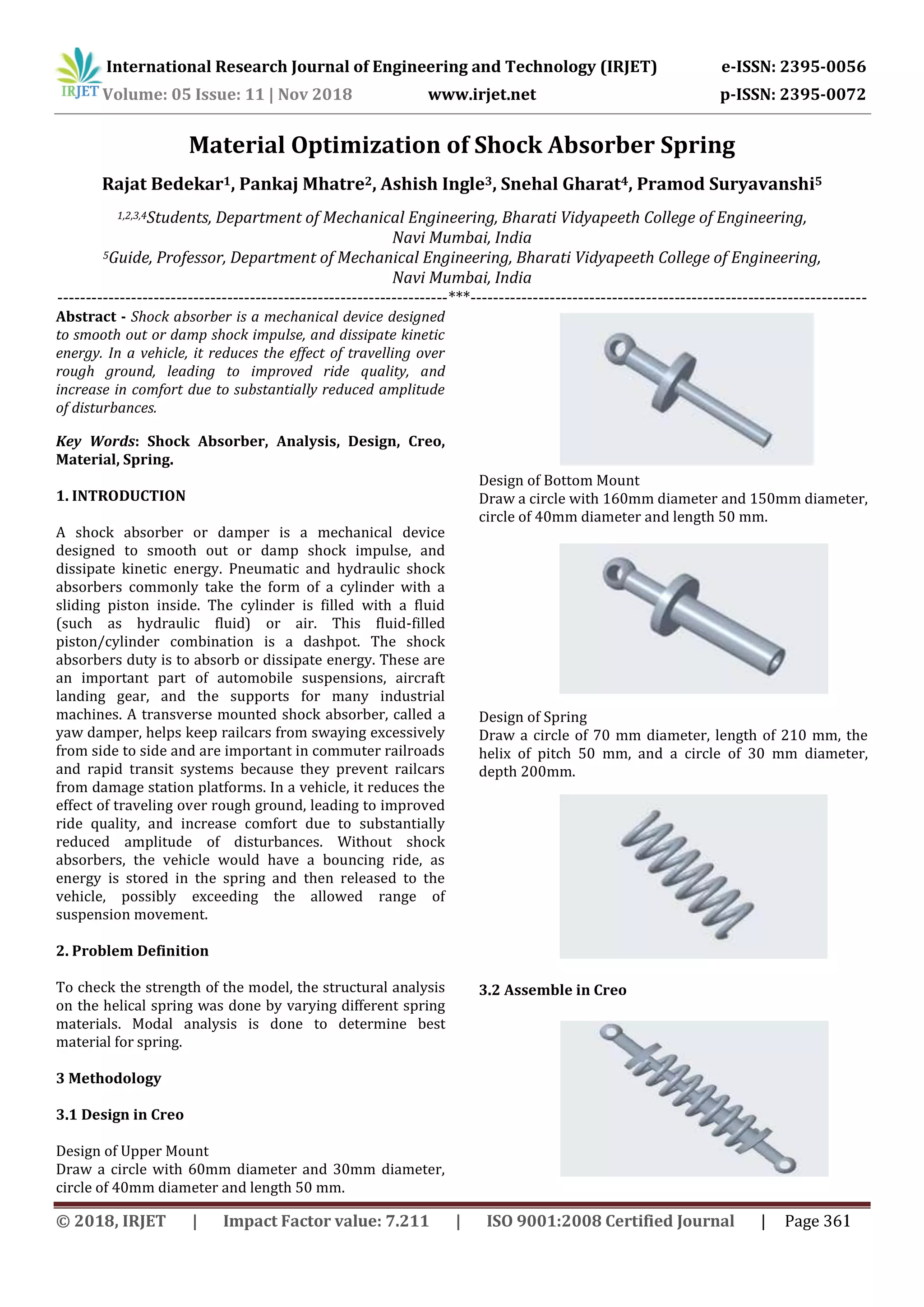
Design of Spring
Draw a circle of 70 mm diameter, length of 210 mm, the
helix of pitch 50 mm, and a circle of 30 mm diameter,
depth 200mm.
3.2 Assemble in Creo
© 2018, IRJET | Impact Factor value: 7.211 | ISO 9001:2008 Certified Journal | Page 361
International Research Journal of Engineering and Technology (IRJET) e-ISSN: 2395-0056
Volume: 05 Issue: 11 | Nov 2018 www.irjet.net p-ISSN: 2395-0072
3.3 Analysis in Workbench
Procedure to follow
1. Open static structure analysis in workbench.
2. Select material from engineering data.
3. Import geometry.
4. In model do meshing.
5. In setup put in boundary conditions
6. And then solve.
7. Change material and again solve.
4. Result
Displacement
Stress
Table of Result
5. Future Scope
1. To optimize the upper and lower mount material.
2. Analysis by considering hydraulic shock absorber.
3. Optimization by considering the angular
displacement at end supports.
6. Conclusions
To validate the strength of our design, we have done
structural
1. The stress intensity and displacement vectors are
less for Stainless Steel than other materials. So, the
best material for spring is Stainless Steel.
2. From the analysis results it is clear that the optimal
stress intensities & maximum displacement values
are obtained for the Stainless Steel material.
Therefore, when the availability of Stainless Steel is more
and cost of Stainless Steel material is affordable then the
scope of materials for springs with Stainless Steel is
preferable.
REFERENCES
[1] Pinjarla Poornamohan, Lakshmana Kishore T, “Design
and Analysis of Shock Absorber,” IJRET, vol. 1, no. 4,
ISSN. 2319-1163, Dec, 2012.
[2] Sudarshan Martande,Y.N Jangale,N.S Motgi, “Design
and Analysis of shock absorber,” IJAIEM, vol 2, no. 3,
ISSN. 2319-4847, March, 2013.
[3] Niranjan Singh, “General Review of Mechanical Springs
used in Suspension Sytem,” IJAERS, studies/3/1, ISSN
2249-8974, Oct-Dec, 2013
[4] Achyut P.Banginwar, Nitin D.Bhusale, Kautuk
V.Totawar, “Design and Analysis of Shock Absorber
using Finite element analysis tool,”vol. 10, Issue 2, pp.
22-28, Feb. 2014.
[5] Youli Zhu, Yanli Wang, Yunalin Huang, “Failure
Analysis of Helical Compression Spring For Heavy
Vehicle’s Suspension Sytem,” Elsevier, 169-173, June,
2014
[6] P.R Jadhav, N.P Doshi, U.D Gulhane, “Analysis of Helical
Spring in Mono-suspension System used in
Motorcycle,” IJRAT, vol 2, Issue 10,ISSN 2321-
9637,Oct,2014.
[7] G.R Chavhan, S.W Burande, L.P.Dhole, “Analysis of
Shock Absorber using different material of spring,”
IJAET, vol 5, Issue 4,ISSN 0976-3945,Dec,2014.
[8] P.Karunakar, P. Varalaxmi, Ch. Rohit R. Reddy,
“Comparative Design Analysis of Two Wheeler,”
ICIEMS, ISBN 978-81, 2014
[9] Rahul Tekade, Chinmay Patil, “Structural and Modal
Analysis of Shock Absorber of Vehicle,” IJETT, vol 21,
no.4, ISSN 2231-5381, March, 2015
© 2018, IRJET | Impact Factor value: 7.211 | ISO 9001:2008 Certified Journal | Page 362
International Research Journal of Engineering and Technology (IRJET) e-ISSN: 2395-0056
Volume: 05 Issue: 11 | Nov 2018 www.irjet.net p-ISSN: 2395-0072
[10] Krysztof Michalczyk, “Analysis of Lateral Vibrations of
Axially loaded Helical Spring,” Journal of theoretical
and applied Mechanics, 53,3,pp-745-755, 2015
[11] Karthik A.S, Manojkumar M.Hanumanalli, Vinaykumar
B. Honakeri, Manjunath S, “Design and Static Analysis
of Shock Absorber,” IJIRST, vol 2, no 12, ISSn 2349-
6010, May, 2016
BIOGRAPHIES
Rajat Bedekar is currently
studying as a student in Bharati
Vidyapeeth college of
engineering, Navi Mumbai. His
field of interest are Heat Transfer
and Thermodynamics
Pankaj Mhatre is currently
studying as a student in Bharati
Vidyapeeth college of
engineering, Navi Mumbai. His
field of interest are Strength of
material and Mechanics
Ashish Ingle is currently studying
as a student in Bharati
Vidyapeeth college of
engineering, Navi Mumbai. His
field of interest are Theory of
Machines and Mechatronics
Snehal Gharat is currently
studying as a student in Bharati
Vidyapeeth college of
engineering, Navi Mumbai. Her
field of interest are Production
planning and Control and
Mathematics.
© 2018, IRJET | Impact Factor value: 7.211 | ISO 9001:2008 Certified Journal | Page 363

IRJET- Material Optimization of Shock Absorber Spring

  • 1.
    International Research Journalof Engineering and Technology (IRJET) e-ISSN: 2395-0056 Volume: 05 Issue: 11 | Nov 2018 www.irjet.net p-ISSN: 2395-0072 Material Optimization of Shock Absorber Spring Rajat Bedekar1, Pankaj Mhatre2, Ashish Ingle3, Snehal Gharat4, Pramod Suryavanshi5 1,2,3,4Students, Department of Mechanical Engineering, Bharati Vidyapeeth College of Engineering, Navi Mumbai, India 5Guide, Professor, Department of Mechanical Engineering, Bharati Vidyapeeth College of Engineering, Navi Mumbai, India ---------------------------------------------------------------------***---------------------------------------------------------------------- Abstract - Shock absorber is a mechanical device designed to smooth out or damp shock impulse, and dissipate kinetic energy. In a vehicle, it reduces the effect of travelling over rough ground, leading to improved ride quality, and increase in comfort due to substantially reduced amplitude of disturbances. Key Words: Shock Absorber, Analysis, Design, Creo, Material, Spring. 1. INTRODUCTION A shock absorber or damper is a mechanical device designed to smooth out or damp shock impulse, and dissipate kinetic energy. Pneumatic and hydraulic shock absorbers commonly take the form of a cylinder with a sliding piston inside. The cylinder is filled with a fluid (such as hydraulic fluid) or air. This fluid-filled piston/cylinder combination is a dashpot. The shock absorbers duty is to absorb or dissipate energy. These are an important part of automobile suspensions, aircraft landing gear, and the supports for many industrial machines. A transverse mounted shock absorber, called a yaw damper, helps keep railcars from swaying excessively from side to side and are important in commuter railroads and rapid transit systems because they prevent railcars from damage station platforms. In a vehicle, it reduces the effect of traveling over rough ground, leading to improved ride quality, and increase comfort due to substantially reduced amplitude of disturbances. Without shock absorbers, the vehicle would have a bouncing ride, as energy is stored in the spring and then released to the vehicle, possibly exceeding the allowed range of suspension movement. 2. Problem Definition To check the strength of the model, the structural analysis on the helical spring was done by varying different spring materials. Modal analysis is done to determine best material for spring. 3 Methodology 3.1 Design in Creo Design of Upper Mount Draw a circle with 60mm diameter and 30mm diameter, circle of 40mm diameter and length 50 mm. Design of Bottom Mount Draw a circle with 160mm diameter and 150mm diameter, circle of 40mm diameter and length 50 mm. Design of Spring Draw a circle of 70 mm diameter, length of 210 mm, the helix of pitch 50 mm, and a circle of 30 mm diameter, depth 200mm. 3.2 Assemble in Creo © 2018, IRJET | Impact Factor value: 7.211 | ISO 9001:2008 Certified Journal | Page 361
  • 2.
    International Research Journalof Engineering and Technology (IRJET) e-ISSN: 2395-0056 Volume: 05 Issue: 11 | Nov 2018 www.irjet.net p-ISSN: 2395-0072 3.3 Analysis in Workbench Procedure to follow 1. Open static structure analysis in workbench. 2. Select material from engineering data. 3. Import geometry. 4. In model do meshing. 5. In setup put in boundary conditions 6. And then solve. 7. Change material and again solve. 4. Result Displacement Stress Table of Result 5. Future Scope 1. To optimize the upper and lower mount material. 2. Analysis by considering hydraulic shock absorber. 3. Optimization by considering the angular displacement at end supports. 6. Conclusions To validate the strength of our design, we have done structural 1. The stress intensity and displacement vectors are less for Stainless Steel than other materials. So, the best material for spring is Stainless Steel. 2. From the analysis results it is clear that the optimal stress intensities & maximum displacement values are obtained for the Stainless Steel material. Therefore, when the availability of Stainless Steel is more and cost of Stainless Steel material is affordable then the scope of materials for springs with Stainless Steel is preferable. REFERENCES [1] Pinjarla Poornamohan, Lakshmana Kishore T, “Design and Analysis of Shock Absorber,” IJRET, vol. 1, no. 4, ISSN. 2319-1163, Dec, 2012. [2] Sudarshan Martande,Y.N Jangale,N.S Motgi, “Design and Analysis of shock absorber,” IJAIEM, vol 2, no. 3, ISSN. 2319-4847, March, 2013. [3] Niranjan Singh, “General Review of Mechanical Springs used in Suspension Sytem,” IJAERS, studies/3/1, ISSN 2249-8974, Oct-Dec, 2013 [4] Achyut P.Banginwar, Nitin D.Bhusale, Kautuk V.Totawar, “Design and Analysis of Shock Absorber using Finite element analysis tool,”vol. 10, Issue 2, pp. 22-28, Feb. 2014. [5] Youli Zhu, Yanli Wang, Yunalin Huang, “Failure Analysis of Helical Compression Spring For Heavy Vehicle’s Suspension Sytem,” Elsevier, 169-173, June, 2014 [6] P.R Jadhav, N.P Doshi, U.D Gulhane, “Analysis of Helical Spring in Mono-suspension System used in Motorcycle,” IJRAT, vol 2, Issue 10,ISSN 2321- 9637,Oct,2014. [7] G.R Chavhan, S.W Burande, L.P.Dhole, “Analysis of Shock Absorber using different material of spring,” IJAET, vol 5, Issue 4,ISSN 0976-3945,Dec,2014. [8] P.Karunakar, P. Varalaxmi, Ch. Rohit R. Reddy, “Comparative Design Analysis of Two Wheeler,” ICIEMS, ISBN 978-81, 2014 [9] Rahul Tekade, Chinmay Patil, “Structural and Modal Analysis of Shock Absorber of Vehicle,” IJETT, vol 21, no.4, ISSN 2231-5381, March, 2015 © 2018, IRJET | Impact Factor value: 7.211 | ISO 9001:2008 Certified Journal | Page 362
  • 3.
    International Research Journalof Engineering and Technology (IRJET) e-ISSN: 2395-0056 Volume: 05 Issue: 11 | Nov 2018 www.irjet.net p-ISSN: 2395-0072 [10] Krysztof Michalczyk, “Analysis of Lateral Vibrations of Axially loaded Helical Spring,” Journal of theoretical and applied Mechanics, 53,3,pp-745-755, 2015 [11] Karthik A.S, Manojkumar M.Hanumanalli, Vinaykumar B. Honakeri, Manjunath S, “Design and Static Analysis of Shock Absorber,” IJIRST, vol 2, no 12, ISSn 2349- 6010, May, 2016 BIOGRAPHIES Rajat Bedekar is currently studying as a student in Bharati Vidyapeeth college of engineering, Navi Mumbai. His field of interest are Heat Transfer and Thermodynamics Pankaj Mhatre is currently studying as a student in Bharati Vidyapeeth college of engineering, Navi Mumbai. His field of interest are Strength of material and Mechanics Ashish Ingle is currently studying as a student in Bharati Vidyapeeth college of engineering, Navi Mumbai. His field of interest are Theory of Machines and Mechatronics Snehal Gharat is currently studying as a student in Bharati Vidyapeeth college of engineering, Navi Mumbai. Her field of interest are Production planning and Control and Mathematics. © 2018, IRJET | Impact Factor value: 7.211 | ISO 9001:2008 Certified Journal | Page 363