Strategies and Resources for
Learning Outcomes
In this session, you will…

   Increase your knowledge of statistics sources

   Learn several strategies for finding statistics

   Develop some ideas about how/when statistics
    may be helpful for different kinds of research
Data versus Statistics
   The terms are used interchangeably, but there are
    important differences

   The term statistics is used to describe
    aggregated, analyzed data, generally answering
    the question, how many?
    (numbers/figures/percents)

   Data refers to the individual responses or
    observations as collected. Untabulated.
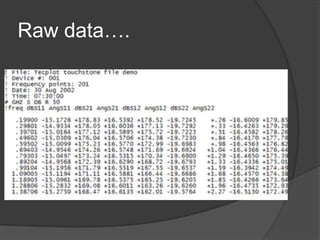
    Unanalyzed. “Raw data”

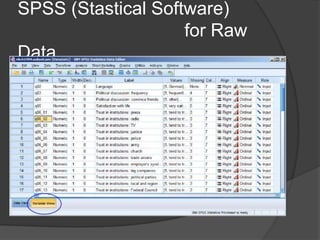
   Raw datasets generally require statistical software
    and the use of codebooks to interpret the data.
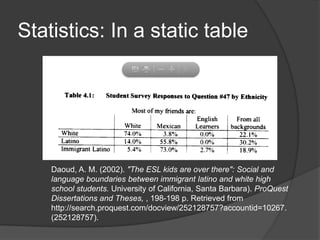
Statistics: In a static table


    Daoud, A. M. (2002). "The ESL kids are over there": Social and
    language boundaries between immigrant latino and white high
    school students. University of California, Santa Barbara). ProQuest
    Dissertations and Theses, , 198-198 p. Retrieved from
    http://search.proquest.com/docview/252128757?accountid=10267.
    (252128757).
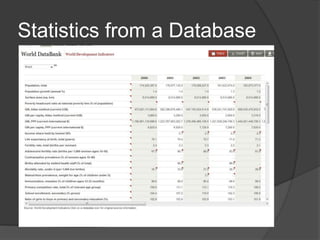
Statistics from a Database
Raw data….
SPSS (Stastical Software)
                    for Raw
Data
What kind of statistics?
   Point-in-time measurements (e.g., how
    may people are above/below the poverty
    line in…?)

   Time series (same data point represented
    over a period of time – years, quarterly,
    months)

   Geographic area – By country, state, city,
    smaller?
Poll data
   Which regions of the country more
    strongly oppose gun control?

   Is a person’s income bracket a good
    predictor of whether they support or
    oppose gun control?
iPoll (from the Roper
Center)
   iPoll
       [search]       gun control
       [organization] Gallup

Note the “crosstabs” symbol

1. Which regions of the country more strongly oppose gun
control?
2. Is a person’s income bracket a good predictor of
whether they support or oppose gun control?
What you want – What there is
   Finding statistics or data is often an exercise in
    making compromises between what you want and
    what there is.

   Some statistical collections won’t go back as far as
    you need

   Some data collections are restricted (to protect
    respondent’s privacy)

   Some data is proprietary and only sold at a steep
    price (this is especially true for business data).
Before the internet…
   There are lots of statistics available on the
    web, and in library subscription databases,
    but many of these sources will not go back
    as far as you need.

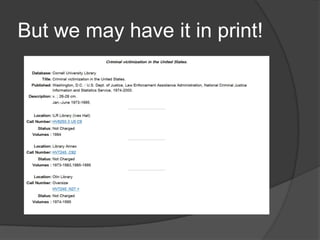
   Example: National Crime Victimization
    Survey
But we may have it in print!
Strategies
   Search an index or compendia or portal to
    statistical sources, such as the Statistical Abstract
    of the United States, OECD iLibrary, and more.

   Find a statistics database

   Search for “statistics” in the library’s “library
    guides”

   Scholar’s trick: Mine the source notes in relevant
    secondary sources (books, journal articles, etc.)
More strategies…

   Search the web, adding the terms “statistics
    portal” “data repository” etc. , but be prepared to
    find both statistics and raw data.

   For raw data, search a data repository such as
    CISER, Databib, Dataverse, AidData, and on, and
    on…
Mine the Secondary
Sources
   Select a database. For this exercise, let’s use
    Academic Search Premier

   Add some search terms

   Add statistics OR data OR table or graph in the
    line below your topic search terms.

   Review what you have found.
Keep an eye out
   New data sources are popping up all the time

   If your work will be data-heavy, look for an option
    to be added to an email list of organizations or
    projects that you have found. For example, while
    working on this session, a note came through my
    email announcing this resource:

LawAtlas.org
   LawAtlasSM is a gateway to key laws aimed at
   improving our health or access to health care.

Finding statistics2

  • 1.
  • 2.
    Learning Outcomes In thissession, you will…  Increase your knowledge of statistics sources  Learn several strategies for finding statistics  Develop some ideas about how/when statistics may be helpful for different kinds of research
  • 3.
    Data versus Statistics  The terms are used interchangeably, but there are important differences  The term statistics is used to describe aggregated, analyzed data, generally answering the question, how many? (numbers/figures/percents)  Data refers to the individual responses or observations as collected. Untabulated. Unanalyzed. “Raw data”  Raw datasets generally require statistical software and the use of codebooks to interpret the data.
  • 4.
    Statistics: In astatic table Daoud, A. M. (2002). "The ESL kids are over there": Social and language boundaries between immigrant latino and white high school students. University of California, Santa Barbara). ProQuest Dissertations and Theses, , 198-198 p. Retrieved from http://search.proquest.com/docview/252128757?accountid=10267. (252128757).
  • 5.
  • 6.
  • 7.
  • 8.
    What kind ofstatistics?  Point-in-time measurements (e.g., how may people are above/below the poverty line in…?)  Time series (same data point represented over a period of time – years, quarterly, months)  Geographic area – By country, state, city, smaller?
  • 9.
    Poll data  Which regions of the country more strongly oppose gun control?  Is a person’s income bracket a good predictor of whether they support or oppose gun control?
  • 10.
    iPoll (from theRoper Center)  iPoll [search] gun control [organization] Gallup Note the “crosstabs” symbol 1. Which regions of the country more strongly oppose gun control? 2. Is a person’s income bracket a good predictor of whether they support or oppose gun control?
  • 11.
    What you want– What there is  Finding statistics or data is often an exercise in making compromises between what you want and what there is.  Some statistical collections won’t go back as far as you need  Some data collections are restricted (to protect respondent’s privacy)  Some data is proprietary and only sold at a steep price (this is especially true for business data).
  • 12.
    Before the internet…  There are lots of statistics available on the web, and in library subscription databases, but many of these sources will not go back as far as you need.  Example: National Crime Victimization Survey
  • 13.
    But we mayhave it in print!
  • 14.
    Strategies  Search an index or compendia or portal to statistical sources, such as the Statistical Abstract of the United States, OECD iLibrary, and more.  Find a statistics database  Search for “statistics” in the library’s “library guides”  Scholar’s trick: Mine the source notes in relevant secondary sources (books, journal articles, etc.)
  • 15.
    More strategies…  Search the web, adding the terms “statistics portal” “data repository” etc. , but be prepared to find both statistics and raw data.  For raw data, search a data repository such as CISER, Databib, Dataverse, AidData, and on, and on…
  • 16.
    Mine the Secondary Sources  Select a database. For this exercise, let’s use Academic Search Premier  Add some search terms  Add statistics OR data OR table or graph in the line below your topic search terms.  Review what you have found.
  • 17.
    Keep an eyeout  New data sources are popping up all the time  If your work will be data-heavy, look for an option to be added to an email list of organizations or projects that you have found. For example, while working on this session, a note came through my email announcing this resource: LawAtlas.org LawAtlasSM is a gateway to key laws aimed at improving our health or access to health care.