Wikipedia?
• Maybe, but…
• Who authored that article (who is the authority standing behind the
article)?
• Is it an article in “good standing?”
• Are the references truly useful, or are they unclear and filled with
broken links?
• Can you cite it as a source? What if the content changes? (What does
that do to the quality of your citation)?
Use with caution (or use something better)
• Wikipedia can sometimes be a good place to start, but you should
follow the references to the actual, cite-able source of the
information.
• Some Wikipedia articles aren’t very good. How will you know?
• http://en.wikipedia.org/wiki/Intellectual_disability
• Research libraries have better, more authoritative sources!
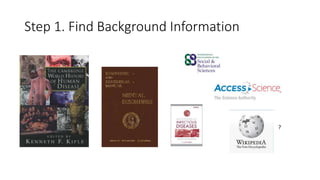
Step 1. Find Background Information
?
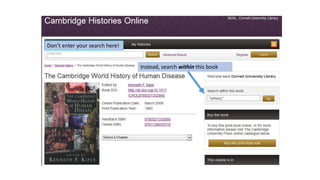
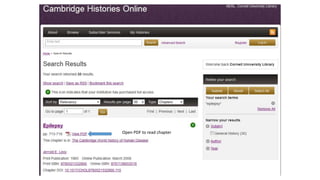
Don’t enter your search here!
Instead, search within this book
Open PDF to read chapter
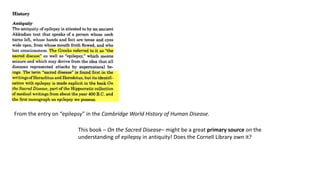
From the entry on “epilepsy” in the Cambridge World History of Human Disease.
This book – On the Sacred Disease– might be a great primary source on the
understanding of epilepsy in antiquity! Does the Cornell Library own it?
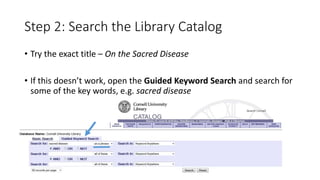
Step 2: Search the Library Catalog
• Try the exact title – On the Sacred Disease
• If this doesn’t work, open the Guided Keyword Search and search for
some of the key words, e.g. sacred disease
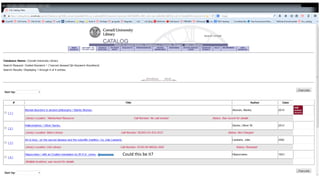
Could this be it?
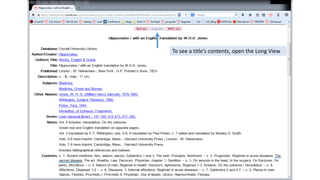
To see a title’s contents, open the Long View
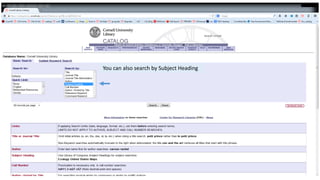
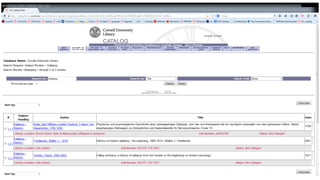
You can also search by Subject Heading
Step 3: Search Databases
• Search discipline-specific databases to find articles
• Database: History of Science, Technology and Medicine
• Please “Pause” and view this Screencast
Other valuable databases!
• Proquest Historical Newspapers – Hit “Pause” and watch this
Screencast
• Proquest American Periodicals
• North American Women's Letters & Diaries -- Colonial to 1950
• Everyday Life & Women in American: 1800 - 1920
• And many more!
Need Help? Ask a Librarian!

Sts body mind

  • 3.
    Wikipedia? • Maybe, but… •Who authored that article (who is the authority standing behind the article)? • Is it an article in “good standing?” • Are the references truly useful, or are they unclear and filled with broken links? • Can you cite it as a source? What if the content changes? (What does that do to the quality of your citation)?
  • 4.
    Use with caution(or use something better) • Wikipedia can sometimes be a good place to start, but you should follow the references to the actual, cite-able source of the information. • Some Wikipedia articles aren’t very good. How will you know? • http://en.wikipedia.org/wiki/Intellectual_disability • Research libraries have better, more authoritative sources!
  • 5.
    Step 1. FindBackground Information ?
  • 6.
    Don’t enter yoursearch here! Instead, search within this book
  • 7.
    Open PDF toread chapter
  • 8.
    From the entryon “epilepsy” in the Cambridge World History of Human Disease. This book – On the Sacred Disease– might be a great primary source on the understanding of epilepsy in antiquity! Does the Cornell Library own it?
  • 9.
    Step 2: Searchthe Library Catalog • Try the exact title – On the Sacred Disease • If this doesn’t work, open the Guided Keyword Search and search for some of the key words, e.g. sacred disease
  • 10.
  • 11.
    To see atitle’s contents, open the Long View
  • 12.
    You can alsosearch by Subject Heading
  • 14.
    Step 3: SearchDatabases • Search discipline-specific databases to find articles • Database: History of Science, Technology and Medicine • Please “Pause” and view this Screencast
  • 15.
    Other valuable databases! •Proquest Historical Newspapers – Hit “Pause” and watch this Screencast • Proquest American Periodicals • North American Women's Letters & Diaries -- Colonial to 1950 • Everyday Life & Women in American: 1800 - 1920 • And many more!
  • 16.
    Need Help? Aska Librarian!