NURS 509: Needs Assessment
Assignment
Finding Statistics & Effective
Database Searching
Tompkins-McCaw Library for the Health Sciences, VCU
Libraries
1. Understand the Issues when trying to Find Statistics on
the Web and in Databases
2. Gain Some Tips on How to Find Statistics on the Web, as
well as in the literature databases
3. Be aware of good sites for finding statistics and the
national, state and local levels
4. Become reacquainted with searching with keyword and
controlled vocabulary/subject headings.
Goals and Objectives
Key Points to Consider
When searching for statistics ask yourself:
o Are statistics likely to be available on this topic?
o Which organization(s) might collect relevant statistics?
o Where might relevant statistics be published or mentioned?
• websites, reports, yearbooks, bulletins, newspapers, magazines, journals
o What keywords might be used to describe these statistics?
• statistics on the heart can be listed under cardiovascular disease
Be prepared for the possibility that:
o Statistics may not exist for the level of detail or all the
variables wanted
• State of Virginia but not Richmond, VA
o The most recent statistics may be several years old
• census data
o Some statistics are not published/freely available
 Many organizations and agencies include health statistics that they
collect or have access to
 Search the Internet for organizations using at least two search
engines [Google/Bing/Yahoo]
 Search for a known organization using quotes, as "American Heart
Association"
 Consider searching by topic, remembering search results are
usually ranked by popularity /are often not ranked by relevance.
 Use synonyms for statistics connected by OR in the search phrase
(as...statistics OR rate OR incidence OR data)
 Use synonyms for the disease or condition in search phrases (as
lung OR pulmonary, heart OR cardiac)
When Searching the Web
for Statistics
• Find the CINAHL Heading That is Closest
to the Topic You Are Searching For
• Select one subheading that is related to
statistics (as epidemiology, trends)
(Selecting two or more subheadings will
greatly limit the results)
OR
• Do a second search (using the Suggest
Subject Terms option) with one or more of
these CINAHL subject headings:
Descriptive Statistics, Incidence, or
Data Analysis, Statistical
OR
• Do a second search using one or more of
these keywords: statistics, incidence, or
data
• MeSH subheading : statistics and
numerical data
 can be searched separately as
"statistics and numerical
data"[subheading]
• MeSH subheading: epidemiology
• MeSH heading: incidence
• Potentially Useful Keywords:
statistics, epidemiology, incidence
Searching the Literature
for Statistics
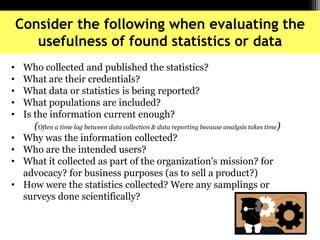
Consider the following when evaluating the
usefulness of found statistics or data
• Who collected and published the statistics?
• What are their credentials?
• What data or statistics is being reported?
• What populations are included?
• Is the information current enough?
(Often a time lag between data collection & data reporting because analysis takes time)
• Why was the information collected?
• Who are the intended users?
• What it collected as part of the organization's mission? for
advocacy? for business purposes (as to sell a product?)
• How were the statistics collected? Were any samplings or
surveys done scientifically?
• US Census Bureau: collects vital health and other statistics.
• CDC National Center for Health Statistics (NCHS) : principal US
health statistics agency that compiles statistical information.
• National Info. Center on Health Services Research & Health
Care Tech. (NICHSR)/ Data, Tools & Statistics: contains selective
links representing a sample of available information. Items are selected for their
quality, authority of authorship, uniqueness, and appropriateness
• NIH Institutes and Offices : starting point for disease specific statistical
information.
• FedStats: Makes statistics available from 100+ agencies/programs available.
Resources for Statistics:
National Resources
State Resources
• Virginia Department of Health
 Division of Health Statistics
 Disease Statistics
 Data and Reports
• Virginia Quick Facts: US Census Bureau
• State and County QuickFacts: U.S. Census Bureau:
access to facts about people, business, and geography.
• State Health Facts: Kaiser Family Foundation
• America's Health Rankings: Annual assessment of the
nation`s health on a state-by-state basis.
• StateMaster: statistical database which allows you to
research and compare a multitude of different data on US
states
 Partners in Information Access for the Public
Health Workforce: includes links for individual states
statistics
Resources for Statistics:
State, County, City
City/Country Resources
• Richmond City Health
Department
• County Health Rankings :
Program of the Robert Wood
Johnson Foundation and the
University of Wisconsin
Population Health Institute
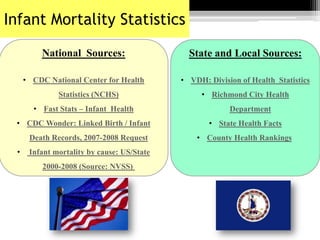
Infant Mortality Statistics
National Sources:
• CDC National Center for Health
Statistics (NCHS)
• Fast Stats – Infant Health
• CDC Wonder: Linked Birth / Infant
Death Records, 2007-2008 Request
• Infant mortality by cause: US/State
2000-2008 (Source: NVSS)
State and Local Sources:
• VDH: Division of Health Statistics
• Richmond City Health
Department
• State Health Facts
• County Health Rankings
Subject Headings / Keywords
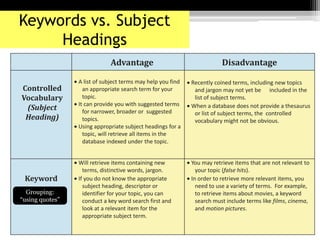
Keywords vs. Subject
Headings
Advantage Disadvantage
Controlled
Vocabulary
(Subject
Heading)
A list of subject terms may help you find
an appropriate search term for your
topic.
It can provide you with suggested terms
for narrower, broader or suggested
topics.
Using appropriate subject headings for a
topic, will retrieve all items in the
database indexed under the topic.
Recently coined terms, including new topics
and jargon may not yet be included in the
list of subject terms.
When a database does not provide a thesaurus
or list of subject terms, the controlled
vocabulary might not be obvious.
Keyword
Will retrieve items containing new
terms, distinctive words, jargon.
If you do not know the appropriate
subject heading, descriptor or
identifier for your topic, you can
conduct a key word search first and
look at a relevant item for the
appropriate subject term.
You may retrieve items that are not relevant to
your topic (false hits).
In order to retrieve more relevant items, you
need to use a variety of terms. For example,
to retrieve items about movies, a keyword
search must include terms like films, cinema,
and motion pictures.
Grouping:
“using quotes”
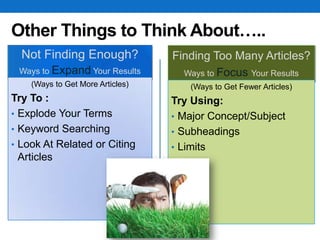
Not Finding Enough?
Ways to Expand Your Results
Finding Too Many Articles?
Ways to Focus Your Results
(Ways to Get More Articles)
Try To :
• Explode Your Terms
• Keyword Searching
• Look At Related or Citing
Articles
(Ways to Get Fewer Articles)
Try Using:
• Major Concept/Subject
• Subheadings
• Limits
Other Things to Think About…..
Get in touch with Me…..
Roy Brown, MLIS
Education and Research Librarian
Tompkins-McCaw Library, VCU Libraries
rebrown2@vcu.edu / Ph. 804-828-1592
IF YOU NEED
HELP……..

NURS 509 : How to find Statistics / Nees Asssessment

  • 1.
    NURS 509: NeedsAssessment Assignment Finding Statistics & Effective Database Searching Tompkins-McCaw Library for the Health Sciences, VCU Libraries
  • 2.
    1. Understand theIssues when trying to Find Statistics on the Web and in Databases 2. Gain Some Tips on How to Find Statistics on the Web, as well as in the literature databases 3. Be aware of good sites for finding statistics and the national, state and local levels 4. Become reacquainted with searching with keyword and controlled vocabulary/subject headings. Goals and Objectives
  • 3.
    Key Points toConsider When searching for statistics ask yourself: o Are statistics likely to be available on this topic? o Which organization(s) might collect relevant statistics? o Where might relevant statistics be published or mentioned? • websites, reports, yearbooks, bulletins, newspapers, magazines, journals o What keywords might be used to describe these statistics? • statistics on the heart can be listed under cardiovascular disease Be prepared for the possibility that: o Statistics may not exist for the level of detail or all the variables wanted • State of Virginia but not Richmond, VA o The most recent statistics may be several years old • census data o Some statistics are not published/freely available
  • 4.
     Many organizationsand agencies include health statistics that they collect or have access to  Search the Internet for organizations using at least two search engines [Google/Bing/Yahoo]  Search for a known organization using quotes, as "American Heart Association"  Consider searching by topic, remembering search results are usually ranked by popularity /are often not ranked by relevance.  Use synonyms for statistics connected by OR in the search phrase (as...statistics OR rate OR incidence OR data)  Use synonyms for the disease or condition in search phrases (as lung OR pulmonary, heart OR cardiac) When Searching the Web for Statistics
  • 5.
    • Find theCINAHL Heading That is Closest to the Topic You Are Searching For • Select one subheading that is related to statistics (as epidemiology, trends) (Selecting two or more subheadings will greatly limit the results) OR • Do a second search (using the Suggest Subject Terms option) with one or more of these CINAHL subject headings: Descriptive Statistics, Incidence, or Data Analysis, Statistical OR • Do a second search using one or more of these keywords: statistics, incidence, or data • MeSH subheading : statistics and numerical data  can be searched separately as "statistics and numerical data"[subheading] • MeSH subheading: epidemiology • MeSH heading: incidence • Potentially Useful Keywords: statistics, epidemiology, incidence Searching the Literature for Statistics
  • 6.
    Consider the followingwhen evaluating the usefulness of found statistics or data • Who collected and published the statistics? • What are their credentials? • What data or statistics is being reported? • What populations are included? • Is the information current enough? (Often a time lag between data collection & data reporting because analysis takes time) • Why was the information collected? • Who are the intended users? • What it collected as part of the organization's mission? for advocacy? for business purposes (as to sell a product?) • How were the statistics collected? Were any samplings or surveys done scientifically?
  • 7.
    • US CensusBureau: collects vital health and other statistics. • CDC National Center for Health Statistics (NCHS) : principal US health statistics agency that compiles statistical information. • National Info. Center on Health Services Research & Health Care Tech. (NICHSR)/ Data, Tools & Statistics: contains selective links representing a sample of available information. Items are selected for their quality, authority of authorship, uniqueness, and appropriateness • NIH Institutes and Offices : starting point for disease specific statistical information. • FedStats: Makes statistics available from 100+ agencies/programs available. Resources for Statistics: National Resources
  • 8.
    State Resources • VirginiaDepartment of Health  Division of Health Statistics  Disease Statistics  Data and Reports • Virginia Quick Facts: US Census Bureau • State and County QuickFacts: U.S. Census Bureau: access to facts about people, business, and geography. • State Health Facts: Kaiser Family Foundation • America's Health Rankings: Annual assessment of the nation`s health on a state-by-state basis. • StateMaster: statistical database which allows you to research and compare a multitude of different data on US states  Partners in Information Access for the Public Health Workforce: includes links for individual states statistics Resources for Statistics: State, County, City City/Country Resources • Richmond City Health Department • County Health Rankings : Program of the Robert Wood Johnson Foundation and the University of Wisconsin Population Health Institute
  • 10.
    Infant Mortality Statistics NationalSources: • CDC National Center for Health Statistics (NCHS) • Fast Stats – Infant Health • CDC Wonder: Linked Birth / Infant Death Records, 2007-2008 Request • Infant mortality by cause: US/State 2000-2008 (Source: NVSS) State and Local Sources: • VDH: Division of Health Statistics • Richmond City Health Department • State Health Facts • County Health Rankings
  • 11.
  • 12.
    Keywords vs. Subject Headings AdvantageDisadvantage Controlled Vocabulary (Subject Heading) A list of subject terms may help you find an appropriate search term for your topic. It can provide you with suggested terms for narrower, broader or suggested topics. Using appropriate subject headings for a topic, will retrieve all items in the database indexed under the topic. Recently coined terms, including new topics and jargon may not yet be included in the list of subject terms. When a database does not provide a thesaurus or list of subject terms, the controlled vocabulary might not be obvious. Keyword Will retrieve items containing new terms, distinctive words, jargon. If you do not know the appropriate subject heading, descriptor or identifier for your topic, you can conduct a key word search first and look at a relevant item for the appropriate subject term. You may retrieve items that are not relevant to your topic (false hits). In order to retrieve more relevant items, you need to use a variety of terms. For example, to retrieve items about movies, a keyword search must include terms like films, cinema, and motion pictures. Grouping: “using quotes”
  • 13.
    Not Finding Enough? Waysto Expand Your Results Finding Too Many Articles? Ways to Focus Your Results (Ways to Get More Articles) Try To : • Explode Your Terms • Keyword Searching • Look At Related or Citing Articles (Ways to Get Fewer Articles) Try Using: • Major Concept/Subject • Subheadings • Limits Other Things to Think About…..
  • 14.
    Get in touchwith Me….. Roy Brown, MLIS Education and Research Librarian Tompkins-McCaw Library, VCU Libraries rebrown2@vcu.edu / Ph. 804-828-1592 IF YOU NEED HELP……..

Editor's Notes

  • #3 A lot of National is local dataCensus data down to census tractNational surveys/some local depending Youth risk behavior survey (state that participate)National Health Interview Survey `
  • #5 A lot of National is local dataCensus data down to census tractNational surveys/some local depending Youth risk behavior survey (state that participate)National Health Interview Survey `
  • #6 A lot of National is local dataCensus data down to census tractNational surveys/some local depending Youth risk behavior survey (state that participate)National Health Interview Survey `
  • #8 A lot of National is local dataCensus data down to census tractNational surveys/some local depending Youth risk behavior survey (state that participate)National Health Interview Survey `
  • #9 A lot of National is local dataCensus data down to census tractNational surveys/some local depending Youth risk behavior survey (state that participate)National Health Interview Survey `
  • #12 A lot of National is local dataCensus data down to census tractNational surveys/some local depending Youth risk behavior survey (state that participate)National Health Interview Survey `