Yash Chavan – 407
Patkar-VardeCollege
Advertising
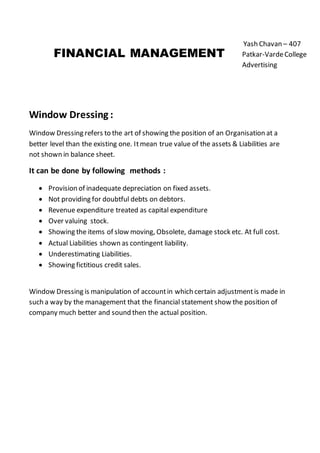
Window Dressing :
Window Dressing refers to the art of showing the position of an Organisation at a
better level than the existing one. Itmean true value of the assets & Liabilities are
not shown in balance sheet.
It can be done by following methods :
 Provision of inadequate depreciation on fixed assets.
 Not providing for doubtful debts on debtors.
 Revenue expenditure treated as capital expenditure
 Over valuing stock.
 Showing the items of slow moving, Obsolete, damage stock etc. At full cost.
 Actual Liabilities shown as contingent liability.
 Underestimating Liabilities.
 Showing fictitious credit sales.
Window Dressing is manipulation of accountin which certain adjustmentis made in
such a way by the management that the financial statement show the position of
company much better and sound then the actual position.
FINANCIAL MANAGEMENT
Current Ratio :
Itmeasures the shot- term solvency of the business by comparing the currentassets
with currentliabilities. Italso called as “Working-Capital Ratio”.
ItExpressed as a Pure Ratio.
Currentratio of 2 : 1 is regarded as a standard currentratio.
Under ideal condition, a current ratio of 2 : 1 is considered as Safe.
The Chore committee recommended that 1.33 : 1 currentratio should be attained by
the business enterprises for good liquidity position.
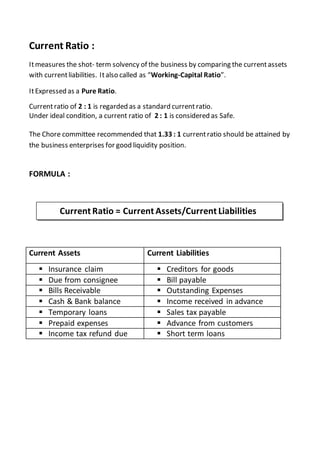
FORMULA :
Current Assets Current Liabilities
 Insurance claim  Creditors for goods
 Due from consignee  Bill payable
 Bills Receivable  Outstanding Expenses
 Cash & Bank balance  Income received in advance
 Temporary loans  Sales tax payable
 Prepaid expenses  Advance from customers
 Income tax refund due  Short term loans
Current Ratio = Current Assets/Current Liabilities
Quick Ratio :
Quick Ratio indicates the immediate solvency position of the company. Italso
indicates very shortterm financial strength, soundness and solvency concern.
ItExpressed as a Pure Ratio.
Quick ratio of 1 : 1 is considered as Standard or Satisfactory.
Quick ratio is a qualitative ratio compared to currentratio as it measures the
immediate ability of a company to meet its most urgentobligations.
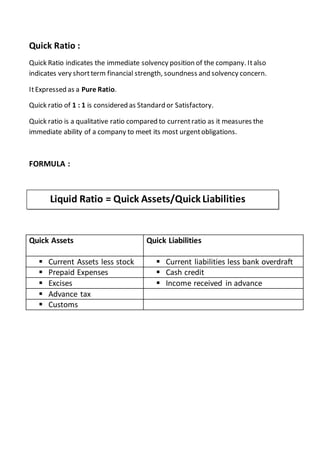
FORMULA :
Quick Assets Quick Liabilities
 Current Assets less stock  Current liabilities less bank overdraft
 Prepaid Expenses  Cash credit
 Excises  Income received in advance
 Advance tax
 Customs
Liquid Ratio = Quick Assets/QuickLiabilities
Stock to working Capital :
Its expressed the relationship between the closing stock and the working capital.
Stock is considered as non-quick currentassets and therefore to the extent of stock
in working capital it affects the immediate solvency of concern.
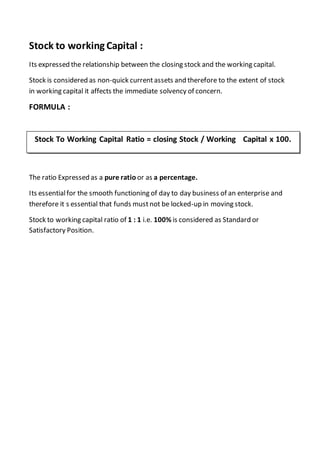
FORMULA :
The ratio Expressed as a pure ratio or as a percentage.
Its essentialfor the smooth functioning of day to day business of an enterprise and
therefore it s essential that funds mustnot be locked-up in moving stock.
Stock to working capital ratio of 1 : 1 i.e. 100% is considered as Standard or
Satisfactory Position.
Stock To Working Capital Ratio = closing Stock / Working Capital x 100.

Financial Management

  • 1.
    Yash Chavan –407 Patkar-VardeCollege Advertising Window Dressing : Window Dressing refers to the art of showing the position of an Organisation at a better level than the existing one. Itmean true value of the assets & Liabilities are not shown in balance sheet. It can be done by following methods :  Provision of inadequate depreciation on fixed assets.  Not providing for doubtful debts on debtors.  Revenue expenditure treated as capital expenditure  Over valuing stock.  Showing the items of slow moving, Obsolete, damage stock etc. At full cost.  Actual Liabilities shown as contingent liability.  Underestimating Liabilities.  Showing fictitious credit sales. Window Dressing is manipulation of accountin which certain adjustmentis made in such a way by the management that the financial statement show the position of company much better and sound then the actual position. FINANCIAL MANAGEMENT
  • 2.
    Current Ratio : Itmeasuresthe shot- term solvency of the business by comparing the currentassets with currentliabilities. Italso called as “Working-Capital Ratio”. ItExpressed as a Pure Ratio. Currentratio of 2 : 1 is regarded as a standard currentratio. Under ideal condition, a current ratio of 2 : 1 is considered as Safe. The Chore committee recommended that 1.33 : 1 currentratio should be attained by the business enterprises for good liquidity position. FORMULA : Current Assets Current Liabilities  Insurance claim  Creditors for goods  Due from consignee  Bill payable  Bills Receivable  Outstanding Expenses  Cash & Bank balance  Income received in advance  Temporary loans  Sales tax payable  Prepaid expenses  Advance from customers  Income tax refund due  Short term loans Current Ratio = Current Assets/Current Liabilities
  • 3.
    Quick Ratio : QuickRatio indicates the immediate solvency position of the company. Italso indicates very shortterm financial strength, soundness and solvency concern. ItExpressed as a Pure Ratio. Quick ratio of 1 : 1 is considered as Standard or Satisfactory. Quick ratio is a qualitative ratio compared to currentratio as it measures the immediate ability of a company to meet its most urgentobligations. FORMULA : Quick Assets Quick Liabilities  Current Assets less stock  Current liabilities less bank overdraft  Prepaid Expenses  Cash credit  Excises  Income received in advance  Advance tax  Customs Liquid Ratio = Quick Assets/QuickLiabilities
  • 4.
    Stock to workingCapital : Its expressed the relationship between the closing stock and the working capital. Stock is considered as non-quick currentassets and therefore to the extent of stock in working capital it affects the immediate solvency of concern. FORMULA : The ratio Expressed as a pure ratio or as a percentage. Its essentialfor the smooth functioning of day to day business of an enterprise and therefore it s essential that funds mustnot be locked-up in moving stock. Stock to working capital ratio of 1 : 1 i.e. 100% is considered as Standard or Satisfactory Position. Stock To Working Capital Ratio = closing Stock / Working Capital x 100.