CORPORATE
ACCOUNTING
GROUP 12
QUESTION:
Discuss briefly the major classifications of cash
flows as per AS-3 . Why is it important to disclose
certain non-cash transactions and how should they
be disclosed ?
FINANCIAL
STATEMENTS OF
COMPANIES
MADE BY:
HIMANSHU SINGH (192296)
ANSH SINGLA (192212)
NAMAN KUMAR (192248)
INTRODUCTION
•
•
Financial statements(or financial report)
is a formal record of the financial
activities of a business, person or other
entity.
Relevant financial information is
presented in structured manner and in
easy form to understand.
OBJECTIVE
•
•
The objective of the financial statements is to provide information
about the financial position ,performance and the changes in
financial position of the enterprise that is useful to wide range of
users in making economic decisions.
Financial statements should be relevant , reliable ,understandable
and comparable.
REQUIREMENT
OF FINANCIAL
STATEMENTS
•
•
•
The financial statements provide true &
fair view of the company and comply with
the AS and should be in the form provided
by Schedule III of Companies Act 2013
The Financial Statements should be laid in
the AGM within six months from the end of
the financial year
The holding company shall in addition,
prepare a Consolidated Financial
Statement of the company along with its
all subsidiaries , associates and joint
ventures and lay before the Annual General
Meeting.
•
•
•
Basic Financial Statements
includes:
Balance sheet or statement of
financial position or net worth
statement
Income Statement or statement of
comprehensive income , statement of
revenue & expense, profit and loss
report
Cash flow statement or fund flow
statement
BALANCE SHEET
•
•
•
•
•
•
•
The balance sheet is a statement of financial position
at a specific point of time or a financial snapshot of the
business
The balance sheet reflects the result of all past
transactions but not how the current financial position
was obtained
It is prepared at the end of the financial year
The Balance sheet consists of three main parts:
Assets
Liabilities
Net worth( owner’s equity)
ASSETS
Current Assets
The assets which can be converted into cash
within a span or period of 1 year are called current
asset
Current assets are very important to business as they are used to fund
day-to-day business operations and to pay for the ongoing operating
expenses
It includes current investments ,inventories ,Trade receivables ,short
term loans ,cash and cash equivalent
NON-CURRENT ASSETS
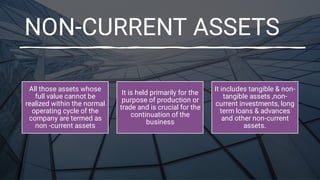
All those assets whose
full value cannot be
realized within the normal
operating cycle of the
company are termed as
non -current assets
It is held primarily for the
purpose of production or
trade and is crucial for the
continuation of the
business
It includes tangible & non-
tangible assets ,non-
current investments, long
term loans & advances
and other non-current
assets.
LIABILITIES
•
•
•
Current Liabilities
All debts and obligations that are due
within the operating cycle of the
company are termed as current liabilities
It is used for calculating important
financial ratios and can affect the
working capital of the business
It includes Trade payables ,short term
borrowings ,short term provisions and
other current liabilities
NON-CURRENT
LIABILITIES
•
•
•
All the dues and obligations that are listed on
the balance sheet which are due after the
operating cycle (after 1 year)of the company
are termed as non-current liabilities
It is an important source of entity’s long-term
financing and has a provide a good scope of
expansion
It includes debentures, bonds payable ,
unsecured or long- term loans etc.
OWNER’S
EQUITY
•
•
Owner equity, or net worth ,is the
difference between total assets and total
liabilities
It reflects the owner’s stake in the
business and includes investment capital
and retained profits
Total Assets – Total Liabilities = Equity
“have” “owe” “what you are worth”
INCOME
STATEMENT
•
•
•
1.
Income statement, also known as the
Profit and Loss Statement, reports the
company’s financial performance in
terms of net profit or loss over a
specified period statement
It provides detailed revenue operations
of the company and act as an analysis
tool for the investors
Contents of Income Statement of the
company includes:
Net Operating Income : Net operating
income is a company’s income after
operating expenses are deducted
Non-operating Income : Non
operating income is the
portion of an organization’s
income that is derived from
activities not related to its
core operations
Investment Income : Income
resulting from interest
payments, dividends, capital
gains upon the sale of
security or other assets
Accumulated and
comprehensive income :
Accumulated income
reported under equity section
of the balance sheet (ex.
Retained earnings, net
income & dividends
After tax operating income:
Income after deducting all
federal, state and withholding
taxes result in disposable
income which helps to
measures company’s
profitability without taking
capital structure.
FINANCIAL
RATIOS
a)
b)
c)
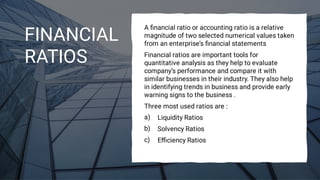
A financial ratio or accounting ratio is a relative
magnitude of two selected numerical values taken
from an enterprise’s financial statements
Financial ratios are important tools for
quantitative analysis as they help to evaluate
company’s performance and compare it with
similar businesses in their industry. They also help
in identifying trends in business and provide early
warning signs to the business .
Three most used ratios are :
Liquidity Ratios
Solvency Ratios
Efficiency Ratios
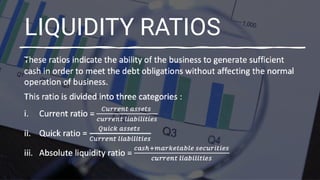
LIQUIDITY RATIOS
•
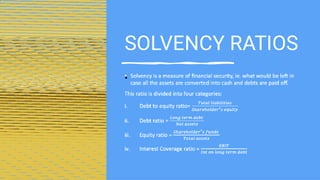
SOLVENCY RATIOS
•
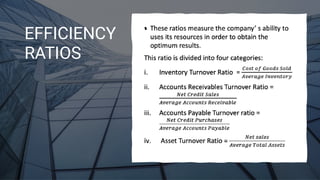
EFFICIENCY
RATIOS
•
CASH FLOW STATEMENT
•
•
•
•
•
•
A cash flow statement is a summary of cash receipts and cash payments
about the operating, investing and financing activities of a business
enterprise
Cash flow statement is used :
To know the liquidity and solvency position
To know the ability of paying dividends
To predict future cash flows
To know the managerial efficiency and for inter-firm comparison
To know the changes in assets and liabilities
OBJECTIVES
The primary objective of
cash flow statement is
to provide information
about the cash receipts
and cash payments of a
business entity for the
accounting period
covered by the income
statement
1
The secondary objective
of cash flow statement
is to provide information
about a business entity’s
operating , investing and
financing activities
during the accounting
period of the company
2
LIMITATIONS
OF
CASH FLOW
STATEMENTS
Cash flow statement records inflows and
outflows of cash only hence, significant non-
cash transactions are omitted
It is not difficult to influence cash balance by
simply postponing cash purchases and sundry
payments
Cash flow statement shows the net cash
flows not the net profit for a given period, so it
is not a substitute for the income statement
There is a gap between net income figure and
net cash flow ,so it does not show the true
financial position of business in totality
DISCLOSURE
OF NON-CASH
TRANSCTIONS
& ITS MANNER
Some investing and financing activities
does not involve cash or cash
equivalents but do represent significant
change in financial position of the
enterprise . So even noncash
transactions of an investing and
financing nature are disclosed in the
financial statements but if they affect
financial conditions significantly, the
FASB (Financial Accounting Standards
Board) requires that they should be
disclosed in either a separate schedule
at the bottom of the statement of cash
flows or in a separate note or
supplementary schedule of the financial
statements.
MEANING OF CASH
FLOWS
•
•
•
It means the movement of cash into enterprise
referred to as sources (Cash inflows) and also
movement of cash out of the enterprise referred to
as uses (Cash outflows).
Inflows and Outflows are reported for:
Operating activities
Investing activities
Financing activities
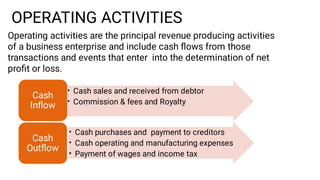
OPERATING ACTIVITIES
Operating activities are the principal revenue producing activities
of a business enterprise and include cash flows from those
transactions and events that enter into the determination of net
profit or loss.
•
•
Cash sales and received from debtor
Commission & fees and Royalty
Cash
Inflow
•
•
•
Cash purchases and payment to creditors
Cash operating and manufacturing expenses
Payment of wages and income tax
Cash
Outflow
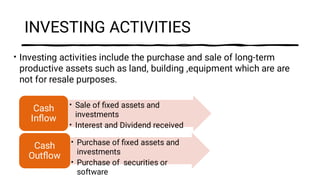
INVESTING ACTIVITIES
• Investing activities include the purchase and sale of long-term
productive assets such as land, building ,equipment which are are
not for resale purposes.
•
•
Sale of fixed assets and
investments
Interest and Dividend received
Cash
Inflow
•
•
Purchase of fixed assets and
investments
Purchase of securities or
software
Cash
Outflow
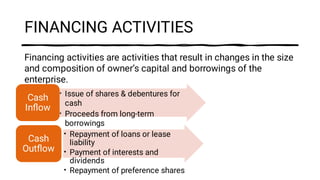
FINANCING ACTIVITIES
Financing activities are activities that result in changes in the size
and composition of owner’s capital and borrowings of the
enterprise.
•
•
Issue of shares & debentures for
cash
Proceeds from long-term
borrowings
Cash
Inflow
•
•
•
Repayment of loans or lease
liability
Payment of interests and
dividends
Repayment of preference shares
Cash
Outflow
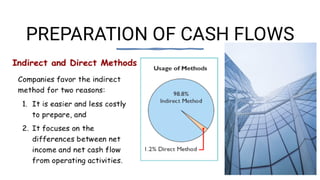
PREPARATION OF CASH FLOWS
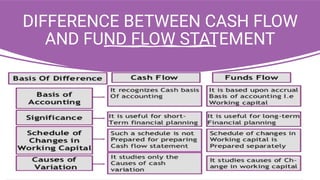
DIFFERENCE BETWEEN CASH FLOW
AND FUND FLOW STATEMENT
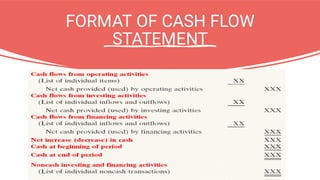
FORMAT OF CASH FLOW
STATEMENT
BIBLIOGRAPHY
•
•
•
•
•
•
Books
JR Monga
Bhushan Kumar Goyal
Website
www.Investopedia.com
www.readyratios.com
www.cleartax.in
www.Wikipedia.in
THANK
YOU

Cash flow statement

  • 1.
  • 2.
    GROUP 12 QUESTION: Discuss brieflythe major classifications of cash flows as per AS-3 . Why is it important to disclose certain non-cash transactions and how should they be disclosed ?
  • 3.
    FINANCIAL STATEMENTS OF COMPANIES MADE BY: HIMANSHUSINGH (192296) ANSH SINGLA (192212) NAMAN KUMAR (192248)
  • 4.
    INTRODUCTION • • Financial statements(or financialreport) is a formal record of the financial activities of a business, person or other entity. Relevant financial information is presented in structured manner and in easy form to understand.
  • 5.
    OBJECTIVE • • The objective ofthe financial statements is to provide information about the financial position ,performance and the changes in financial position of the enterprise that is useful to wide range of users in making economic decisions. Financial statements should be relevant , reliable ,understandable and comparable.
  • 6.
    REQUIREMENT OF FINANCIAL STATEMENTS • • • The financialstatements provide true & fair view of the company and comply with the AS and should be in the form provided by Schedule III of Companies Act 2013 The Financial Statements should be laid in the AGM within six months from the end of the financial year The holding company shall in addition, prepare a Consolidated Financial Statement of the company along with its all subsidiaries , associates and joint ventures and lay before the Annual General Meeting.
  • 7.
    • • • Basic Financial Statements includes: Balancesheet or statement of financial position or net worth statement Income Statement or statement of comprehensive income , statement of revenue & expense, profit and loss report Cash flow statement or fund flow statement
  • 8.
    BALANCE SHEET • • • • • • • The balancesheet is a statement of financial position at a specific point of time or a financial snapshot of the business The balance sheet reflects the result of all past transactions but not how the current financial position was obtained It is prepared at the end of the financial year The Balance sheet consists of three main parts: Assets Liabilities Net worth( owner’s equity)
  • 9.
    ASSETS Current Assets The assetswhich can be converted into cash within a span or period of 1 year are called current asset Current assets are very important to business as they are used to fund day-to-day business operations and to pay for the ongoing operating expenses It includes current investments ,inventories ,Trade receivables ,short term loans ,cash and cash equivalent
  • 10.
    NON-CURRENT ASSETS All thoseassets whose full value cannot be realized within the normal operating cycle of the company are termed as non -current assets It is held primarily for the purpose of production or trade and is crucial for the continuation of the business It includes tangible & non- tangible assets ,non- current investments, long term loans & advances and other non-current assets.
  • 11.
    LIABILITIES • • • Current Liabilities All debtsand obligations that are due within the operating cycle of the company are termed as current liabilities It is used for calculating important financial ratios and can affect the working capital of the business It includes Trade payables ,short term borrowings ,short term provisions and other current liabilities
  • 12.
    NON-CURRENT LIABILITIES • • • All the duesand obligations that are listed on the balance sheet which are due after the operating cycle (after 1 year)of the company are termed as non-current liabilities It is an important source of entity’s long-term financing and has a provide a good scope of expansion It includes debentures, bonds payable , unsecured or long- term loans etc.
  • 13.
    OWNER’S EQUITY • • Owner equity, ornet worth ,is the difference between total assets and total liabilities It reflects the owner’s stake in the business and includes investment capital and retained profits Total Assets – Total Liabilities = Equity “have” “owe” “what you are worth”
  • 14.
    INCOME STATEMENT • • • 1. Income statement, alsoknown as the Profit and Loss Statement, reports the company’s financial performance in terms of net profit or loss over a specified period statement It provides detailed revenue operations of the company and act as an analysis tool for the investors Contents of Income Statement of the company includes: Net Operating Income : Net operating income is a company’s income after operating expenses are deducted
  • 15.
    Non-operating Income :Non operating income is the portion of an organization’s income that is derived from activities not related to its core operations Investment Income : Income resulting from interest payments, dividends, capital gains upon the sale of security or other assets Accumulated and comprehensive income : Accumulated income reported under equity section of the balance sheet (ex. Retained earnings, net income & dividends After tax operating income: Income after deducting all federal, state and withholding taxes result in disposable income which helps to measures company’s profitability without taking capital structure.
  • 16.
    FINANCIAL RATIOS a) b) c) A financial ratioor accounting ratio is a relative magnitude of two selected numerical values taken from an enterprise’s financial statements Financial ratios are important tools for quantitative analysis as they help to evaluate company’s performance and compare it with similar businesses in their industry. They also help in identifying trends in business and provide early warning signs to the business . Three most used ratios are : Liquidity Ratios Solvency Ratios Efficiency Ratios
  • 17.
  • 18.
  • 19.
  • 20.
    CASH FLOW STATEMENT • • • • • • Acash flow statement is a summary of cash receipts and cash payments about the operating, investing and financing activities of a business enterprise Cash flow statement is used : To know the liquidity and solvency position To know the ability of paying dividends To predict future cash flows To know the managerial efficiency and for inter-firm comparison To know the changes in assets and liabilities
  • 21.
    OBJECTIVES The primary objectiveof cash flow statement is to provide information about the cash receipts and cash payments of a business entity for the accounting period covered by the income statement 1 The secondary objective of cash flow statement is to provide information about a business entity’s operating , investing and financing activities during the accounting period of the company 2
  • 22.
    LIMITATIONS OF CASH FLOW STATEMENTS Cash flowstatement records inflows and outflows of cash only hence, significant non- cash transactions are omitted It is not difficult to influence cash balance by simply postponing cash purchases and sundry payments Cash flow statement shows the net cash flows not the net profit for a given period, so it is not a substitute for the income statement There is a gap between net income figure and net cash flow ,so it does not show the true financial position of business in totality
  • 23.
    DISCLOSURE OF NON-CASH TRANSCTIONS & ITSMANNER Some investing and financing activities does not involve cash or cash equivalents but do represent significant change in financial position of the enterprise . So even noncash transactions of an investing and financing nature are disclosed in the financial statements but if they affect financial conditions significantly, the FASB (Financial Accounting Standards Board) requires that they should be disclosed in either a separate schedule at the bottom of the statement of cash flows or in a separate note or supplementary schedule of the financial statements.
  • 24.
    MEANING OF CASH FLOWS • • • Itmeans the movement of cash into enterprise referred to as sources (Cash inflows) and also movement of cash out of the enterprise referred to as uses (Cash outflows). Inflows and Outflows are reported for: Operating activities Investing activities Financing activities
  • 25.
    OPERATING ACTIVITIES Operating activitiesare the principal revenue producing activities of a business enterprise and include cash flows from those transactions and events that enter into the determination of net profit or loss. • • Cash sales and received from debtor Commission & fees and Royalty Cash Inflow • • • Cash purchases and payment to creditors Cash operating and manufacturing expenses Payment of wages and income tax Cash Outflow
  • 26.
    INVESTING ACTIVITIES • Investingactivities include the purchase and sale of long-term productive assets such as land, building ,equipment which are are not for resale purposes. • • Sale of fixed assets and investments Interest and Dividend received Cash Inflow • • Purchase of fixed assets and investments Purchase of securities or software Cash Outflow
  • 27.
    FINANCING ACTIVITIES Financing activitiesare activities that result in changes in the size and composition of owner’s capital and borrowings of the enterprise. • • Issue of shares & debentures for cash Proceeds from long-term borrowings Cash Inflow • • • Repayment of loans or lease liability Payment of interests and dividends Repayment of preference shares Cash Outflow
  • 28.
  • 29.
    DIFFERENCE BETWEEN CASHFLOW AND FUND FLOW STATEMENT
  • 30.
    FORMAT OF CASHFLOW STATEMENT
  • 31.
    BIBLIOGRAPHY • • • • • • Books JR Monga Bhushan KumarGoyal Website www.Investopedia.com www.readyratios.com www.cleartax.in www.Wikipedia.in
  • 32.