ISLAMIC
FINANCIAL PLANNING
Mahyuddin Khalid
Risk Management and Takaful
Planning
Chapter Outline
Content
Basic Concept of Insurance
Concept of Takaful
Business Model Used by Takaful Operator
Takaful Products
How Much to Insure?
Approaches Available to Determine
Maintenance Fund
Determine the Objective of Buying Insurance
Choosing a Right Policy
2
Introduction
 Shariah model of Life Insurance does not mean to insure
one‘s life, but it is a financial transaction undertaking to
protect widows, orphans and other dependents of the
deceased (assured) against future unexpected financial risk.
 The conventional system, however, offers a life insurance
policy, which may not be free from riba (interest), or some
other elements, which are not recognized by Islamic
teaching.
3
Introduction
 Therefore, Islamic insurance or known as Takaful was
introduced to cater the needs of Muslim in order to protect
their family and also assets from death or disaster.
4
Resolution of Scholars on Insurance
National Fatwa Committee of Malaysia, 1972
 Extract of the Minutes of The Discourse of National Fatwa
Committee For Islamic Affairs Malaysia -15 June 1972
 “Life insurance transacted by present-day life insurance companies is a
transaction containing the elements of al-Gharar, al-Maisir and al-Riba and
as a consequence its contract is void therefore HARAM”
Resolution of Islamic Fiqh Academy of OIC, 1985
5
Definition of Takaful
 Takaful was laid down in the system of aqilah – an arrangement
of mutual help or indemnification customary in some tribes at
the time of the Prophet Muhammad (pbuh).
 The contract of takaful provides solidarity in respect of any
tragedy in human life and loss to the business or property.
 Literally, takaful means joint guarantee, shared responsibility,
shared guarantee, collective assurance and mutual undertaking,
which reflect a reciprocal relationship and agreement of mutual
help among members in a particular group.
 In the Quran, the word kafala is mentioned in several contexts
such as in Surah Ali-Imran, verse 37.
6
Definition of Takaful
Islamic Financial Service Act 2013 defines takaful as:
 “an arrangement based on mutual assistance under which takaful
participants agree to contribute to a common fund providing for
mutual financial benefits payable to the takaful participants or
their beneficiaries on the occurrence of pre-agreed events;”.
7
Contractual Relationship Among The
Participants (Tabarru’)
 The underlying contract among the participants or
policyholders is the donation or tabarru’ contract.
Tabarru’:
 Agreement by a participant to relinquish, as donation, a sum of
contribution that he/she agrees to pay into takaful fund
The purpose of this concept is to provide mutual indemnity
to the takaful participant, where the donation acts as a
mutual help and joint guarantee should any fellow
participants suffers as a defined loss.
8
Contract Among Takaful Participants
There is no insurer-insured relationship between the
participants and the takaful operator.
 The participants are insuring themselves.
 The takaful operator is engaged by the participants (as a group)
to manage the takaful scheme for them.
In general, the takaful operator is expected to:
 Manage the underwriting of takaful contributions and payment of
protection amount or claims ; and
 Manage any investment portfolio of the fund.
9
Business Model Used By Takaful
Operators
Approved by scholars:
 Mudharabah (profit sharing)
 Mudharabah is a profit sharing contract whereby one party provides the
capital (Ras ‘ul maal and the other party provides the expertise (MudhariS).
 Wakalah
 Wakalah is a contract whereby one party acts on behalf of another for a
fee.
 Hybrid (Mudharabah + al'Wakalah)
Concept of tabarru’ applicable under all
10
Takaful Products
Family takaful
General takaful
11
Benefits of Takaful
 Reduces financial burden to individuals as compensation will be
obtained and/or outstanding liabilities will be covered upon
untimely death or total disability.
 Provides dependents or heirs ability to secure inherited
properties.
 Participants are entitle to a share of profit or surplus of
operations based on profit sharing principle of al-mudharabah.
 Free of liability by the guarantor on any outstanding credit
facility or financing/loan.
 Participants are able to be ‘rewarded’ in the hereafter on the
donation made through the tabarru’concept.
12
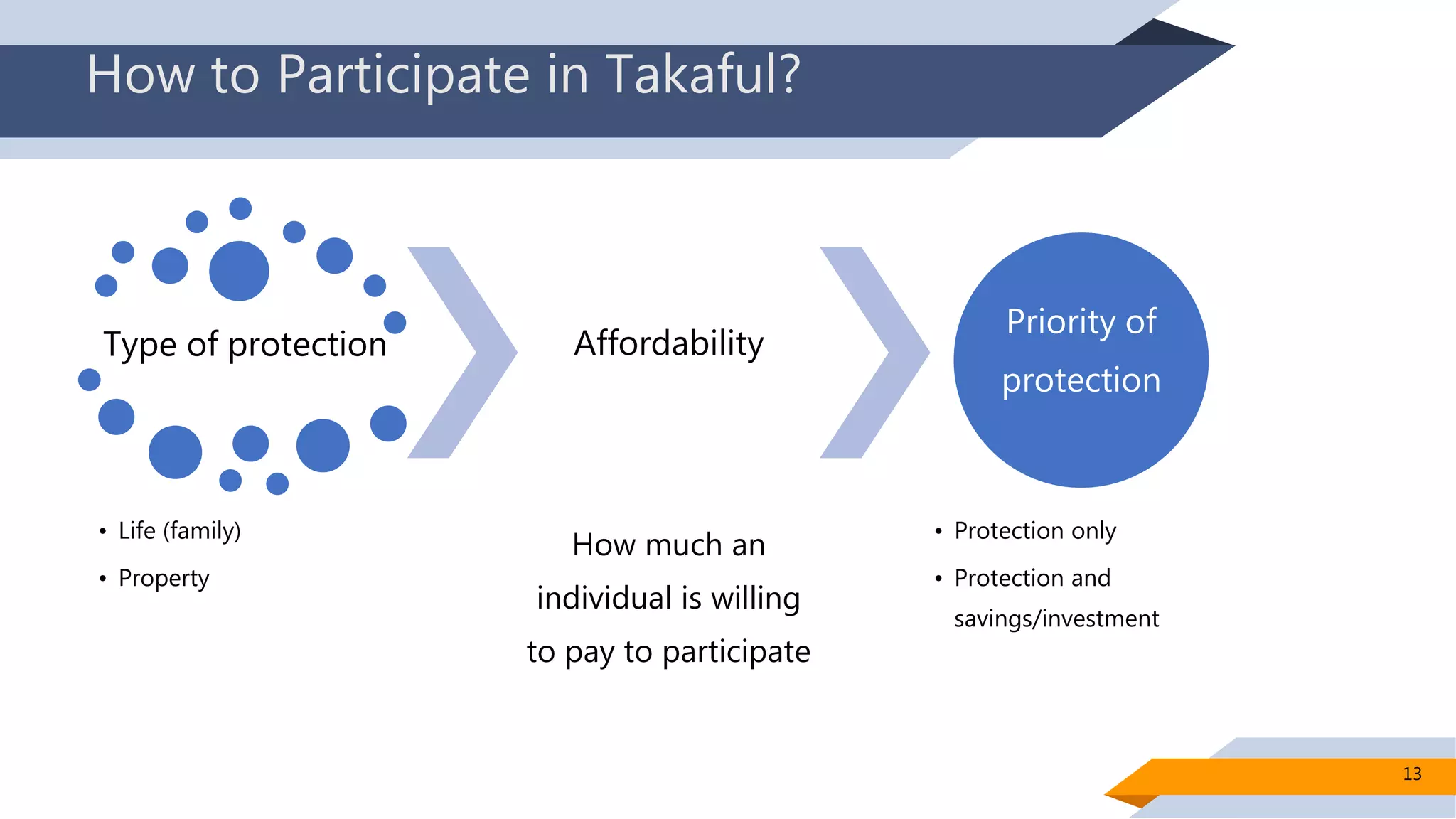
How to Participate in Takaful?
Type of protection
• Life (family)
• Property
Affordability
How much an
individual is willing
to pay to participate
Priority of
protection
• Protection only
• Protection and
savings/investment
13
Key Principles of Insurance and Takaful
1. Indemnity:
 Applies to the physical damage to a property where the loss can
be quantified in monetary terms.
 In the event the insured suffer a loss, the insurance company will
pay or indemnify the insured to the position he or she was in
before the loss.
 The payment of losses will not exceed the value of the property
destroyed.
14
Key Principles of Insurance and Takaful
2. Insurable interest:
 Means an insured person will undergo a personal financial loss
when a loss caused by an insured peril occurs.
 If the insured will not experience financial losses from the
damage of the object, then the insured cannot insure the object.
15
Key Principles of Insurance and Takaful
3. Utmost good faith:
 The policy owner must disclose all material facts when buying a
policy.
 If fails to disclose, the policy may become invalid.
16
Key Principles of Insurance and Takaful
4. Contribution:
 The principle comes into play when there are 2 or more insurance
coverage on one risk.
 When the total amount of claim from 2 or more insurers exceeds
the amount of loss suffered, the insurers will pay a proportionate
amount according to the liability.
17
Key Principles of Insurance and Takaful
5. Subrogation:
 This principle is a result of the principle of indemnity.
 The insurer who has indemnified the insured’s loss is entitled to
recover the loss from any liable third parties who are responsible
to the extent of its liability.
 Subrogation only applies to general insurance.
18
Key Principles of Insurance and Takaful
6. Proximate cause:
 Defined as the efficient cause that brings about a loss with no
other intervening cause that breaks the chain of events.
 A claim is not payable by the insurer if the proximate cause is
other than the named peril.
19
How Much to Insure?
The most important aspect of our insurance protection
needs is family maintenance fund.
It will insure the viability of the dependent family unit.
The size of fund will reflect the level of living we would like
to see maintained.
So budget an amount that is at least enough to eliminate
the need for major financial adjustment.
On the other hand, we don’t want to over budget that
makes us worth more to our family dead than alive.
20
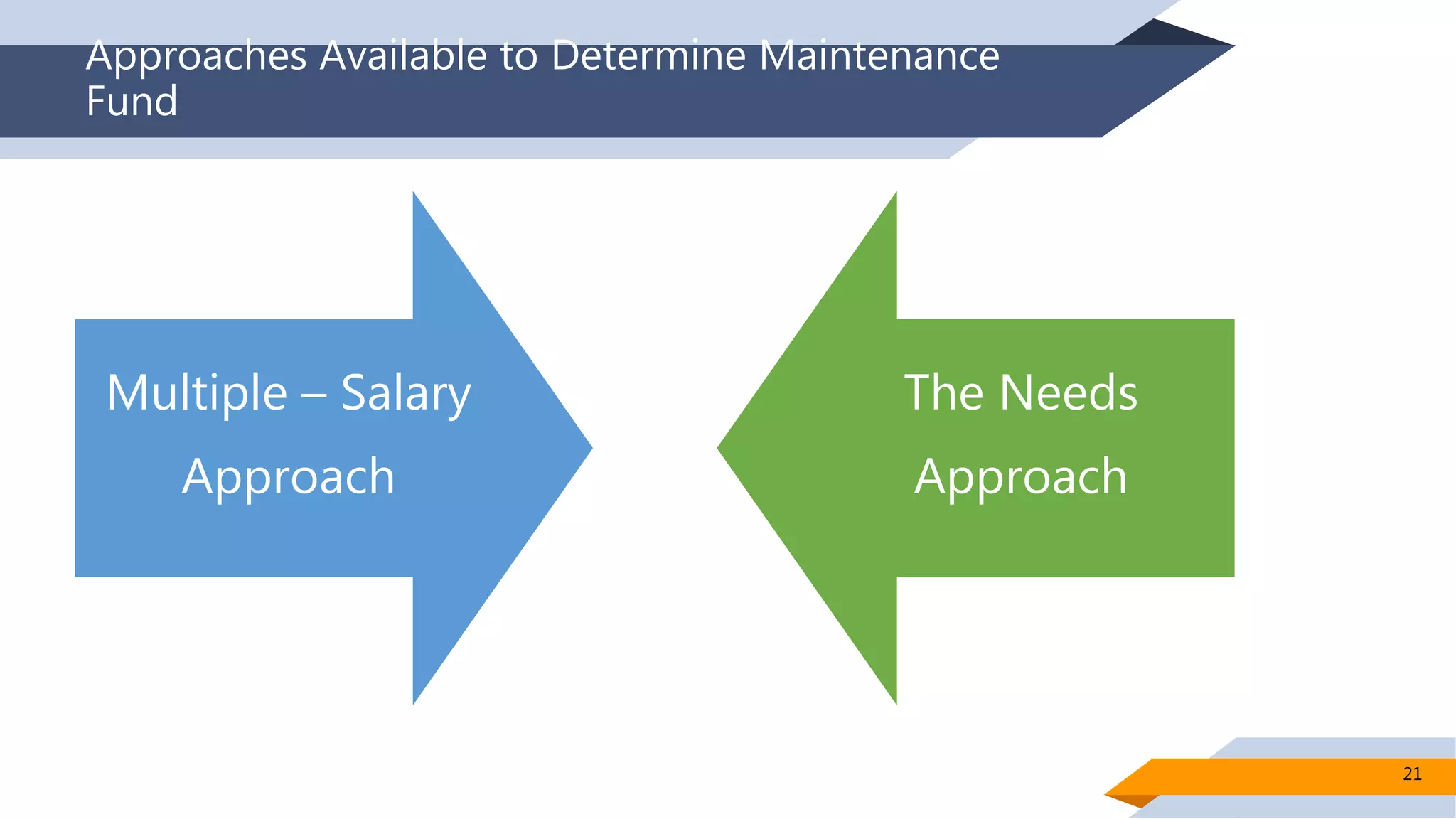
Approaches Available to Determine Maintenance
Fund
Multiple – Salary
Approach
The Needs
Approach
21
Multiple – Salary Approach
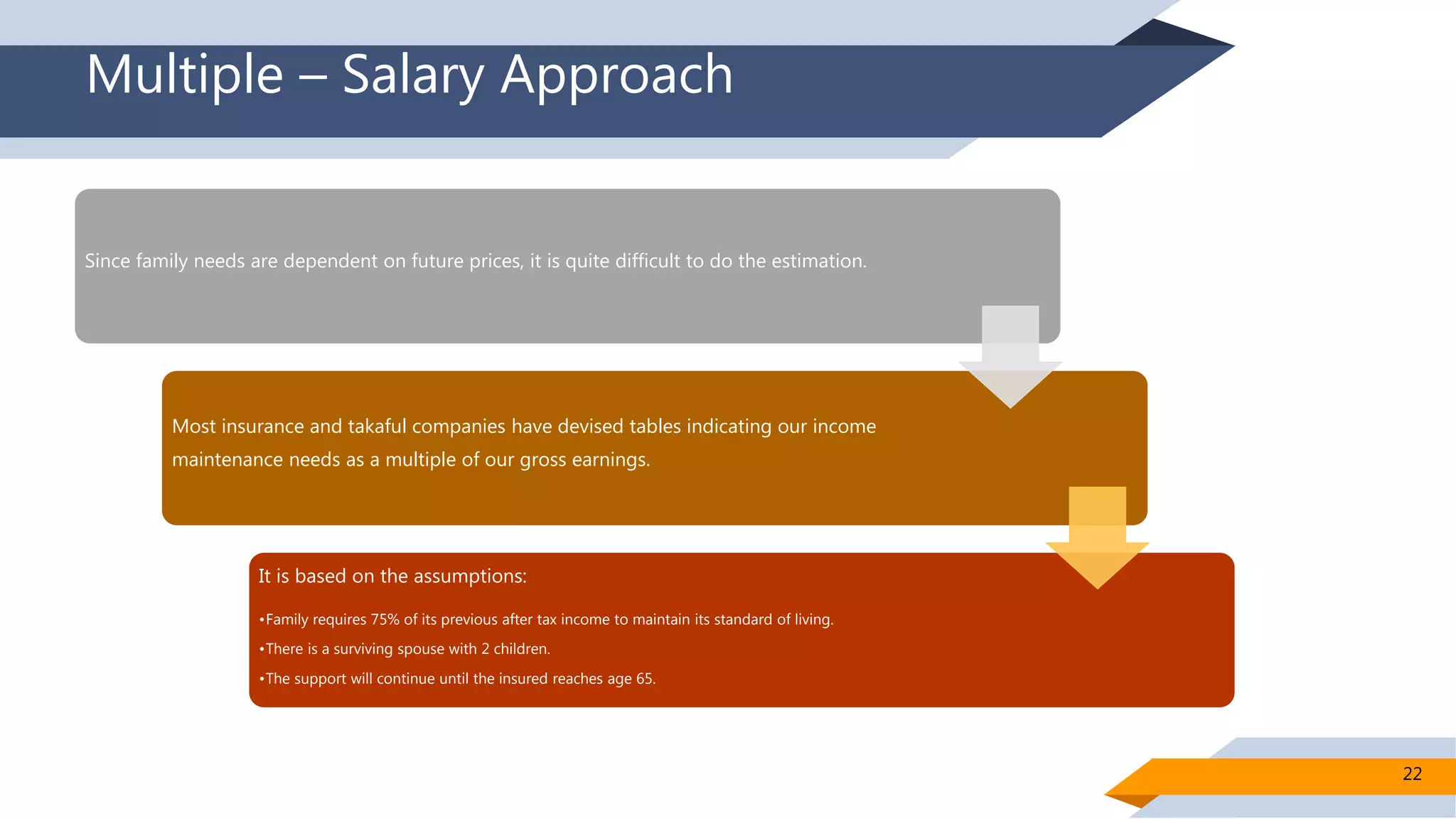
Since family needs are dependent on future prices, it is quite difficult to do the estimation.
Most insurance and takaful companies have devised tables indicating our income
maintenance needs as a multiple of our gross earnings.
It is based on the assumptions:
•Family requires 75% of its previous after tax income to maintain its standard of living.
•There is a surviving spouse with 2 children.
•The support will continue until the insured reaches age 65.
22
Multiple – Salary Approach
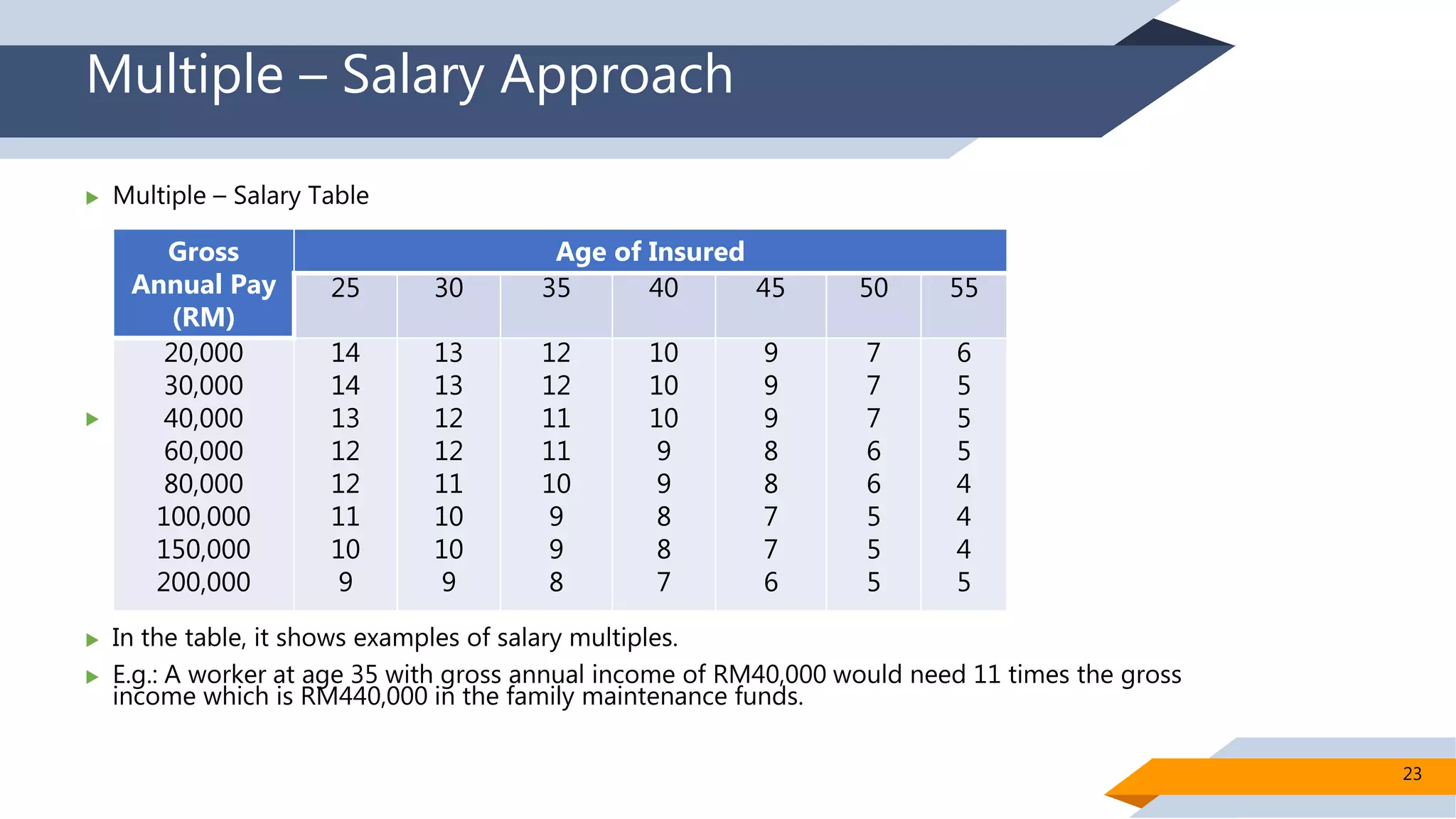
 Multiple – Salary Table

 In the table, it shows examples of salary multiples.
 E.g.: A worker at age 35 with gross annual income of RM40,000 would need 11 times the gross
income which is RM440,000 in the family maintenance funds.
Gross
Annual Pay
(RM)
Age of Insured
25 30 35 40 45 50 55
20,000
30,000
40,000
60,000
80,000
100,000
150,000
200,000
14
14
13
12
12
11
10
9
13
13
12
12
11
10
10
9
12
12
11
11
10
9
9
8
10
10
10
9
9
8
8
7
9
9
9
8
8
7
7
6
7
7
7
6
6
5
5
5
6
5
5
5
4
4
4
5
23
The Needs Approach
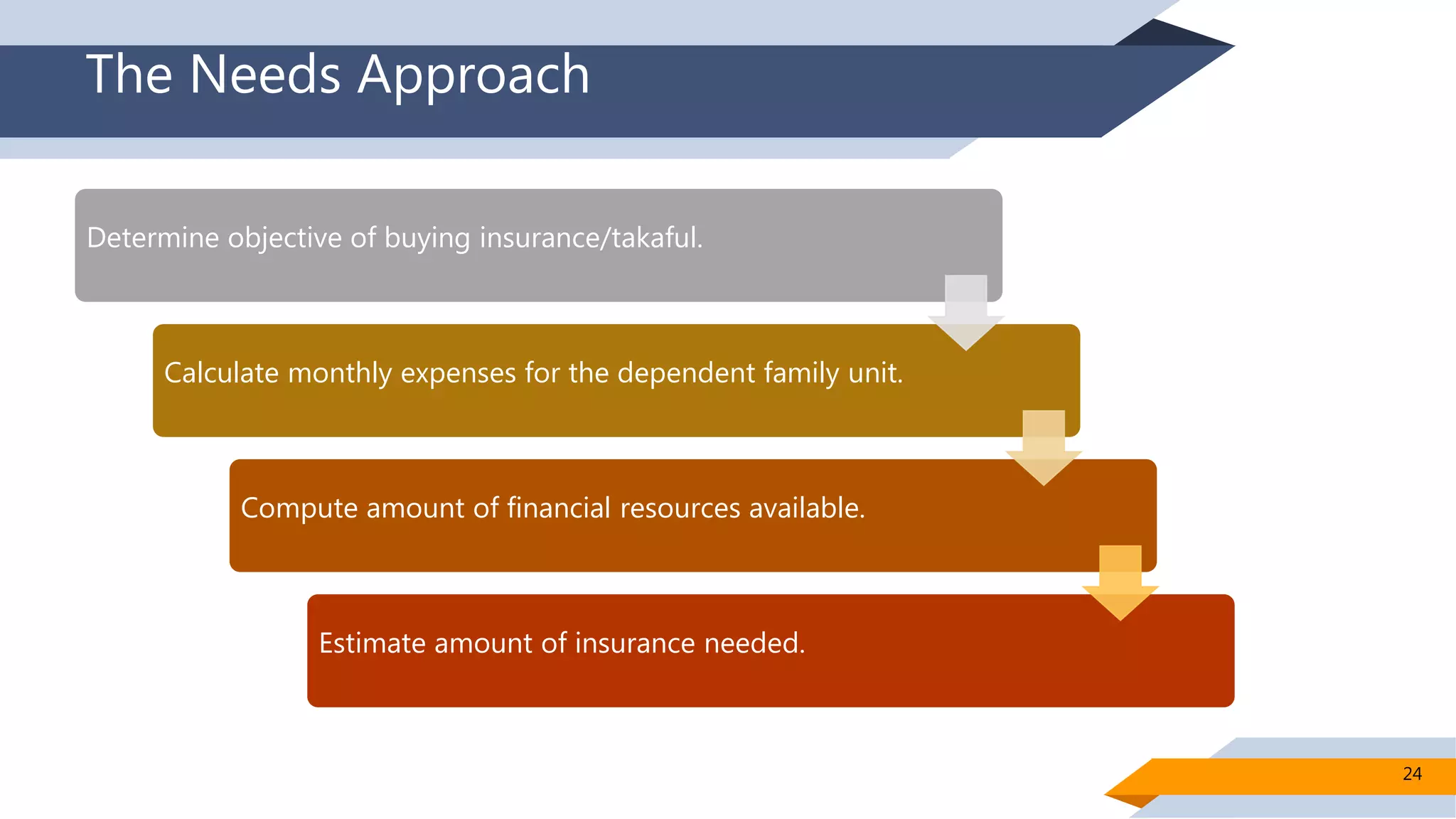
Determine objective of buying insurance/takaful.
Calculate monthly expenses for the dependent family unit.
Compute amount of financial resources available.
Estimate amount of insurance needed.
24
Determine the Objective of Having
Takaful
Pay outstanding home financing
Settle other outstanding debt
Provided money for children education
Provide money for spouse’s retirement
Supplement family income
Provide liquidity for family
Be clear about the objective to better estimate
the insurance cover needed.
25
Calculate Monthly Expenses For The
Dependent Family Unit
Estimate the monthly living expenses for the surviving
family members on the basis of family budget.
Do not forget to take into account inflation to have the
required amount of funds (expenses for example 5% -
10%).
Estimate amount of
funds needed
26
Compute Amount of Financial Resources
Available
Employer’s insurance
EPF savings
Pensions
Annuities
Household savings
Properties
Shares etc.
Not all our financial needs must be met by insurance alone. Most families
have other resources to rely on should the income provider die prematurely.
We should subtract
the family’s
financial resources
from the estimated
need to avoid
being over
insured.
27
Estimate Amount of Insurance Needed
The optimal amount of life insurance to purchase is the
difference between our estimated needs and estimated
funds.
However, our needs and resources are not static.
As time goes on, our insurance goals and family’s financial
circumstances will change.
Therefore, life insurance plans should be reviewed from
time to time (e.g. every 5 years).
28
29
Choosing a Right Policy
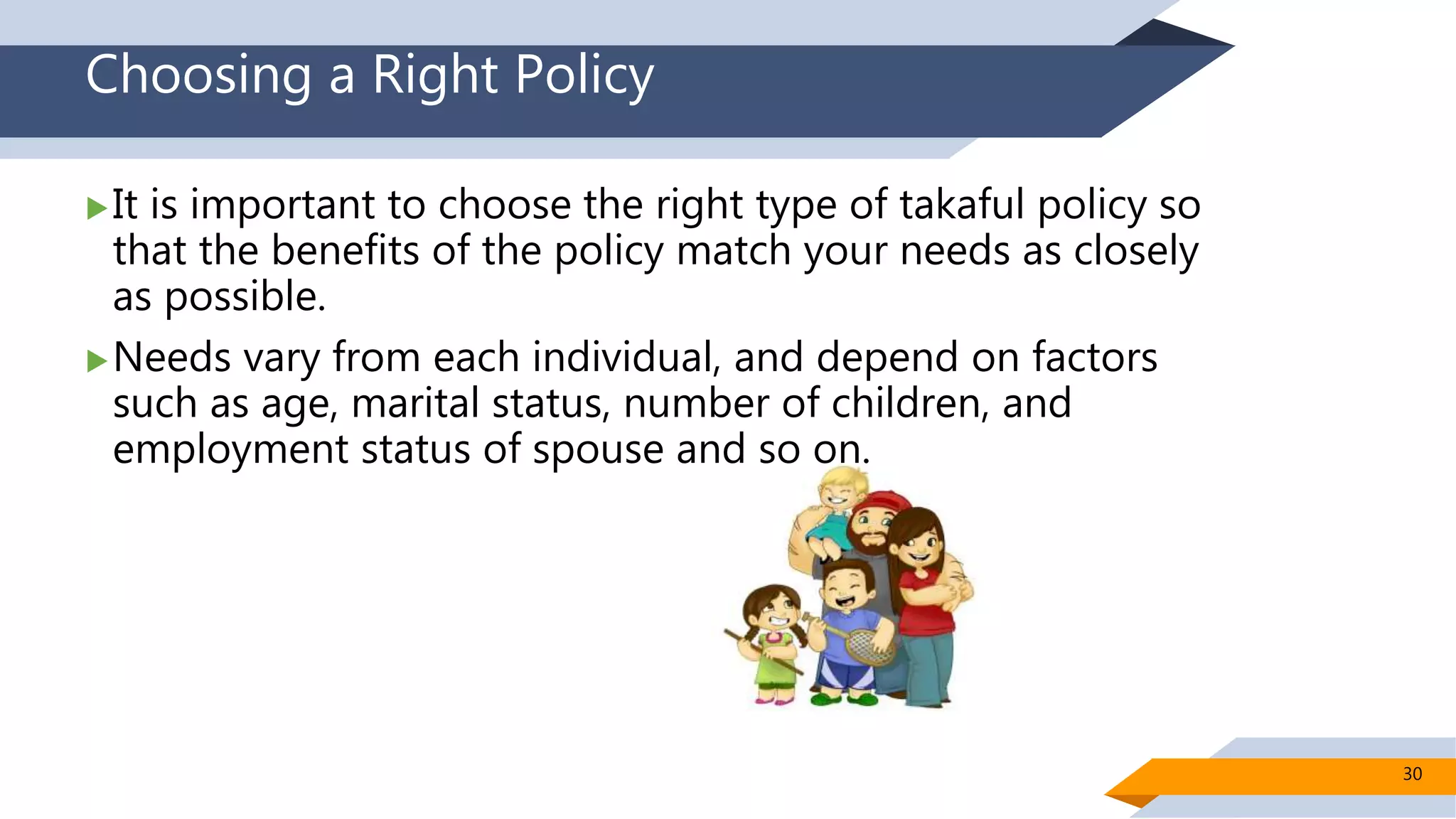
It is important to choose the right type of takaful policy so
that the benefits of the policy match your needs as closely
as possible.
Needs vary from each individual, and depend on factors
such as age, marital status, number of children, and
employment status of spouse and so on.
30
Choosing a Right Policy
Remember that the basic purpose of having taakful is to
ensure that the dependents are financially secure.
Therefore, a single person and couples with no children will
have less need for takaful protection apart from MRTA to
cover housing loans.
In general, the fewer the number of dependents and the
more financial resources we have, the lesser is our need for
takaful protection.
31
Choosing a Right Policy
Young families with small children are going to need large
amount of death protection.
Mature families in the 40-50 age group has different
takaful protection needs compared to young families.
32
Choosing a Right Policy
By this time, you probably have enough amount of saving
but still not enough to retire.
So investment-linked takaful policies can be considered.
Such policies provide a source of investment returns for
old age, while in the meantime; offer a limited degree of
takaful coverage.
An alternative to this investment-linked policy would be to
buy into unit trust or mutual fund and use the premiums
saved to secure a term policy.
33
Tips on choosing a Right Policy
Choose a takaful operator company that is reputable,
financially stable and has a good payment track record.
Compare premiums when shopping for a policy which are
similar in terms of coverage, sum assured, maturity,
provisions and other features.
Choose a qualified takaful agent.
Read and understand all the fine print in the contract
before signing the agreement.
34
Mahyuddin Khalid
End of Chapter
Risk Management and Takaful
Planning
35

Chapter 5 Risk Management and Takaful Planning

  • 1.
    ISLAMIC FINANCIAL PLANNING Mahyuddin Khalid RiskManagement and Takaful Planning
  • 2.
    Chapter Outline Content Basic Conceptof Insurance Concept of Takaful Business Model Used by Takaful Operator Takaful Products How Much to Insure? Approaches Available to Determine Maintenance Fund Determine the Objective of Buying Insurance Choosing a Right Policy 2
  • 3.
    Introduction  Shariah modelof Life Insurance does not mean to insure one‘s life, but it is a financial transaction undertaking to protect widows, orphans and other dependents of the deceased (assured) against future unexpected financial risk.  The conventional system, however, offers a life insurance policy, which may not be free from riba (interest), or some other elements, which are not recognized by Islamic teaching. 3
  • 4.
    Introduction  Therefore, Islamicinsurance or known as Takaful was introduced to cater the needs of Muslim in order to protect their family and also assets from death or disaster. 4
  • 5.
    Resolution of Scholarson Insurance National Fatwa Committee of Malaysia, 1972  Extract of the Minutes of The Discourse of National Fatwa Committee For Islamic Affairs Malaysia -15 June 1972  “Life insurance transacted by present-day life insurance companies is a transaction containing the elements of al-Gharar, al-Maisir and al-Riba and as a consequence its contract is void therefore HARAM” Resolution of Islamic Fiqh Academy of OIC, 1985 5
  • 6.
    Definition of Takaful Takaful was laid down in the system of aqilah – an arrangement of mutual help or indemnification customary in some tribes at the time of the Prophet Muhammad (pbuh).  The contract of takaful provides solidarity in respect of any tragedy in human life and loss to the business or property.  Literally, takaful means joint guarantee, shared responsibility, shared guarantee, collective assurance and mutual undertaking, which reflect a reciprocal relationship and agreement of mutual help among members in a particular group.  In the Quran, the word kafala is mentioned in several contexts such as in Surah Ali-Imran, verse 37. 6
  • 7.
    Definition of Takaful IslamicFinancial Service Act 2013 defines takaful as:  “an arrangement based on mutual assistance under which takaful participants agree to contribute to a common fund providing for mutual financial benefits payable to the takaful participants or their beneficiaries on the occurrence of pre-agreed events;”. 7
  • 8.
    Contractual Relationship AmongThe Participants (Tabarru’)  The underlying contract among the participants or policyholders is the donation or tabarru’ contract. Tabarru’:  Agreement by a participant to relinquish, as donation, a sum of contribution that he/she agrees to pay into takaful fund The purpose of this concept is to provide mutual indemnity to the takaful participant, where the donation acts as a mutual help and joint guarantee should any fellow participants suffers as a defined loss. 8
  • 9.
    Contract Among TakafulParticipants There is no insurer-insured relationship between the participants and the takaful operator.  The participants are insuring themselves.  The takaful operator is engaged by the participants (as a group) to manage the takaful scheme for them. In general, the takaful operator is expected to:  Manage the underwriting of takaful contributions and payment of protection amount or claims ; and  Manage any investment portfolio of the fund. 9
  • 10.
    Business Model UsedBy Takaful Operators Approved by scholars:  Mudharabah (profit sharing)  Mudharabah is a profit sharing contract whereby one party provides the capital (Ras ‘ul maal and the other party provides the expertise (MudhariS).  Wakalah  Wakalah is a contract whereby one party acts on behalf of another for a fee.  Hybrid (Mudharabah + al'Wakalah) Concept of tabarru’ applicable under all 10
  • 11.
  • 12.
    Benefits of Takaful Reduces financial burden to individuals as compensation will be obtained and/or outstanding liabilities will be covered upon untimely death or total disability.  Provides dependents or heirs ability to secure inherited properties.  Participants are entitle to a share of profit or surplus of operations based on profit sharing principle of al-mudharabah.  Free of liability by the guarantor on any outstanding credit facility or financing/loan.  Participants are able to be ‘rewarded’ in the hereafter on the donation made through the tabarru’concept. 12
  • 13.
    How to Participatein Takaful? Type of protection • Life (family) • Property Affordability How much an individual is willing to pay to participate Priority of protection • Protection only • Protection and savings/investment 13
  • 14.
    Key Principles ofInsurance and Takaful 1. Indemnity:  Applies to the physical damage to a property where the loss can be quantified in monetary terms.  In the event the insured suffer a loss, the insurance company will pay or indemnify the insured to the position he or she was in before the loss.  The payment of losses will not exceed the value of the property destroyed. 14
  • 15.
    Key Principles ofInsurance and Takaful 2. Insurable interest:  Means an insured person will undergo a personal financial loss when a loss caused by an insured peril occurs.  If the insured will not experience financial losses from the damage of the object, then the insured cannot insure the object. 15
  • 16.
    Key Principles ofInsurance and Takaful 3. Utmost good faith:  The policy owner must disclose all material facts when buying a policy.  If fails to disclose, the policy may become invalid. 16
  • 17.
    Key Principles ofInsurance and Takaful 4. Contribution:  The principle comes into play when there are 2 or more insurance coverage on one risk.  When the total amount of claim from 2 or more insurers exceeds the amount of loss suffered, the insurers will pay a proportionate amount according to the liability. 17
  • 18.
    Key Principles ofInsurance and Takaful 5. Subrogation:  This principle is a result of the principle of indemnity.  The insurer who has indemnified the insured’s loss is entitled to recover the loss from any liable third parties who are responsible to the extent of its liability.  Subrogation only applies to general insurance. 18
  • 19.
    Key Principles ofInsurance and Takaful 6. Proximate cause:  Defined as the efficient cause that brings about a loss with no other intervening cause that breaks the chain of events.  A claim is not payable by the insurer if the proximate cause is other than the named peril. 19
  • 20.
    How Much toInsure? The most important aspect of our insurance protection needs is family maintenance fund. It will insure the viability of the dependent family unit. The size of fund will reflect the level of living we would like to see maintained. So budget an amount that is at least enough to eliminate the need for major financial adjustment. On the other hand, we don’t want to over budget that makes us worth more to our family dead than alive. 20
  • 21.
    Approaches Available toDetermine Maintenance Fund Multiple – Salary Approach The Needs Approach 21
  • 22.
    Multiple – SalaryApproach Since family needs are dependent on future prices, it is quite difficult to do the estimation. Most insurance and takaful companies have devised tables indicating our income maintenance needs as a multiple of our gross earnings. It is based on the assumptions: •Family requires 75% of its previous after tax income to maintain its standard of living. •There is a surviving spouse with 2 children. •The support will continue until the insured reaches age 65. 22
  • 23.
    Multiple – SalaryApproach  Multiple – Salary Table   In the table, it shows examples of salary multiples.  E.g.: A worker at age 35 with gross annual income of RM40,000 would need 11 times the gross income which is RM440,000 in the family maintenance funds. Gross Annual Pay (RM) Age of Insured 25 30 35 40 45 50 55 20,000 30,000 40,000 60,000 80,000 100,000 150,000 200,000 14 14 13 12 12 11 10 9 13 13 12 12 11 10 10 9 12 12 11 11 10 9 9 8 10 10 10 9 9 8 8 7 9 9 9 8 8 7 7 6 7 7 7 6 6 5 5 5 6 5 5 5 4 4 4 5 23
  • 24.
    The Needs Approach Determineobjective of buying insurance/takaful. Calculate monthly expenses for the dependent family unit. Compute amount of financial resources available. Estimate amount of insurance needed. 24
  • 25.
    Determine the Objectiveof Having Takaful Pay outstanding home financing Settle other outstanding debt Provided money for children education Provide money for spouse’s retirement Supplement family income Provide liquidity for family Be clear about the objective to better estimate the insurance cover needed. 25
  • 26.
    Calculate Monthly ExpensesFor The Dependent Family Unit Estimate the monthly living expenses for the surviving family members on the basis of family budget. Do not forget to take into account inflation to have the required amount of funds (expenses for example 5% - 10%). Estimate amount of funds needed 26
  • 27.
    Compute Amount ofFinancial Resources Available Employer’s insurance EPF savings Pensions Annuities Household savings Properties Shares etc. Not all our financial needs must be met by insurance alone. Most families have other resources to rely on should the income provider die prematurely. We should subtract the family’s financial resources from the estimated need to avoid being over insured. 27
  • 28.
    Estimate Amount ofInsurance Needed The optimal amount of life insurance to purchase is the difference between our estimated needs and estimated funds. However, our needs and resources are not static. As time goes on, our insurance goals and family’s financial circumstances will change. Therefore, life insurance plans should be reviewed from time to time (e.g. every 5 years). 28
  • 29.
  • 30.
    Choosing a RightPolicy It is important to choose the right type of takaful policy so that the benefits of the policy match your needs as closely as possible. Needs vary from each individual, and depend on factors such as age, marital status, number of children, and employment status of spouse and so on. 30
  • 31.
    Choosing a RightPolicy Remember that the basic purpose of having taakful is to ensure that the dependents are financially secure. Therefore, a single person and couples with no children will have less need for takaful protection apart from MRTA to cover housing loans. In general, the fewer the number of dependents and the more financial resources we have, the lesser is our need for takaful protection. 31
  • 32.
    Choosing a RightPolicy Young families with small children are going to need large amount of death protection. Mature families in the 40-50 age group has different takaful protection needs compared to young families. 32
  • 33.
    Choosing a RightPolicy By this time, you probably have enough amount of saving but still not enough to retire. So investment-linked takaful policies can be considered. Such policies provide a source of investment returns for old age, while in the meantime; offer a limited degree of takaful coverage. An alternative to this investment-linked policy would be to buy into unit trust or mutual fund and use the premiums saved to secure a term policy. 33
  • 34.
    Tips on choosinga Right Policy Choose a takaful operator company that is reputable, financially stable and has a good payment track record. Compare premiums when shopping for a policy which are similar in terms of coverage, sum assured, maturity, provisions and other features. Choose a qualified takaful agent. Read and understand all the fine print in the contract before signing the agreement. 34
  • 35.
    Mahyuddin Khalid End ofChapter Risk Management and Takaful Planning 35