Effect of Alcohol on Pancreas 
Pooja Goswami 
AI.I.M.S. New Delhi
Point to be covered 
• Pancreas normal physiology and anatomy 
• Exocrine & endocrine function of pancreas 
• Epidemiology 
• Different hypothesis for pancreatitis 
• Effect of alcohol on pancreas 
• Effect of alcohol on PSCs 
• Role of PSCs in fibrosis or cancer progression
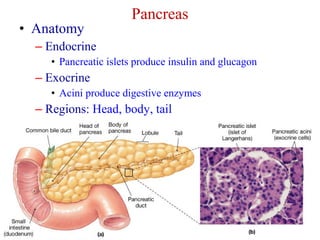
Pancreas 
• Anatomy 
– Endocrine 
• Pancreatic islets produce insulin and glucagon 
– Exocrine 
• Acini produce digestive enzymes 
– Regions: Head, body, tail
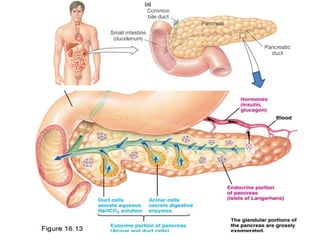
Normal Pancreas 
• The pancreatic gland contains three major types of 
cells. 
• The ductular cells make up about 10% of the 
pancreas and secrete solutions rich in bicarbonate. 

• The acinar cells comprise over 80% of the pancreas 
and they synthesize and secrete pancreatic enzymes. 
• The islet cells make up about 10% of the pancreas 
and form the endocrine portion of the pancreas. These 
cells secrete the hormones insulin, glucagon, 
somatostatin, and pancreatic polypeptide.
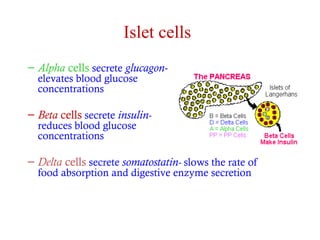
Islet cells 
– Alpha cells secrete glucagon-elevates 
blood glucose 
concentrations 
– Beta cells secrete insulin-reduces 
blood glucose 
concentrations 
– Delta cells secrete somatostatin- slows the rate of 
food absorption and digestive enzyme secretion
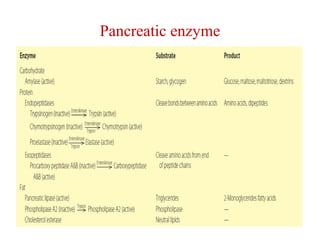
Pancreatic enzyme
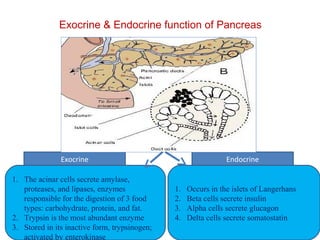
Exocrine & Endocrine function of Pancreas 
Exocrine Endocrine 
1. Occurs in the islets of Langerhans 
2. Beta cells secrete insulin 
3. Alpha cells secrete glucagon 
4. Delta cells secrete somatostatin 
1. The acinar cells secrete amylase, 
proteases, and lipases, enzymes 
responsible for the digestion of 3 food 
types: carbohydrate, protein, and fat. 
2. Trypsin is the most abundant enzyme 
3. Stored in its inactive form, trypsinogen; 
activated by enterokinase
Alcohol & Pancreatitis 
• Alcohol abuse accounts for 38-94% CP 
• Daily 80g/day for 13-21 years to develop 
alcohol induced pancreatitis 
• Only 10 % of heavy drinker develop 
pancreatic inflammation 
• Black ppl are 3-4 times more chances to 
develop pancreatitis 
• Patient get diagnosed at age of 35-40 years of 
age
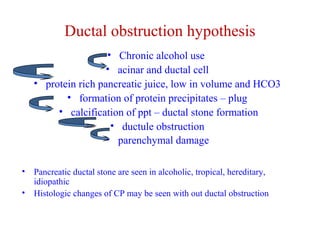
Ductal obstruction hypothesis 
• Chronic alcohol use 
• acinar and ductal cell 
• protein rich pancreatic juice, low in volume and HCO3 
• formation of protein precipitates – plug 
• calcification of ppt – ductal stone formation 
• ductule obstruction 
• parenchymal damage 
• Pancreatic ductal stone are seen in alcoholic, tropical, hereditary, 
idiopathic 
• Histologic changes of CP may be seen with out ductal obstruction
Toxic metabolic hypothesis 
• (alcohol) Direct injurious effect on acinar and ductal cells 
• Increased membrane lipid peroxidation (oxidative stress), 
free radical production 
• Increase acinar cell sensitivity to pathogenic stimuli 
• Activation of pancreatic stellate cells (alcohol, cytokines) – 
produce proteins of extracellular matrix
Necrosis fibrosis hypothesis 
• Repeated episodes of acute pancreatitis with cellular 
necrosis or apoptosis, healing replaces necrotic tissue with 
fibrosis 
• Evidence from natural history studies - more severe and 
frequent attacks 
• More evidence from hereditary pancreatitis and 
animal models 
• But some have evidence of chronic pancreatitis at 
time of first clinical acute attack
Genetics Basis of CP 
Autosomal dominant disorder 
Cationic Trypsinogen gene mutation….PRSS1(R122H) 
Autosomal Recessive….CFTR mutation 
Susceptabilty gene….SPINK1 
Course Modifiers…..various polymorphisms 
(ADH2,ADH3,ALDH2,CYP2E1 ETC.)
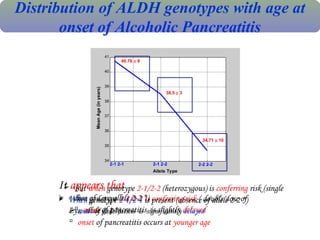
Distribution of ALDH genotypes with age at 
onset of Alcoholic Pancreatitis 
41 
40 
39 
38 
37 
36 
35 
34 
38.5 ± 3 
Allele Type 
Mean Age (in years) 
40.76 ± 8 
34.71 ± 10 
2-1 2-1 2-1 2-2 2-2 2-2 
It appears that 
 When genotype 2-2/is conferring risk ( double dose of 
Lys; allele 2-2 *) 
 But when genotype 2-1/2-2 (heterozygous) is conferring risk (single 
dose of Lys; allele 2-2 *) 
 When genotype 2-1/2-1 is present (absence of allele 2-2 *) 
 onset of pancreatitis is slightly delayed 
 onset of pancreatitis is significantly delayed 
 onset of pancreatitis occurs at younger age
Alcohol and Pancreas 
• Incompletely understood and intensely 
studied. 
• Why 10% heavy alcoholics develop chronic 
pancreatitis and the rest not, or limited to 
asymptomatic pancreatic fibrosis
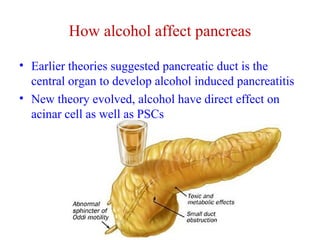
How alcohol affect pancreas 
• Earlier theories suggested pancreatic duct is the 
central organ to develop alcohol induced pancreatitis 
• New theory evolved, alcohol have direct effect on 
acinar cell as well as PSCs
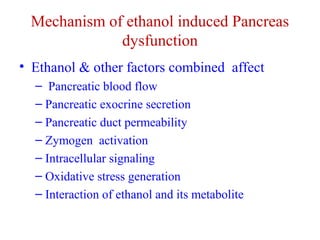
Mechanism of ethanol induced Pancreas 
dysfunction 
• Ethanol & other factors combined affect 
– Pancreatic blood flow 
– Pancreatic exocrine secretion 
– Pancreatic duct permeability 
– Zymogen activation 
– Intracellular signaling 
– Oxidative stress generation 
– Interaction of ethanol and its metabolite
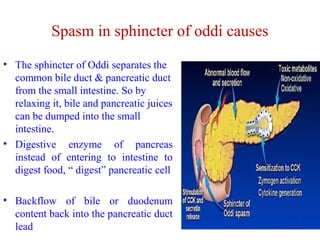
Spasm in sphincter of oddi causes 
• The sphincter of Oddi separates the 
common bile duct & pancreatic duct 
from the small intestine. So by 
relaxing it, bile and pancreatic juices 
can be dumped into the small 
intestine. 
• Digestive enzyme of pancreas 
instead of entering to intestine to 
digest food, “ digest” pancreatic cell 
• Backflow of bile or duodenum 
content back into the pancreatic duct 
lead
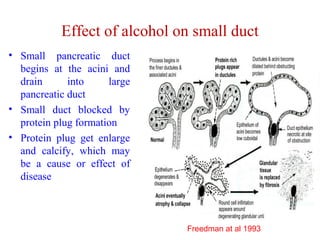
Effect of alcohol on small duct 
• Small pancreatic duct 
begins at the acini and 
drain into large 
pancreatic duct 
• Small duct blocked by 
protein plug formation 
• Protein plug get enlarge 
and calcify, which may 
be a cause or effect of 
disease 
Freedman at al 1993
Protein plug: pancreatic digestive enzyme and 
lithostathine & GP2 
• Pancreatic Lithostathine 
– Form 5-10% protein of pancreatic secretion 
– Inhibit the deposition of ca+ from pancreatic juice, therfore 
its ↓ level promote calcification of protein (Bernard et al 
1992) 
– Convert lithostathine into lithostathine S1( to initiate plug 
formation 
– Long term alcohol consumption leads to ↑ conc. of 
lithostathine in juice, which promotes protein deposition in 
ducts (Apte et al 1996) 
• Pancreatic GP2 
– Help in protein precipitation from pancreatic juice 
– Alcohol consumption lead to ↑ conc. of GP2, favor plug 
formation
Effect of protein plug formation on 
pancreas 
• Protein plug formation or stone in small duct 
lead to ulceration, scarring further obstruction 
& finally atrophy and fibrosis via 
– Reduces pancreatic secretion 
– Increased viscosity of secretion 
– Decrease citrate conc. In pancreatic juice, a 
predisposing factor for crystal formation 
– Producing protein to increase stone formation 
Protein plug known to be a player in progression of disease if not initiation
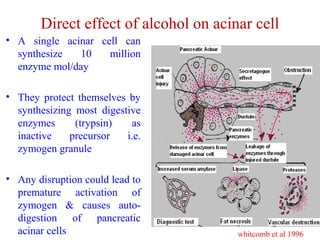
Direct effect of alcohol on acinar cell 
• A single acinar cell can 
synthesize 10 million 
enzyme mol/day 
• They protect themselves by 
synthesizing most digestive 
enzymes (trypsin) as 
inactive precursor i.e. 
zymogen granule 
• Any disruption could lead to 
premature activation of 
zymogen & causes auto-digestion 
of pancreatic 
acinar cells whitcomb et al 1996
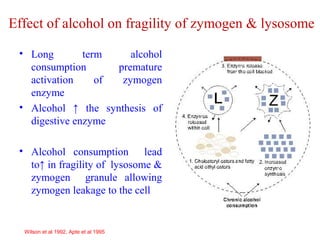
Effect of alcohol on fragility of zymogen & lysosome 
• Long term alcohol 
consumption premature 
activation of zymogen 
enzyme 
• Alcohol ↑ the synthesis of 
digestive enzyme 
• Alcohol consumption lead 
to↑ in fragility of lysosome & 
zymogen granule allowing 
zymogen leakage to the cell 
Wilson et al 1992, Apte et al 1995
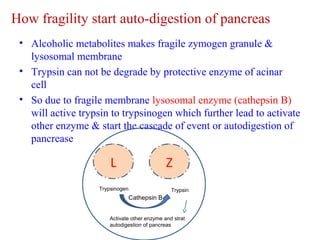
How fragility start auto-digestion of pancreas 
• Alcoholic metabolites makes fragile zymogen granule & 
lysosomal membrane 
• Trypsin can not be degrade by protective enzyme of acinar 
cell 
• So due to fragile membrane lysosomal enzyme (cathepsin B) 
will active trypsin to trypsinogen which further lead to activate 
other enzyme & start the cascade of event or autodigestion of 
pancrease 
L Z 
Trypsinogen Trypsin 
Cathepsin B 
Activate other enzyme and strat 
autodigestion of pancreas
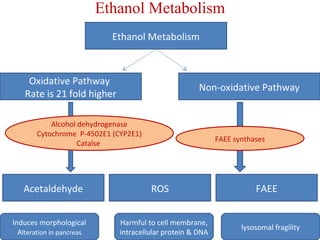
Ethanol Metabolism 
Ethanol Metabolism 
Non-oxidative Pathway 
Oxidative Pathway 
Rate is 21 fold higher 
Alcohol dehydrogenase 
Cytochrome P-4502E1 (CYP2E1) 
Catalse FAEE synthases 
Acetaldehyde ROS 
FAEE 
Induces morphological 
Alteration in pancreas 
Harmful to cell membrane, 
intracellular protein & DNA 
lysosomal fragility
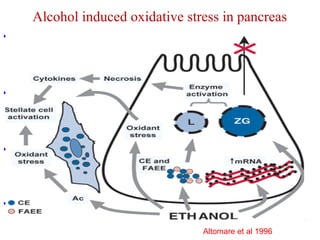
Alcohol induced oxidative stress in pancreas 
• The cell is normally protected from the disruptive effect of free 
radicals by antioxidant system, which releases during normal 
metabolism of alcohol via CYP2E1 
• Oxidative stress is the imbalance between production of ROS & 
defense mechanism (Antioxidant glutathione, peroxidase, 
superoxide mutase & catalase) 
• This imbalance may be a due to 
– ROS release during ethanol oxidation via CYP2E1 
– Depletion of ROS scavenger gluthathione 
• As a result oxidative stress destabilizes zymogen & lysosome 
granules lead to auto digestion of pancreas via acinar cell activation 
• 
Altomare et al 1996
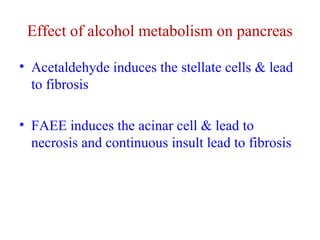
Effect of alcohol metabolism on pancreas 
• Acetaldehyde induces the stellate cells & lead 
to fibrosis 
• FAEE induces the acinar cell & lead to 
necrosis and continuous insult lead to fibrosis
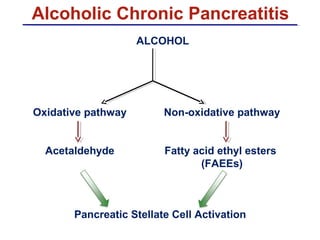
Alcoholic Chronic Pancreatitis 
ALCOHOL 
Oxidative pathway 
Acetaldehyde 
Non-oxidative pathway 
Fatty acid ethyl esters 
(FAEEs) 
Pancreatic Stellate Cell Activation
Pancreatic stellate cells (PSCs) 
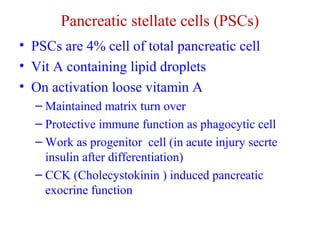
• PSCs are 4% cell of total pancreatic cell 
• Vit A containing lipid droplets 
• On activation loose vitamin A 
– Maintained matrix turn over 
– Protective immune function as phagocytic cell 
– Work as progenitor cell (in acute injury secrte 
insulin after differentiation) 
– CCK (Cholecystokinin ) induced pancreatic 
exocrine function
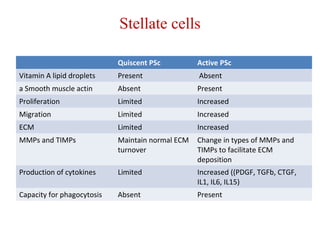
Stellate cells 
Quiscent PSc Active PSc 
Vitamin A lipid droplets Present Absent 
a Smooth muscle actin Absent Present 
Proliferation Limited Increased 
Migration Limited Increased 
ECM Limited Increased 
MMPs and TIMPs Maintain normal ECM 
turnover 
Change in types of MMPs and 
TIMPs to facilitate ECM 
deposition 
Production of cytokines Limited Increased ((PDGF, TGFb, CTGF, 
IL1, IL6, IL15) 
Capacity for phagocytosis Absent Present
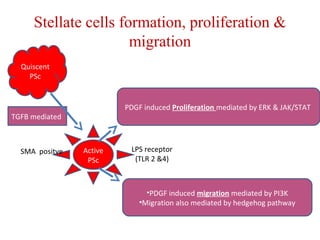
Stellate cells formation, proliferation & 
Active 
PSc 
migration 
PDGF induced Proliferation mediated by ERK & JAK/STAT 
•PDGF induced migration mediated by PI3K 
•Migration also mediated by hedgehog pathway 
Quiscent 
PSc 
TGFB mediated 
LPS receptor 
(TLR 2 &4) 
SMA positve
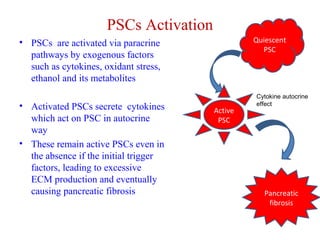
PSCs Activation 
• PSCs are activated via paracrine 
pathways by exogenous factors 
such as cytokines, oxidant stress, 
ethanol and its metabolites 
• Activated PSCs secrete cytokines 
which act on PSC in autocrine 
way 
• These remain active PSCs even in 
the absence if the initial trigger 
factors, leading to excessive 
ECM production and eventually 
causing pancreatic fibrosis 
Active 
PSC 
Quiescent 
PSC 
Cytokine autocrine 
effect 
Pancreatic 
fibrosis
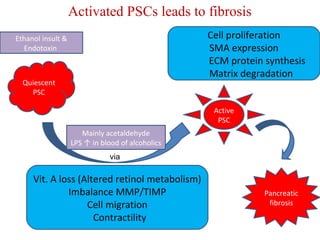
Activated PSCs leads to fibrosis 
Active 
PSC 
Quiescent 
PSC 
Cell proliferation 
SMA expression 
ECM protein synthesis 
Matrix degradation 
via 
Vit. A loss (Altered retinol metabolism) 
Imbalance MMP/TIMP 
Cell migration 
Contractility 
Pancreatic 
fibrosis 
Ethanol insult & 
Endotoxin 
Mainly acetaldehyde 
LPS ↑ in blood of alcoholics
PSC in Chronic Pancreatitis: Animal 
studies 
• Fibrosis has been produced in rat model via 
(1) trinitrobenzene sulfonic acid (TNBS) injection into the pancreatic 
duct (Haber et al., 1999) 
(2) intravenous injection of an organotin compound dubutyltin chloride 
(DBTC) (Emmrich et al., 2000) 
(3) spontaneous chronic pancreatitis in WBN/Kob rats (Ohashi et al., 
1990) 
(4) severe hyperstimula- tion obstructive pancreatitis (SHOP), 
involving intraperitoneal (IP) injections of supramaximal doses of 
caerulein (a synthetic analogue of CCK, a major pancreatic 
secretagogue) + bile- pancreatic duct ligation (Murayama et al., 
1999) 
(5) repeated IP injections of a superoxide dismutase inhibitor 
(Matsumura et al., 2001)
Continued.. 
• (6) intragastric high dose alcohol administration + repeated 
caerulein injections (Tsukamoto et al., 1988; Uesugi et al., 
2004) 
• (7) chronic alcohol administration (liquid diet) with repeated 
cyclosporin and caerulein injections (Gukovsky et al., 2008) 
• (8) chronic alcohol administration with repeated endo- toxin 
LPS, injections (Vonlaufen et al., 2007b). 
•Rat model produced by chronic alcohol administration and 
repeated endotoxin exposuren that is based on a well recognized 
clinical phenomenon, namely endo- toxinaemia (secondary to 
increased gut mucosal permeability) in alcoholics (Bode et al., 
1993; Parlesak, 2005). 
•Thus, the alcohol feeding, LPS challenge model possibly 
represents the most physiologically relevant model of chronic 
alcoholic pancreatitis described to date.
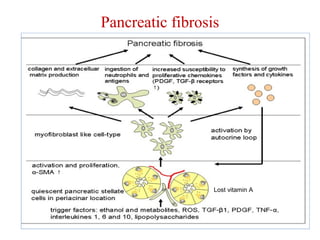
Pancreatic fibrosis 
Lost vitamin A
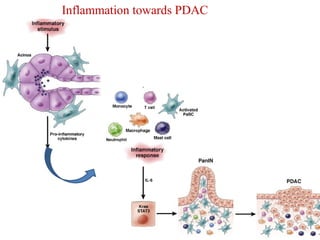
Inflammation towards PDAC
THANK YOU FOR YOU ATTENTION

Final seminar 1 oct 13

  • 1.
    Effect of Alcoholon Pancreas Pooja Goswami AI.I.M.S. New Delhi
  • 2.
    Point to becovered • Pancreas normal physiology and anatomy • Exocrine & endocrine function of pancreas • Epidemiology • Different hypothesis for pancreatitis • Effect of alcohol on pancreas • Effect of alcohol on PSCs • Role of PSCs in fibrosis or cancer progression
  • 4.
    Pancreas • Anatomy – Endocrine • Pancreatic islets produce insulin and glucagon – Exocrine • Acini produce digestive enzymes – Regions: Head, body, tail
  • 5.
    Normal Pancreas •The pancreatic gland contains three major types of cells. • The ductular cells make up about 10% of the pancreas and secrete solutions rich in bicarbonate. • The acinar cells comprise over 80% of the pancreas and they synthesize and secrete pancreatic enzymes. • The islet cells make up about 10% of the pancreas and form the endocrine portion of the pancreas. These cells secrete the hormones insulin, glucagon, somatostatin, and pancreatic polypeptide.
  • 6.
    Islet cells –Alpha cells secrete glucagon-elevates blood glucose concentrations – Beta cells secrete insulin-reduces blood glucose concentrations – Delta cells secrete somatostatin- slows the rate of food absorption and digestive enzyme secretion
  • 7.
  • 8.
    Exocrine & Endocrinefunction of Pancreas Exocrine Endocrine 1. Occurs in the islets of Langerhans 2. Beta cells secrete insulin 3. Alpha cells secrete glucagon 4. Delta cells secrete somatostatin 1. The acinar cells secrete amylase, proteases, and lipases, enzymes responsible for the digestion of 3 food types: carbohydrate, protein, and fat. 2. Trypsin is the most abundant enzyme 3. Stored in its inactive form, trypsinogen; activated by enterokinase
  • 9.
    Alcohol & Pancreatitis • Alcohol abuse accounts for 38-94% CP • Daily 80g/day for 13-21 years to develop alcohol induced pancreatitis • Only 10 % of heavy drinker develop pancreatic inflammation • Black ppl are 3-4 times more chances to develop pancreatitis • Patient get diagnosed at age of 35-40 years of age
  • 10.
    Ductal obstruction hypothesis • Chronic alcohol use • acinar and ductal cell • protein rich pancreatic juice, low in volume and HCO3 • formation of protein precipitates – plug • calcification of ppt – ductal stone formation • ductule obstruction • parenchymal damage • Pancreatic ductal stone are seen in alcoholic, tropical, hereditary, idiopathic • Histologic changes of CP may be seen with out ductal obstruction
  • 11.
    Toxic metabolic hypothesis • (alcohol) Direct injurious effect on acinar and ductal cells • Increased membrane lipid peroxidation (oxidative stress), free radical production • Increase acinar cell sensitivity to pathogenic stimuli • Activation of pancreatic stellate cells (alcohol, cytokines) – produce proteins of extracellular matrix
  • 12.
    Necrosis fibrosis hypothesis • Repeated episodes of acute pancreatitis with cellular necrosis or apoptosis, healing replaces necrotic tissue with fibrosis • Evidence from natural history studies - more severe and frequent attacks • More evidence from hereditary pancreatitis and animal models • But some have evidence of chronic pancreatitis at time of first clinical acute attack
  • 13.
    Genetics Basis ofCP Autosomal dominant disorder Cationic Trypsinogen gene mutation….PRSS1(R122H) Autosomal Recessive….CFTR mutation Susceptabilty gene….SPINK1 Course Modifiers…..various polymorphisms (ADH2,ADH3,ALDH2,CYP2E1 ETC.)
  • 14.
    Distribution of ALDHgenotypes with age at onset of Alcoholic Pancreatitis 41 40 39 38 37 36 35 34 38.5 ± 3 Allele Type Mean Age (in years) 40.76 ± 8 34.71 ± 10 2-1 2-1 2-1 2-2 2-2 2-2 It appears that  When genotype 2-2/is conferring risk ( double dose of Lys; allele 2-2 *)  But when genotype 2-1/2-2 (heterozygous) is conferring risk (single dose of Lys; allele 2-2 *)  When genotype 2-1/2-1 is present (absence of allele 2-2 *)  onset of pancreatitis is slightly delayed  onset of pancreatitis is significantly delayed  onset of pancreatitis occurs at younger age
  • 15.
    Alcohol and Pancreas • Incompletely understood and intensely studied. • Why 10% heavy alcoholics develop chronic pancreatitis and the rest not, or limited to asymptomatic pancreatic fibrosis
  • 16.
    How alcohol affectpancreas • Earlier theories suggested pancreatic duct is the central organ to develop alcohol induced pancreatitis • New theory evolved, alcohol have direct effect on acinar cell as well as PSCs
  • 17.
    Mechanism of ethanolinduced Pancreas dysfunction • Ethanol & other factors combined affect – Pancreatic blood flow – Pancreatic exocrine secretion – Pancreatic duct permeability – Zymogen activation – Intracellular signaling – Oxidative stress generation – Interaction of ethanol and its metabolite
  • 18.
    Spasm in sphincterof oddi causes • The sphincter of Oddi separates the common bile duct & pancreatic duct from the small intestine. So by relaxing it, bile and pancreatic juices can be dumped into the small intestine. • Digestive enzyme of pancreas instead of entering to intestine to digest food, “ digest” pancreatic cell • Backflow of bile or duodenum content back into the pancreatic duct lead
  • 19.
    Effect of alcoholon small duct • Small pancreatic duct begins at the acini and drain into large pancreatic duct • Small duct blocked by protein plug formation • Protein plug get enlarge and calcify, which may be a cause or effect of disease Freedman at al 1993
  • 20.
    Protein plug: pancreaticdigestive enzyme and lithostathine & GP2 • Pancreatic Lithostathine – Form 5-10% protein of pancreatic secretion – Inhibit the deposition of ca+ from pancreatic juice, therfore its ↓ level promote calcification of protein (Bernard et al 1992) – Convert lithostathine into lithostathine S1( to initiate plug formation – Long term alcohol consumption leads to ↑ conc. of lithostathine in juice, which promotes protein deposition in ducts (Apte et al 1996) • Pancreatic GP2 – Help in protein precipitation from pancreatic juice – Alcohol consumption lead to ↑ conc. of GP2, favor plug formation
  • 21.
    Effect of proteinplug formation on pancreas • Protein plug formation or stone in small duct lead to ulceration, scarring further obstruction & finally atrophy and fibrosis via – Reduces pancreatic secretion – Increased viscosity of secretion – Decrease citrate conc. In pancreatic juice, a predisposing factor for crystal formation – Producing protein to increase stone formation Protein plug known to be a player in progression of disease if not initiation
  • 22.
    Direct effect ofalcohol on acinar cell • A single acinar cell can synthesize 10 million enzyme mol/day • They protect themselves by synthesizing most digestive enzymes (trypsin) as inactive precursor i.e. zymogen granule • Any disruption could lead to premature activation of zymogen & causes auto-digestion of pancreatic acinar cells whitcomb et al 1996
  • 23.
    Effect of alcoholon fragility of zymogen & lysosome • Long term alcohol consumption premature activation of zymogen enzyme • Alcohol ↑ the synthesis of digestive enzyme • Alcohol consumption lead to↑ in fragility of lysosome & zymogen granule allowing zymogen leakage to the cell Wilson et al 1992, Apte et al 1995
  • 24.
    How fragility startauto-digestion of pancreas • Alcoholic metabolites makes fragile zymogen granule & lysosomal membrane • Trypsin can not be degrade by protective enzyme of acinar cell • So due to fragile membrane lysosomal enzyme (cathepsin B) will active trypsin to trypsinogen which further lead to activate other enzyme & start the cascade of event or autodigestion of pancrease L Z Trypsinogen Trypsin Cathepsin B Activate other enzyme and strat autodigestion of pancreas
  • 25.
    Ethanol Metabolism EthanolMetabolism Non-oxidative Pathway Oxidative Pathway Rate is 21 fold higher Alcohol dehydrogenase Cytochrome P-4502E1 (CYP2E1) Catalse FAEE synthases Acetaldehyde ROS FAEE Induces morphological Alteration in pancreas Harmful to cell membrane, intracellular protein & DNA lysosomal fragility
  • 26.
    Alcohol induced oxidativestress in pancreas • The cell is normally protected from the disruptive effect of free radicals by antioxidant system, which releases during normal metabolism of alcohol via CYP2E1 • Oxidative stress is the imbalance between production of ROS & defense mechanism (Antioxidant glutathione, peroxidase, superoxide mutase & catalase) • This imbalance may be a due to – ROS release during ethanol oxidation via CYP2E1 – Depletion of ROS scavenger gluthathione • As a result oxidative stress destabilizes zymogen & lysosome granules lead to auto digestion of pancreas via acinar cell activation • Altomare et al 1996
  • 27.
    Effect of alcoholmetabolism on pancreas • Acetaldehyde induces the stellate cells & lead to fibrosis • FAEE induces the acinar cell & lead to necrosis and continuous insult lead to fibrosis
  • 28.
    Alcoholic Chronic Pancreatitis ALCOHOL Oxidative pathway Acetaldehyde Non-oxidative pathway Fatty acid ethyl esters (FAEEs) Pancreatic Stellate Cell Activation
  • 29.
    Pancreatic stellate cells(PSCs) • PSCs are 4% cell of total pancreatic cell • Vit A containing lipid droplets • On activation loose vitamin A – Maintained matrix turn over – Protective immune function as phagocytic cell – Work as progenitor cell (in acute injury secrte insulin after differentiation) – CCK (Cholecystokinin ) induced pancreatic exocrine function
  • 30.
    Stellate cells QuiscentPSc Active PSc Vitamin A lipid droplets Present Absent a Smooth muscle actin Absent Present Proliferation Limited Increased Migration Limited Increased ECM Limited Increased MMPs and TIMPs Maintain normal ECM turnover Change in types of MMPs and TIMPs to facilitate ECM deposition Production of cytokines Limited Increased ((PDGF, TGFb, CTGF, IL1, IL6, IL15) Capacity for phagocytosis Absent Present
  • 31.
    Stellate cells formation,proliferation & Active PSc migration PDGF induced Proliferation mediated by ERK & JAK/STAT •PDGF induced migration mediated by PI3K •Migration also mediated by hedgehog pathway Quiscent PSc TGFB mediated LPS receptor (TLR 2 &4) SMA positve
  • 32.
    PSCs Activation •PSCs are activated via paracrine pathways by exogenous factors such as cytokines, oxidant stress, ethanol and its metabolites • Activated PSCs secrete cytokines which act on PSC in autocrine way • These remain active PSCs even in the absence if the initial trigger factors, leading to excessive ECM production and eventually causing pancreatic fibrosis Active PSC Quiescent PSC Cytokine autocrine effect Pancreatic fibrosis
  • 33.
    Activated PSCs leadsto fibrosis Active PSC Quiescent PSC Cell proliferation SMA expression ECM protein synthesis Matrix degradation via Vit. A loss (Altered retinol metabolism) Imbalance MMP/TIMP Cell migration Contractility Pancreatic fibrosis Ethanol insult & Endotoxin Mainly acetaldehyde LPS ↑ in blood of alcoholics
  • 34.
    PSC in ChronicPancreatitis: Animal studies • Fibrosis has been produced in rat model via (1) trinitrobenzene sulfonic acid (TNBS) injection into the pancreatic duct (Haber et al., 1999) (2) intravenous injection of an organotin compound dubutyltin chloride (DBTC) (Emmrich et al., 2000) (3) spontaneous chronic pancreatitis in WBN/Kob rats (Ohashi et al., 1990) (4) severe hyperstimula- tion obstructive pancreatitis (SHOP), involving intraperitoneal (IP) injections of supramaximal doses of caerulein (a synthetic analogue of CCK, a major pancreatic secretagogue) + bile- pancreatic duct ligation (Murayama et al., 1999) (5) repeated IP injections of a superoxide dismutase inhibitor (Matsumura et al., 2001)
  • 35.
    Continued.. • (6)intragastric high dose alcohol administration + repeated caerulein injections (Tsukamoto et al., 1988; Uesugi et al., 2004) • (7) chronic alcohol administration (liquid diet) with repeated cyclosporin and caerulein injections (Gukovsky et al., 2008) • (8) chronic alcohol administration with repeated endo- toxin LPS, injections (Vonlaufen et al., 2007b). •Rat model produced by chronic alcohol administration and repeated endotoxin exposuren that is based on a well recognized clinical phenomenon, namely endo- toxinaemia (secondary to increased gut mucosal permeability) in alcoholics (Bode et al., 1993; Parlesak, 2005). •Thus, the alcohol feeding, LPS challenge model possibly represents the most physiologically relevant model of chronic alcoholic pancreatitis described to date.
  • 36.
  • 37.
  • 38.
    THANK YOU FORYOU ATTENTION