DESIGN AND DEVELOPMENT OF
METAL REINFORCED FIBRE
COMPOSITES
PROJECT MEMBERS :
RAJESH .L. (10109114043)
MOHAMMED ABDUL BAAQI (10109114305)
EDWIN RAJ (10109114301)
KALANDAR BASEER ALI (10109114021)
PROJECT GUIDE : PROJECT CO-ORDINATOR:
Dr. MOHD.F. SHABIR Dr. S. SATHISH
ABSTRACT
The word COMPOSITES means composition of
materials are engineered or naturally occurring
materials made from two or more constituent
materials with significantly different physical and
chemical properties which remains separate and
distinct at the macroscopic or microscopic within the
finished structure.
PROBLEM DEFINITION
To design, fabricate and conduct a mechanical characterization of a new
hybrid (PBO reinforced al-mg eutectic alloy) composite that has the
following properties like;
1. High ultimate tensile strength
2. High young’s modulus
3. Low density
4. High specific strength
5. High stiffness
6. Fracture toughness
7. High impact strength
8. High hardness
Constraints: temperature and oxygen presence
Variables: cooling rate, volume factor.
Beyond the scope: interface and inter phase studies, cooling rate.
OBJECTIVES
Objectives: To fabricate a new metal reinforced polymer composites most
specifically a higher modulus PBO fibre reinforced aluminium magnesium
eutectic alloy metal matrix composites by vacuum liquid metal melt
infiltration technique and investigate the mechanical characteristics of the
PBO reinforced al-mg alloy MMC. Some important objectives:
1. To obtain a unidirectional polymer reinforced MMC.
2. To obtain a lower specific weight PRMMC than MM alone.
3. To obtain a higher specific tensile modulus PRMMC than MM alone.
4. To obtain a higher specific tensile strength PRMMC than MM alone.
5. To obtain a higher fracture toughness PRMMC than MM alone.
6. To obtain a higher impact toughness PRMMC than MM alone.
7. To obtain a higher damage tolerance PRMMC than MM alone.
8. To obtain the bonding nature of PBO fibre and MM.
9. To obtain the thermal degradation in the properties of PRMMC.
10.To obtain the low cost production.
SCOPE OF RESEARCH
Scope is limited to metal matrix composites reinforced with
high performance polymer fibres that are produced by
infiltration technique. The scope is also limited in improving
some of the mechanical properties so as to enable it to be
used for light weight high performance applications.
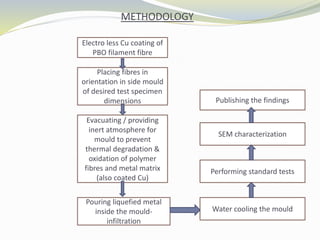
METHODOLOGY
Electro less Cu coating of
PBO filament fibre
Placing fibres in
orientation in side mould
of desired test specimen
dimensions
Evacuating / providing
inert atmosphere for
mould to prevent
thermal degradation &
oxidation of polymer
fibres and metal matrix
(also coated Cu)
Pouring liquefied metal
inside the mould-
infiltration
Water cooling the mould
Performing standard tests
SEM characterization
Publishing the findings
DESIGN CALCULATION
The property of composite material is given by,
PC = Vf Pf + Vmaterialmatrix Pmaterial matrix
The total volume is given by,
Vt =Vf + Vmaterial matrix
Then,
Vf= Vtf /Vt
Vmaterial matrix = Vtmaterial matrix /Vt
Here,
Vtf orVt material matrix = E / ρg
Where,
PC= Property of composite material,
Pf= Property of fiber,
Pmaterial matrix= Property of material matrix,
Vt = Total volume of composite material,
Vf = Volume of fiber,
Vmaterial matrix =Volume of material matrix,
Vtf= Total volume occupied by the fiber,
Vt material matrix = Total volume occupied by the material matrix,
E = Young’s modulus of the material as well as for fiber,
Ρ = Density of the material as well as for fiber,
G = Acceleration due to gravity.
COMPARISON OF ZYLON PROPERTIES WITH OTHER FIBERS:
FIBERS
TENSILE
STRENGTH (Gpa)
ELONGATION
%
MODULUS
(Gpa)
DENSITY
g/cm3
HEAT
RESISTANCE
In deg. C
ZYLON 5.8 3.5 180 1.54 650
STEEL
FIBER
2.8 1.8 200 7.8
POLYSTER 1.1 25 15 1.38 260
AL-MG EQUILIBRIUM DIAGRAM:
NEED FOR MAKING THE EUTECTIC (Al-Mg) ALLOY
The melting point of the fibre (zylon) is 650C and the temperature of the
alloy should not exceed 500C, if it does so then the fibre will undergo
thermal degradation.
According to the al-mg equilibrium diagram (shown in the previous slide) it
has been confirmed that the temperature of the eutectic alloy will not
exceed 500C.That is why this eutectic (al-mg) alloy has been selected.
MECHANICAL PROPERTIES:
ALUMINIUM
TEST CONDUCTED READING
YOUNG’ MODULUS (Gpa) 70
YIELD STRENGTH (Mpa) 18
ULTIMATE TENSILE STRENGTH (Mpa) 45
BRINELL HARDNESS 109.33
THANK YOU… 

FINAL REVIEW

  • 2.
    DESIGN AND DEVELOPMENTOF METAL REINFORCED FIBRE COMPOSITES
  • 3.
    PROJECT MEMBERS : RAJESH.L. (10109114043) MOHAMMED ABDUL BAAQI (10109114305) EDWIN RAJ (10109114301) KALANDAR BASEER ALI (10109114021) PROJECT GUIDE : PROJECT CO-ORDINATOR: Dr. MOHD.F. SHABIR Dr. S. SATHISH
  • 4.
    ABSTRACT The word COMPOSITESmeans composition of materials are engineered or naturally occurring materials made from two or more constituent materials with significantly different physical and chemical properties which remains separate and distinct at the macroscopic or microscopic within the finished structure.
  • 5.
    PROBLEM DEFINITION To design,fabricate and conduct a mechanical characterization of a new hybrid (PBO reinforced al-mg eutectic alloy) composite that has the following properties like; 1. High ultimate tensile strength 2. High young’s modulus 3. Low density 4. High specific strength 5. High stiffness 6. Fracture toughness 7. High impact strength 8. High hardness Constraints: temperature and oxygen presence Variables: cooling rate, volume factor. Beyond the scope: interface and inter phase studies, cooling rate.
  • 6.
    OBJECTIVES Objectives: To fabricatea new metal reinforced polymer composites most specifically a higher modulus PBO fibre reinforced aluminium magnesium eutectic alloy metal matrix composites by vacuum liquid metal melt infiltration technique and investigate the mechanical characteristics of the PBO reinforced al-mg alloy MMC. Some important objectives: 1. To obtain a unidirectional polymer reinforced MMC. 2. To obtain a lower specific weight PRMMC than MM alone. 3. To obtain a higher specific tensile modulus PRMMC than MM alone. 4. To obtain a higher specific tensile strength PRMMC than MM alone. 5. To obtain a higher fracture toughness PRMMC than MM alone. 6. To obtain a higher impact toughness PRMMC than MM alone. 7. To obtain a higher damage tolerance PRMMC than MM alone. 8. To obtain the bonding nature of PBO fibre and MM. 9. To obtain the thermal degradation in the properties of PRMMC. 10.To obtain the low cost production.
  • 7.
    SCOPE OF RESEARCH Scopeis limited to metal matrix composites reinforced with high performance polymer fibres that are produced by infiltration technique. The scope is also limited in improving some of the mechanical properties so as to enable it to be used for light weight high performance applications.
  • 8.
    METHODOLOGY Electro less Cucoating of PBO filament fibre Placing fibres in orientation in side mould of desired test specimen dimensions Evacuating / providing inert atmosphere for mould to prevent thermal degradation & oxidation of polymer fibres and metal matrix (also coated Cu) Pouring liquefied metal inside the mould- infiltration Water cooling the mould Performing standard tests SEM characterization Publishing the findings
  • 9.
    DESIGN CALCULATION The propertyof composite material is given by, PC = Vf Pf + Vmaterialmatrix Pmaterial matrix The total volume is given by, Vt =Vf + Vmaterial matrix Then, Vf= Vtf /Vt Vmaterial matrix = Vtmaterial matrix /Vt Here, Vtf orVt material matrix = E / ρg Where, PC= Property of composite material, Pf= Property of fiber, Pmaterial matrix= Property of material matrix, Vt = Total volume of composite material, Vf = Volume of fiber, Vmaterial matrix =Volume of material matrix, Vtf= Total volume occupied by the fiber, Vt material matrix = Total volume occupied by the material matrix, E = Young’s modulus of the material as well as for fiber, Ρ = Density of the material as well as for fiber, G = Acceleration due to gravity.
  • 10.
    COMPARISON OF ZYLONPROPERTIES WITH OTHER FIBERS: FIBERS TENSILE STRENGTH (Gpa) ELONGATION % MODULUS (Gpa) DENSITY g/cm3 HEAT RESISTANCE In deg. C ZYLON 5.8 3.5 180 1.54 650 STEEL FIBER 2.8 1.8 200 7.8 POLYSTER 1.1 25 15 1.38 260
  • 11.
  • 12.
    NEED FOR MAKINGTHE EUTECTIC (Al-Mg) ALLOY The melting point of the fibre (zylon) is 650C and the temperature of the alloy should not exceed 500C, if it does so then the fibre will undergo thermal degradation. According to the al-mg equilibrium diagram (shown in the previous slide) it has been confirmed that the temperature of the eutectic alloy will not exceed 500C.That is why this eutectic (al-mg) alloy has been selected.
  • 14.
    MECHANICAL PROPERTIES: ALUMINIUM TEST CONDUCTEDREADING YOUNG’ MODULUS (Gpa) 70 YIELD STRENGTH (Mpa) 18 ULTIMATE TENSILE STRENGTH (Mpa) 45 BRINELL HARDNESS 109.33
  • 17.