MODERN HOME AUTOMATION CONTROL BY USING
TOUCHLESS HAND GESTURE
MOTION TECHNOLOGY
BATCH NO:10
PRESENTED BY GUIDED BY
R.ELAMATHI(731811106015) Mr. M.UDHAYAKUMAR M.E.,
R.ENIYA(731811106017) Assistant Professor,
K.JEEVANANDAM(731811106031) Department of ECE
M.KAMALA KANNAN (731811106037)
MAHARAJA ENGINEERING
COLLEGE,AVINASHI
DEPARTMENT OF ELECTRONICS AND COMMUNICATION
ENGINEERING
OBJECTIVE
•To control the home appliances with ease from their place
itself by using touchless hand gesture technology.
•It mainly focus the disabled persons to control the
electronic devices without moving.
•For Ex: Electronic device such as light,fan and its
speed,TV,etc...can be easily controlled.
ABSTRACT
•To creating the ideal smart homes environment.
• Special attention for elderly person, sick patients, and
handicapped person.
• Touchless hand gesture motion is used as command for
controlling the devices.
• Recognizes movement of the hand motion from one
direction to another with help of Gest IC MGC3130.
CONT…
• MGC3130-3D gesture recognition and tracking
controller chip.
• It has one transmit and five very sensitive receive
channels of electrodes.
• It is capable to detect distortions of a transmitted
electrical field corresponding to capacitive changes.
• Spatial arrangement of the electrodes allows the chip to
determine the center of gravity of the electric field
distortion. Finally it triggers the relay for the output.
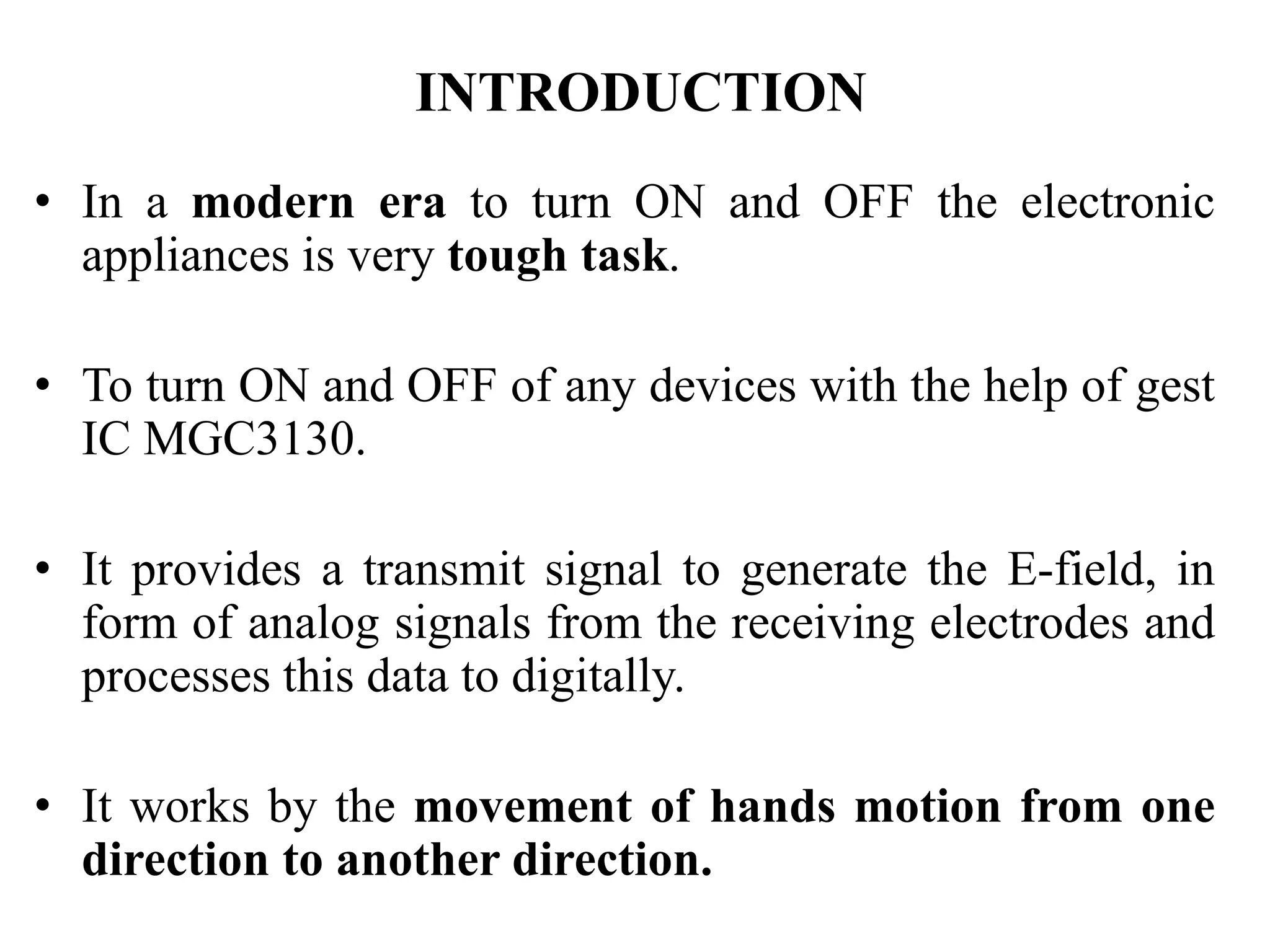
INTRODUCTION
• In a modern era to turn ON and OFF the electronic
appliances is very tough task.
• To turn ON and OFF of any devices with the help of gest
IC MGC3130.
• It provides a transmit signal to generate the E-field, in
form of analog signals from the receiving electrodes and
processes this data to digitally.
• It works by the movement of hands motion from one
direction to another direction.
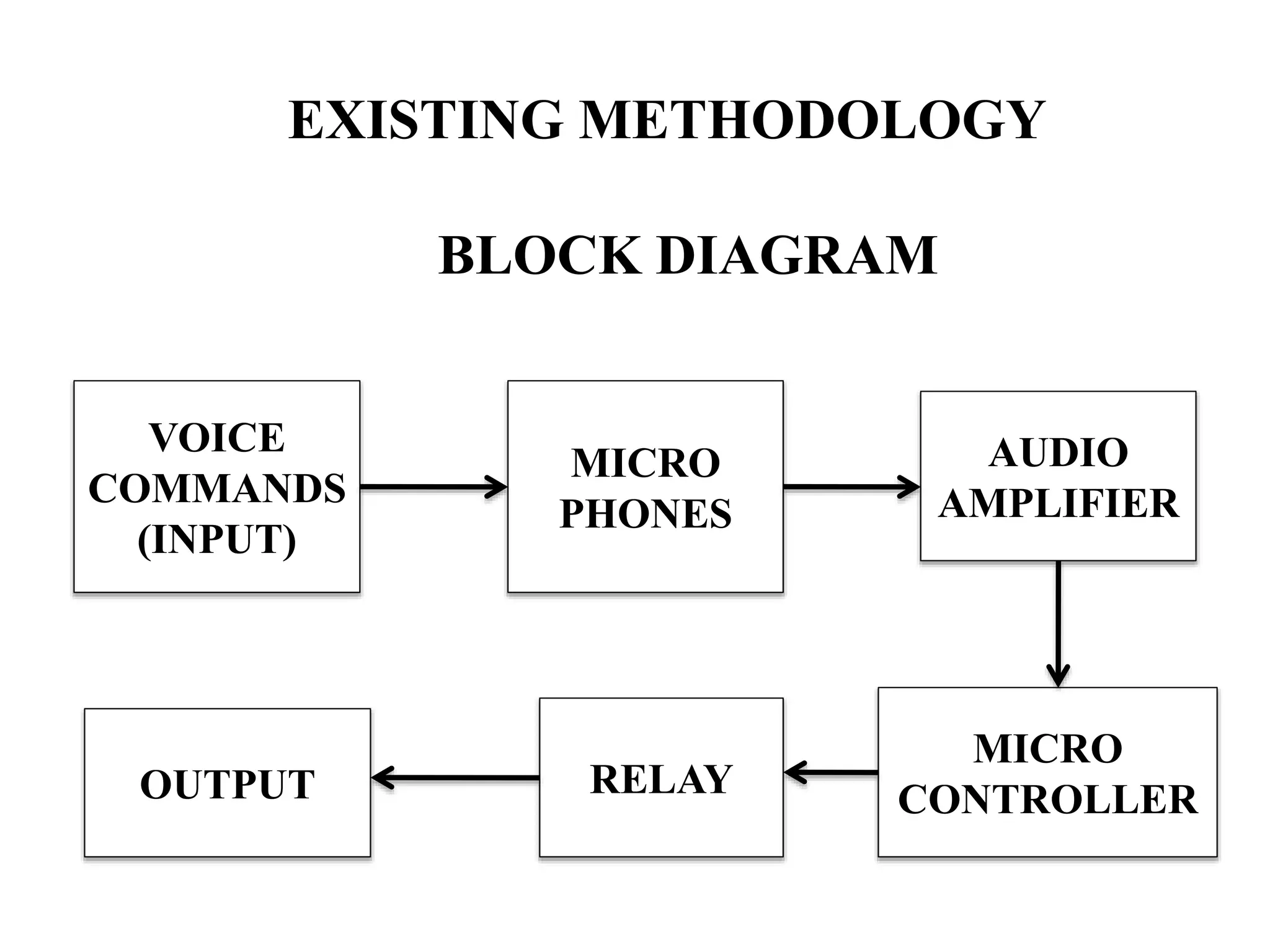
EXISTING METHODOLOGY
BLOCK DIAGRAM
MICRO
PHONES
AUDIO
AMPLIFIER
VOICE
COMMANDS
(INPUT)
MICRO
CONTROLLERRELAYOUTPUT
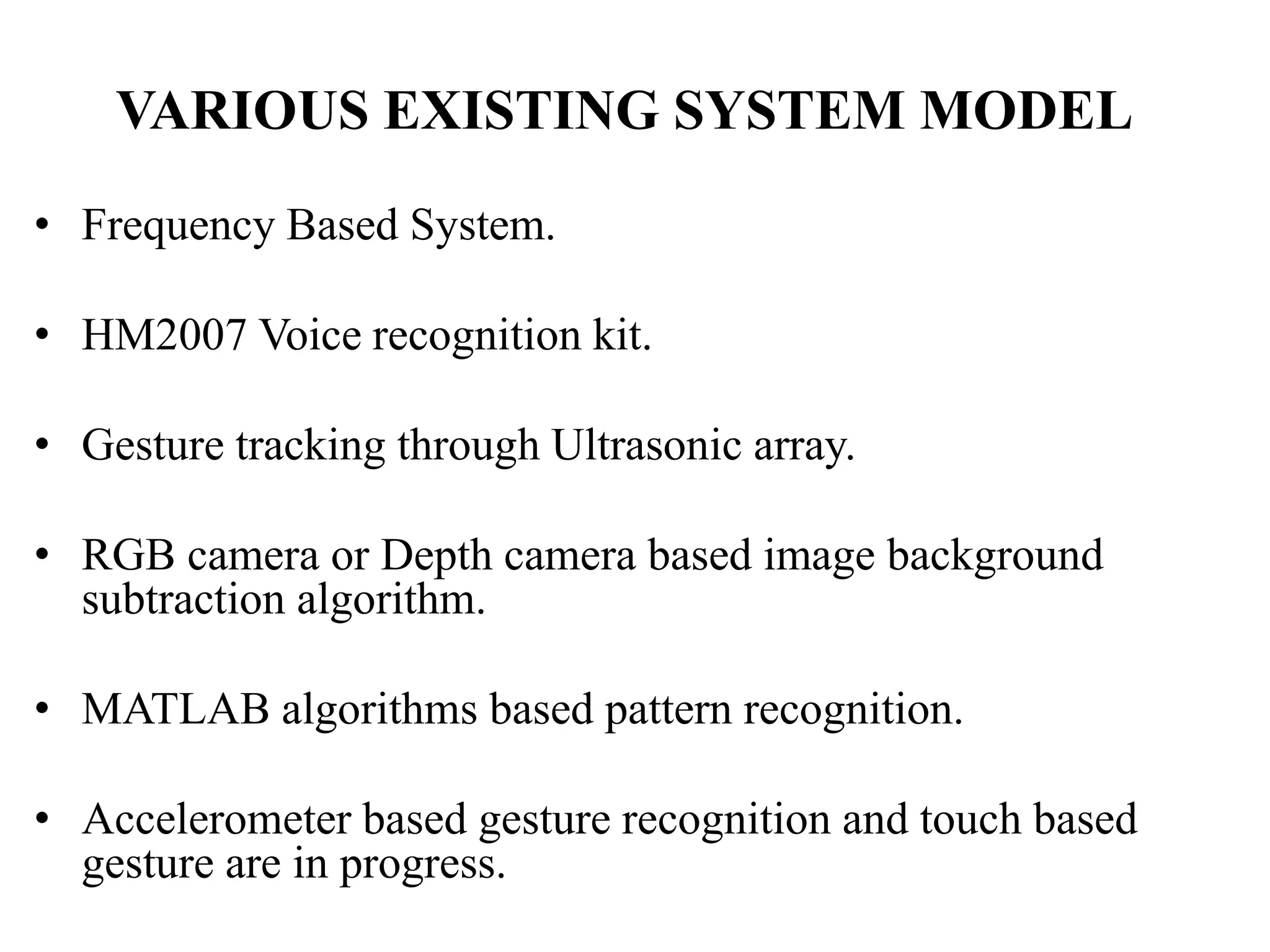
VARIOUS EXISTING SYSTEM MODEL
• Frequency Based System.
• HM2007 Voice recognition kit.
• Gesture tracking through Ultrasonic array.
• RGB camera or Depth camera based image background
subtraction algorithm.
• MATLAB algorithms based pattern recognition.
• Accelerometer based gesture recognition and touch based
gesture are in progress.
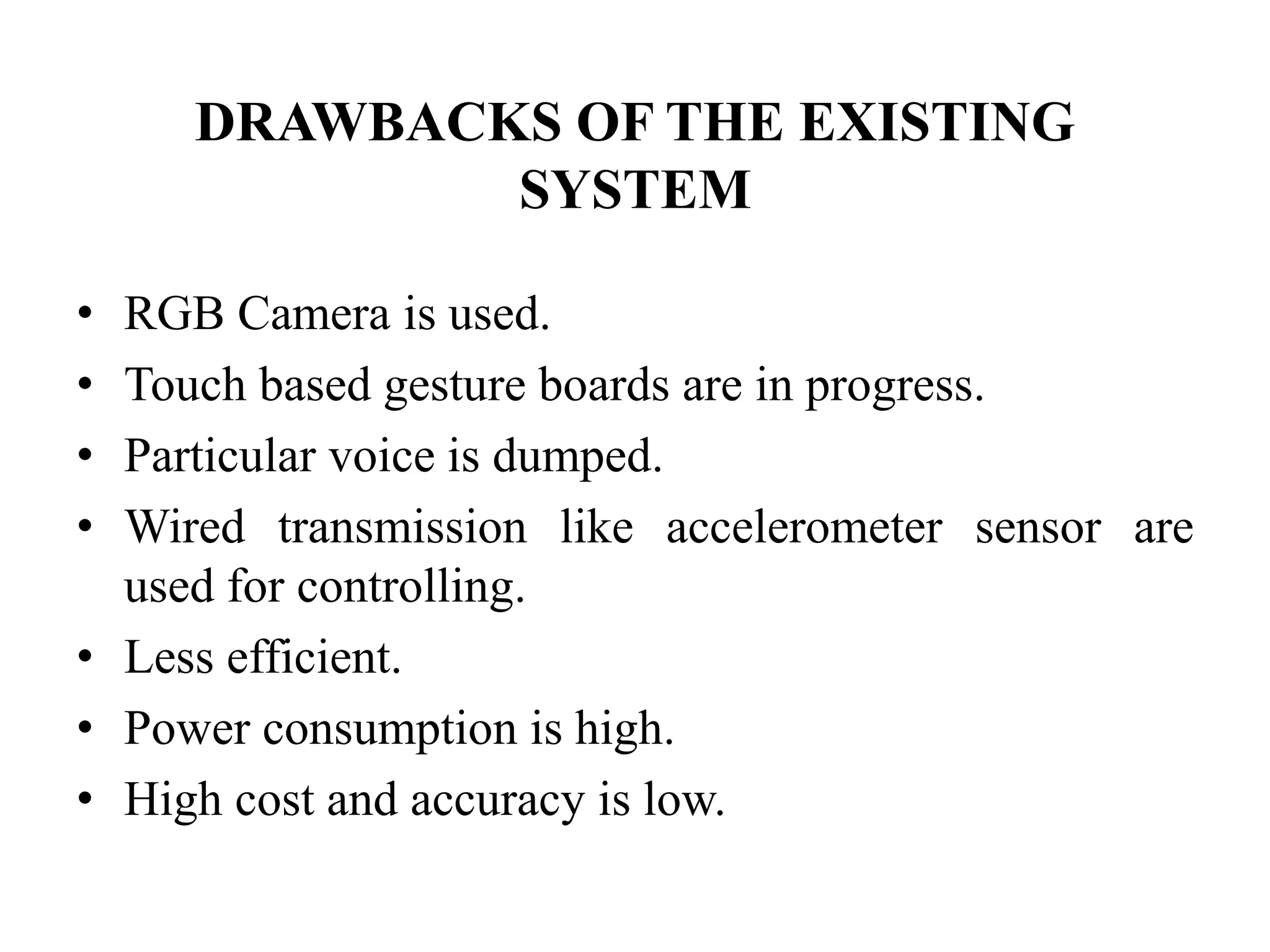
DRAWBACKS OF THE EXISTING
SYSTEM
• RGB Camera is used.
• Touch based gesture boards are in progress.
• Particular voice is dumped.
• Wired transmission like accelerometer sensor are
used for controlling.
• Less efficient.
• Power consumption is high.
• High cost and accuracy is low.
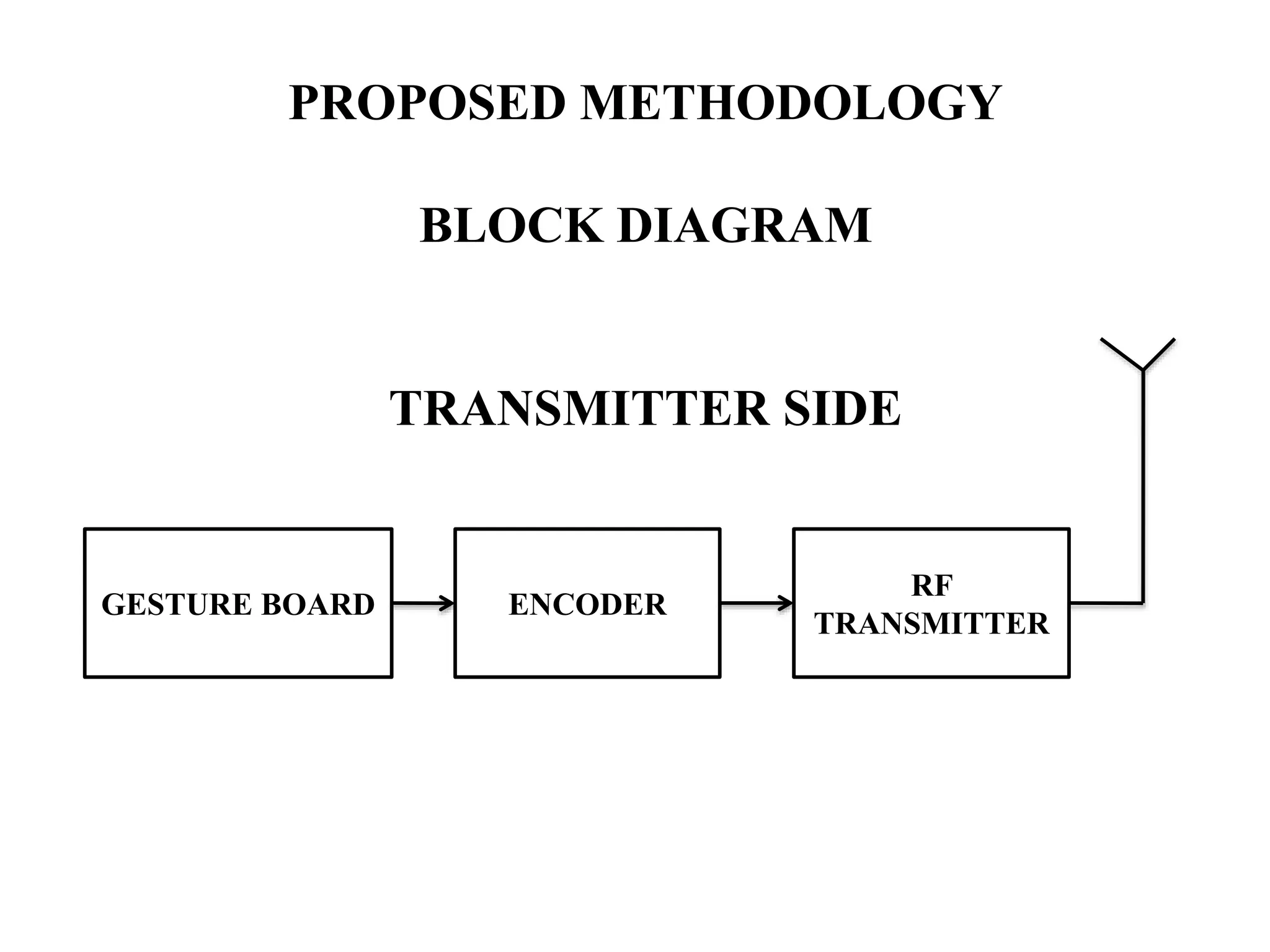
PROPOSED METHODOLOGY
BLOCK DIAGRAM
TRANSMITTER SIDE
GESTURE BOARD ENCODER
RF
TRANSMITTER
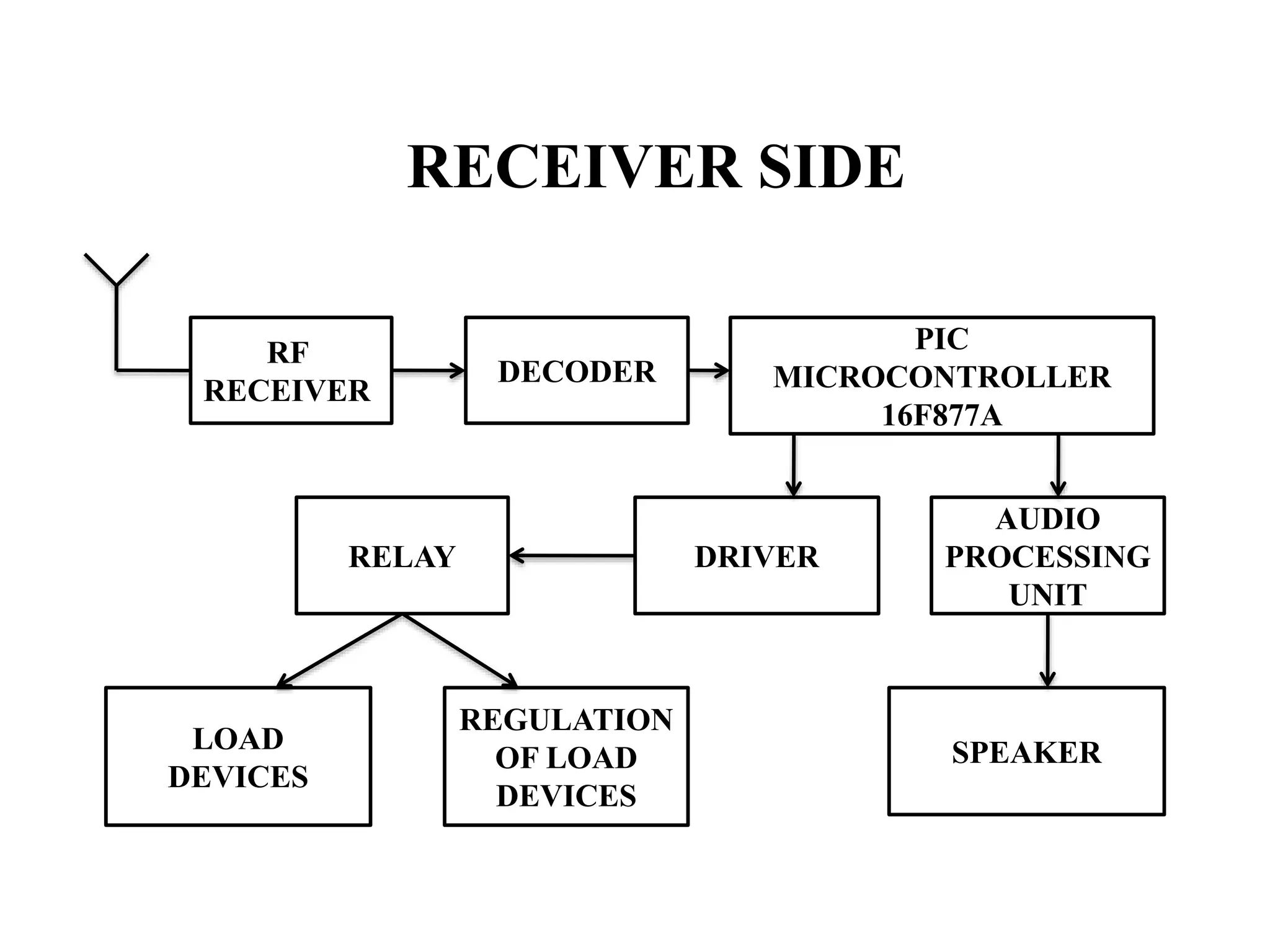
RECEIVER SIDE
RF
RECEIVER
DECODER
PIC
MICROCONTROLLER
16F877A
RELAY DRIVER
AUDIO
PROCESSING
UNIT
LOAD
DEVICES
REGULATION
OF LOAD
DEVICES
SPEAKER
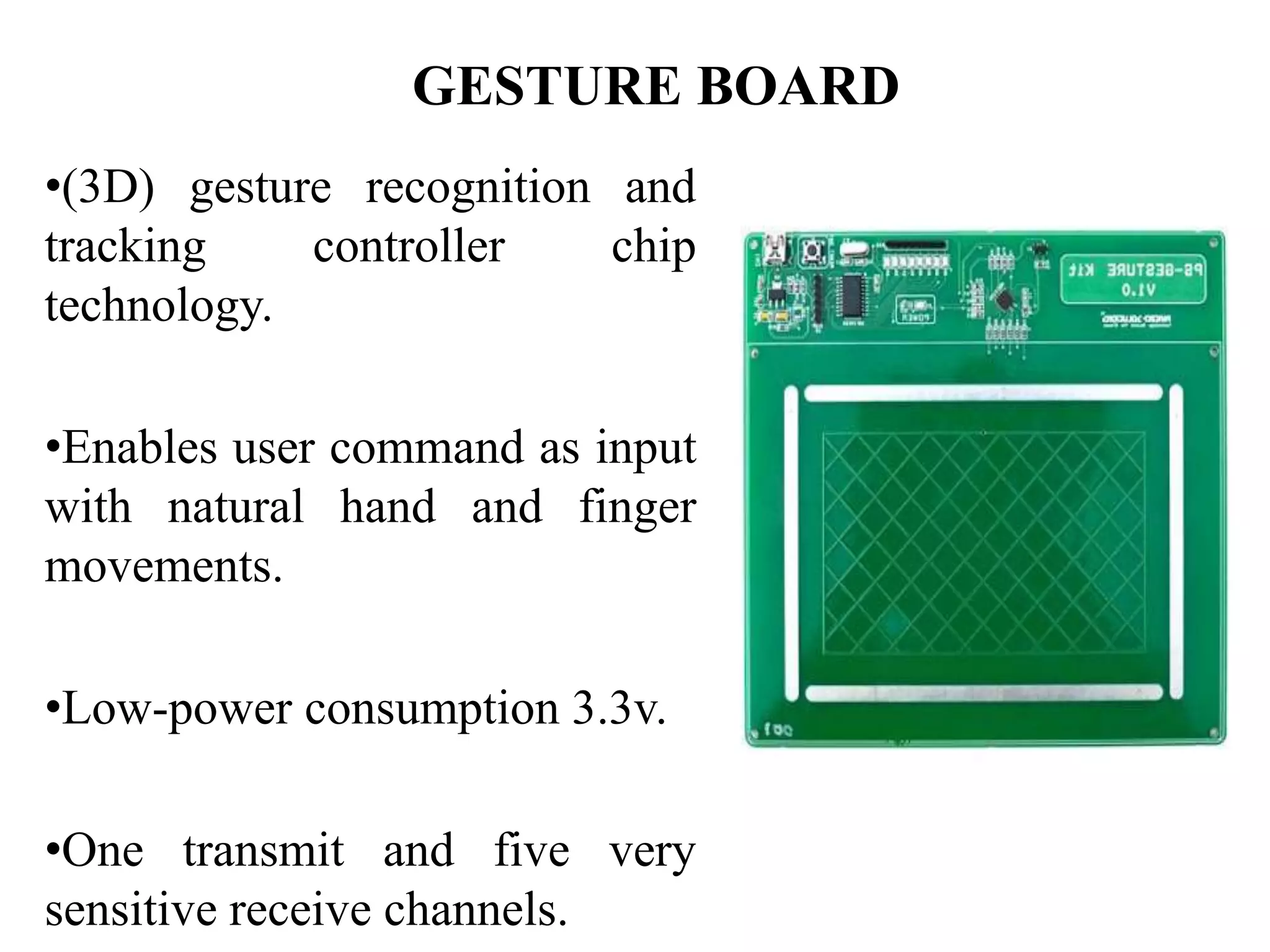
GESTURE BOARD
•(3D) gesture recognition and
tracking controller chip
technology.
•Enables user command as input
with natural hand and finger
movements.
•Low-power consumption 3.3v.
•One transmit and five very
sensitive receive channels.
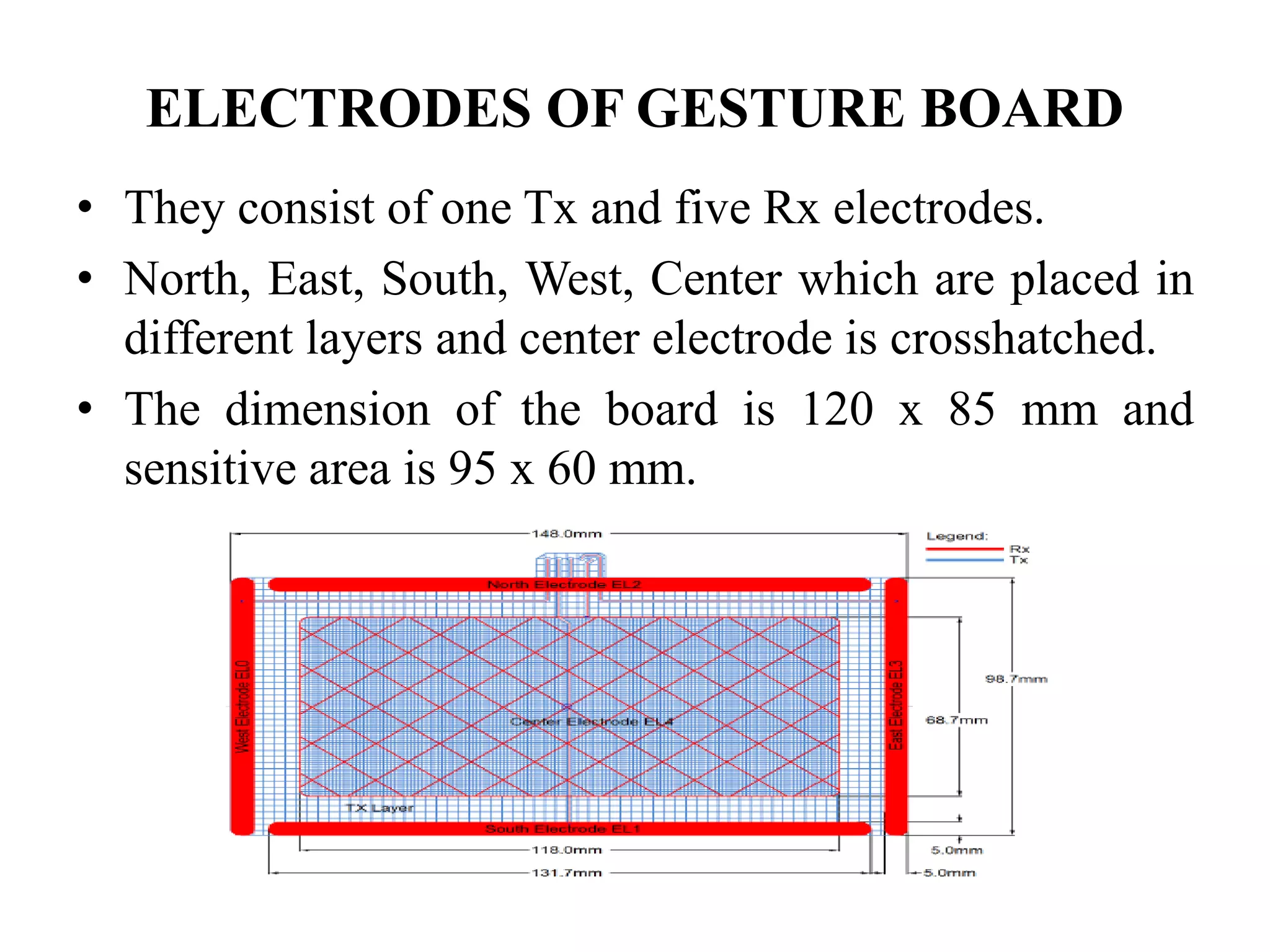
ELECTRODES OF GESTURE BOARD
• They consist of one Tx and five Rx electrodes.
• North, East, South, West, Center which are placed in
different layers and center electrode is crosshatched.
• The dimension of the board is 120 x 85 mm and
sensitive area is 95 x 60 mm.
OPERATION OF THE BOARD
• 3D sensor technology utilizes an electric field for
advanced proximity sensing.
• E-fields are generated by electrical charges and
propagate 3D around the surface.
• Transmit frequencies range-100 kHz which reflects a
wavelength of about 3km.
• Four receiver electrodes to detect the E-field variations
at different positions.
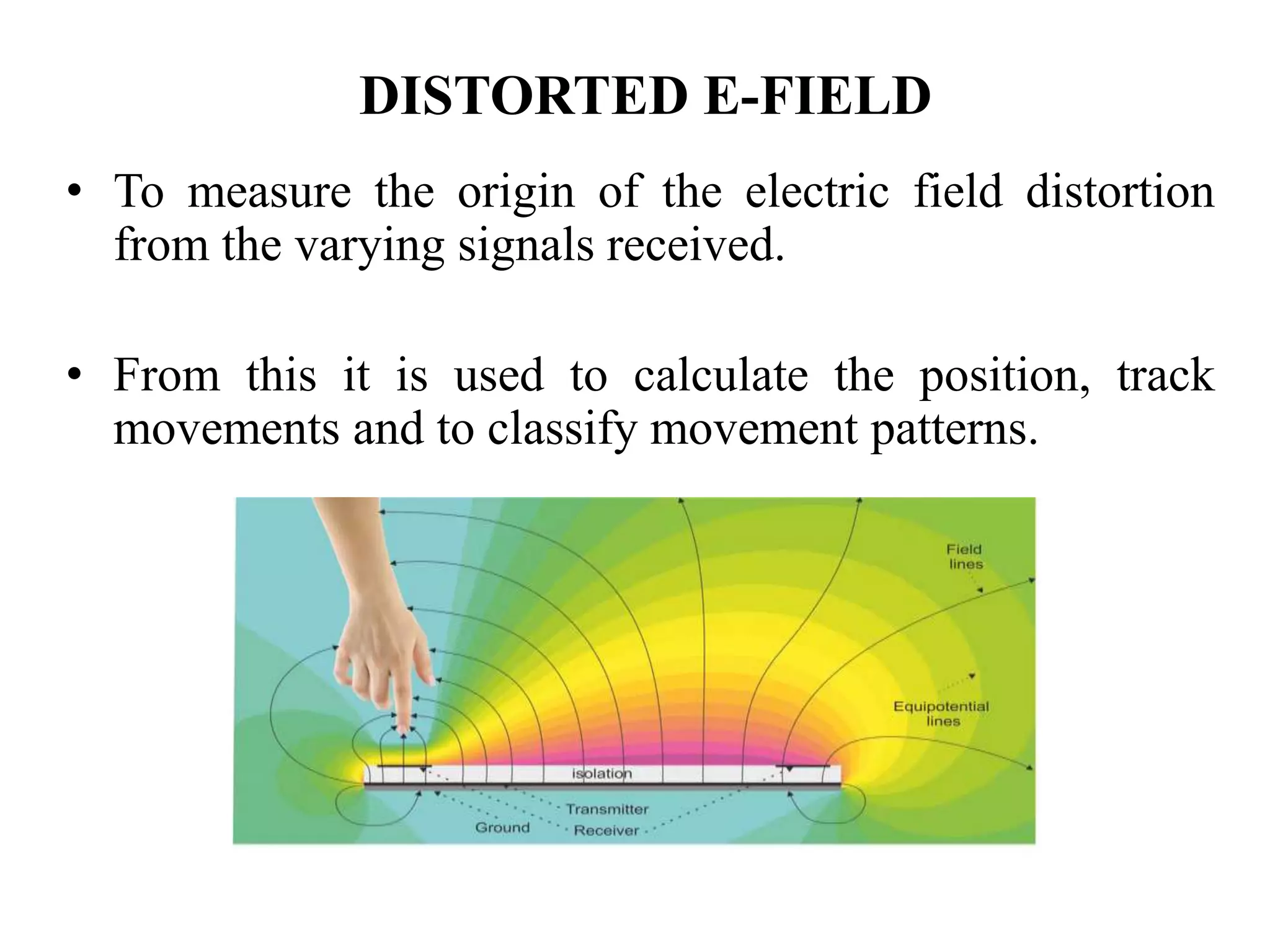
DISTORTED E-FIELD
• To measure the origin of the electric field distortion
from the varying signals received.
• From this it is used to calculate the position, track
movements and to classify movement patterns.
PIC MICROCONTROLLER
(PIC16F877A)
• Fully static design.
• Wide operating voltage range (2.0V to 5.5V).
• 100,000 erase/write cycle Enhanced Flash.
• Serial Programming.
• Easily Programmable.
• Low cost.
• Power saving mode.
• Selectable oscillator options.
• Low-power, high-speed Flash/EEPROM technology.
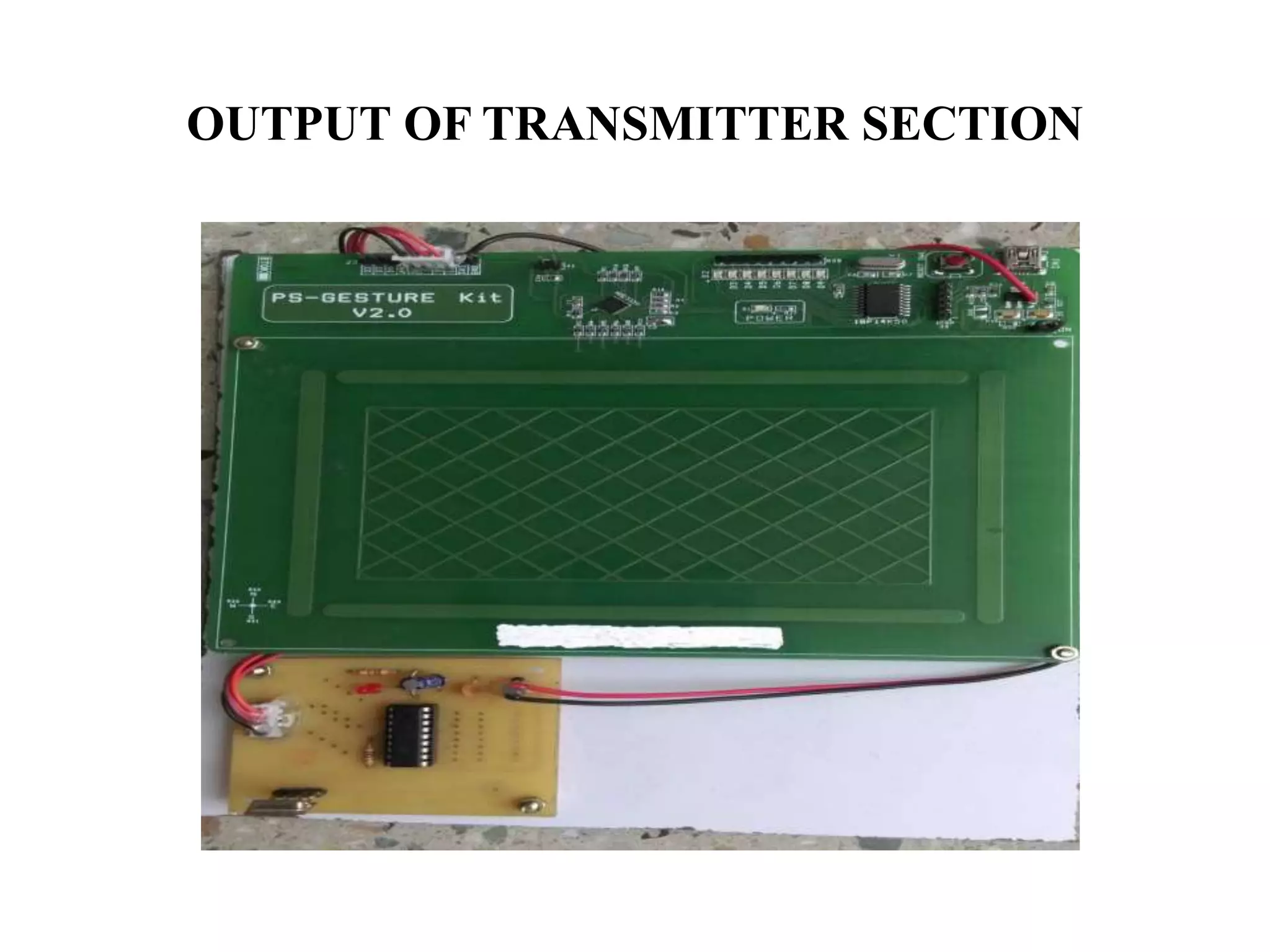
OUTPUT OF TRANSMITTER SECTION
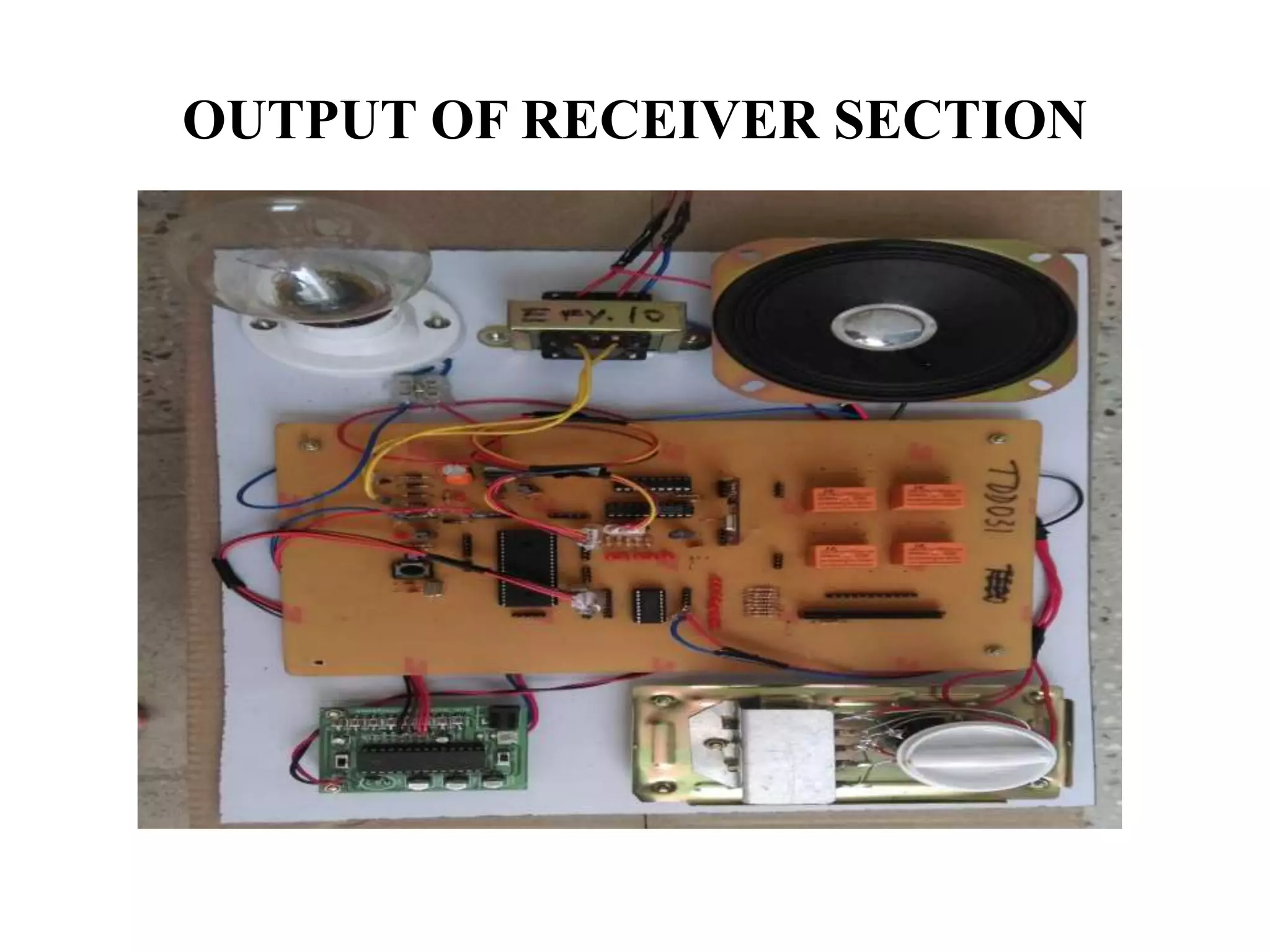
OUTPUT OF RECEIVER SECTION
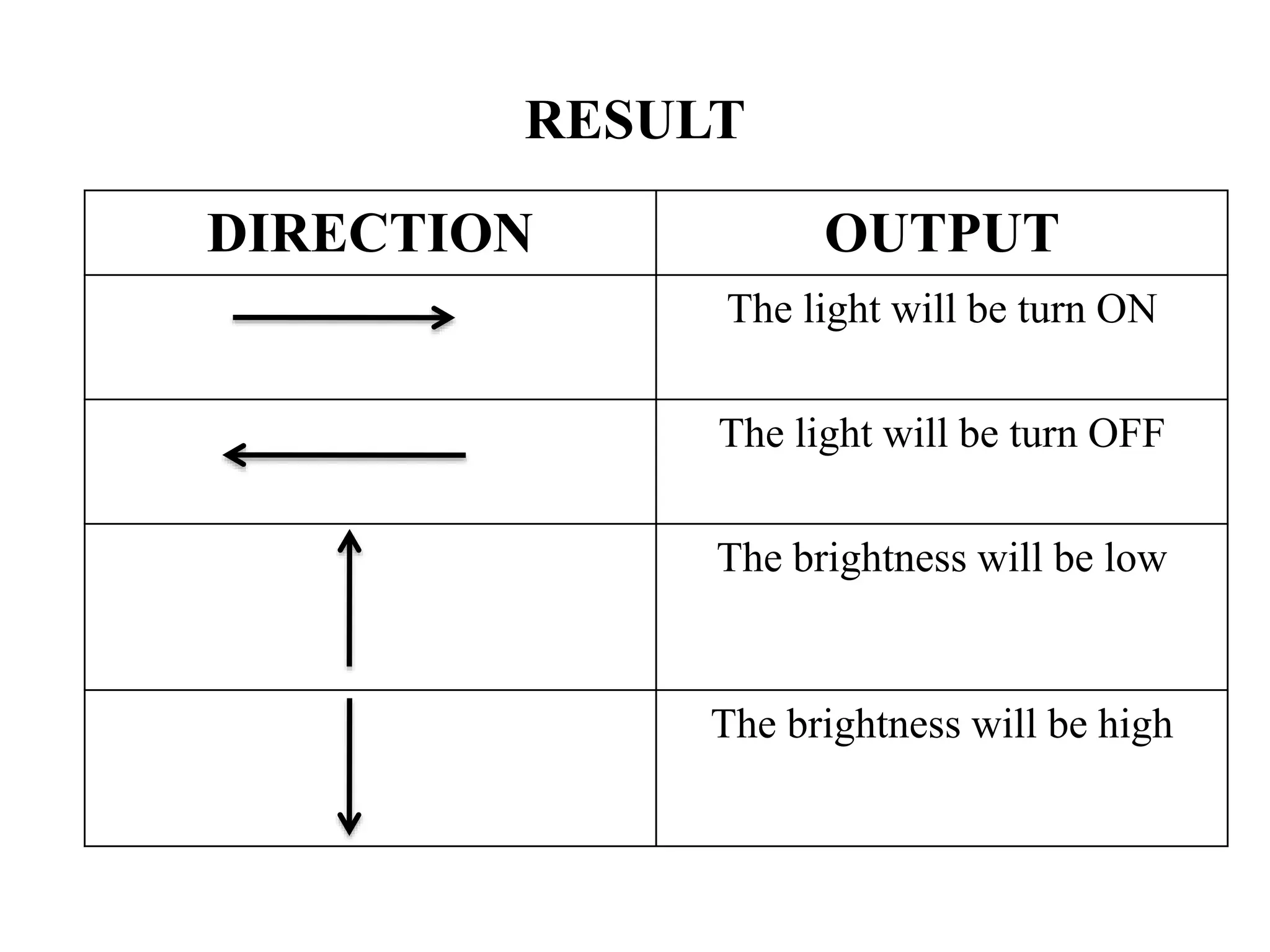
RESULT
DIRECTION OUTPUT
The light will be turn ON
The light will be turn OFF
The brightness will be low
The brightness will be high
ADVANTAGES
• Free hand motion and touchless board.
• No wired transmission.
• No cameras and accelerometer sensors.
• Low cost and high performance.
• Low power consumption.
• Compact and ease of handling.
• High immunity to noise.
• Highly flexible.
• High accuracy and portable.
• No complexity.
APPLICATIONS
• Useful for physically challenged person.
• Higher authority persons can control the whole unit from
the place itself.
• Used for controlling the Robots for detecting the object.
• Notebooks/PC Peripherals.
• Electronic Readers and Game Controllers.
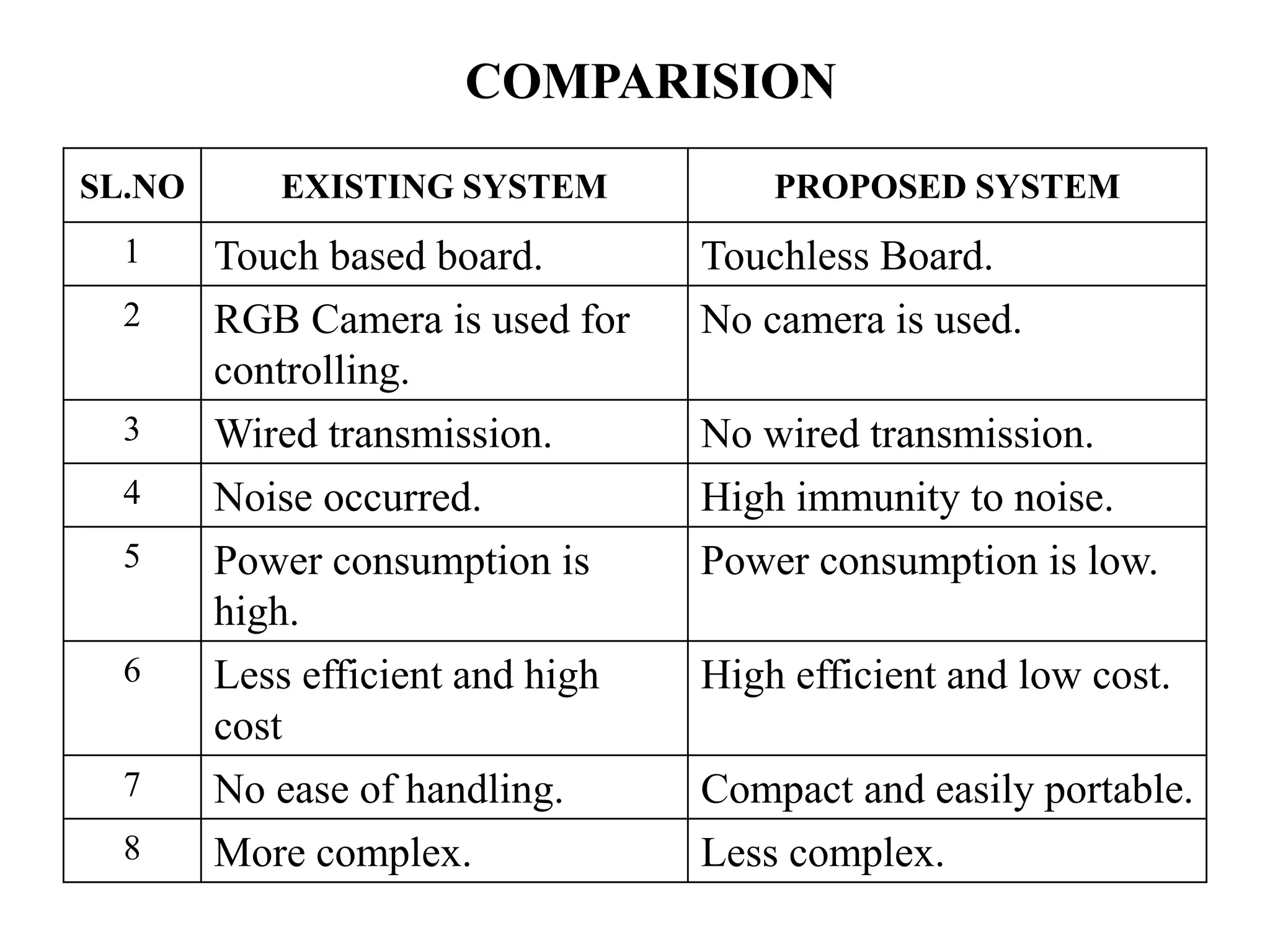
COMPARISION
SL.NO EXISTING SYSTEM PROPOSED SYSTEM
1 Touch based board. Touchless Board.
2 RGB Camera is used for
controlling.
No camera is used.
3 Wired transmission. No wired transmission.
4 Noise occurred. High immunity to noise.
5 Power consumption is
high.
Power consumption is low.
6 Less efficient and high
cost
High efficient and low cost.
7 No ease of handling. Compact and easily portable.
8 More complex. Less complex.
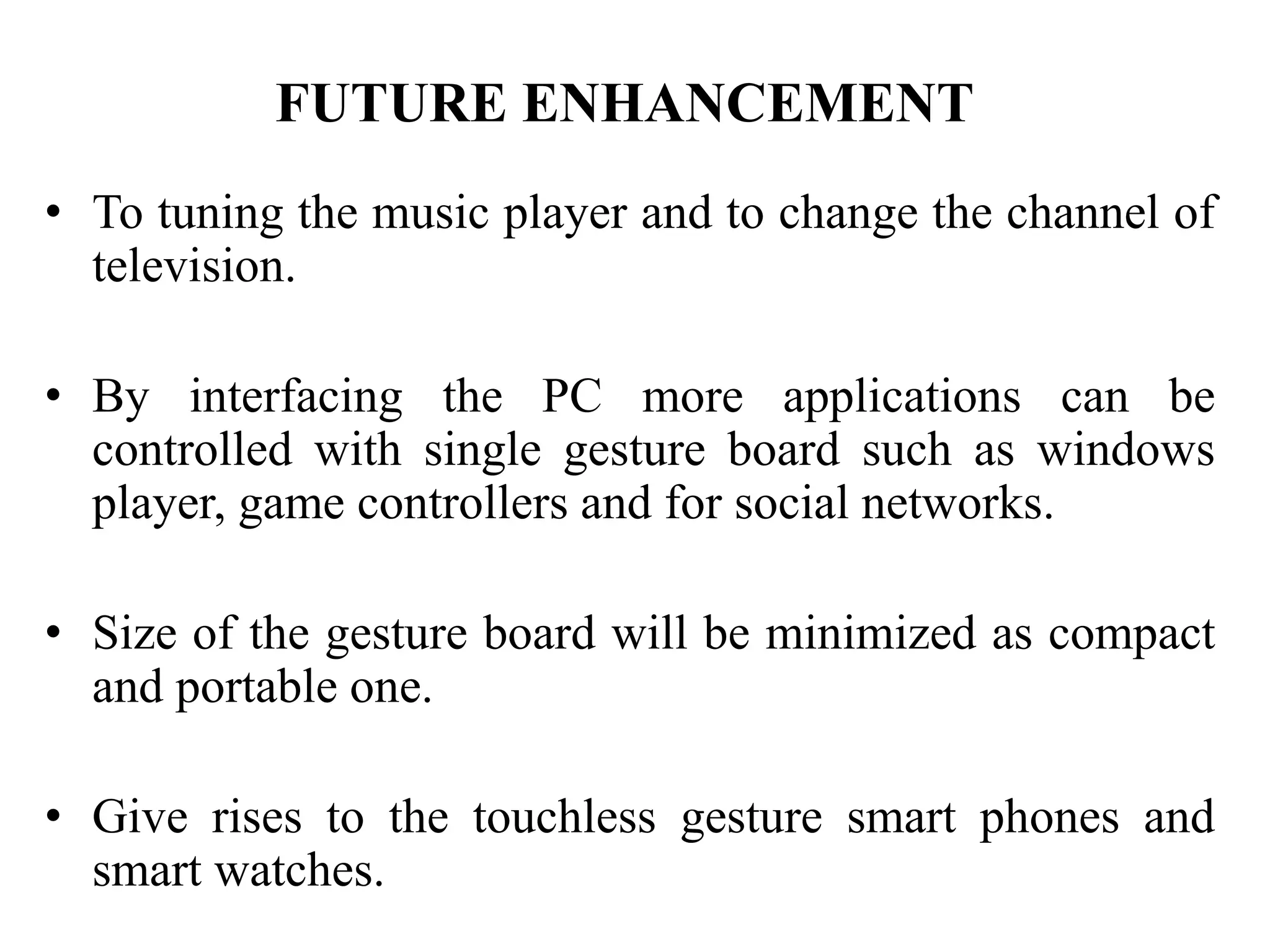
FUTURE ENHANCEMENT
• To tuning the music player and to change the channel of
television.
• By interfacing the PC more applications can be
controlled with single gesture board such as windows
player, game controllers and for social networks.
• Size of the gesture board will be minimized as compact
and portable one.
• Give rises to the touchless gesture smart phones and
smart watches.
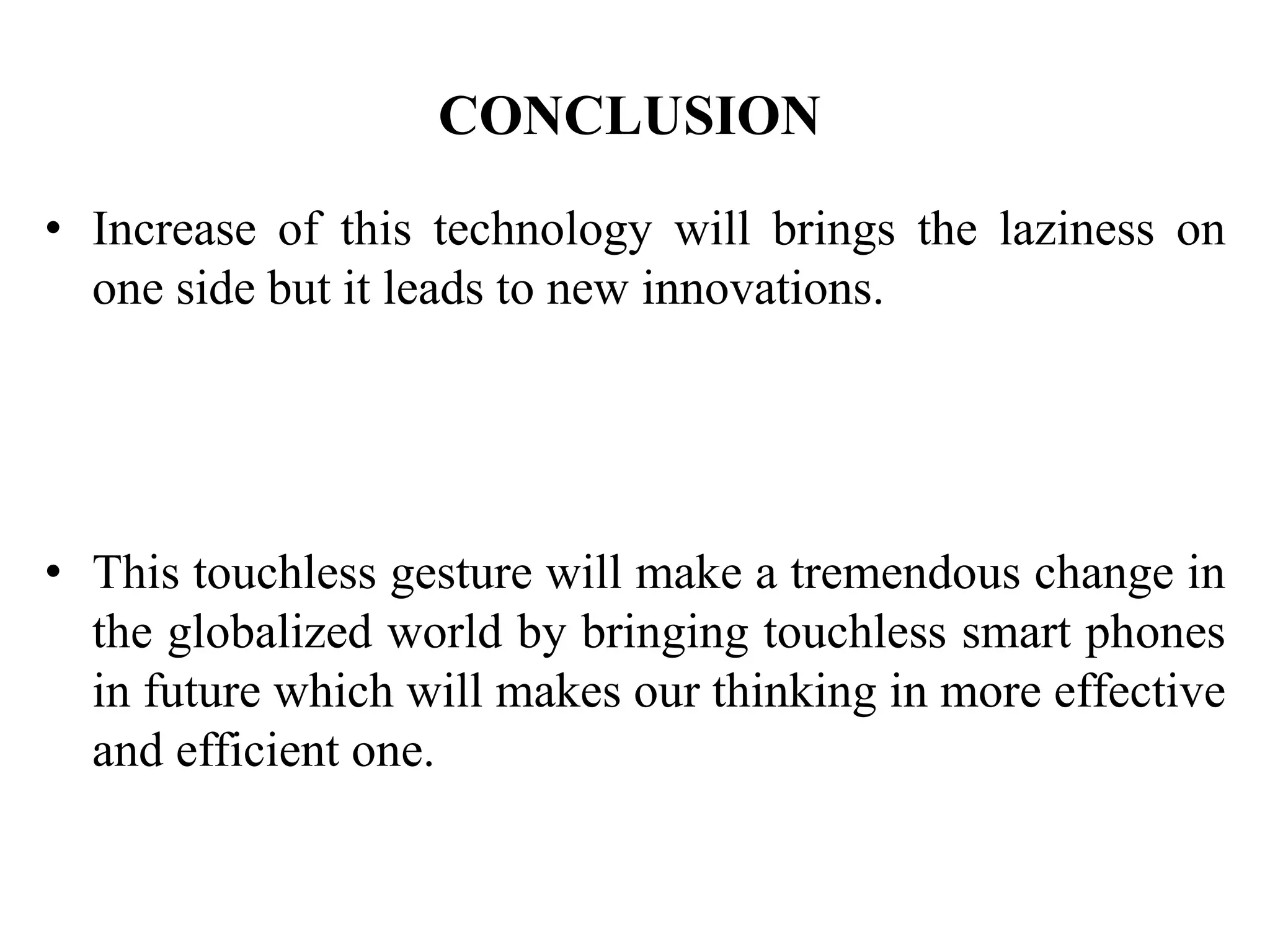
CONCLUSION
• Increase of this technology will brings the laziness on
one side but it leads to new innovations.
• This touchless gesture will make a tremendous change in
the globalized world by bringing touchless smart phones
in future which will makes our thinking in more effective
and efficient one.
REFERENCES
• Mirabella.O, Brischetto.M, Mastroeni.G,(2010)”MEMS based
gesture recognition”.
• I. S. Mackenzie and W. Buxton, "Extending fitts' law to
twodimensional tasks," in Proceedings of CHI'92, pp. 219-226,
May 1992.
• S. K. Kim, G. H. Park, S. H. Yim, S. M. Choi, and S. J. Choi,
“Gesture recognizing hand-held interface with vibrotactile
feedback for 3D interaction,” IEEE Trans. Consumer Electronics,
vol. 55, no. 3, pp.1169-1177, Aug. 2009.
• H. Heo, E. C. Lee, K. R. Park, C. J. Kim, and M. C. Whang, “A
realistic game system using multi-modal user interfaces,” IEEE
Trans. Consumer Electronics, vol. 56, no. 3, pp. 1364-1372, Aug.
2010.
• Ki-cheol son, Jong-yeol lee,(2011)”The methods of android
application speed up by using NDK”.
THANK YOU !!

FINAL REVIEW

  • 1.
    MODERN HOME AUTOMATIONCONTROL BY USING TOUCHLESS HAND GESTURE MOTION TECHNOLOGY BATCH NO:10 PRESENTED BY GUIDED BY R.ELAMATHI(731811106015) Mr. M.UDHAYAKUMAR M.E., R.ENIYA(731811106017) Assistant Professor, K.JEEVANANDAM(731811106031) Department of ECE M.KAMALA KANNAN (731811106037) MAHARAJA ENGINEERING COLLEGE,AVINASHI DEPARTMENT OF ELECTRONICS AND COMMUNICATION ENGINEERING
  • 2.
    OBJECTIVE •To control thehome appliances with ease from their place itself by using touchless hand gesture technology. •It mainly focus the disabled persons to control the electronic devices without moving. •For Ex: Electronic device such as light,fan and its speed,TV,etc...can be easily controlled.
  • 3.
    ABSTRACT •To creating theideal smart homes environment. • Special attention for elderly person, sick patients, and handicapped person. • Touchless hand gesture motion is used as command for controlling the devices. • Recognizes movement of the hand motion from one direction to another with help of Gest IC MGC3130.
  • 4.
    CONT… • MGC3130-3D gesturerecognition and tracking controller chip. • It has one transmit and five very sensitive receive channels of electrodes. • It is capable to detect distortions of a transmitted electrical field corresponding to capacitive changes. • Spatial arrangement of the electrodes allows the chip to determine the center of gravity of the electric field distortion. Finally it triggers the relay for the output.
  • 5.
    INTRODUCTION • In amodern era to turn ON and OFF the electronic appliances is very tough task. • To turn ON and OFF of any devices with the help of gest IC MGC3130. • It provides a transmit signal to generate the E-field, in form of analog signals from the receiving electrodes and processes this data to digitally. • It works by the movement of hands motion from one direction to another direction.
  • 6.
  • 7.
    VARIOUS EXISTING SYSTEMMODEL • Frequency Based System. • HM2007 Voice recognition kit. • Gesture tracking through Ultrasonic array. • RGB camera or Depth camera based image background subtraction algorithm. • MATLAB algorithms based pattern recognition. • Accelerometer based gesture recognition and touch based gesture are in progress.
  • 8.
    DRAWBACKS OF THEEXISTING SYSTEM • RGB Camera is used. • Touch based gesture boards are in progress. • Particular voice is dumped. • Wired transmission like accelerometer sensor are used for controlling. • Less efficient. • Power consumption is high. • High cost and accuracy is low.
  • 9.
    PROPOSED METHODOLOGY BLOCK DIAGRAM TRANSMITTERSIDE GESTURE BOARD ENCODER RF TRANSMITTER
  • 10.
  • 11.
    GESTURE BOARD •(3D) gesturerecognition and tracking controller chip technology. •Enables user command as input with natural hand and finger movements. •Low-power consumption 3.3v. •One transmit and five very sensitive receive channels.
  • 12.
    ELECTRODES OF GESTUREBOARD • They consist of one Tx and five Rx electrodes. • North, East, South, West, Center which are placed in different layers and center electrode is crosshatched. • The dimension of the board is 120 x 85 mm and sensitive area is 95 x 60 mm.
  • 13.
    OPERATION OF THEBOARD • 3D sensor technology utilizes an electric field for advanced proximity sensing. • E-fields are generated by electrical charges and propagate 3D around the surface. • Transmit frequencies range-100 kHz which reflects a wavelength of about 3km. • Four receiver electrodes to detect the E-field variations at different positions.
  • 14.
    DISTORTED E-FIELD • Tomeasure the origin of the electric field distortion from the varying signals received. • From this it is used to calculate the position, track movements and to classify movement patterns.
  • 15.
    PIC MICROCONTROLLER (PIC16F877A) • Fullystatic design. • Wide operating voltage range (2.0V to 5.5V). • 100,000 erase/write cycle Enhanced Flash. • Serial Programming. • Easily Programmable. • Low cost. • Power saving mode. • Selectable oscillator options. • Low-power, high-speed Flash/EEPROM technology.
  • 16.
  • 17.
  • 18.
    RESULT DIRECTION OUTPUT The lightwill be turn ON The light will be turn OFF The brightness will be low The brightness will be high
  • 19.
    ADVANTAGES • Free handmotion and touchless board. • No wired transmission. • No cameras and accelerometer sensors. • Low cost and high performance. • Low power consumption. • Compact and ease of handling. • High immunity to noise. • Highly flexible. • High accuracy and portable. • No complexity.
  • 20.
    APPLICATIONS • Useful forphysically challenged person. • Higher authority persons can control the whole unit from the place itself. • Used for controlling the Robots for detecting the object. • Notebooks/PC Peripherals. • Electronic Readers and Game Controllers.
  • 21.
    COMPARISION SL.NO EXISTING SYSTEMPROPOSED SYSTEM 1 Touch based board. Touchless Board. 2 RGB Camera is used for controlling. No camera is used. 3 Wired transmission. No wired transmission. 4 Noise occurred. High immunity to noise. 5 Power consumption is high. Power consumption is low. 6 Less efficient and high cost High efficient and low cost. 7 No ease of handling. Compact and easily portable. 8 More complex. Less complex.
  • 22.
    FUTURE ENHANCEMENT • Totuning the music player and to change the channel of television. • By interfacing the PC more applications can be controlled with single gesture board such as windows player, game controllers and for social networks. • Size of the gesture board will be minimized as compact and portable one. • Give rises to the touchless gesture smart phones and smart watches.
  • 23.
    CONCLUSION • Increase ofthis technology will brings the laziness on one side but it leads to new innovations. • This touchless gesture will make a tremendous change in the globalized world by bringing touchless smart phones in future which will makes our thinking in more effective and efficient one.
  • 24.
    REFERENCES • Mirabella.O, Brischetto.M,Mastroeni.G,(2010)”MEMS based gesture recognition”. • I. S. Mackenzie and W. Buxton, "Extending fitts' law to twodimensional tasks," in Proceedings of CHI'92, pp. 219-226, May 1992. • S. K. Kim, G. H. Park, S. H. Yim, S. M. Choi, and S. J. Choi, “Gesture recognizing hand-held interface with vibrotactile feedback for 3D interaction,” IEEE Trans. Consumer Electronics, vol. 55, no. 3, pp.1169-1177, Aug. 2009. • H. Heo, E. C. Lee, K. R. Park, C. J. Kim, and M. C. Whang, “A realistic game system using multi-modal user interfaces,” IEEE Trans. Consumer Electronics, vol. 56, no. 3, pp. 1364-1372, Aug. 2010. • Ki-cheol son, Jong-yeol lee,(2011)”The methods of android application speed up by using NDK”.
  • 25.