Exploration of world cities
- Dubai
By : Mallika M
SD 03
LANGUAGE
• The Emirati dialect is a dialectal variety of
the Arabic language that is spoken in Dubai.
• Although Arabic is the official language of
the UAE, English is the most spoken
language in Dubai. You will also find a lot of
expatriates who speak Hindi, Urdu, Bengali,
Tamil, Tagalog, Persian, Chinese,
Malayalam, in addition to many other
languages.
Food
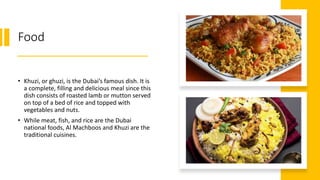
• Khuzi, or ghuzi, is the Dubai’s famous dish. It is
a complete, filling and delicious meal since this
dish consists of roasted lamb or mutton served
on top of a bed of rice and topped with
vegetables and nuts.
• While meat, fish, and rice are the Dubai
national foods, Al Machboos and Khuzi are the
traditional cuisines.
Festivals
• There are many festivals that occur in Dubai.
Some of the main and most famous festivals :
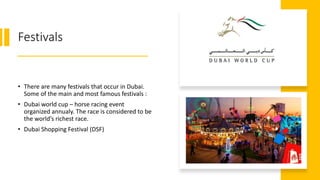
• Dubai world cup – horse racing event
organized annualy. The race is considered to be
the world’s richest race.
• Dubai Shopping Festival (DSF)
History
• Dubai is thought to have been established as a fishing village in the early 18th century and was, by 1822, a
town of some 700–800 members of the Bani Yas tribe and subject to the rule of Sheikh Tahnun bin
Shakhbut of Abu Dhabi.
• In 1901, Maktoum bin Hasher Al Maktoum established Dubai as a free port with no taxation on imports or
exports and also gave merchants parcels of land and guarantees of protection and tolerance.
• Dubai's geographical proximity to Iran made it an important trade location. The town of Dubai was an
important port of call for foreign tradesmen, chiefly those from Iran, many of whom eventually settled in
the town. By the beginning of the 20th century, it was an important port. Dubai was known for its pearl
exports until the 1930s.
• Despite a lack of oil, Dubai's ruler from 1958, Sheikh Rashid bin Saeed Al Maktoum, used revenue from
trading activities to build infrastructure. Private companies were established to build and operate
infrastructure, including electricity, telephone services and both the ports and airport operators.
• During this time, Dubai started to become an important transit hub because of its location. This caused a
boom in the airport industry in Dubai.
Religion
Islam is both the official
and majority religion in
Dubai followed by
approximately 76% of the
population.
Other religions
represented in the country
including Christianity,
Hinduism, Buddhism,
Judaism and Sikhism are
practiced by non-nationals.
Arts
• Art in Dubai is an emerging activity in
Dubai, United Arab Emirates. New
galleries such as Carbon 12 Dubai, art
fairs, artists, art patrons and collectors
have grown in number.
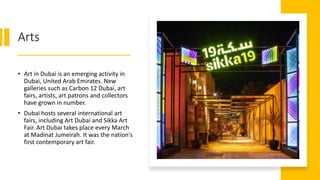
• Dubai hosts several international art
fairs, including Art Dubai and Sikka Art
Fair. Art Dubai takes place every March
at Madinat Jumeirah. It was the nation's
first contemporary art fair.
Sports
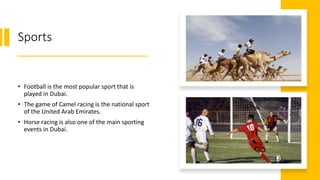
• Football is the most popular sport that is
played in Dubai.
• The game of Camel racing is the national sport
of the United Arab Emirates.
• Horse racing is also one of the main sporting
events in Dubai.
Environment
• Dubai is a city in the United Arab Emirates, and is recognized as one of the fastest growing cities in
the world. This rapid urbanization has led to many environmental issues because of the harsh
environment, paucity of local resources such as food, water, and building materials, and the
unplanned manner of expansion.
• One major environmental issue in Dubai is potential water shortage. Dubai is among the cities with
the lowest levels of precipitation. At the same time, the emirate is ranked among the top three
countries in water usage. Water in Dubai comes mainly from energy-intensive desalination of sea
water.
• In the future, global warming will become a bigger issue and this could be a huge problem for Dubai
because the country’s population centres are located along the coast. As sea levels rise, this could
lead to flooding.
Politics
• Politics of the United Arab Emirates(UAE) takes place in a framework of a federal, presidential, and a
constitutional monarchy (a federation of absolute monarchies).
• The United Arab Emirates (UAE) is a federation of seven constituent monarchies: the Emirates of Abu
Dhabi, Ajman, Dubai, Fujairah, Ras al-Khaimah, Sharjah, and Umm al-Quwain.
• According to convention, the ruler of Abu Dhabi is the President of the United Arab Emirates and the
head of state, and the ruler of Dubai is the Prime Minister of the United Arab Emirates, the head of
the government.
• Although complexity of local government differs depending on size and development of each emirate,
most such as Dubai have their own executive councils chaired by their respective rulers and
possessing various departments reflective of federal ministries. Various autonomous agencies also
exist such as the Environment Agency, Tourism Authority, Authority for Culture and Heritage, and the
Health Authority.
Demographics
• Dubai's 2020 population is now estimated at 2,878,344. In 1950, the population of Dubai was 20,000.
Dubai has grown by 477,277 since 2015, which represents a 3.69% annual change. It is the third
largest population in UAE
• The population density in the metropolis area is approximately 762.6 individuals living per square
kilometre.
• The population is composed of just 15% native residents, with the remaining 85% being composed of
expatriates. About 85% of the expatriate population – or 71% of the total population is Asian,
primarily from India (accounting for 51%). Other Asians in Dubai are originally from Pakistan (17%),
Bangladesh (9%) and the Philippines (3%). The city also has a high number of Somalis, and British
expatriates make up the largest population of Western expatriates.
• In case of male to female ratio, Dubai’s population is composed of approximately 75% males.
Transportation and
network
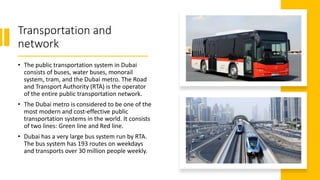
• The public transportation system in Dubai
consists of buses, water buses, monorail
system, tram, and the Dubai metro. The Road
and Transport Authority (RTA) is the operator
of the entire public transportation network.
• The Dubai metro is considered to be one of the
most modern and cost-effective public
transportation systems in the world. It consists
of two lines: Green line and Red line.
• Dubai has a very large bus system run by RTA.
The bus system has 193 routes on weekdays
and transports over 30 million people weekly.
Society and
Economics
• Before oil was discovered in the 1950s the UAE's
economy was dependent on fishing and a declining pearl
industry. But since oil exports began in 1962, the
country's society and economy have been transformed.
The UAE has diversified and has become a regional
trading and tourism hub.
• Contrary to popular belief, Dubai does not have an oil-
based economy. The little oil wealth it did enjoy between
the 1960s and the 1990s was used to enhance other
sectors of its economy by building physical infrastructure.
• Trade remains at the core of Dubai’s economy, with the
city operating two of the world’s largest ports and a busy
international air cargo hub. The Jebel Ali free-trade zone
was established in the 1980s to attract industrial
investment; activities based there include aluminium
smelting, car manufacturing, and cement production.
Land use pattern
• Land use:
• Agricultural land: 4.6% (2011 est.)
• Arable land: 0.5% (2011 est.)
• Permanent crops: 0.5% (2011 est.)
• Permanent pasture: 3.6% (2011 est.)
• Forest: 3.8% (2011 est.)
• Other: 91.6% (2011 est.)
• Land-use is loosely controlled by Dubai Municipality, which states what an
explicit use of a single plot of land can be. There are no means of formal
appeal of any authority’s decision at any time regarding land-use decisions.
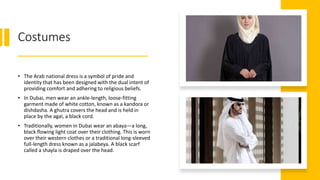
Costumes
• The Arab national dress is a symbol of pride and
identity that has been designed with the dual intent of
providing comfort and adhering to religious beliefs.
• In Dubai, men wear an ankle-length, loose-fitting
garment made of white cotton, known as a kandora or
dishdasha. A ghutra covers the head and is held in
place by the agal, a black cord.
• Traditionally, women in Dubai wear an abaya―a long,
black flowing light coat over their clothing. This is worn
over their western clothes or a traditional long-sleeved
full-length dress known as a jalabeya. A black scarf
called a shayla is draped over the head.
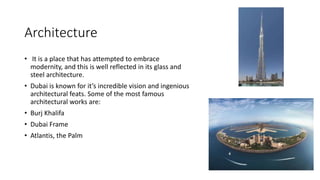
Architecture
• It is a place that has attempted to embrace
modernity, and this is well reflected in its glass and
steel architecture.
• Dubai is known for it’s incredible vision and ingenious
architectural feats. Some of the most famous
architectural works are:
• Burj Khalifa
• Dubai Frame
• Atlantis, the Palm
Technology
and science
• Dubai is a technological hub.
• The emirate aims to have “the world’s first
blockchain-powered government” by 2020, and also
wants to become “the world’s 3D-printing hub”.
There is a target in place from the Dubai Roads and
Transit Administration for a quarter of car journeys
taken in Dubai to be driverless by 2030.
• Dubai launched its Smart Dubai initiative in March
2014 with a goal of making Dubai the smartest city
in the world: the initiative has six core focuses, the
economy, environment, people, mobility, living and
governance. Under the smart city umbrella, Dubai
has also been investing heavily in technology-based
healthcare.
THANKYOU

Exploration of world cities

  • 1.
    Exploration of worldcities - Dubai By : Mallika M SD 03
  • 2.
    LANGUAGE • The Emiratidialect is a dialectal variety of the Arabic language that is spoken in Dubai. • Although Arabic is the official language of the UAE, English is the most spoken language in Dubai. You will also find a lot of expatriates who speak Hindi, Urdu, Bengali, Tamil, Tagalog, Persian, Chinese, Malayalam, in addition to many other languages.
  • 3.
    Food • Khuzi, orghuzi, is the Dubai’s famous dish. It is a complete, filling and delicious meal since this dish consists of roasted lamb or mutton served on top of a bed of rice and topped with vegetables and nuts. • While meat, fish, and rice are the Dubai national foods, Al Machboos and Khuzi are the traditional cuisines.
  • 4.
    Festivals • There aremany festivals that occur in Dubai. Some of the main and most famous festivals : • Dubai world cup – horse racing event organized annualy. The race is considered to be the world’s richest race. • Dubai Shopping Festival (DSF)
  • 5.
    History • Dubai isthought to have been established as a fishing village in the early 18th century and was, by 1822, a town of some 700–800 members of the Bani Yas tribe and subject to the rule of Sheikh Tahnun bin Shakhbut of Abu Dhabi. • In 1901, Maktoum bin Hasher Al Maktoum established Dubai as a free port with no taxation on imports or exports and also gave merchants parcels of land and guarantees of protection and tolerance. • Dubai's geographical proximity to Iran made it an important trade location. The town of Dubai was an important port of call for foreign tradesmen, chiefly those from Iran, many of whom eventually settled in the town. By the beginning of the 20th century, it was an important port. Dubai was known for its pearl exports until the 1930s. • Despite a lack of oil, Dubai's ruler from 1958, Sheikh Rashid bin Saeed Al Maktoum, used revenue from trading activities to build infrastructure. Private companies were established to build and operate infrastructure, including electricity, telephone services and both the ports and airport operators. • During this time, Dubai started to become an important transit hub because of its location. This caused a boom in the airport industry in Dubai.
  • 6.
    Religion Islam is boththe official and majority religion in Dubai followed by approximately 76% of the population. Other religions represented in the country including Christianity, Hinduism, Buddhism, Judaism and Sikhism are practiced by non-nationals.
  • 7.
    Arts • Art inDubai is an emerging activity in Dubai, United Arab Emirates. New galleries such as Carbon 12 Dubai, art fairs, artists, art patrons and collectors have grown in number. • Dubai hosts several international art fairs, including Art Dubai and Sikka Art Fair. Art Dubai takes place every March at Madinat Jumeirah. It was the nation's first contemporary art fair.
  • 8.
    Sports • Football isthe most popular sport that is played in Dubai. • The game of Camel racing is the national sport of the United Arab Emirates. • Horse racing is also one of the main sporting events in Dubai.
  • 9.
    Environment • Dubai isa city in the United Arab Emirates, and is recognized as one of the fastest growing cities in the world. This rapid urbanization has led to many environmental issues because of the harsh environment, paucity of local resources such as food, water, and building materials, and the unplanned manner of expansion. • One major environmental issue in Dubai is potential water shortage. Dubai is among the cities with the lowest levels of precipitation. At the same time, the emirate is ranked among the top three countries in water usage. Water in Dubai comes mainly from energy-intensive desalination of sea water. • In the future, global warming will become a bigger issue and this could be a huge problem for Dubai because the country’s population centres are located along the coast. As sea levels rise, this could lead to flooding.
  • 10.
    Politics • Politics ofthe United Arab Emirates(UAE) takes place in a framework of a federal, presidential, and a constitutional monarchy (a federation of absolute monarchies). • The United Arab Emirates (UAE) is a federation of seven constituent monarchies: the Emirates of Abu Dhabi, Ajman, Dubai, Fujairah, Ras al-Khaimah, Sharjah, and Umm al-Quwain. • According to convention, the ruler of Abu Dhabi is the President of the United Arab Emirates and the head of state, and the ruler of Dubai is the Prime Minister of the United Arab Emirates, the head of the government. • Although complexity of local government differs depending on size and development of each emirate, most such as Dubai have their own executive councils chaired by their respective rulers and possessing various departments reflective of federal ministries. Various autonomous agencies also exist such as the Environment Agency, Tourism Authority, Authority for Culture and Heritage, and the Health Authority.
  • 11.
    Demographics • Dubai's 2020population is now estimated at 2,878,344. In 1950, the population of Dubai was 20,000. Dubai has grown by 477,277 since 2015, which represents a 3.69% annual change. It is the third largest population in UAE • The population density in the metropolis area is approximately 762.6 individuals living per square kilometre. • The population is composed of just 15% native residents, with the remaining 85% being composed of expatriates. About 85% of the expatriate population – or 71% of the total population is Asian, primarily from India (accounting for 51%). Other Asians in Dubai are originally from Pakistan (17%), Bangladesh (9%) and the Philippines (3%). The city also has a high number of Somalis, and British expatriates make up the largest population of Western expatriates. • In case of male to female ratio, Dubai’s population is composed of approximately 75% males.
  • 12.
    Transportation and network • Thepublic transportation system in Dubai consists of buses, water buses, monorail system, tram, and the Dubai metro. The Road and Transport Authority (RTA) is the operator of the entire public transportation network. • The Dubai metro is considered to be one of the most modern and cost-effective public transportation systems in the world. It consists of two lines: Green line and Red line. • Dubai has a very large bus system run by RTA. The bus system has 193 routes on weekdays and transports over 30 million people weekly.
  • 13.
    Society and Economics • Beforeoil was discovered in the 1950s the UAE's economy was dependent on fishing and a declining pearl industry. But since oil exports began in 1962, the country's society and economy have been transformed. The UAE has diversified and has become a regional trading and tourism hub. • Contrary to popular belief, Dubai does not have an oil- based economy. The little oil wealth it did enjoy between the 1960s and the 1990s was used to enhance other sectors of its economy by building physical infrastructure. • Trade remains at the core of Dubai’s economy, with the city operating two of the world’s largest ports and a busy international air cargo hub. The Jebel Ali free-trade zone was established in the 1980s to attract industrial investment; activities based there include aluminium smelting, car manufacturing, and cement production.
  • 14.
    Land use pattern •Land use: • Agricultural land: 4.6% (2011 est.) • Arable land: 0.5% (2011 est.) • Permanent crops: 0.5% (2011 est.) • Permanent pasture: 3.6% (2011 est.) • Forest: 3.8% (2011 est.) • Other: 91.6% (2011 est.) • Land-use is loosely controlled by Dubai Municipality, which states what an explicit use of a single plot of land can be. There are no means of formal appeal of any authority’s decision at any time regarding land-use decisions.
  • 15.
    Costumes • The Arabnational dress is a symbol of pride and identity that has been designed with the dual intent of providing comfort and adhering to religious beliefs. • In Dubai, men wear an ankle-length, loose-fitting garment made of white cotton, known as a kandora or dishdasha. A ghutra covers the head and is held in place by the agal, a black cord. • Traditionally, women in Dubai wear an abaya―a long, black flowing light coat over their clothing. This is worn over their western clothes or a traditional long-sleeved full-length dress known as a jalabeya. A black scarf called a shayla is draped over the head.
  • 16.
    Architecture • It isa place that has attempted to embrace modernity, and this is well reflected in its glass and steel architecture. • Dubai is known for it’s incredible vision and ingenious architectural feats. Some of the most famous architectural works are: • Burj Khalifa • Dubai Frame • Atlantis, the Palm
  • 17.
    Technology and science • Dubaiis a technological hub. • The emirate aims to have “the world’s first blockchain-powered government” by 2020, and also wants to become “the world’s 3D-printing hub”. There is a target in place from the Dubai Roads and Transit Administration for a quarter of car journeys taken in Dubai to be driverless by 2030. • Dubai launched its Smart Dubai initiative in March 2014 with a goal of making Dubai the smartest city in the world: the initiative has six core focuses, the economy, environment, people, mobility, living and governance. Under the smart city umbrella, Dubai has also been investing heavily in technology-based healthcare.
  • 18.