IQAC /NAAC
University of Mumbai
Dr.Amit Hemant Mishal
Associate Professor
CCYM’S Hashu Advani College of Special
Education
https://www.hashuadvanismarak.org/hacse/
IQAC- With reference To Capacity
Building of Institution's
Dr Mishal Amit H
Associate Professor (Education)
IQAC will work with the HEIs throughout their academic journey.
IQAC
• PUSH for QUALITY
• FORCE For Quality
• Brainstorm for Quality
• Hand in hand for Quality
• Opportunity for quality
Quality becomes part and parcel, ……………..
Quality is a journey not a destination
• The IQAC is meant for planning, guiding and monitoring Quality
Assurance (QA) and Quality Enhancement (QE) activities of the
colleges.
• National Assessment and Accreditation Council (NAAC) -improve the
quality of education in colleges or institutions.
• In pursuance of the National Action Plan of the NAAC, Bangalore, for
performance evaluation, assessment and accreditation and quality
up-gradation of institutions of higher education.
• Later proposed Internal Quality Assurance Cell (IQAC), a key quality
sustenance measure.
• UGC issued guidelines - 2012 – establishment/ monitoring IQACs to
Establish -internal mechanism for sustenance,
assurance,enhancement of quality culture of education imparted by
HEIs.
• Every accredited institution establish an (IQAC) as a post-
accreditation quality sustenance measure.
• To support the continuous process of providing quality education,
adopting and assessing creative teaching-learning methods, and
more.
Composition of IQAC
• Chairmanship of the Head of the institution with heads of important academic and
administrative units and a few teachers and a few distinguished educationists and
representatives of local management and stakeholders
The composition of the IQAC may be as follows:
• Chairperson: Head of the Institution
• A few senior administrative officers
• Three to eight teachers
• One member from the Management
• One/two nominees from local society, Students and Alumni
• One/two nominees from Employers /Industrialists/stakeholders
• One of the senior teachers as the coordinator/Director of the IQAC
IQAC-WORK/ROLE
• Continuous process
• Part of institution's system /facilitative ,participative voluntary
system/unit/organ
• Work towards realizing goals of quality enhancement and sustenance.
• Develop system for conscious, consistent, catalytic improvement in
performance
• Channelize efforts / measures of an institution towards academic excellence.
• Institutional functioning towards quality enhancement through
Internalization of quality culture and institutionalization of best practices.
• Success –on- sense of belongingness and participation in all the constituents
of the institution.
• Channelizes all efforts / measures towards promoting its holistic academic
excellence.
• Improvement in the overall performance of the institution
• Strives to provide a good environment for learning.
• Emphasis on revising the curriculum- need-based courses and global trends.
• Focuses on introducing inter-disciplinary, job-oriented and skill-based
courses,Choice Based Credit System with academic flexibility , introducing
socially relevant extension programmes and implementing Feedback
Mechanism.
• Working out planned interventionist strategies to remove deficiencies
• Put in place processes for improving standards across all academic
programmes in college.
• another hierarchical structure
• a record-keeping exercise
• Quality-related institutional processes
• Quality Culture in institution
• Documentation of programmes /activities
• Research, Publications
• Nodal Agency-coordinating quality-related activities
• Adoption/Disseminate - best practices
• Arrangement for feedback stakeholders
• MoU
• Faculty Exchange /Collaboration
• Organization of inter /intra institutional workshops, seminars -quality
related themes
• Promotion of quality circles
• Research Project /Funding Projects
• FDPS
• E-governance, SOPS etc
• Do not serve as a data centre
• An Admisinstrative body
• Means to bring together - administrators, teachers, students, supporting
staff and all other stakeholders
Academic ,Co-Academic
Annual Report Submission Every year by End of Calendar Year
Meetings ,Minutes With Agenda
IQAC initiatives
IQAC organizes …………..
NAAC SEVEN CRITERIA FOR ACCREDITIATION
• Criterion 1- Curriculum Planning
• Criterion 2- Transaction of Curriculum, Innovation
• Criterion 3- Research Method
• Criterion 4- Infrastructure +Lib
• Criterion 5- Co-curricular Activities + Student Progression
• Criterion 6- Administration & Governance
• Criterion 7- Community, Outreach
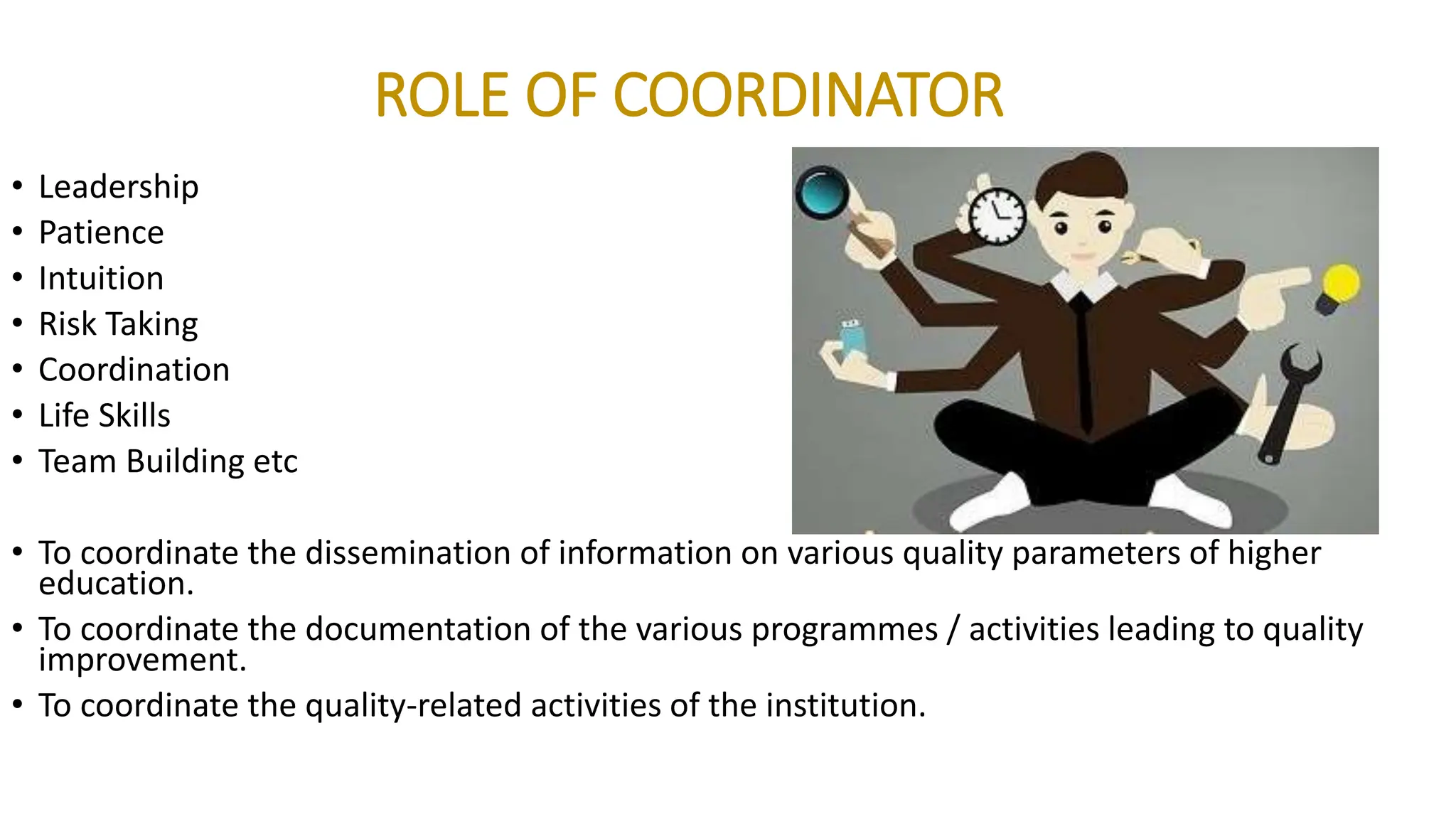
ROLE OF COORDINATOR
• Leadership
• Patience
• Intuition
• Risk Taking
• Coordination
• Life Skills
• Team Building etc
• To coordinate the dissemination of information on various quality parameters of higher
education.
• To coordinate the documentation of the various programmes / activities leading to quality
improvement.
• To coordinate the quality-related activities of the institution.
CAPACITY BUILDING
1. Organization Skill
2. Planning
3. Documentation
4. Preservation for future reference
5. Change in attitude/lack of information/prejudice -against
• Quality of teaching, learning, evaluation
• mentoring, community service, inclusion, research
• value addition ,student progression, placement, pursuing further studies
• audit, funding, research in higher education in this territory
What………………new accreditation system of NAAC!
What,Why,When,How…………….
• Binary accreditation system - “accredited” or “not accredited”
• Encourage all institutions to get on board NAAC accreditation
• Rated on levels 1-5 on Maturity-Based Graded Accreditation (MBGA)
based
• Level 1 to Level 4 will be classified as ‘Institutions of National
Excellence’
• Institutions Level 5 will be classified as ‘Institutions of Global
Excellence for Multi-Disciplinary Research and Education’.
• In line with the global best practices set by leading countries in the
field of education.
The implementation of recommendations:
2 stages
•In stage one- binary accreditation - next four months
•MBGA will be implemented by December 2024.
•No new applications will be accepted as per the present
methodology after four months
• Will replace the present system of ranking C to A++
Institutions that have already applied and are applying in the
next four months shall have the option to either go by the
present process or by the new methodology of binary
accreditation.
*Current system of ranking is based on the Cumulative Grade Point Average (CGPA)
gained by an institution.
• Rural and remote location institutions -mentoring and handholding
• One Nation One Data Platform - integrity and transparency in handling
institutional data.
New platform shall capture superset of data from HEIs for varied purposes (of
approval, accreditation, ranking) with an in-built design for collateral cross-
checking to check authenticity of data.
• Trust and Data Driven system with minimal visits to an institution for verification;
• Heavy penalties on giving wrong submissions.
• Additional Provision for customized ranking based on stakeholders such as
industry, funding agencies, students etc.
Hoping transformative reforms for strengthening assessment and accreditation of
the HEIs cum True!
NEVER STOP LEARNING, BECAUSE LIFE NEVER
STOPS TEACHING "
Excellence is not an endpoint but an ongoing
journey.
Any Questions Which I can solve Ill try …..
References :
• 1.https://bestcolleges.indiatoday.in/news-detail/naac-introduces-new-
accreditation-system (retrieved on 9.2.24 at 12.09pm)
• 2.http://naac.gov.in/images/docs/Publication/books/NAAC_Assessment_Upda
te.pdf ( retrieved on 9.2.24 at 12.31pm)
• 3. https://www.thehindu.com/news/national/naac-to-introduce-new-binary-
accreditation-system-in-four-months/article67784096.ece (retrieved on 9.2.24
at 12.20pm)
• 4. Source of Image:https://www.peoplematters.in/article/strategic-
hr/capacity-building-an-organizational-goal-that-hr-facilitates-14108
• 5. Source of Image:https://keydifferences.com/wp-
content/uploads/2014/11/leader-vs-manager1.jpg

FINAL PRESENTATION IQAC Meaning Significance

  • 1.
    IQAC /NAAC University ofMumbai Dr.Amit Hemant Mishal Associate Professor CCYM’S Hashu Advani College of Special Education https://www.hashuadvanismarak.org/hacse/
  • 2.
    IQAC- With referenceTo Capacity Building of Institution's Dr Mishal Amit H Associate Professor (Education) IQAC will work with the HEIs throughout their academic journey.
  • 3.
    IQAC • PUSH forQUALITY • FORCE For Quality • Brainstorm for Quality • Hand in hand for Quality • Opportunity for quality Quality becomes part and parcel, …………….. Quality is a journey not a destination
  • 4.
    • The IQACis meant for planning, guiding and monitoring Quality Assurance (QA) and Quality Enhancement (QE) activities of the colleges. • National Assessment and Accreditation Council (NAAC) -improve the quality of education in colleges or institutions. • In pursuance of the National Action Plan of the NAAC, Bangalore, for performance evaluation, assessment and accreditation and quality up-gradation of institutions of higher education. • Later proposed Internal Quality Assurance Cell (IQAC), a key quality sustenance measure.
  • 5.
    • UGC issuedguidelines - 2012 – establishment/ monitoring IQACs to Establish -internal mechanism for sustenance, assurance,enhancement of quality culture of education imparted by HEIs. • Every accredited institution establish an (IQAC) as a post- accreditation quality sustenance measure. • To support the continuous process of providing quality education, adopting and assessing creative teaching-learning methods, and more.
  • 6.
    Composition of IQAC •Chairmanship of the Head of the institution with heads of important academic and administrative units and a few teachers and a few distinguished educationists and representatives of local management and stakeholders The composition of the IQAC may be as follows: • Chairperson: Head of the Institution • A few senior administrative officers • Three to eight teachers • One member from the Management • One/two nominees from local society, Students and Alumni • One/two nominees from Employers /Industrialists/stakeholders • One of the senior teachers as the coordinator/Director of the IQAC
  • 7.
    IQAC-WORK/ROLE • Continuous process •Part of institution's system /facilitative ,participative voluntary system/unit/organ • Work towards realizing goals of quality enhancement and sustenance. • Develop system for conscious, consistent, catalytic improvement in performance • Channelize efforts / measures of an institution towards academic excellence. • Institutional functioning towards quality enhancement through Internalization of quality culture and institutionalization of best practices. • Success –on- sense of belongingness and participation in all the constituents of the institution.
  • 8.
    • Channelizes allefforts / measures towards promoting its holistic academic excellence. • Improvement in the overall performance of the institution • Strives to provide a good environment for learning. • Emphasis on revising the curriculum- need-based courses and global trends. • Focuses on introducing inter-disciplinary, job-oriented and skill-based courses,Choice Based Credit System with academic flexibility , introducing socially relevant extension programmes and implementing Feedback Mechanism. • Working out planned interventionist strategies to remove deficiencies • Put in place processes for improving standards across all academic programmes in college. • another hierarchical structure • a record-keeping exercise
  • 9.
    • Quality-related institutionalprocesses • Quality Culture in institution • Documentation of programmes /activities • Research, Publications • Nodal Agency-coordinating quality-related activities • Adoption/Disseminate - best practices • Arrangement for feedback stakeholders
  • 10.
    • MoU • FacultyExchange /Collaboration • Organization of inter /intra institutional workshops, seminars -quality related themes • Promotion of quality circles • Research Project /Funding Projects • FDPS • E-governance, SOPS etc
  • 11.
    • Do notserve as a data centre • An Admisinstrative body • Means to bring together - administrators, teachers, students, supporting staff and all other stakeholders Academic ,Co-Academic Annual Report Submission Every year by End of Calendar Year Meetings ,Minutes With Agenda IQAC initiatives IQAC organizes …………..
  • 12.
    NAAC SEVEN CRITERIAFOR ACCREDITIATION • Criterion 1- Curriculum Planning • Criterion 2- Transaction of Curriculum, Innovation • Criterion 3- Research Method • Criterion 4- Infrastructure +Lib • Criterion 5- Co-curricular Activities + Student Progression • Criterion 6- Administration & Governance • Criterion 7- Community, Outreach
  • 13.
    ROLE OF COORDINATOR •Leadership • Patience • Intuition • Risk Taking • Coordination • Life Skills • Team Building etc • To coordinate the dissemination of information on various quality parameters of higher education. • To coordinate the documentation of the various programmes / activities leading to quality improvement. • To coordinate the quality-related activities of the institution.
  • 14.
    CAPACITY BUILDING 1. OrganizationSkill 2. Planning 3. Documentation 4. Preservation for future reference 5. Change in attitude/lack of information/prejudice -against • Quality of teaching, learning, evaluation • mentoring, community service, inclusion, research • value addition ,student progression, placement, pursuing further studies • audit, funding, research in higher education in this territory
  • 15.
    What………………new accreditation systemof NAAC! What,Why,When,How……………. • Binary accreditation system - “accredited” or “not accredited” • Encourage all institutions to get on board NAAC accreditation • Rated on levels 1-5 on Maturity-Based Graded Accreditation (MBGA) based • Level 1 to Level 4 will be classified as ‘Institutions of National Excellence’ • Institutions Level 5 will be classified as ‘Institutions of Global Excellence for Multi-Disciplinary Research and Education’. • In line with the global best practices set by leading countries in the field of education.
  • 16.
    The implementation ofrecommendations: 2 stages •In stage one- binary accreditation - next four months •MBGA will be implemented by December 2024. •No new applications will be accepted as per the present methodology after four months • Will replace the present system of ranking C to A++ Institutions that have already applied and are applying in the next four months shall have the option to either go by the present process or by the new methodology of binary accreditation.
  • 17.
    *Current system ofranking is based on the Cumulative Grade Point Average (CGPA) gained by an institution. • Rural and remote location institutions -mentoring and handholding • One Nation One Data Platform - integrity and transparency in handling institutional data. New platform shall capture superset of data from HEIs for varied purposes (of approval, accreditation, ranking) with an in-built design for collateral cross- checking to check authenticity of data. • Trust and Data Driven system with minimal visits to an institution for verification; • Heavy penalties on giving wrong submissions. • Additional Provision for customized ranking based on stakeholders such as industry, funding agencies, students etc. Hoping transformative reforms for strengthening assessment and accreditation of the HEIs cum True!
  • 18.
    NEVER STOP LEARNING,BECAUSE LIFE NEVER STOPS TEACHING " Excellence is not an endpoint but an ongoing journey. Any Questions Which I can solve Ill try …..
  • 19.
    References : • 1.https://bestcolleges.indiatoday.in/news-detail/naac-introduces-new- accreditation-system(retrieved on 9.2.24 at 12.09pm) • 2.http://naac.gov.in/images/docs/Publication/books/NAAC_Assessment_Upda te.pdf ( retrieved on 9.2.24 at 12.31pm) • 3. https://www.thehindu.com/news/national/naac-to-introduce-new-binary- accreditation-system-in-four-months/article67784096.ece (retrieved on 9.2.24 at 12.20pm) • 4. Source of Image:https://www.peoplematters.in/article/strategic- hr/capacity-building-an-organizational-goal-that-hr-facilitates-14108 • 5. Source of Image:https://keydifferences.com/wp- content/uploads/2014/11/leader-vs-manager1.jpg