Self Help Group Bank Linkage: Through the responsible Finance Lens
A study on state of Practice in SHG Bank Linkage in Madhya Pradesh, Bihar and Karnataka

Amulya K Champatiray
Parul Agarwal
Misha Sharma
IFMR Research, Chennai, India
Agenda
• Background
• Research Questions
• Methodology and sample
• Financial Performance
• Other Performance Indicators
• Overall Recommendations
Background
• SHG-BLP status as of March 2013
– 73.18 lakh savings-linked SHGs with savings balance of over INR 8217.25 cr

– 44.51 lakh credit-linked SHGs with bank loan outstanding of INR 39375.30 cr
– Over 95 million households covered as on 31st March 2013

• In March 2012, NABARD introduced ‘SHG-2’ with number of revisions
in the programme including
– Introduced the concept of ‘voluntary savings’ and
– Joint Liability Group of entrepreneurial-members with the SHG for income
generation activities

• In June 2011, NRLM was introduced that envisions SHGs as a delivery

mechanism of massive poverty alleviation initiative.
Research Objectives
• To understand the financial and non-financial interactions of SHG with
external agencies like banks and SHPIs

• To study the internal group dynamics in terms of financial transactions,
decision making, cohesiveness, transparency and acceptance towards
technology and new policy
Sample and Methodology
• 200 SHGs each spread across 2-3 districts in the states of
Bihar, Madhya Pradesh and Karnataka
• SHGs ranged in the age group of 1-6 years
• Data Collection Instruments:
– Leader module administered with leader
– Transaction module administered with leader and treasurer
– Members module administered with progressive and not so progressive

members
– Interviews with respective SHPIs
Sample Characteristics
State wise distribution of literacy levels among SHG members (%)
Literacy Level

Bihar

MP

Karnataka

Can read and write

16

20

38

Cannot read and write but sign

46

35

39

Can neither read nor write

38

44

22

State wise distribution of occupation among SHG members (%)
Occupation

Bihar

MP

Karnataka

Farm activities

54

81

56

Non-farm activities

41

18

27

Unemployed

5

1

17
Financial Performance
Performance and Policy implications on the following
aspects:
• Savings
• Lending and Borrowing
• Book Keeping
Savings: Performance
Details of Compulsory Savings

Details

Bihar

MP

Karnataka

9
(weekly)

3
(weekly)

114
(Monthly)

Percentage of groups where all the
members do not contribute to compulsory
savings

15

65

5

Percentage of groups where all the
members' savings are deposited in SHG
bank account

2.5

7.25

97.25

Average number of times a member has
defaulted in the group

4.5

2

0.4

Average number of times when a penalty
is paid for default

0

0.1

0.1

1394

1179

2875

Average Savings Amount per frequency

Average member's savings corpus
Savings: Default Management
Penalty and Interest Rate on
Savings

Bihar

MP

Karnataka

Average penalty amount for default

5

2

6

Percentage of groups with no penalty

84

76

60

Average interest rate on savings

0

0

2

100

100

47

Percentage of groups that do not offer
interest on members’ savings
Savings: Discipline among Members and Leaders

Leader

Member
Bihar

95.36
93.34

>3 Years

36.49
46.38

31.58
51.4

7.21
3.19

7.41
3.08

<=3 Years

95.83
93.75

% of Members and Leaders Never Defaulted on Savings

Leader

Member
MP

Leader

Member

Karnataka

% of Members Never Defaulted on Savings
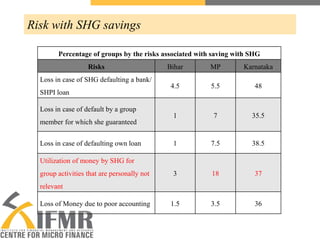
Risk with SHG savings
Percentage of groups by the risks associated with saving with SHG
Risks

Bihar

MP

Karnataka

4.5

5.5

48

1

7

35.5

1

7.5

38.5

3

18

37

1.5

3.5

36

Loss in case of SHG defaulting a bank/
SHPI loan
Loss in case of default by a group
member for which she guaranteed
Loss in case of defaulting own loan

Utilization of money by SHG for
group activities that are personally not
relevant
Loss of Money due to poor accounting
Demand for the additional voluntary savings options
• None of the groups across the study SHGs are practicing the
concept of voluntary deposits

• A small fraction of SHGs faced a situation where some
members in the group wanted to save more than others.
– 4% of groups in Bihar,

– 7% in MP and
– 26% in Karnataka
Savings: Policy Implications
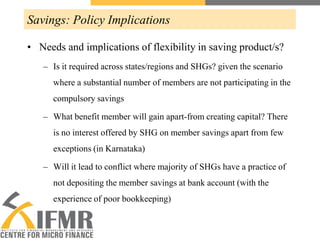
• Needs and implications of flexibility in saving product/s?
– Is it required across states/regions and SHGs? given the scenario
where a substantial number of members are not participating in the
compulsory savings
– What benefit member will gain apart-from creating capital? There
is no interest offered by SHG on member savings apart from few
exceptions (in Karnataka)

– Will it lead to conflict where majority of SHGs have a practice of
not depositing the member savings at bank account (with the
experience of poor bookkeeping)
Lending and Borrowing: Performance

Percentage of groups

Borrowing and lending practices of groups
98%

96%

91%
Groups that lend internally

42%
Groups that have borrowed
from bank in the last six
months

20%
9%
Bihar

MP
States

Karnataka
Internal Lending: Performance
Details of Internal Lending Policy
Details
Bihar
Average percentage of members/per SHG with loan
33%
outstanding as of 30th June 2013
Average loan size (minimum and maximum / in INR)
98 -5595
Average loan repayment period (min-Max in month)
% of groups where interest rates differ for different loans
% of groups where loan repayment period differs for
different loans
% of groups where members are penalized for defaulting on
repayment
Average minimum and maximum penalty rate for single
term default

MP

Karnataka

41%

38%

105 –
3210

5118 17850

1 - 12

1-6

9 - 13

1

5

8

52

79

18

7

22

17

6 – 13

4-7

15 - 17
Borrowing from bank and SHPI
Details regarding external
borrowings

Bihar

MP

Karnataka

BANK

SHPI

BANK

SHPI

BANK

SHPI

Percentage of SHGs whose loan
application has been rejected at
least once

12%

95%

7%

2%

19%

14%

Percentage of SHGs who have
taken more than one loan

2%

2%

21%

no
data

55%

4%

Average number of days taken to
process the loan

59

64

40

no
data

28

22

434254210

no
data

51231230270

47875398880

Average min and max amount
borrowed per SHG (in INR)

Average annual interest rate
charged
Average repayment period
(months)
Percentage of loans linked to
SHG corpus

21705- 3917154536 50374
13

13

12

0

14

10

23

41

-

0

22

18

23%

68%

26%

0%

48%

32%
Discipline among Members and Leaders in External
Loan Repayment
% of Members and Leaders Never Defaulted on External
Loan Repayment

Leader

Member
Bihar

Leader

Member
MP

Leader

67.02

13.83

62.5

no obs.

16.67

96.23

>3

100

87.5

97.39

93.66

97.78

91.94

<=3

Member

Karnataka
Loan default management
• Internal Lending
– A better system of penalizing the members need to be in place. Current
analysis shows that the penalty amount charged is not sufficient enough
to incentivize members not to default indicating a scope of raising the
penalty fee to control defaults further.

• Lending by Banks
– Considering the loan size and default rates, amount disbursed to SHGs
need to be checked which might currently be too high for MP and
Karnataka and a little low for Bihar.
Cost on bank loan
•

Interest rate on bank loans is charged at 12% to 14%

•

Opportunity cost during the loan process: Rs. 100 - 140 per member per day.

•

Average total transportation cost per SHG in processing bank loan
– Bihar 111
– MP 518 and
– Karnataka 1,803

•

Processing fees being charged on their bank loans,
– MP 268
– Karnataka 610 and
– Bihar - not reported

•

Loan account maintenance
– MP 500
– Karnataka 313 and
– Bihar – not reported

•

Insurance contribution i.e. linked to their loan: Karnataka Rs. 8,736
SHG Interaction with Bank
The average time taken during interaction with bank to facilitate regular
transaction of deposit and withdrawal:
• about 60 minutes in the case of Bihar and MP,

• 30-45 minutes in the case of Karnataka
Percentage of groups by the type of assistance provided by the bank in the loan
application process
Type of assistance

Bihar

MP

Karnataka

Filling loan application
Guidance and information on required documents
for loan

17

54

78

15

51

75

Promptly conducting due-diligence (rating)

3

23

75

Providing assistance/guidance in making SHG
eligible for loan

4

40

69
Lending and Borrowing: Policy Implications
• Without proper mechanism of default management among substantial
number of SHGs – would the soft loan / revolving fund be beneficial or
will it create conflicts?
• What should be the priority for SHG and SHPI – to offer more credit
products or timely sanction of existing credit product?
• Are banks prepared to take on more responsibility of managing funds
that will come up with the structural and functional changes
introduced?
Book-Keeping: Performance
Status of Book-Keeping
States

% of SHGs NOT
Recording of
maintaining books
meeting (minutes)
of accounts
regularly

Training on bookkeeping

99%
(recorded after the
meeting)
93%

7%

44% SHGs received training
90% demand for more training

MP

(recorded during
the meeting)
87%

3%

20% SHGs received training
90% demand for more training

Karnataka

(10% of SHGs do
not maintain
meeting minutes)

2%

32% SHGs received training
78% demand for more training

Bihar
Book-Keeping: Quality (accuracy, clear and timely update):
Karnataka

MP

Bihar

Overall
observation

Majority of the SHGs were maintaining high standard of business records
A smaller fraction of SHGs face difficulty in updating passbooks due to
increase in migration of group members

Most of the groups are depending on the SHPI/s for maintaining their
records
Groups in MP are performing second best after Karnataka.
A small section of SHGs (5% to 10%) in MP reported of problems with
record keeping
Most of the groups are depending on the SHPI/s for maintaining their
records
Though books were updated but there are concerns of clarity and accuracy
in their records
A large section of SHGs are lagging behind due to lack of timely
availability of required stationaries
• Technology: None of the sample SHGs use any form of technology for their
record keeping
• A lack of proper quality control mechanism in place
Book Keeping: Policy Implications
• With the current standard of book-keeping
– it will be difficult to manage voluntary savings – it might lead to
group conflict
– Managing soft-loan and revolving fund will be difficult and
specifically JLG loan management will be a challenge
– Groups’ involvement in community development work will be
difficult to check and track
Other Indicators: Transparency
Members’ awareness on group policy:
For a meagre 1.17% of the groups
Karnataka

•

Awareness regarding bank's
lending policy

across the SHGs under study were the
members not well versed with the

68
64

~Prog

Interest rate
at which
group have
borrowed
from bank

81
79

Prog

group’s policies.

15
15

MP

15
16

Prog

Sharing of financial status with members

States

~Prog

in every meeting
98% in Bihar,

•

87% in MP

•

84.21% in Karnataka
–

11.58% SHGs in Karnataka share it
only when a member asks for it

59

~Prog

20

Bihar

•

Total amount
of bank loan
outstanding

61

Prog

25

0

50
Percentage of groups

100
Information sharing and use of technology
•

About 90% of the sample SHGs
believes technology can help in
improving the standards of bookkeeping (regular and accurate

updating of records).
•

A significant number of SHGs across
study states (18.95% in
Karnataka, 25.63% in MP and 28% in

Bihar) expressed their willingness to
adopt technology.
•

SHGs are willing to pay a range of
Rs. 3000 to Rs. 10000
Other Indicators: Social Performance
Percentage of groups by the topics and frequency of discussion

Financial
Social (Comm.
Based)
Political
Development

of the village

48

1

81

18

1

1

43

56

23

69

8

52

42

6

3

23

74

8

53

39

12

43

45

2

40

58

29

64

7

32

47

21

Never

51

When
needed

Regular

1

Never

98

When
needed

1

Never

Regular

Karnataka

When
needed

Topics

MP

Regular

Bihar
Other Indicators: Social Performance

Percentage of groups

Group activities performed for the community
120
100

27

80
60
40
20
0

75

47
23
9

27
7
15

7
15

29

38
60
6
15

48

20
10
3

SHG Activities performed for the community

58
3

Karnataka
MP
Bihar
Other Indicators: Member dropouts
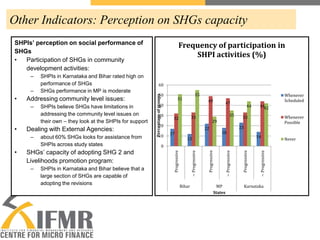
Other Indicators: Perception on SHGs capacity
SHPIs’ perception on social performance of
SHGs
•
Participation of SHGs in community
development activities:

–

•

about 60% SHGs looks for assistance from
SHPIs across study states

SHGs’ capacity of adopting SHG 2 and
Livelihoods promotion program:
–

SHPIs in Karnataka and Bihar believe that a
large section of SHGs are capable of
adopting the revisions

40
30
20
10

17

47
35

33

32

Whenever
Scheduled

29
22

18

44

44
42
Whenever
Possible

33
23
14

12

0

Bihar

MP
States

~ Progressive

Dealing with External Agencies:

49

Progressive

•

SHPIs believe SHGs have limitations in
addressing the community level issues on
their own – they look at the SHPIs for support

55

51

~ Progressive

–

50

Progressive

Addressing community level issues:

~ Progressive

•

60

Progressive

–

SHPIs in Karnataka and Bihar rated high on
performance of SHGs
SHGs performance in MP is moderate

Percentage of groups

–

Frequency of participation in
SHPI activities (%)

Karnataka

Never
Overall Recommendations
•
•
•
•
•

Fund and Default Management
Transparency and Accountability
Engagement of External Institutions
Conflict Resolution
Community Level Sensitization
Thank you

For further questions and discussion please write to the researchers at:
amulyakrishna.champatiray@ifmr.ac.in
parul.agarwal@ifmr.ac.in
misha.sharma@ifmr.ac.in

Financing Practices in SHGs

  • 1.
    Self Help GroupBank Linkage: Through the responsible Finance Lens A study on state of Practice in SHG Bank Linkage in Madhya Pradesh, Bihar and Karnataka Amulya K Champatiray Parul Agarwal Misha Sharma IFMR Research, Chennai, India
  • 2.
    Agenda • Background • ResearchQuestions • Methodology and sample • Financial Performance • Other Performance Indicators • Overall Recommendations
  • 3.
    Background • SHG-BLP statusas of March 2013 – 73.18 lakh savings-linked SHGs with savings balance of over INR 8217.25 cr – 44.51 lakh credit-linked SHGs with bank loan outstanding of INR 39375.30 cr – Over 95 million households covered as on 31st March 2013 • In March 2012, NABARD introduced ‘SHG-2’ with number of revisions in the programme including – Introduced the concept of ‘voluntary savings’ and – Joint Liability Group of entrepreneurial-members with the SHG for income generation activities • In June 2011, NRLM was introduced that envisions SHGs as a delivery mechanism of massive poverty alleviation initiative.
  • 4.
    Research Objectives • Tounderstand the financial and non-financial interactions of SHG with external agencies like banks and SHPIs • To study the internal group dynamics in terms of financial transactions, decision making, cohesiveness, transparency and acceptance towards technology and new policy
  • 5.
    Sample and Methodology •200 SHGs each spread across 2-3 districts in the states of Bihar, Madhya Pradesh and Karnataka • SHGs ranged in the age group of 1-6 years • Data Collection Instruments: – Leader module administered with leader – Transaction module administered with leader and treasurer – Members module administered with progressive and not so progressive members – Interviews with respective SHPIs
  • 6.
    Sample Characteristics State wisedistribution of literacy levels among SHG members (%) Literacy Level Bihar MP Karnataka Can read and write 16 20 38 Cannot read and write but sign 46 35 39 Can neither read nor write 38 44 22 State wise distribution of occupation among SHG members (%) Occupation Bihar MP Karnataka Farm activities 54 81 56 Non-farm activities 41 18 27 Unemployed 5 1 17
  • 7.
    Financial Performance Performance andPolicy implications on the following aspects: • Savings • Lending and Borrowing • Book Keeping
  • 8.
    Savings: Performance Details ofCompulsory Savings Details Bihar MP Karnataka 9 (weekly) 3 (weekly) 114 (Monthly) Percentage of groups where all the members do not contribute to compulsory savings 15 65 5 Percentage of groups where all the members' savings are deposited in SHG bank account 2.5 7.25 97.25 Average number of times a member has defaulted in the group 4.5 2 0.4 Average number of times when a penalty is paid for default 0 0.1 0.1 1394 1179 2875 Average Savings Amount per frequency Average member's savings corpus
  • 9.
    Savings: Default Management Penaltyand Interest Rate on Savings Bihar MP Karnataka Average penalty amount for default 5 2 6 Percentage of groups with no penalty 84 76 60 Average interest rate on savings 0 0 2 100 100 47 Percentage of groups that do not offer interest on members’ savings
  • 10.
    Savings: Discipline amongMembers and Leaders Leader Member Bihar 95.36 93.34 >3 Years 36.49 46.38 31.58 51.4 7.21 3.19 7.41 3.08 <=3 Years 95.83 93.75 % of Members and Leaders Never Defaulted on Savings Leader Member MP Leader Member Karnataka % of Members Never Defaulted on Savings
  • 11.
    Risk with SHGsavings Percentage of groups by the risks associated with saving with SHG Risks Bihar MP Karnataka 4.5 5.5 48 1 7 35.5 1 7.5 38.5 3 18 37 1.5 3.5 36 Loss in case of SHG defaulting a bank/ SHPI loan Loss in case of default by a group member for which she guaranteed Loss in case of defaulting own loan Utilization of money by SHG for group activities that are personally not relevant Loss of Money due to poor accounting
  • 12.
    Demand for theadditional voluntary savings options • None of the groups across the study SHGs are practicing the concept of voluntary deposits • A small fraction of SHGs faced a situation where some members in the group wanted to save more than others. – 4% of groups in Bihar, – 7% in MP and – 26% in Karnataka
  • 13.
    Savings: Policy Implications •Needs and implications of flexibility in saving product/s? – Is it required across states/regions and SHGs? given the scenario where a substantial number of members are not participating in the compulsory savings – What benefit member will gain apart-from creating capital? There is no interest offered by SHG on member savings apart from few exceptions (in Karnataka) – Will it lead to conflict where majority of SHGs have a practice of not depositing the member savings at bank account (with the experience of poor bookkeeping)
  • 14.
    Lending and Borrowing:Performance Percentage of groups Borrowing and lending practices of groups 98% 96% 91% Groups that lend internally 42% Groups that have borrowed from bank in the last six months 20% 9% Bihar MP States Karnataka
  • 15.
    Internal Lending: Performance Detailsof Internal Lending Policy Details Bihar Average percentage of members/per SHG with loan 33% outstanding as of 30th June 2013 Average loan size (minimum and maximum / in INR) 98 -5595 Average loan repayment period (min-Max in month) % of groups where interest rates differ for different loans % of groups where loan repayment period differs for different loans % of groups where members are penalized for defaulting on repayment Average minimum and maximum penalty rate for single term default MP Karnataka 41% 38% 105 – 3210 5118 17850 1 - 12 1-6 9 - 13 1 5 8 52 79 18 7 22 17 6 – 13 4-7 15 - 17
  • 17.
    Borrowing from bankand SHPI Details regarding external borrowings Bihar MP Karnataka BANK SHPI BANK SHPI BANK SHPI Percentage of SHGs whose loan application has been rejected at least once 12% 95% 7% 2% 19% 14% Percentage of SHGs who have taken more than one loan 2% 2% 21% no data 55% 4% Average number of days taken to process the loan 59 64 40 no data 28 22 434254210 no data 51231230270 47875398880 Average min and max amount borrowed per SHG (in INR) Average annual interest rate charged Average repayment period (months) Percentage of loans linked to SHG corpus 21705- 3917154536 50374 13 13 12 0 14 10 23 41 - 0 22 18 23% 68% 26% 0% 48% 32%
  • 18.
    Discipline among Membersand Leaders in External Loan Repayment % of Members and Leaders Never Defaulted on External Loan Repayment Leader Member Bihar Leader Member MP Leader 67.02 13.83 62.5 no obs. 16.67 96.23 >3 100 87.5 97.39 93.66 97.78 91.94 <=3 Member Karnataka
  • 19.
    Loan default management •Internal Lending – A better system of penalizing the members need to be in place. Current analysis shows that the penalty amount charged is not sufficient enough to incentivize members not to default indicating a scope of raising the penalty fee to control defaults further. • Lending by Banks – Considering the loan size and default rates, amount disbursed to SHGs need to be checked which might currently be too high for MP and Karnataka and a little low for Bihar.
  • 20.
    Cost on bankloan • Interest rate on bank loans is charged at 12% to 14% • Opportunity cost during the loan process: Rs. 100 - 140 per member per day. • Average total transportation cost per SHG in processing bank loan – Bihar 111 – MP 518 and – Karnataka 1,803 • Processing fees being charged on their bank loans, – MP 268 – Karnataka 610 and – Bihar - not reported • Loan account maintenance – MP 500 – Karnataka 313 and – Bihar – not reported • Insurance contribution i.e. linked to their loan: Karnataka Rs. 8,736
  • 21.
    SHG Interaction withBank The average time taken during interaction with bank to facilitate regular transaction of deposit and withdrawal: • about 60 minutes in the case of Bihar and MP, • 30-45 minutes in the case of Karnataka Percentage of groups by the type of assistance provided by the bank in the loan application process Type of assistance Bihar MP Karnataka Filling loan application Guidance and information on required documents for loan 17 54 78 15 51 75 Promptly conducting due-diligence (rating) 3 23 75 Providing assistance/guidance in making SHG eligible for loan 4 40 69
  • 22.
    Lending and Borrowing:Policy Implications • Without proper mechanism of default management among substantial number of SHGs – would the soft loan / revolving fund be beneficial or will it create conflicts? • What should be the priority for SHG and SHPI – to offer more credit products or timely sanction of existing credit product? • Are banks prepared to take on more responsibility of managing funds that will come up with the structural and functional changes introduced?
  • 23.
    Book-Keeping: Performance Status ofBook-Keeping States % of SHGs NOT Recording of maintaining books meeting (minutes) of accounts regularly Training on bookkeeping 99% (recorded after the meeting) 93% 7% 44% SHGs received training 90% demand for more training MP (recorded during the meeting) 87% 3% 20% SHGs received training 90% demand for more training Karnataka (10% of SHGs do not maintain meeting minutes) 2% 32% SHGs received training 78% demand for more training Bihar
  • 24.
    Book-Keeping: Quality (accuracy,clear and timely update): Karnataka MP Bihar Overall observation Majority of the SHGs were maintaining high standard of business records A smaller fraction of SHGs face difficulty in updating passbooks due to increase in migration of group members Most of the groups are depending on the SHPI/s for maintaining their records Groups in MP are performing second best after Karnataka. A small section of SHGs (5% to 10%) in MP reported of problems with record keeping Most of the groups are depending on the SHPI/s for maintaining their records Though books were updated but there are concerns of clarity and accuracy in their records A large section of SHGs are lagging behind due to lack of timely availability of required stationaries • Technology: None of the sample SHGs use any form of technology for their record keeping • A lack of proper quality control mechanism in place
  • 25.
    Book Keeping: PolicyImplications • With the current standard of book-keeping – it will be difficult to manage voluntary savings – it might lead to group conflict – Managing soft-loan and revolving fund will be difficult and specifically JLG loan management will be a challenge – Groups’ involvement in community development work will be difficult to check and track
  • 26.
    Other Indicators: Transparency Members’awareness on group policy: For a meagre 1.17% of the groups Karnataka • Awareness regarding bank's lending policy across the SHGs under study were the members not well versed with the 68 64 ~Prog Interest rate at which group have borrowed from bank 81 79 Prog group’s policies. 15 15 MP 15 16 Prog Sharing of financial status with members States ~Prog in every meeting 98% in Bihar, • 87% in MP • 84.21% in Karnataka – 11.58% SHGs in Karnataka share it only when a member asks for it 59 ~Prog 20 Bihar • Total amount of bank loan outstanding 61 Prog 25 0 50 Percentage of groups 100
  • 27.
    Information sharing anduse of technology • About 90% of the sample SHGs believes technology can help in improving the standards of bookkeeping (regular and accurate updating of records). • A significant number of SHGs across study states (18.95% in Karnataka, 25.63% in MP and 28% in Bihar) expressed their willingness to adopt technology. • SHGs are willing to pay a range of Rs. 3000 to Rs. 10000
  • 28.
    Other Indicators: SocialPerformance Percentage of groups by the topics and frequency of discussion Financial Social (Comm. Based) Political Development of the village 48 1 81 18 1 1 43 56 23 69 8 52 42 6 3 23 74 8 53 39 12 43 45 2 40 58 29 64 7 32 47 21 Never 51 When needed Regular 1 Never 98 When needed 1 Never Regular Karnataka When needed Topics MP Regular Bihar
  • 29.
    Other Indicators: SocialPerformance Percentage of groups Group activities performed for the community 120 100 27 80 60 40 20 0 75 47 23 9 27 7 15 7 15 29 38 60 6 15 48 20 10 3 SHG Activities performed for the community 58 3 Karnataka MP Bihar
  • 30.
  • 31.
    Other Indicators: Perceptionon SHGs capacity SHPIs’ perception on social performance of SHGs • Participation of SHGs in community development activities: – • about 60% SHGs looks for assistance from SHPIs across study states SHGs’ capacity of adopting SHG 2 and Livelihoods promotion program: – SHPIs in Karnataka and Bihar believe that a large section of SHGs are capable of adopting the revisions 40 30 20 10 17 47 35 33 32 Whenever Scheduled 29 22 18 44 44 42 Whenever Possible 33 23 14 12 0 Bihar MP States ~ Progressive Dealing with External Agencies: 49 Progressive • SHPIs believe SHGs have limitations in addressing the community level issues on their own – they look at the SHPIs for support 55 51 ~ Progressive – 50 Progressive Addressing community level issues: ~ Progressive • 60 Progressive – SHPIs in Karnataka and Bihar rated high on performance of SHGs SHGs performance in MP is moderate Percentage of groups – Frequency of participation in SHPI activities (%) Karnataka Never
  • 32.
    Overall Recommendations • • • • • Fund andDefault Management Transparency and Accountability Engagement of External Institutions Conflict Resolution Community Level Sensitization
  • 33.
    Thank you For furtherquestions and discussion please write to the researchers at: amulyakrishna.champatiray@ifmr.ac.in parul.agarwal@ifmr.ac.in misha.sharma@ifmr.ac.in

Editor's Notes

  • #21 (as the per day loss of income of an SHG member who visits the bank leaving her job unattended)