Behavioral aspects of Management Accounting Submitted by: Florian Huesmann Mahima Anita Bakkar Moeen Akhtar Ankit Singh Date: 03.11.09
Table of content General characteristics of Management Accounting - Aims of MA - Differences between Management Accounting & Financial Accounting Behavioral aspects of Management Accounting -Motivational theories in Management Accounting -Behavioral implecations of MA Ethics Conclusion
Management Accounting Definition: A value-adding continuous improvement process of planning, designing, measuring and operating both nonfinancial information systems and financial information systems that guides management action, motivates behavior, and supports and creates the cultural values necessary to achieve an organization’s strategic, tactical and operating objectives
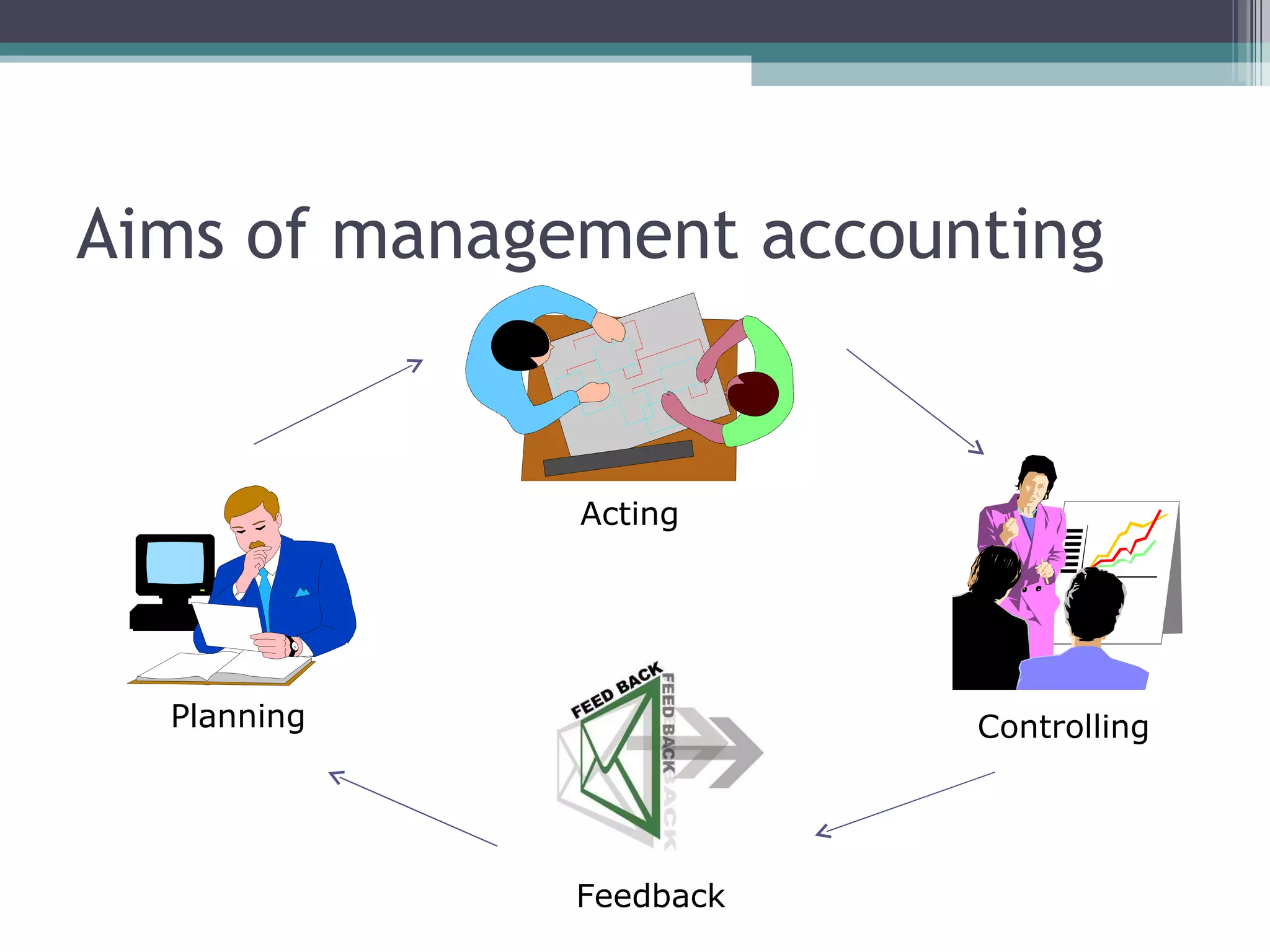
Aims of management accounting Planning Feedback Controlling Acting
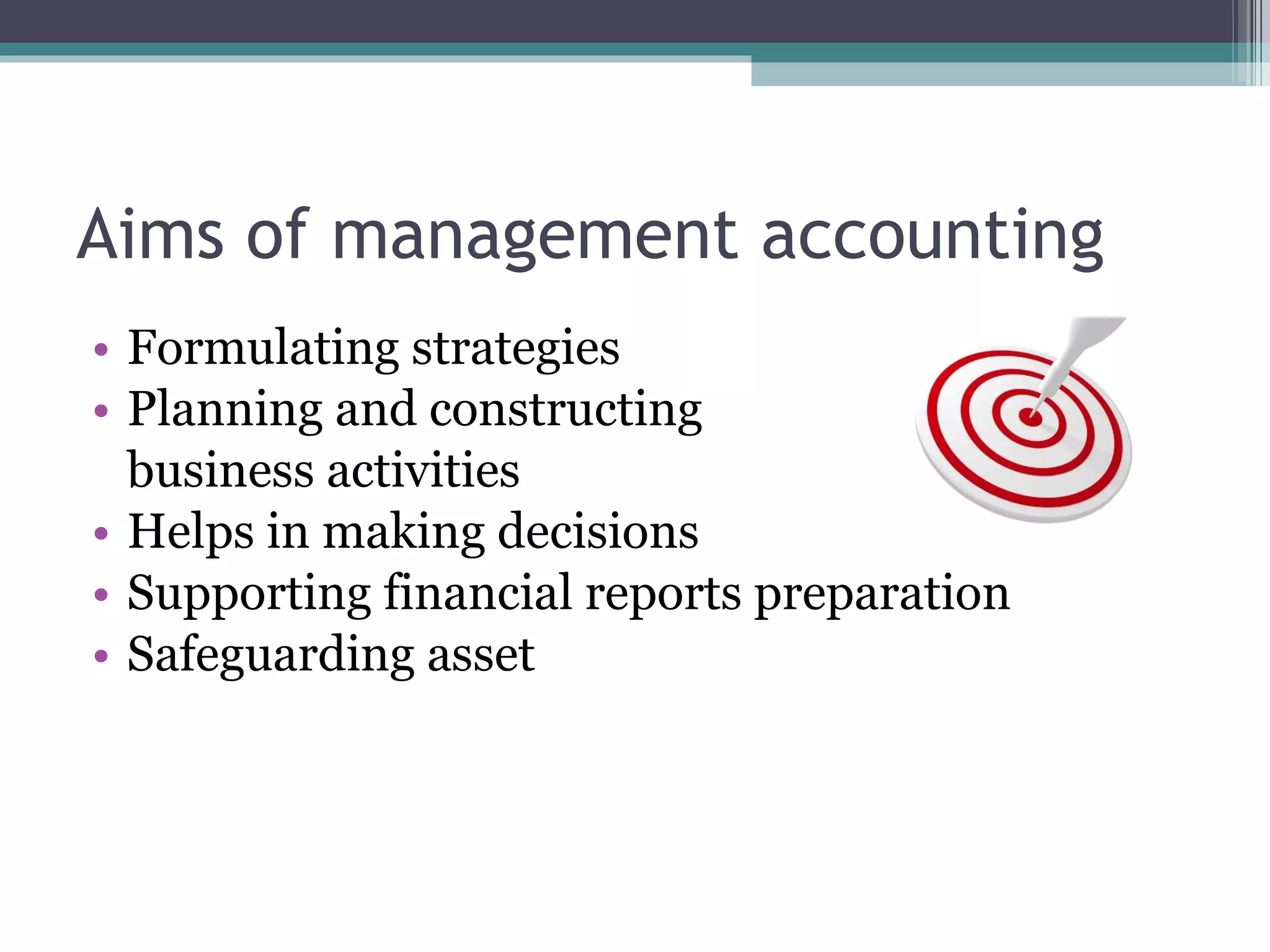
Aims of management accounting Formulating strategies  Planning and constructing  business activities  Helps in making decisions Supporting financial reports preparation  Safeguarding asset
Aims of management accounting Distinguish between financial accounting and management accounting Information of management  accounting is used for internal purposes only, not for external reports Management accounting has a future perspective and helps managers in making decisions.
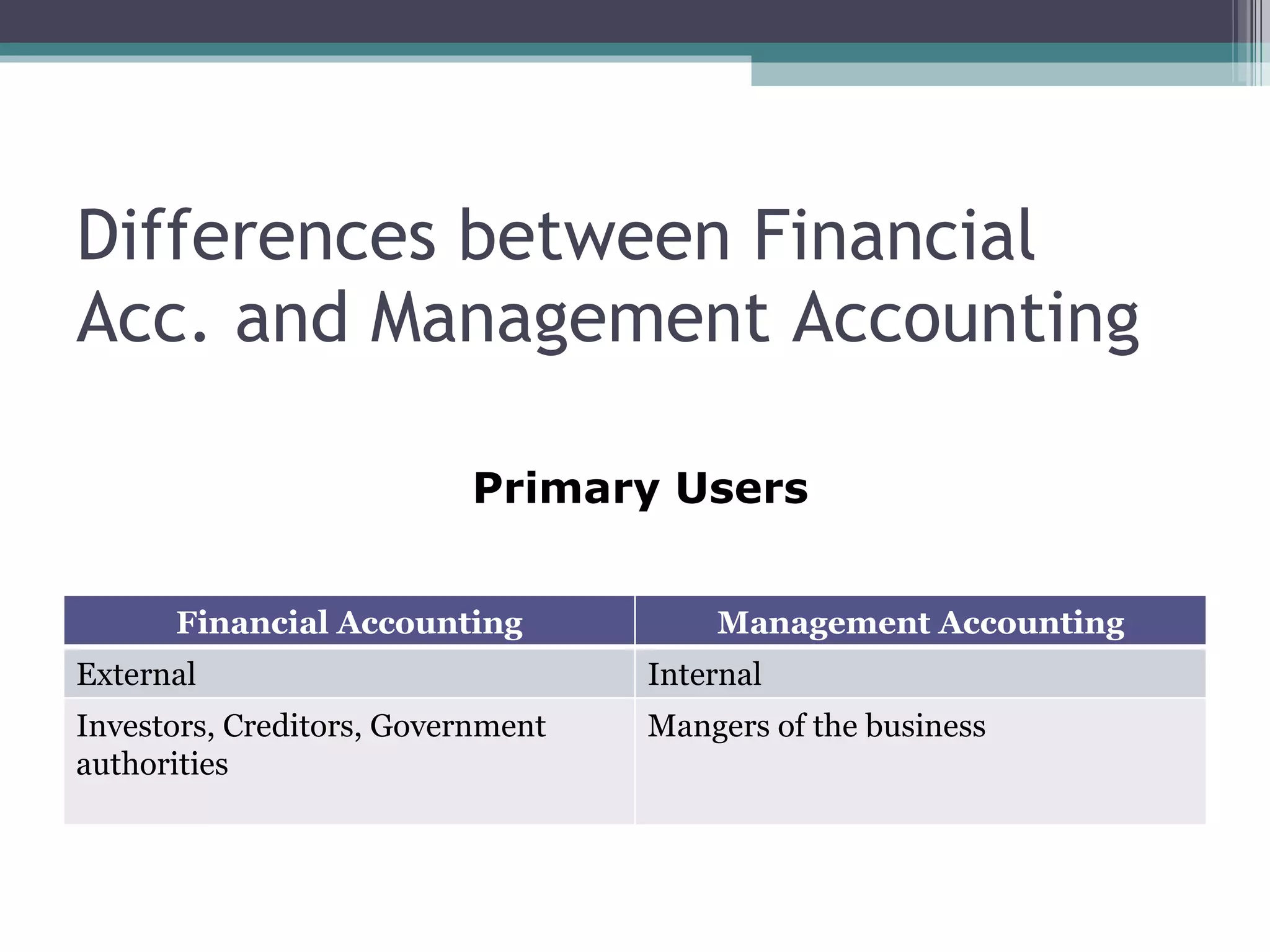
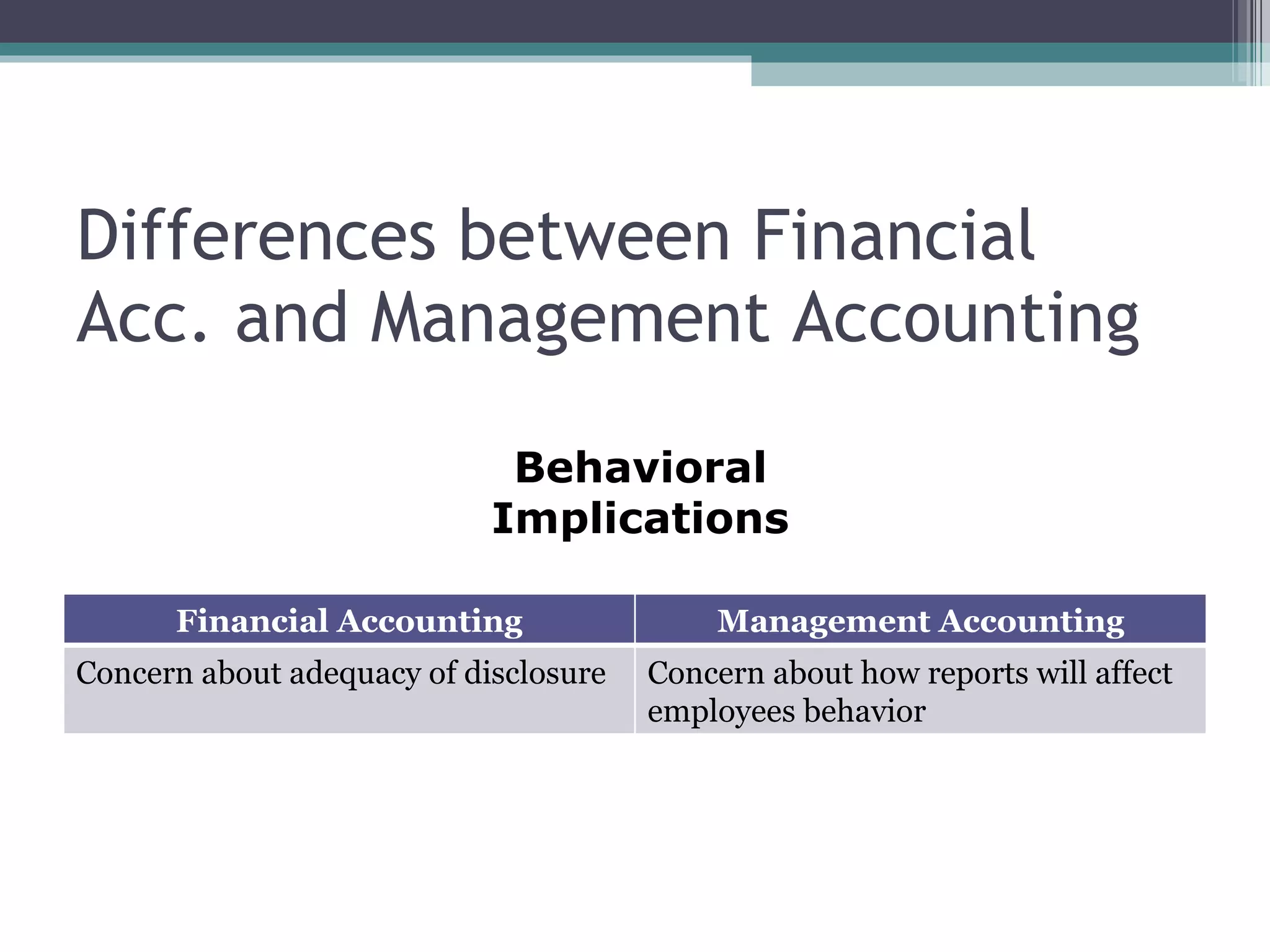
Differences between Financial Acc. and Management Accounting Primary Users Financial Accounting Management Accounting External Internal Investors, Creditors, Government authorities Mangers of the business
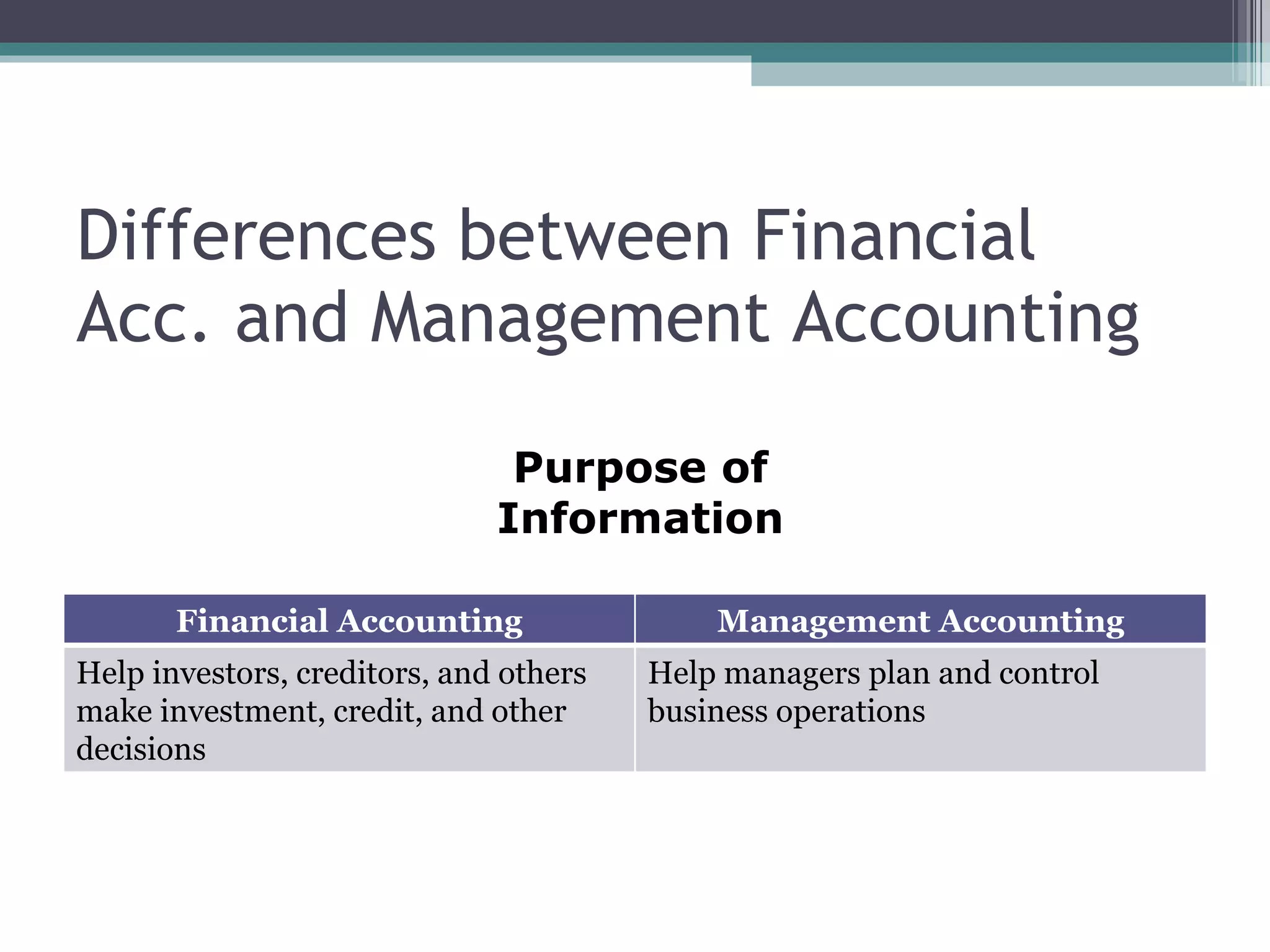
Differences between Financial Acc. and Management Accounting Purpose of Information Financial Accounting Management Accounting Help investors, creditors, and others make investment, credit, and other decisions Help managers plan and control business operations
Differences between Financial Acc. and Management Accounting Behavioral Implications Financial Accounting Management Accounting Concern about adequacy of disclosure Concern about how reports will affect employees behavior
Role of MA within the Corporation Cost accounting became the major role in management accounting Linkage between the management team and the financial department Management Accounting is important for nearly every part of the company, as well as for the overall success of a company
Behavioral aspects of Management Accounting Behavioral aspect of management accounting is that which influences the decision of the people concerned with decision making in the accounting system.
Subjective representation of objective phenomena Behavior depends on individuals’ mental representations, which can differ in important ways from objective indicators. Effects of MA practice on individuals’ behavior can depend not only on how objectively informative the MA practice is about factors that affect their welfare but also on how understandable the MA practice is how well individuals can form usable mental representations of it and connect it to their other mental representations and how it stimulates individuals’ attention, cognition, and/or motivation
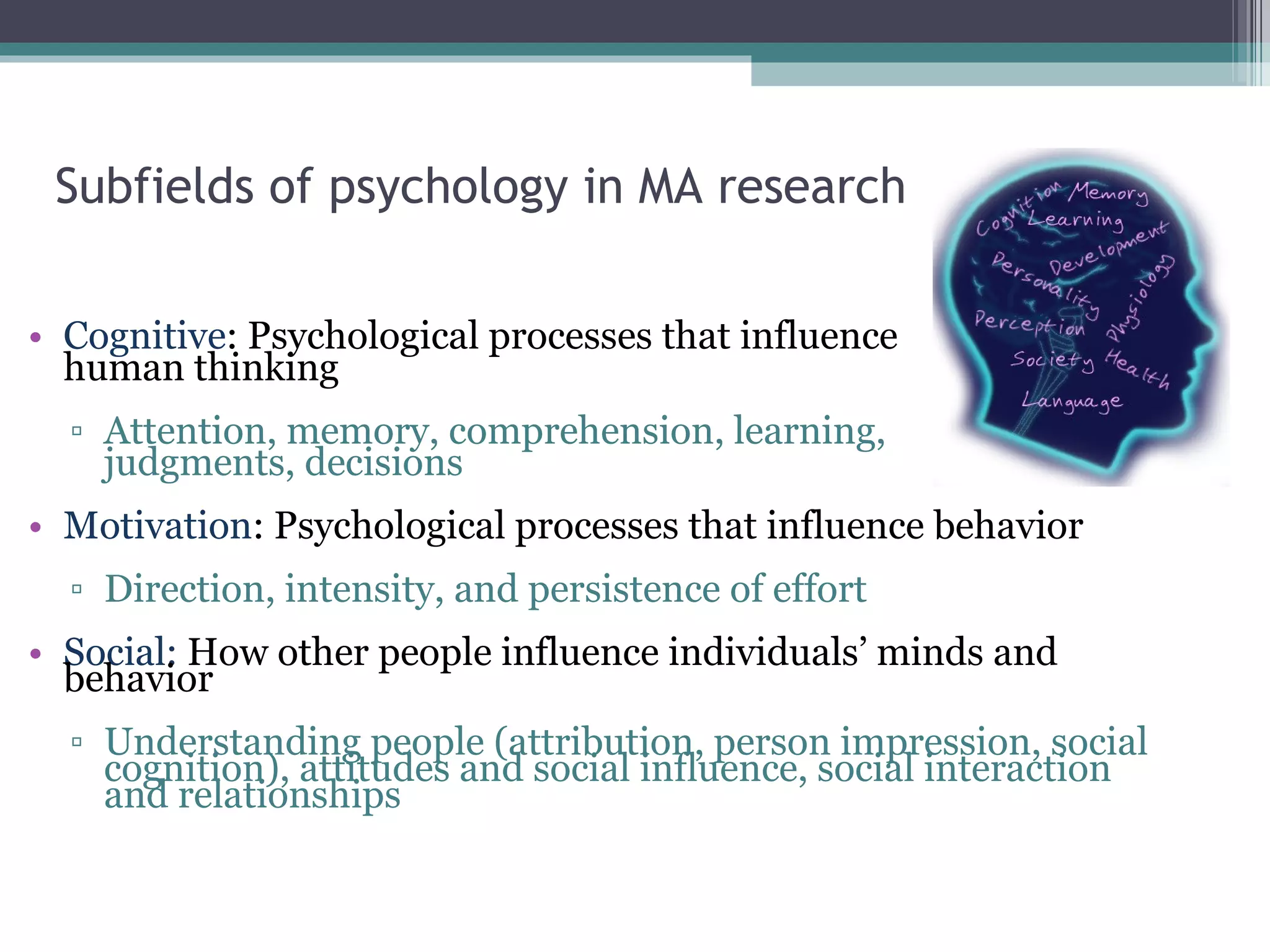
Subfields of psychology in MA research Cognitive : Psychological processes that influence  human thinking Attention, memory, comprehension, learning,  judgments, decisions Motivation : Psychological processes that influence behavior Direction, intensity, and persistence of effort Social:  How other people influence individuals’ minds and behavior Understanding people (attribution, person impression, social cognition), attitudes and social influence, social interaction and relationships
Motivational Theories in  management accounting Goal setting theory Performance is a positive function of goal difficulty Specific goals reduce variation in performance Incentives indirectly influence performance via its effect on goal commitment Goal-performance relation is influenced by goal commitment, goal importance, feedback, task complexity, self-efficacy
Organizational justice theory Individuals are motivated to maintain a balance in exchange relations by comparing their and others’ ratio of inputs to outcomes (e.g., pay) If individuals believe their ratio is inequitable, then they experience negative emotions, which they minimize by changing their inputs and/or outcomes
Human Resource Model Of Motivation (HRMM) Perhaps the most contemporary management view of motivation Based on initiatives to improve the quality of working life and the strong influence of Japanese management practices Introduces a high level of employee responsibility for and participation in decisions in the work environment    2003 Prentice Hall Business Publishing, PowerPoint supplement to  Management Accounting, 4rd ed. , Atkinson, Kaplan, and Young, prepared by Terry M. Lease, Ph.D., CPA, Sonoma State University
Central Assumptions of the HRMM Organizations operate under a system of beliefs about the values, purpose, and direction of their organization People find work enjoyable and desire to participate in: Developing objectives Making decisions Attaining goals in their work environment Individuals are motivated by both financial and nonfinancial means of compensation    2003 Prentice Hall Business Publishing, PowerPoint supplement to  Management Accounting, 4rd ed. , Atkinson, Kaplan, and Young, prepared by Terry M. Lease, Ph.D., CPA, Sonoma State University
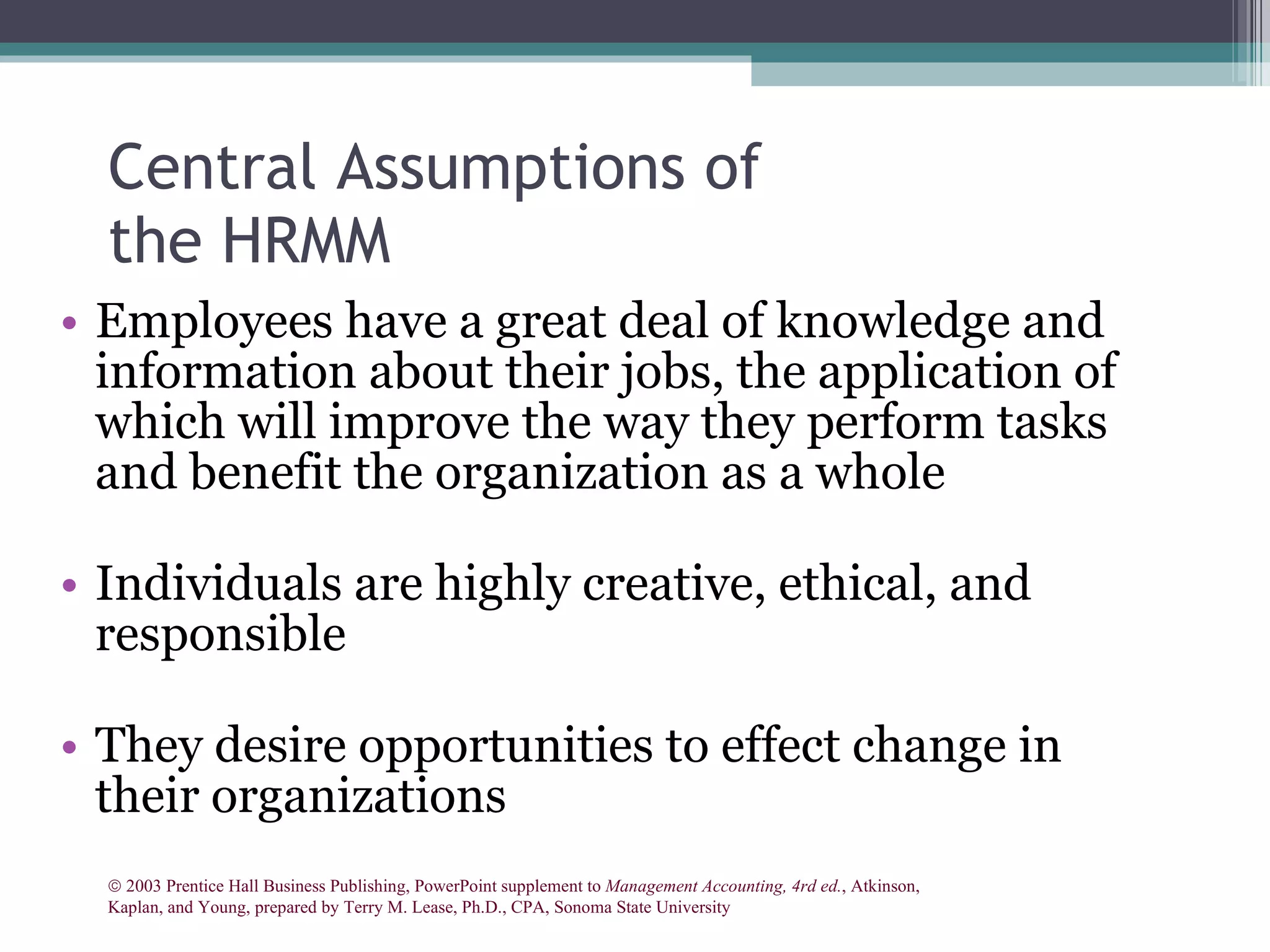
Central Assumptions of the HRMM Employees have a great deal of knowledge and information about their jobs, the application of which will improve the way they perform tasks and benefit the organization as a whole Individuals are highly creative, ethical, and responsible They desire opportunities to effect change in their organizations    2003 Prentice Hall Business Publishing, PowerPoint supplement to  Management Accounting, 4rd ed. , Atkinson, Kaplan, and Young, prepared by Terry M. Lease, Ph.D., CPA, Sonoma State University
COST BEHAVIOUR ANALYSIS
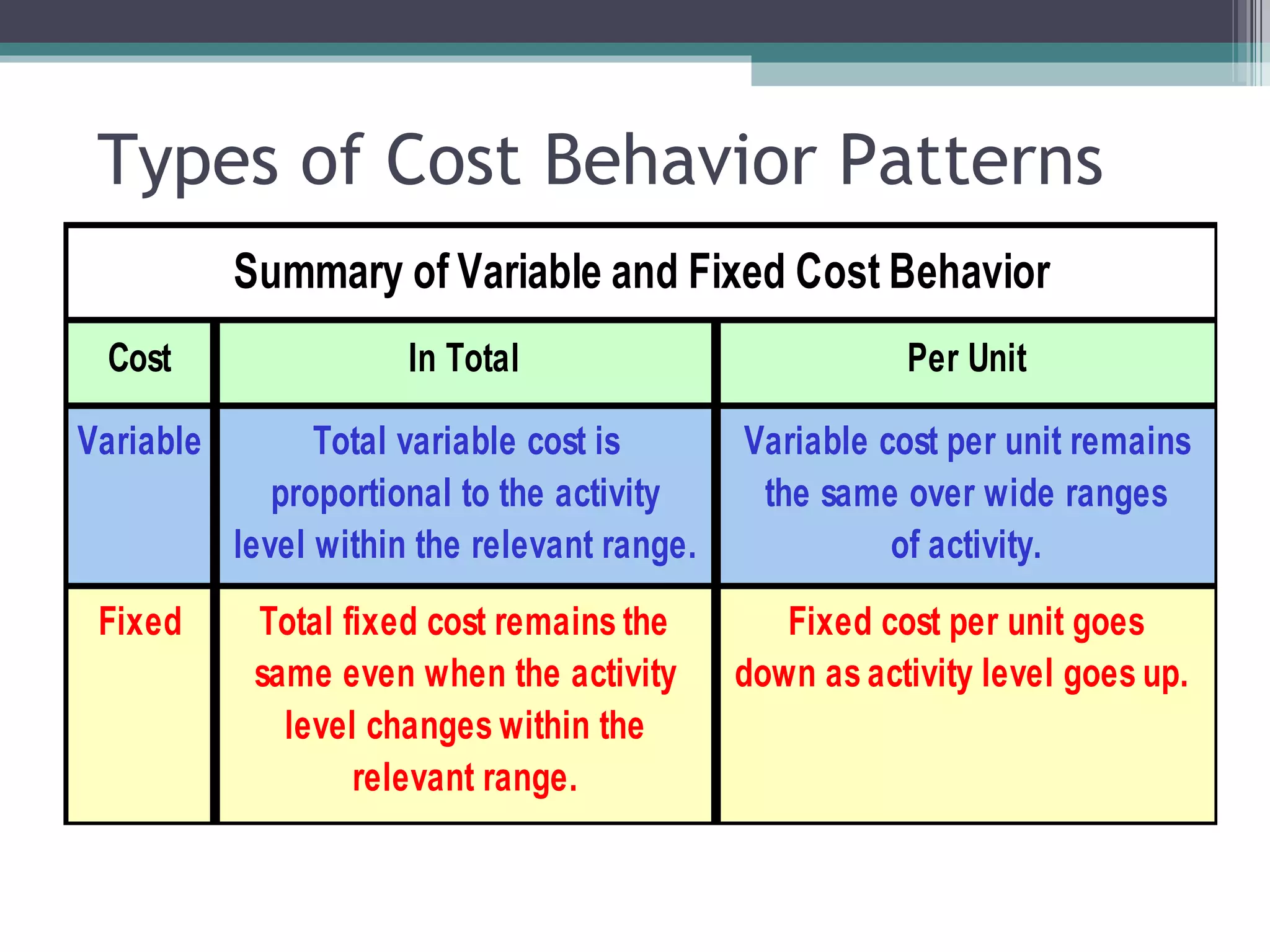
Types of Cost Behavior Patterns
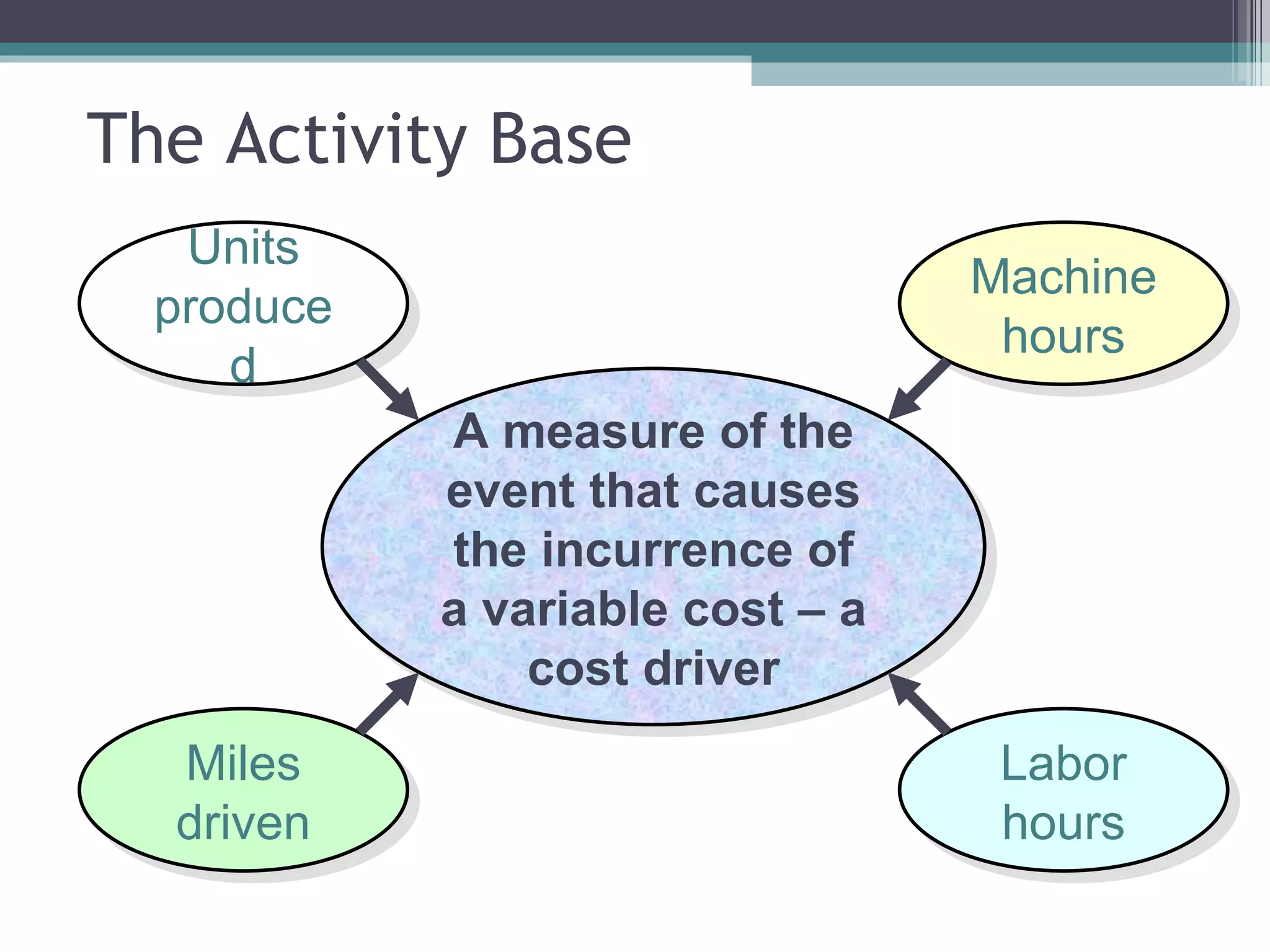
The Activity Base A measure of the event that causes the incurrence of a variable cost – a cost driver Units produced Miles driven Labor hours Machine hours
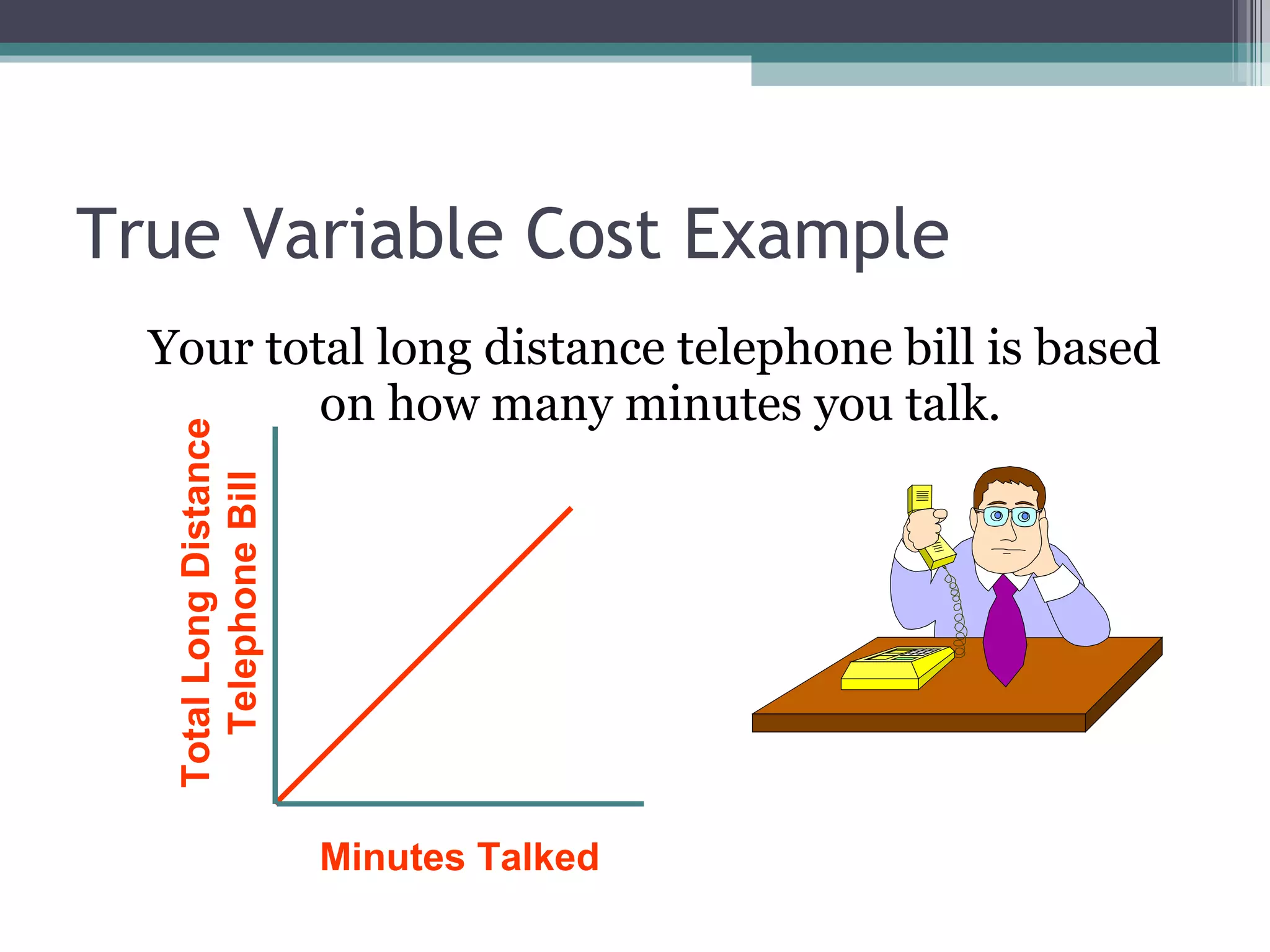
True Variable Cost Example Your total long distance telephone bill is based on how many minutes you talk. Minutes Talked Total Long Distance Telephone Bill
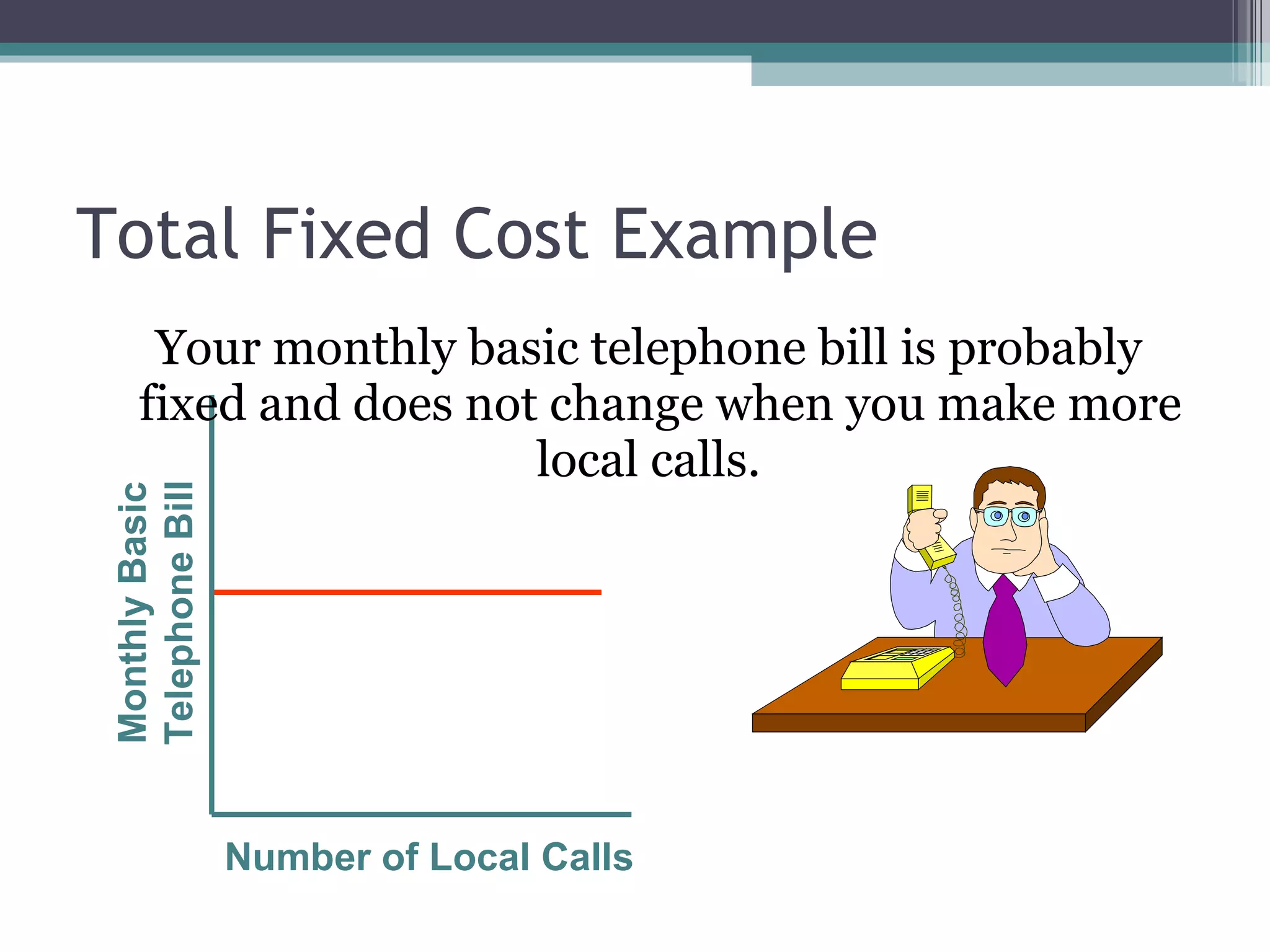
Total Fixed Cost Example Your monthly basic telephone bill is probably fixed and does not change when you make more local calls.  Number of Local Calls Monthly Basic Telephone Bill
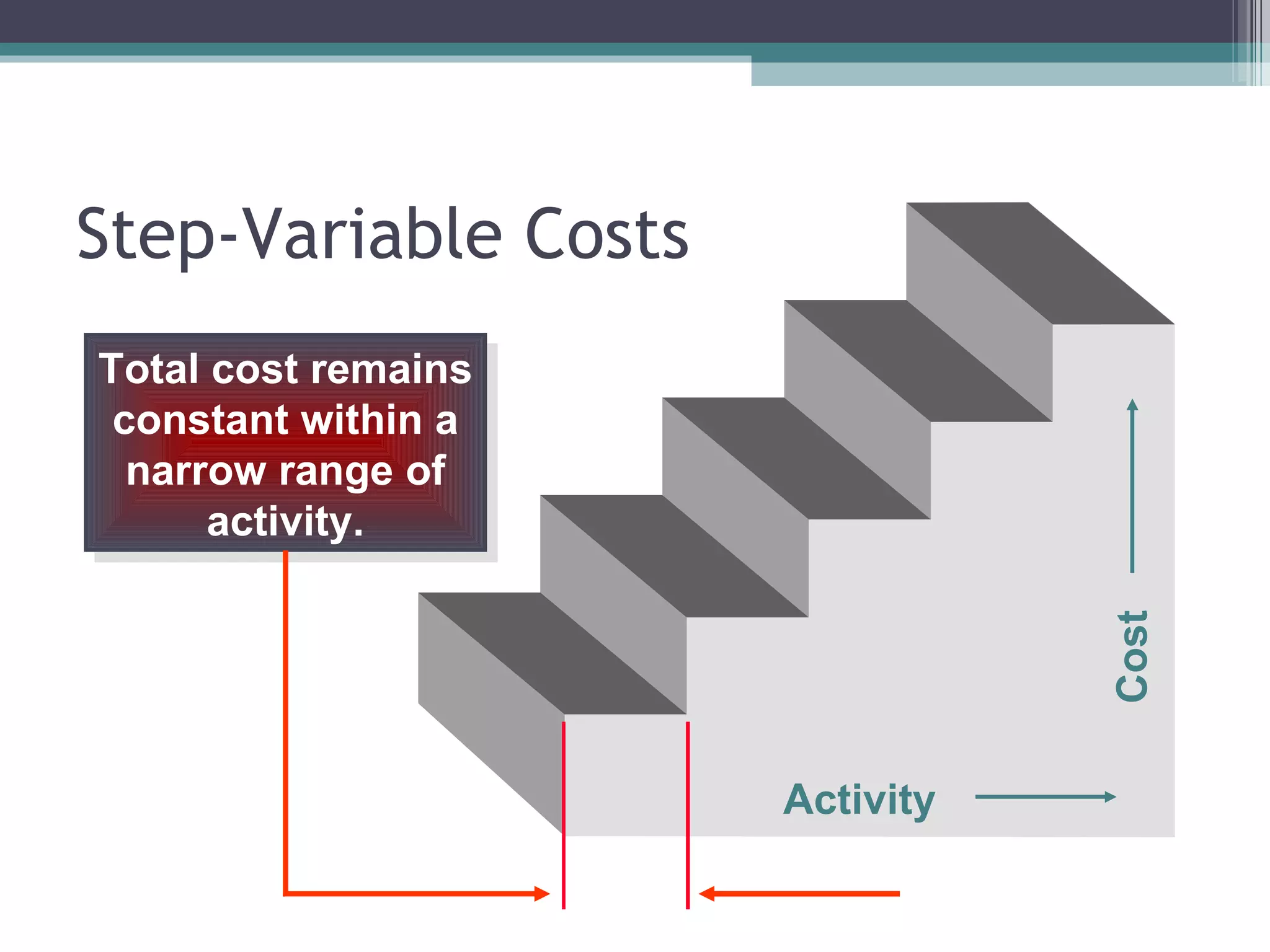
Step-Variable Costs Activity Cost Total cost remains constant within a narrow range of activity.
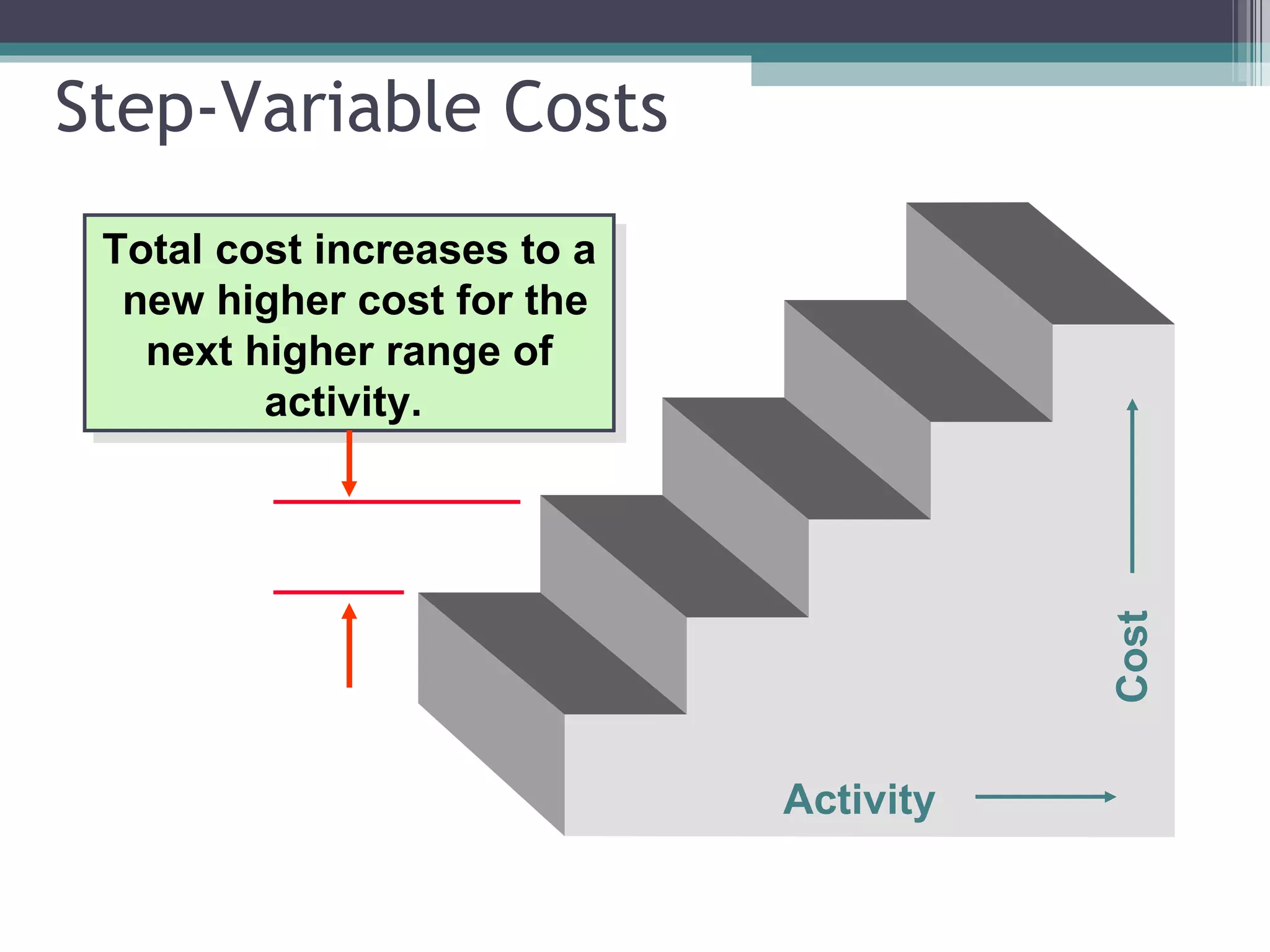
Step-Variable Costs Activity Cost Total cost increases to a  new higher cost for the next higher range of activity.
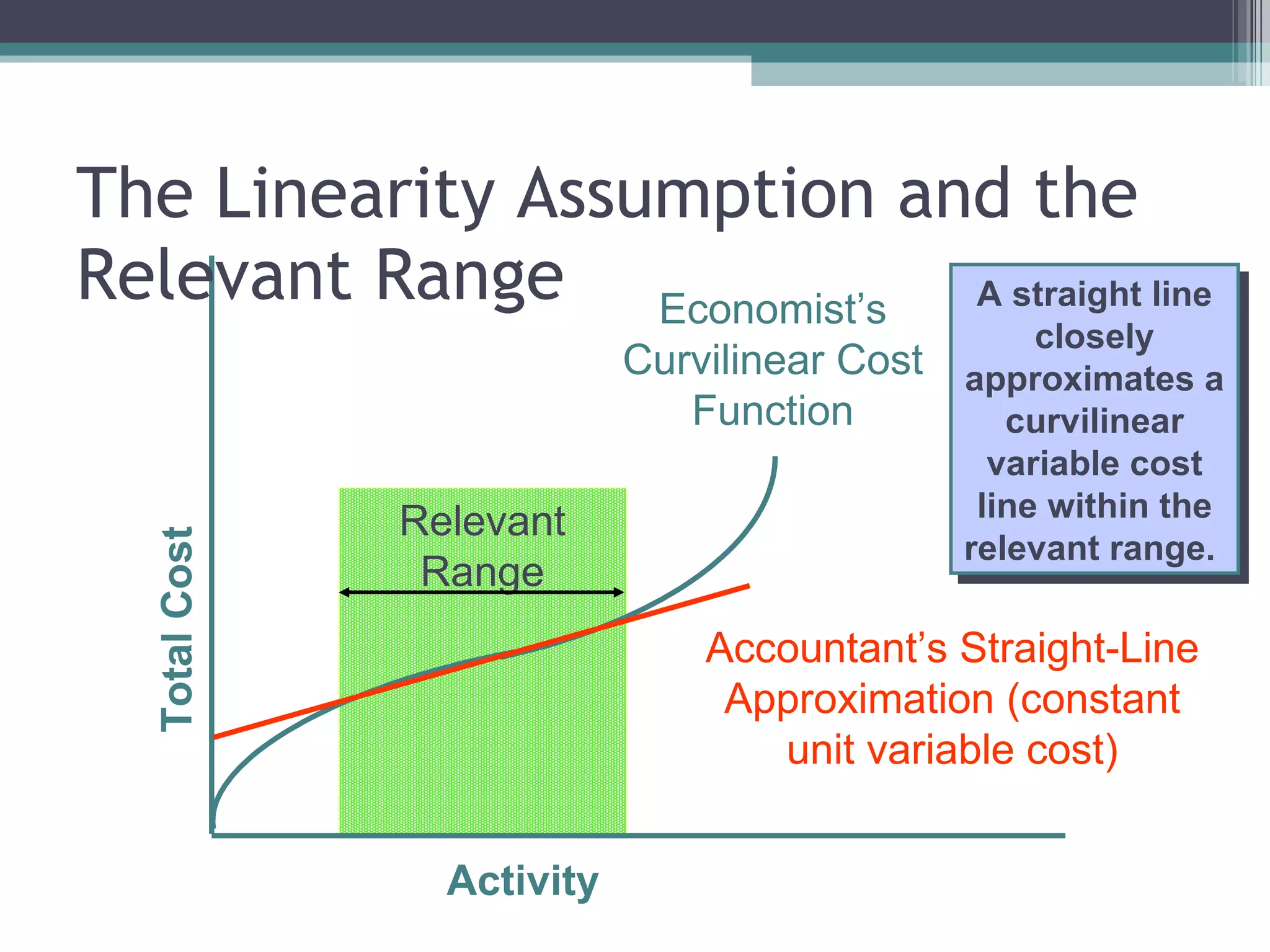
The Linearity Assumption and the Relevant Range Activity Total Cost Economist’s Curvilinear Cost Function Relevant Range A straight line closely approximates a curvilinear variable cost line within the relevant range.  Accountant’s Straight-Line Approximation (constant unit variable cost)
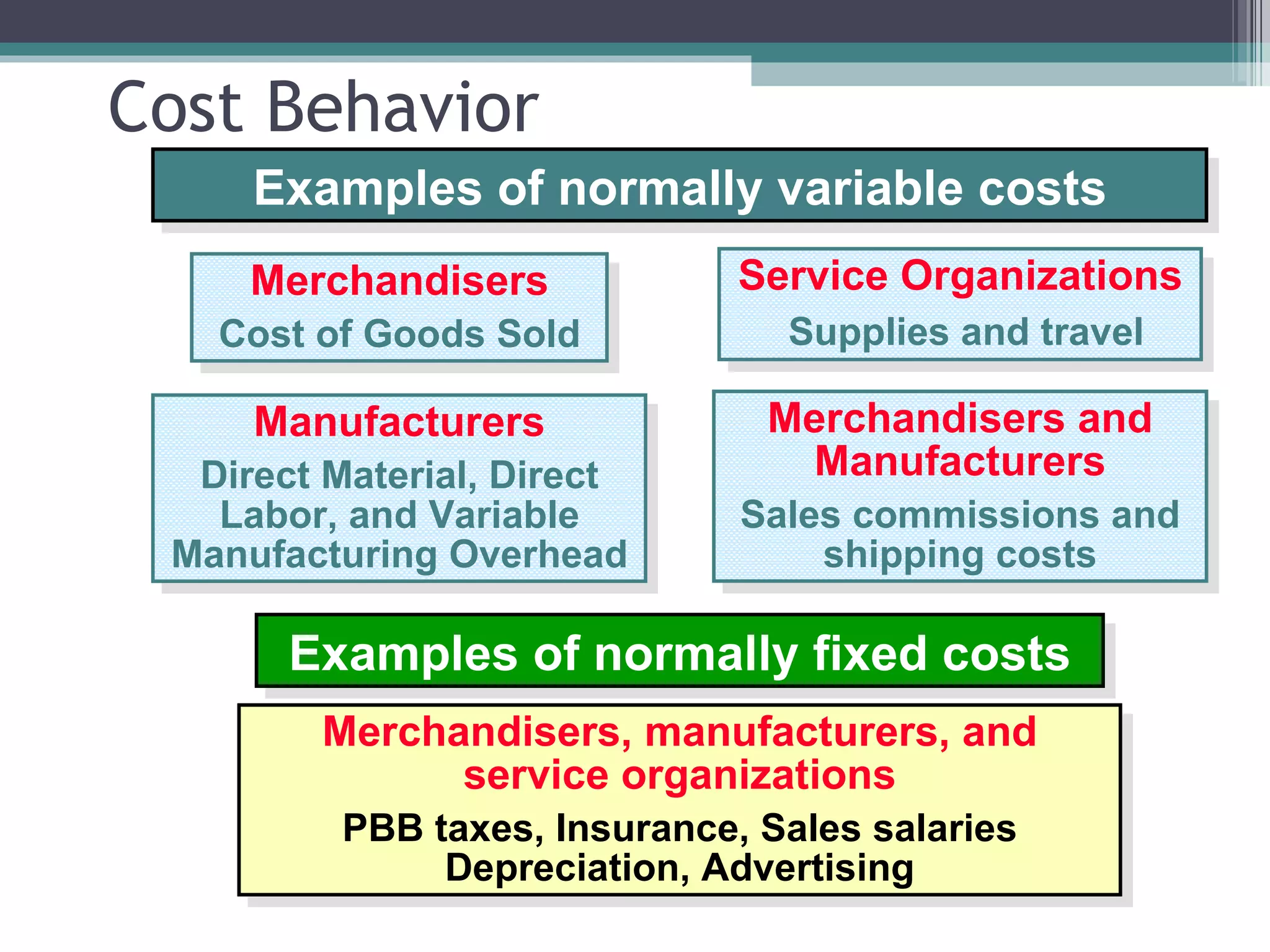
Cost Behavior Merchandisers Cost of Goods Sold Manufacturers Direct Material, Direct Labor, and Variable Manufacturing Overhead Merchandisers and Manufacturers Sales commissions and shipping costs Service Organizations Supplies and travel Examples of normally variable costs Examples of normally fixed costs Merchandisers, manufacturers, and service organizations PBB taxes, Insurance, Sales salaries Depreciation, Advertising
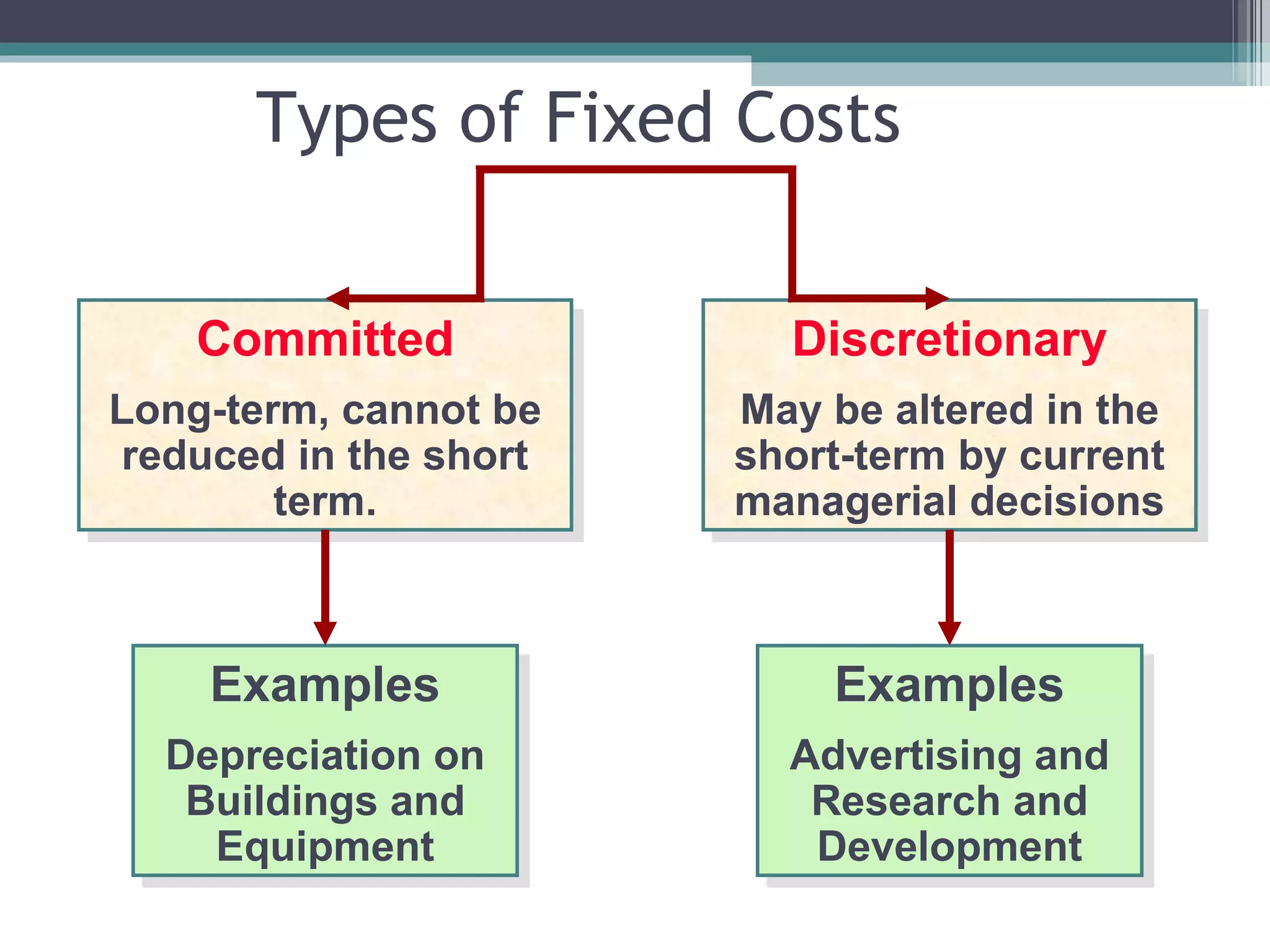
Types of Fixed Costs Examples Advertising and Research and Development Examples Depreciation on Buildings and Equipment Discretionary May be altered in the short-term by current managerial decisions Committed Long-term, cannot be reduced in the short term.
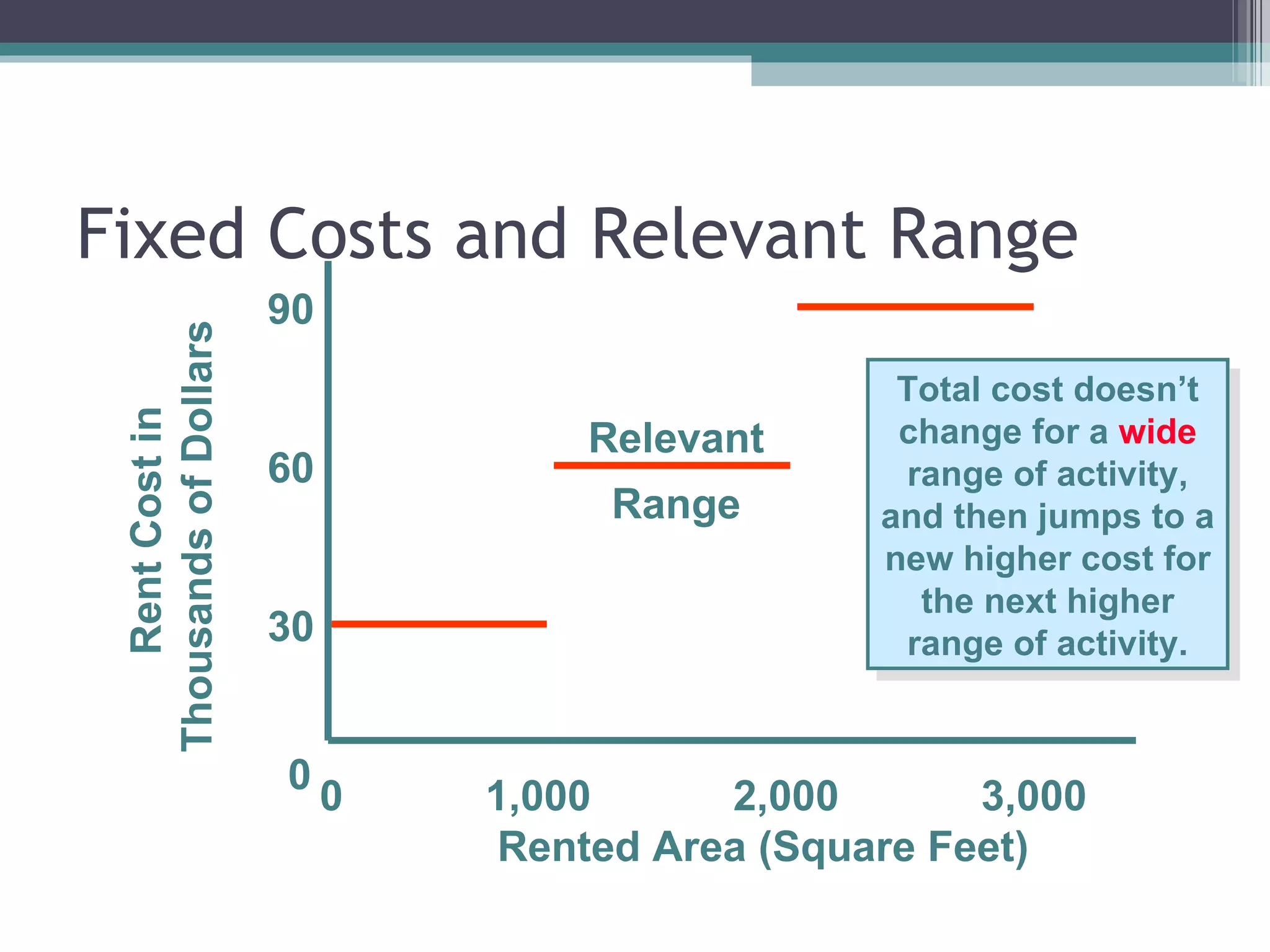
Fixed Costs and Relevant Range Rent Cost in Thousands of Dollars  0  1,000  2,000  3,000    Rented Area (Square Feet) 0 30 60 90 Relevant  Range Total cost doesn’t change for a  wide  range of activity, and then jumps to a new higher cost for the next higher range of activity.
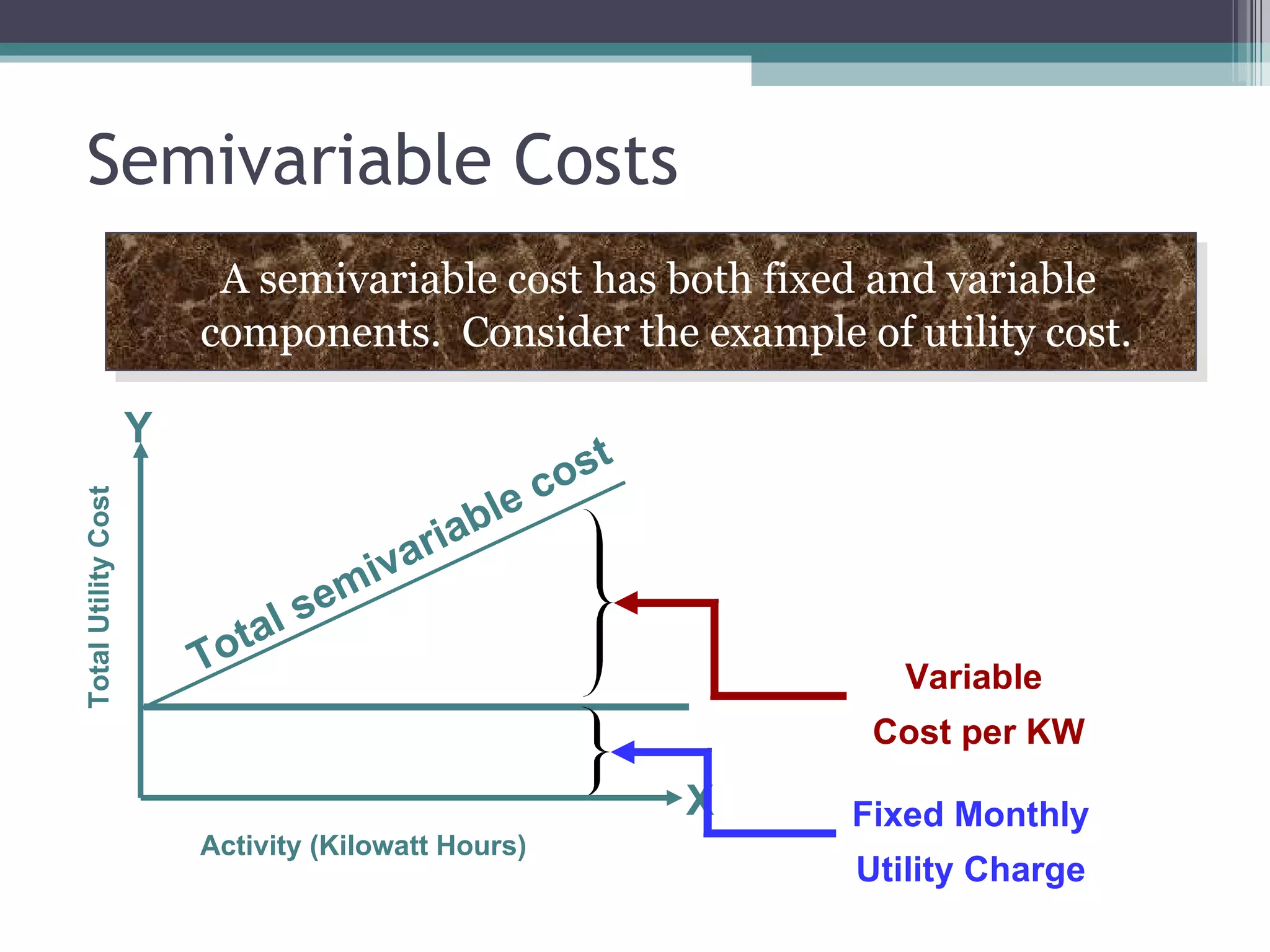
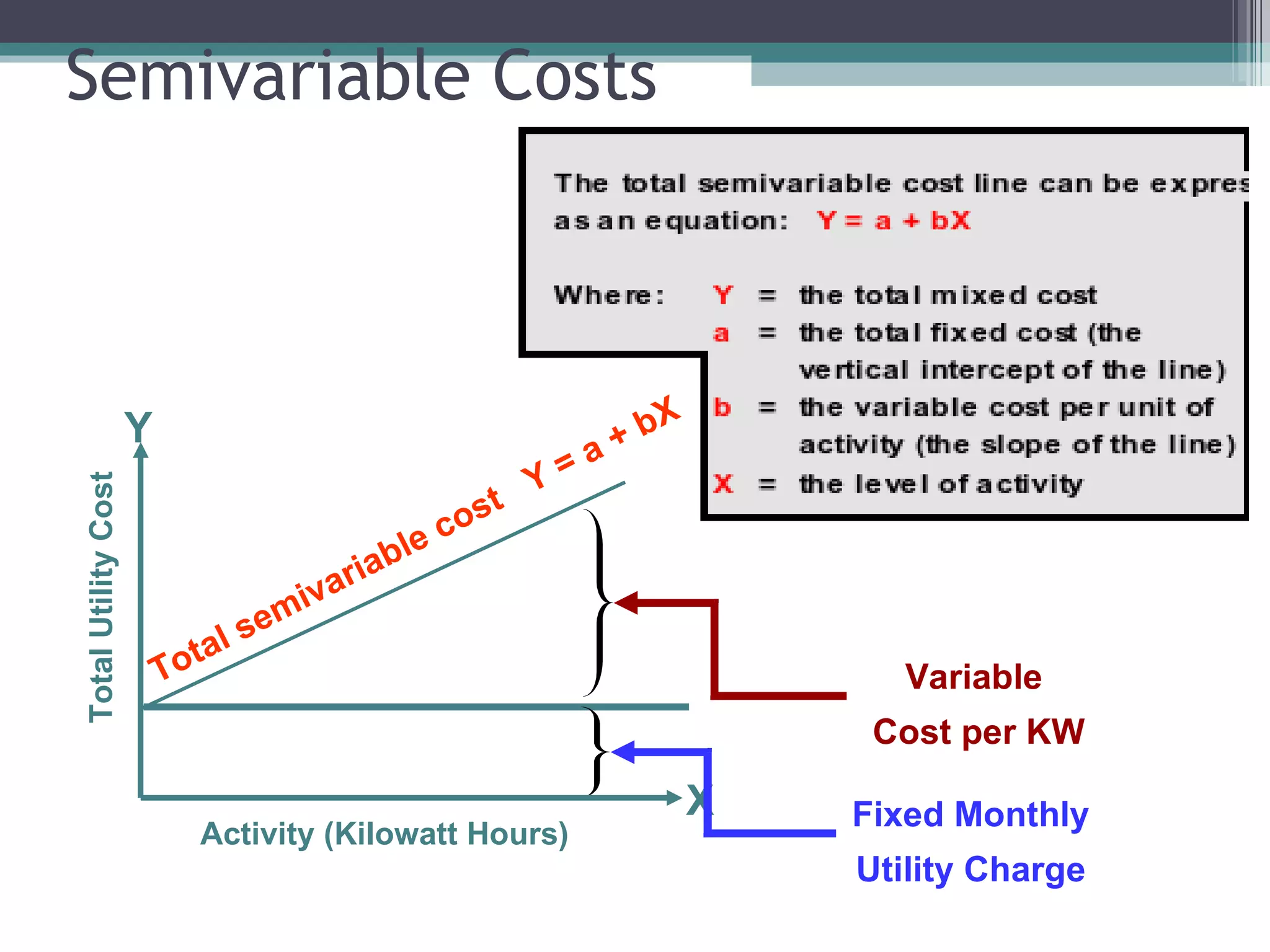
Semivariable Costs  Fixed Monthly Utility Charge Variable  Cost per KW Activity (Kilowatt Hours)   Total Utility Cost A semivariable cost has both fixed and variable components.  Consider the example of utility cost.  Total semivariable cost  X Y
Semivariable Costs  Fixed Monthly Utility Charge Variable  Cost per KW Activity (Kilowatt Hours)  Total Utility Cost Total semivariable cost  Y = a + bX X Y
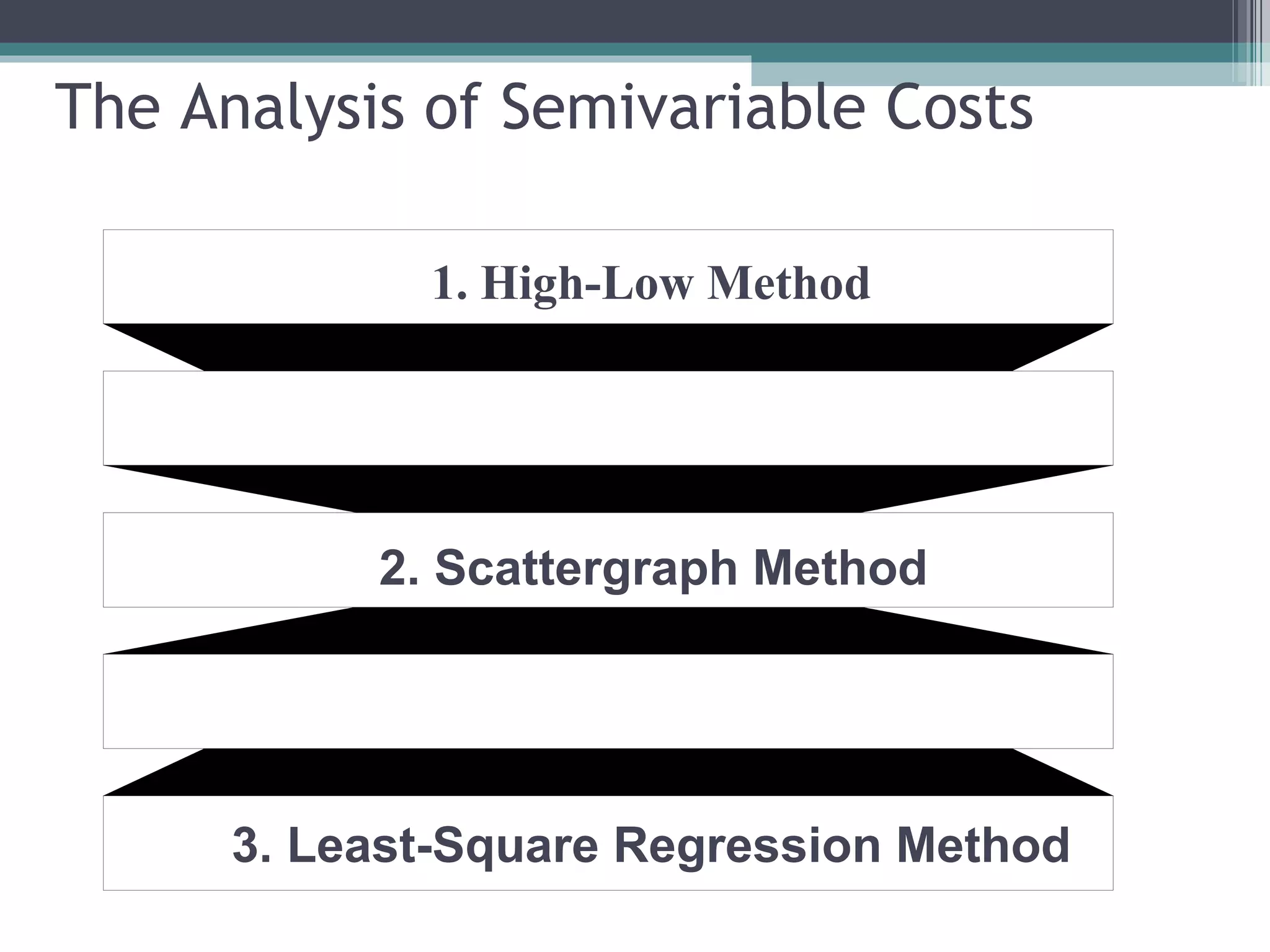
The Analysis of Semivariable Costs 1. High-Low Method 3. Least-Square Regression Method 2. Scattergraph Method
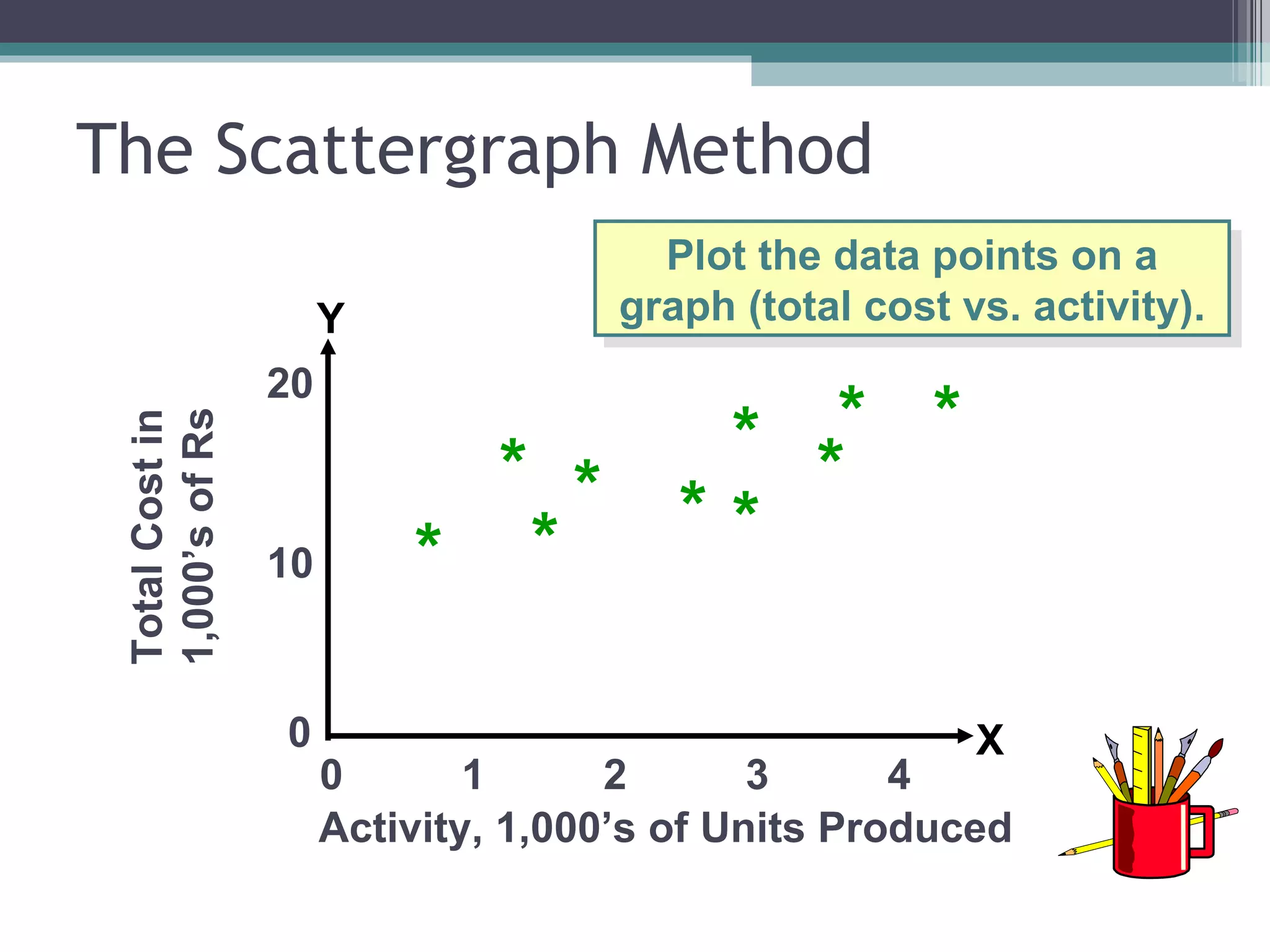
The Scattergraph Method Plot the data points on a graph (total cost vs. activity). 0  1  2  3  4 * Total Cost in 1,000’s of Rs 10 20 0 * * * * * * * * * Activity, 1,000’s of Units Produced X Y
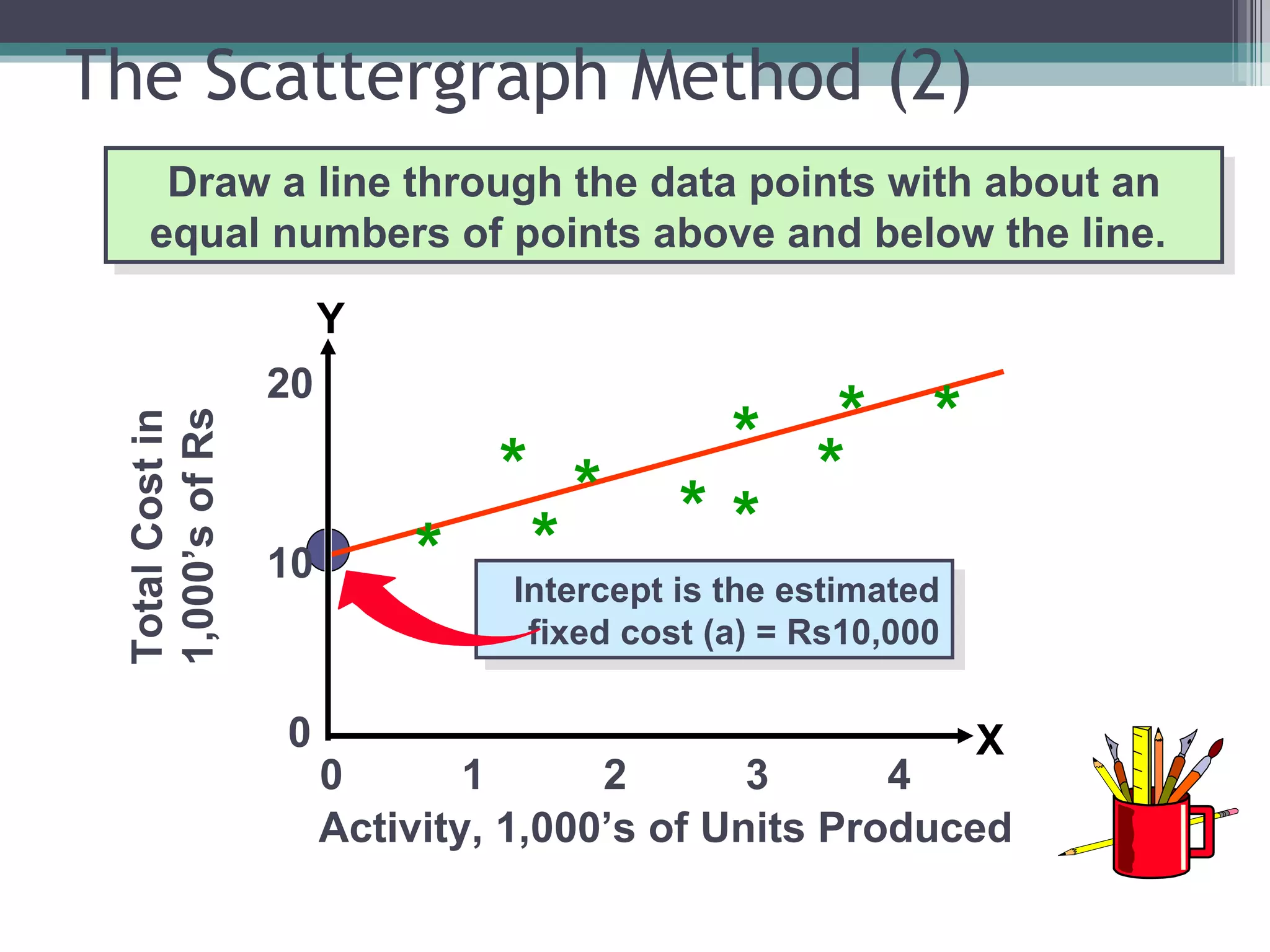
The Scattergraph Method (2) 0  1  2  3  4 * Total Cost in 1,000’s of Rs 10 20 0 * * * * * * * * * Activity, 1,000’s of Units Produced X Y Intercept is the estimated fixed cost (a) = Rs10,000 Draw a line through the data points with about an equal numbers of points above and below the line.
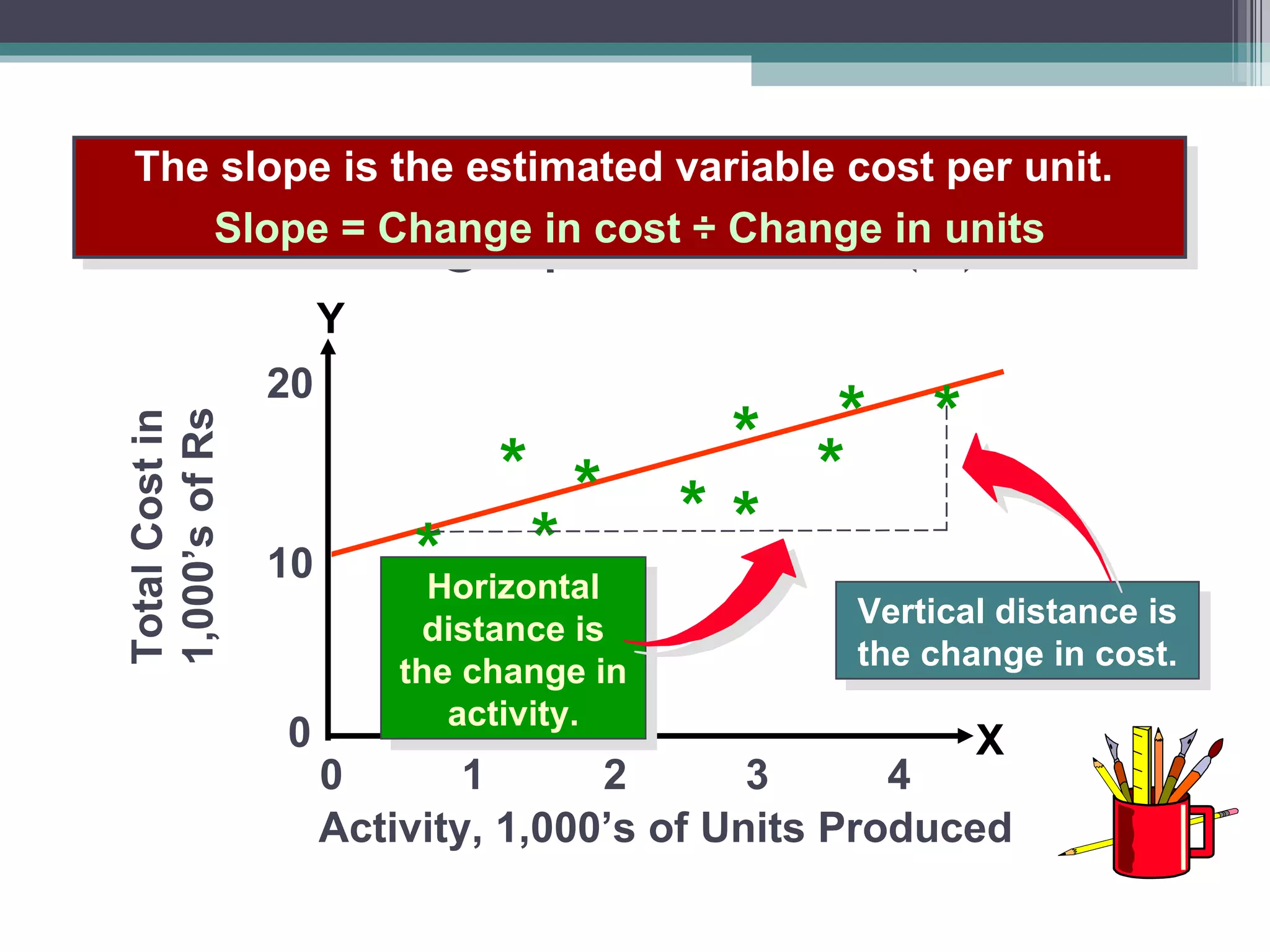
The Scattergraph Method (3) 0  1  2  3  4 * Total Cost in 1,000’s of Rs 10 20 0 * * * * * * * * * Activity, 1,000’s of Units Produced X Y The slope is the estimated variable cost per unit.  Slope = Change in cost ÷ Change in units Vertical distance is the change in cost. Horizontal distance is the change in activity.
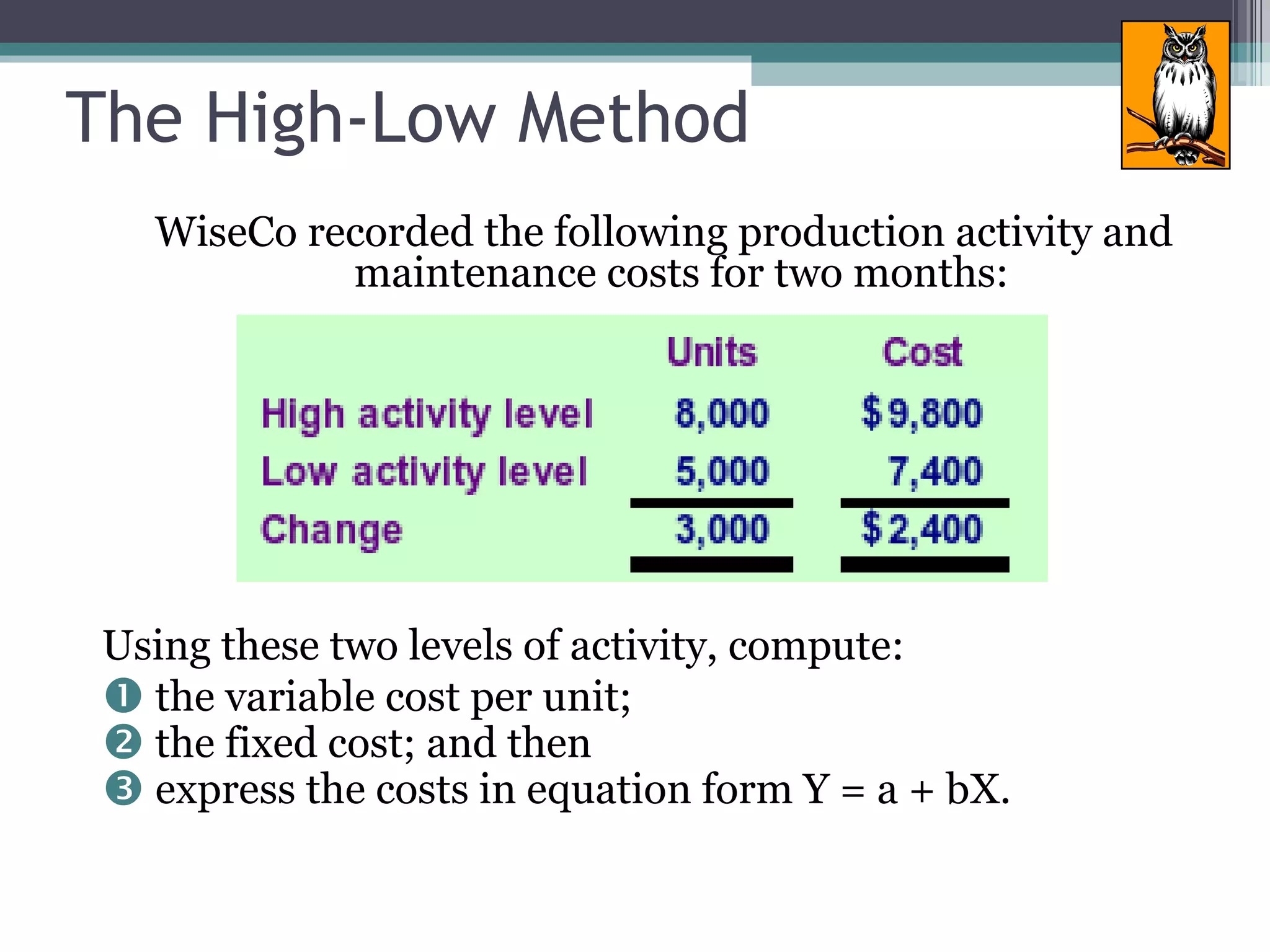
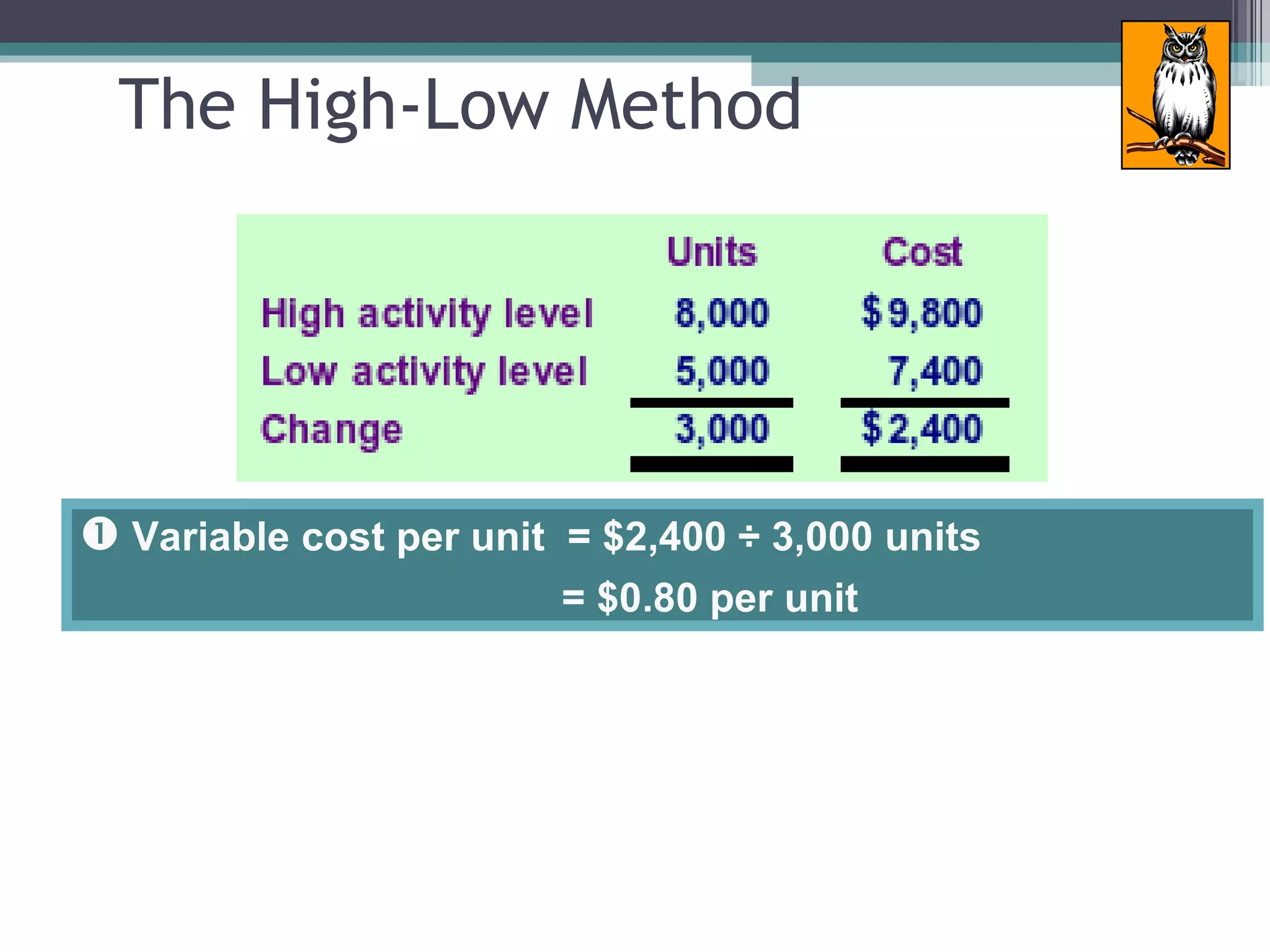
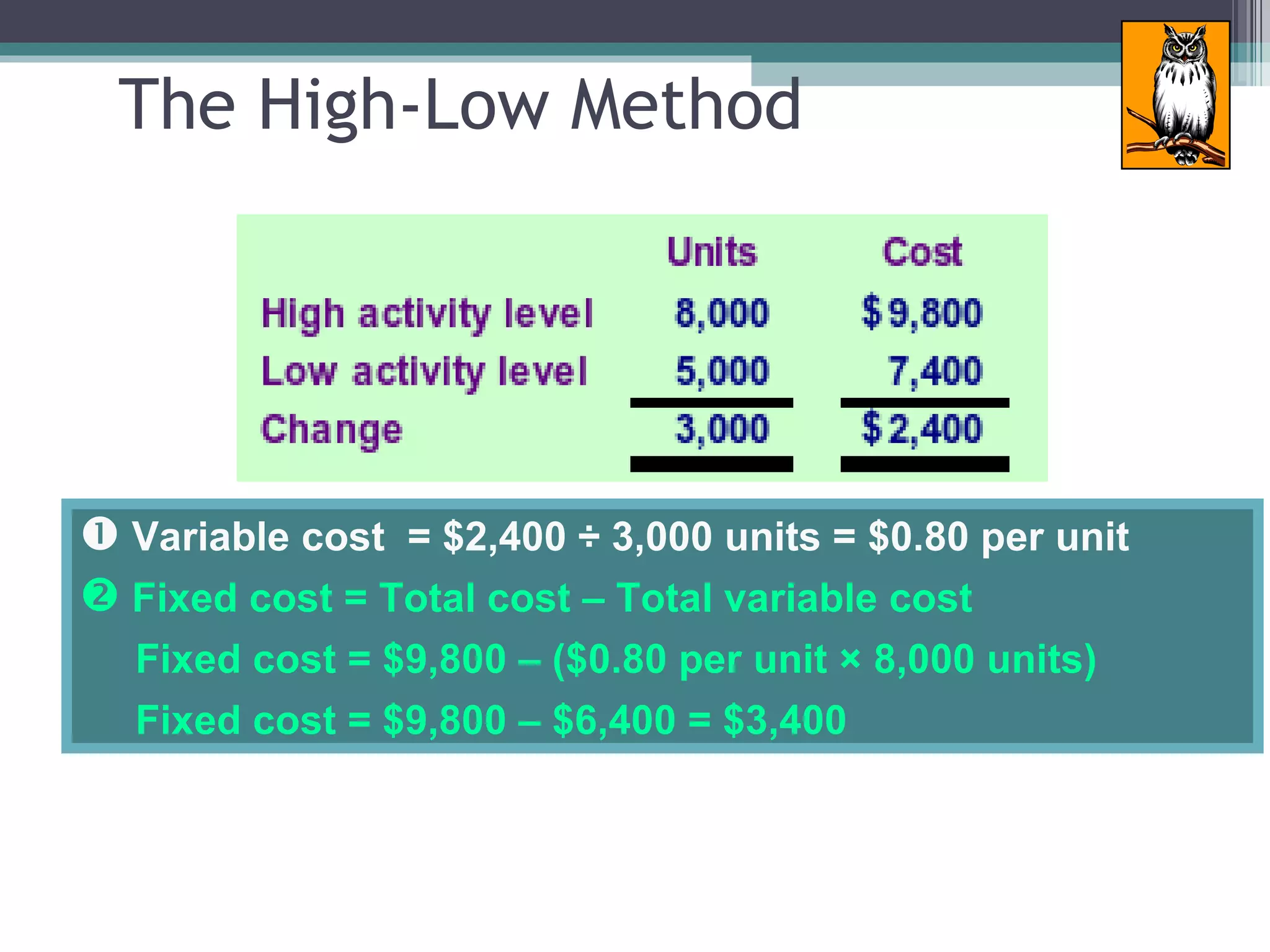
WiseCo recorded the following production activity and maintenance costs for two months: Using these two levels of activity, compute: the variable cost per unit;  the fixed cost; and then express the costs in equation form Y = a + bX.  The High-Low Method
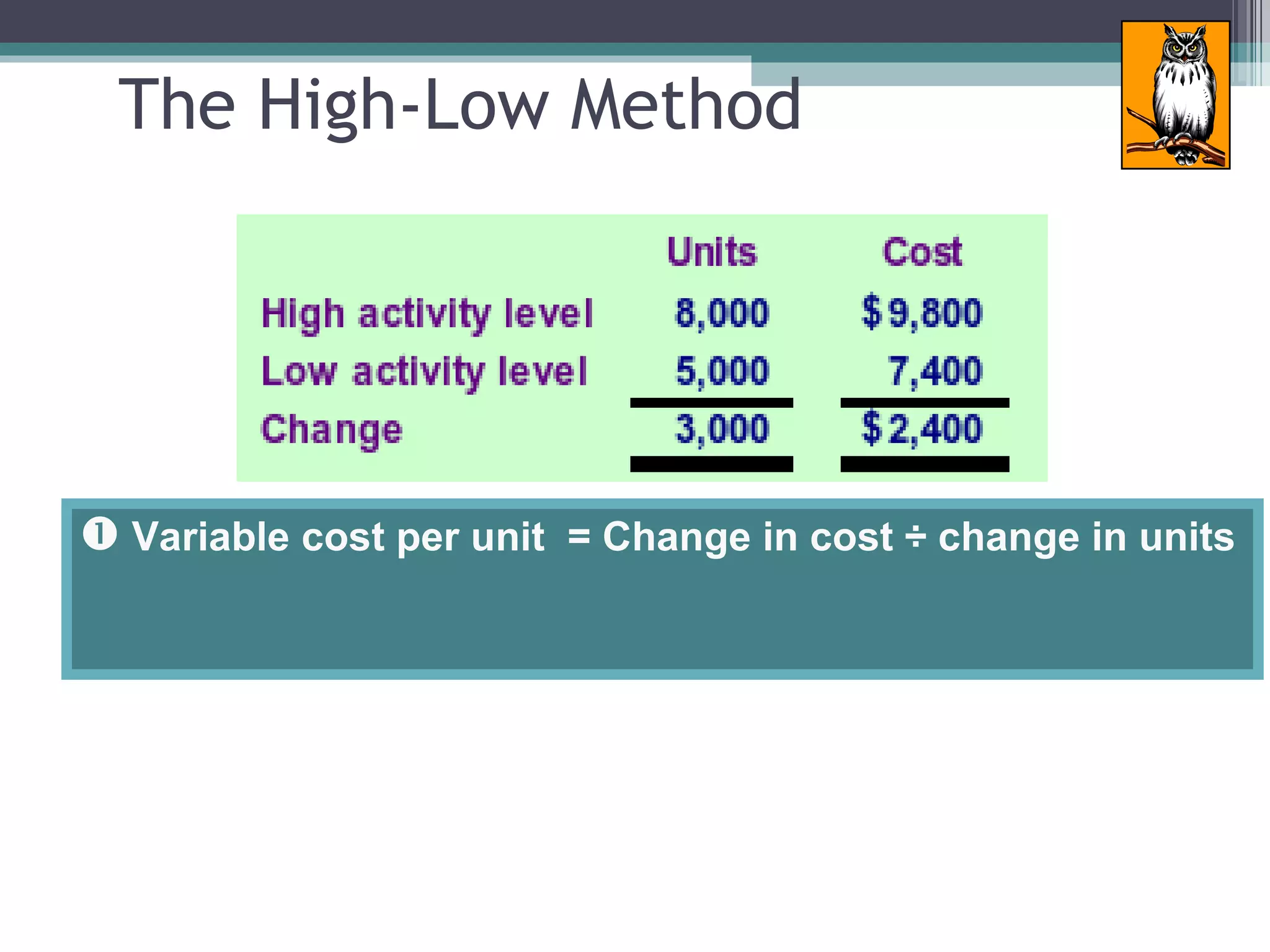
Change  in cost Change in units The High-Low Method Variable cost per unit  = Change in cost ÷ change in units
The High-Low Method Variable cost per unit  = $2,400 ÷ 3,000 units  = $0.80 per unit
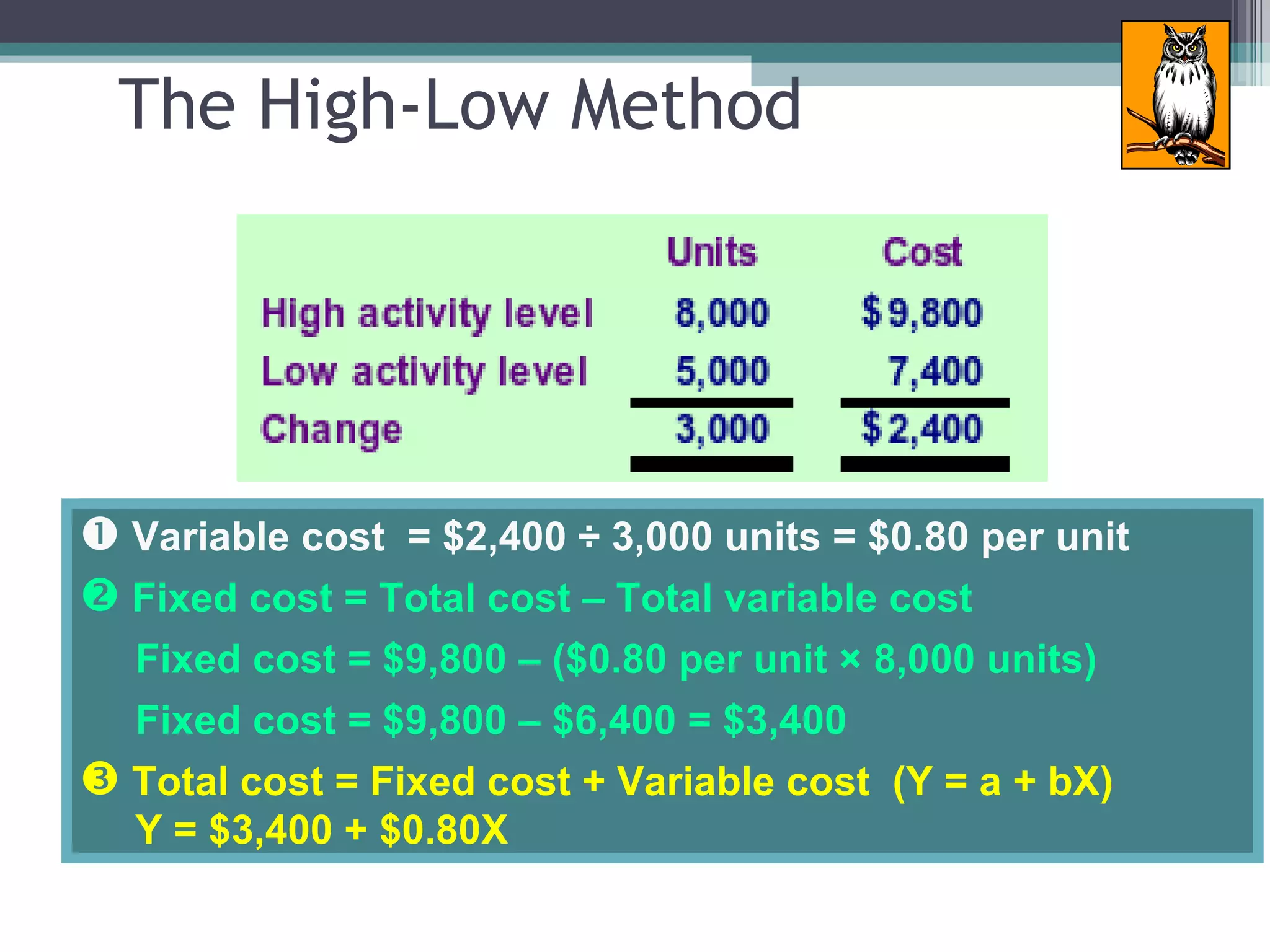
The High-Low Method Variable cost  = $2,400 ÷ 3,000 units = $0.80 per unit Fixed cost = Total cost – Total variable cost Fixed cost = $9,800 – ($0.80 per unit × 8,000 units) Fixed cost = $9,800 – $6,400 = $3,400
Variable cost  = $2,400 ÷ 3,000 units = $0.80 per unit Fixed cost = Total cost – Total variable cost Fixed cost = $9,800 – ($0.80 per unit × 8,000 units) Fixed cost = $9,800 – $6,400 = $3,400 Total cost = Fixed cost + Variable cost  (Y = a + bX)   Y = $3,400 + $0.80X  The High-Low Method
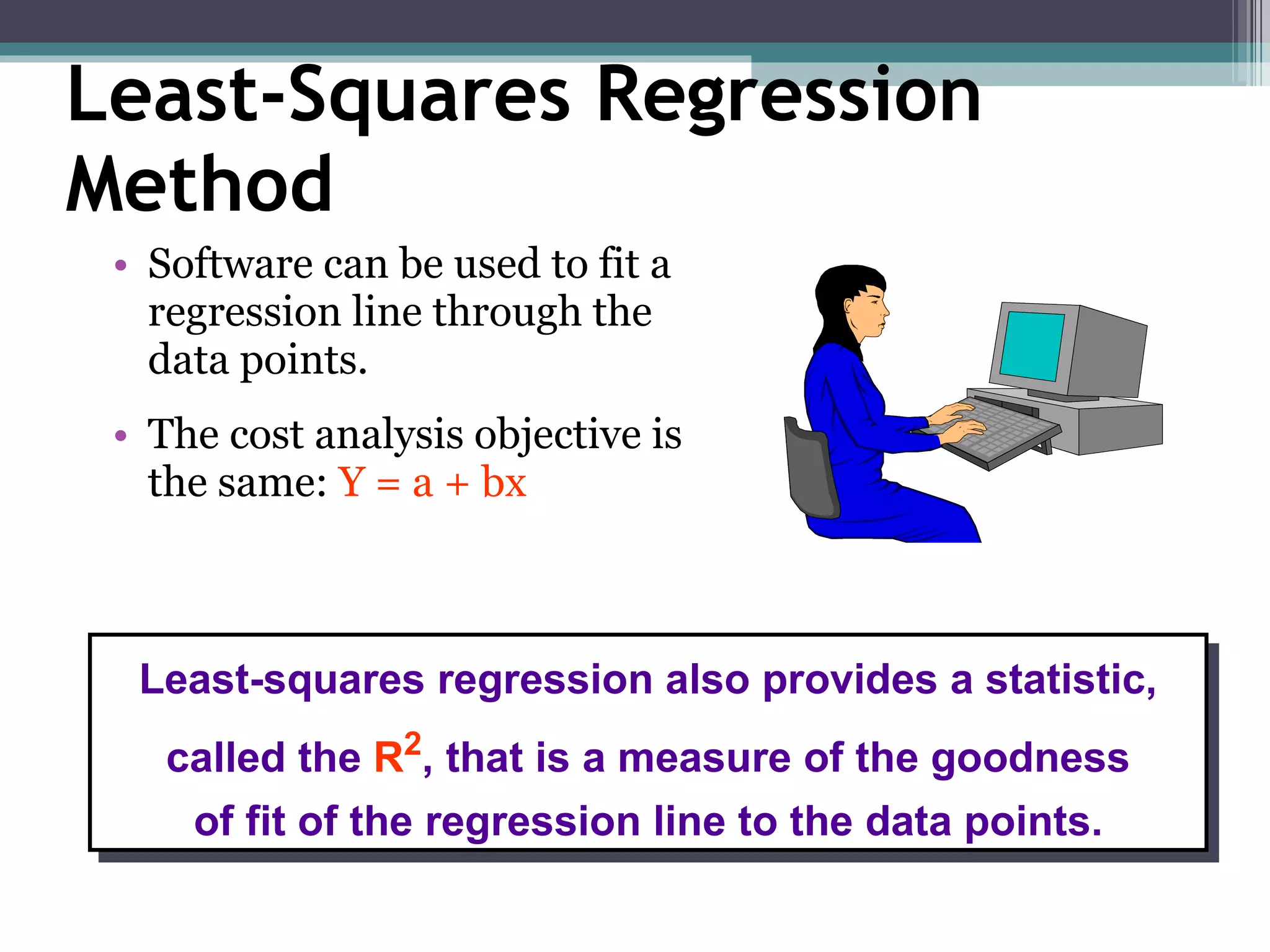
Software can be used to fit a regression line through the data points. The cost analysis objective is the same:  Y = a + bx Least-Squares Regression Method Least-squares regression also provides a statistic, called the  R 2 , that is a measure of the goodness of fit of the regression line to the data points.
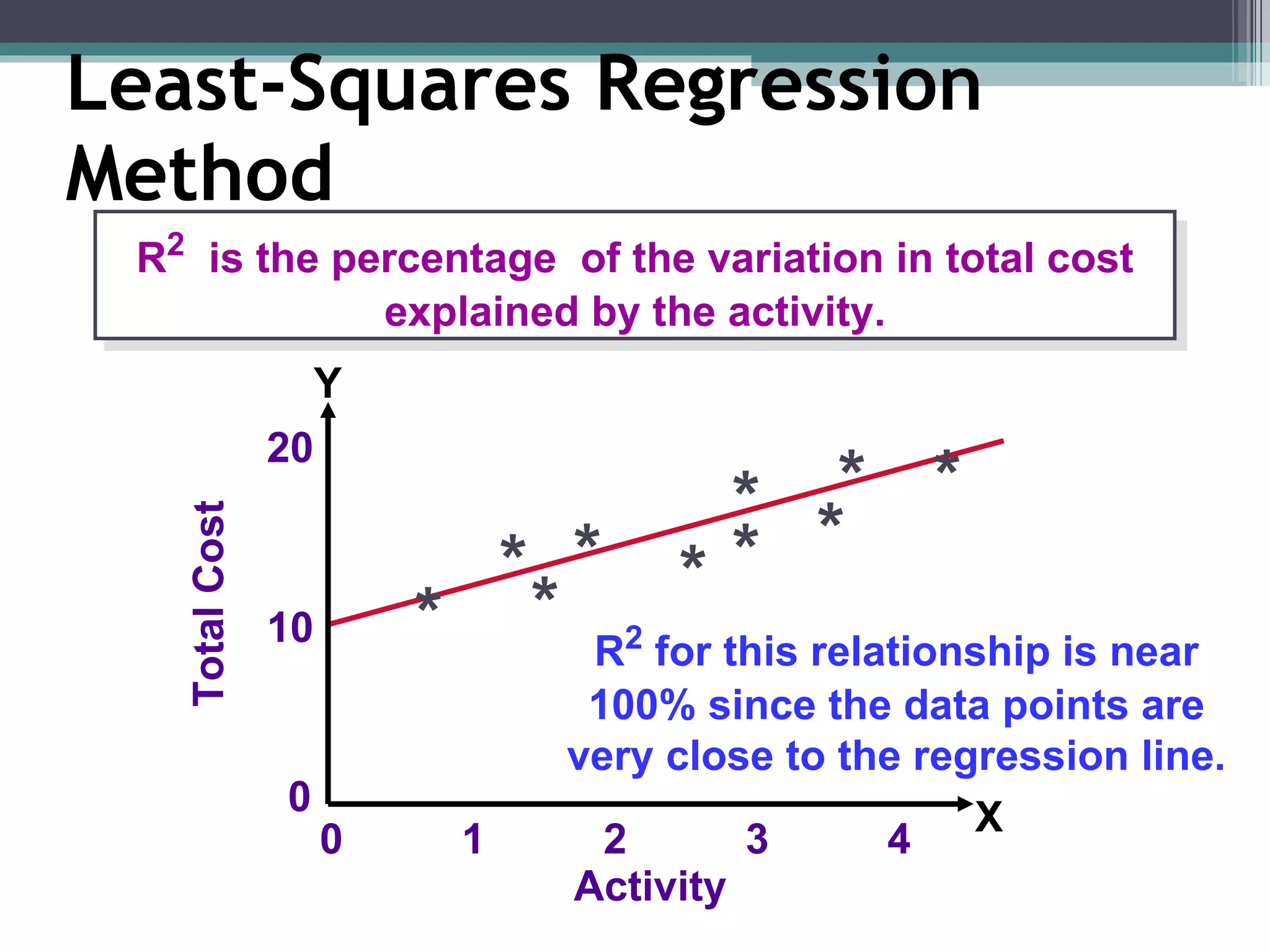
Least-Squares Regression Method 0  1  2  3  4 Total Cost 10 20 0 Activity * * * * * * * * * * R 2   is the percentage  of the variation in total cost explained by the activity. R 2  for this relationship is near 100% since the data points are very close to the regression line. X Y
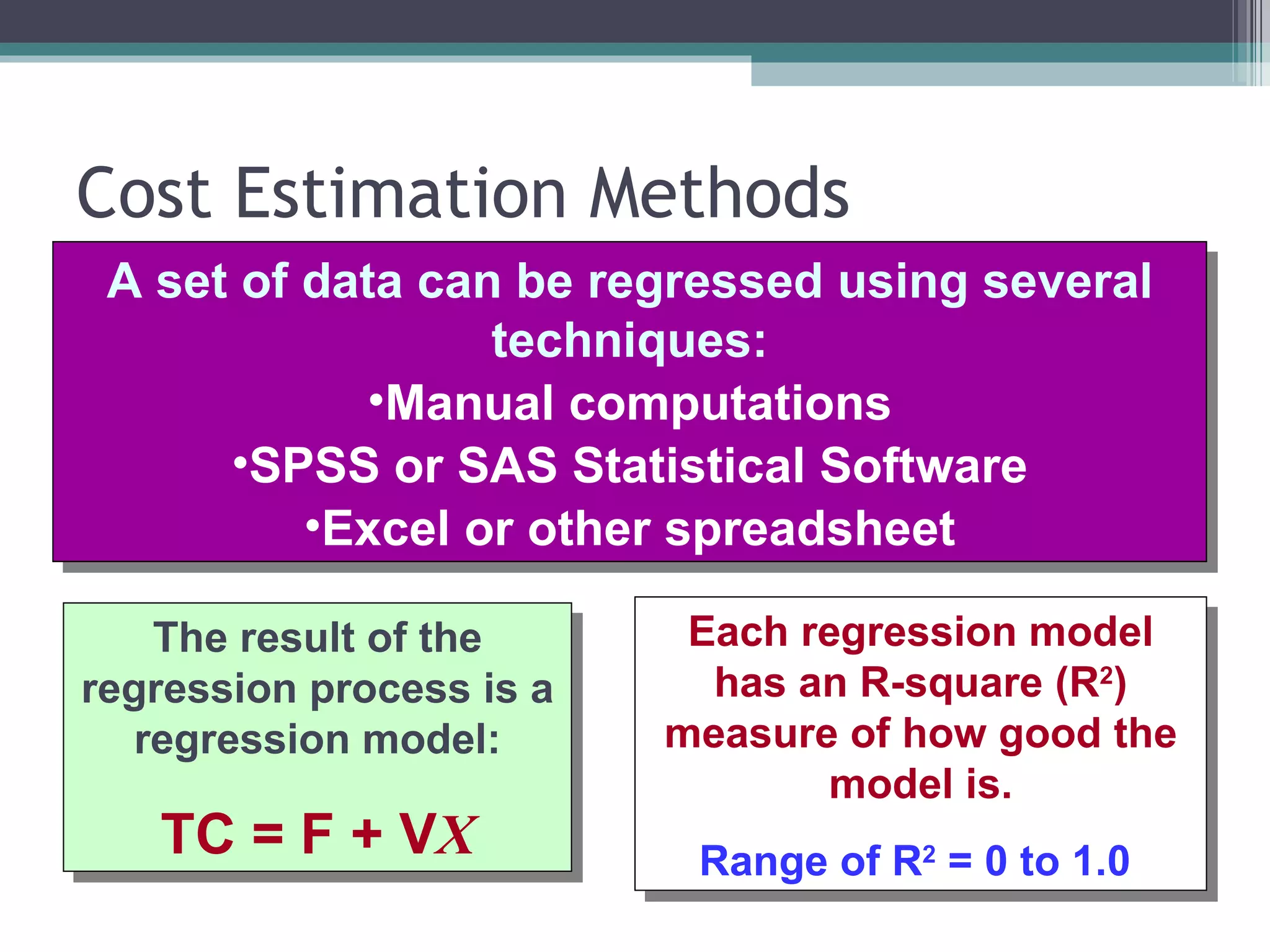
Cost Estimation Methods Regression Analysis A set of data can be regressed using several techniques: Manual computations SPSS or SAS Statistical Software Excel or other spreadsheet The result of the regression process is a regression model: TC = F + V X Each regression model has an R-square (R 2 ) measure of how good the model is. Range of R 2  = 0 to 1.0
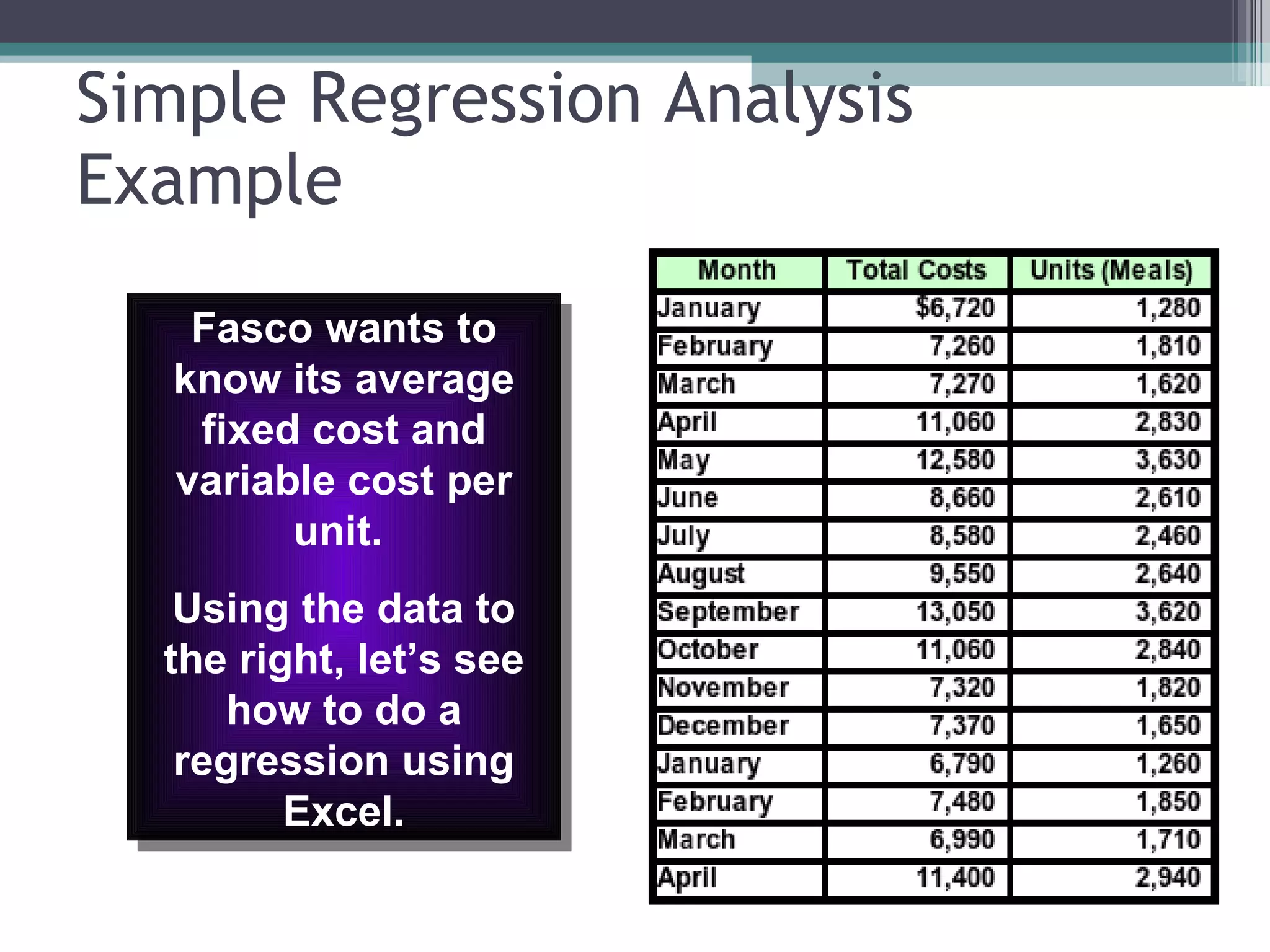
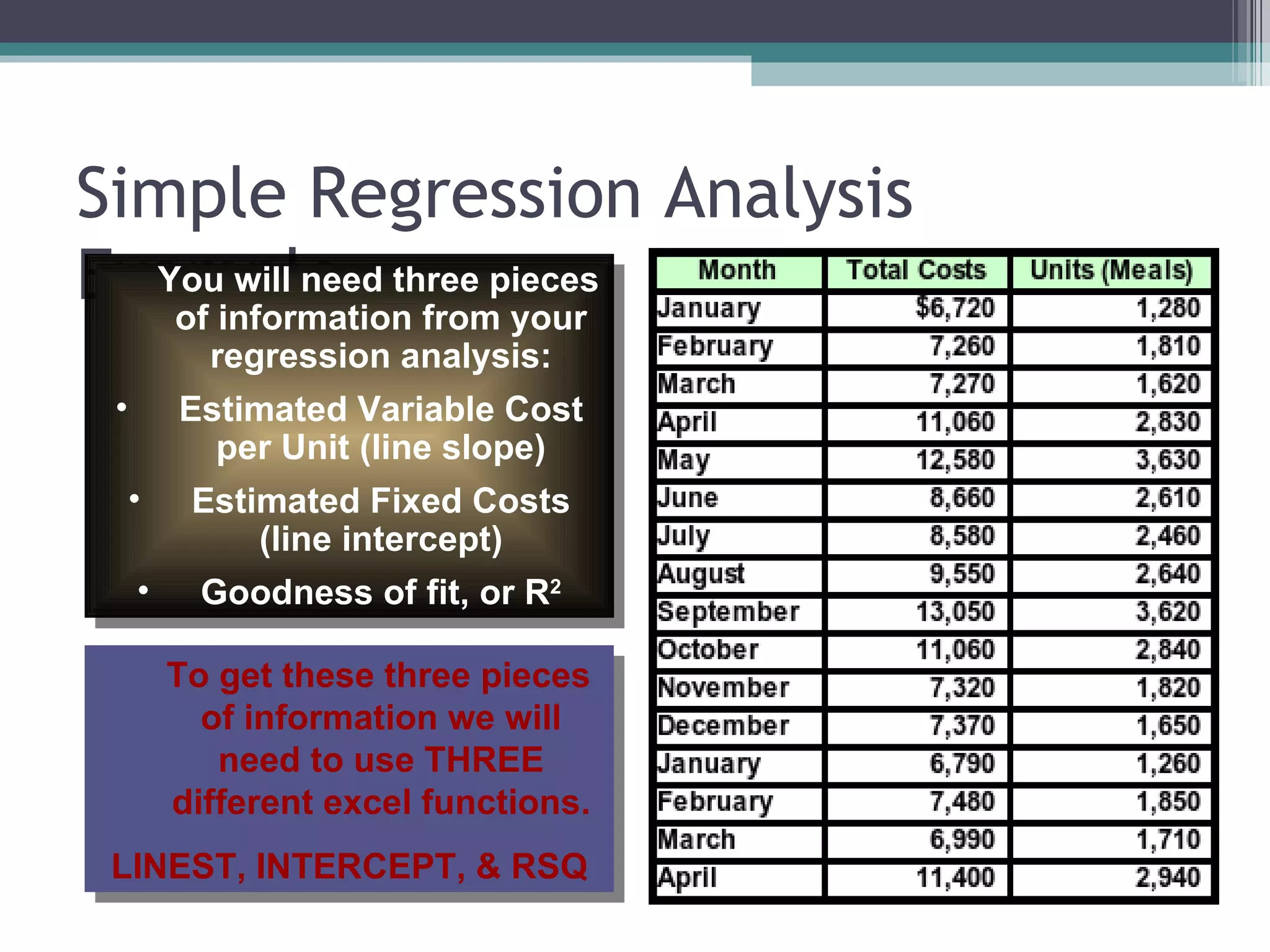
Simple Regression Analysis Example Fasco wants to know its average fixed cost and variable cost per unit.  Using the data to the right, let’s see how to do a regression using Excel.
Simple Regression Analysis Example You will need three pieces of information from your regression analysis: Estimated Variable Cost per Unit (line slope) Estimated Fixed Costs (line intercept) Goodness of fit, or R 2 To get these three pieces of information we will need to use THREE different excel functions. LINEST, INTERCEPT, & RSQ
 
Behavioral implications  ~ Behavior is a mirror in which every one displays his own image. ~ J. Wolfgang von Goethe
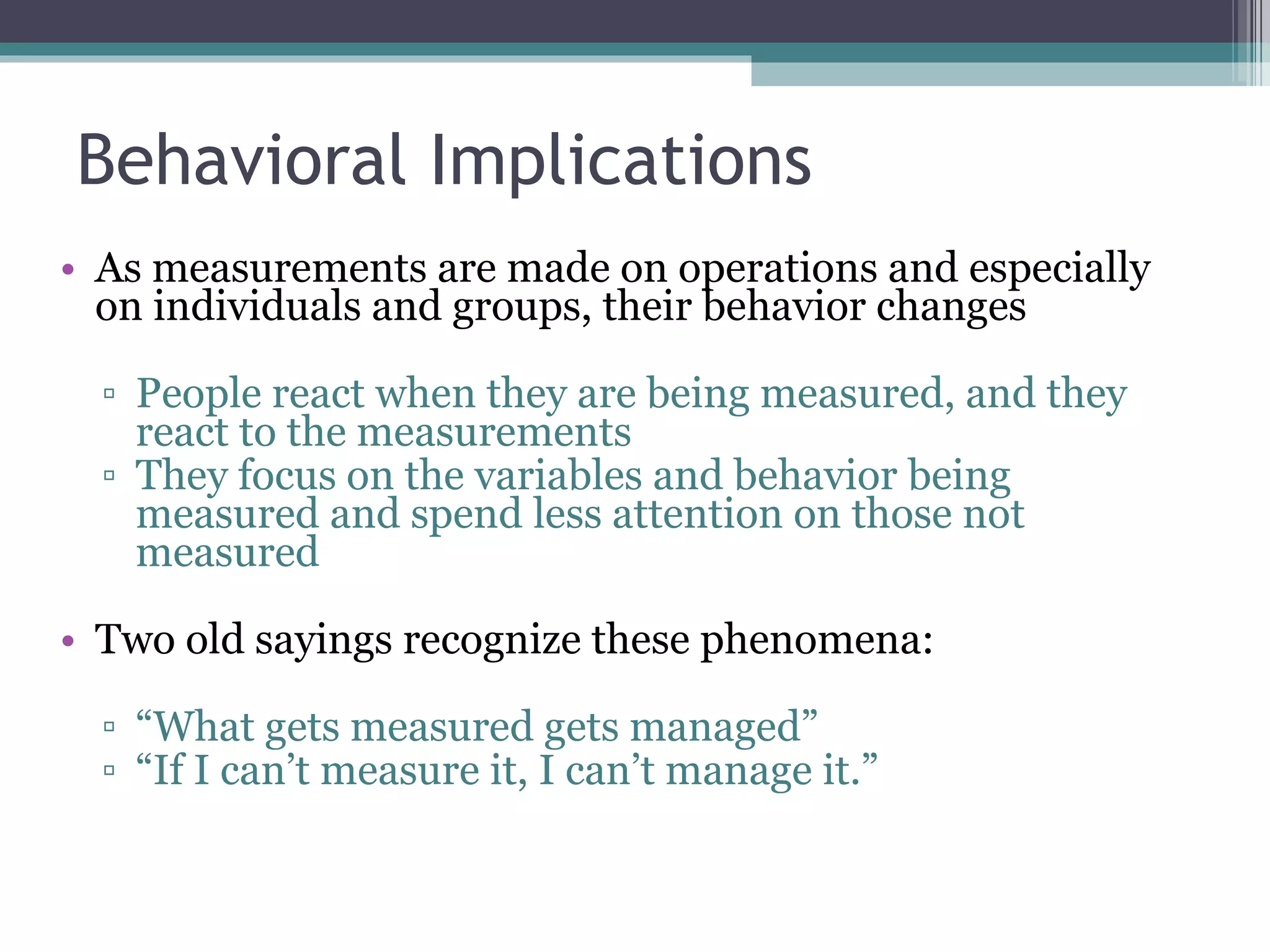
Behavioral Implications As measurements are made on operations and especially on individuals and groups, their behavior changes People react when they are being measured, and they react to the measurements They focus on the variables and behavior being measured and spend less attention on those not measured Two old sayings recognize these phenomena: “ What gets measured gets managed” “ If I can’t measure it, I can’t manage it.”
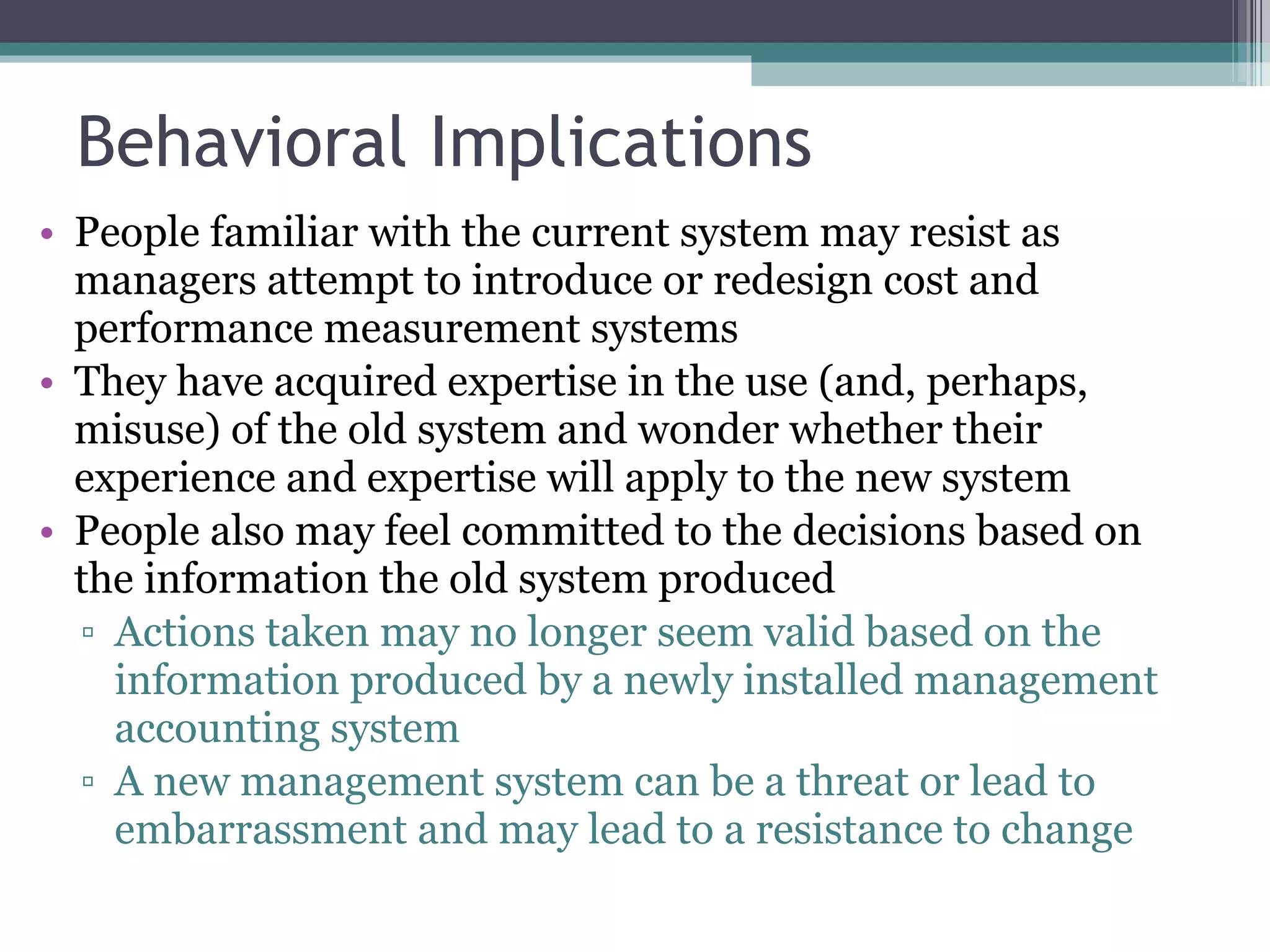
Behavioral Implications People familiar with the current system may resist as managers attempt to introduce or redesign cost and performance measurement systems They have acquired expertise in the use (and, perhaps, misuse) of the old system and wonder whether their experience and expertise will apply to the new system People also may feel committed to the decisions based on the information the old system produced Actions taken may no longer seem valid based on the information produced by a newly installed management accounting system A new management system can be a threat or lead to embarrassment and may lead to a resistance to change
Behavioral Implications Management accountants must understand and anticipate the reactions of individuals to information and measurements An analysis of the behavioral and organizational reactions to the measurements must accompany the design and introduction of new measurements and systems More importantly, when the measurements are used not only for information, planning, and decision-making but also for control, evaluation, and reward, employees and managers place great pressure on the   measurements themselves
Ethics With Conclusion ~ Ethics is the activity of man directed to secure the inner perfection of his own personality. ~ Albert Schweizer
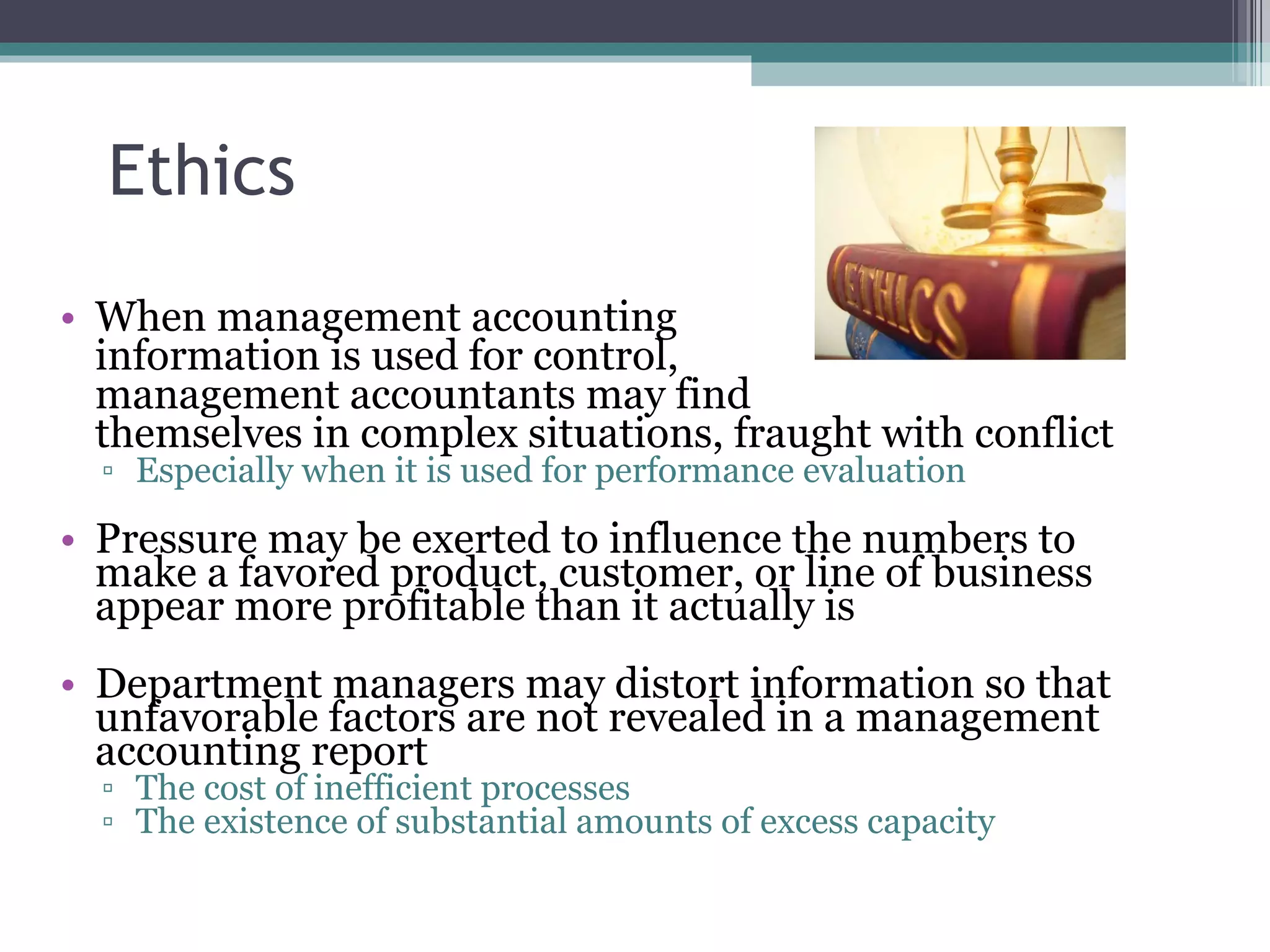
Ethics When management accounting  information is used for control,  management accountants may find  themselves in complex situations, fraught with conflict Especially when it is used for performance evaluation Pressure may be exerted to influence the numbers to make a favored product, customer, or line of business appear more profitable than it actually is Department managers may distort information so that unfavorable factors are not revealed in a management accounting report The cost of inefficient processes The existence of substantial amounts of excess capacity
Ethics Senior executives whose incentive compensation is based on the reported financial numbers may put pressure on accountants To recognize revenue from a customer early  To defer until subsequent periods the recognition of an expense In some circumstances, to recognize certain expenses early so that much higher earnings may be reported in future periods All of these behaviors were evident in the frauds dominating the financial news in recent years Organizational leadership plays a critical role in fostering a culture of high ethical standards
Ethics The way an individual responds to pressure derives from inner values and beliefs, but individuals are strongly influenced by their view of organizational standards If individuals see unethical or illegal behavior practiced by the organization’s leaders and superiors or coworkers, they may feel that such behavior is accepted and sanctioned An individual without a strong set of personal beliefs and values may find it difficult to withstand the pressure to “go along with the flow” and participate in this behavior when a difficult or conflicting situation arises Such as being asked to misrepresent an organization unit’s performance potential when the unit is being offered for sale
Ethics Professional organizations usually establish ethical norms and codes of professional conduct for their members The professional association can monitor and police its norms and codes through peer reviews They have procedures for disciplinary action when violations are detected Many of the guidelines are phrased in terms of what management accountants should not do, consistent with how boundary systems operate

Ppt On behavioural aspects of managerial accounting

  • 1.
    Behavioral aspects ofManagement Accounting Submitted by: Florian Huesmann Mahima Anita Bakkar Moeen Akhtar Ankit Singh Date: 03.11.09
  • 2.
    Table of contentGeneral characteristics of Management Accounting - Aims of MA - Differences between Management Accounting & Financial Accounting Behavioral aspects of Management Accounting -Motivational theories in Management Accounting -Behavioral implecations of MA Ethics Conclusion
  • 3.
    Management Accounting Definition:A value-adding continuous improvement process of planning, designing, measuring and operating both nonfinancial information systems and financial information systems that guides management action, motivates behavior, and supports and creates the cultural values necessary to achieve an organization’s strategic, tactical and operating objectives
  • 4.
    Aims of managementaccounting Planning Feedback Controlling Acting
  • 5.
    Aims of managementaccounting Formulating strategies Planning and constructing business activities Helps in making decisions Supporting financial reports preparation Safeguarding asset
  • 6.
    Aims of managementaccounting Distinguish between financial accounting and management accounting Information of management accounting is used for internal purposes only, not for external reports Management accounting has a future perspective and helps managers in making decisions.
  • 7.
    Differences between FinancialAcc. and Management Accounting Primary Users Financial Accounting Management Accounting External Internal Investors, Creditors, Government authorities Mangers of the business
  • 8.
    Differences between FinancialAcc. and Management Accounting Purpose of Information Financial Accounting Management Accounting Help investors, creditors, and others make investment, credit, and other decisions Help managers plan and control business operations
  • 9.
    Differences between FinancialAcc. and Management Accounting Behavioral Implications Financial Accounting Management Accounting Concern about adequacy of disclosure Concern about how reports will affect employees behavior
  • 10.
    Role of MAwithin the Corporation Cost accounting became the major role in management accounting Linkage between the management team and the financial department Management Accounting is important for nearly every part of the company, as well as for the overall success of a company
  • 11.
    Behavioral aspects ofManagement Accounting Behavioral aspect of management accounting is that which influences the decision of the people concerned with decision making in the accounting system.
  • 12.
    Subjective representation ofobjective phenomena Behavior depends on individuals’ mental representations, which can differ in important ways from objective indicators. Effects of MA practice on individuals’ behavior can depend not only on how objectively informative the MA practice is about factors that affect their welfare but also on how understandable the MA practice is how well individuals can form usable mental representations of it and connect it to their other mental representations and how it stimulates individuals’ attention, cognition, and/or motivation
  • 13.
    Subfields of psychologyin MA research Cognitive : Psychological processes that influence human thinking Attention, memory, comprehension, learning, judgments, decisions Motivation : Psychological processes that influence behavior Direction, intensity, and persistence of effort Social: How other people influence individuals’ minds and behavior Understanding people (attribution, person impression, social cognition), attitudes and social influence, social interaction and relationships
  • 14.
    Motivational Theories in management accounting Goal setting theory Performance is a positive function of goal difficulty Specific goals reduce variation in performance Incentives indirectly influence performance via its effect on goal commitment Goal-performance relation is influenced by goal commitment, goal importance, feedback, task complexity, self-efficacy
  • 15.
    Organizational justice theoryIndividuals are motivated to maintain a balance in exchange relations by comparing their and others’ ratio of inputs to outcomes (e.g., pay) If individuals believe their ratio is inequitable, then they experience negative emotions, which they minimize by changing their inputs and/or outcomes
  • 16.
    Human Resource Model Of Motivation (HRMM)Perhaps the most contemporary management view of motivation Based on initiatives to improve the quality of working life and the strong influence of Japanese management practices Introduces a high level of employee responsibility for and participation in decisions in the work environment  2003 Prentice Hall Business Publishing, PowerPoint supplement to Management Accounting, 4rd ed. , Atkinson, Kaplan, and Young, prepared by Terry M. Lease, Ph.D., CPA, Sonoma State University
  • 17.
    Central Assumptions ofthe HRMM Organizations operate under a system of beliefs about the values, purpose, and direction of their organization People find work enjoyable and desire to participate in: Developing objectives Making decisions Attaining goals in their work environment Individuals are motivated by both financial and nonfinancial means of compensation  2003 Prentice Hall Business Publishing, PowerPoint supplement to Management Accounting, 4rd ed. , Atkinson, Kaplan, and Young, prepared by Terry M. Lease, Ph.D., CPA, Sonoma State University
  • 18.
    Central Assumptions ofthe HRMM Employees have a great deal of knowledge and information about their jobs, the application of which will improve the way they perform tasks and benefit the organization as a whole Individuals are highly creative, ethical, and responsible They desire opportunities to effect change in their organizations  2003 Prentice Hall Business Publishing, PowerPoint supplement to Management Accounting, 4rd ed. , Atkinson, Kaplan, and Young, prepared by Terry M. Lease, Ph.D., CPA, Sonoma State University
  • 19.
  • 20.
    Types of CostBehavior Patterns
  • 21.
    The Activity BaseA measure of the event that causes the incurrence of a variable cost – a cost driver Units produced Miles driven Labor hours Machine hours
  • 22.
    True Variable CostExample Your total long distance telephone bill is based on how many minutes you talk. Minutes Talked Total Long Distance Telephone Bill
  • 23.
    Total Fixed CostExample Your monthly basic telephone bill is probably fixed and does not change when you make more local calls. Number of Local Calls Monthly Basic Telephone Bill
  • 24.
    Step-Variable Costs ActivityCost Total cost remains constant within a narrow range of activity.
  • 25.
    Step-Variable Costs ActivityCost Total cost increases to a new higher cost for the next higher range of activity.
  • 26.
    The Linearity Assumptionand the Relevant Range Activity Total Cost Economist’s Curvilinear Cost Function Relevant Range A straight line closely approximates a curvilinear variable cost line within the relevant range. Accountant’s Straight-Line Approximation (constant unit variable cost)
  • 27.
    Cost Behavior MerchandisersCost of Goods Sold Manufacturers Direct Material, Direct Labor, and Variable Manufacturing Overhead Merchandisers and Manufacturers Sales commissions and shipping costs Service Organizations Supplies and travel Examples of normally variable costs Examples of normally fixed costs Merchandisers, manufacturers, and service organizations PBB taxes, Insurance, Sales salaries Depreciation, Advertising
  • 28.
    Types of FixedCosts Examples Advertising and Research and Development Examples Depreciation on Buildings and Equipment Discretionary May be altered in the short-term by current managerial decisions Committed Long-term, cannot be reduced in the short term.
  • 29.
    Fixed Costs andRelevant Range Rent Cost in Thousands of Dollars 0 1,000 2,000 3,000 Rented Area (Square Feet) 0 30 60 90 Relevant Range Total cost doesn’t change for a wide range of activity, and then jumps to a new higher cost for the next higher range of activity.
  • 30.
    Semivariable Costs Fixed Monthly Utility Charge Variable Cost per KW Activity (Kilowatt Hours) Total Utility Cost A semivariable cost has both fixed and variable components. Consider the example of utility cost. Total semivariable cost X Y
  • 31.
    Semivariable Costs Fixed Monthly Utility Charge Variable Cost per KW Activity (Kilowatt Hours) Total Utility Cost Total semivariable cost Y = a + bX X Y
  • 32.
    The Analysis ofSemivariable Costs 1. High-Low Method 3. Least-Square Regression Method 2. Scattergraph Method
  • 33.
    The Scattergraph MethodPlot the data points on a graph (total cost vs. activity). 0 1 2 3 4 * Total Cost in 1,000’s of Rs 10 20 0 * * * * * * * * * Activity, 1,000’s of Units Produced X Y
  • 34.
    The Scattergraph Method(2) 0 1 2 3 4 * Total Cost in 1,000’s of Rs 10 20 0 * * * * * * * * * Activity, 1,000’s of Units Produced X Y Intercept is the estimated fixed cost (a) = Rs10,000 Draw a line through the data points with about an equal numbers of points above and below the line.
  • 35.
    The Scattergraph Method(3) 0 1 2 3 4 * Total Cost in 1,000’s of Rs 10 20 0 * * * * * * * * * Activity, 1,000’s of Units Produced X Y The slope is the estimated variable cost per unit. Slope = Change in cost ÷ Change in units Vertical distance is the change in cost. Horizontal distance is the change in activity.
  • 36.
    WiseCo recorded thefollowing production activity and maintenance costs for two months: Using these two levels of activity, compute: the variable cost per unit; the fixed cost; and then express the costs in equation form Y = a + bX. The High-Low Method
  • 37.
    Change  incost Change in units The High-Low Method Variable cost per unit = Change in cost ÷ change in units
  • 38.
    The High-Low MethodVariable cost per unit = $2,400 ÷ 3,000 units = $0.80 per unit
  • 39.
    The High-Low MethodVariable cost = $2,400 ÷ 3,000 units = $0.80 per unit Fixed cost = Total cost – Total variable cost Fixed cost = $9,800 – ($0.80 per unit × 8,000 units) Fixed cost = $9,800 – $6,400 = $3,400
  • 40.
    Variable cost = $2,400 ÷ 3,000 units = $0.80 per unit Fixed cost = Total cost – Total variable cost Fixed cost = $9,800 – ($0.80 per unit × 8,000 units) Fixed cost = $9,800 – $6,400 = $3,400 Total cost = Fixed cost + Variable cost (Y = a + bX) Y = $3,400 + $0.80X The High-Low Method
  • 41.
    Software can beused to fit a regression line through the data points. The cost analysis objective is the same: Y = a + bx Least-Squares Regression Method Least-squares regression also provides a statistic, called the R 2 , that is a measure of the goodness of fit of the regression line to the data points.
  • 42.
    Least-Squares Regression Method0 1 2 3 4 Total Cost 10 20 0 Activity * * * * * * * * * * R 2 is the percentage of the variation in total cost explained by the activity. R 2 for this relationship is near 100% since the data points are very close to the regression line. X Y
  • 43.
    Cost Estimation MethodsRegression Analysis A set of data can be regressed using several techniques: Manual computations SPSS or SAS Statistical Software Excel or other spreadsheet The result of the regression process is a regression model: TC = F + V X Each regression model has an R-square (R 2 ) measure of how good the model is. Range of R 2 = 0 to 1.0
  • 44.
    Simple Regression AnalysisExample Fasco wants to know its average fixed cost and variable cost per unit. Using the data to the right, let’s see how to do a regression using Excel.
  • 45.
    Simple Regression AnalysisExample You will need three pieces of information from your regression analysis: Estimated Variable Cost per Unit (line slope) Estimated Fixed Costs (line intercept) Goodness of fit, or R 2 To get these three pieces of information we will need to use THREE different excel functions. LINEST, INTERCEPT, & RSQ
  • 46.
  • 47.
    Behavioral implications ~ Behavior is a mirror in which every one displays his own image. ~ J. Wolfgang von Goethe
  • 48.
    Behavioral Implications Asmeasurements are made on operations and especially on individuals and groups, their behavior changes People react when they are being measured, and they react to the measurements They focus on the variables and behavior being measured and spend less attention on those not measured Two old sayings recognize these phenomena: “ What gets measured gets managed” “ If I can’t measure it, I can’t manage it.”
  • 49.
    Behavioral Implications Peoplefamiliar with the current system may resist as managers attempt to introduce or redesign cost and performance measurement systems They have acquired expertise in the use (and, perhaps, misuse) of the old system and wonder whether their experience and expertise will apply to the new system People also may feel committed to the decisions based on the information the old system produced Actions taken may no longer seem valid based on the information produced by a newly installed management accounting system A new management system can be a threat or lead to embarrassment and may lead to a resistance to change
  • 50.
    Behavioral Implications Managementaccountants must understand and anticipate the reactions of individuals to information and measurements An analysis of the behavioral and organizational reactions to the measurements must accompany the design and introduction of new measurements and systems More importantly, when the measurements are used not only for information, planning, and decision-making but also for control, evaluation, and reward, employees and managers place great pressure on the measurements themselves
  • 51.
    Ethics With Conclusion~ Ethics is the activity of man directed to secure the inner perfection of his own personality. ~ Albert Schweizer
  • 52.
    Ethics When managementaccounting information is used for control, management accountants may find themselves in complex situations, fraught with conflict Especially when it is used for performance evaluation Pressure may be exerted to influence the numbers to make a favored product, customer, or line of business appear more profitable than it actually is Department managers may distort information so that unfavorable factors are not revealed in a management accounting report The cost of inefficient processes The existence of substantial amounts of excess capacity
  • 53.
    Ethics Senior executiveswhose incentive compensation is based on the reported financial numbers may put pressure on accountants To recognize revenue from a customer early To defer until subsequent periods the recognition of an expense In some circumstances, to recognize certain expenses early so that much higher earnings may be reported in future periods All of these behaviors were evident in the frauds dominating the financial news in recent years Organizational leadership plays a critical role in fostering a culture of high ethical standards
  • 54.
    Ethics The wayan individual responds to pressure derives from inner values and beliefs, but individuals are strongly influenced by their view of organizational standards If individuals see unethical or illegal behavior practiced by the organization’s leaders and superiors or coworkers, they may feel that such behavior is accepted and sanctioned An individual without a strong set of personal beliefs and values may find it difficult to withstand the pressure to “go along with the flow” and participate in this behavior when a difficult or conflicting situation arises Such as being asked to misrepresent an organization unit’s performance potential when the unit is being offered for sale
  • 55.
    Ethics Professional organizationsusually establish ethical norms and codes of professional conduct for their members The professional association can monitor and police its norms and codes through peer reviews They have procedures for disciplinary action when violations are detected Many of the guidelines are phrased in terms of what management accountants should not do, consistent with how boundary systems operate

Editor's Notes

  • #4 That means that management accounting is mainly a controlling process, which helps the management in it‘s decisions. For example it is used for the Performance Management to develop the practice of business decision-making and managing the performance of the organization or for the Risk Management to contribute to frameworks and practices for identifying and measuring risks.
  • #5 The aims of MA can basically described as a circle. It is about the planning of actions, acting, controlling of the actions and giving back feedback.
  • #11 For example the management accountants provide services like price modeling, cost analysis, variance analysis, budgeting, life-cycle analysis and so on.