© Education Resource Strategies, Inc., 2017
Draft – do not cite or disseminate
Maximizing Resources for
School Improvement
How states can support low-performing
schools in the age of ESSA: Part II
June 22, 2017
Draft – do not cite or disseminateDraft – do not cite or disseminate
Resource Allocation Studies
1
Draft – do not cite or disseminate
ESSA also requires resource allocation studies that may
prove to be excellent resources for states
“…The State education agency shall periodically review resource allocation to
support school improvement in each local education agency in the State
serving—
(I) a significant number of schools identified for comprehensive support
and improvement… and
(II) a significant number of schools implementing targeted support and
improvement plans…”
2
States are required to review resource allocation and provide technical support to districts with
many low-performing schools.
Draft – do not cite or disseminate
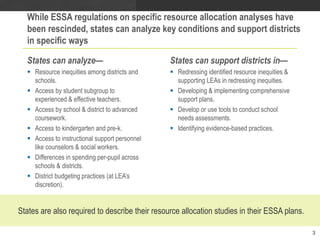
While ESSA regulations on specific resource allocation analyses have
been rescinded, states can analyze key conditions and support districts
in specific ways
States can analyze—
 Resource inequities among districts and
schools.
 Access by student subgroup to
experienced & effective teachers.
 Access by school & district to advanced
coursework.
 Access to kindergarten and pre-k.
 Access to instructional support personnel
like counselors & social workers.
 Differences in spending per-pupil across
schools & districts.
 District budgeting practices (at LEA’s
discretion).
3
States can support districts in—
 Redressing identified resource inequities &
supporting LEAs in redressing inequities.
 Developing & implementing comprehensive
support plans.
 Develop or use tools to conduct school
needs assessments.
 Identifying evidence-based practices.
States are also required to describe their resource allocation studies in their ESSA plans.
Draft – do not cite or disseminate
To support a sustainable school improvement strategy,
resource allocation studies need to accomplish five things
4
School level District level
1. Identify opportunities to
reallocate school resources
2. Help school leadership teams
create integrated budget,
staffing plans, and schedules
that align long-term resources
toward a vision for success
1. Determine whether districts
are allocating resources
equitably
2. Identify specific opportunities
to reallocate system
resources
3. Help systems create the
enabling conditions of long-
term success
There are also state-level opportunities to identify resource allocation patterns and opportunities.
Draft – do not cite or disseminateSchool Level Example #1
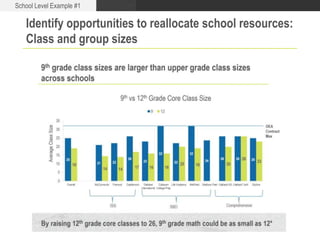
Identify opportunities to reallocate school resources:
Class and group sizes
Draft – do not cite or disseminateSchool Level Example #1
Identify opportunities to reallocate school resources:
Time and teacher effectiveness
24% 25% 24%
29%
21%
19% 20%
16%
19%
21%
17%
15% 15% 14%
16%
Fulton Hall Treutlen Vidalia Marietta
% Time in 9th Grade Math, by Prior Year
Proficiency
Did not meet standards Proficient Advanced
24%
14%
Math Support Teachers All Math Teachers
% of All Teachers that are Novice
Most GA districts gave additional time to struggling
students….
However, these classes were
disproportionately staffed by novice teachers
Draft – do not cite or disseminateSchool Level Example #2
Help school leadership teams create integrated budget, staffing plans, and
schedules that align long-term resources toward a vision for success
 Planning for the following year happens in alignment with major decision-making milestones.
Draft – do not cite or disseminate
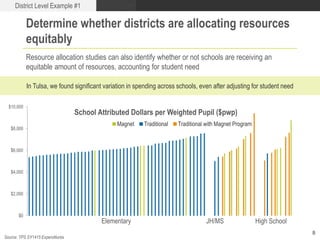
Determine whether districts are allocating resources
equitably
Resource allocation studies can also identify whether or not schools are receiving an
equitable amount of resources, accounting for student need
8
$0
$2,000
$4,000
$6,000
$8,000
$10,000
School Attributed Dollars per Weighted Pupil ($pwp)
Magnet Traditional Traditional with Magnet Program
Elementary JH/MS High School
Source: TPS SY1415 Expenditures
In Tulsa, we found significant variation in spending across schools, even after adjusting for student need
District Level Example #1
Draft – do not cite or disseminate
Identify specific opportunities to reallocate system resources
District Level Example #2
Draft – do not cite or disseminate
Identify specific opportunities to reallocate system resources
District Level Example #2
Draft – do not cite or disseminateDistrict Level Example #3
Help systems create the enabling conditions of long-term
success
Draft – do not cite or disseminate
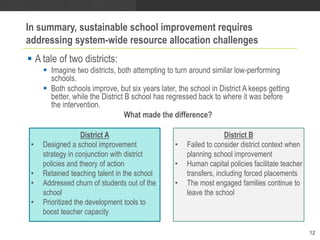
In summary, sustainable school improvement requires
addressing system-wide resource allocation challenges
 A tale of two districts:
 Imagine two districts, both attempting to turn around similar low-performing
schools.
 Both schools improve, but six years later, the school in District A keeps getting
better, while the District B school has regressed back to where it was before
the intervention.
What made the difference?
12
District A
• Designed a school improvement
strategy in conjunction with district
policies and theory of action
• Retained teaching talent in the school
• Addressed churn of students out of the
school
• Prioritized the development tools to
boost teacher capacity
District B
• Failed to consider district context when
planning school improvement
• Human capital policies facilitate teacher
transfers, including forced placements
• The most engaged families continue to
leave the school
Draft – do not cite or disseminate
Next Steps
13
 Maximize the opportunity created by ESSA’s resource
allocation study mandate:
 Write a strong RFP, setting up a process that improves
resource allocation throughout your state and in your low-
performing schools
 Incorporate these principles into your state plan and look for
opportunities to promote effective resource use
 ERS is currently working with CCSSO on sample RFP
language which should be available soon…
Draft – do not cite or disseminateDraft – do not cite or disseminate
Contact us
QUESTIONS?

Maximizing Resources for School Improvement, Part 2

  • 1.
    © Education ResourceStrategies, Inc., 2017 Draft – do not cite or disseminate Maximizing Resources for School Improvement How states can support low-performing schools in the age of ESSA: Part II June 22, 2017
  • 2.
    Draft – donot cite or disseminateDraft – do not cite or disseminate Resource Allocation Studies 1
  • 3.
    Draft – donot cite or disseminate ESSA also requires resource allocation studies that may prove to be excellent resources for states “…The State education agency shall periodically review resource allocation to support school improvement in each local education agency in the State serving— (I) a significant number of schools identified for comprehensive support and improvement… and (II) a significant number of schools implementing targeted support and improvement plans…” 2 States are required to review resource allocation and provide technical support to districts with many low-performing schools.
  • 4.
    Draft – donot cite or disseminate While ESSA regulations on specific resource allocation analyses have been rescinded, states can analyze key conditions and support districts in specific ways States can analyze—  Resource inequities among districts and schools.  Access by student subgroup to experienced & effective teachers.  Access by school & district to advanced coursework.  Access to kindergarten and pre-k.  Access to instructional support personnel like counselors & social workers.  Differences in spending per-pupil across schools & districts.  District budgeting practices (at LEA’s discretion). 3 States can support districts in—  Redressing identified resource inequities & supporting LEAs in redressing inequities.  Developing & implementing comprehensive support plans.  Develop or use tools to conduct school needs assessments.  Identifying evidence-based practices. States are also required to describe their resource allocation studies in their ESSA plans.
  • 5.
    Draft – donot cite or disseminate To support a sustainable school improvement strategy, resource allocation studies need to accomplish five things 4 School level District level 1. Identify opportunities to reallocate school resources 2. Help school leadership teams create integrated budget, staffing plans, and schedules that align long-term resources toward a vision for success 1. Determine whether districts are allocating resources equitably 2. Identify specific opportunities to reallocate system resources 3. Help systems create the enabling conditions of long- term success There are also state-level opportunities to identify resource allocation patterns and opportunities.
  • 6.
    Draft – donot cite or disseminateSchool Level Example #1 Identify opportunities to reallocate school resources: Class and group sizes
  • 7.
    Draft – donot cite or disseminateSchool Level Example #1 Identify opportunities to reallocate school resources: Time and teacher effectiveness 24% 25% 24% 29% 21% 19% 20% 16% 19% 21% 17% 15% 15% 14% 16% Fulton Hall Treutlen Vidalia Marietta % Time in 9th Grade Math, by Prior Year Proficiency Did not meet standards Proficient Advanced 24% 14% Math Support Teachers All Math Teachers % of All Teachers that are Novice Most GA districts gave additional time to struggling students…. However, these classes were disproportionately staffed by novice teachers
  • 8.
    Draft – donot cite or disseminateSchool Level Example #2 Help school leadership teams create integrated budget, staffing plans, and schedules that align long-term resources toward a vision for success  Planning for the following year happens in alignment with major decision-making milestones.
  • 9.
    Draft – donot cite or disseminate Determine whether districts are allocating resources equitably Resource allocation studies can also identify whether or not schools are receiving an equitable amount of resources, accounting for student need 8 $0 $2,000 $4,000 $6,000 $8,000 $10,000 School Attributed Dollars per Weighted Pupil ($pwp) Magnet Traditional Traditional with Magnet Program Elementary JH/MS High School Source: TPS SY1415 Expenditures In Tulsa, we found significant variation in spending across schools, even after adjusting for student need District Level Example #1
  • 10.
    Draft – donot cite or disseminate Identify specific opportunities to reallocate system resources District Level Example #2
  • 11.
    Draft – donot cite or disseminate Identify specific opportunities to reallocate system resources District Level Example #2
  • 12.
    Draft – donot cite or disseminateDistrict Level Example #3 Help systems create the enabling conditions of long-term success
  • 13.
    Draft – donot cite or disseminate In summary, sustainable school improvement requires addressing system-wide resource allocation challenges  A tale of two districts:  Imagine two districts, both attempting to turn around similar low-performing schools.  Both schools improve, but six years later, the school in District A keeps getting better, while the District B school has regressed back to where it was before the intervention. What made the difference? 12 District A • Designed a school improvement strategy in conjunction with district policies and theory of action • Retained teaching talent in the school • Addressed churn of students out of the school • Prioritized the development tools to boost teacher capacity District B • Failed to consider district context when planning school improvement • Human capital policies facilitate teacher transfers, including forced placements • The most engaged families continue to leave the school
  • 14.
    Draft – donot cite or disseminate Next Steps 13  Maximize the opportunity created by ESSA’s resource allocation study mandate:  Write a strong RFP, setting up a process that improves resource allocation throughout your state and in your low- performing schools  Incorporate these principles into your state plan and look for opportunities to promote effective resource use  ERS is currently working with CCSSO on sample RFP language which should be available soon…
  • 15.
    Draft – donot cite or disseminateDraft – do not cite or disseminate Contact us QUESTIONS?