Rethinking Resources
for Student Success
Tough Times as Opportunity
December 2, 2011
The National Council of State Legislators
Education Resource Strategies 2
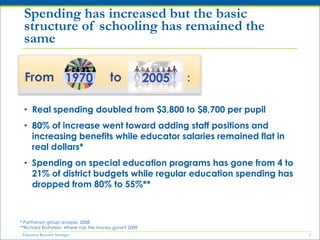
• Real spending doubled from $3,800 to $8,700 per pupil
• 80% of increase went toward adding staff positions and
increasing benefits while educator salaries remained flat in
real dollars*
• Spending on special education programs has gone from 4 to
21% of district budgets while regular education spending has
dropped from 80% to 55%**
Spending has increased but the basic
structure of schooling has remained the
same
* Parthenon group analysis, 2008
**Richard Rothstein, Where has the money gone? 2009
From 1970 to 2005 :
Education Resource Strategies 3
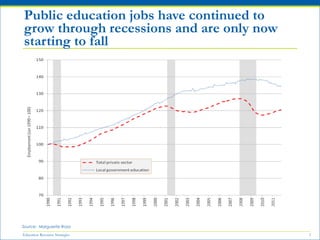
Public education jobs have continued to
grow through recessions and are only now
starting to fall
Source: Marguerite Roza
Education Resource Strategies 4
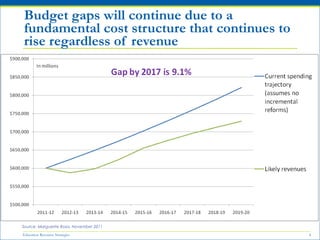
Budget gaps will continue due to a
fundamental cost structure that continues to
rise regardless of revenue
Source: Marguerite Roza, November 2011
Education Resource Strategies 5
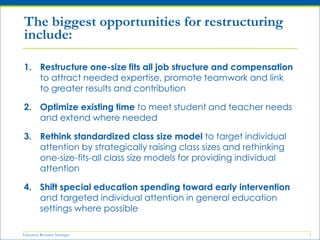
1. Restructure one-size fits all job structure and compensation
to attract needed expertise, promote teamwork and link
to greater results and contribution
2. Optimize existing time to meet student and teacher needs
and extend where needed
3. Rethink standardized class size model to target individual
attention by strategically raising class sizes and rethinking
one-size-fits-all class size models for providing individual
attention
4. Shift special education spending toward early intervention
and targeted individual attention in general education
settings where possible
The biggest opportunities for restructuring
include:
Education Resource Strategies 6
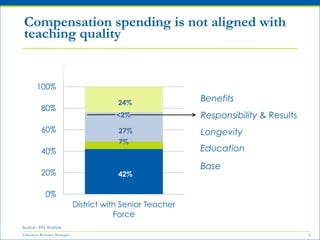
Compensation spending is not aligned with
teaching quality
0%
20%
40%
60%
80%
100%
120%
District with Senior Teacher
Force
42%
7%
27%
24%
<2%
Benefits
Responsibility & Results
Longevity
Education
Base
Source: ERS Analysis
Education Resource Strategies 7
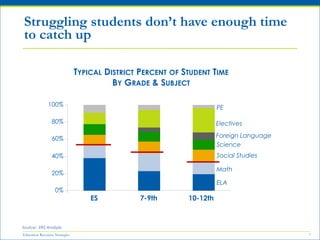
Struggling students don’t have enough time
to catch up
TYPICAL DISTRICT PERCENT OF STUDENT TIME
BY GRADE & SUBJECT
0%
20%
40%
60%
80%
100%
ES 7-9th 10-12th
PE
Foreign Language
Electives
Science
Social Studies
Math
ELA
Source: ERS Analysis
Education Resource Strategies 8
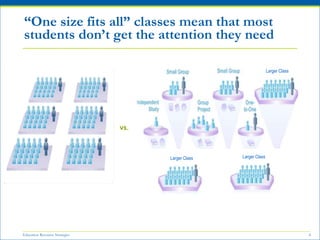
“One size fits all” classes mean that most
students don’t get the attention they need
vs.
Larger Class
Larger Class
Larger Class
Education Resource Strategies 9
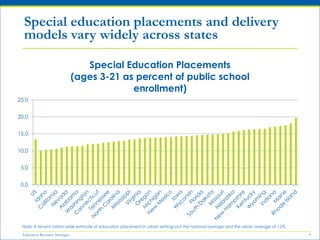
Special education placements and delivery
models vary widely across states
Note: A recent nation-wide estimate of education placement in urban settings put the national average and the urban average at 12%.
0.0
5.0
10.0
15.0
20.0
25.0
Special Education Placements
(ages 3-21 as percent of public school
enrollment)
Education Resource Strategies 10
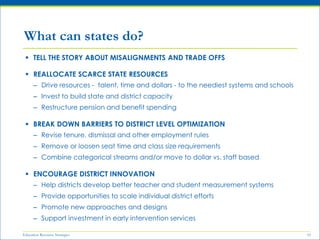
 TELL THE STORY ABOUT MISALIGNMENTS AND TRADE OFFS
 REALLOCATE SCARCE STATE RESOURCES
– Drive resources - talent, time and dollars - to the neediest systems and schools
– Invest to build state and district capacity
– Restructure pension and benefit spending
 BREAK DOWN BARRIERS TO DISTRICT LEVEL OPTIMIZATION
– Revise tenure, dismissal and other employment rules
– Remove or loosen seat time and class size requirements
– Combine categorical streams and/or move to dollar vs. staff based
 ENCOURAGE DISTRICT INNOVATION
– Help districts develop better teacher and student measurement systems
– Provide opportunities to scale individual district efforts
– Promote new approaches and designs
– Support investment in early intervention services
What can states do?
Education Resource Strategies 11
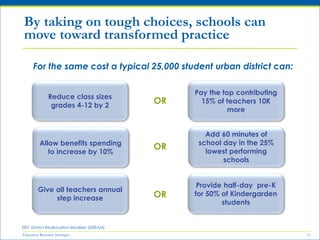
By taking on tough choices, schools can
move toward transformed practice
For the same cost a typical 25,000 student urban district can:
ERS’ District Reallocation Modeler (DREAM)
Reduce class sizes
grades 4-12 by 2
Pay the top contributing
15% of teachers 10K
more
OR
Give all teachers annual
step increase
Allow benefits spending
to increase by 10%
OR
Provide half-day pre-K
for 50% of Kindergarden
students
Add 60 minutes of
school day in the 25%
lowest performing
schools
OR

Tough Times as opportunity

  • 1.
    Rethinking Resources for StudentSuccess Tough Times as Opportunity December 2, 2011 The National Council of State Legislators
  • 2.
    Education Resource Strategies2 • Real spending doubled from $3,800 to $8,700 per pupil • 80% of increase went toward adding staff positions and increasing benefits while educator salaries remained flat in real dollars* • Spending on special education programs has gone from 4 to 21% of district budgets while regular education spending has dropped from 80% to 55%** Spending has increased but the basic structure of schooling has remained the same * Parthenon group analysis, 2008 **Richard Rothstein, Where has the money gone? 2009 From 1970 to 2005 :
  • 3.
    Education Resource Strategies3 Public education jobs have continued to grow through recessions and are only now starting to fall Source: Marguerite Roza
  • 4.
    Education Resource Strategies4 Budget gaps will continue due to a fundamental cost structure that continues to rise regardless of revenue Source: Marguerite Roza, November 2011
  • 5.
    Education Resource Strategies5 1. Restructure one-size fits all job structure and compensation to attract needed expertise, promote teamwork and link to greater results and contribution 2. Optimize existing time to meet student and teacher needs and extend where needed 3. Rethink standardized class size model to target individual attention by strategically raising class sizes and rethinking one-size-fits-all class size models for providing individual attention 4. Shift special education spending toward early intervention and targeted individual attention in general education settings where possible The biggest opportunities for restructuring include:
  • 6.
    Education Resource Strategies6 Compensation spending is not aligned with teaching quality 0% 20% 40% 60% 80% 100% 120% District with Senior Teacher Force 42% 7% 27% 24% <2% Benefits Responsibility & Results Longevity Education Base Source: ERS Analysis
  • 7.
    Education Resource Strategies7 Struggling students don’t have enough time to catch up TYPICAL DISTRICT PERCENT OF STUDENT TIME BY GRADE & SUBJECT 0% 20% 40% 60% 80% 100% ES 7-9th 10-12th PE Foreign Language Electives Science Social Studies Math ELA Source: ERS Analysis
  • 8.
    Education Resource Strategies8 “One size fits all” classes mean that most students don’t get the attention they need vs. Larger Class Larger Class Larger Class
  • 9.
    Education Resource Strategies9 Special education placements and delivery models vary widely across states Note: A recent nation-wide estimate of education placement in urban settings put the national average and the urban average at 12%. 0.0 5.0 10.0 15.0 20.0 25.0 Special Education Placements (ages 3-21 as percent of public school enrollment)
  • 10.
    Education Resource Strategies10  TELL THE STORY ABOUT MISALIGNMENTS AND TRADE OFFS  REALLOCATE SCARCE STATE RESOURCES – Drive resources - talent, time and dollars - to the neediest systems and schools – Invest to build state and district capacity – Restructure pension and benefit spending  BREAK DOWN BARRIERS TO DISTRICT LEVEL OPTIMIZATION – Revise tenure, dismissal and other employment rules – Remove or loosen seat time and class size requirements – Combine categorical streams and/or move to dollar vs. staff based  ENCOURAGE DISTRICT INNOVATION – Help districts develop better teacher and student measurement systems – Provide opportunities to scale individual district efforts – Promote new approaches and designs – Support investment in early intervention services What can states do?
  • 11.
    Education Resource Strategies11 By taking on tough choices, schools can move toward transformed practice For the same cost a typical 25,000 student urban district can: ERS’ District Reallocation Modeler (DREAM) Reduce class sizes grades 4-12 by 2 Pay the top contributing 15% of teachers 10K more OR Give all teachers annual step increase Allow benefits spending to increase by 10% OR Provide half-day pre-K for 50% of Kindergarden students Add 60 minutes of school day in the 25% lowest performing schools OR