Rethinking Resources
for Student Success
Sustaining Turnaround at Scale
Opening Session, October 13, 2011
Realizing the Promise
Education Resource Strategies 2
 Explore opportunities and challenges involved in attempting
school turnaround at scale
 Begin planning NOW to sustain turnaround work once
transition funding and special exemptions run out
 Identify ways we need to work together to raise the likelihood
of success
 Celebrate, honor and support each other’s efforts
Sustaining Turnaround at Scale: Summit Goals
Education Resource Strategies 3
 Boston
 Charlotte-Mecklenburg
 Chicago
 Cincinnati
 Denver
 District of Columbia
 Duval County (Jacksonville
 Providence
Summit Participants: District Teams
Education Resource Strategies 4
 Academy of Urban School Leadership
 Achievement Network
 Blueprint Schools Network
 Citizen Schools
 City Connects
 City Year
 Corporation for National and Community
Service
 Council of Chief State School Officers
 Mass Insight Education
 National Center for Time and Learning
 New Leaders for New Schools
 New Schools Venture Fund
Summit Participants: Partners
 New Schools Venture Fund
 ReNEW
 Say Yes to Education
 Strategic Grant Partners
 TeachPlus
 The Annenberg Institute for School Reform
 The Aspen Institute
 The Education Trust
 The New Teacher Project
 Turnaround for Children
 U.S. Department of Education
 University of Virginia Partnership for Leaders
in Education
Education Resource Strategies 5
 We are a non-profit firm dedicated to helping school systems spend
and organize time, talent and technology to create great schools
at scale
 We partner with system leaders to analyze spending, human
resource, organization and student data to better align with high
performance strategies
 We leverage insight from this work to provide lessons and tools for
school leaders and those who support them
 Our work is grounded in over a decade of experience working with
school districts across the country
5
Education Resource Strategies
Education Resource Strategies 6
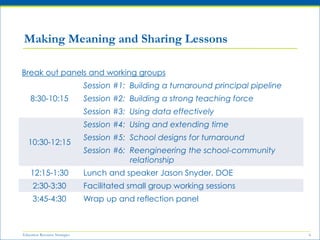
Making Meaning and Sharing Lessons
Break out panels and working groups
8:30-10:15
Session #1: Building a turnaround principal pipeline
Session #2: Building a strong teaching force
Session #3: Using data effectively
10:30-12:15
Session #4: Using and extending time
Session #5: School designs for turnaround
Session #6: Reengineering the school-community
relationship
12:15-1:30 Lunch and speaker Jason Snyder, DOE
2:30-3:30 Facilitated small group working sessions
3:45-4:30 Wrap up and reflection panel
Education Resource Strategies 7
Communicating from the Summit
Education Resource Strategies 8
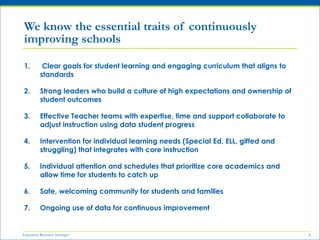
1. Clear goals for student learning and engaging curriculum that aligns to
standards
2. Strong leaders who build a culture of high expectations and ownership of
student outcomes
3. Effective Teacher teams with expertise, time and support collaborate to
adjust instruction using data student progress
4. Intervention for individual learning needs (Special Ed, ELL, gifted and
struggling) that integrates with core instruction
5. Individual attention and schedules that prioritize core academics and
allow time for students to catch up
6. Safe, welcoming community for students and families
7. Ongoing use of data for continuous improvement
We know the essential traits of continuously
improving schools
Education Resource Strategies 9
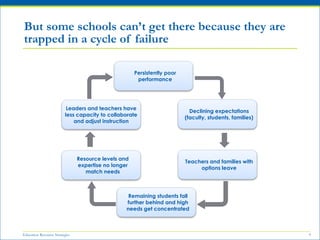
But some schools can’t get there because they are
trapped in a cycle of failure
Declining expectations
(faculty, students, families)
Remaining students fall
further behind and high
needs get concentrated
Teachers and families with
options leave
Persistently poor
performance
Resource levels and
expertise no longer
match needs
Leaders and teachers have
less capacity to collaborate
and adjust instruction
Education Resource Strategies 10
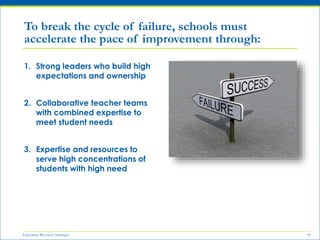
1. Strong leaders who build high
expectations and ownership
2. Collaborative teacher teams
with combined expertise to
meet student needs
3. Expertise and resources to
serve high concentrations of
students with high need
To break the cycle of failure, schools must
accelerate the pace of improvement through:
Education Resource Strategies 11
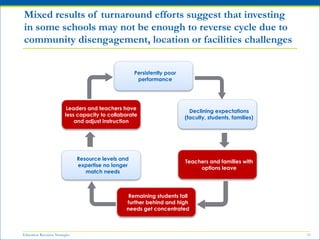
Mixed results of turnaround efforts suggest that investing
in some schools may not be enough to reverse cycle due to
community disengagement, location or facilities challenges
Declining expectations
(faculty, students, families)
Remaining students fall
further behind and high
needs get concentrated
Teachers and families with
options leave
Persistently poor
performance
Resource levels and
expertise no longer
match needs
Leaders and teachers have
less capacity to collaborate
and adjust instruction
Education Resource Strategies 12
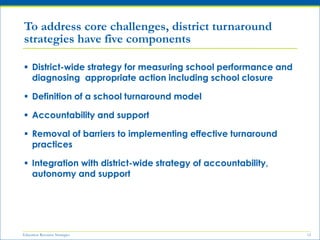
 District-wide strategy for measuring school performance and
diagnosing appropriate action including school closure
 Definition of a school turnaround model
 Accountability and support
 Removal of barriers to implementing effective turnaround
practices
 Integration with district-wide strategy of accountability,
autonomy and support
To address core challenges, district turnaround
strategies have five components
Education Resource Strategies 13
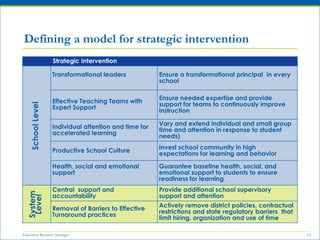
Defining a model for strategic intervention
Strategic Intervention
SchoolLevel
Transformational leaders Ensure a transformational principal in every
school
Effective Teaching Teams with
Expert Support
Ensure needed expertise and provide
support for teams to continuously improve
instruction
Individual attention and time for
accelerated learning
Vary and extend individual and small group
time and attention in response to student
needs)
Productive School Culture Invest school community in high
expectations for learning and behavior
Health, social and emotional
support
Guarantee baseline health, social, and
emotional support to students to ensure
readiness for learning
System
Level
Central support and
accountability
Provide additional school supervisory
support and attention
Removal of Barriers to Effective
Turnaround practices
Actively remove district policies, contractual
restrictions and state regulatory barriers that
limit hiring, organization and use of time
Education Resource Strategies 14
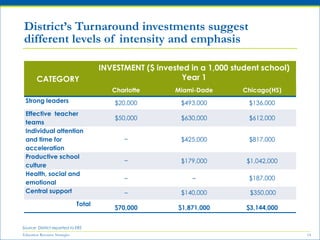
District’s Turnaround investments suggest
different levels of intensity and emphasis
CATEGORY
INVESTMENT ($ invested in a 1,000 student school)
Year 1
Charlotte Miami-Dade Chicago(HS)
Strong leaders $20,000 $493,000 $136,000
Effective teacher
teams
$50,000 $630,000 $612,000
Individual attention
and time for
acceleration
– $425,000 $817,000
Productive school
culture
– $179,000 $1,042,000
Health, social and
emotional
– – $187,000
Central support – $140,000 $350,000
Total
$70,000 $1,871,000 $3,144,000
Source: District reported to ERS
Education Resource Strategies 15
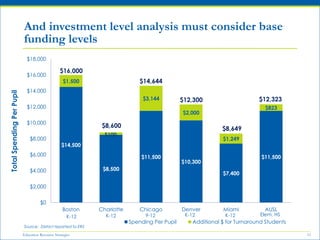
And investment level analysis must consider base
funding levels
$14,500
$8,500
$11,500
$10,300
$7,400
$11,500
$1,500
$100
$3,144
$2,000
$1,249
$823
$0
$2,000
$4,000
$6,000
$8,000
$10,000
$12,000
$14,000
$16,000
$18,000
Boston Charlotte Chicago Denver Miami AUSL
Spending Per Pupil Additional $ for Turnaround Students
$16,000
$8,600
$14,644
$12,300
$8,649
$12,323
K-12 9-12 K-12 K-12 Elem, HSK-12
TotalSpendingPerPupil
Source: District reported to ERS
Education Resource Strategies 16
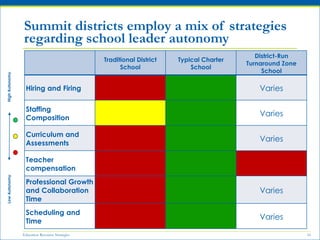
Summit districts employ a mix of strategies
regarding school leader autonomy
Traditional District
School
Typical Charter
School
District-Run
Turnaround Zone
School
Hiring and Firing Varies
Staffing
Composition
Varies
Curriculum and
Assessments
Varies
Teacher
compensation
Professional Growth
and Collaboration
Time
Varies
Scheduling and
Time
Varies
LowAutonomyHighAutonomy
Education Resource Strategies 17
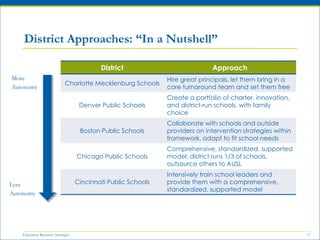
District Approaches: “In a Nutshell”
District Approach
Charlotte Mecklenburg Schools
Hire great principals, let them bring in a
core turnaround team and set them free
Denver Public Schools
Create a portfolio of charter, innovation,
and district-run schools, with family
choice
Boston Public Schools
Collaborate with schools and outside
providers on intervention strategies within
framework, adapt to fit school needs
Chicago Public Schools
Comprehensive, standardized, supported
model; district runs 1/3 of schools,
outsource others to AUSL
Cincinnati Public Schools
Intensively train school leaders and
provide them with a comprehensive,
standardized, supported model
More
Autonomy
Less
Autonomy
Education Resource Strategies 18
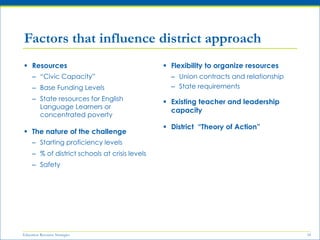
 Resources
– “Civic Capacity”
– Base Funding Levels
– State resources for English
Language Learners or
concentrated poverty
 The nature of the challenge
– Starting proficiency levels
– % of district schools at crisis levels
– Safety
Factors that influence district approach
 Flexibility to organize resources
– Union contracts and relationship
– State requirements
 Existing teacher and leadership
capacity
 District “Theory of Action”
Education Resource Strategies 19
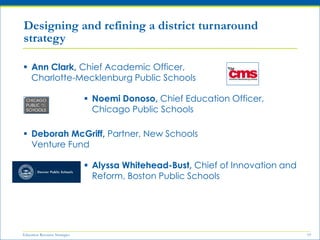
 Ann Clark, Chief Academic Officer,
Charlotte-Mecklenburg Public Schools
 Deborah McGriff, Partner, New Schools
Venture Fund
Designing and refining a district turnaround
strategy
 Noemi Donoso, Chief Education Officer,
Chicago Public Schools
 Alyssa Whitehead-Bust, Chief of Innovation and
Reform, Boston Public Schools
Education Resource Strategies 20
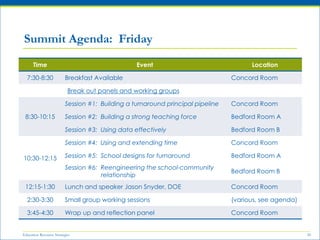
Summit Agenda: Friday
Time Event Location
7:30-8:30 Breakfast Available Concord Room
Break out panels and working groups
8:30-10:15
Session #1: Building a turnaround principal pipeline Concord Room
Session #2: Building a strong teaching force Bedford Room A
Session #3: Using data effectively Bedford Room B
10:30-12:15
Session #4: Using and extending time Concord Room
Session #5: School designs for turnaround Bedford Room A
Session #6: Reengineering the school-community
relationship
Bedford Room B
12:15-1:30 Lunch and speaker Jason Snyder, DOE Concord Room
2:30-3:30 Small group working sessions (various, see agenda)
3:45-4:30 Wrap up and reflection panel Concord Room

Sustaining Turnaround at Scale: Realizing

  • 1.
    Rethinking Resources for StudentSuccess Sustaining Turnaround at Scale Opening Session, October 13, 2011 Realizing the Promise
  • 2.
    Education Resource Strategies2  Explore opportunities and challenges involved in attempting school turnaround at scale  Begin planning NOW to sustain turnaround work once transition funding and special exemptions run out  Identify ways we need to work together to raise the likelihood of success  Celebrate, honor and support each other’s efforts Sustaining Turnaround at Scale: Summit Goals
  • 3.
    Education Resource Strategies3  Boston  Charlotte-Mecklenburg  Chicago  Cincinnati  Denver  District of Columbia  Duval County (Jacksonville  Providence Summit Participants: District Teams
  • 4.
    Education Resource Strategies4  Academy of Urban School Leadership  Achievement Network  Blueprint Schools Network  Citizen Schools  City Connects  City Year  Corporation for National and Community Service  Council of Chief State School Officers  Mass Insight Education  National Center for Time and Learning  New Leaders for New Schools  New Schools Venture Fund Summit Participants: Partners  New Schools Venture Fund  ReNEW  Say Yes to Education  Strategic Grant Partners  TeachPlus  The Annenberg Institute for School Reform  The Aspen Institute  The Education Trust  The New Teacher Project  Turnaround for Children  U.S. Department of Education  University of Virginia Partnership for Leaders in Education
  • 5.
    Education Resource Strategies5  We are a non-profit firm dedicated to helping school systems spend and organize time, talent and technology to create great schools at scale  We partner with system leaders to analyze spending, human resource, organization and student data to better align with high performance strategies  We leverage insight from this work to provide lessons and tools for school leaders and those who support them  Our work is grounded in over a decade of experience working with school districts across the country 5 Education Resource Strategies
  • 6.
    Education Resource Strategies6 Making Meaning and Sharing Lessons Break out panels and working groups 8:30-10:15 Session #1: Building a turnaround principal pipeline Session #2: Building a strong teaching force Session #3: Using data effectively 10:30-12:15 Session #4: Using and extending time Session #5: School designs for turnaround Session #6: Reengineering the school-community relationship 12:15-1:30 Lunch and speaker Jason Snyder, DOE 2:30-3:30 Facilitated small group working sessions 3:45-4:30 Wrap up and reflection panel
  • 7.
    Education Resource Strategies7 Communicating from the Summit
  • 8.
    Education Resource Strategies8 1. Clear goals for student learning and engaging curriculum that aligns to standards 2. Strong leaders who build a culture of high expectations and ownership of student outcomes 3. Effective Teacher teams with expertise, time and support collaborate to adjust instruction using data student progress 4. Intervention for individual learning needs (Special Ed, ELL, gifted and struggling) that integrates with core instruction 5. Individual attention and schedules that prioritize core academics and allow time for students to catch up 6. Safe, welcoming community for students and families 7. Ongoing use of data for continuous improvement We know the essential traits of continuously improving schools
  • 9.
    Education Resource Strategies9 But some schools can’t get there because they are trapped in a cycle of failure Declining expectations (faculty, students, families) Remaining students fall further behind and high needs get concentrated Teachers and families with options leave Persistently poor performance Resource levels and expertise no longer match needs Leaders and teachers have less capacity to collaborate and adjust instruction
  • 10.
    Education Resource Strategies10 1. Strong leaders who build high expectations and ownership 2. Collaborative teacher teams with combined expertise to meet student needs 3. Expertise and resources to serve high concentrations of students with high need To break the cycle of failure, schools must accelerate the pace of improvement through:
  • 11.
    Education Resource Strategies11 Mixed results of turnaround efforts suggest that investing in some schools may not be enough to reverse cycle due to community disengagement, location or facilities challenges Declining expectations (faculty, students, families) Remaining students fall further behind and high needs get concentrated Teachers and families with options leave Persistently poor performance Resource levels and expertise no longer match needs Leaders and teachers have less capacity to collaborate and adjust instruction
  • 12.
    Education Resource Strategies12  District-wide strategy for measuring school performance and diagnosing appropriate action including school closure  Definition of a school turnaround model  Accountability and support  Removal of barriers to implementing effective turnaround practices  Integration with district-wide strategy of accountability, autonomy and support To address core challenges, district turnaround strategies have five components
  • 13.
    Education Resource Strategies13 Defining a model for strategic intervention Strategic Intervention SchoolLevel Transformational leaders Ensure a transformational principal in every school Effective Teaching Teams with Expert Support Ensure needed expertise and provide support for teams to continuously improve instruction Individual attention and time for accelerated learning Vary and extend individual and small group time and attention in response to student needs) Productive School Culture Invest school community in high expectations for learning and behavior Health, social and emotional support Guarantee baseline health, social, and emotional support to students to ensure readiness for learning System Level Central support and accountability Provide additional school supervisory support and attention Removal of Barriers to Effective Turnaround practices Actively remove district policies, contractual restrictions and state regulatory barriers that limit hiring, organization and use of time
  • 14.
    Education Resource Strategies14 District’s Turnaround investments suggest different levels of intensity and emphasis CATEGORY INVESTMENT ($ invested in a 1,000 student school) Year 1 Charlotte Miami-Dade Chicago(HS) Strong leaders $20,000 $493,000 $136,000 Effective teacher teams $50,000 $630,000 $612,000 Individual attention and time for acceleration – $425,000 $817,000 Productive school culture – $179,000 $1,042,000 Health, social and emotional – – $187,000 Central support – $140,000 $350,000 Total $70,000 $1,871,000 $3,144,000 Source: District reported to ERS
  • 15.
    Education Resource Strategies15 And investment level analysis must consider base funding levels $14,500 $8,500 $11,500 $10,300 $7,400 $11,500 $1,500 $100 $3,144 $2,000 $1,249 $823 $0 $2,000 $4,000 $6,000 $8,000 $10,000 $12,000 $14,000 $16,000 $18,000 Boston Charlotte Chicago Denver Miami AUSL Spending Per Pupil Additional $ for Turnaround Students $16,000 $8,600 $14,644 $12,300 $8,649 $12,323 K-12 9-12 K-12 K-12 Elem, HSK-12 TotalSpendingPerPupil Source: District reported to ERS
  • 16.
    Education Resource Strategies16 Summit districts employ a mix of strategies regarding school leader autonomy Traditional District School Typical Charter School District-Run Turnaround Zone School Hiring and Firing Varies Staffing Composition Varies Curriculum and Assessments Varies Teacher compensation Professional Growth and Collaboration Time Varies Scheduling and Time Varies LowAutonomyHighAutonomy
  • 17.
    Education Resource Strategies17 District Approaches: “In a Nutshell” District Approach Charlotte Mecklenburg Schools Hire great principals, let them bring in a core turnaround team and set them free Denver Public Schools Create a portfolio of charter, innovation, and district-run schools, with family choice Boston Public Schools Collaborate with schools and outside providers on intervention strategies within framework, adapt to fit school needs Chicago Public Schools Comprehensive, standardized, supported model; district runs 1/3 of schools, outsource others to AUSL Cincinnati Public Schools Intensively train school leaders and provide them with a comprehensive, standardized, supported model More Autonomy Less Autonomy
  • 18.
    Education Resource Strategies18  Resources – “Civic Capacity” – Base Funding Levels – State resources for English Language Learners or concentrated poverty  The nature of the challenge – Starting proficiency levels – % of district schools at crisis levels – Safety Factors that influence district approach  Flexibility to organize resources – Union contracts and relationship – State requirements  Existing teacher and leadership capacity  District “Theory of Action”
  • 19.
    Education Resource Strategies19  Ann Clark, Chief Academic Officer, Charlotte-Mecklenburg Public Schools  Deborah McGriff, Partner, New Schools Venture Fund Designing and refining a district turnaround strategy  Noemi Donoso, Chief Education Officer, Chicago Public Schools  Alyssa Whitehead-Bust, Chief of Innovation and Reform, Boston Public Schools
  • 20.
    Education Resource Strategies20 Summit Agenda: Friday Time Event Location 7:30-8:30 Breakfast Available Concord Room Break out panels and working groups 8:30-10:15 Session #1: Building a turnaround principal pipeline Concord Room Session #2: Building a strong teaching force Bedford Room A Session #3: Using data effectively Bedford Room B 10:30-12:15 Session #4: Using and extending time Concord Room Session #5: School designs for turnaround Bedford Room A Session #6: Reengineering the school-community relationship Bedford Room B 12:15-1:30 Lunch and speaker Jason Snyder, DOE Concord Room 2:30-3:30 Small group working sessions (various, see agenda) 3:45-4:30 Wrap up and reflection panel Concord Room

Editor's Notes

  • #6 Source: ERS Library SlidesJDAUG08 Location: \\Minerva\ers_data\Internal ERS\Slide Library Documents\1-ERS Slides