4/10/2019
1
Implementing the
NCDPI Organizational Assessment
Recommendation #6:
Regional Support Structure
Maria Pitre-Martin, PhD
1
2
4/10/2019
2
3
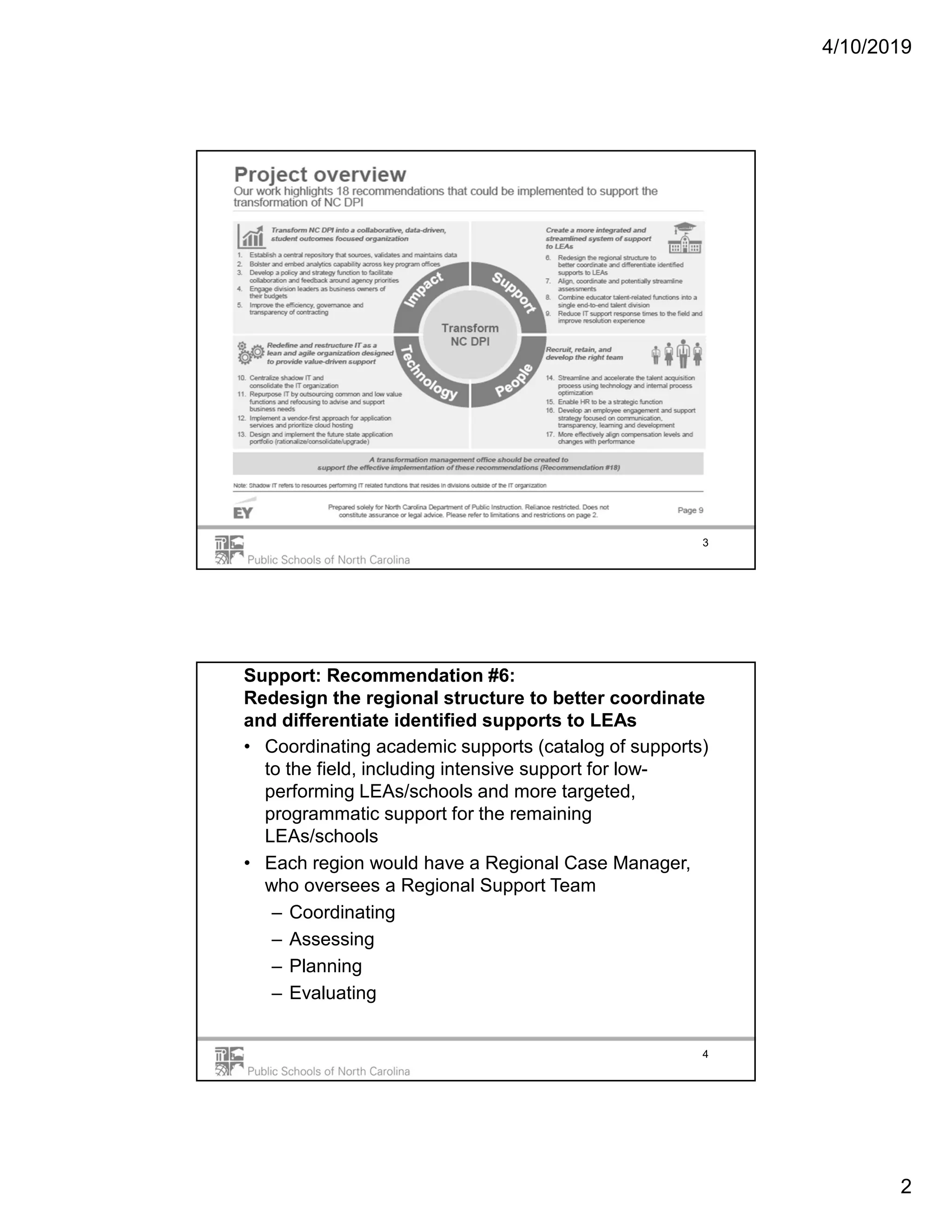
Support: Recommendation #6:
Redesign the regional structure to better coordinate
and differentiate identified supports to LEAs
• Coordinating academic supports (catalog of supports)
to the field, including intensive support for low-
performing LEAs/schools and more targeted,
programmatic support for the remaining
LEAs/schools
• Each region would have a Regional Case Manager,
who oversees a Regional Support Team
– Coordinating
– Assessing
– Planning
– Evaluating
4
4/10/2019
3
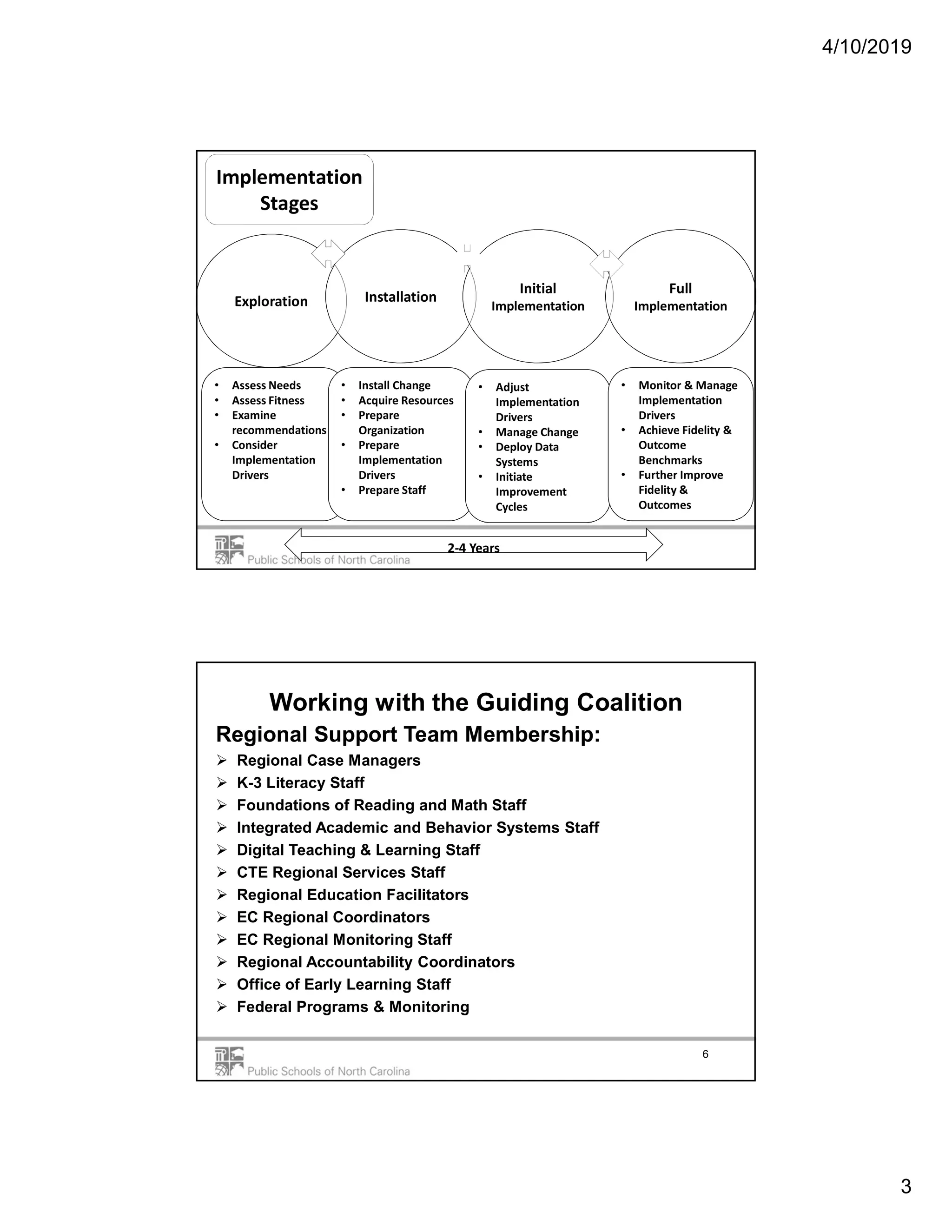
Implementation
Stages
Exploration Installation
Initial
Implementation
Full
Implementation
2-4 Years2-4 Years
• Assess Needs
• Assess Fitness
• Examine
recommendations
• Consider
Implementation
Drivers
• Install Change
• Acquire Resources
• Prepare
Organization
• Prepare
Implementation
Drivers
• Prepare Staff
• Adjust
Implementation
Drivers
• Manage Change
• Deploy Data
Systems
• Initiate
Improvement
Cycles
• Monitor & Manage
Implementation
Drivers
• Achieve Fidelity &
Outcome
Benchmarks
• Further Improve
Fidelity &
Outcomes
Working with the Guiding Coalition
Regional Support Team Membership:
 Regional Case Managers
 K-3 Literacy Staff
 Foundations of Reading and Math Staff
 Integrated Academic and Behavior Systems Staff
 Digital Teaching & Learning Staff
 CTE Regional Services Staff
 Regional Education Facilitators
 EC Regional Coordinators
 EC Regional Monitoring Staff
 Regional Accountability Coordinators
 Office of Early Learning Staff
 Federal Programs & Monitoring
6
4/10/2019
4
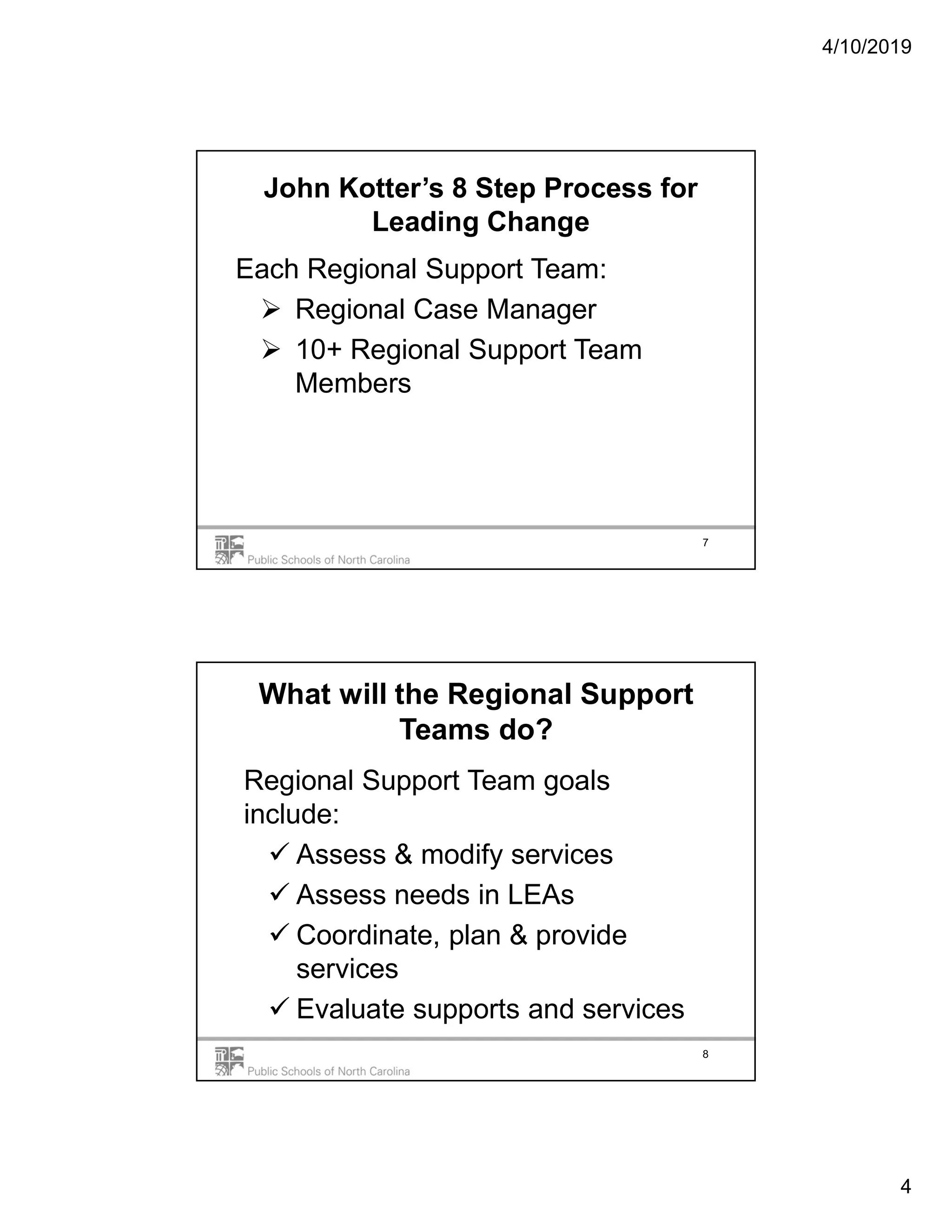
John Kotter’s 8 Step Process for
Leading Change
Each Regional Support Team:
 Regional Case Manager
 10+ Regional Support Team
Members
7
What will the Regional Support
Teams do?
Regional Support Team goals
include:
 Assess & modify services
 Assess needs in LEAs
 Coordinate, plan & provide
services
 Evaluate supports and services
8
4/10/2019
5
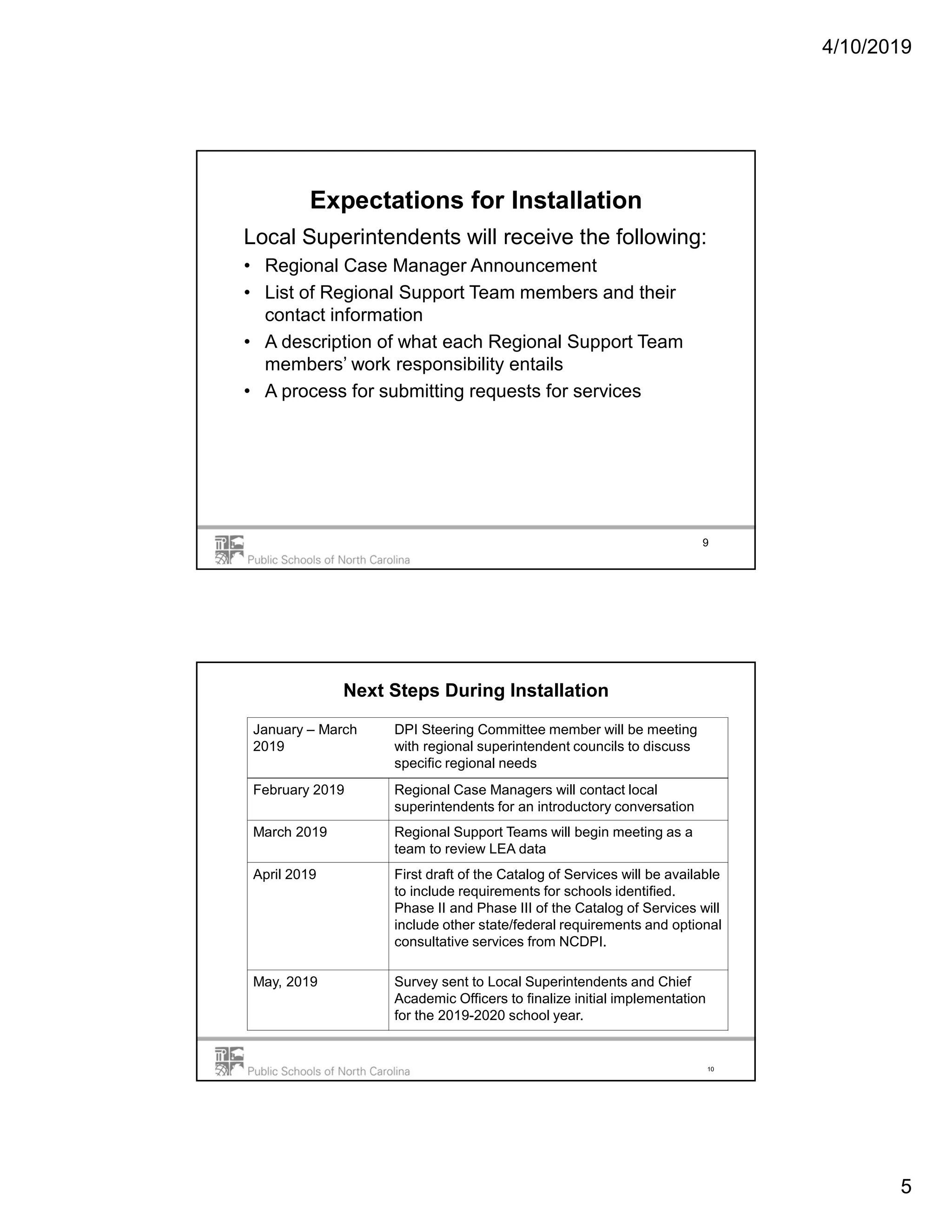
Expectations for Installation
Local Superintendents will receive the following:
• Regional Case Manager Announcement
• List of Regional Support Team members and their
contact information
• A description of what each Regional Support Team
members’ work responsibility entails
• A process for submitting requests for services
9
10
Next Steps During Installation
January – March
2019
DPI Steering Committee member will be meeting
with regional superintendent councils to discuss
specific regional needs
February 2019 Regional Case Managers will contact local
superintendents for an introductory conversation
March 2019 Regional Support Teams will begin meeting as a
team to review LEA data
April 2019 First draft of the Catalog of Services will be available
to include requirements for schools identified.
Phase II and Phase III of the Catalog of Services will
include other state/federal requirements and optional
consultative services from NCDPI.
May, 2019 Survey sent to Local Superintendents and Chief
Academic Officers to finalize initial implementation
for the 2019-2020 school year.
4/10/2019
6
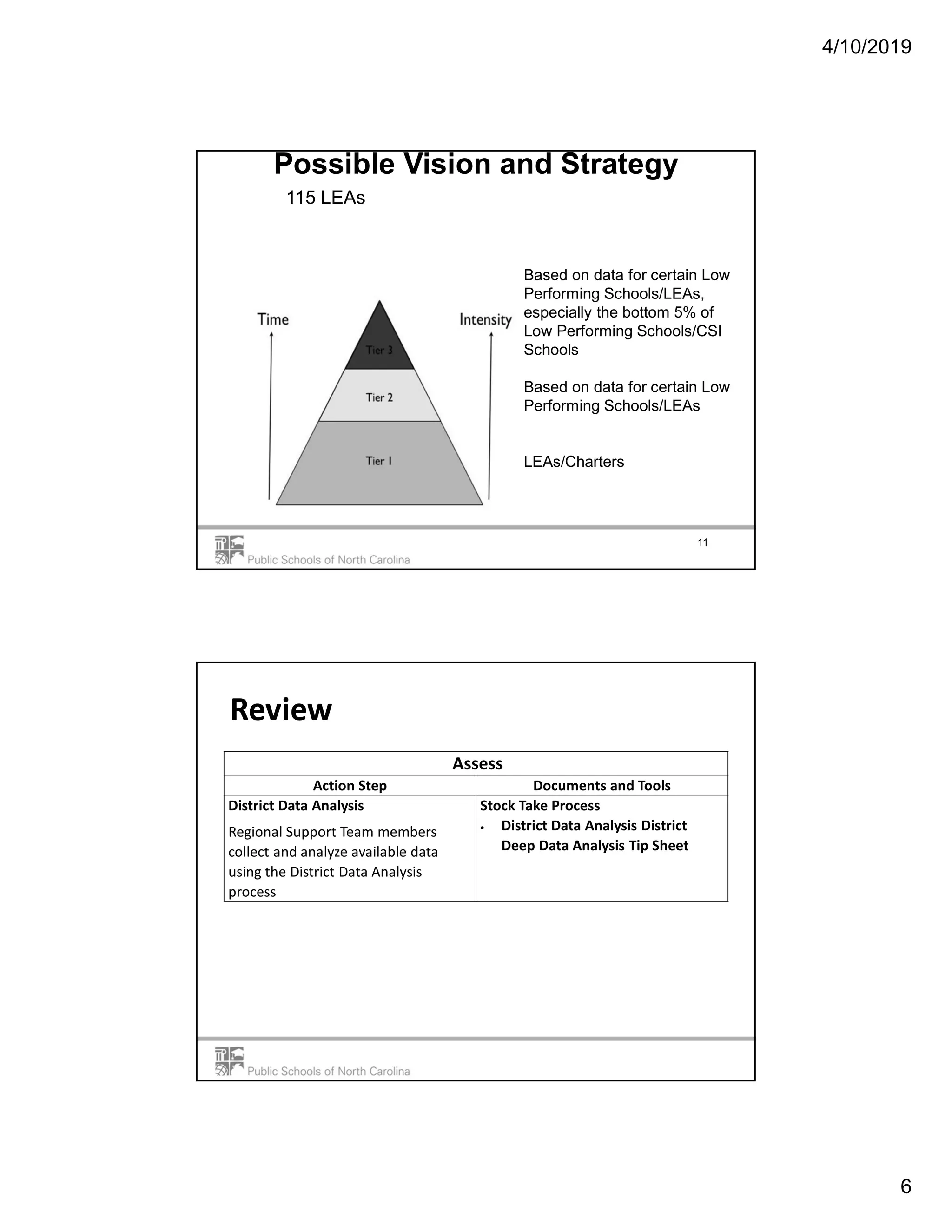
Possible Vision and Strategy
11
Based on data for certain Low
Performing Schools/LEAs,
especially the bottom 5% of
Low Performing Schools/CSI
Schools
Based on data for certain Low
Performing Schools/LEAs
LEAs/Charters
115 LEAs
Review
Assess
Action Step Documents and Tools
District Data Analysis
Regional Support Team members
collect and analyze available data
using the District Data Analysis
process
Stock Take Process
 District Data Analysis District
Deep Data Analysis Tip Sheet
4/10/2019
7
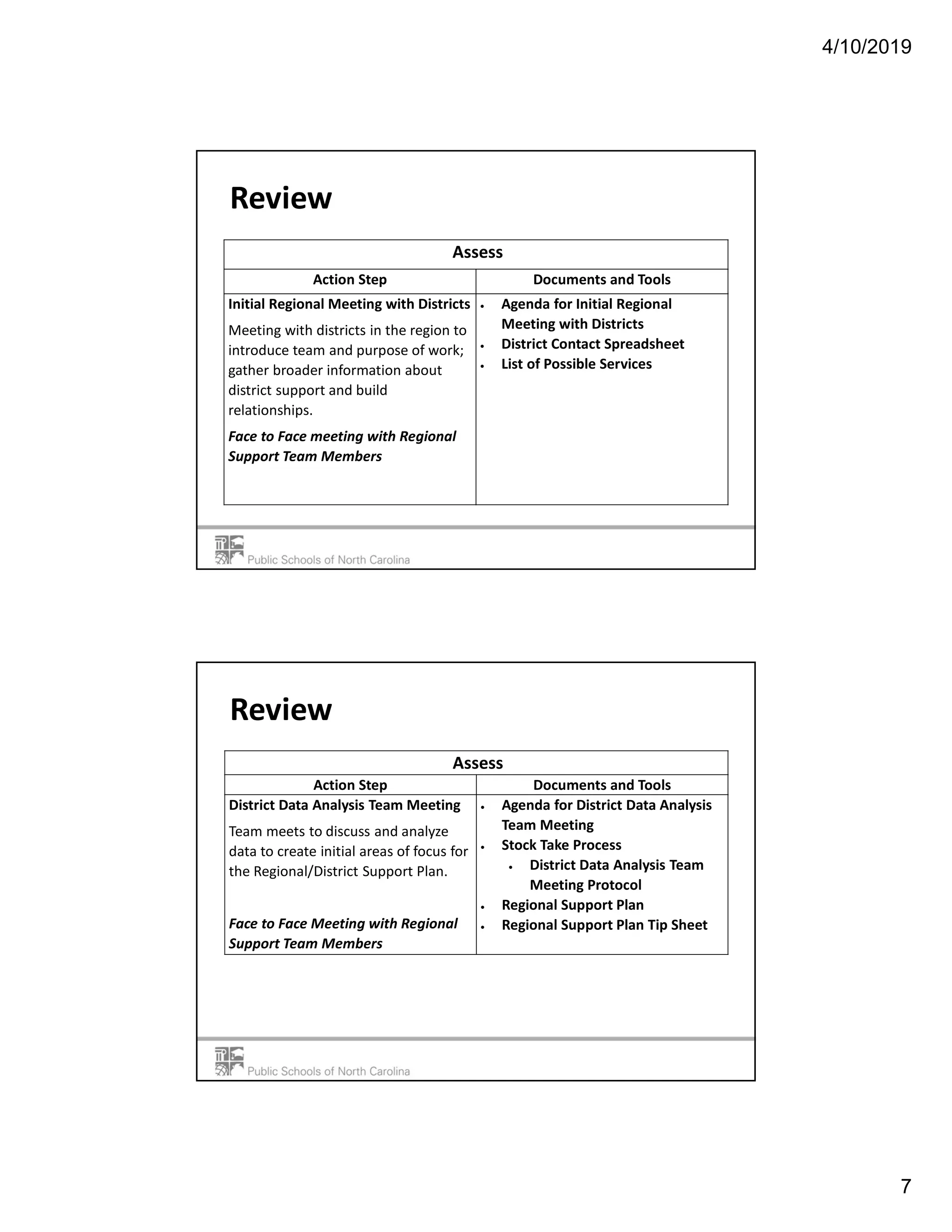
Review
Assess
Action Step Documents and Tools
Initial Regional Meeting with Districts
Meeting with districts in the region to
introduce team and purpose of work;
gather broader information about
district support and build
relationships.
Face to Face meeting with Regional
Support Team Members
 Agenda for Initial Regional
Meeting with Districts
 District Contact Spreadsheet
 List of Possible Services
Review
Assess
Action Step Documents and Tools
District Data Analysis Team Meeting
Team meets to discuss and analyze
data to create initial areas of focus for
the Regional/District Support Plan.
Face to Face Meeting with Regional
Support Team Members
 Agenda for District Data Analysis
Team Meeting
 Stock Take Process
 District Data Analysis Team
Meeting Protocol
 Regional Support Plan
 Regional Support Plan Tip Sheet
4/10/2019
8
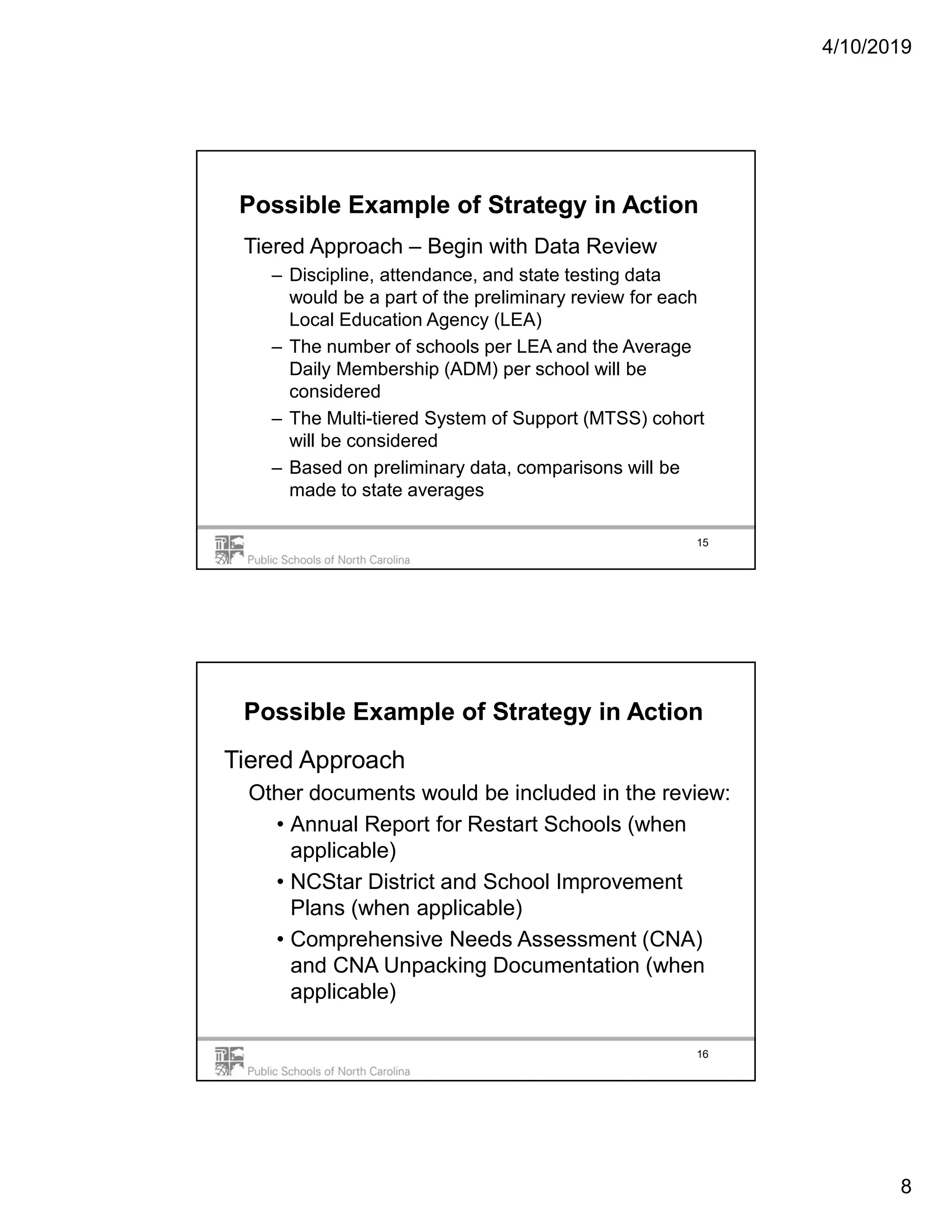
Possible Example of Strategy in Action
Tiered Approach – Begin with Data Review
– Discipline, attendance, and state testing data
would be a part of the preliminary review for each
Local Education Agency (LEA)
– The number of schools per LEA and the Average
Daily Membership (ADM) per school will be
considered
– The Multi-tiered System of Support (MTSS) cohort
will be considered
– Based on preliminary data, comparisons will be
made to state averages
15
Possible Example of Strategy in Action
Tiered Approach
Other documents would be included in the review:
• Annual Report for Restart Schools (when
applicable)
• NCStar District and School Improvement
Plans (when applicable)
• Comprehensive Needs Assessment (CNA)
and CNA Unpacking Documentation (when
applicable)
16
4/10/2019
9
Possible Example of Strategy in Action
Tiered Approach
Use of State/Federal Supports
– Guidance in the use of Formula and
Competitive Federal Grants
– Consideration for Comprehensive Support
and Improvement (CSI)/Targeted Support
and Improvement (TSI) Efforts under ESSA
(Every Student Succeeds Act)
– Consideration of Evidence Based
Interventions
17
18
Immediate Next Steps
• Work with the Guiding Coalition to review data for regions
and districts
• Continue the hiring process for Regional Case Managers
• Work with the Guiding Coalition to determine what
services will be provided (Catalog of Supports/Services)
• Continue to seek feedback from stakeholders
• Plan professional learning for the Regional Case
Managers and Regional Support Team Members
• Develop the strategies, approaches, protocols, and
processes to ensure quality implementation
• Finalize the communication strategy as we unveil the
Regional Support Structure
4/10/2019
10
Support: Recommendation #6:
Redesign the regional structure to better
coordinate and differentiate identified
supports to LEAs
Desired Outcomes:
• Increased coordination across the academic areas at
NCDPI
• More efficient deployment of agency resources as
duplication of effort is reduced
• Clear articulation of DPI’s priorities as they relate to
programs and associated supports (menu of options)
• Increased use of data to drive decision-making
• Improved field perceptions on the consistency and quality of
supports provided by NCDPI
19
Questions

Maria Pitrie-Martin Redesign of DPI District Support

  • 1.
    4/10/2019 1 Implementing the NCDPI OrganizationalAssessment Recommendation #6: Regional Support Structure Maria Pitre-Martin, PhD 1 2
  • 2.
    4/10/2019 2 3 Support: Recommendation #6: Redesignthe regional structure to better coordinate and differentiate identified supports to LEAs • Coordinating academic supports (catalog of supports) to the field, including intensive support for low- performing LEAs/schools and more targeted, programmatic support for the remaining LEAs/schools • Each region would have a Regional Case Manager, who oversees a Regional Support Team – Coordinating – Assessing – Planning – Evaluating 4
  • 3.
    4/10/2019 3 Implementation Stages Exploration Installation Initial Implementation Full Implementation 2-4 Years2-4Years • Assess Needs • Assess Fitness • Examine recommendations • Consider Implementation Drivers • Install Change • Acquire Resources • Prepare Organization • Prepare Implementation Drivers • Prepare Staff • Adjust Implementation Drivers • Manage Change • Deploy Data Systems • Initiate Improvement Cycles • Monitor & Manage Implementation Drivers • Achieve Fidelity & Outcome Benchmarks • Further Improve Fidelity & Outcomes Working with the Guiding Coalition Regional Support Team Membership:  Regional Case Managers  K-3 Literacy Staff  Foundations of Reading and Math Staff  Integrated Academic and Behavior Systems Staff  Digital Teaching & Learning Staff  CTE Regional Services Staff  Regional Education Facilitators  EC Regional Coordinators  EC Regional Monitoring Staff  Regional Accountability Coordinators  Office of Early Learning Staff  Federal Programs & Monitoring 6
  • 4.
    4/10/2019 4 John Kotter’s 8Step Process for Leading Change Each Regional Support Team:  Regional Case Manager  10+ Regional Support Team Members 7 What will the Regional Support Teams do? Regional Support Team goals include:  Assess & modify services  Assess needs in LEAs  Coordinate, plan & provide services  Evaluate supports and services 8
  • 5.
    4/10/2019 5 Expectations for Installation LocalSuperintendents will receive the following: • Regional Case Manager Announcement • List of Regional Support Team members and their contact information • A description of what each Regional Support Team members’ work responsibility entails • A process for submitting requests for services 9 10 Next Steps During Installation January – March 2019 DPI Steering Committee member will be meeting with regional superintendent councils to discuss specific regional needs February 2019 Regional Case Managers will contact local superintendents for an introductory conversation March 2019 Regional Support Teams will begin meeting as a team to review LEA data April 2019 First draft of the Catalog of Services will be available to include requirements for schools identified. Phase II and Phase III of the Catalog of Services will include other state/federal requirements and optional consultative services from NCDPI. May, 2019 Survey sent to Local Superintendents and Chief Academic Officers to finalize initial implementation for the 2019-2020 school year.
  • 6.
    4/10/2019 6 Possible Vision andStrategy 11 Based on data for certain Low Performing Schools/LEAs, especially the bottom 5% of Low Performing Schools/CSI Schools Based on data for certain Low Performing Schools/LEAs LEAs/Charters 115 LEAs Review Assess Action Step Documents and Tools District Data Analysis Regional Support Team members collect and analyze available data using the District Data Analysis process Stock Take Process  District Data Analysis District Deep Data Analysis Tip Sheet
  • 7.
    4/10/2019 7 Review Assess Action Step Documentsand Tools Initial Regional Meeting with Districts Meeting with districts in the region to introduce team and purpose of work; gather broader information about district support and build relationships. Face to Face meeting with Regional Support Team Members  Agenda for Initial Regional Meeting with Districts  District Contact Spreadsheet  List of Possible Services Review Assess Action Step Documents and Tools District Data Analysis Team Meeting Team meets to discuss and analyze data to create initial areas of focus for the Regional/District Support Plan. Face to Face Meeting with Regional Support Team Members  Agenda for District Data Analysis Team Meeting  Stock Take Process  District Data Analysis Team Meeting Protocol  Regional Support Plan  Regional Support Plan Tip Sheet
  • 8.
    4/10/2019 8 Possible Example ofStrategy in Action Tiered Approach – Begin with Data Review – Discipline, attendance, and state testing data would be a part of the preliminary review for each Local Education Agency (LEA) – The number of schools per LEA and the Average Daily Membership (ADM) per school will be considered – The Multi-tiered System of Support (MTSS) cohort will be considered – Based on preliminary data, comparisons will be made to state averages 15 Possible Example of Strategy in Action Tiered Approach Other documents would be included in the review: • Annual Report for Restart Schools (when applicable) • NCStar District and School Improvement Plans (when applicable) • Comprehensive Needs Assessment (CNA) and CNA Unpacking Documentation (when applicable) 16
  • 9.
    4/10/2019 9 Possible Example ofStrategy in Action Tiered Approach Use of State/Federal Supports – Guidance in the use of Formula and Competitive Federal Grants – Consideration for Comprehensive Support and Improvement (CSI)/Targeted Support and Improvement (TSI) Efforts under ESSA (Every Student Succeeds Act) – Consideration of Evidence Based Interventions 17 18 Immediate Next Steps • Work with the Guiding Coalition to review data for regions and districts • Continue the hiring process for Regional Case Managers • Work with the Guiding Coalition to determine what services will be provided (Catalog of Supports/Services) • Continue to seek feedback from stakeholders • Plan professional learning for the Regional Case Managers and Regional Support Team Members • Develop the strategies, approaches, protocols, and processes to ensure quality implementation • Finalize the communication strategy as we unveil the Regional Support Structure
  • 10.
    4/10/2019 10 Support: Recommendation #6: Redesignthe regional structure to better coordinate and differentiate identified supports to LEAs Desired Outcomes: • Increased coordination across the academic areas at NCDPI • More efficient deployment of agency resources as duplication of effort is reduced • Clear articulation of DPI’s priorities as they relate to programs and associated supports (menu of options) • Increased use of data to drive decision-making • Improved field perceptions on the consistency and quality of supports provided by NCDPI 19 Questions