April 2010 Scaling and Sustaining Change: The District Role in School Turnaround  November 4, 2010
Barriers to successful school improvement at scale “ One size fits all” programs EDUCATION RESOURCE STRATEGIES, INC.
Barriers to successful school improvement at scale Support layered on top of broken structures EDUCATION RESOURCE STRATEGIES, INC.
Barriers to successful school improvement at scale Temporary fixes that don’t improve the system EDUCATION RESOURCE STRATEGIES, INC.
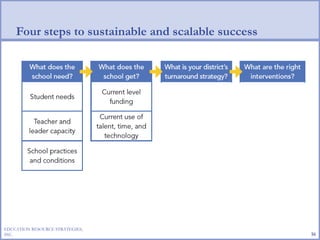
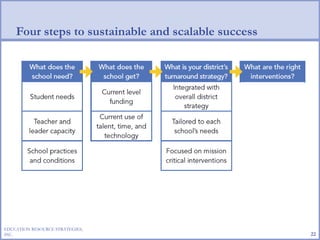
Four steps to sustainable and scalable success EDUCATION RESOURCE STRATEGIES, INC.
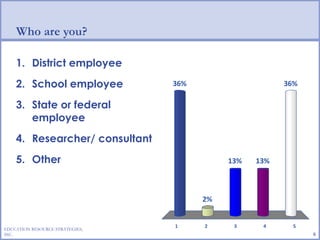
Who are you? District employee School employee State or federal employee Researcher/ consultant Other EDUCATION RESOURCE STRATEGIES, INC.
How many “turnaround schools” are there in your district? None 1-3 3-6 6-10 More than 10 EDUCATION RESOURCE STRATEGIES, INC.
Education Resource Strategies:  Who we are ERS is a non-profit that partners with urban districts to change the way people, time, and money are used so that all students receive the support they need to succeed.  EDUCATION RESOURCE STRATEGIES, INC. CHICAGO  (05) LA  (06, 07) ST. PAUL  (06) OAKLAND  (07)
Why is school turnaround so hard?  EDUCATION RESOURCE STRATEGIES, INC. The Cycle of Failure
Four steps to sustainable and scalable success EDUCATION RESOURCE STRATEGIES, INC.
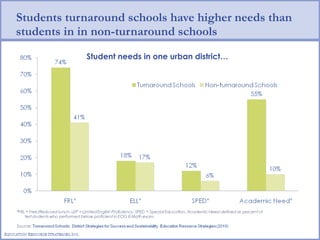
Students turnaround schools have higher needs than students in in non-turnaround schools Student needs in one urban district…
Low performing schools are also more likely to have an unstable teaching force…  Note: School Performance metric is average of % students proficient in Math and % students proficient in ELA Bottom Quartile Schools  by performance (Q4) Q3 Top Quartile Schools  by performance (Q1) Q2 52.9% 47.9% 41.5% 39.8% (0-3 years) (0-3 years) Source: The Teaching Job:  Restructuring for Effectiveness. Education Resource Strategies (2010)
… and lower performing teachers Source: Turnaround Schools:  District Strategies for Success and Sustainability. Education Resource Strategies (2010) EDUCATION RESOURCE STRATEGIES, INC. Lowest Performing School Highest Performing School School Performance Continuum District A Distribution of High Performing Teachers* across  School Performance Quintiles 40% 50% 58% 51% 73%
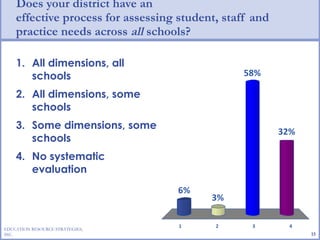
Does your district have an  effective process for assessing student, staff and practice needs across  all  schools? All dimensions, all schools All dimensions, some schools Some dimensions, some schools No systematic evaluation EDUCATION RESOURCE STRATEGIES, INC.
Four steps to sustainable and scalable success EDUCATION RESOURCE STRATEGIES, INC.
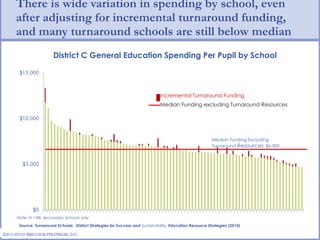
Note: N = 88, Secondary Schools only There is wide variation in spending by school, even after adjusting for incremental turnaround funding, and many turnaround schools are still below median Incremental Turnaround Funding Median Funding excluding Turnaround Resources Median Funding Excluding Turnaround  Resources : $6,500 District C General Education Spending Per Pupil by School Source: Turnaround Schools:  District Strategies for Success and  Sustainability . Education Resource Strategies (2010)
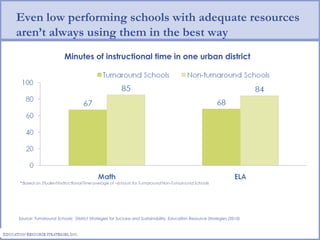
Source: Turnaround Schools:  District Strategies for Success and Sustainability. Education Resource Strategies (2010) Even low performing schools with adequate resources aren’t always using them in the best way Minutes of instructional time in one urban district
EFFECTIVE TEACHING TEAMS with complementary skills, and time to collaborate with experts around student data and work ADDITIONAL INSTRUCTIONAL TIME especially in core academic subjects, for struggling students TARGETED INDIVIDUAL ATTENTION including reduced class sizes in key subjects and grades and flexible schedules and grouping structures Strategic School Design Practices
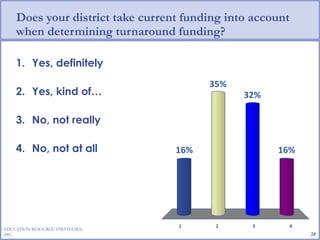
Does your district take current funding into account when determining turnaround funding? Yes, definitely Yes, kind of… No, not really No, not at all EDUCATION RESOURCE STRATEGIES, INC.
Does your district ensure  that schools are maximizing their current resources before or in addition to receiving turnaround funding? Yes, definitely! Yes, kind of… No, not really… No, not at all EDUCATION RESOURCE STRATEGIES, INC.
Four steps to sustainable and scalable success EDUCATION RESOURCE STRATEGIES, INC.
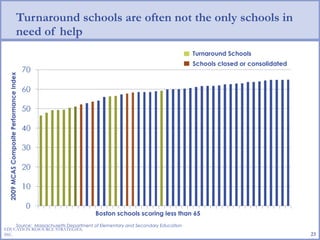
Turnaround schools are often not the only schools in need of help Source:  Massachusetts Department of Elementary and Secondary Education EDUCATION RESOURCE STRATEGIES, INC. Turnaround Schools Schools closed or consolidated 2009 MCAS Composite Performance Index Boston schools scoring less than 65
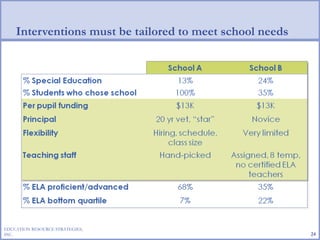
Interventions must be tailored to meet school needs EDUCATION RESOURCE STRATEGIES, INC.
Four steps to sustainable and scalable success EDUCATION RESOURCE STRATEGIES, INC.
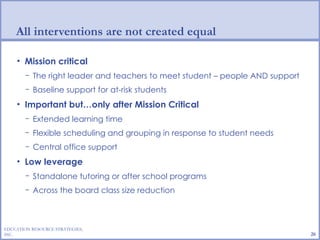
All interventions are not created equal Mission critical The right leader and teachers to meet student – people AND support Baseline support for at-risk students Important but…only after Mission Critical Extended learning time Flexible scheduling and grouping in response to student needs Central office support Low leverage Standalone tutoring or after school programs Across the board class size reduction EDUCATION RESOURCE STRATEGIES, INC.
A tale of four districts… Source: Turnaround Schools:  District Strategies for Success and Sustainability. Education Resource Strategies (2010) EDUCATION RESOURCE STRATEGIES, INC. ? Principals? Teachers? Teacher support? Extended time? Student results?
Does your district’s turnaround strategy invest first in mission critical areas? Yes, definitely! Yes, kind of… No, not really… No, not at all EDUCATION RESOURCE STRATEGIES, INC.
How do the four Federal school improvement models fit in? EDUCATION RESOURCE STRATEGIES, INC.
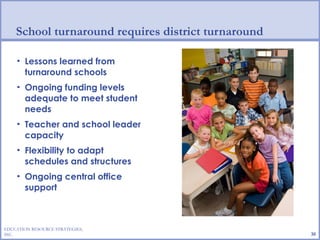
School turnaround requires district turnaround Lessons learned from turnaround schools Ongoing funding levels adequate to meet student needs Teacher and school leader capacity Flexibility to adapt schedules and structures Ongoing central office support EDUCATION RESOURCE STRATEGIES, INC.
Is your district addressing district-wide conditions that don’t support sustainable school improvement? Yes, definitely! Yes, kind of… No, not really… No, not at all EDUCATION RESOURCE STRATEGIES, INC.
Barriers to successful school improvement at scale “ One size fits all” programs Support layered on top of broken structures Temporary fixes that don’t  improve the system EDUCATION RESOURCE STRATEGIES, INC.
Four steps to sustainable and scalable success EDUCATION RESOURCE STRATEGIES, INC.
THANK YOU!!! Self- assessments Detail on the four steps Charts with do it yourself worksheets Action items Available at:  http://erstrategies.org/resources/featured/ EDUCATION RESOURCE STRATEGIES, INC.

Scaling and sustaining change

  • 1.
    April 2010 Scalingand Sustaining Change: The District Role in School Turnaround November 4, 2010
  • 2.
    Barriers to successfulschool improvement at scale “ One size fits all” programs EDUCATION RESOURCE STRATEGIES, INC.
  • 3.
    Barriers to successfulschool improvement at scale Support layered on top of broken structures EDUCATION RESOURCE STRATEGIES, INC.
  • 4.
    Barriers to successfulschool improvement at scale Temporary fixes that don’t improve the system EDUCATION RESOURCE STRATEGIES, INC.
  • 5.
    Four steps tosustainable and scalable success EDUCATION RESOURCE STRATEGIES, INC.
  • 6.
    Who are you?District employee School employee State or federal employee Researcher/ consultant Other EDUCATION RESOURCE STRATEGIES, INC.
  • 7.
    How many “turnaroundschools” are there in your district? None 1-3 3-6 6-10 More than 10 EDUCATION RESOURCE STRATEGIES, INC.
  • 8.
    Education Resource Strategies: Who we are ERS is a non-profit that partners with urban districts to change the way people, time, and money are used so that all students receive the support they need to succeed. EDUCATION RESOURCE STRATEGIES, INC. CHICAGO (05) LA (06, 07) ST. PAUL (06) OAKLAND (07)
  • 9.
    Why is schoolturnaround so hard? EDUCATION RESOURCE STRATEGIES, INC. The Cycle of Failure
  • 10.
    Four steps tosustainable and scalable success EDUCATION RESOURCE STRATEGIES, INC.
  • 11.
    Four steps tosustainable and scalable success EDUCATION RESOURCE STRATEGIES, INC.
  • 12.
    Students turnaround schoolshave higher needs than students in in non-turnaround schools Student needs in one urban district…
  • 13.
    Low performing schoolsare also more likely to have an unstable teaching force… Note: School Performance metric is average of % students proficient in Math and % students proficient in ELA Bottom Quartile Schools by performance (Q4) Q3 Top Quartile Schools by performance (Q1) Q2 52.9% 47.9% 41.5% 39.8% (0-3 years) (0-3 years) Source: The Teaching Job: Restructuring for Effectiveness. Education Resource Strategies (2010)
  • 14.
    … and lowerperforming teachers Source: Turnaround Schools: District Strategies for Success and Sustainability. Education Resource Strategies (2010) EDUCATION RESOURCE STRATEGIES, INC. Lowest Performing School Highest Performing School School Performance Continuum District A Distribution of High Performing Teachers* across School Performance Quintiles 40% 50% 58% 51% 73%
  • 15.
    Does your districthave an effective process for assessing student, staff and practice needs across all schools? All dimensions, all schools All dimensions, some schools Some dimensions, some schools No systematic evaluation EDUCATION RESOURCE STRATEGIES, INC.
  • 16.
    Four steps tosustainable and scalable success EDUCATION RESOURCE STRATEGIES, INC.
  • 17.
    Note: N =88, Secondary Schools only There is wide variation in spending by school, even after adjusting for incremental turnaround funding, and many turnaround schools are still below median Incremental Turnaround Funding Median Funding excluding Turnaround Resources Median Funding Excluding Turnaround Resources : $6,500 District C General Education Spending Per Pupil by School Source: Turnaround Schools: District Strategies for Success and Sustainability . Education Resource Strategies (2010)
  • 18.
    Source: Turnaround Schools: District Strategies for Success and Sustainability. Education Resource Strategies (2010) Even low performing schools with adequate resources aren’t always using them in the best way Minutes of instructional time in one urban district
  • 19.
    EFFECTIVE TEACHING TEAMSwith complementary skills, and time to collaborate with experts around student data and work ADDITIONAL INSTRUCTIONAL TIME especially in core academic subjects, for struggling students TARGETED INDIVIDUAL ATTENTION including reduced class sizes in key subjects and grades and flexible schedules and grouping structures Strategic School Design Practices
  • 20.
    Does your districttake current funding into account when determining turnaround funding? Yes, definitely Yes, kind of… No, not really No, not at all EDUCATION RESOURCE STRATEGIES, INC.
  • 21.
    Does your districtensure that schools are maximizing their current resources before or in addition to receiving turnaround funding? Yes, definitely! Yes, kind of… No, not really… No, not at all EDUCATION RESOURCE STRATEGIES, INC.
  • 22.
    Four steps tosustainable and scalable success EDUCATION RESOURCE STRATEGIES, INC.
  • 23.
    Turnaround schools areoften not the only schools in need of help Source: Massachusetts Department of Elementary and Secondary Education EDUCATION RESOURCE STRATEGIES, INC. Turnaround Schools Schools closed or consolidated 2009 MCAS Composite Performance Index Boston schools scoring less than 65
  • 24.
    Interventions must betailored to meet school needs EDUCATION RESOURCE STRATEGIES, INC.
  • 25.
    Four steps tosustainable and scalable success EDUCATION RESOURCE STRATEGIES, INC.
  • 26.
    All interventions arenot created equal Mission critical The right leader and teachers to meet student – people AND support Baseline support for at-risk students Important but…only after Mission Critical Extended learning time Flexible scheduling and grouping in response to student needs Central office support Low leverage Standalone tutoring or after school programs Across the board class size reduction EDUCATION RESOURCE STRATEGIES, INC.
  • 27.
    A tale offour districts… Source: Turnaround Schools: District Strategies for Success and Sustainability. Education Resource Strategies (2010) EDUCATION RESOURCE STRATEGIES, INC. ? Principals? Teachers? Teacher support? Extended time? Student results?
  • 28.
    Does your district’sturnaround strategy invest first in mission critical areas? Yes, definitely! Yes, kind of… No, not really… No, not at all EDUCATION RESOURCE STRATEGIES, INC.
  • 29.
    How do thefour Federal school improvement models fit in? EDUCATION RESOURCE STRATEGIES, INC.
  • 30.
    School turnaround requiresdistrict turnaround Lessons learned from turnaround schools Ongoing funding levels adequate to meet student needs Teacher and school leader capacity Flexibility to adapt schedules and structures Ongoing central office support EDUCATION RESOURCE STRATEGIES, INC.
  • 31.
    Is your districtaddressing district-wide conditions that don’t support sustainable school improvement? Yes, definitely! Yes, kind of… No, not really… No, not at all EDUCATION RESOURCE STRATEGIES, INC.
  • 32.
    Barriers to successfulschool improvement at scale “ One size fits all” programs Support layered on top of broken structures Temporary fixes that don’t improve the system EDUCATION RESOURCE STRATEGIES, INC.
  • 33.
    Four steps tosustainable and scalable success EDUCATION RESOURCE STRATEGIES, INC.
  • 34.
    THANK YOU!!! Self-assessments Detail on the four steps Charts with do it yourself worksheets Action items Available at: http://erstrategies.org/resources/featured/ EDUCATION RESOURCE STRATEGIES, INC.

Editor's Notes

  • #2 11/22/2010
  • #9 Source: ERS introduction only Location: \\\\Minerva\\ers_data\\Internal ERS\\Slide Library Documents\\1-ERS Slides