4/10/2019
1
Turnaround Efforts in NC
North Carolina Governor’s Commission on
Access to a Sound Basic Education
Pat Ashley
April 11, 2019
(c)PAshley2018
The Turnaround Challenge
Significantly Increasing Student Achievement
in Sustainable Ways
4/10/2019
2
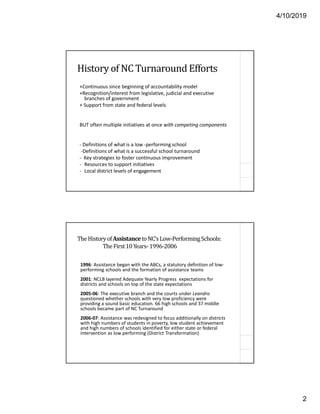
History of NC Turnaround Efforts
+Continuous since beginning of accountability model
+Recognition/interest from legislative, judicial and executive
branches of government
+ Support from state and federal levels
BUT often multiple initiatives at once with competing components
- Definitions of what is a low -performing school
-Definitions of what is a successful school turnaround
- Key strategies to foster continuous improvement
- Resources to support initiatives
- Local district levels of engagement
TheHistoryofAssistancetoNC’sLow-PerformingSchools:
TheFirst10Years-1996-2006
1996: Assistance began with the ABCs, a statutory definition of low-
performing schools and the formation of assistance teams
2001: NCLB layered Adequate Yearly Progress expectations for
districts and schools on top of the state expectations
2005-06: The executive branch and the courts under Leandro
questioned whether schools with very low proficiency were
providing a sound basic education. 66 high schools and 37 middle
schools became part of NC Turnaround
2006-07: Assistance was redesigned to focus additionally on districts
with high numbers of students in poverty, low student achievement
and high numbers of schools identified for either state or federal
intervention as low performing (District Transformation)
4/10/2019
3
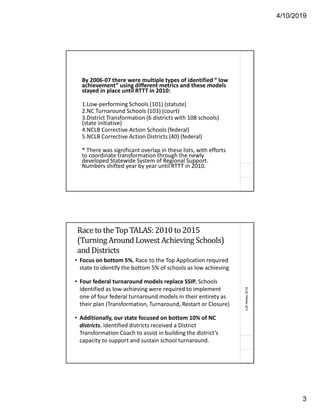
By 2006-07 there were multiple types of identified “ low
achievement” using different metrics and these models
stayed in place until RTTT in 2010:
1.Low-performing Schools (101) (statute)
2.NC Turnaround Schools (103) (court)
3.District Transformation (6 districts with 108 schools)
(state initiative)
4.NCLB Corrective Action Schools (federal)
5.NCLB Corrective Action Districts (40) (federal)
* There was significant overlap in these lists, with efforts
to coordinate transformation through the newly
developed Statewide System of Regional Support.
Numbers shifted year by year until RTTT in 2010.
(c)PAshley2018
Race to the Top TALAS: 2010 to 2015
(Turning Around Lowest Achieving Schools)
and Districts
• Focus on bottom 5%. Race to the Top Application required
state to identify the bottom 5% of schools as low achieving
• Four federal turnaround models replace SSIP. Schools
identified as low-achieving were required to implement
one of four federal turnaround models in their entirety as
their plan (Transformation, Turnaround, Restart or Closure)
• Additionally, our state focused on bottom 10% of NC
districts. Identified districts received a District
Transformation Coach to assist in building the district’s
capacity to support and sustain school turnaround.
4/10/2019
4
(c)PAshley2018
Race to the Top TALAS 2010 to 2015
NC proposed other interventions to support increased student
achievement in identified schools and districts:
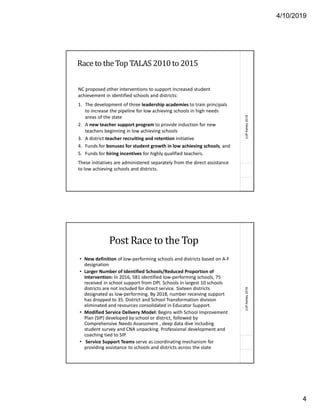
1. The development of three leadership academies to train principals
to increase the pipeline for low achieving schools in high needs
areas of the state
2. A new teacher support program to provide induction for new
teachers beginning in low achieving schools
3. A district teacher recruiting and retention initiative
4. Funds for bonuses for student growth in low achieving schools, and
5. Funds for hiring incentives for highly qualified teachers.
These initiatives are administered separately from the direct assistance
to low achieving schools and districts.
(c)PAshley2018
Post Race to the Top
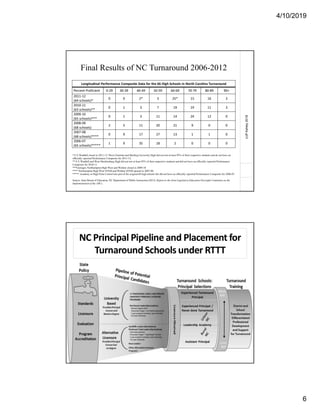
• New definition of low-performing schools and districts based on A-F
designation
• Larger Number of Identified Schools/Reduced Proportion of
Intervention: In 2016, 581 identified low-performing schools, 75
received in school support from DPI. Schools in largest 10 schools
districts are not included for direct service. Sixteen districts
designated as low-performing. By 2018, number receiving support
has dropped to 35. District and School Transformation division
eliminated and resources consolidated in Educator Support.
• Modified Service Delivery Model: Begins with School Improvement
Plan (SIP) developed by school or district, followed by
Comprehensive Needs Assessment , deep data dive including
student survey and CNA unpacking. Professional development and
coaching tied to SIP.
• Service Support Teams serve as coordinating mechanism for
providing assistance to schools and districts across the state
4/10/2019
5
(c)PAshley2018
Post Race to the Top
• Achievement School District implemented in statute then reimaged
and renamed Innovation School District (IDS). Includes one
elementary school in Robeson County and can assume responsibility
for additional schools in future years.
• RESTART and The Innovation Project (TIP): Using a state revision of
the Restart model implemented under RTTT, a district can apply to
implement their own school Restart, giving a school/district some
charter-like flexibility to create a locally initiated Turnaround plan for
a school within flexible parameters. This strategy grew rapidly as
districts saw advantages in local control, flexibility of funding and
protection from selection for ISD. Restart efforts are supported by
The Innovation Project, which districts can elect to join.
What data exists ?
Annual reports to SBOE and General
Assembly
Multiple research studies by multiple
authors
Most successful model/effort may have
been Turnaround and Transformation
model prior to RTTT
4/10/2019
6
(c)PAshley2018
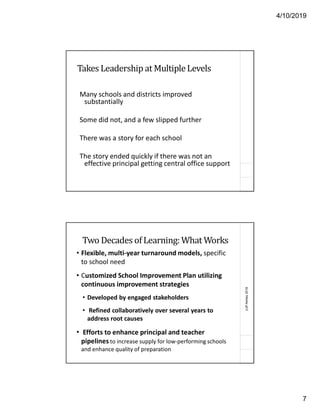
Longitudinal Performance Composite Data for the 66 High Schools in North Carolina Turnaround
Percent Proficient 0-29 30-39 40-49 50-59 60-69 70-79 80-89 90+
2011-12
(64 schools)*
0 0 2* 3 25* 15 16 3
2010-11
(63 schools)**
0 1 3 7 19 19 11 3
2009-10
(65 schools)***
0 1 3 11 14 24 12 0
2008-09
(68 schools)
2 5 11 20 21 9 0 0
2007-08
(68 schools)****
0 9 17 27 13 1 1 0
2006-07
(65 schools)*****
1 9 35 18 2 0 0 0
* E E Waddell closed in 2011-12. West Charlotte and Harding University High did not test at least 95% of their respective students and do not have an
officially reported Performance Composite for 2011-12.
** E E Waddell and West Mecklenburg High did not test at least 95% of their respective students and did not have an officially reported Performance
Composite for 2010-11.
***Garinger, Northampton High West and Weldon closed in 2009-10.
**** Northampton High West STEM and Weldon STEM opened in 2007-08.
***** Academy at High Point Central was part of the original 66 high schools but did not have an officially reported Performance Composite for 2006-07.
Source: State Board of Education, NC Department of Public Instruction (2013). Report to the Joint Legislative Education Oversight Committee on the
Implementation of the ABCs.
Final Results of NC Turnaround 2006-2012
(c)PAshley2018
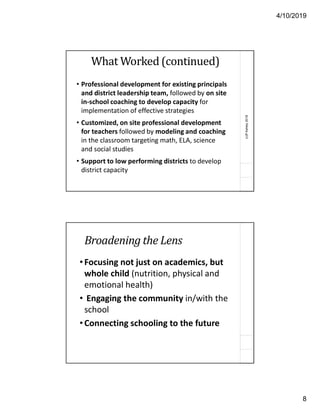
NC Principal Pipeline and Placement for
Turnaround Schools under RTTT
4/10/2019
7
Takes Leadership at MultipleLevels
Many schools and districts improved
substantially
Some did not, and a few slipped further
There was a story for each school
The story ended quickly if there was not an
effective principal getting central office support
(c)PAshley2018
Two Decades of Learning:What Works
• Flexible, multi-year turnaround models, specific
to school need
• Customized School Improvement Plan utilizing
continuous improvement strategies
• Developed by engaged stakeholders
• Refined collaboratively over several years to
address root causes
• Efforts to enhance principal and teacher
pipelines to increase supply for low-performing schools
and enhance quality of preparation
4/10/2019
8
(c)PAshley2018
What Worked (continued)
• Professional development for existing principals
and district leadership team, followed by on site
in-school coaching to develop capacity for
implementation of effective strategies
• Customized, on site professional development
for teachers followed by modeling and coaching
in the classroom targeting math, ELA, science
and social studies
• Support to low performing districts to develop
district capacity
Broadening the Lens
• Focusing not just on academics, but
whole child (nutrition, physical and
emotional health)
• Engaging the community in/with the
school
• Connecting schooling to the future
4/10/2019
9
(c)PAshley2018
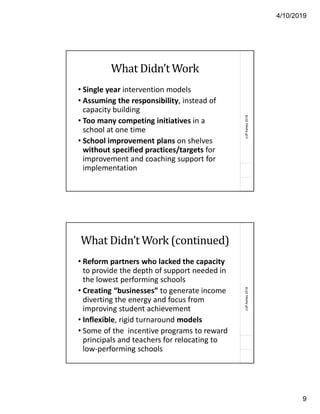
What Didn’t Work
• Single year intervention models
• Assuming the responsibility, instead of
capacity building
• Too many competing initiatives in a
school at one time
• School improvement plans on shelves
without specified practices/targets for
improvement and coaching support for
implementation
(c)PAshley2018
What Didn’t Work (continued)
• Reform partners who lacked the capacity
to provide the depth of support needed in
the lowest performing schools
• Creating “businesses” to generate income
diverting the energy and focus from
improving student achievement
• Inflexible, rigid turnaround models
• Some of the incentive programs to reward
principals and teachers for relocating to
low-performing schools
4/10/2019
10
(c)PAshley2018
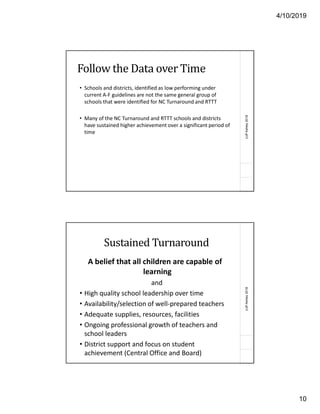
Follow the Data over Time
• Schools and districts, identified as low performing under
current A-F guidelines are not the same general group of
schools that were identified for NC Turnaround and RTTT
• Many of the NC Turnaround and RTTT schools and districts
have sustained higher achievement over a significant period of
time
(c)PAshley2018Sustained Turnaround
A belief that all children are capable of
learning
and
• High quality school leadership over time
• Availability/selection of well-prepared teachers
• Adequate supplies, resources, facilities
• Ongoing professional growth of teachers and
school leaders
• District support and focus on student
achievement (Central Office and Board)
4/10/2019
11
(c)PAshley2018
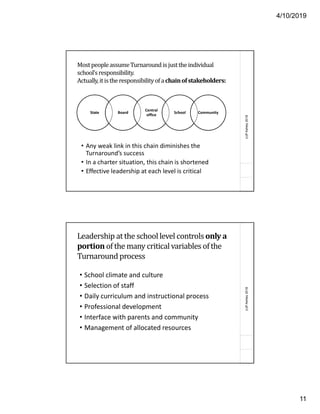
MostpeopleassumeTurnaround isjusttheindividual
school’sresponsibility.
Actually,itistheresponsibilityofachainofstakeholders:
• Any weak link in this chain diminishes the
Turnaround’s success
• In a charter situation, this chain is shortened
• Effective leadership at each level is critical
State Board
Central
office
School Community
(c)PAshley2018
Leadership at the schoollevel controls only a
portion of the many criticalvariables ofthe
Turnaround process
• School climate and culture
• Selection of staff
• Daily curriculum and instructional process
• Professional development
• Interface with parents and community
• Management of allocated resources
4/10/2019
12
(c)PAshley2018
Thedistrict(board andcentraloffice)controlsa
differentportionof criticalvariablesofthe
Turnaroundprocess
• Who will be principal
• Who will support the principal (especially if inexperienced)
• Teacher hiring process/sometimes assignment
• Budget and allocation of resources
• Any local accountability systems such as benchmark
assessments
• Relevant policies such as suspension and attendance
• School calendar and school hours
(c)PAshley2018
The Stateplays a significant role in
ensuring a sound basic education
•Establishes the teacher and principal pipelines
•Establishes the accountability system
•Establishes the definition of low-performing
•Establishes the framework for support and
allocates resources
•Determines priority of Turnaround efforts among
competing initiatives
4/10/2019
13
(c)PAshley2018
The “pressure” to motivate improvement needs
to be balanced by the “support” needed to make
change happen
• NCLB was more about sanctions and corrective
action than about support and help for change
• Big influxes of money (ex. SIG) for short period of
time does not equal sustainability
• Schools and districts at bottom experience more
challenges as well as more churn of leaders and
teachers
• Without external pressure, some schools and
districts might put adult interests before kids’
needs
(c)PAshley2018
The definitionsof “low-performing”
schools and districts matter
• Should pass a common sense test
• There needs to be a match between definition
“scope” and resource allocation
4/10/2019
14
(c)PAshley2018
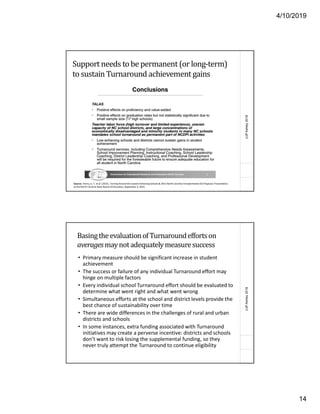
Support needs tobe permanent (or long-term)
to sustain Turnaround achievement gains
Source: Henry, G. T. et al. (2015). Turning Around the Lowest-AchievingSchools & 2015 North Carolina TransformationIES Proposal.Presentation
to the North Carolina State Board of Education, September 3, 2015.
(c)PAshley2018
Basingtheevaluationof Turnaroundeffortson
averagesmaynotadequatelymeasuresuccess
• Primary measure should be significant increase in student
achievement
• The success or failure of any individual Turnaround effort may
hinge on multiple factors
• Every individual school Turnaround effort should be evaluated to
determine what went right and what went wrong
• Simultaneous efforts at the school and district levels provide the
best chance of sustainability over time
• There are wide differences in the challenges of rural and urban
districts and schools
• In some instances, extra funding associated with Turnaround
initiatives may create a perverse incentive: districts and schools
don’t want to risk losing the supplemental funding, so they
never truly attempt the Turnaround to continue eligibility
4/10/2019
15
(c)PAshley2018
Additional
Resources:
Reports to
the JLEOC
(c)PAshley2018
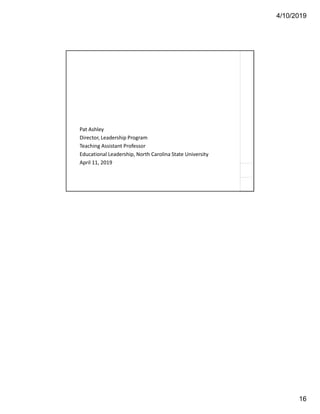
Additional Resources:
NCDPI Jones County video
4/10/2019
16
Pat Ashley
Director, Leadership Program
Teaching Assistant Professor
Educational Leadership, North Carolina State University
April 11, 2019

Pat Ashley NC Turnaround Efforts

  • 1.
    4/10/2019 1 Turnaround Efforts inNC North Carolina Governor’s Commission on Access to a Sound Basic Education Pat Ashley April 11, 2019 (c)PAshley2018 The Turnaround Challenge Significantly Increasing Student Achievement in Sustainable Ways
  • 2.
    4/10/2019 2 History of NCTurnaround Efforts +Continuous since beginning of accountability model +Recognition/interest from legislative, judicial and executive branches of government + Support from state and federal levels BUT often multiple initiatives at once with competing components - Definitions of what is a low -performing school -Definitions of what is a successful school turnaround - Key strategies to foster continuous improvement - Resources to support initiatives - Local district levels of engagement TheHistoryofAssistancetoNC’sLow-PerformingSchools: TheFirst10Years-1996-2006 1996: Assistance began with the ABCs, a statutory definition of low- performing schools and the formation of assistance teams 2001: NCLB layered Adequate Yearly Progress expectations for districts and schools on top of the state expectations 2005-06: The executive branch and the courts under Leandro questioned whether schools with very low proficiency were providing a sound basic education. 66 high schools and 37 middle schools became part of NC Turnaround 2006-07: Assistance was redesigned to focus additionally on districts with high numbers of students in poverty, low student achievement and high numbers of schools identified for either state or federal intervention as low performing (District Transformation)
  • 3.
    4/10/2019 3 By 2006-07 therewere multiple types of identified “ low achievement” using different metrics and these models stayed in place until RTTT in 2010: 1.Low-performing Schools (101) (statute) 2.NC Turnaround Schools (103) (court) 3.District Transformation (6 districts with 108 schools) (state initiative) 4.NCLB Corrective Action Schools (federal) 5.NCLB Corrective Action Districts (40) (federal) * There was significant overlap in these lists, with efforts to coordinate transformation through the newly developed Statewide System of Regional Support. Numbers shifted year by year until RTTT in 2010. (c)PAshley2018 Race to the Top TALAS: 2010 to 2015 (Turning Around Lowest Achieving Schools) and Districts • Focus on bottom 5%. Race to the Top Application required state to identify the bottom 5% of schools as low achieving • Four federal turnaround models replace SSIP. Schools identified as low-achieving were required to implement one of four federal turnaround models in their entirety as their plan (Transformation, Turnaround, Restart or Closure) • Additionally, our state focused on bottom 10% of NC districts. Identified districts received a District Transformation Coach to assist in building the district’s capacity to support and sustain school turnaround.
  • 4.
    4/10/2019 4 (c)PAshley2018 Race to theTop TALAS 2010 to 2015 NC proposed other interventions to support increased student achievement in identified schools and districts: 1. The development of three leadership academies to train principals to increase the pipeline for low achieving schools in high needs areas of the state 2. A new teacher support program to provide induction for new teachers beginning in low achieving schools 3. A district teacher recruiting and retention initiative 4. Funds for bonuses for student growth in low achieving schools, and 5. Funds for hiring incentives for highly qualified teachers. These initiatives are administered separately from the direct assistance to low achieving schools and districts. (c)PAshley2018 Post Race to the Top • New definition of low-performing schools and districts based on A-F designation • Larger Number of Identified Schools/Reduced Proportion of Intervention: In 2016, 581 identified low-performing schools, 75 received in school support from DPI. Schools in largest 10 schools districts are not included for direct service. Sixteen districts designated as low-performing. By 2018, number receiving support has dropped to 35. District and School Transformation division eliminated and resources consolidated in Educator Support. • Modified Service Delivery Model: Begins with School Improvement Plan (SIP) developed by school or district, followed by Comprehensive Needs Assessment , deep data dive including student survey and CNA unpacking. Professional development and coaching tied to SIP. • Service Support Teams serve as coordinating mechanism for providing assistance to schools and districts across the state
  • 5.
    4/10/2019 5 (c)PAshley2018 Post Race tothe Top • Achievement School District implemented in statute then reimaged and renamed Innovation School District (IDS). Includes one elementary school in Robeson County and can assume responsibility for additional schools in future years. • RESTART and The Innovation Project (TIP): Using a state revision of the Restart model implemented under RTTT, a district can apply to implement their own school Restart, giving a school/district some charter-like flexibility to create a locally initiated Turnaround plan for a school within flexible parameters. This strategy grew rapidly as districts saw advantages in local control, flexibility of funding and protection from selection for ISD. Restart efforts are supported by The Innovation Project, which districts can elect to join. What data exists ? Annual reports to SBOE and General Assembly Multiple research studies by multiple authors Most successful model/effort may have been Turnaround and Transformation model prior to RTTT
  • 6.
    4/10/2019 6 (c)PAshley2018 Longitudinal Performance CompositeData for the 66 High Schools in North Carolina Turnaround Percent Proficient 0-29 30-39 40-49 50-59 60-69 70-79 80-89 90+ 2011-12 (64 schools)* 0 0 2* 3 25* 15 16 3 2010-11 (63 schools)** 0 1 3 7 19 19 11 3 2009-10 (65 schools)*** 0 1 3 11 14 24 12 0 2008-09 (68 schools) 2 5 11 20 21 9 0 0 2007-08 (68 schools)**** 0 9 17 27 13 1 1 0 2006-07 (65 schools)***** 1 9 35 18 2 0 0 0 * E E Waddell closed in 2011-12. West Charlotte and Harding University High did not test at least 95% of their respective students and do not have an officially reported Performance Composite for 2011-12. ** E E Waddell and West Mecklenburg High did not test at least 95% of their respective students and did not have an officially reported Performance Composite for 2010-11. ***Garinger, Northampton High West and Weldon closed in 2009-10. **** Northampton High West STEM and Weldon STEM opened in 2007-08. ***** Academy at High Point Central was part of the original 66 high schools but did not have an officially reported Performance Composite for 2006-07. Source: State Board of Education, NC Department of Public Instruction (2013). Report to the Joint Legislative Education Oversight Committee on the Implementation of the ABCs. Final Results of NC Turnaround 2006-2012 (c)PAshley2018 NC Principal Pipeline and Placement for Turnaround Schools under RTTT
  • 7.
    4/10/2019 7 Takes Leadership atMultipleLevels Many schools and districts improved substantially Some did not, and a few slipped further There was a story for each school The story ended quickly if there was not an effective principal getting central office support (c)PAshley2018 Two Decades of Learning:What Works • Flexible, multi-year turnaround models, specific to school need • Customized School Improvement Plan utilizing continuous improvement strategies • Developed by engaged stakeholders • Refined collaboratively over several years to address root causes • Efforts to enhance principal and teacher pipelines to increase supply for low-performing schools and enhance quality of preparation
  • 8.
    4/10/2019 8 (c)PAshley2018 What Worked (continued) •Professional development for existing principals and district leadership team, followed by on site in-school coaching to develop capacity for implementation of effective strategies • Customized, on site professional development for teachers followed by modeling and coaching in the classroom targeting math, ELA, science and social studies • Support to low performing districts to develop district capacity Broadening the Lens • Focusing not just on academics, but whole child (nutrition, physical and emotional health) • Engaging the community in/with the school • Connecting schooling to the future
  • 9.
    4/10/2019 9 (c)PAshley2018 What Didn’t Work •Single year intervention models • Assuming the responsibility, instead of capacity building • Too many competing initiatives in a school at one time • School improvement plans on shelves without specified practices/targets for improvement and coaching support for implementation (c)PAshley2018 What Didn’t Work (continued) • Reform partners who lacked the capacity to provide the depth of support needed in the lowest performing schools • Creating “businesses” to generate income diverting the energy and focus from improving student achievement • Inflexible, rigid turnaround models • Some of the incentive programs to reward principals and teachers for relocating to low-performing schools
  • 10.
    4/10/2019 10 (c)PAshley2018 Follow the Dataover Time • Schools and districts, identified as low performing under current A-F guidelines are not the same general group of schools that were identified for NC Turnaround and RTTT • Many of the NC Turnaround and RTTT schools and districts have sustained higher achievement over a significant period of time (c)PAshley2018Sustained Turnaround A belief that all children are capable of learning and • High quality school leadership over time • Availability/selection of well-prepared teachers • Adequate supplies, resources, facilities • Ongoing professional growth of teachers and school leaders • District support and focus on student achievement (Central Office and Board)
  • 11.
    4/10/2019 11 (c)PAshley2018 MostpeopleassumeTurnaround isjusttheindividual school’sresponsibility. Actually,itistheresponsibilityofachainofstakeholders: • Anyweak link in this chain diminishes the Turnaround’s success • In a charter situation, this chain is shortened • Effective leadership at each level is critical State Board Central office School Community (c)PAshley2018 Leadership at the schoollevel controls only a portion of the many criticalvariables ofthe Turnaround process • School climate and culture • Selection of staff • Daily curriculum and instructional process • Professional development • Interface with parents and community • Management of allocated resources
  • 12.
    4/10/2019 12 (c)PAshley2018 Thedistrict(board andcentraloffice)controlsa differentportionof criticalvariablesofthe Turnaroundprocess •Who will be principal • Who will support the principal (especially if inexperienced) • Teacher hiring process/sometimes assignment • Budget and allocation of resources • Any local accountability systems such as benchmark assessments • Relevant policies such as suspension and attendance • School calendar and school hours (c)PAshley2018 The Stateplays a significant role in ensuring a sound basic education •Establishes the teacher and principal pipelines •Establishes the accountability system •Establishes the definition of low-performing •Establishes the framework for support and allocates resources •Determines priority of Turnaround efforts among competing initiatives
  • 13.
    4/10/2019 13 (c)PAshley2018 The “pressure” tomotivate improvement needs to be balanced by the “support” needed to make change happen • NCLB was more about sanctions and corrective action than about support and help for change • Big influxes of money (ex. SIG) for short period of time does not equal sustainability • Schools and districts at bottom experience more challenges as well as more churn of leaders and teachers • Without external pressure, some schools and districts might put adult interests before kids’ needs (c)PAshley2018 The definitionsof “low-performing” schools and districts matter • Should pass a common sense test • There needs to be a match between definition “scope” and resource allocation
  • 14.
    4/10/2019 14 (c)PAshley2018 Support needs tobepermanent (or long-term) to sustain Turnaround achievement gains Source: Henry, G. T. et al. (2015). Turning Around the Lowest-AchievingSchools & 2015 North Carolina TransformationIES Proposal.Presentation to the North Carolina State Board of Education, September 3, 2015. (c)PAshley2018 Basingtheevaluationof Turnaroundeffortson averagesmaynotadequatelymeasuresuccess • Primary measure should be significant increase in student achievement • The success or failure of any individual Turnaround effort may hinge on multiple factors • Every individual school Turnaround effort should be evaluated to determine what went right and what went wrong • Simultaneous efforts at the school and district levels provide the best chance of sustainability over time • There are wide differences in the challenges of rural and urban districts and schools • In some instances, extra funding associated with Turnaround initiatives may create a perverse incentive: districts and schools don’t want to risk losing the supplemental funding, so they never truly attempt the Turnaround to continue eligibility
  • 15.
  • 16.
    4/10/2019 16 Pat Ashley Director, LeadershipProgram Teaching Assistant Professor Educational Leadership, North Carolina State University April 11, 2019