CLAN
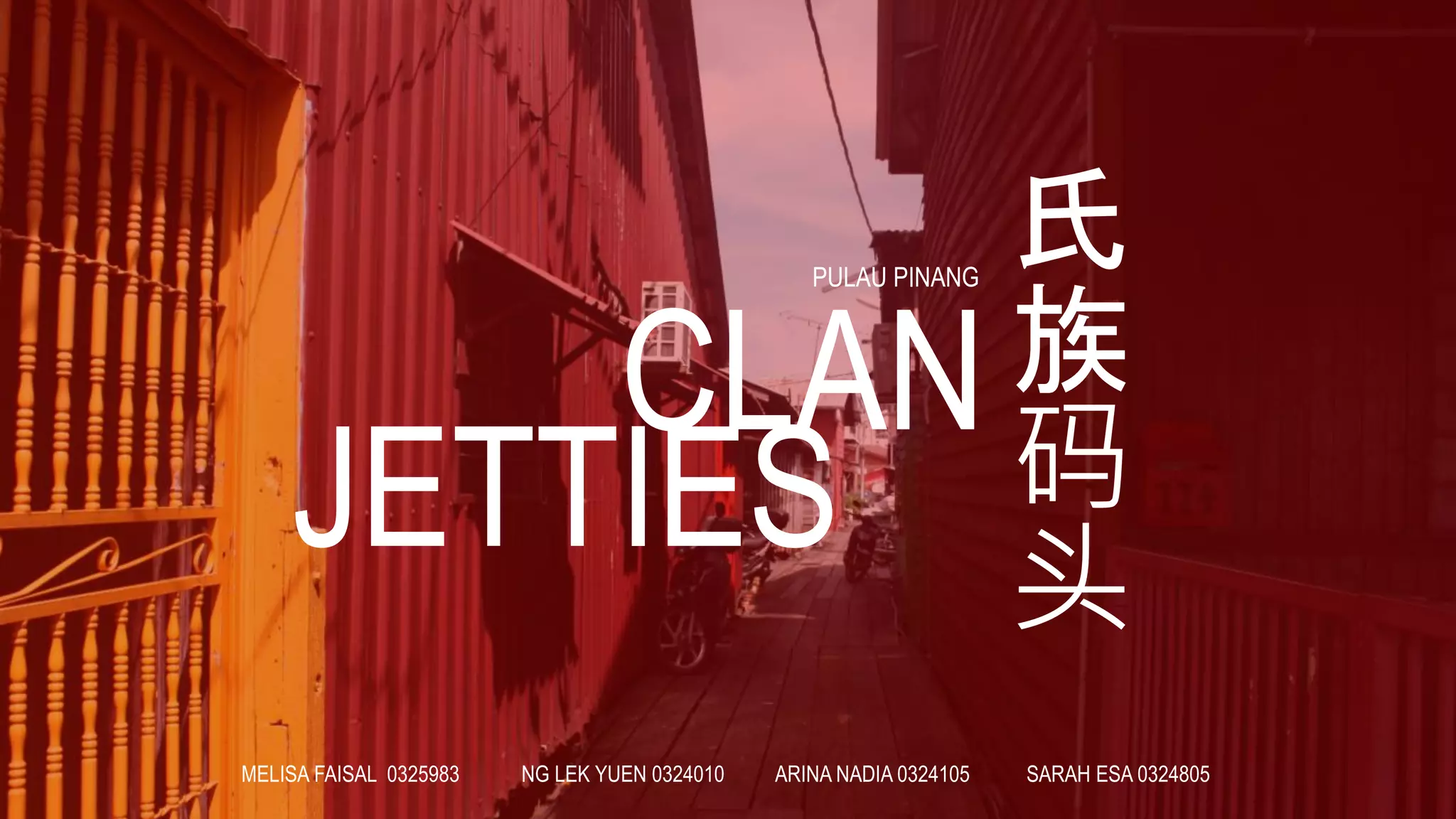
PULAU PINANG
MELISA FAISAL 0325983 NG LEK YUEN 0324010 ARINA NADIA 0324105 SARAH ESA 0324805
氏
族
码
头
JETTIES
KEY PLAN
Penang is a Malaysian state located on the
northwest coast of the Peninsular Malaysia,
by the Malacca Strait.
LOCATION
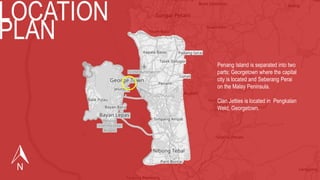
Penang Island is separated into two
parts; Georgetown where the capital
city is located and Seberang Perai
on the Malay Peninsula.
Clan Jetties is located in Pengkalan
Weld, Georgetown.
PLAN
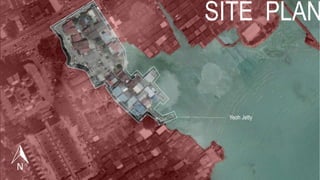
SITE PLAN
Yeoh Jetty
ZONING
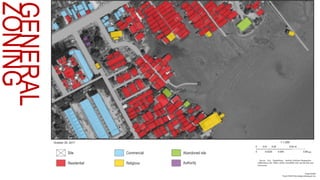
GENERAL
Site
Residential
Commercial
Religious
Abandoned site
Authority
ZONING
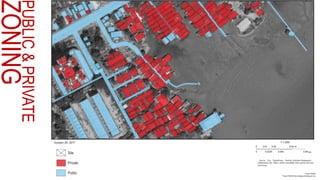
PUBLIC&PRIVATE
Site
Private
Public
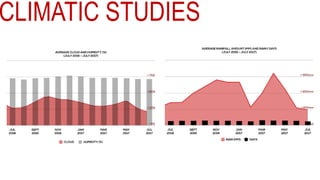
CLIMATIC STUDIES
SUN CHART
CLIMATIC STUDIES
SIGNIFICANT
建筑风格
ARCHITECTURE
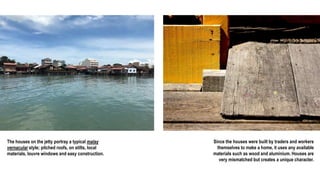
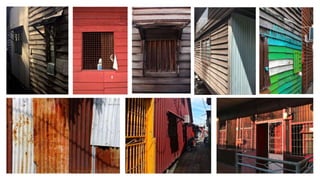
The houses on the jetty portray a typical malay
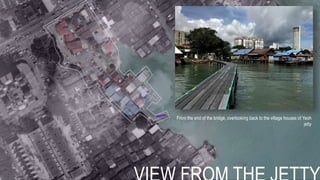
vernacular style; pitched roofs, on stilts, local
materials, louvre windows and easy construction.
Since the houses were built by traders and workers
themselves to make a home, it uses any available
materials such as wood and aluminium. Houses are
very mismatched but creates a unique character.
CIRCULATIONS
循
环
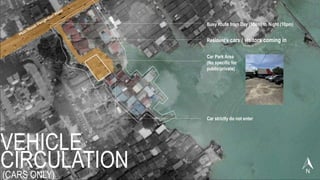
(CARS ONLY)
VEHICLE
CIRCULATION
Busy route from Day (10am) to Night (10pm)
Resident’s cars / visitors coming in
Car Park Area
(No specific for
public/private)
Car strictly do not enter
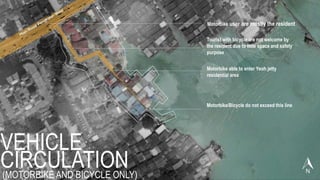
(MOTORBIKE AND BICYCLE ONLY)
VEHICLE
CIRCULATION
Motorbike able to enter Yeoh jetty
residential area
Motorbike user are mostly the resident
Tourist with bicycle are not welcome by
the resident due to little space and safety
purpose
Motorbike/Bicycle do not exceed this line
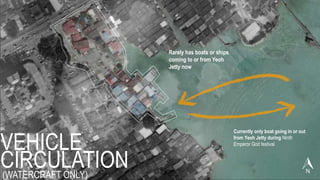
(WATERCRAFT ONLY)
VEHICLE
CIRCULATION
Currently only boat going in or out
from Yeoh Jetty during Ninth
Emperor God festival
Rarely has boats or ships
coming to or from Yeoh
Jetty now
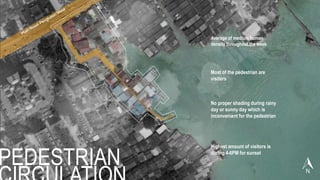
PEDESTRIAN
No proper shading during rainy
day or sunny day which is
inconvenient for the pedestrian
Most of the pedestrian are
visitors
Average of medium human
density throughout the week
Highest amount of visitors is
during 4-6PM for sunset
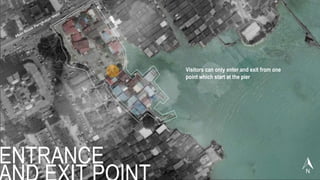
ENTRANCE
Visitors can only enter and exit from one
point which start at the pier
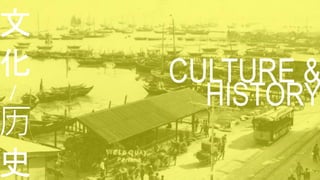
CULTURE &
HISTORY
文
化
/
历
史
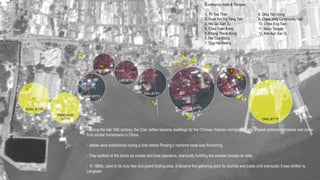
- During the late 19th century, the Clan Jetties became dwellings for the Chinese Hokkien immigrants, who shared common surnames and came
from similar hometowns in China.
- Jetties were established during a time where Penang’s maritime trade was flourishing.
- They worked at the docks as coolies and boat operators, eventually building the wooden houses on stilts.
- In 1980s, used to be duty free and grand trading area. It became the gathering point for tourists and boats until eventually it was shifted to
Langkawi
Community Halls & Temples
1. Ri Yue Than
2. Suan Hai Ing Yang Tian
3. Wu Gu Xian Zu
4. Chao Yuan Kong
5. Khang Thean Kong
6. Hai Gua Kiong
7. Ting Hai Keong
8. Qing Yan Gong
9. Chew Jetty Community Hall
10. Chow Eng Tien
11. Mazu Temple
12. Kim Aun San Si
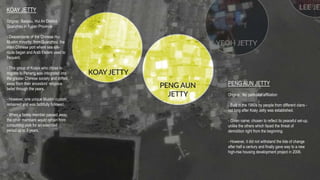
KOAY JETTY
Origins: Baiqipu, Hui An District,
Quanzhou in Fujian Province
- Descendants of the Chinese Hui
Muslim minority; from Quanzhou, the
main Chinese port where sea silk-
route began and Arab traders used to
frequent.
- This group of Koays who chose to
migrate to Penang was integrated into
the greater Chinese society and drifted
away from their ancestors’ religious
belief through the years.
- However, one unique Muslim custom
remained and was faithfully followed.
- When a family member passed away,
the other members would refrain from
consuming pork for an extended
period up to 3 years.
PENG AUN JETTY
Origins: No particular affiliation
- Built in the 1960s by people from different clans -
not long after Koay Jetty was established.
- Given name; chosen to reflect its peaceful set-up,
unlike the others which faced the threat of
demolition right from the beginning.
- However, it did not withstand the tide of change
after half a century and finally gave way to a new
high-rise housing development project in 2006.
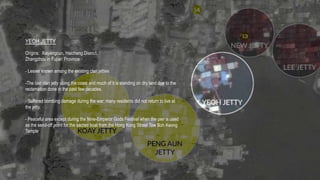
YEOH JETTY
Origins: Xiayangcun, Haicheng District,
Zhangzhou in Fujian Province
- Lesser known among the existing clan jetties
-The last clan jetty along the coast and much of it is standing on dry land due to the
reclamation done in the past few decades.
- Suffered bombing damage during the war; many residents did not return to live at
the jetty.
- Peaceful area except during the Nine-Emperor Gods Festival when the pier is used
as the send-off point for the sacred boat from the Hong Kong Street Tow Boh Keong
Temple
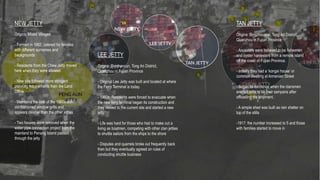
NEW JETTY
Origins: Mixed Villages
- Formed in 1962; catered for families
with different surnames and
backgrounds
- Residents from the Chew Jetty moved
here when they were allowed
- New site followed more stringent
planning requirements from the Land
Office
- Maintains the look of the 1960s with
old-fashioned window grills and
appears cleaner than the other jetties
- Two houses were removed when the
water pipe connection project from the
mainland to Penang Island passed
through the jetty
LEE JETTY
Origins: Duishancun, Tong An District,
Quanzhou in Fujian Province
- Original Lee Jetty was built and located at where
the Ferry Terminal is today.
- 1960s: Residents were forced to evacuate when
the new ferry terminal began its construction and
they moved to the current site and started a new
jetty.
- Life was hard for those who had to make out a
living as boatmen, competing with other clan jetties
to shuttle sailors from the ships to the shore
- Disputes and quarrels broke out frequently back
then but they eventually agreed on rules of
conducting shuttle business
TAN JETTY
Origins: Bingzhoushe, Tong An District,
Quanzhou in Fujian Province
- Ancestors were believed to be fishermen
and oyster harvesters from a remote island
off the coast of Fujian Province.
- Initially they had a ‘kongsi house’ or
common dwelling at Armenian Street
- Began its existence when the clansmen
erected stilts to tie their sampans after
offloading the shipment.
- A simple shed was built as rain shelter on
top of the stilts
-1917: the number increased to 5 and those
with families started to move in
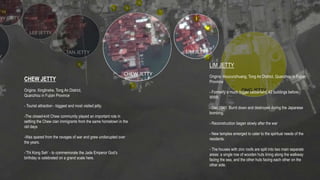
CHEW JETTY
Origins: Xinglinshe, Tong An District,
Quanzhou in Fujian Province
- Tourist attraction - biggest and most visited jetty.
-The closed-knit Chew community played an important role in
settling the Chew clan immigrants from the same hometown in the
old days
-Was spared from the ravages of war and grew undisrupted over
the years.
-’Thi Kong Seh’ - to commemorate the Jade Emperor God’s
birthday is celebrated on a grand scale here.
LIM JETTY
Origins: Houcunzhuang, Tong An District, Quanzhou in Fujian
Province
- Formerly a much bigger settlement; 42 buildings before
WWII.
- Dec 1941: Burnt down and destroyed during the Japanese
bombing.
- Reconstruction began slowly after the war
- New temples emerged to cater to the spiritual needs of the
residents.
- The houses with zinc roofs are split into two main separate
areas: a single row of wooden huts lining along the walkway
facing the sea, and the other huts facing each other on the
other side.
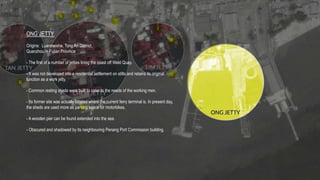
ONG JETTY
Origins: Luanmeishe, Tong An District,
Quanzhou in Fujian Province
- The first of a number of jetties lining the coast off Weld Quay.
- It was not developed into a residential settlement on stilts and retains its original
function as a work jetty.
- Common resting sheds were built to cater to the needs of the working men.
- Its former site was actually located where the current ferry terminal is. In present day,
the sheds are used more as parking space for motorbikes,
- A wooden pier can be found extended into the sea.
- Obscured and shadowed by its neighbouring Penang Port Commission building.
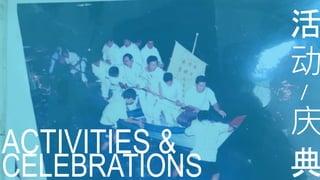
ACTIVITIES &
CELEBRATIONS
活
动
/
庆
典
拜
天
公
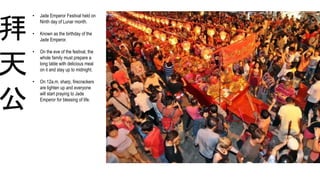
• Jade Emperor Festival held on
Ninth day of Lunar month.
• Known as the birthday of the
Jade Emperor.
• On the eve of the festival, the
whole family must prepare a
long table with delicious meal
on it and stay up to midnight.
• On 12a.m. sharp, firecrackers
are lighten up and everyone
will start praying to Jade
Emperor for blessing of life.
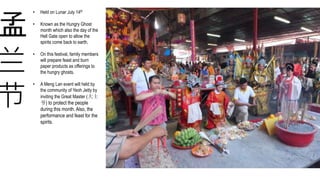
兰
节
孟
• Held on Lunar July 14th
• Known as the Hungry Ghost
month which also the day of the
Hell Gate open to allow the
spirits come back to earth.
• On this festival, family members
will prepare feast and burn
paper products as offerings to
the hungry ghosts.
• A Meng Lan event will held by
the community of Yeoh Jetty by
inviting the Great Master (大士
爷) to protect the people
during this month. Also, the
performance and feast for the
spirits.
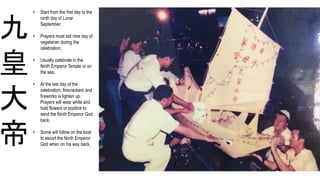
九
皇
大
帝
• Start from the first day to the
ninth day of Lunar
September.
• Prayers must eat nine day of
vegetarian during the
celebration.
• Usually celebrate in the
Ninth Emperor Temple or on
the sea.
• At the last day of the
celebration, firecrackers and
fireworks is lighten up.
Prayers will wear white and
hold flowers or joystick to
send the Ninth Emperor God
back.
• Some will follow on the boat
to escort the Ninth Emperor
God when on his way back.
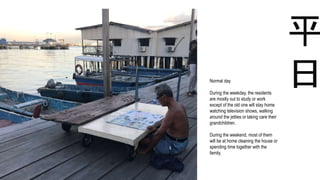
平
日Normal day
During the weekday, the residents
are mostly out to study or work
except of the old one will stay home
watching television shows, walking
around the jetties or taking care their
grandchildren.
During the weekend, most of them
will be at home cleaning the house or
spending time together with the
family.
VIEWS & VISTA
观点/景观
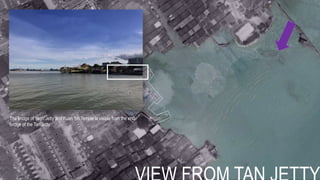
The bridge of Yeoh Jetty and Kuan Yin Temple is visible from the end
bridge of the Tan Jetty
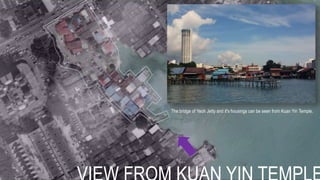
The bridge of Yeoh Jetty and it's housings can be seen from Kuan Yin Temple.
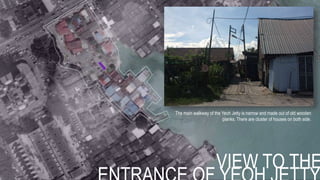
VIEW TO THE
The main walkway of the Yeoh Jetty is narrow and made out of old wooden
planks. There are cluster of houses on both side.
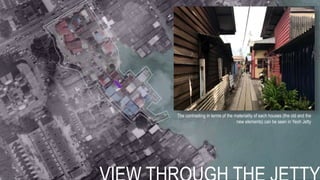
The contrasting in terms of the materiality of each houses (the old and the
new elements) can be seen in Yeoh Jetty
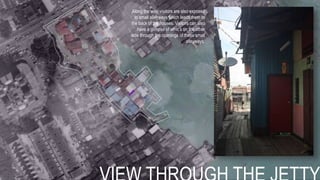
Along the way, visitors are also exposed
to small alleyways which leads them to
the back of the houses. Visitors can also
have a glimpse of what's on the other
side through the openings of these small
alleyways.
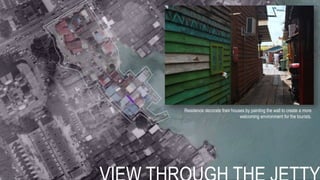
Residence decorate their houses by painting the wall to create a more
welcoming environment for the tourists.
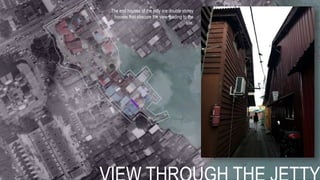
The end houses of the jetty are double storey
houses that obscure the view leading to the
site.
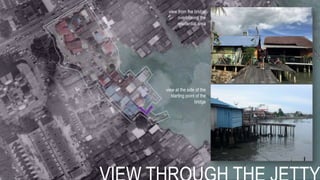
view from the bridge
overlooking the
residential area
view at the side of the
starting point of the
bridge
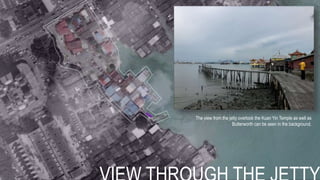
The view from the jetty overlook the Kuan Yin Temple as well as
Butterworth can be seen in the background.
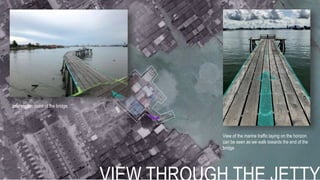
View of the marine traffic laying on the horizon
can be seen as we walk towards the end of the
bridge
Intersection point of the bridge.
[ 1 ] view of the
housing of Lee
Jetty and Tan Jetty
[ 4 ] view of the
housing of the
New/Mixed
Jetty
[ 2 ] view of the
vast ocean
and ships
[ 3 ] view of the
Kuan Yin
Temple
[ 4 ] [ 3 ]
[ 2 ]
[ 1 ]
From the end of the bridge, overlooking back to the village houses of Yeoh
jetty
S.W.O.T.
ANALYSIS
结论 / 分析
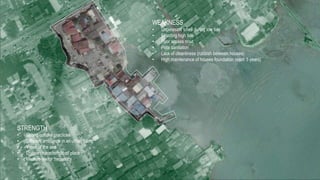
STRENGTH
• Strong cultural practices
• Different ambiance in an urban fitting
• Views of the sea
• Unique characteristic of place
• Medium visitor frequency
WEAKNESS
• Unpleasant smell during low tide
• Flooding high tide
• Poor access road
• Poor sanitation
• Lack of cleanliness (rubbish between houses)
• High maintenance of houses foundation (each 5 years)
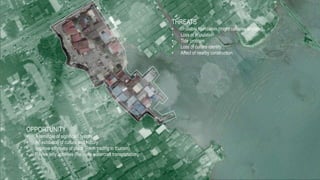
OPPORTUNITY
• A reminder of significant history
• An exhibition of culture and history
• Improve economy of place (From trading to tourism)
• Revive jetty activities (Re-invite watercraft transportation)
THREATS
• Unstable foundation (might collapse anytime)
• Loss of population
• Tide problem
• Loss of culture identity
• Affect of nearby construction
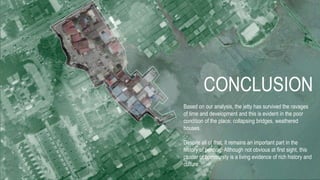
Based on our analysis, the jetty has survived the ravages
of time and development and this is evident in the poor
condition of the place; collapsing bridges, weathered
houses.
Despite all of that, it remains an important part in the
history of penang. Although not obvious at first sight, this
cluster of community is a living evidence of rich history and
culture.
CONCLUSION

Final

  • 1.
    CLAN PULAU PINANG MELISA FAISAL0325983 NG LEK YUEN 0324010 ARINA NADIA 0324105 SARAH ESA 0324805 氏 族 码 头 JETTIES
  • 2.
    KEY PLAN Penang isa Malaysian state located on the northwest coast of the Peninsular Malaysia, by the Malacca Strait.
  • 3.
    LOCATION Penang Island isseparated into two parts; Georgetown where the capital city is located and Seberang Perai on the Malay Peninsula. Clan Jetties is located in Pengkalan Weld, Georgetown. PLAN
  • 4.
  • 5.
  • 6.
  • 7.
  • 8.
  • 9.
  • 10.
    The houses onthe jetty portray a typical malay vernacular style; pitched roofs, on stilts, local materials, louvre windows and easy construction. Since the houses were built by traders and workers themselves to make a home, it uses any available materials such as wood and aluminium. Houses are very mismatched but creates a unique character.
  • 12.
  • 13.
    (CARS ONLY) VEHICLE CIRCULATION Busy routefrom Day (10am) to Night (10pm) Resident’s cars / visitors coming in Car Park Area (No specific for public/private) Car strictly do not enter
  • 14.
    (MOTORBIKE AND BICYCLEONLY) VEHICLE CIRCULATION Motorbike able to enter Yeoh jetty residential area Motorbike user are mostly the resident Tourist with bicycle are not welcome by the resident due to little space and safety purpose Motorbike/Bicycle do not exceed this line
  • 15.
    (WATERCRAFT ONLY) VEHICLE CIRCULATION Currently onlyboat going in or out from Yeoh Jetty during Ninth Emperor God festival Rarely has boats or ships coming to or from Yeoh Jetty now
  • 16.
    PEDESTRIAN No proper shadingduring rainy day or sunny day which is inconvenient for the pedestrian Most of the pedestrian are visitors Average of medium human density throughout the week Highest amount of visitors is during 4-6PM for sunset
  • 17.
    ENTRANCE Visitors can onlyenter and exit from one point which start at the pier
  • 18.
  • 19.
    - During thelate 19th century, the Clan Jetties became dwellings for the Chinese Hokkien immigrants, who shared common surnames and came from similar hometowns in China. - Jetties were established during a time where Penang’s maritime trade was flourishing. - They worked at the docks as coolies and boat operators, eventually building the wooden houses on stilts. - In 1980s, used to be duty free and grand trading area. It became the gathering point for tourists and boats until eventually it was shifted to Langkawi Community Halls & Temples 1. Ri Yue Than 2. Suan Hai Ing Yang Tian 3. Wu Gu Xian Zu 4. Chao Yuan Kong 5. Khang Thean Kong 6. Hai Gua Kiong 7. Ting Hai Keong 8. Qing Yan Gong 9. Chew Jetty Community Hall 10. Chow Eng Tien 11. Mazu Temple 12. Kim Aun San Si
  • 20.
    KOAY JETTY Origins: Baiqipu,Hui An District, Quanzhou in Fujian Province - Descendants of the Chinese Hui Muslim minority; from Quanzhou, the main Chinese port where sea silk- route began and Arab traders used to frequent. - This group of Koays who chose to migrate to Penang was integrated into the greater Chinese society and drifted away from their ancestors’ religious belief through the years. - However, one unique Muslim custom remained and was faithfully followed. - When a family member passed away, the other members would refrain from consuming pork for an extended period up to 3 years. PENG AUN JETTY Origins: No particular affiliation - Built in the 1960s by people from different clans - not long after Koay Jetty was established. - Given name; chosen to reflect its peaceful set-up, unlike the others which faced the threat of demolition right from the beginning. - However, it did not withstand the tide of change after half a century and finally gave way to a new high-rise housing development project in 2006.
  • 21.
    YEOH JETTY Origins: Xiayangcun,Haicheng District, Zhangzhou in Fujian Province - Lesser known among the existing clan jetties -The last clan jetty along the coast and much of it is standing on dry land due to the reclamation done in the past few decades. - Suffered bombing damage during the war; many residents did not return to live at the jetty. - Peaceful area except during the Nine-Emperor Gods Festival when the pier is used as the send-off point for the sacred boat from the Hong Kong Street Tow Boh Keong Temple
  • 22.
    NEW JETTY Origins: MixedVillages - Formed in 1962; catered for families with different surnames and backgrounds - Residents from the Chew Jetty moved here when they were allowed - New site followed more stringent planning requirements from the Land Office - Maintains the look of the 1960s with old-fashioned window grills and appears cleaner than the other jetties - Two houses were removed when the water pipe connection project from the mainland to Penang Island passed through the jetty LEE JETTY Origins: Duishancun, Tong An District, Quanzhou in Fujian Province - Original Lee Jetty was built and located at where the Ferry Terminal is today. - 1960s: Residents were forced to evacuate when the new ferry terminal began its construction and they moved to the current site and started a new jetty. - Life was hard for those who had to make out a living as boatmen, competing with other clan jetties to shuttle sailors from the ships to the shore - Disputes and quarrels broke out frequently back then but they eventually agreed on rules of conducting shuttle business TAN JETTY Origins: Bingzhoushe, Tong An District, Quanzhou in Fujian Province - Ancestors were believed to be fishermen and oyster harvesters from a remote island off the coast of Fujian Province. - Initially they had a ‘kongsi house’ or common dwelling at Armenian Street - Began its existence when the clansmen erected stilts to tie their sampans after offloading the shipment. - A simple shed was built as rain shelter on top of the stilts -1917: the number increased to 5 and those with families started to move in
  • 23.
    CHEW JETTY Origins: Xinglinshe,Tong An District, Quanzhou in Fujian Province - Tourist attraction - biggest and most visited jetty. -The closed-knit Chew community played an important role in settling the Chew clan immigrants from the same hometown in the old days -Was spared from the ravages of war and grew undisrupted over the years. -’Thi Kong Seh’ - to commemorate the Jade Emperor God’s birthday is celebrated on a grand scale here. LIM JETTY Origins: Houcunzhuang, Tong An District, Quanzhou in Fujian Province - Formerly a much bigger settlement; 42 buildings before WWII. - Dec 1941: Burnt down and destroyed during the Japanese bombing. - Reconstruction began slowly after the war - New temples emerged to cater to the spiritual needs of the residents. - The houses with zinc roofs are split into two main separate areas: a single row of wooden huts lining along the walkway facing the sea, and the other huts facing each other on the other side.
  • 24.
    ONG JETTY Origins: Luanmeishe,Tong An District, Quanzhou in Fujian Province - The first of a number of jetties lining the coast off Weld Quay. - It was not developed into a residential settlement on stilts and retains its original function as a work jetty. - Common resting sheds were built to cater to the needs of the working men. - Its former site was actually located where the current ferry terminal is. In present day, the sheds are used more as parking space for motorbikes, - A wooden pier can be found extended into the sea. - Obscured and shadowed by its neighbouring Penang Port Commission building.
  • 25.
  • 26.
    拜 天 公 • Jade EmperorFestival held on Ninth day of Lunar month. • Known as the birthday of the Jade Emperor. • On the eve of the festival, the whole family must prepare a long table with delicious meal on it and stay up to midnight. • On 12a.m. sharp, firecrackers are lighten up and everyone will start praying to Jade Emperor for blessing of life.
  • 27.
    兰 节 孟 • Held onLunar July 14th • Known as the Hungry Ghost month which also the day of the Hell Gate open to allow the spirits come back to earth. • On this festival, family members will prepare feast and burn paper products as offerings to the hungry ghosts. • A Meng Lan event will held by the community of Yeoh Jetty by inviting the Great Master (大士 爷) to protect the people during this month. Also, the performance and feast for the spirits.
  • 28.
    九 皇 大 帝 • Start fromthe first day to the ninth day of Lunar September. • Prayers must eat nine day of vegetarian during the celebration. • Usually celebrate in the Ninth Emperor Temple or on the sea. • At the last day of the celebration, firecrackers and fireworks is lighten up. Prayers will wear white and hold flowers or joystick to send the Ninth Emperor God back. • Some will follow on the boat to escort the Ninth Emperor God when on his way back.
  • 29.
    平 日Normal day During theweekday, the residents are mostly out to study or work except of the old one will stay home watching television shows, walking around the jetties or taking care their grandchildren. During the weekend, most of them will be at home cleaning the house or spending time together with the family.
  • 30.
  • 31.
    The bridge ofYeoh Jetty and Kuan Yin Temple is visible from the end bridge of the Tan Jetty
  • 32.
    The bridge ofYeoh Jetty and it's housings can be seen from Kuan Yin Temple.
  • 33.
    VIEW TO THE Themain walkway of the Yeoh Jetty is narrow and made out of old wooden planks. There are cluster of houses on both side.
  • 34.
    The contrasting interms of the materiality of each houses (the old and the new elements) can be seen in Yeoh Jetty
  • 35.
    Along the way,visitors are also exposed to small alleyways which leads them to the back of the houses. Visitors can also have a glimpse of what's on the other side through the openings of these small alleyways.
  • 36.
    Residence decorate theirhouses by painting the wall to create a more welcoming environment for the tourists.
  • 37.
    The end housesof the jetty are double storey houses that obscure the view leading to the site.
  • 38.
    view from thebridge overlooking the residential area view at the side of the starting point of the bridge
  • 39.
    The view fromthe jetty overlook the Kuan Yin Temple as well as Butterworth can be seen in the background.
  • 40.
    View of themarine traffic laying on the horizon can be seen as we walk towards the end of the bridge Intersection point of the bridge.
  • 41.
    [ 1 ]view of the housing of Lee Jetty and Tan Jetty [ 4 ] view of the housing of the New/Mixed Jetty [ 2 ] view of the vast ocean and ships [ 3 ] view of the Kuan Yin Temple [ 4 ] [ 3 ] [ 2 ] [ 1 ]
  • 42.
    From the endof the bridge, overlooking back to the village houses of Yeoh jetty
  • 43.
  • 44.
    STRENGTH • Strong culturalpractices • Different ambiance in an urban fitting • Views of the sea • Unique characteristic of place • Medium visitor frequency WEAKNESS • Unpleasant smell during low tide • Flooding high tide • Poor access road • Poor sanitation • Lack of cleanliness (rubbish between houses) • High maintenance of houses foundation (each 5 years)
  • 45.
    OPPORTUNITY • A reminderof significant history • An exhibition of culture and history • Improve economy of place (From trading to tourism) • Revive jetty activities (Re-invite watercraft transportation) THREATS • Unstable foundation (might collapse anytime) • Loss of population • Tide problem • Loss of culture identity • Affect of nearby construction
  • 46.
    Based on ouranalysis, the jetty has survived the ravages of time and development and this is evident in the poor condition of the place; collapsing bridges, weathered houses. Despite all of that, it remains an important part in the history of penang. Although not obvious at first sight, this cluster of community is a living evidence of rich history and culture. CONCLUSION

Editor's Notes