Question <--- Whyshould anyone use a laminar flow system ? --->
<---Answer--->
The Basic reason, of course, is to make available source of air from which most of the particulate
matter has been removed; as a matter of fact 99.99% of everything air-borne down to 0.3 microns
should be screened out. Now you have an environment whose air supply is free of bacteria, fungi,
pollen, and practically all air-borne dirt, to use for whatever purpose such an environment will do the
most good.
3.
Question <--- Whatactually a laminar air flow system ? --->
<---Answer--->
A Laminar airflow system contains three basic elements - a blower, a high efficiency air filter, and a
plenum. There may be variations on this idea - many blowers, many filters, and very large plenums, but
all have the same basics. The flow is called laminar because the turbulent air upstream is changed by the
filter into a straight-line flow off the downstream face of the filter.
4.
Question <--- Howare the High-efficiency particulate air ( HEPA filters) tested ? --->
<---Answer--->
How The HEPA filters are tested by the DOP-dioctylphthalate-method when manufactured. DOP, a liquid
plasticizer is heated to the point of vaporization and reconstituted into 0.3 micron particles to form a
monodisperse aerosol. These single size particles are diluted with air until a concentration of 100 micrograms
per liter is reached, and the aerosol-air mixture is passed through the filter. The amount of penetration is
measured on the downstream side with a forward light scattering photometer, giving the familiar readings of
0,03% or better, The material used to make the filter material is tested in the same way by the filter material
manufacturer.
5.
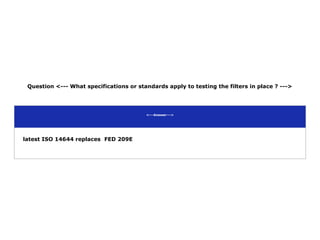
Question <--- Whatspecifications or standards apply to testing the filters in place ? --->
<---Answer--->
latest ISO 14644 replaces FED 209E
6.
Class Limits
Class Name>= 0.1µm >=0.2µm
>=
0.3µm
>= 0.5µm >=5.0µm
Volume Units
SI English m3 ft3 m3 ft3 m3 ft3 m3 ft3 m3 ft3
M
1
350 9.91 75.7 2.14 30.9 0.875 10.0 0.283 -- --
M
1.5
1 1240 35 265 7.50 106 3.00 35.3 1.00 -- --
M
2
3500 99.1 757 21.4 309 8.75 100 2.83 -- --
M
2.5
10 12400 350 2650 75.0 1060 30.0 353 10.0 -- --
M
3
35000 991 7570 214 3090 87.5 1000 28.3 -- --
M
3.5
100 -- -- 26500 750 10600 300 3530 100 -- --
M
4
-- -- 75700 2140 30900 875 10000 283 -- --
M
4.5
1000 -- -- -- -- -- -- 35300 1000 247 7.00
M
5
-- -- -- -- -- -- 100000 2830 618 17.5
M
5.5
10000 -- -- -- -- -- -- 353000 10000 2470 70.0
M
6
-- -- -- -- -- -- 1000000 28300 6180 175
M
6.5
100000 -- -- -- -- -- -- 3350000 100000 24700 700
M
7
-- -- -- -- -- -- 10000000 283000 61800 1750
Federal Standard 209E Class Limits
7.
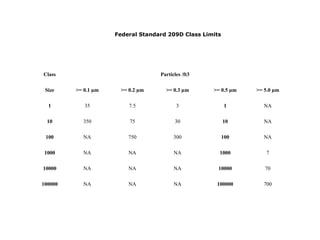
Federal Standard 209DClass Limits
Class Particles /ft3
Size >= 0.1 µm >= 0.2 µm >= 0.3 µm >= 0.5 µm >= 5.0 µm
1 35 7.5 3 1 NA
10 350 75 30 10 NA
100 NA 750 300 100 NA
1000 NA NA NA 1000 7
10000 NA NA NA 10000 70
100000 NA NA NA 100000 700
8.
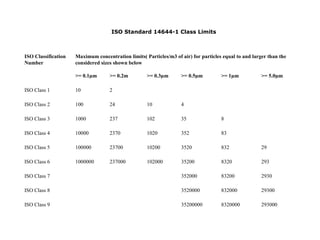
ISO Standard 14644-1Class Limits
ISO Classification
Number
Maximum concentration limits( Particles/m3 of air) for particles equal to and larger than the
considered sizes shown below
>= 0.1µm >= 0.2m >= 0.3µm >= 0.5µm >= 1µm >= 5.0µm
ISO Class 1 10 2
ISO Class 2 100 24 10 4
ISO Class 3 1000 237 102 35 8
ISO Class 4 10000 2370 1020 352 83
ISO Class 5 100000 23700 10200 3520 832 29
ISO Class 6 1000000 237000 102000 35200 8320 293
ISO Class 7 352000 83200 2930
ISO Class 8 3520000 832000 29300
ISO Class 9 35200000 8320000 293000
9.
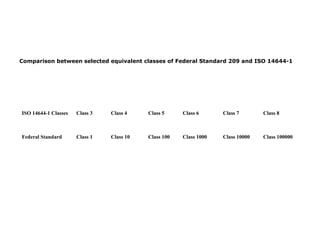
Comparison between selectedequivalent classes of Federal Standard 209 and ISO 14644-1
ISO 14644-1 Classes Class 3 Class 4 Class 5 Class 6 Class 7 Class 8
Federal Standard Class 1 Class 10 Class 100 Class 1000 Class 10000 Class 100000
10.
Question <--- Isthis in-place filter test the same one as the filter manufacturer uses ? --->
<---Answer--->
NO, but it is based on the same principle. The photometer is the same, but the DOP is generated by air.
This is done by using a special Laskin nozzle which creates an aerosol when it is immersed in DOP liquid and
air passed through it. This aerosol, unlike that used to test the filters at time of manufacture, is not a
monodisperse 0.3 micron cloud, but is polydispersed, ranging from 0.32 microns to 1 microns, averaging
approximately 0.45 microns. It is also possible to create a similar polydisperse aerosol by heat atmosphere
by purging with an inert gas such as nitrogen 0r argon. The concentration of DOP so obtained will be very
high, and can be used for testing air streams 5,000 to 50,000 CFM
11.
Question <--- Whatis the procedure for in-place test?--->
<---Answer--->
Actually, it is rather simple. A DOP generator introduces aerosol as a challenge agent into
the upstream side of the filter system. A sample of this aerosol-air mixture is taken on the upstream
side of the filter with a linear forward light scattering photometer for use as a baseline to compare
the downstream readings. Since the upstream concentration is known, and the photometer is linear,
the downstream samples may be read out in percent of concentration, as recommended in the
standards and specifications. Any leak greater than 0.01% of the upstream concentration is too
much, and the spot should be marked for repairs in actuality, there should be no leaks around the
filter seals, and in practice, readings at the face of the filter are usually in the 0.004% to 0.008%
range.
12.
Question <--- Whatdoes percent of penetration mean ? --->
<---Answer--->
It is the amount of challenge aerosol, detected on the downstream side of a filter by a linear
photometer, measured against the concentration of challenge aerosol on the upstream side of the filter.
With a base of 100% for the upstream concentration, and a reading of 0.01% penetration on the
downstream side, the indication is that the filter is 99.99% efficient with respect to that particular
concentration.
13.
Question <--- Whywas 0.01% established as a significant ? --->
<---Answer--->
Why Studies were made of the effects of different size leaks on typical types of work such as photo
resist, micro welds, sterile transfers, and the like where it was shown that a leak of 0.01% was border
at which reject rates began to increase and excessive contamination was detected.
14.
Question <--- Whycan't the leak test be run with ambient air within a room ? --->
<---Answer--->
Because they’re usually isn't enough particulate matter in the ambient to be used as a challenge.
The minimum specified by AACC-2T is 3x10 power 5 particles of plus 0.5 microns.
15.
Question <--- Ifplates to obtain bacterial counts are used, must the in-place test still be run ? --->
<---Answer--->
If Yes, because as in the answer above, the amount of bacteria in the ambient will vary from time
to time and give erroneous data. Besides, the test should be run to eliminate any possible leaks greater
than 0.001%
16.
Question <--- CanFilter leaks not be detected by agar plates ? --->
<---Answer--->
With an LAF situation this becomes chancy when a full scan procedure is adopted. With the
stationary procedures both flat on the tables or normal to the air flow, detection is quite nearly impossible
17.
Question <--- Howabout impingement devices ? --->
<---Answer--->
These are certainly effective, but a biologic challenge becomes essential if filter validation is sought.
For in -house routine checks this is an approved procedure. For validation this would be both inaccurate and
compromising of the sterile work area.
18.
Question <--- IsDOP aerosol harmful to the filters ? --->
<---Answer--->
No! Not if used properly. Tests were run on a HEPA filter backed up with charcoal filter, exposing
the unit to 100 micrograms per liter of DOP for two hours. NO DOP penetration could be detected. Clean air
was blown through the system for another hour and then the charcoal was analyzed for traces of DOP. The
result was zero.
19.
Question <--- Whathappens to the DOP once it is in the system ? --->
<---Answer--->
The DOP particles, being a liquid aerosol, impinge on the surfaces of the glass fibers making up the
filter, and are trapped there, Each tiny droplet spreads out to form a mono-molecular layer on the surface,
and since the surface area is extremely large, there is little chance of saturation. It would take an extremely
high concentration of DOP, generated very close to the filter surface, to cause wetting out. Once the DOP is
trapped, it stays on the fibers and is not released
20.
Question <--- WhenDOP is used to test a system, does the room have to be wiped down ? --->
<---Answer--->
No, since a comparatively small amount of DOP is released into the clean area, and most of this is
swept out in the air stream. Some may impinge on room surfaces, but his amount is negligible since the
particles are so small they are subject to Brownian movement and remain suspended until the filter
material finally traps them.
21.
Question <--- Withreference to Fed. Std. 209b, What is the relationship of the various classes of clean
rooms( 100, 10 000, and 100 000 ) to the
0.01% figure ? --->
<---Answer--->
There is no relationship at all. For example- a clean room with no one in it might be class 100,
while the addition of personnel will send it into other higher categories. However, suppose the filters
supplying a room were thoroughly checked for leaks, and all significant leaks were sealed, this room is
operating at maximum efficiency with respect to the filters, and since the filters are mechanical in nature,
there is nothing the operator can do to change conditions in this area.
The achievement of a particular class would relate to the number of air changes per hour as well as the
scavenging design of the system.
22.
Question <--- Cana particle counter not be used to determine the class of the room ? --->
<---Answer--->
All the particle counter can do is give a reading of the number of particles per cubic foot at any one point at
one time. It doesn't indicate what the particles are, or where they come from. The stepwise checkout of a
clean room should be first to run the DOP test to find the significant leaks and eliminate them. If the
subsequent introduction of personnel and equipment causes generation of particulate matter, which may be of
concern to the successful operation of the room one more step to be taken.
A sample of the room air should be taken with a Millipore-type filter after which the particles collected may be
sized and counted, but and this is the most important- they may now be identified. This identification will
enable the room operator to establish the source of contamination is harmful to the work being done. No
particle counter in existence can do this for you. As a matter of fact, to quote from paragraph 60 Fed, Std,
209a referring to the DOP test," .... In most instances, this type of facility check will be more meaningful than
any attempt to make an actual particle count, due to the extremely low particle concentrations expected, plus
the difficulty of taking a representative sample in a laminar air flow stream".
23.
Question <--- Butisn't a particle count important data ? --->
<---Answer--->
It is useful from the standpoint of routine surveillance. Deviations from action levels established for the
facility, if not corrected by routine maintenance procedure, would signal a need for filter validations and we
are back to square one -DOP
24.
Question <--- But,why can't leak test be carried out with a particle counters ? --->
<---Answer--->
You can, but he basic function of a particle counter is to count and size particle, usually by sampling at a
rather slow rate of 0.1 cfm with LAF, Isokinetic sampling would be mandatory. Scanning a filter seal in this
manner would be a slow process involving great operator skill, and what is more important the reading
obtained would have no relation to the established level for a significant.
25.
Question <--- Whatare the advantages of the DOP in-place test over attempting a leak test with a
particle counter ? --->
<---Answer--->
To begin with, it is not possible to use DOP with a particle counter-the concentration of aerosol is so high that the counter
becomes saturated and jams, requiring a trip to the factory for repairs (except where expensive high volume samples with
a diluting air source, are employed). The DOP test tells the story right away-where the leaks are and how great. There are
no time delays for readouts or probe recovery. The readouts relate to filter performance and not to an abstraction. The last
applies to linear photometers only; log scale instruments give only relative results
26.
Question <--- Howoften should the DOP in-place test to be run ? --->
<---Answer--->
Because some high-efficiency air filtration systems are used more than others, there is no standard answer to this question.
However, to be on the safe side, it is recommended that after the first complete checkout following installation, a check of the
filter seals be made on a ninety-day basis, with a complete scan of the filters two times a year.
27.
Question <--- Whatqualifications are necessary for in-place test personnel ? --->
<---Answer--->
They should have a thorough knowledge of the test equipment and its use, familiarity with specification requirements and the
company protocol, and good training and experience in the technology of in-place testing of HEPA systems.
When independent personnel are hired for certification testing of systems, they should have all above qualifications and
should be able to provide proof of capability through references. It cannot be stressed enough that qualified personnel who
will provide a thorough and honest service must be used
28.
Question <--- Whenshould the HEPA filters be replaced ? --->
<---Answer--->
The average HEPA filter, properly installed, and with frequent changes of the pre filter, should last from five to eight years.
There are always unusual cases: filter used to capture radioactive particles or pathogenic organisms should, of course, be
changed when they become unsafe for use. Otherwise, the resistance of the filter as indicated on a monometer or the airflow
measured with a velocity meter are indications of need for a change.
29.
Question <--- Doall filter material makers and filter manufacturers use the same methods for testing
their products ? --->
<---Answer--->
The procedure, fortunately, is clear. Having leak-tested the system and sealed the leaks, take a sample of the air in the
room with a Millipore-type filter, both, for biologic and sample under a microscope, classify, identify, and take necessary
steps to eliminate the source.
30.
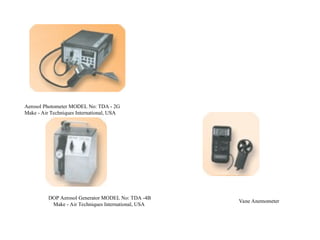
Aerosol Photometer MODELNo: TDA - 2G
Make - Air Techniques International, USA
DOP Aerosol Generator MODEL No: TDA -4B
Make - Air Techniques International, USA
Vane Anemometer