Prajwal Shrestha
Sandeep Poudel
Arjun Shrestha
Asmit Gautam
Introduction
An Indian electronic commerce company based in Bangalore, India
Offers products like books, media, consumer electronics and personal and health
care products.
offers In-a-Day Guarantee and Same-Day-Guarantee, 30-day replacement policy.
Rank: 156th in the world
9th in India
Founders:
Sachin Bansal and Binny Bansal
in 2007.
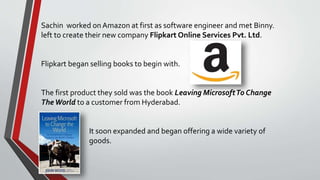
Sachin worked on Amazon at first as software engineer and met Binny.
left to create their new company Flipkart Online Services Pvt. Ltd.
Flipkart began selling books to begin with.
The first product they sold was the book Leaving MicrosoftTo Change
TheWorld to a customer from Hyderabad.
It soon expanded and began offering a wide variety of
goods.
Initially they used word of mouth to
popularise their company.
Within two years Flipkart became one of
the top 100 Indian sites
credited for being India's largest online
bookseller with over 10 million titles on
offer.
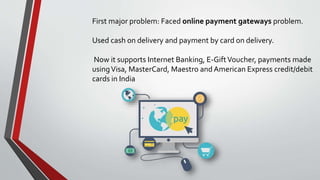
First major problem: Faced online payment gateways problem.
Used cash on delivery and payment by card on delivery.
Now it supports Internet Banking, E-GiftVoucher, payments made
usingVisa, MasterCard, Maestro and American Express credit/debit
cards in India
2018:Walmart bought 77% stake of flipkart for $16billion
Types of Ecommerce
1)Based on parties
Started as B2C company, as they used to sell and deliver books themselves.
But shifting to ‘market place model’ in 2013 allowed 3rd party merchants to sell
goods to consumers through flipkart website, so now its mixture of B2B and
B2C both.
I
2) Based on transaction type
As flipkart site allows 3rd party merchants to sell their goods to consumers,
it follows brokerage model
E-Business Model
It follows Transaction fee model, as it charges 3rd party merchants a
certain amount as per the cost of their products, if consumers buy it
through flipkart site.
With Flipkart's product listing ads, sellers can make their ad visible to the
right customer.
And flipkart charges the sellers certain amount
for it. So, it follows Advertisement model
as well.
It also follows Affiliate Model. Flipkart pays affiliate if one places product
banners or links on their website to refer users to Flipkart.com
One can earn up to 12% every time a user clicks on the banner/link and
makes a purchase on Flipkart site.
Business Model
1. Bookstore at your door
2.The store at your door
3. Jo diktha hai wo bikta hai
4. no kidding no worries
5. Shopping ka naya address
6. Ab har wish hoogi puri
7. Abhi Nahi to Kabhi Nahi
8. if it’s trendy its on flipkart
9. Be trendy, Always
10. itne me, Itnaaa milega
11. Ab Mehengai giregi
Slogans
Critism
ADF;;KKJ
CONCLUSION

FilpKart.Com - All about it

  • 1.
  • 2.
    Introduction An Indian electroniccommerce company based in Bangalore, India Offers products like books, media, consumer electronics and personal and health care products. offers In-a-Day Guarantee and Same-Day-Guarantee, 30-day replacement policy. Rank: 156th in the world 9th in India Founders: Sachin Bansal and Binny Bansal in 2007.
  • 3.
    Sachin worked onAmazon at first as software engineer and met Binny. left to create their new company Flipkart Online Services Pvt. Ltd. Flipkart began selling books to begin with. The first product they sold was the book Leaving MicrosoftTo Change TheWorld to a customer from Hyderabad. It soon expanded and began offering a wide variety of goods.
  • 4.
    Initially they usedword of mouth to popularise their company. Within two years Flipkart became one of the top 100 Indian sites credited for being India's largest online bookseller with over 10 million titles on offer.
  • 5.
    First major problem:Faced online payment gateways problem. Used cash on delivery and payment by card on delivery. Now it supports Internet Banking, E-GiftVoucher, payments made usingVisa, MasterCard, Maestro and American Express credit/debit cards in India
  • 8.
    2018:Walmart bought 77%stake of flipkart for $16billion
  • 9.
    Types of Ecommerce 1)Basedon parties Started as B2C company, as they used to sell and deliver books themselves. But shifting to ‘market place model’ in 2013 allowed 3rd party merchants to sell goods to consumers through flipkart website, so now its mixture of B2B and B2C both. I
  • 10.
    2) Based ontransaction type As flipkart site allows 3rd party merchants to sell their goods to consumers, it follows brokerage model
  • 11.
    E-Business Model It followsTransaction fee model, as it charges 3rd party merchants a certain amount as per the cost of their products, if consumers buy it through flipkart site.
  • 12.
    With Flipkart's productlisting ads, sellers can make their ad visible to the right customer. And flipkart charges the sellers certain amount for it. So, it follows Advertisement model as well.
  • 13.
    It also followsAffiliate Model. Flipkart pays affiliate if one places product banners or links on their website to refer users to Flipkart.com One can earn up to 12% every time a user clicks on the banner/link and makes a purchase on Flipkart site. Business Model
  • 14.
    1. Bookstore atyour door 2.The store at your door 3. Jo diktha hai wo bikta hai 4. no kidding no worries 5. Shopping ka naya address 6. Ab har wish hoogi puri 7. Abhi Nahi to Kabhi Nahi 8. if it’s trendy its on flipkart 9. Be trendy, Always 10. itne me, Itnaaa milega 11. Ab Mehengai giregi Slogans
  • 15.
  • 16.

Editor's Notes

  • #4 comparison search engine
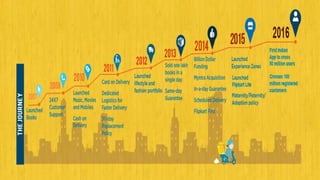
  • #7 2012: launch of its own native mobile shopping app. 2013: adopted third-party marketplace model allowed 3rd party mechants to sell goods to consumers throught flipkart website, and delivery will be done by flipkart online fashion retailers -- Myntra and Jabong