Sovereignties in Contention: Nations, Regions and Citizens in Europe
26th International Conference of Europeanists | June 20-22, 2019. Universidad Carlos III de Madrid
FIGHTING FOR SOVEREIGNTY?
THE LIE BEHIND THE RIGHT-WING POPULIST NATIONALISM
IN HUNGARY
Attila Antal
Eötvös Loránd University Faculty of Law Institute of Political
Science
and
Social Theory Research Group at Institute of Political History
antal.attila@ajk.elte.hu
antalattila.hu
The research is financed by EFOP-3.6.3-VEKOP-16-2017-00007
Overview
Introduction
1 The Captured History: Discursive Nationalism
2 The Cooperation of Neoliberalism and Authoritarian
Populism
Conclusion
Introduction
Orbán regime: fight for sovereignty?
Challenge this over-simplification
Compromise between the authoritarian
government and the globalized
capitalism
Case studies
Discursive fight for sovereignty (in
hostorical sense)
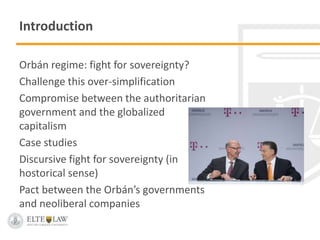
Pact between the Orbán’s governments
and neoliberal companies
1 The Captured History: Discursive Nationalism
„Populism and nationalism have been closely related” (De Cleen, 2017)
Discursive struggle for hegemony
Imagined concept of nation
Articulation populism with exclusionary nationalist demands and
populism demands for the sovereignty of the nation as against larger
state structures, colonising forces and supra-national political bodies
(De Cleen, 2017)
Orbán’s historical predecessor: interwar right-wing nationalist regime
Horthy’s regime: right-wing (and elitist) populism, a highly
conservative ruling elite, anti-communism, clericalism, increasing
authoritarianism
1 The Captured History: Discursive Nationalism
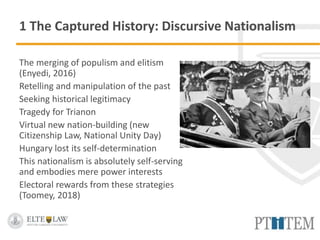
The merging of populism and elitism
(Enyedi, 2016)
Retelling and manipulation of the past
Seeking historical legitimacy
Tragedy for Trianon
Virtual new nation-building (new
Citizenship Law, National Unity Day)
Hungary lost its self-determination
This nationalism is absolutely self-serving
and embodies mere power interests
Electoral rewards from these strategies
(Toomey, 2018)
2 The Cooperation of Neoliberalism and
Authoritarian Populism
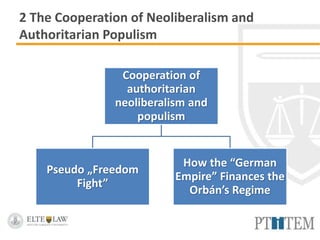
Cooperation of
authoritarian
neoliberalism and
populism
Pseudo „Freedom
Fight”
How the “German
Empire” Finances the
Orbán’s Regime
2 The Cooperation of Neoliberalism and
Authoritarian Populism
2.1 Pseudo „Freedom Fight”
Crisis of 2008: Orbán argued that the moral foundations of
western capitalism were shaken and strongly criticized the
hegemony of neoliberal solutions
Speculative capitalism vs productive capitalism
Struggle between the Hungarian government and the
IMF/World Bank/EU
“Economic freedom fight” and “unorthodox economic
policy”
Get back the financial sovereignty to make a pact with the
banks and companies of global capitalism
2 The Cooperation of Neoliberalism and
Authoritarian Populism
2.1 Pseudo „Freedom Fight”
Special tax
Demonstration of government political power in the
financial (primarily banks, insurers) and corporate sectors
Blocking the negotiations with IMF
New tax pacage: bank tax, flat tax, the new 16 percent
personal income tax and the reduction corporate tax from
19 to 10 percent
Put the (selected) multinationals and the national oligarchs
into position
Orbán as a “a modern Robin Hood”?
2 The Cooperation of Neoliberalism and
Authoritarian Populism
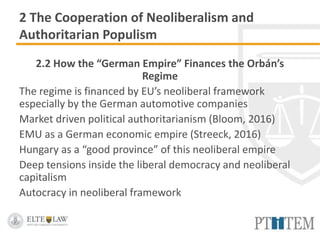
2.2 How the “German Empire” Finances the Orbán’s
Regime
The regime is financed by EU’s neoliberal framework
especially by the German automotive companies
Market driven political authoritarianism (Bloom, 2016)
EMU as a German economic empire (Streeck, 2016)
Hungary as a “good province” of this neoliberal empire
Deep tensions inside the liberal democracy and neoliberal
capitalism
Autocracy in neoliberal framework
2 The Cooperation of Neoliberalism and
Authoritarian Populism
2.2 How the “German Empire” Finances the Orbán’s
Regime
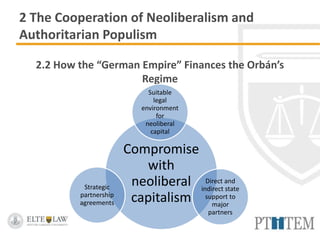
Compromise
with
neoliberal
capitalism
Suitable
legal
environment
for
neoliberal
capital
Direct and
indirect state
support to
major
partners
Strategic
partnership
agreements
2 The Cooperation of Neoliberalism and
Authoritarian Populism
2.2 How the “German Empire” Finances the Orbán’s
Regime
Compromise with neoliberal capitalism: strategic
partnership agreements between the government and the
companies, providing direct and indirect state support to
major partners, creation of a suitable legal environment for
neoliberal capital
Strategic partnership agreements: grey zone between
authoritarian state and globalised capitalism; 81 between
2012 and 2019; 15 were concluded with the German
companies’ Hungarian subsidiaries
2 The Cooperation of Neoliberalism and
Authoritarian Populism
2.2 How the “German Empire” Finances the Orbán’s
Regime
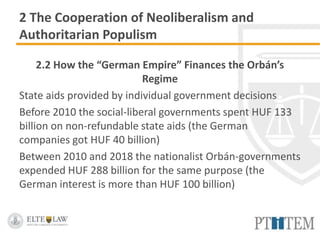
State aids provided by individual government decisions
Before 2010 the social-liberal governments spent HUF 133
billion on non-refundable state aids (the German
companies got HUF 40 billion)
Between 2010 and 2018 the nationalist Orbán-governments
expended HUF 288 billion for the same purpose (the
German interest is more than HUF 100 billion)
2 The Cooperation of Neoliberalism and
Authoritarian Populism
State subsidies of German-related companies in proportion to the subsidies
of all state-supported companies in Hungary (2004-2018) (thousand HUF)
0
20000000
40000000
60000000
80000000
100000000
120000000
2004 2005 2006 2007 2008 2009 2010 2011 2012 2013 2014 2015 2016 2017 2018
German Summary
The Hungarian province aided in last 14 years
the more than HUF 140 billion (which is one
third of the whole money) the German
enterprises
2 The Cooperation of Neoliberalism and
Authoritarian Populism
2.2 How the “German Empire” Finances the Orbán’s
Regime
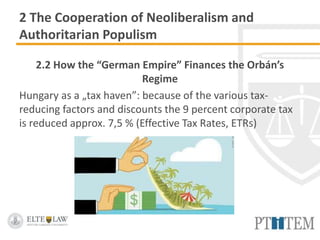
Hungary as a „tax haven”: because of the various tax-
reducing factors and discounts the 9 percent corporate tax
is reduced approx. 7,5 % (Effective Tax Rates, ETRs)
Conclusions
Nationalism as purpose of the political leader
Fidesz strives to channel extreme political messages
Lie of „economic freedom fight”
Hungarian economy depends heavily on the players of
neoliberal capitalism
Further investigations: energy policy, Orbán-Putin
relationship, geopolitical context
Declining sovereignty
References
Bartha, A. (2014): Lifting The Lid On Lobbying – National Report of Hungary.
Transparency International Hungary, Retrieved from https://transparency.hu/wp-
content/uploads/2016/03/Lifting-The-Lid-On-Lobbying-National-Report-of-
Hungary.pdf
Bloom, P. (2016). Authoritarian Capitalism in the Age of Globalization. Cheltenham, UK
and Northampton, MA, USA: Edward Elgar Publishing.
De Cleen, B. (2017): Populism and Nationalism. In: Kaltwasser et al., 2017, 342–362.
Enyedi, Zsolt (2016). Paternalist populism and illiberal elitism in Central Europe.
Journal of Political Ideologies, 21(1), 9–25.
Ministry of Foreign Affairs and Trade: Strategic Partnership Agreements. Retrieved
from http://www.kormany.hu/hu/kulgazdasagi-es-kulugyminiszterium/strategiai-
partnersegi-megallapodasok (the site is Hungarian)
Toomey, M. (2018). History, nationalism and democracy: myth and narrative in Viktor
Orbán’s ‘illiberal Hungary’. New Perspectives: Interdisciplinary Journal of Central &
East European Politics and International Relations, 2018(26)1, 87–108.
THANK YOU FOR YOUR ATTENTION!

Fighting for sovereignty

  • 1.
    Sovereignties in Contention:Nations, Regions and Citizens in Europe 26th International Conference of Europeanists | June 20-22, 2019. Universidad Carlos III de Madrid FIGHTING FOR SOVEREIGNTY? THE LIE BEHIND THE RIGHT-WING POPULIST NATIONALISM IN HUNGARY Attila Antal Eötvös Loránd University Faculty of Law Institute of Political Science and Social Theory Research Group at Institute of Political History antal.attila@ajk.elte.hu antalattila.hu The research is financed by EFOP-3.6.3-VEKOP-16-2017-00007
  • 2.
    Overview Introduction 1 The CapturedHistory: Discursive Nationalism 2 The Cooperation of Neoliberalism and Authoritarian Populism Conclusion
  • 3.
    Introduction Orbán regime: fightfor sovereignty? Challenge this over-simplification Compromise between the authoritarian government and the globalized capitalism Case studies Discursive fight for sovereignty (in hostorical sense) Pact between the Orbán’s governments and neoliberal companies
  • 4.
    1 The CapturedHistory: Discursive Nationalism „Populism and nationalism have been closely related” (De Cleen, 2017) Discursive struggle for hegemony Imagined concept of nation Articulation populism with exclusionary nationalist demands and populism demands for the sovereignty of the nation as against larger state structures, colonising forces and supra-national political bodies (De Cleen, 2017) Orbán’s historical predecessor: interwar right-wing nationalist regime Horthy’s regime: right-wing (and elitist) populism, a highly conservative ruling elite, anti-communism, clericalism, increasing authoritarianism
  • 5.
    1 The CapturedHistory: Discursive Nationalism The merging of populism and elitism (Enyedi, 2016) Retelling and manipulation of the past Seeking historical legitimacy Tragedy for Trianon Virtual new nation-building (new Citizenship Law, National Unity Day) Hungary lost its self-determination This nationalism is absolutely self-serving and embodies mere power interests Electoral rewards from these strategies (Toomey, 2018)
  • 6.
    2 The Cooperationof Neoliberalism and Authoritarian Populism Cooperation of authoritarian neoliberalism and populism Pseudo „Freedom Fight” How the “German Empire” Finances the Orbán’s Regime
  • 7.
    2 The Cooperationof Neoliberalism and Authoritarian Populism 2.1 Pseudo „Freedom Fight” Crisis of 2008: Orbán argued that the moral foundations of western capitalism were shaken and strongly criticized the hegemony of neoliberal solutions Speculative capitalism vs productive capitalism Struggle between the Hungarian government and the IMF/World Bank/EU “Economic freedom fight” and “unorthodox economic policy” Get back the financial sovereignty to make a pact with the banks and companies of global capitalism
  • 8.
    2 The Cooperationof Neoliberalism and Authoritarian Populism 2.1 Pseudo „Freedom Fight” Special tax Demonstration of government political power in the financial (primarily banks, insurers) and corporate sectors Blocking the negotiations with IMF New tax pacage: bank tax, flat tax, the new 16 percent personal income tax and the reduction corporate tax from 19 to 10 percent Put the (selected) multinationals and the national oligarchs into position Orbán as a “a modern Robin Hood”?
  • 9.
    2 The Cooperationof Neoliberalism and Authoritarian Populism 2.2 How the “German Empire” Finances the Orbán’s Regime The regime is financed by EU’s neoliberal framework especially by the German automotive companies Market driven political authoritarianism (Bloom, 2016) EMU as a German economic empire (Streeck, 2016) Hungary as a “good province” of this neoliberal empire Deep tensions inside the liberal democracy and neoliberal capitalism Autocracy in neoliberal framework
  • 10.
    2 The Cooperationof Neoliberalism and Authoritarian Populism 2.2 How the “German Empire” Finances the Orbán’s Regime Compromise with neoliberal capitalism Suitable legal environment for neoliberal capital Direct and indirect state support to major partners Strategic partnership agreements
  • 11.
    2 The Cooperationof Neoliberalism and Authoritarian Populism 2.2 How the “German Empire” Finances the Orbán’s Regime Compromise with neoliberal capitalism: strategic partnership agreements between the government and the companies, providing direct and indirect state support to major partners, creation of a suitable legal environment for neoliberal capital Strategic partnership agreements: grey zone between authoritarian state and globalised capitalism; 81 between 2012 and 2019; 15 were concluded with the German companies’ Hungarian subsidiaries
  • 12.
    2 The Cooperationof Neoliberalism and Authoritarian Populism 2.2 How the “German Empire” Finances the Orbán’s Regime State aids provided by individual government decisions Before 2010 the social-liberal governments spent HUF 133 billion on non-refundable state aids (the German companies got HUF 40 billion) Between 2010 and 2018 the nationalist Orbán-governments expended HUF 288 billion for the same purpose (the German interest is more than HUF 100 billion)
  • 13.
    2 The Cooperationof Neoliberalism and Authoritarian Populism State subsidies of German-related companies in proportion to the subsidies of all state-supported companies in Hungary (2004-2018) (thousand HUF) 0 20000000 40000000 60000000 80000000 100000000 120000000 2004 2005 2006 2007 2008 2009 2010 2011 2012 2013 2014 2015 2016 2017 2018 German Summary The Hungarian province aided in last 14 years the more than HUF 140 billion (which is one third of the whole money) the German enterprises
  • 14.
    2 The Cooperationof Neoliberalism and Authoritarian Populism 2.2 How the “German Empire” Finances the Orbán’s Regime Hungary as a „tax haven”: because of the various tax- reducing factors and discounts the 9 percent corporate tax is reduced approx. 7,5 % (Effective Tax Rates, ETRs)
  • 15.
    Conclusions Nationalism as purposeof the political leader Fidesz strives to channel extreme political messages Lie of „economic freedom fight” Hungarian economy depends heavily on the players of neoliberal capitalism Further investigations: energy policy, Orbán-Putin relationship, geopolitical context Declining sovereignty
  • 16.
    References Bartha, A. (2014):Lifting The Lid On Lobbying – National Report of Hungary. Transparency International Hungary, Retrieved from https://transparency.hu/wp- content/uploads/2016/03/Lifting-The-Lid-On-Lobbying-National-Report-of- Hungary.pdf Bloom, P. (2016). Authoritarian Capitalism in the Age of Globalization. Cheltenham, UK and Northampton, MA, USA: Edward Elgar Publishing. De Cleen, B. (2017): Populism and Nationalism. In: Kaltwasser et al., 2017, 342–362. Enyedi, Zsolt (2016). Paternalist populism and illiberal elitism in Central Europe. Journal of Political Ideologies, 21(1), 9–25. Ministry of Foreign Affairs and Trade: Strategic Partnership Agreements. Retrieved from http://www.kormany.hu/hu/kulgazdasagi-es-kulugyminiszterium/strategiai- partnersegi-megallapodasok (the site is Hungarian) Toomey, M. (2018). History, nationalism and democracy: myth and narrative in Viktor Orbán’s ‘illiberal Hungary’. New Perspectives: Interdisciplinary Journal of Central & East European Politics and International Relations, 2018(26)1, 87–108.
  • 17.
    THANK YOU FORYOUR ATTENTION!