Geography 5Rachel Hultgren
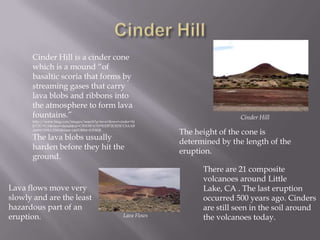
Cinder HillCinder Hill is a cinder cone which is a mound “of basaltic scoria that forms by streaming gases that carry lava blobs and ribbons into the atmosphere to form lava fountains.” http://www.bing.com/images/search?q=lava+flows+cinder+hill%2C+CA&view=detail&id=CB5D5FA31F9EEB72C823CC8AABA6891359EC026D&first=1&FORM=IDFRIRThe lava blobs usually harden before they hit the ground.Cinder HillThe height of the cone is determined by the length of the eruption.There are 21 composite volcanoes around Little Lake, CA . The last eruption occurred 500 years ago. Cinders are still seen in the soil around the volcanoes today.Lava flows move very slowly and are the least hazardous part of an eruption.Lava Flows
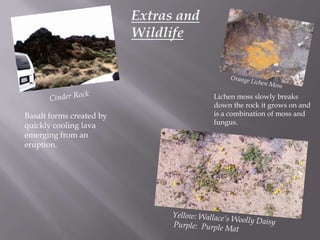
Extras and WildlifeOrange Lichen MossCinder RockLichen moss slowly breaks down the rock it grows on and is a combination of moss and fungus.Basalt forms created by quickly cooling lava emerging from an eruption.Yellow: Wallace’s Woolly Daisy  Purple:  Purple Mat
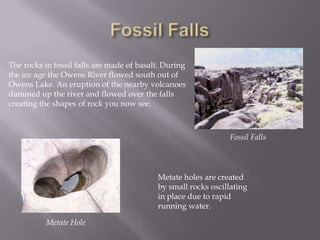
Fossil FallsThe rocks in fossil falls are made of basalt. During the ice age the Owens River flowed south out of Owens Lake. An eruption of the nearby volcanoes dammed up the river and flowed over the falls creating the shapes of rock you now see.Fossil FallsMetate holes are created by small rocks oscillating in place due to rapid running water.Metate Hole
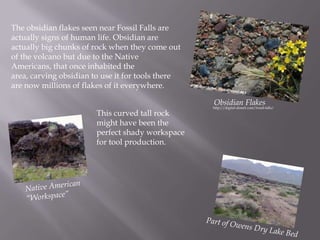
The obsidian flakes seen near Fossil Falls are actually signs of human life. Obsidian are actually big chunks of rock when they come out of the volcano but due to the Native Americans, that once inhabited the area, carving obsidian to use it for tools there are now millions of flakes of it everywhere.Obsidian Flakes  http://digital-desert.com/fossil-falls/This curved tall rock might have been the perfect shady workspace for tool production.Native American      “Workspace”Part of Owens Dry Lake Bed
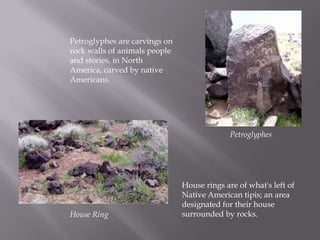
Petroglyphes are carvings on rock walls of animals people and stories, in North America, carved by native Americans.PetroglyphesHouse rings are of what's left of Native American tipis; an area designated for their house surrounded by rocks.House Ring
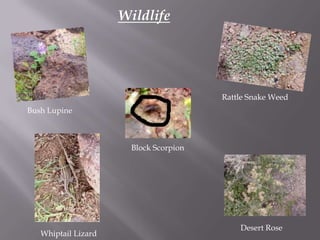
WildlifeRattle Snake WeedBush LupineBlock ScorpionDesert RoseWhiptail Lizard
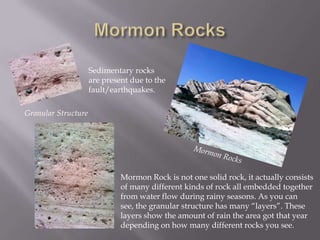
Mormon RocksSedimentary rocks are present due to the fault/earthquakes.Granular StructureMormon RocksMormon Rock is not one solid rock, it actually consists of many different kinds of rock all embedded together from water flow during rainy seasons. As you can see, the granular structure has many “layers”. These layers show the amount of rain the area got that year depending on how many different rocks you see.
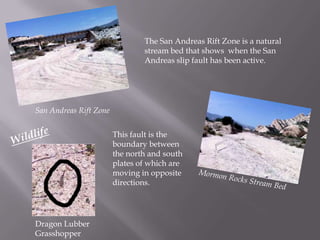
The San Andreas Rift Zone is a natural stream bed that shows  when the San Andreas slip fault has been active.San Andreas Rift ZoneWildlifeThis fault is the boundary between the north and south plates of which are moving in opposite directions.Mormon Rocks Stream BedDragon Lubber Grasshopper
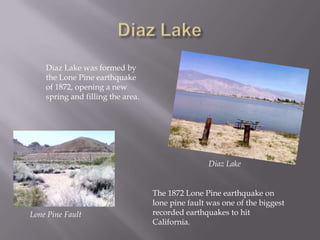
Diaz LakeDiaz Lake was formed by the Lone Pine earthquake of 1872, opening a new spring and filling the area. Diaz LakeThe 1872 Lone Pine earthquake on lone pine fault was one of the biggest recorded earthquakes to hit California.Lone Pine Fault
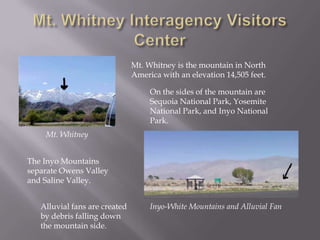
Mt. Whitney Interagency Visitors CenterMt. Whitney is the mountain in North America with an elevation 14,505 feet.On the sides of the mountain are Sequoia National Park, Yosemite National Park, and Inyo National Park.Mt. WhitneyThe Inyo Mountains separate Owens Valley and Saline Valley.Inyo-White Mountains and Alluvial FanAlluvial fans are created by debris falling down the mountain side.
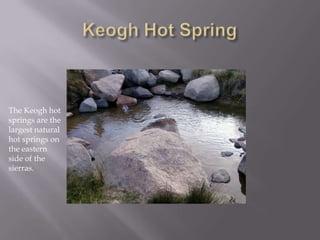
Keogh Hot SpringThe Keogh hot springs are the largest natural hot springs on the eastern side of the sierras.
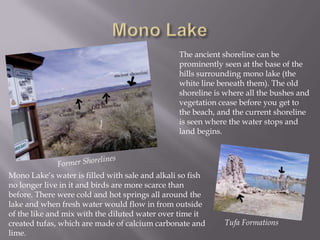
Mono LakeThe ancient shoreline can be prominently seen at the base of the hills surrounding mono lake (the white line beneath them). The old shoreline is where all the bushes and vegetation cease before you get to the beach, and the current shoreline is seen where the water stops and land begins.Former ShorelinesMono Lake’s water is filled with sale and alkali so fish no longer live in it and birds are more scarce than before. There were cold and hot springs all around the lake and when fresh water would flow in from outside of the like and mix with the diluted water over time it created tufas, which are made of calcium carbonate and lime.Tufa Formations
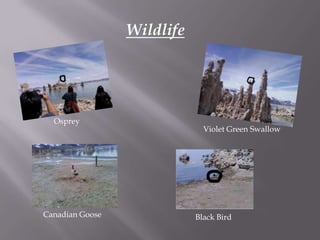
WildlifeOspreyViolet Green SwallowCanadian GooseBlack Bird
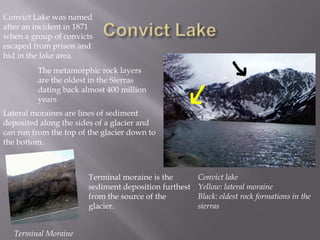
Convict LakeConvict Lake was named after an incident in 1871 when a group of convicts escaped from prison and hid in the lake area.The metamorphic rock layers are the oldest in the Sierras dating back almost 400 million yearsLateral moraines are lines of sediment deposited along the sides of a glacier and can run from the top of the glacier down to the bottom.Convict lakeYellow: lateral moraineBlack: oldest rock formations in the sierrasTerminal moraine is the sediment deposition furthest from the source of the glacier.Terminal Moraine
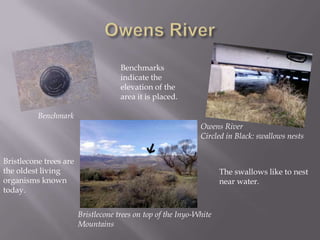
Owens RiverBenchmarks indicate the elevation of the area it is placed.BenchmarkOwens RiverCircled in Black: swallows nestsBristlecone trees are the oldest living organisms known today.The swallows like to nest near water.Bristlecone trees on top of the Inyo-White Mountains
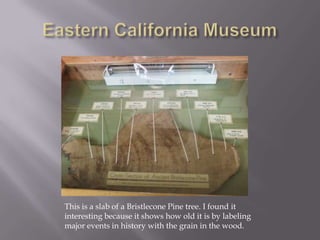
Eastern California MuseumThis is a slab of a Bristlecone Pine tree. I found it interesting because it shows how old it is by labeling major events in history with the grain in the wood.
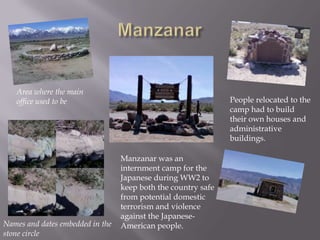
ManzanarArea where the main office used to bePeople relocated to the camp had to build their own houses and administrative buildings.Manzanar was an internment camp for the Japanese during WW2 to keep both the country safe from potential domestic terrorism and violence against the Japanese-American people.Names and dates embedded in the stone circle
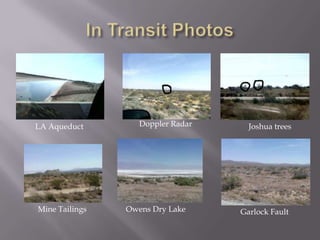
In Transit PhotosDoppler RadarLA AqueductJoshua treesMine TailingsOwens Dry LakeGarlock Fault

Geography 5

  • 1.
  • 2.
    Cinder HillCinder Hillis a cinder cone which is a mound “of basaltic scoria that forms by streaming gases that carry lava blobs and ribbons into the atmosphere to form lava fountains.” http://www.bing.com/images/search?q=lava+flows+cinder+hill%2C+CA&view=detail&id=CB5D5FA31F9EEB72C823CC8AABA6891359EC026D&first=1&FORM=IDFRIRThe lava blobs usually harden before they hit the ground.Cinder HillThe height of the cone is determined by the length of the eruption.There are 21 composite volcanoes around Little Lake, CA . The last eruption occurred 500 years ago. Cinders are still seen in the soil around the volcanoes today.Lava flows move very slowly and are the least hazardous part of an eruption.Lava Flows
  • 3.
    Extras and WildlifeOrangeLichen MossCinder RockLichen moss slowly breaks down the rock it grows on and is a combination of moss and fungus.Basalt forms created by quickly cooling lava emerging from an eruption.Yellow: Wallace’s Woolly Daisy Purple: Purple Mat
  • 4.
    Fossil FallsThe rocksin fossil falls are made of basalt. During the ice age the Owens River flowed south out of Owens Lake. An eruption of the nearby volcanoes dammed up the river and flowed over the falls creating the shapes of rock you now see.Fossil FallsMetate holes are created by small rocks oscillating in place due to rapid running water.Metate Hole
  • 5.
    The obsidian flakesseen near Fossil Falls are actually signs of human life. Obsidian are actually big chunks of rock when they come out of the volcano but due to the Native Americans, that once inhabited the area, carving obsidian to use it for tools there are now millions of flakes of it everywhere.Obsidian Flakes http://digital-desert.com/fossil-falls/This curved tall rock might have been the perfect shady workspace for tool production.Native American “Workspace”Part of Owens Dry Lake Bed
  • 6.
    Petroglyphes are carvingson rock walls of animals people and stories, in North America, carved by native Americans.PetroglyphesHouse rings are of what's left of Native American tipis; an area designated for their house surrounded by rocks.House Ring
  • 7.
    WildlifeRattle Snake WeedBushLupineBlock ScorpionDesert RoseWhiptail Lizard
  • 8.
    Mormon RocksSedimentary rocksare present due to the fault/earthquakes.Granular StructureMormon RocksMormon Rock is not one solid rock, it actually consists of many different kinds of rock all embedded together from water flow during rainy seasons. As you can see, the granular structure has many “layers”. These layers show the amount of rain the area got that year depending on how many different rocks you see.
  • 9.
    The San AndreasRift Zone is a natural stream bed that shows when the San Andreas slip fault has been active.San Andreas Rift ZoneWildlifeThis fault is the boundary between the north and south plates of which are moving in opposite directions.Mormon Rocks Stream BedDragon Lubber Grasshopper
  • 10.
    Diaz LakeDiaz Lakewas formed by the Lone Pine earthquake of 1872, opening a new spring and filling the area. Diaz LakeThe 1872 Lone Pine earthquake on lone pine fault was one of the biggest recorded earthquakes to hit California.Lone Pine Fault
  • 11.
    Mt. Whitney InteragencyVisitors CenterMt. Whitney is the mountain in North America with an elevation 14,505 feet.On the sides of the mountain are Sequoia National Park, Yosemite National Park, and Inyo National Park.Mt. WhitneyThe Inyo Mountains separate Owens Valley and Saline Valley.Inyo-White Mountains and Alluvial FanAlluvial fans are created by debris falling down the mountain side.
  • 12.
    Keogh Hot SpringTheKeogh hot springs are the largest natural hot springs on the eastern side of the sierras.
  • 13.
    Mono LakeThe ancientshoreline can be prominently seen at the base of the hills surrounding mono lake (the white line beneath them). The old shoreline is where all the bushes and vegetation cease before you get to the beach, and the current shoreline is seen where the water stops and land begins.Former ShorelinesMono Lake’s water is filled with sale and alkali so fish no longer live in it and birds are more scarce than before. There were cold and hot springs all around the lake and when fresh water would flow in from outside of the like and mix with the diluted water over time it created tufas, which are made of calcium carbonate and lime.Tufa Formations
  • 14.
  • 15.
    Convict LakeConvict Lakewas named after an incident in 1871 when a group of convicts escaped from prison and hid in the lake area.The metamorphic rock layers are the oldest in the Sierras dating back almost 400 million yearsLateral moraines are lines of sediment deposited along the sides of a glacier and can run from the top of the glacier down to the bottom.Convict lakeYellow: lateral moraineBlack: oldest rock formations in the sierrasTerminal moraine is the sediment deposition furthest from the source of the glacier.Terminal Moraine
  • 16.
    Owens RiverBenchmarks indicatethe elevation of the area it is placed.BenchmarkOwens RiverCircled in Black: swallows nestsBristlecone trees are the oldest living organisms known today.The swallows like to nest near water.Bristlecone trees on top of the Inyo-White Mountains
  • 17.
    Eastern California MuseumThisis a slab of a Bristlecone Pine tree. I found it interesting because it shows how old it is by labeling major events in history with the grain in the wood.
  • 18.
    ManzanarArea where themain office used to bePeople relocated to the camp had to build their own houses and administrative buildings.Manzanar was an internment camp for the Japanese during WW2 to keep both the country safe from potential domestic terrorism and violence against the Japanese-American people.Names and dates embedded in the stone circle
  • 19.
    In Transit PhotosDopplerRadarLA AqueductJoshua treesMine TailingsOwens Dry LakeGarlock Fault