TENDER
It is an offer in writing by contractor
to execute certain specified work,
or to supply specified materials, or
transport of materials at certain rates,
within a fixed duration, subject to
certain terms & conditions.
NECESSITY
To find whether an offer can be
received from interested builders to
execute the work within estimated
limit of time and finance.
TYPES
OF
TENDERS
OPEN TENDER
• unlimited competition
• wide publicity
• open to all contractors
• low cost works
Depending on nature, volume &
expertise of work, types of Open
tender:-
• Global tenders
• Local tenders
GLOBAL TENDERS
• published in international newspapers
• open for contractors around the world
• preferred for large projects
• works done for airport, tunnel, express
highway etc.
• avoids personal influence or favour
LOCAL TENDERS
• published in local newspapers
• publicity limited to the country
• used in all government departments
• not suitable for urgent works
• avoids personal influence or favour
LIMITED TENDER
• limited competition
• owner/architect invites the tenders
• used for specialized & private works
• competitors of specialized field enter
• selection as per knowledge, experience
& reputation by owner’s choice
• done as per specifications & time
NEGOTIATED TENDER
• payment negotiated with a single
contractor
• used when no choice besides one firm
• done for urgent priority
• done when time valued more than cost
• competition is not free and fair
TENDER NOTICE
• an advertisement published in
newspaper
• client calls interested contractors
• includes ECP, TL, EMD, SD etc.
• document on which agreement with
the contractor is based
POINTS TO BE INCLUDED
WHILE DRAFTING A TENDER
NOTICE
• name & address of inviting authority
• mode of submitting tender (sealed)
• class of contractor
• nature of work & its location
• estimated cost of work
• amount of EMD (cheque)
• amount of security deposit
• duration of work
• type of tender form
• cost of blank tender form (cash)
• dates & time of issue
• dates & time of receipt
• mention holiday, if any
• postal procedure
• opening procedure of tenders
• reservation of rights
• validity period
• signature of competent authority
TENDER NOTICE
EARNEST MONEY
• only really interested contractors are
expected to enter the competition
• it is an amount - token of his sincere wish to
do the said work
• earnest intention amount paid with tender
• depends on ECP
• usually 1 to 2 % of ECP
• EMD carries no interest
• if tender is accepted, this EMD is adjusted as the
security deposit payable by contractor
• after submission/acceptance of tender if
contractor withdraws his offer/neglects to execute
work – forfeit EMD
• EMD is given as treasury challan or deposit at
call receipt with tender
SECURITY DEPOSIT
• security against failure to fulfill terms
• depends on type of work & ECP
• usually 2 to 5% of ECP
• submitted in cash with EE
• paid within 10 days of selection
• paid in parts – at agreement & RA bills 10%
• SD is refunded after DLP
VALIDITY PERIOD
• period within which rates quoted are valid
• contractor may or may not agree with
modification of rates
• it starts after submitting tender
• depends on importance of work,
completion time & the amount involved
• 30 to 90 days (offer is valid)
RIGHT TO REJECT ONE OR ALL
TENDERS
REJECTION OF LOWEST
TENDER
• capacity is doubtful (tools/staff)
• unbalanced bid
• bad reputation/experience
• rates not workable
• lack of experience in particular work
• puts additional conditions
• tender filled partially
• not a registered one
• EMD is not submitted
• not used appropriate form
• tender not signed
• becomes bankrupt
REJECTION OF ALL
TENDERS
• minimum tenders not received (i.e., 3)
• ring formation
• major changes in design/drawings
• work gets cancelled due to unforeseen
circumstances
• rates quoted are very high than estimated
• collision suspected among contractors
• pages removed or replaced ?
• modifications not initialed ?
CORRIGENDUM TO
TENDER NOTICE
• to inform about extension of date & time
• regarding issue & receipt of forms
• advertisement is published
NECESSITY
• if the duration for preparing tender is short
• tender papers not ready
• enough forms not available
• important changes in design/drawing
DRAFT CORRIGENDUM
TO TENDER NOTICE
TENDER DOCUMENTS
• it is a set of blank standard forms &
details related to the project
• prepared in the office of EE
• tender documents – contract documents
• brief tender notice
•conditions of contract
• schedule A, B, C
• tender agreement
• bill of quantities
• income tax clearance
• challan of EMD
• previous & current work details
• details of tools & equipments available
• details of technical staff
• specifications
• copy of registration certificate
• working drawing
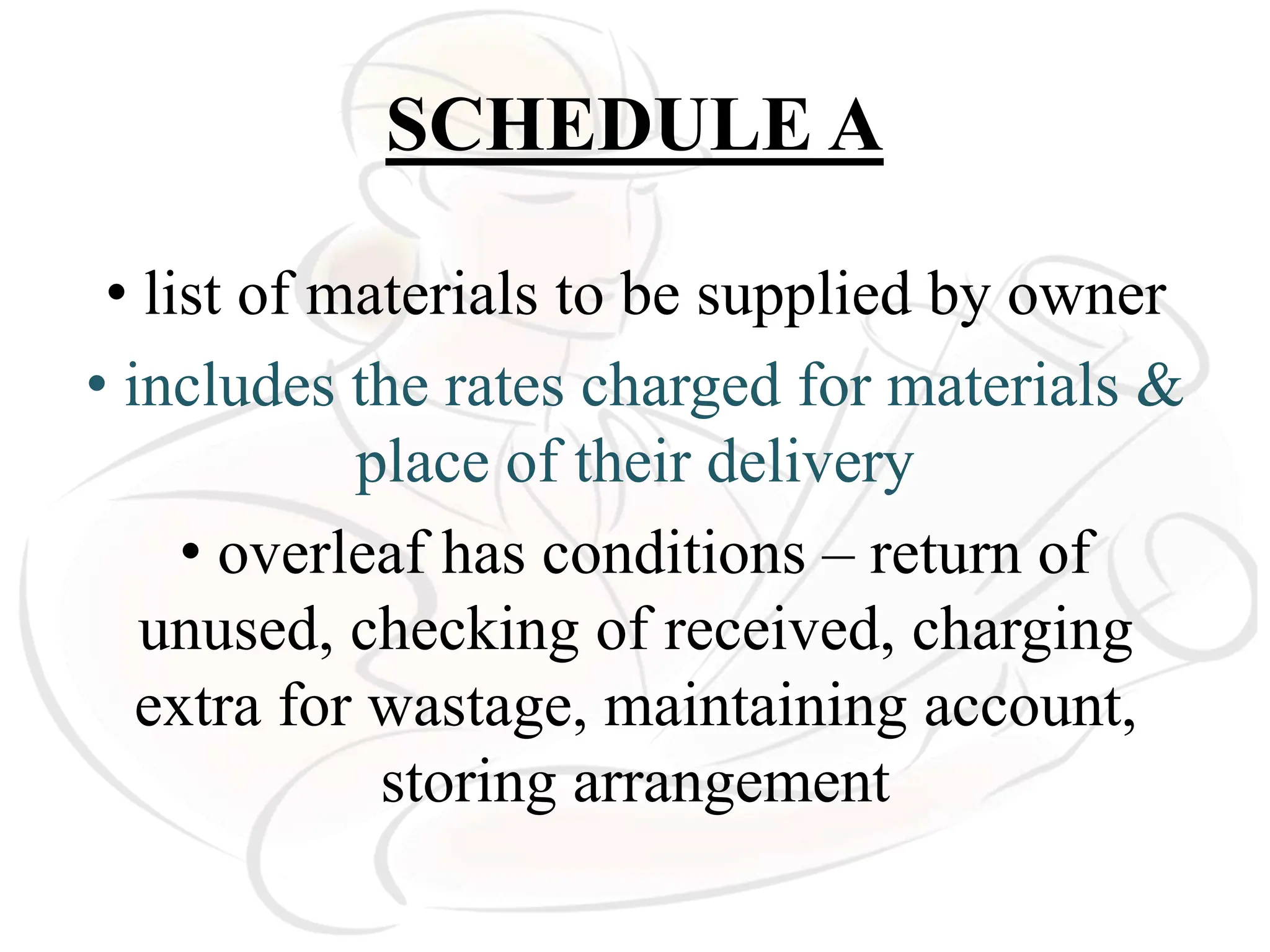
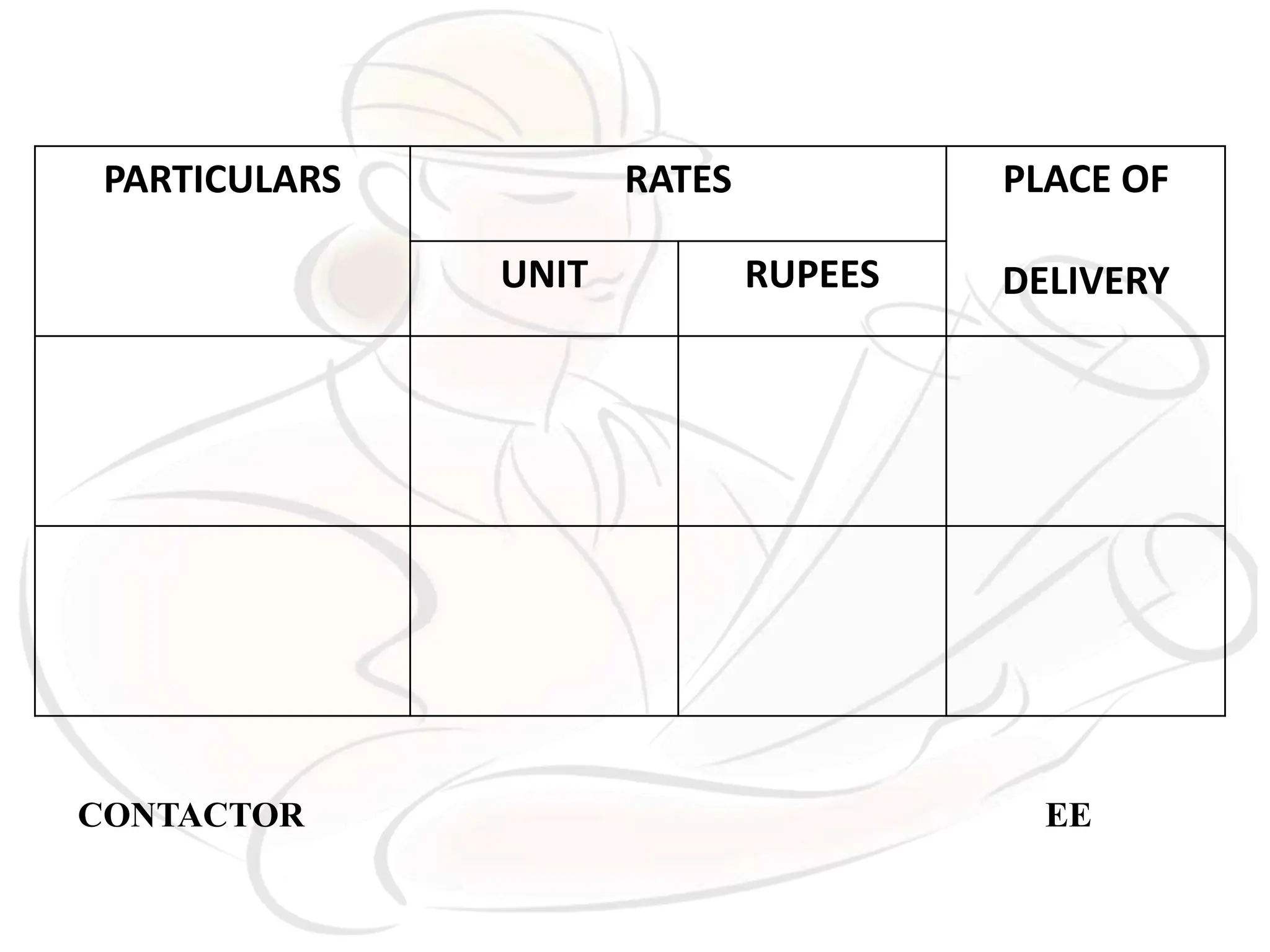
SCHEDULE A
• list of materials to be supplied by owner
• includes the rates charged for materials &
place of their delivery
• overleaf has conditions – return of
unused, checking of received, charging
extra for wastage, maintaining account,
storing arrangement
PARTICULARS RATES PLACE OF
DELIVERY
UNIT RUPEES
CONTACTOR EE
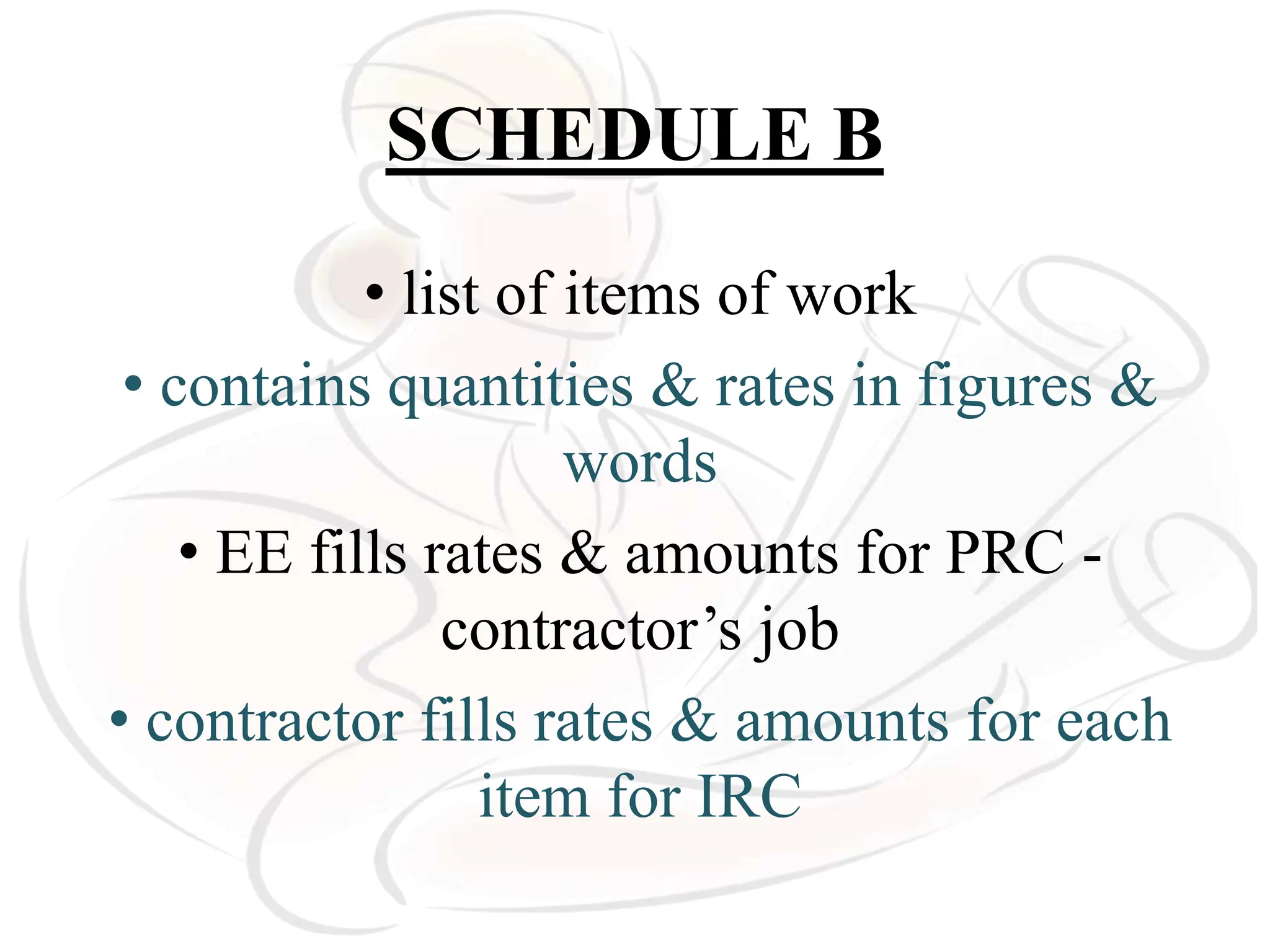
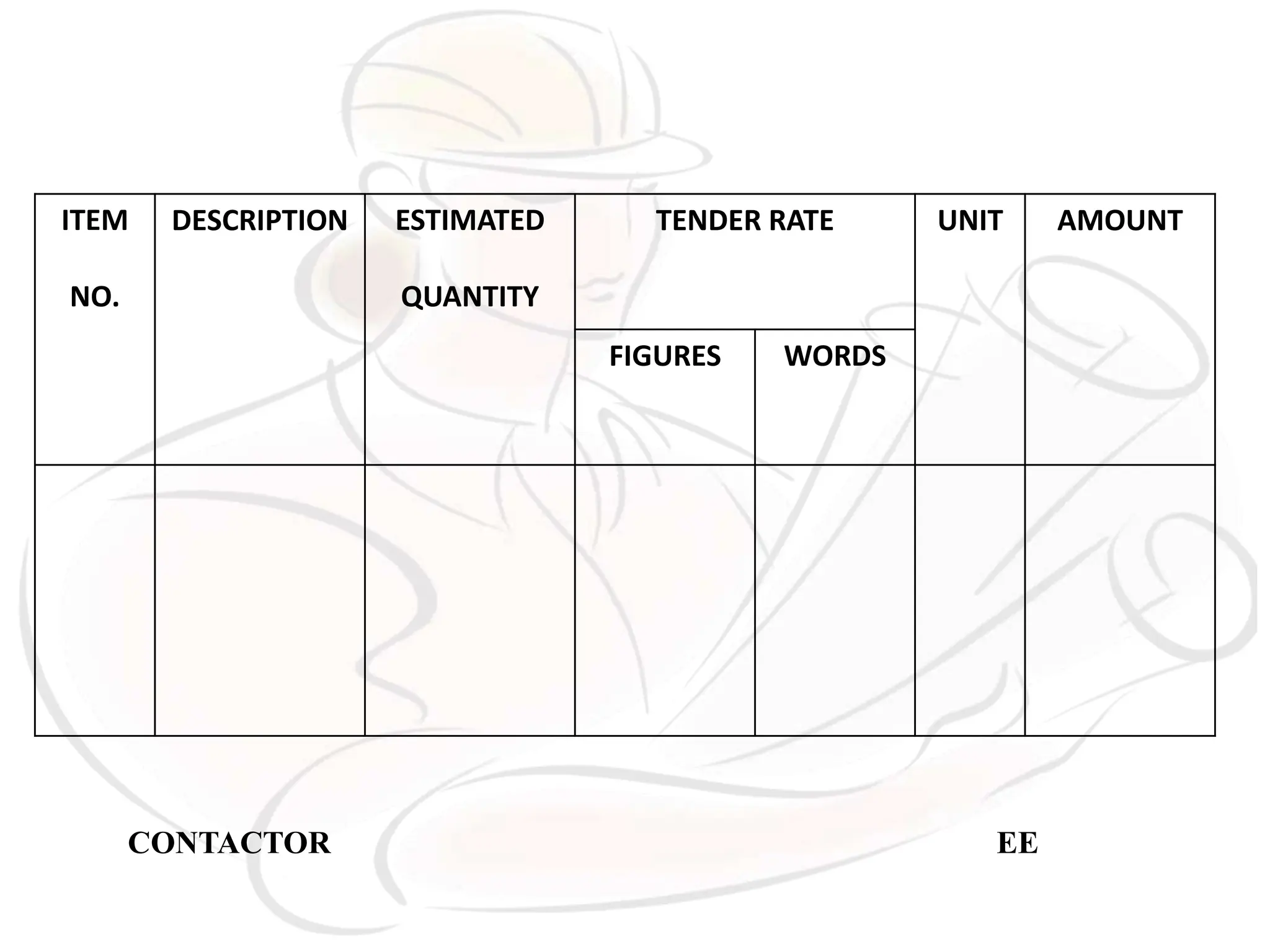
SCHEDULE B
• list of items of work
• contains quantities & rates in figures &
words
• EE fills rates & amounts for PRC -
contractor’s job
• contractor fills rates & amounts for each
item for IRC
ITEM
NO.
DESCRIPTION ESTIMATED
QUANTITY
TENDER RATE UNIT AMOUNT
FIGURES WORDS
CONTACTOR EE
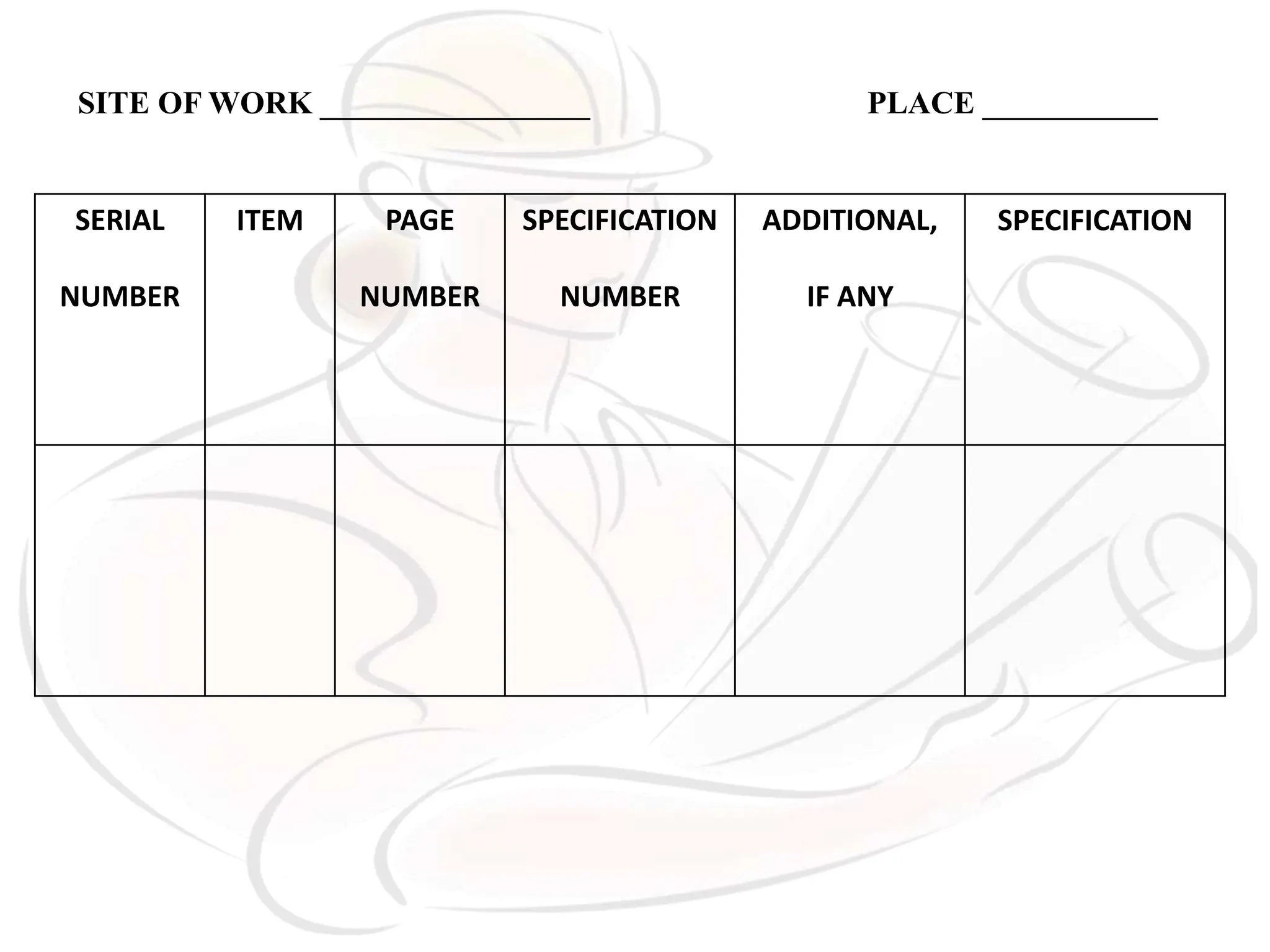
SCHEDULE C
• list of items with their serial numbers,
page number of specification booklet,
specification number & specifications.
SERIAL
NUMBER
ITEM PAGE
NUMBER
SPECIFICATION
NUMBER
ADDITIONAL,
IF ANY
SPECIFICATION
SITE OF WORK _________________ PLACE ___________
TERMS IN TENDER
DOCUMENTS
CONTRACT CONDITIONS
TIME LIMIT
• total duration of work
• if TL is crossed, owner loses returns
from property, which is then recovered
from contractor as penalty
TIME EXTENSION
• work can be delayed due to many
unavoidable reasons (natural
calamities/beyond our control)
• contractor can apply for extension to EE
• if owner delays work, suitable extension
PENALTY
• fine for not following terms of contract
• if allotted work is incomplete or
• progress not in proportion to time passed or
• contractor does not follow specifications
• SE decides amount of penalty
• maximum 10% of EPC
DEFECTIVE MATERIAL &
WORKMANSHIP
• if unsound/defective material is used
• if imperfect/unskilled workmanship exists
• contractor should remove defects at his own
expenses
• if contractors fails to do so, he should then pay
compensation for it.
SUSPENSION OF WORK
• if contractor does not follow specification,
drawing, design then
• work is suspended and contractor is informed
in writing
• for remaining work, new tenders can be called
SUBLETTING OF CONTRACT
• sub contract is done among two contractors
with the consent of owner
• main contractor takes the work from owner
• main contractor appoints sub contractor for
doing different parts of work
• specialized works – air conditioning, lift
erection, plumbing, fabrication etc.
• main contractor is responsible for conditions of
contract & payment to sub contractor
EXTRA ITEMS
• unforeseen difficulties, negligence while
preparing drawings raises concern for EI
• primary EI (part of contract)
• secondary EI (supplementary to contract)
• contractor is bound to execute as per revised
drawings all EI, necessary TE is given
• EI payment done as per DSR or as per contract
or as per mutually agreed rates to avoid disputes
ESCALATION
• rates of engineering materials are
mentioned in the tender form
• during construction, rates may rise
• the owner is liable to pay the difference to
contractor, after construction is over
• common clause due to swelling of prices
PRICE VARIATION CLAUSE
• due to inflation, prices – wages rise
• if PVC is not there, contractor abandons work
• to stop this, PVC should exist
• considered materials may be steel, cement,
sand, teakwood etc. whose prices may fluctuate
DEFECT LIABILITY PERIOD
• contractor is liable to carry out proper work
during execution and also do needful
maintenance for some time after the construction
• DLP is normally 6 months – 1 year
• all DLP works are done at contractor’s expenses
• if not done by him, his SD is used for it and
done through other contractor
LIQUIDATED DAMAGES
• compensation paid by contractor due to delay
• has no relation with actual loss
• can be recovered from RA bill or SD
• usually `100 per day
• not applicable if delay is due to EI, late
possession of site from owner
UNLIQUIDATED DAMAGES
• damages having relation with actual loss
• for breach of contract, one party has to pay
for the loss suffered by the other
ARBITRATION
• civil engineering contract includes wide
operations with high index of legal conditions
• each one wants to earn max profit in min efforts
• due to uncertainties, disputes arise
• if every dispute is taken to court - time is lost,
work is suspended till decision comes &
investment of parties remains yield less
• through alternative (arbitration), disputes are
settled outside court
An arbitrator should –
• possess confidence of both parties
• be impartial
• be a panel member
• have experience & knowledge of field
(law)
Causes of disputes –
• measurement of items
• difference in specification & drawing
• different interpretation
• extra items
• workmanship
• payment
• subletting of contract
Advantages of arbitration –
• consumes less time & money
• simple procedure
• hearing may be arranged as per parties
convenience
• decision may be fair as it is given by expert of
the concerned field
TERMINATION OF CONTRACT
(the end)
• due to any of the following reasons, a contract may
end :-
• completion of work – work completed as per
agreement, DLP is over (happiest reason)
• mutual agreement – based on some unavoidable
reasons, parties together decide to stop working –
contractor paid for past work & remaining can be done
with fresh agreement
• breach of contract conditions – if a party violates
one or more conditions, other party can end the
contract after giving warning - payment claim can be
made
• impossibility to complete – if work does not
progress – neighbor puts legal complication, issue on
ownership, due to flood funds transferred elsewhere
for relief works
Work stops indefinitely – later terminated
• by operation of law – if contractor files a request
in court to end the work due to no funds – court
gives stay order, work may end
• EMD
•SD
• rates quoted should include tax
• labor wages to be paid as per minimum wages act
FILLING THE TENDER BY
CONTRACTOR & POINTS TO BE
OBSERVED BY HIM
A clever contractor properly plans his work after
reading the tender notice for –
• Pre – tender planning
• Post – tender planning
PROCEDURE OF SUBMITTING
TENDER
•check whether required things are mentioned like
certificates, resources data, schedule B, challan of
EMD
• challan, registration certificate, forwarding letter
– envelope 1
• tender documents set – envelope 2
• seal envelope 1 & 2 in one packet
PRE – TENDER PLANNING
• study of tender documents
• check availability of required resources
• visit the site, check soil, water table, access,
quarry location, lead & lift, water availability
• reasonable rates shall be pre-determined
• find different alternatives of doing a work
• analysis of bidding trend
• time study
• possibility of appointing sub-contractors
PROCEDURE OF OPENING
TENDER
• committee for opening, scrutiny & acceptance
• competent authority – chairperson
• attendance of present ones
• tenders placed in order – serially
• envelopes opened – check signature, EMD, rates
quoted or not, calculations
• announce the quoted rates to all
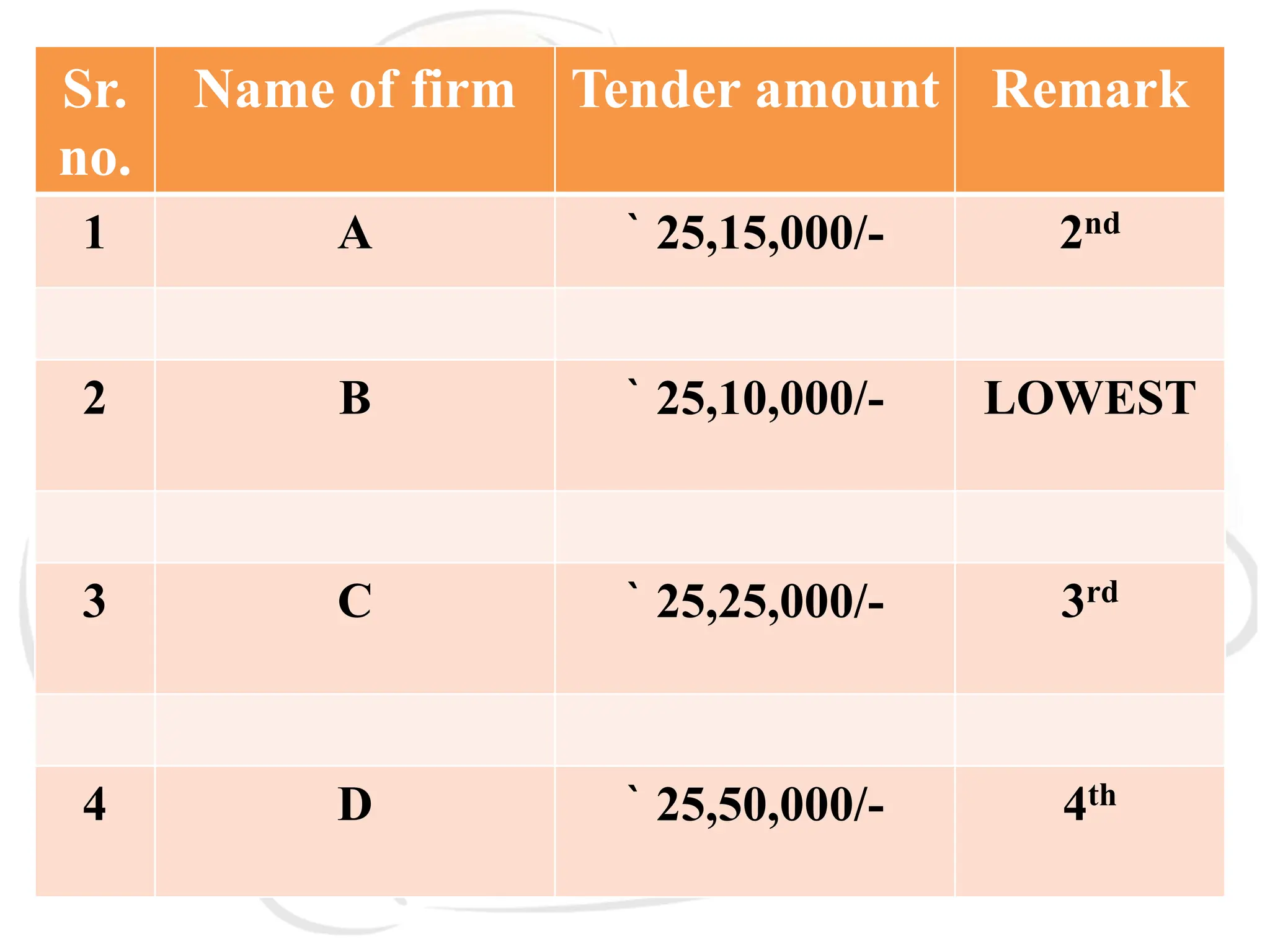
COMPARATIVE STATEMENT
• table showing rates quoted by all
• it has name of firm, rates quoted, total amount
• useful to compare firms based on rates, tax,
other charges
• it helps in deciding the tender award
Sr.
no.
Name of firm Tender amount Remark
1 A ` 25,15,000/- 2nd
2 B ` 25,10,000/- LOWEST
3 C ` 25,25,000/- 3rd
4 D ` 25,50,000/- 4th
SCRUTINY OF TENDERS
• list of tenders received with EMD
• duly signed
• contract conditions are same & not altered
• rates in words and figures – if difference in the
two – select lowest of it
• check calculations
• check whether unbalanced
• very low rates – bad quality – justify with rate
analysis
AWARD OF CONTRACT
• after proper scrutiny and study of comparative
statement, tender is awarded
• usually lowest is selected
• if lowest seems not workable, go for second
lowest
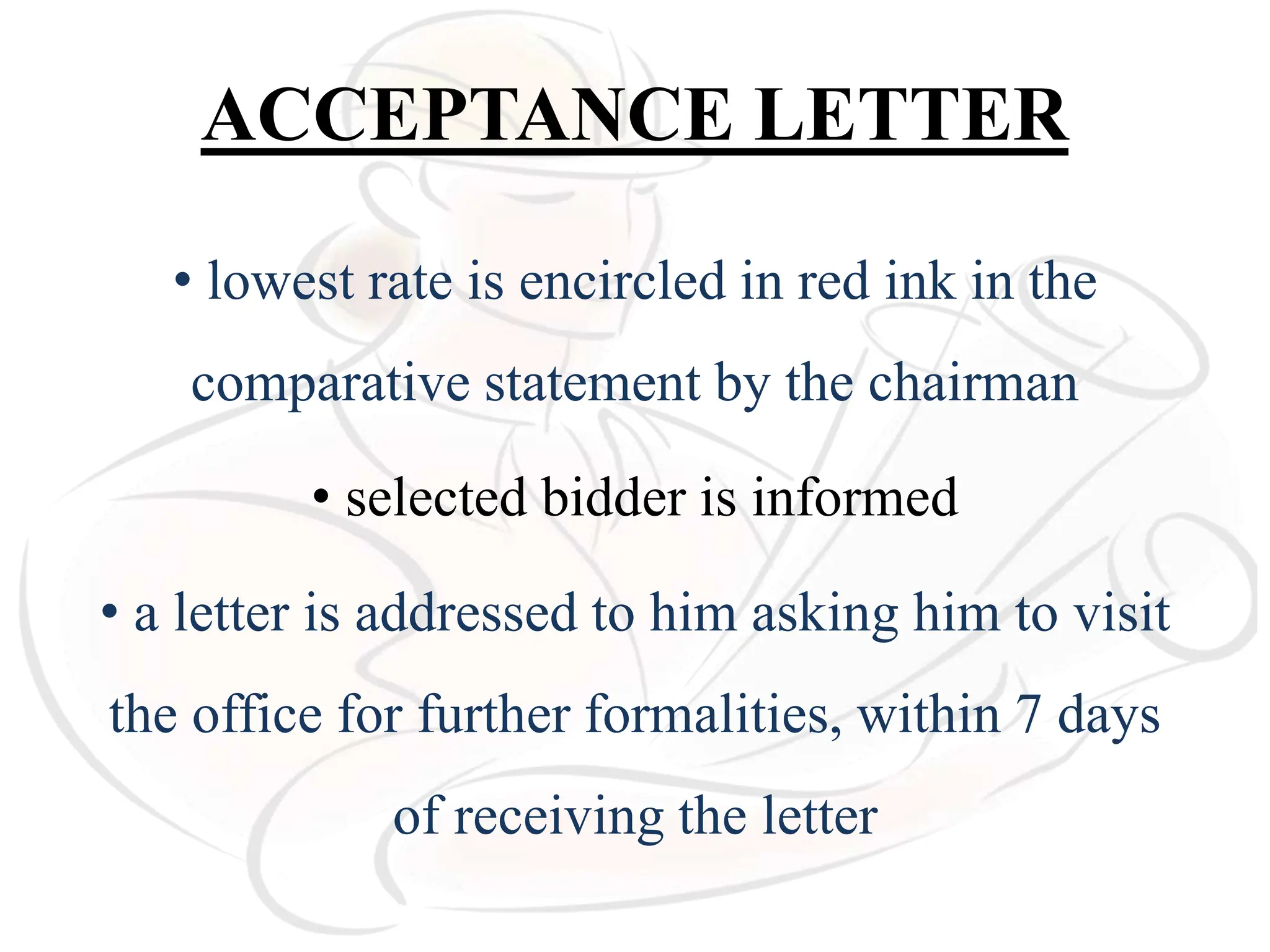
ACCEPTANCE LETTER
• lowest rate is encircled in red ink in the
comparative statement by the chairman
• selected bidder is informed
• a letter is addressed to him asking him to visit
the office for further formalities, within 7 days
of receiving the letter
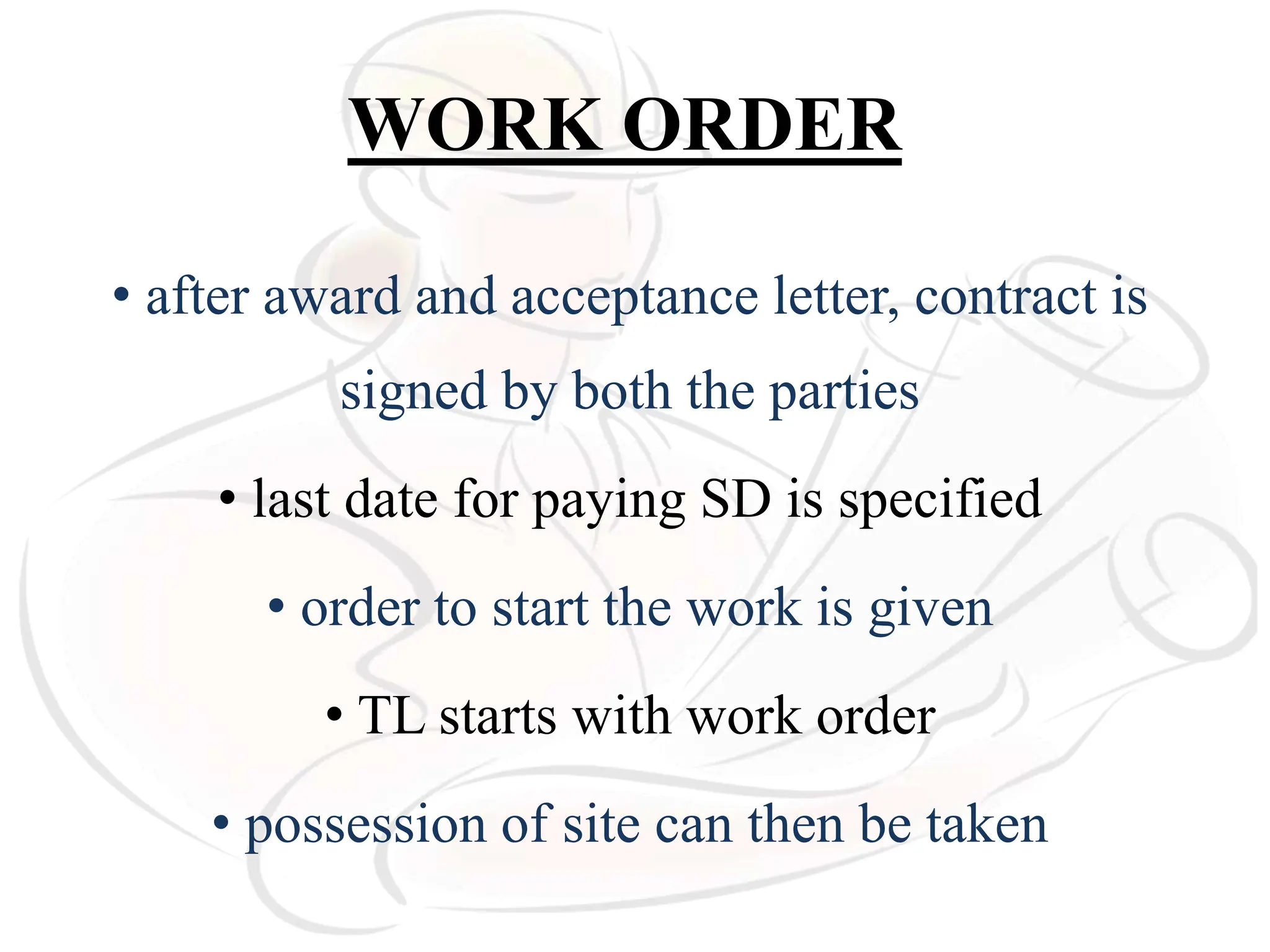
WORK ORDER
• after award and acceptance letter, contract is
signed by both the parties
• last date for paying SD is specified
• order to start the work is given
• TL starts with work order
• possession of site can then be taken
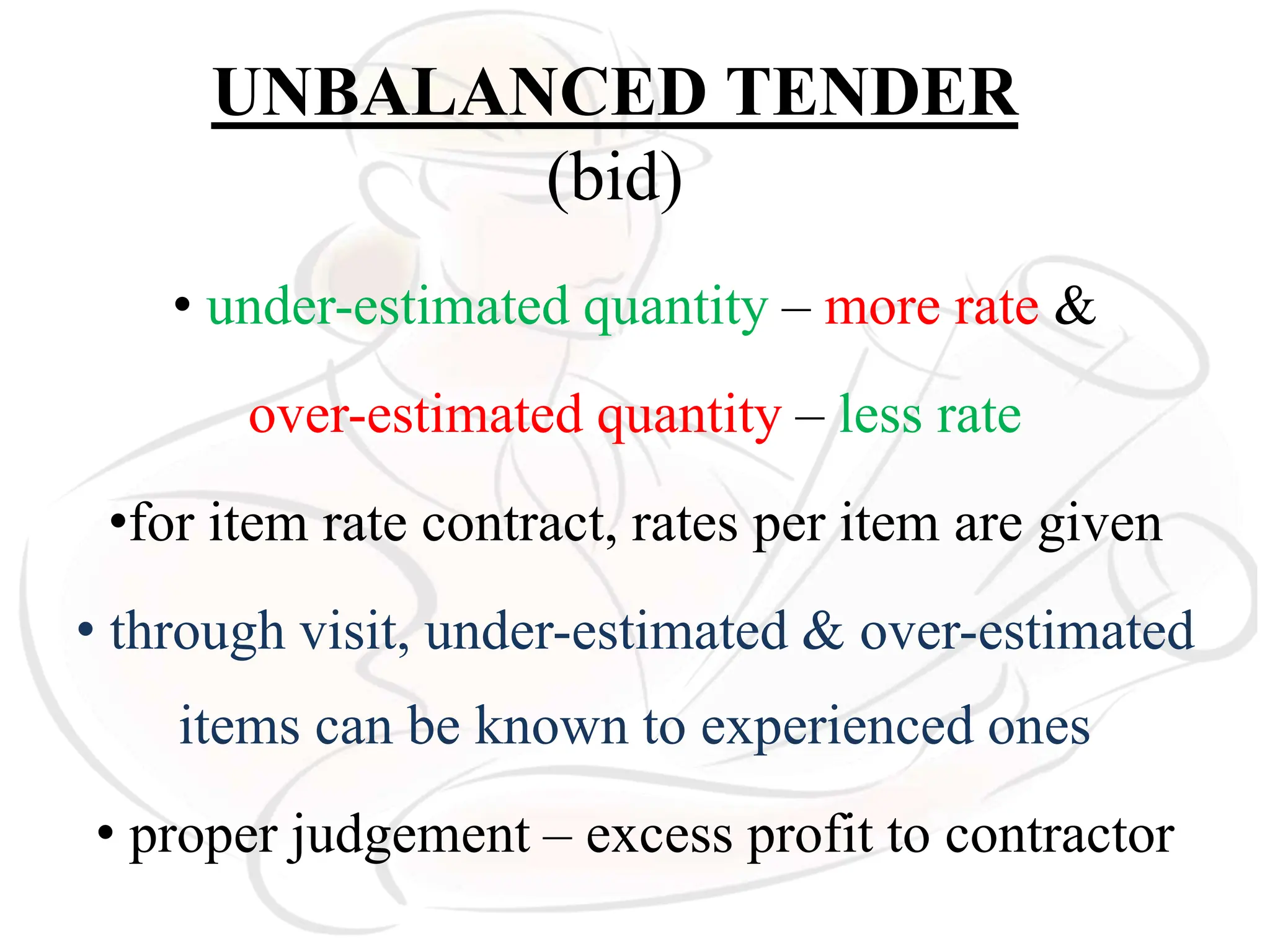
UNBALANCED TENDER
(bid)
• under-estimated quantity – more rate &
over-estimated quantity – less rate
•for item rate contract, rates per item are given
• through visit, under-estimated & over-estimated
items can be known to experienced ones
• proper judgement – excess profit to contractor
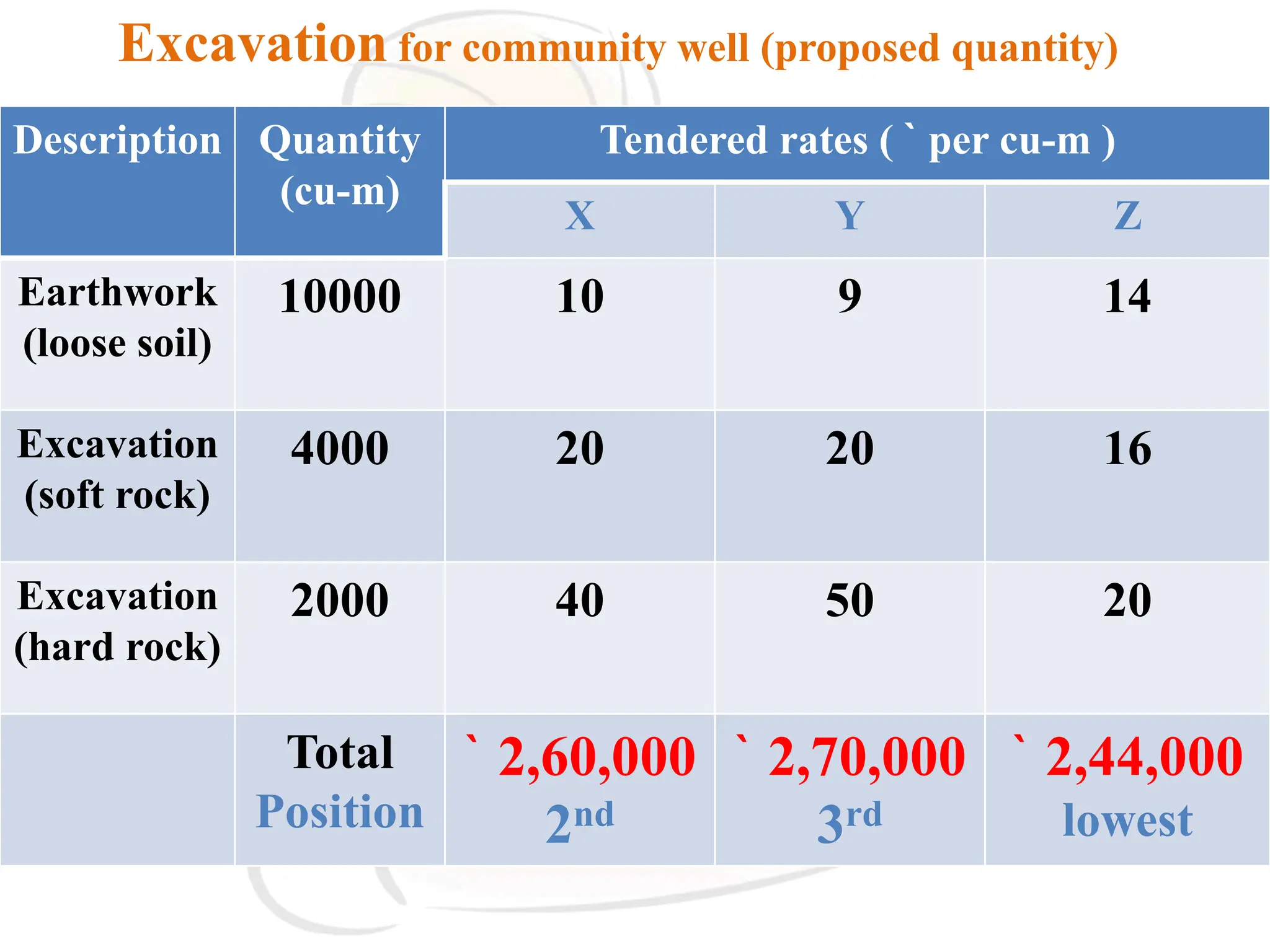
Description Quantity
(cu-m)
Tendered rates ( ` per cu-m )
X Y Z
Earthwork
(loose soil)
10000 10 9 14
Excavation
(soft rock)
4000 20 20 16
Excavation
(hard rock)
2000 40 50 20
Total
Position
` 2,60,000
2nd
` 2,70,000
3rd
` 2,44,000
lowest
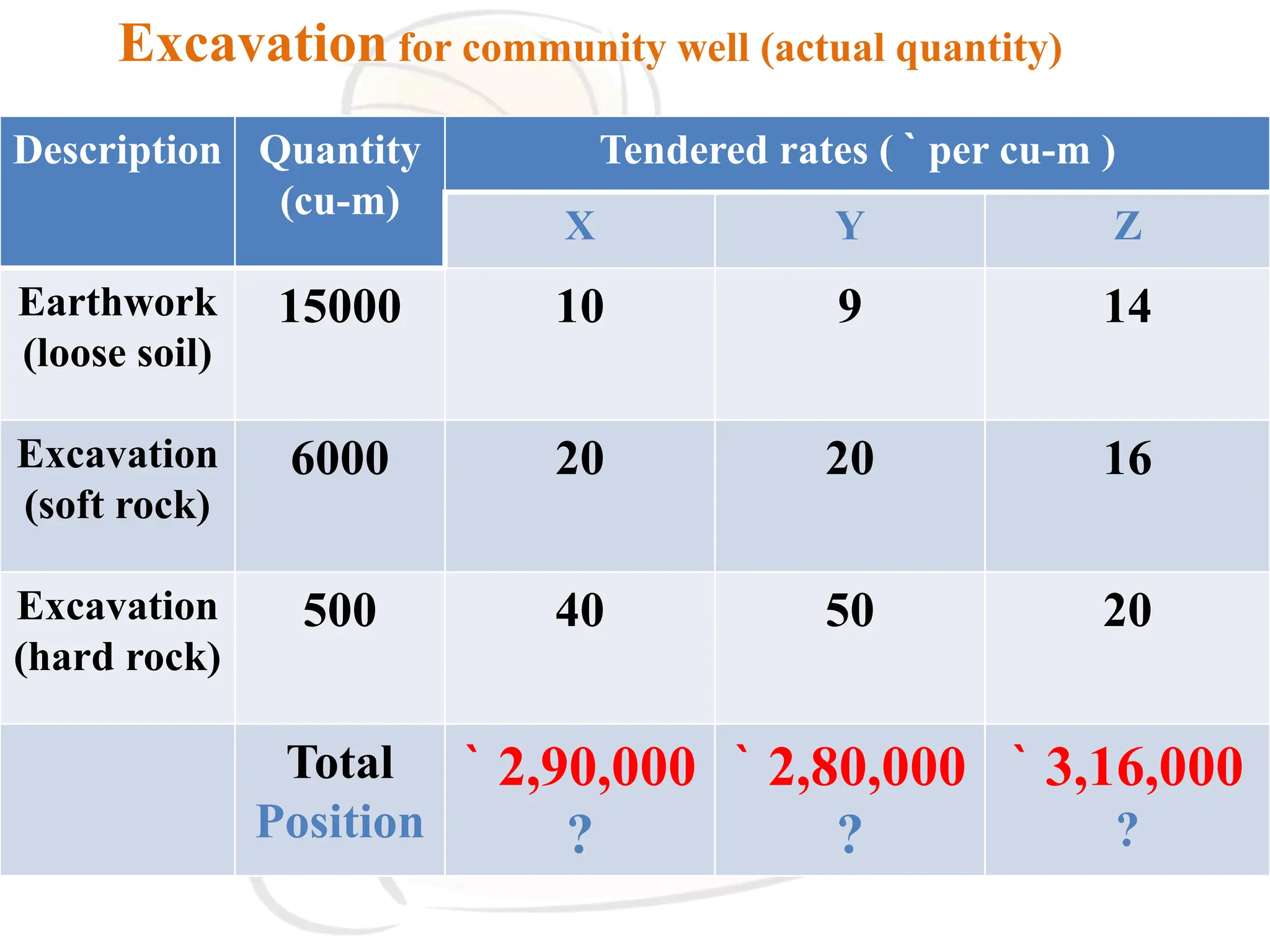
Excavation for community well (proposed quantity)
Description Quantity
(cu-m)
Tendered rates ( ` per cu-m )
X Y Z
Earthwork
(loose soil)
15000 10 9 14
Excavation
(soft rock)
6000 20 20 16
Excavation
(hard rock)
500 40 50 20
Total
Position
` 2,90,000
?
` 2,80,000
?
` 3,16,000
?
Excavation for community well (actual quantity)
RING FORMATION
• group of contractors come together & decide,
who among them should get the tender
• based on this decision, they quote the rates
• intended winner bids the lowest rate & other
group members quote higher rates than him
• this way they are assured of the job

TENDERS and Contracts basic syllabus for engineering

  • 1.
    TENDER It is anoffer in writing by contractor to execute certain specified work, or to supply specified materials, or transport of materials at certain rates, within a fixed duration, subject to certain terms & conditions.
  • 2.
    NECESSITY To find whetheran offer can be received from interested builders to execute the work within estimated limit of time and finance.
  • 3.
  • 4.
    OPEN TENDER • unlimitedcompetition • wide publicity • open to all contractors • low cost works
  • 5.
    Depending on nature,volume & expertise of work, types of Open tender:- • Global tenders • Local tenders
  • 6.
    GLOBAL TENDERS • publishedin international newspapers • open for contractors around the world • preferred for large projects • works done for airport, tunnel, express highway etc. • avoids personal influence or favour
  • 7.
    LOCAL TENDERS • publishedin local newspapers • publicity limited to the country • used in all government departments • not suitable for urgent works • avoids personal influence or favour
  • 8.
    LIMITED TENDER • limitedcompetition • owner/architect invites the tenders • used for specialized & private works • competitors of specialized field enter • selection as per knowledge, experience & reputation by owner’s choice • done as per specifications & time
  • 9.
    NEGOTIATED TENDER • paymentnegotiated with a single contractor • used when no choice besides one firm • done for urgent priority • done when time valued more than cost • competition is not free and fair
  • 10.
    TENDER NOTICE • anadvertisement published in newspaper • client calls interested contractors • includes ECP, TL, EMD, SD etc. • document on which agreement with the contractor is based
  • 11.
    POINTS TO BEINCLUDED WHILE DRAFTING A TENDER NOTICE
  • 12.
    • name &address of inviting authority • mode of submitting tender (sealed) • class of contractor • nature of work & its location • estimated cost of work • amount of EMD (cheque)
  • 13.
    • amount ofsecurity deposit • duration of work • type of tender form • cost of blank tender form (cash) • dates & time of issue • dates & time of receipt
  • 14.
    • mention holiday,if any • postal procedure • opening procedure of tenders • reservation of rights • validity period • signature of competent authority
  • 15.
  • 16.
    EARNEST MONEY • onlyreally interested contractors are expected to enter the competition • it is an amount - token of his sincere wish to do the said work • earnest intention amount paid with tender • depends on ECP • usually 1 to 2 % of ECP
  • 17.
    • EMD carriesno interest • if tender is accepted, this EMD is adjusted as the security deposit payable by contractor • after submission/acceptance of tender if contractor withdraws his offer/neglects to execute work – forfeit EMD • EMD is given as treasury challan or deposit at call receipt with tender
  • 18.
    SECURITY DEPOSIT • securityagainst failure to fulfill terms • depends on type of work & ECP • usually 2 to 5% of ECP • submitted in cash with EE • paid within 10 days of selection • paid in parts – at agreement & RA bills 10% • SD is refunded after DLP
  • 19.
    VALIDITY PERIOD • periodwithin which rates quoted are valid • contractor may or may not agree with modification of rates • it starts after submitting tender • depends on importance of work, completion time & the amount involved • 30 to 90 days (offer is valid)
  • 20.
    RIGHT TO REJECTONE OR ALL TENDERS
  • 21.
  • 22.
    • capacity isdoubtful (tools/staff) • unbalanced bid • bad reputation/experience • rates not workable • lack of experience in particular work • puts additional conditions
  • 23.
    • tender filledpartially • not a registered one • EMD is not submitted • not used appropriate form • tender not signed • becomes bankrupt
  • 24.
  • 25.
    • minimum tendersnot received (i.e., 3) • ring formation • major changes in design/drawings • work gets cancelled due to unforeseen circumstances
  • 26.
    • rates quotedare very high than estimated • collision suspected among contractors • pages removed or replaced ? • modifications not initialed ?
  • 27.
    CORRIGENDUM TO TENDER NOTICE •to inform about extension of date & time • regarding issue & receipt of forms • advertisement is published
  • 28.
    NECESSITY • if theduration for preparing tender is short • tender papers not ready • enough forms not available • important changes in design/drawing
  • 29.
  • 30.
    TENDER DOCUMENTS • itis a set of blank standard forms & details related to the project • prepared in the office of EE • tender documents – contract documents
  • 31.
    • brief tendernotice •conditions of contract • schedule A, B, C • tender agreement • bill of quantities • income tax clearance
  • 32.
    • challan ofEMD • previous & current work details • details of tools & equipments available • details of technical staff • specifications • copy of registration certificate • working drawing
  • 33.
    SCHEDULE A • listof materials to be supplied by owner • includes the rates charged for materials & place of their delivery • overleaf has conditions – return of unused, checking of received, charging extra for wastage, maintaining account, storing arrangement
  • 34.
    PARTICULARS RATES PLACEOF DELIVERY UNIT RUPEES CONTACTOR EE
  • 35.
    SCHEDULE B • listof items of work • contains quantities & rates in figures & words • EE fills rates & amounts for PRC - contractor’s job • contractor fills rates & amounts for each item for IRC
  • 36.
    ITEM NO. DESCRIPTION ESTIMATED QUANTITY TENDER RATEUNIT AMOUNT FIGURES WORDS CONTACTOR EE
  • 37.
    SCHEDULE C • listof items with their serial numbers, page number of specification booklet, specification number & specifications.
  • 38.
  • 39.
  • 40.
    TIME LIMIT • totalduration of work • if TL is crossed, owner loses returns from property, which is then recovered from contractor as penalty
  • 41.
    TIME EXTENSION • workcan be delayed due to many unavoidable reasons (natural calamities/beyond our control) • contractor can apply for extension to EE • if owner delays work, suitable extension
  • 42.
    PENALTY • fine fornot following terms of contract • if allotted work is incomplete or • progress not in proportion to time passed or • contractor does not follow specifications • SE decides amount of penalty • maximum 10% of EPC
  • 43.
    DEFECTIVE MATERIAL & WORKMANSHIP •if unsound/defective material is used • if imperfect/unskilled workmanship exists • contractor should remove defects at his own expenses • if contractors fails to do so, he should then pay compensation for it.
  • 44.
    SUSPENSION OF WORK •if contractor does not follow specification, drawing, design then • work is suspended and contractor is informed in writing • for remaining work, new tenders can be called
  • 45.
    SUBLETTING OF CONTRACT •sub contract is done among two contractors with the consent of owner • main contractor takes the work from owner • main contractor appoints sub contractor for doing different parts of work • specialized works – air conditioning, lift erection, plumbing, fabrication etc. • main contractor is responsible for conditions of contract & payment to sub contractor
  • 46.
    EXTRA ITEMS • unforeseendifficulties, negligence while preparing drawings raises concern for EI • primary EI (part of contract) • secondary EI (supplementary to contract) • contractor is bound to execute as per revised drawings all EI, necessary TE is given • EI payment done as per DSR or as per contract or as per mutually agreed rates to avoid disputes
  • 47.
    ESCALATION • rates ofengineering materials are mentioned in the tender form • during construction, rates may rise • the owner is liable to pay the difference to contractor, after construction is over • common clause due to swelling of prices
  • 48.
    PRICE VARIATION CLAUSE •due to inflation, prices – wages rise • if PVC is not there, contractor abandons work • to stop this, PVC should exist • considered materials may be steel, cement, sand, teakwood etc. whose prices may fluctuate
  • 49.
    DEFECT LIABILITY PERIOD •contractor is liable to carry out proper work during execution and also do needful maintenance for some time after the construction • DLP is normally 6 months – 1 year • all DLP works are done at contractor’s expenses • if not done by him, his SD is used for it and done through other contractor
  • 50.
    LIQUIDATED DAMAGES • compensationpaid by contractor due to delay • has no relation with actual loss • can be recovered from RA bill or SD • usually `100 per day • not applicable if delay is due to EI, late possession of site from owner
  • 51.
    UNLIQUIDATED DAMAGES • damageshaving relation with actual loss • for breach of contract, one party has to pay for the loss suffered by the other
  • 52.
    ARBITRATION • civil engineeringcontract includes wide operations with high index of legal conditions • each one wants to earn max profit in min efforts • due to uncertainties, disputes arise • if every dispute is taken to court - time is lost, work is suspended till decision comes & investment of parties remains yield less • through alternative (arbitration), disputes are settled outside court
  • 53.
    An arbitrator should– • possess confidence of both parties • be impartial • be a panel member • have experience & knowledge of field (law)
  • 54.
    Causes of disputes– • measurement of items • difference in specification & drawing • different interpretation • extra items • workmanship • payment • subletting of contract
  • 55.
    Advantages of arbitration– • consumes less time & money • simple procedure • hearing may be arranged as per parties convenience • decision may be fair as it is given by expert of the concerned field
  • 56.
    TERMINATION OF CONTRACT (theend) • due to any of the following reasons, a contract may end :- • completion of work – work completed as per agreement, DLP is over (happiest reason) • mutual agreement – based on some unavoidable reasons, parties together decide to stop working – contractor paid for past work & remaining can be done with fresh agreement
  • 57.
    • breach ofcontract conditions – if a party violates one or more conditions, other party can end the contract after giving warning - payment claim can be made • impossibility to complete – if work does not progress – neighbor puts legal complication, issue on ownership, due to flood funds transferred elsewhere for relief works Work stops indefinitely – later terminated
  • 58.
    • by operationof law – if contractor files a request in court to end the work due to no funds – court gives stay order, work may end • EMD •SD • rates quoted should include tax • labor wages to be paid as per minimum wages act
  • 59.
    FILLING THE TENDERBY CONTRACTOR & POINTS TO BE OBSERVED BY HIM A clever contractor properly plans his work after reading the tender notice for – • Pre – tender planning • Post – tender planning
  • 60.
    PROCEDURE OF SUBMITTING TENDER •checkwhether required things are mentioned like certificates, resources data, schedule B, challan of EMD • challan, registration certificate, forwarding letter – envelope 1 • tender documents set – envelope 2 • seal envelope 1 & 2 in one packet
  • 61.
    PRE – TENDERPLANNING • study of tender documents • check availability of required resources • visit the site, check soil, water table, access, quarry location, lead & lift, water availability • reasonable rates shall be pre-determined • find different alternatives of doing a work • analysis of bidding trend • time study • possibility of appointing sub-contractors
  • 62.
    PROCEDURE OF OPENING TENDER •committee for opening, scrutiny & acceptance • competent authority – chairperson • attendance of present ones • tenders placed in order – serially • envelopes opened – check signature, EMD, rates quoted or not, calculations • announce the quoted rates to all
  • 63.
    COMPARATIVE STATEMENT • tableshowing rates quoted by all • it has name of firm, rates quoted, total amount • useful to compare firms based on rates, tax, other charges • it helps in deciding the tender award
  • 64.
    Sr. no. Name of firmTender amount Remark 1 A ` 25,15,000/- 2nd 2 B ` 25,10,000/- LOWEST 3 C ` 25,25,000/- 3rd 4 D ` 25,50,000/- 4th
  • 65.
    SCRUTINY OF TENDERS •list of tenders received with EMD • duly signed • contract conditions are same & not altered • rates in words and figures – if difference in the two – select lowest of it • check calculations • check whether unbalanced • very low rates – bad quality – justify with rate analysis
  • 66.
    AWARD OF CONTRACT •after proper scrutiny and study of comparative statement, tender is awarded • usually lowest is selected • if lowest seems not workable, go for second lowest
  • 67.
    ACCEPTANCE LETTER • lowestrate is encircled in red ink in the comparative statement by the chairman • selected bidder is informed • a letter is addressed to him asking him to visit the office for further formalities, within 7 days of receiving the letter
  • 68.
    WORK ORDER • afteraward and acceptance letter, contract is signed by both the parties • last date for paying SD is specified • order to start the work is given • TL starts with work order • possession of site can then be taken
  • 69.
    UNBALANCED TENDER (bid) • under-estimatedquantity – more rate & over-estimated quantity – less rate •for item rate contract, rates per item are given • through visit, under-estimated & over-estimated items can be known to experienced ones • proper judgement – excess profit to contractor
  • 70.
    Description Quantity (cu-m) Tendered rates( ` per cu-m ) X Y Z Earthwork (loose soil) 10000 10 9 14 Excavation (soft rock) 4000 20 20 16 Excavation (hard rock) 2000 40 50 20 Total Position ` 2,60,000 2nd ` 2,70,000 3rd ` 2,44,000 lowest Excavation for community well (proposed quantity)
  • 71.
    Description Quantity (cu-m) Tendered rates( ` per cu-m ) X Y Z Earthwork (loose soil) 15000 10 9 14 Excavation (soft rock) 6000 20 20 16 Excavation (hard rock) 500 40 50 20 Total Position ` 2,90,000 ? ` 2,80,000 ? ` 3,16,000 ? Excavation for community well (actual quantity)
  • 72.
    RING FORMATION • groupof contractors come together & decide, who among them should get the tender • based on this decision, they quote the rates • intended winner bids the lowest rate & other group members quote higher rates than him • this way they are assured of the job