Background
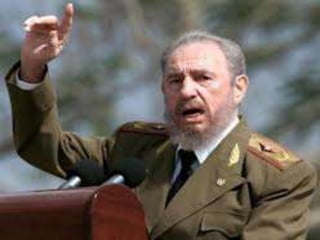
• Leader of Cuba’s Revolution
• Feb 1959 – Sep 1976: Prime
Minister of Cuba
• President of the Council of
Ministers of Cuba
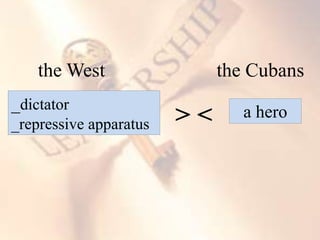
the West
_dictator
_repressive apparatus
the Cubans
a hero> <
Biography
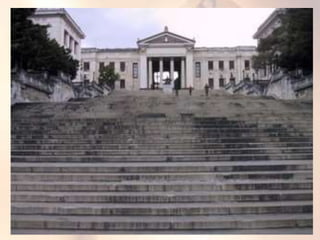
• August 13th, 1926
• 1945: Habana University
• 1950-1952: lawer, member of
Partido Ortodoxo
* Partido Ortodoxo: the socialist Party of the Cuban People
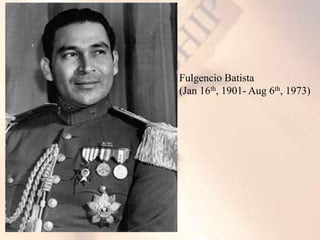
Fulgencio Batista
(Jan 16th, 1901- Aug 6th, 1973)
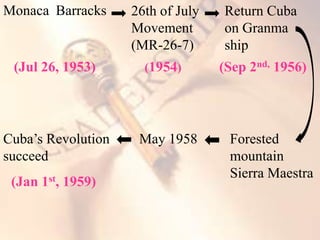
Monaca Barracks
(Jul 26, 1953)
26th of July
Movement
(MR-26-7)
(1954)
Return Cuba
on Granma
ship
(Sep 2nd, 1956)
Forested
mountain
Sierra Maestra
May 1958Cuba’s Revolution
succeed
(Jan 1st, 1959)
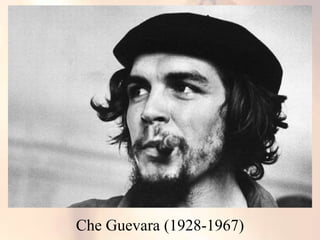
Che Guevara (1928-1967)
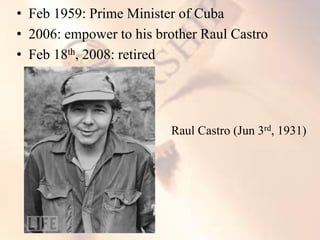
• Feb 1959: Prime Minister of Cuba
• 2006: empower to his brother Raul Castro
• Feb 18th, 2008: retired
Raul Castro (Jun 3rd, 1931)
• Was assassinated 638 times by CIA (Feb 2011)
• “If surviving after assassinations is awared
Olympic medal, I will win the gold medal”
• 50 medal from over 40 countries -Fidel Castro-
Vision
• May 1st, 1961: Cuba was a socialist country.
• “Marxism taught me what society is. I like a
blindfolded man in a forest, who did not even
know the north or south. If you are not the last to
really understand the history of class struggle, or
at least have a clear idea that society is divided
between the rich and the poor, and some
conquered and implementation trust others, you
are lost in a forest, does not know anything.”
• Feb 1960, Commercial Treaty with the Soviet
Union
• Nationalized industry, combination of organic
agriculture
• “There is often talk about human rights, but it is also
necessary to talk about human rights. Why should some
people go barefoot, so others can travel in luxury cars?
Why are people living in thirty-five years, so that others
may live seventy years? Why are miserably poor
accuracy, so that others can be extremely rich? I say
represents the world's children who do not have a piece
of bread. I speak on behalf of those who have no pain
medication, who have the right to life and human
dignity has been denied.”
-Fidel Castro's Message to the United Nations General Assembly, 1979-
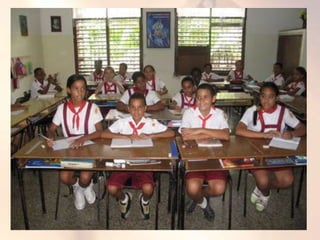
• “Castro first and most important is always going to
be an equal commitment. He despises any system in
which one class or group of people to live better than
others. He wanted a system that provides the basic
needs for all-sufficient food, health care, adequate
housing and education.”
• The main emphasis is placed on education
• Care centers are opened
• Reducing homelessness
• Building social infrastructure
Leading Principles of Fidel Castro
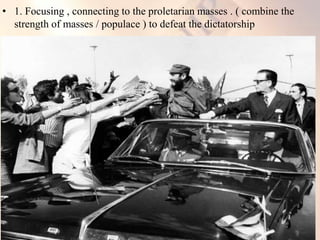
• 1. Focusing , connecting to the proletarian masses . ( combine the
strength of masses / populace ) to defeat the dictatorship
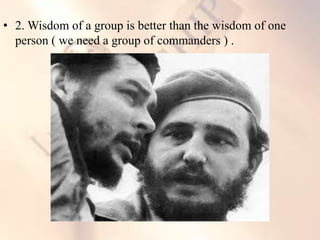
• 2. Wisdom of a group is better than the wisdom of one
person ( we need a group of commanders ) .
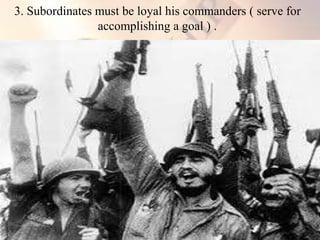
3. Subordinates must be loyal his commanders ( serve for
accomplishing a goal ) .
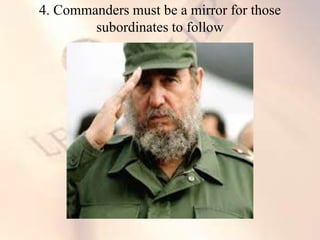
4. Commanders must be a mirror for those
subordinates to follow
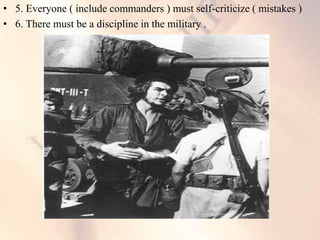
• 5. Everyone ( include commanders ) must self-criticize ( mistakes )
• 6. There must be a discipline in the military .
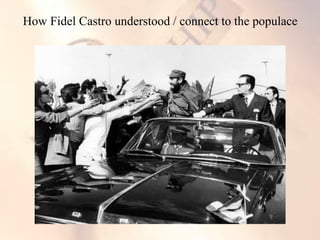
How Fidel Castro understood / connect to the populace
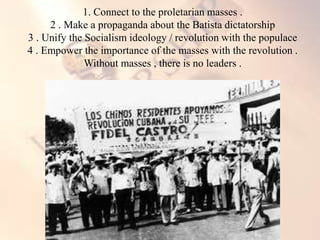
1. Connect to the proletarian masses .
2 . Make a propaganda about the Batista dictatorship
3 . Unify the Socialism ideology / revolution with the populace
4 . Empower the importance of the masses with the revolution .
Without masses , there is no leaders .
Effectiveness of your leader
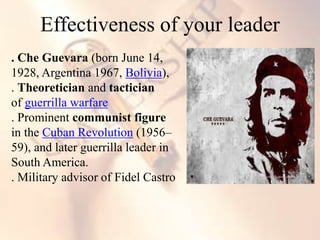
. Che Guevara (born June 14,
1928, Argentina 1967, Bolivia),
. Theoretician and tactician
of guerrilla warfare
. Prominent communist figure
in the Cuban Revolution (1956–
59), and later guerrilla leader in
South America.
. Military advisor of Fidel Castro
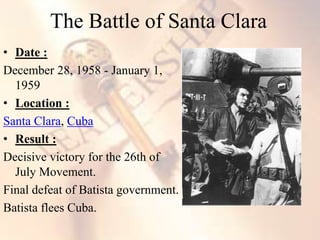
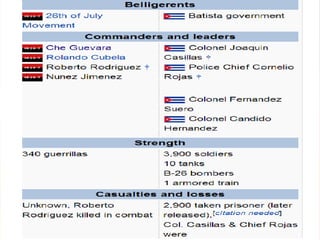
• Date :
December 28, 1958 - January 1,
1959
• Location :
Santa Clara, Cuba
• Result :
Decisive victory for the 26th of
July Movement.
Final defeat of Batista government.
Batista flees Cuba.
The Battle of Santa Clara
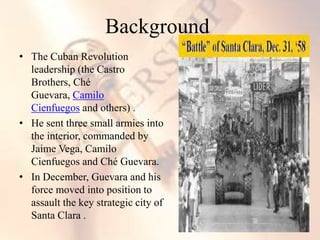
• The Cuban Revolution
leadership (the Castro
Brothers, Ché
Guevara, Camilo
Cienfuegos and others) .
• He sent three small armies into
the interior, commanded by
Jaime Vega, Camilo
Cienfuegos and Ché Guevara.
• In December, Guevara and his
force moved into position to
assault the key strategic city of
Santa Clara .
Background
• Guevara’s attack looked suicidal.
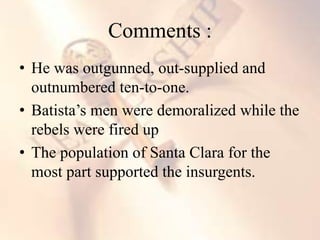
Force Disposition :
• He was outgunned, out-supplied and
outnumbered ten-to-one.
• Batista’s men were demoralized while the
rebels were fired up
• The population of Santa Clara for the
most part supported the insurgents.
Comments :
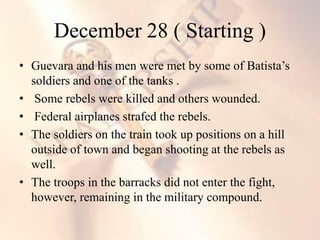
• Guevara and his men were met by some of Batista’s
soldiers and one of the tanks .
• Some rebels were killed and others wounded.
• Federal airplanes strafed the rebels.
• The soldiers on the train took up positions on a hill
outside of town and began shooting at the rebels as
well.
• The troops in the barracks did not enter the fight,
however, remaining in the military compound.
December 28 ( Starting )
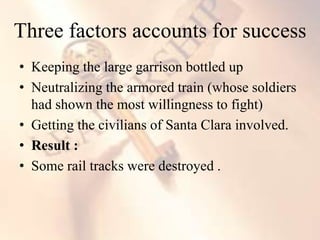
• Keeping the large garrison bottled up
• Neutralizing the armored train (whose soldiers
had shown the most willingness to fight)
• Getting the civilians of Santa Clara involved.
• Result :
• Some rail tracks were destroyed .
Three factors accounts for success
• The officers inside the armored train  The
barracks for protection.
• The damage to the rails caused a derailment,
and three of the cars overturned.
• Ché struck quickly, sending his men to fire on
the train and attack it with homemade Molotov
cocktails.
• The men inside, cooking in the heat, quickly
surrendered.
December 29
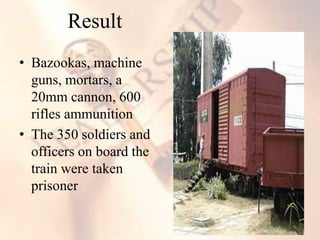
• Bazookas, machine
guns, mortars, a
20mm cannon, 600
rifles ammunition
• The 350 soldiers and
officers on board the
train were taken
prisoner
Result
• On the December 30, Ché’s men ran into a deadly
firefight at the police headquarters. ( In the city , the
police was afraid , the populace were tortured for
supporting the rebels ) .
• On the 31st, the police barracks fell and Ché and his
men were in possession of the city itself, although not
the military barracks.
• January 1, the demoralized garrison surrendered
unconditionally.
December 30 – January 1
• Ché was fanatically loyal to Fidel Castro and
when he arrived in Havana he controlled the
best-equipped army in the country
• Castro took command without much trouble
from the others.
• Castro was good at assigning tasks to his
subordinates .
Overview :
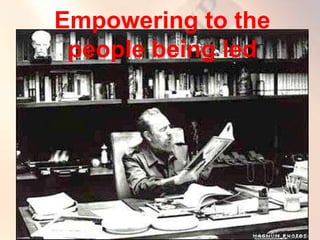
Empowering to the
people being led
Personal and public life
“fiercely hard-working, dedicated,loyal... generous
and magnanimous” – (Biographer Leycester
Coltman)
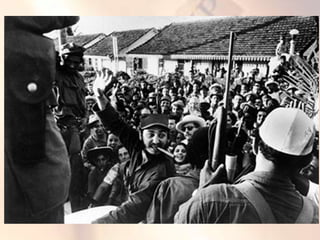
liked to meet with ordinary citizens and took a
particularly paternal attitude toward Cubans -
(Biographer Peter Bourne)
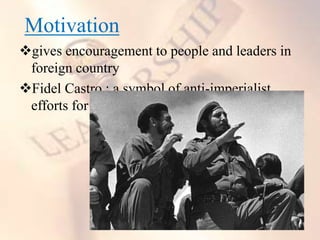
Motivation
gives encouragement to people and leaders in
foreign country
Fidel Castro : a symbol of anti-imperialist
efforts for people around the world
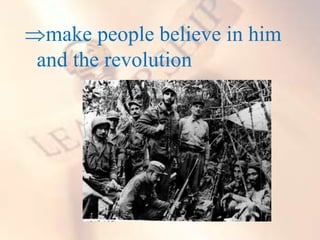
make people believe in him
and the revolution
Developing others
• Receiving lawsuit for poor people
• Speeches : corruption, injustice, poverty
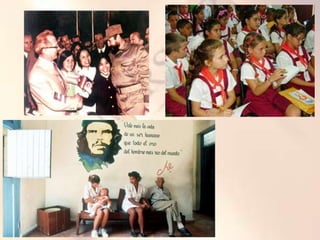
• The measures to improve people’s life
 tax
 land
 service(Anti-apartheid)
 education
 health care
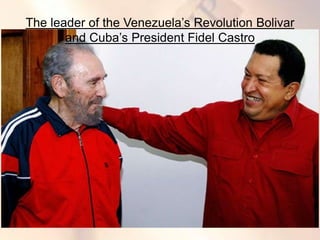
The leader of the Venezuela’s Revolution Bolivar
and Cuba’s President Fidel Castro
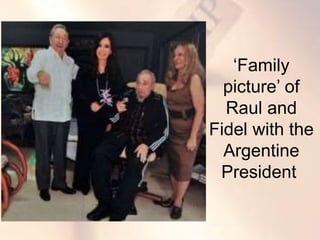
‘Family
picture’ of
Raul and
Fidel with the
Argentine
President
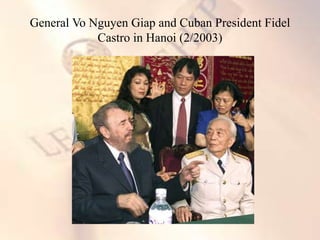
General Vo Nguyen Giap and Cuban President Fidel
Castro in Hanoi (2/2003)
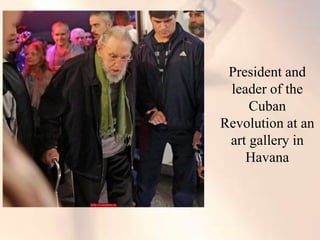
President and
leader of the
Cuban
Revolution at an
art gallery in
Havana
Thank you for your
listening !

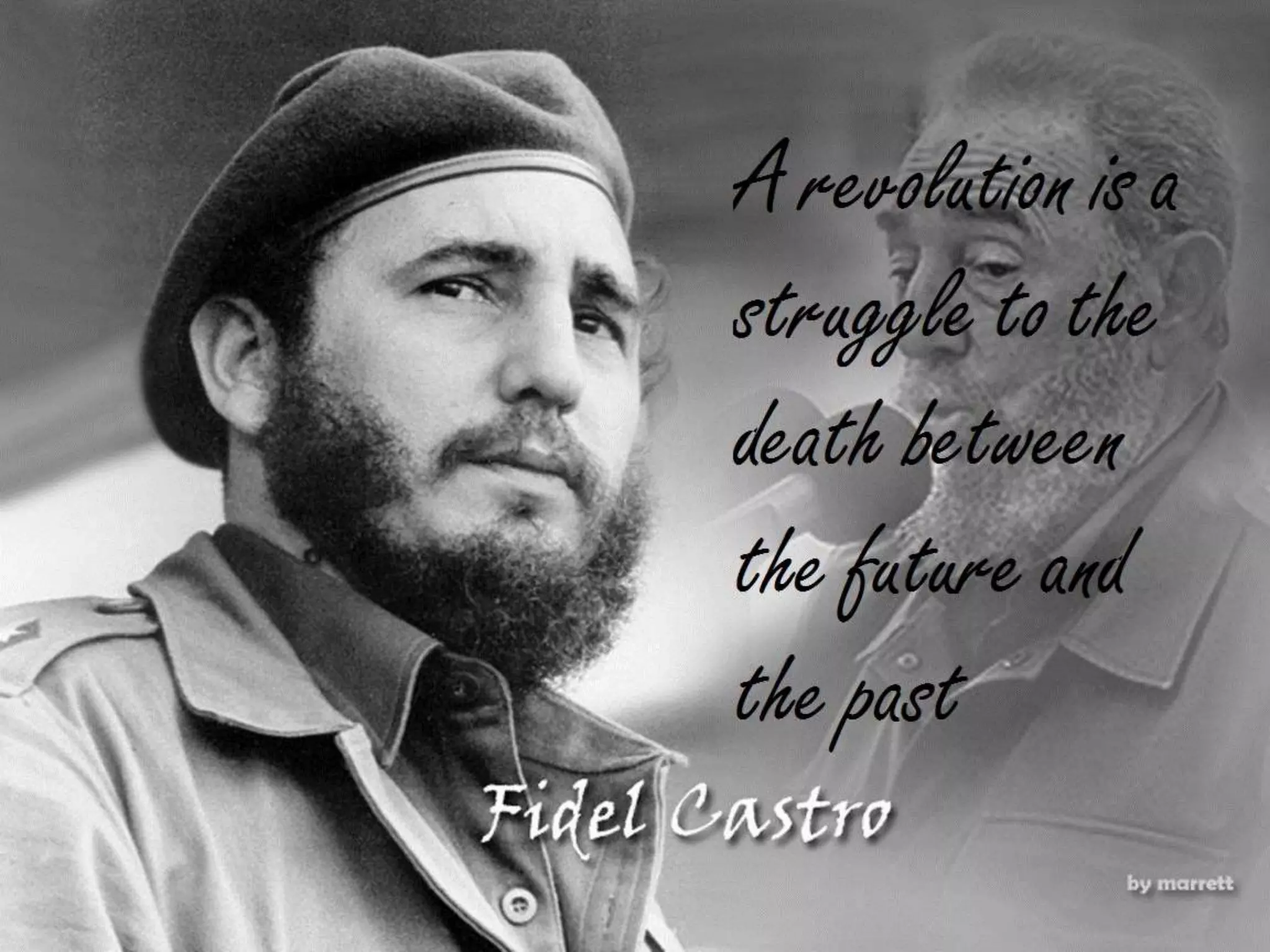
Fidel castro

  • 2.
    Background • Leader ofCuba’s Revolution • Feb 1959 – Sep 1976: Prime Minister of Cuba • President of the Council of Ministers of Cuba
  • 3.
  • 4.
    Biography • August 13th,1926 • 1945: Habana University • 1950-1952: lawer, member of Partido Ortodoxo * Partido Ortodoxo: the socialist Party of the Cuban People
  • 6.
    Fulgencio Batista (Jan 16th,1901- Aug 6th, 1973)
  • 7.
    Monaca Barracks (Jul 26,1953) 26th of July Movement (MR-26-7) (1954) Return Cuba on Granma ship (Sep 2nd, 1956) Forested mountain Sierra Maestra May 1958Cuba’s Revolution succeed (Jan 1st, 1959)
  • 8.
  • 9.
    • Feb 1959:Prime Minister of Cuba • 2006: empower to his brother Raul Castro • Feb 18th, 2008: retired Raul Castro (Jun 3rd, 1931)
  • 10.
    • Was assassinated638 times by CIA (Feb 2011) • “If surviving after assassinations is awared Olympic medal, I will win the gold medal” • 50 medal from over 40 countries -Fidel Castro-
  • 11.
    Vision • May 1st,1961: Cuba was a socialist country. • “Marxism taught me what society is. I like a blindfolded man in a forest, who did not even know the north or south. If you are not the last to really understand the history of class struggle, or at least have a clear idea that society is divided between the rich and the poor, and some conquered and implementation trust others, you are lost in a forest, does not know anything.”
  • 12.
    • Feb 1960,Commercial Treaty with the Soviet Union • Nationalized industry, combination of organic agriculture
  • 13.
    • “There isoften talk about human rights, but it is also necessary to talk about human rights. Why should some people go barefoot, so others can travel in luxury cars? Why are people living in thirty-five years, so that others may live seventy years? Why are miserably poor accuracy, so that others can be extremely rich? I say represents the world's children who do not have a piece of bread. I speak on behalf of those who have no pain medication, who have the right to life and human dignity has been denied.” -Fidel Castro's Message to the United Nations General Assembly, 1979-
  • 15.
    • “Castro firstand most important is always going to be an equal commitment. He despises any system in which one class or group of people to live better than others. He wanted a system that provides the basic needs for all-sufficient food, health care, adequate housing and education.” • The main emphasis is placed on education • Care centers are opened • Reducing homelessness • Building social infrastructure
  • 16.
  • 18.
    • 1. Focusing, connecting to the proletarian masses . ( combine the strength of masses / populace ) to defeat the dictatorship
  • 19.
    • 2. Wisdomof a group is better than the wisdom of one person ( we need a group of commanders ) .
  • 20.
    3. Subordinates mustbe loyal his commanders ( serve for accomplishing a goal ) .
  • 21.
    4. Commanders mustbe a mirror for those subordinates to follow
  • 22.
    • 5. Everyone( include commanders ) must self-criticize ( mistakes ) • 6. There must be a discipline in the military .
  • 23.
    How Fidel Castrounderstood / connect to the populace
  • 24.
    1. Connect tothe proletarian masses . 2 . Make a propaganda about the Batista dictatorship 3 . Unify the Socialism ideology / revolution with the populace 4 . Empower the importance of the masses with the revolution . Without masses , there is no leaders .
  • 25.
    Effectiveness of yourleader . Che Guevara (born June 14, 1928, Argentina 1967, Bolivia), . Theoretician and tactician of guerrilla warfare . Prominent communist figure in the Cuban Revolution (1956– 59), and later guerrilla leader in South America. . Military advisor of Fidel Castro
  • 26.
    • Date : December28, 1958 - January 1, 1959 • Location : Santa Clara, Cuba • Result : Decisive victory for the 26th of July Movement. Final defeat of Batista government. Batista flees Cuba. The Battle of Santa Clara
  • 27.
    • The CubanRevolution leadership (the Castro Brothers, Ché Guevara, Camilo Cienfuegos and others) . • He sent three small armies into the interior, commanded by Jaime Vega, Camilo Cienfuegos and Ché Guevara. • In December, Guevara and his force moved into position to assault the key strategic city of Santa Clara . Background
  • 28.
    • Guevara’s attacklooked suicidal. Force Disposition :
  • 30.
    • He wasoutgunned, out-supplied and outnumbered ten-to-one. • Batista’s men were demoralized while the rebels were fired up • The population of Santa Clara for the most part supported the insurgents. Comments :
  • 31.
    • Guevara andhis men were met by some of Batista’s soldiers and one of the tanks . • Some rebels were killed and others wounded. • Federal airplanes strafed the rebels. • The soldiers on the train took up positions on a hill outside of town and began shooting at the rebels as well. • The troops in the barracks did not enter the fight, however, remaining in the military compound. December 28 ( Starting )
  • 32.
    • Keeping thelarge garrison bottled up • Neutralizing the armored train (whose soldiers had shown the most willingness to fight) • Getting the civilians of Santa Clara involved. • Result : • Some rail tracks were destroyed . Three factors accounts for success
  • 33.
    • The officersinside the armored train  The barracks for protection. • The damage to the rails caused a derailment, and three of the cars overturned. • Ché struck quickly, sending his men to fire on the train and attack it with homemade Molotov cocktails. • The men inside, cooking in the heat, quickly surrendered. December 29
  • 34.
    • Bazookas, machine guns,mortars, a 20mm cannon, 600 rifles ammunition • The 350 soldiers and officers on board the train were taken prisoner Result
  • 35.
    • On theDecember 30, Ché’s men ran into a deadly firefight at the police headquarters. ( In the city , the police was afraid , the populace were tortured for supporting the rebels ) . • On the 31st, the police barracks fell and Ché and his men were in possession of the city itself, although not the military barracks. • January 1, the demoralized garrison surrendered unconditionally. December 30 – January 1
  • 36.
    • Ché wasfanatically loyal to Fidel Castro and when he arrived in Havana he controlled the best-equipped army in the country • Castro took command without much trouble from the others. • Castro was good at assigning tasks to his subordinates . Overview :
  • 37.
  • 38.
    Personal and publiclife “fiercely hard-working, dedicated,loyal... generous and magnanimous” – (Biographer Leycester Coltman) liked to meet with ordinary citizens and took a particularly paternal attitude toward Cubans - (Biographer Peter Bourne)
  • 39.
    Motivation gives encouragement topeople and leaders in foreign country Fidel Castro : a symbol of anti-imperialist efforts for people around the world
  • 40.
    make people believein him and the revolution
  • 42.
    Developing others • Receivinglawsuit for poor people • Speeches : corruption, injustice, poverty
  • 43.
    • The measuresto improve people’s life  tax  land  service(Anti-apartheid)  education  health care
  • 45.
    The leader ofthe Venezuela’s Revolution Bolivar and Cuba’s President Fidel Castro
  • 46.
    ‘Family picture’ of Raul and Fidelwith the Argentine President
  • 47.
    General Vo NguyenGiap and Cuban President Fidel Castro in Hanoi (2/2003)
  • 48.
    President and leader ofthe Cuban Revolution at an art gallery in Havana
  • 49.
    Thank you foryour listening !