Fibromyalgia Syndrome
Marwa Abo Elmaaty Besar
Lecturer of Internal Medicine
(Rheumatology Immunology Unit)
(Pediatric Rheumatology)
Fibromyalgia Syndrome:
A functional somatic syndrome, bodily distress syndrome or as a somatoform
disorder.
Fms is classified to be a first rank syndrome (unknown aetiology, heterogenous
pathogenesis and defined phenotype).
A typical group of symptoms and the exclusion of a somatic disease sufficiently
explaining the symptoms.
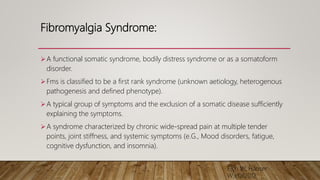
A syndrome characterized by chronic wide-spread pain at multiple tender
points, joint stiffness, and systemic symptoms (e.G., Mood disorders, fatigue,
cognitive dysfunction, and insomnia).
Eich W, Häuser
W;etal2012
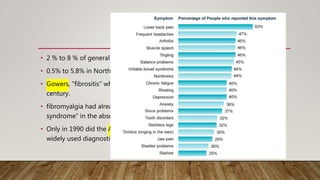
• 2 % to 8 % of general population.
• 0.5% to 5.8% in North America and Europe.
• Gowers, “fibrositis” which was used until the seventies and eighties of the last
century.
• fibromyalgia had already been described in the nineteenth century, “pain
syndrome” in the absence of a specific organic disease.
• Only in 1990 did the American College of Rheumatology committee write up the
widely used diagnostic criteria.
Pathogenesis:-
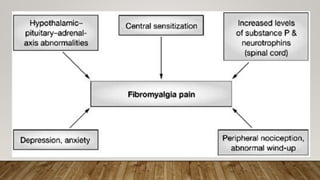
• Central sensitization (or pain centralization);
• ‘ windup”, (NMDA) receptor; Impaired descending inhibitory pain pathways.
• Serotonin (5-HT), substance P
.
• Changes in brain morphology; Grey matter volume, decreases in cortical thickness and overall
brain volume.
• Peripheral abnormality with changes consistent with small fibre neuropathy.
• Genetic Factors. several familial studies, polygenic, the serotonin transporter gene, the
catechol-O methyltransferase gene , the dopamine D4 receptor gene , and the HLA-region
• Musculoskeletal factors: fear-avoidance behaviours and kinaesiophobia (fear of
movement)
• Sleep disturbance: disruption to stage four non rapid eye movement sleep.
• Other mechanisms; (HPA) dysfunction, low cortisol, GH.
• Psychological factors; depression, anxiety, obsessive–compulsive disorder and post-
traumatic stress disorder.
• Trigger Factors:
• Infections; viruses such as HCV, HIV, Coxsackie B, and Parvovirus and bacteria like
Borrelia.
• Physical trauma, vaccinations and chemical substances.
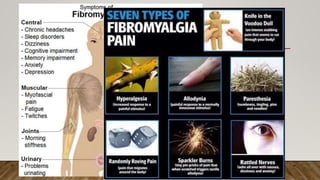
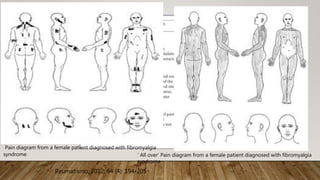
Symptoms And Sign:
Pain diagram from a female patient diagnosed with fibromyalgia
syndrome ‘ All over’ Pain diagram from a female patient diagnosed with fibromyalgia
syndrome
Reumatismo, 2012; 64 (4): 194-205
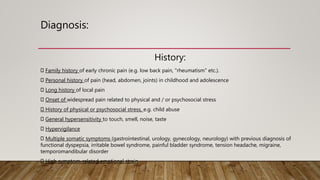
Diagnosis:
History:
Family history of early chronic pain (e.g. low back pain, "rheumatism" etc.).
Personal history of pain (head, abdomen, joints) in childhood and adolescence
Long history of local pain
Onset of widespread pain related to physical and / or psychosocial stress
History of physical or psychosocial stress, e.g. child abuse
General hypersensitivity to touch, smell, noise, taste
Hypervigilance
Multiple somatic symptoms (gastrointestinal, urology, gynecology, neurology) with previous diagnosis of
functional dyspepsia, irritable bowel syndrome, painful bladder syndrome, tension headache, migraine,
temporomandibular disorder
High symptom-related emotional strain
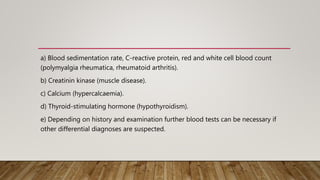
a) Blood sedimentation rate, C-reactive protein, red and white cell blood count
(polymyalgia rheumatica, rheumatoid arthritis).
b) Creatinin kinase (muscle disease).
c) Calcium (hypercalcaemia).
d) Thyroid-stimulating hormone (hypothyroidism).
e) Depending on history and examination further blood tests can be necessary if
other differential diagnoses are suspected.
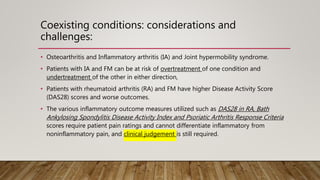
Coexisting conditions: considerations and
challenges:
• Osteoarthritis and Inflammatory arthritis (IA) and Joint hypermobility syndrome.
• Patients with IA and FM can be at risk of overtreatment of one condition and
undertreatment of the other in either direction,
• Patients with rheumatoid arthritis (RA) and FM have higher Disease Activity Score
(DAS28) scores and worse outcomes.
• The various inflammatory outcome measures utilized such as DAS28 in RA, Bath
Ankylosing Spondylitis Disease Activity Index and Psoriatic Arthritis Response Criteria
scores require patient pain ratings and cannot differentiate inflammatory from
noninflammatory pain, and clinical judgement is still required.
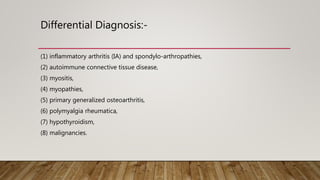
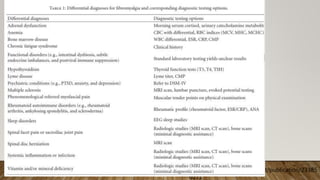
Differential Diagnosis:-
(1) inflammatory arthritis (IA) and spondylo-arthropathies,
(2) autoimmune connective tissue disease,
(3) myositis,
(4) myopathies,
(5) primary generalized osteoarthritis,
(6) polymyalgia rheumatica,
(7) hypothyroidism,
(8) malignancies.
https://www.researchgate.net/publication/23385
0271
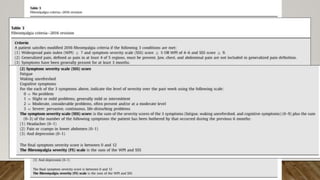
This table is from the 2016 Revisions to the 2010/2011 fibromyalgia diagnostic criteria article, which appeared in Volume 46, Issue 3 of the Seminars inArthritis and
Rheumatism journal.
Wolfe F,etal2011
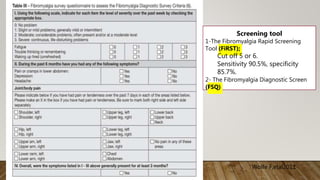
Screening tool
1-The Fibromyalgia Rapid Screening
Tool (FiRST);
Cut off 5 or 6.
Sensitivity 90.5%, specificity
85.7%.
2- The Fibromyalgia Diagnostic Screen
(FSQ)
H Cohen,2017
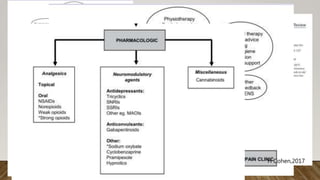
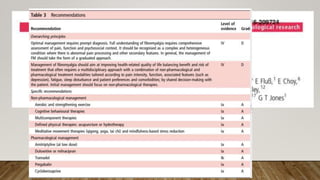
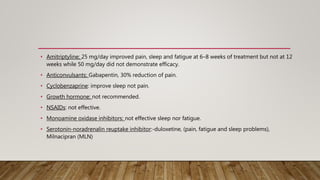
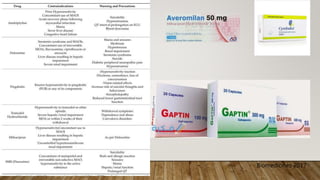
• Amitriptyline; 25 mg/day improved pain, sleep and fatigue at 6–8 weeks of treatment but not at 12
weeks while 50 mg/day did not demonstrate efficacy.
• Anticonvulsants: Gabapentin, 30% reduction of pain.
• Cyclobenzaprine: improve sleep not pain.
• Growth hormone: not recommended.
• NSAIDs: not effective.
• Monoamine oxidase inhibitors: not effective sleep nor fatigue.
• Serotonin-noradrenalin reuptake inhibitor:-duloxetine, (pain, fatigue and sleep problems),
Milnacipran (MLN)
Biomedicines 2017
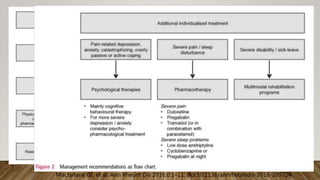
Macfarlane GJ, et al. Ann Rheum Dis 2016;0:1–11. doi:10.1136/annrheumdis-2016-209724
Reference:-
• http://ard.bmj.com/content/early/2016/07/04/annrheumdis-2016-209724.
• Wolfe F, Clauw DJ, Fitzcharles MA, et al. The American College of Rheumatology preliminary diagnostic criteria for fibromyalgia and
measurement of symptom severity. Arthritis Care Res (Hoboken). 2010; 62: 600-10.
• Eich W, Häuser W, Arnold B, et al. Definition, classification, clinical diagnosis and prognosis of fibromyalgia syndrome. Schmerz. 2012; 26:
in press.
• Wolfe F, Clauw DJ, Fitzcharles MA, et al. Fibromyalgia criteria and severity scales for clinical and epidemiological studies: a modification of
the ACR Preliminary Diagnostic Criteria for Fibromyalgia. J Rheumatol. 2011;38: 1113-22.
• Briggs EV, Battelli D, Gordon D, et al. Current pain education within undergraduate medical studies across Europe: Advancing the
Provision of Pain Education and Learning (APPEAL)study. BMJ Open 2015; 5(8): e006984.
• Wolfe, F.; Smythe, H.A.; Yunus, M.B.; Bennett, R.M.; Bombardier, C.; Goldenberg, D.L. The American college of rheumatology 1990 criteria
for the classification of fibromyalgia. Report of the multicenter criteria committee. Arthritis Rheum. 1990, 33, 160–172.
• Raymond, J.R.; Mukhin, Y.V.; Gelasco, A.; Turner, J.; Collinsworth, G.; Gettys, T.W.; Grewal, J.S.; Garnovskaya, M.N. Multiplicity of
mechanisms of serotonin receptor signal transduction. Pharmacol. Ther. 2001, 92, 179–212.
Fibromylagia

Fibromylagia

  • 1.
    Fibromyalgia Syndrome Marwa AboElmaaty Besar Lecturer of Internal Medicine (Rheumatology Immunology Unit) (Pediatric Rheumatology)
  • 2.
    Fibromyalgia Syndrome: A functionalsomatic syndrome, bodily distress syndrome or as a somatoform disorder. Fms is classified to be a first rank syndrome (unknown aetiology, heterogenous pathogenesis and defined phenotype). A typical group of symptoms and the exclusion of a somatic disease sufficiently explaining the symptoms. A syndrome characterized by chronic wide-spread pain at multiple tender points, joint stiffness, and systemic symptoms (e.G., Mood disorders, fatigue, cognitive dysfunction, and insomnia). Eich W, Häuser W;etal2012
  • 3.
    • 2 %to 8 % of general population. • 0.5% to 5.8% in North America and Europe. • Gowers, “fibrositis” which was used until the seventies and eighties of the last century. • fibromyalgia had already been described in the nineteenth century, “pain syndrome” in the absence of a specific organic disease. • Only in 1990 did the American College of Rheumatology committee write up the widely used diagnostic criteria.
  • 5.
    Pathogenesis:- • Central sensitization(or pain centralization); • ‘ windup”, (NMDA) receptor; Impaired descending inhibitory pain pathways. • Serotonin (5-HT), substance P . • Changes in brain morphology; Grey matter volume, decreases in cortical thickness and overall brain volume. • Peripheral abnormality with changes consistent with small fibre neuropathy. • Genetic Factors. several familial studies, polygenic, the serotonin transporter gene, the catechol-O methyltransferase gene , the dopamine D4 receptor gene , and the HLA-region
  • 6.
    • Musculoskeletal factors:fear-avoidance behaviours and kinaesiophobia (fear of movement) • Sleep disturbance: disruption to stage four non rapid eye movement sleep. • Other mechanisms; (HPA) dysfunction, low cortisol, GH. • Psychological factors; depression, anxiety, obsessive–compulsive disorder and post- traumatic stress disorder. • Trigger Factors: • Infections; viruses such as HCV, HIV, Coxsackie B, and Parvovirus and bacteria like Borrelia. • Physical trauma, vaccinations and chemical substances.
  • 7.
  • 8.
    Pain diagram froma female patient diagnosed with fibromyalgia syndrome ‘ All over’ Pain diagram from a female patient diagnosed with fibromyalgia syndrome Reumatismo, 2012; 64 (4): 194-205
  • 9.
    Diagnosis: History: Family history ofearly chronic pain (e.g. low back pain, "rheumatism" etc.). Personal history of pain (head, abdomen, joints) in childhood and adolescence Long history of local pain Onset of widespread pain related to physical and / or psychosocial stress History of physical or psychosocial stress, e.g. child abuse General hypersensitivity to touch, smell, noise, taste Hypervigilance Multiple somatic symptoms (gastrointestinal, urology, gynecology, neurology) with previous diagnosis of functional dyspepsia, irritable bowel syndrome, painful bladder syndrome, tension headache, migraine, temporomandibular disorder High symptom-related emotional strain
  • 10.
    a) Blood sedimentationrate, C-reactive protein, red and white cell blood count (polymyalgia rheumatica, rheumatoid arthritis). b) Creatinin kinase (muscle disease). c) Calcium (hypercalcaemia). d) Thyroid-stimulating hormone (hypothyroidism). e) Depending on history and examination further blood tests can be necessary if other differential diagnoses are suspected.
  • 11.
    Coexisting conditions: considerationsand challenges: • Osteoarthritis and Inflammatory arthritis (IA) and Joint hypermobility syndrome. • Patients with IA and FM can be at risk of overtreatment of one condition and undertreatment of the other in either direction, • Patients with rheumatoid arthritis (RA) and FM have higher Disease Activity Score (DAS28) scores and worse outcomes. • The various inflammatory outcome measures utilized such as DAS28 in RA, Bath Ankylosing Spondylitis Disease Activity Index and Psoriatic Arthritis Response Criteria scores require patient pain ratings and cannot differentiate inflammatory from noninflammatory pain, and clinical judgement is still required.
  • 12.
    Differential Diagnosis:- (1) inflammatoryarthritis (IA) and spondylo-arthropathies, (2) autoimmune connective tissue disease, (3) myositis, (4) myopathies, (5) primary generalized osteoarthritis, (6) polymyalgia rheumatica, (7) hypothyroidism, (8) malignancies.
  • 13.
  • 14.
    This table isfrom the 2016 Revisions to the 2010/2011 fibromyalgia diagnostic criteria article, which appeared in Volume 46, Issue 3 of the Seminars inArthritis and Rheumatism journal.
  • 15.
    Wolfe F,etal2011 Screening tool 1-TheFibromyalgia Rapid Screening Tool (FiRST); Cut off 5 or 6. Sensitivity 90.5%, specificity 85.7%. 2- The Fibromyalgia Diagnostic Screen (FSQ)
  • 16.
  • 18.
    • Amitriptyline; 25mg/day improved pain, sleep and fatigue at 6–8 weeks of treatment but not at 12 weeks while 50 mg/day did not demonstrate efficacy. • Anticonvulsants: Gabapentin, 30% reduction of pain. • Cyclobenzaprine: improve sleep not pain. • Growth hormone: not recommended. • NSAIDs: not effective. • Monoamine oxidase inhibitors: not effective sleep nor fatigue. • Serotonin-noradrenalin reuptake inhibitor:-duloxetine, (pain, fatigue and sleep problems), Milnacipran (MLN)
  • 19.
  • 20.
    Macfarlane GJ, etal. Ann Rheum Dis 2016;0:1–11. doi:10.1136/annrheumdis-2016-209724
  • 21.
    Reference:- • http://ard.bmj.com/content/early/2016/07/04/annrheumdis-2016-209724. • WolfeF, Clauw DJ, Fitzcharles MA, et al. The American College of Rheumatology preliminary diagnostic criteria for fibromyalgia and measurement of symptom severity. Arthritis Care Res (Hoboken). 2010; 62: 600-10. • Eich W, Häuser W, Arnold B, et al. Definition, classification, clinical diagnosis and prognosis of fibromyalgia syndrome. Schmerz. 2012; 26: in press. • Wolfe F, Clauw DJ, Fitzcharles MA, et al. Fibromyalgia criteria and severity scales for clinical and epidemiological studies: a modification of the ACR Preliminary Diagnostic Criteria for Fibromyalgia. J Rheumatol. 2011;38: 1113-22. • Briggs EV, Battelli D, Gordon D, et al. Current pain education within undergraduate medical studies across Europe: Advancing the Provision of Pain Education and Learning (APPEAL)study. BMJ Open 2015; 5(8): e006984. • Wolfe, F.; Smythe, H.A.; Yunus, M.B.; Bennett, R.M.; Bombardier, C.; Goldenberg, D.L. The American college of rheumatology 1990 criteria for the classification of fibromyalgia. Report of the multicenter criteria committee. Arthritis Rheum. 1990, 33, 160–172. • Raymond, J.R.; Mukhin, Y.V.; Gelasco, A.; Turner, J.; Collinsworth, G.; Gettys, T.W.; Grewal, J.S.; Garnovskaya, M.N. Multiplicity of mechanisms of serotonin receptor signal transduction. Pharmacol. Ther. 2001, 92, 179–212.