Avani Akbari(PT)
MPT 2nd
year
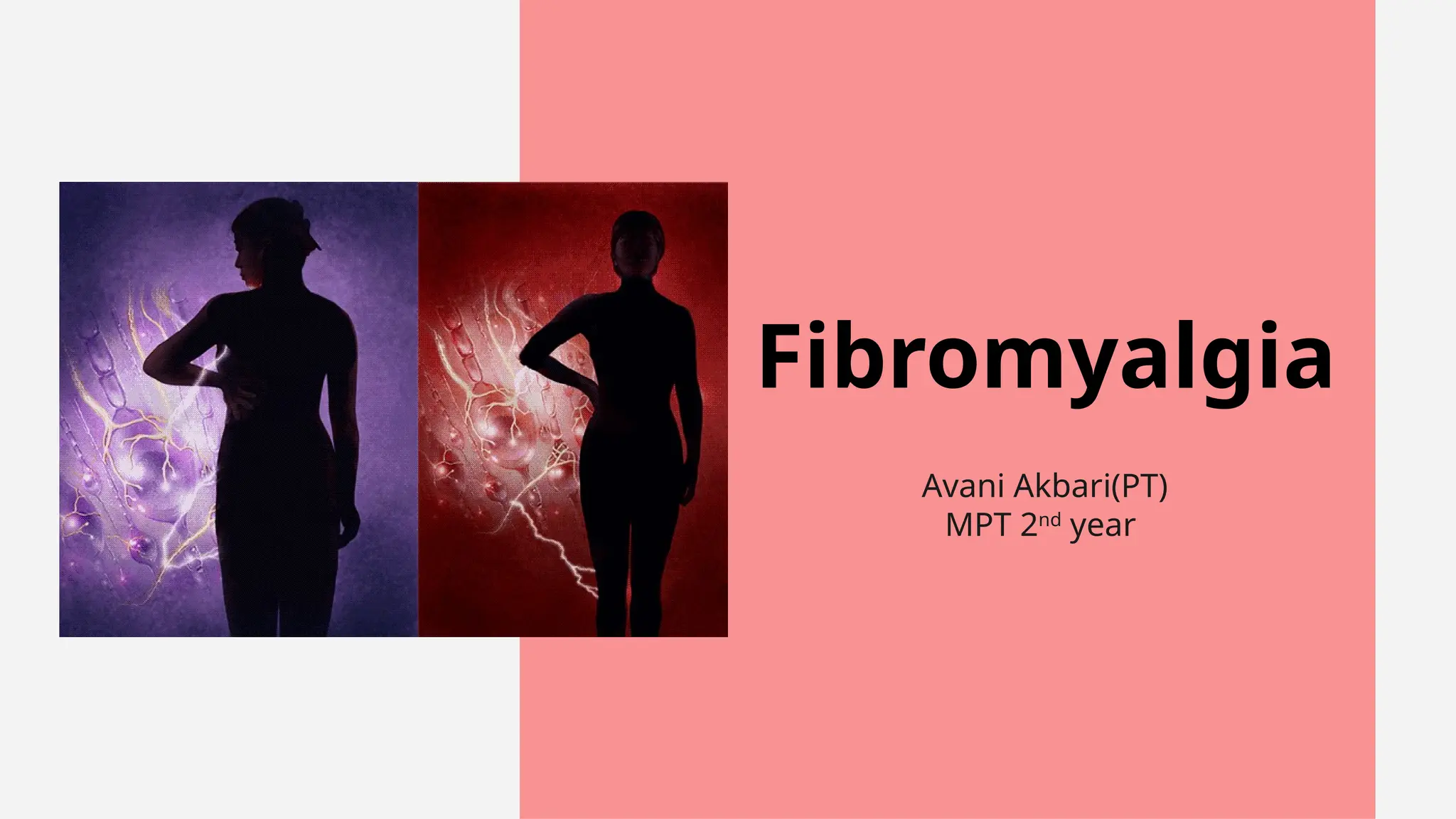
Fibromyalgia
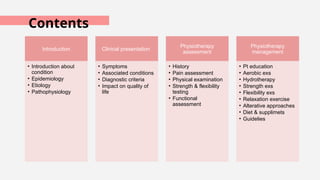
Contents
Introduction
• Introduction about
condition
• Epidemiology
• Etiology
• Pathophysiology
Clinical presentation
• Symptoms
• Associated conditions
• Diagnostic criteria
• Impact on quality of
life
Physiotherapy
assessment
• History
• Pain assessment
• Physical examination
• Strength & flexibility
testing
• Functional
assessment
Physiotherapy
management
• Pt education
• Aerobic exs
• Hydrotherapy
• Strength exs
• Flexibility exs
• Relaxation exercise
• Alterative approaches
• Diet & supplimets
• Guidelies
Introduction
● chronic condition - widespread pain, without damage/ inflammation in tissue
● rheumatic diseases - higher risk of fibromyalgia.
● It is not an inflammatory or autoimmune disease. Research - nervous system is
involved. Brain chemicals (serotonin and norepinephrine) may be off balance, changing
reactions to painful stimuli. (Hyperalgesia and allodynia)
● Fibromyalgia may cause tender points, fatigue, poor sleep, and mood problems
(anxiety/stress). It does not cause any signs on x-rays or blood tests. Management -
Medications, exercise, and therapy help. (Updated February 2023 by Karmela Chan, MD, and reviewed by the
American College of Rheumatology Committee on Communications and Marketing.)
● Etiology: genetic factor & environmental factor
Epidemiology
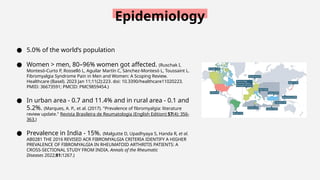
● 5.0% of the world’s population
● Women > men, 80–96% women got affected. (Ruschak I,
Montesó-Curto P, Rosselló L, Aguilar Martín C, Sánchez-Montesó L, Toussaint L.
Fibromyalgia Syndrome Pain in Men and Women: A Scoping Review.
Healthcare (Basel). 2023 Jan 11;11(2):223. doi: 10.3390/healthcare11020223.
PMID: 36673591; PMCID: PMC9859454.)
● In urban area - 0.7 and 11.4% and in rural area - 0.1 and
5.2%. (Marques, A. P., et al. (2017). "Prevalence of fibromyalgia: literature
review update." Revista Brasileira de Reumatologia (English Edition) 57(4): 356-
363.)
● Prevalence in India - 15%. (Malgutte D, Upadhyaya S, Handa R, et al.
AB0281 THE 2016 REVISED ACR FIBROMYALGIA CRITERIA IDENTIFY A HIGHER
PREVALENCE OF FIBROMYALGIA IN RHEUMATOID ARTHRITIS PATIENTS: A
CROSS-SECTIONAL STUDY FROM INDIA. Annals of the Rheumatic
Diseases 2022;81:1267.)
Etiology
• Exact etiology of FM is still being researched:
• Several trigger factors of FM –
• ↑ed sensitivity to different stimuli ex, heat & cold, mechanical & ischemic pressure
• Condition characterized by persistent or recurring pain and emotional distress ex, IBS,
TMD, anxiety, & chronic inflammatory disease, etc…
• BIOLOGIC ABNORMALITIES IN FIBROMYALGIA:
• Neuroendocrine System - Abnormal functioning In the hypothalamic-pituitary-adrenal
(HPA) axis, which results in the inability to suppress cortisol
• Autonomic Nervous System - es BP, es production of GF
↑ ↓
• GENETIC AND FAMILY INFLUENCE ON FIBROMYALGIA:
• Candidate Genes - 5-HTT gene ( es pain sensitivity),
↑ COMT
• ENVIRONMENTAL TRIGGERS:
• Physical Stressors - in the workplace, manual work (heavy lifting, repetitive motions, or
squatting for extended periods of time)
• Psychosocial Stressors - dissatisfaction with social support from colleagues & monotonous
work. (Bradley LA. Pathophysiology of fibromyalgia. Am J Med. 2009 Dec;122(12 Suppl):S22-30. doi:
10.1016/j.amjmed.2009.09.008. PMID: 19962493; PMCID: PMC2821819)
Pathophysiology
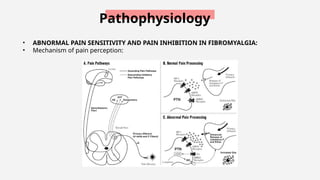
• ABNORMAL PAIN SENSITIVITY AND PAIN INHIBITION IN FIBROMYALGIA:
• Mechanism of pain perception:
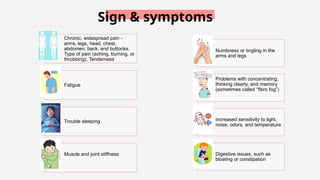
Chronic, widespread pain -
arms, legs, head, chest,
abdomen, back, and buttocks.
Type of pain (aching, burning, or
throbbing), Tenderness
Fatigue
Trouble sleeping
Muscle and joint stiffness
Numbness or tingling in the
arms and legs
Problems with concentrating,
thinking clearly, and memory
(sometimes called “fibro fog”)
Increased sensitivity to light,
noise, odors, and temperature
Digestive issues, such as
bloating or constipation
Sign & symptoms
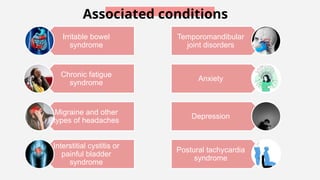
Irritable bowel
syndrome
Chronic fatigue
syndrome
Migraine and other
types of headaches
Interstitial cystitis or
painful bladder
syndrome
Associated conditions
Temporomandibular
joint disorders
Anxiety
Depression
Postural tachycardia
syndrome
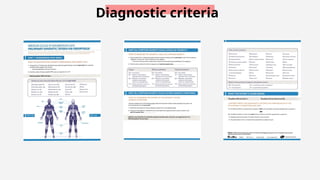
Diagnostic criteria
• The American College of Rheumatology 2010 criteria
• does not require - tender point count
• Patients are assessed by
• Widespread pain index (WPI) – divides the body into 19 regions & scores how many regions
are reported painful
• Symptom severity score (SSS) – assesses severity of fatigue, unrefreshing sleep & cognitive
symptoms
• diagnostic criteria:
• WPI 7 & SSS 5 or WPI 3-6 & SSS 9
≥ ≥ ≥
• Symptoms have been present 3 months
≥
• Patient does not have a disorder that would otherwise explain the pain
Diagnostic criteria
Impact on quality of life
• Quality of life in patients with fibromyalgia: Contributions of disease symptoms,
lifestyle and multi-medication:
• most important variable – mood (anxiety/ depression), low – HADS score
• others - sleep dysfunction, self-reported pain intensity, and lifestyle/medication
• SF-36 scores indicated a very poor QoL
• activities of daily life, participation in society, work & reducing the positive mental state
• sleep quality - Pittsburgh Sleep Quality Index, sleep disturbance - >90% , difficult for body
to recover after a day, poorer performance and greater fatigue, as well as in higher pain
perception and lower QoL
• smoking - associated with psychological factors (depression, anxiety, and fatigue)
• Tobacco use – worse QoL
• regular exercise – high QoL
• social function - physical or emotional health problems less if regular exercise, group
exercise helped - to improve social life (Fernandez-Feijoo F, Samartin-Veiga N, Carrillo-de-la-Peña MT. Quality of
life in patients with fibromyalgia: Contributions of disease symptoms, lifestyle and multi-medication. Front Psychol. 2022 Oct
3;13:924405. doi: 10.3389/fpsyg.2022.924405. PMID: 36262444; PMCID: PMC9574370.)
Physiotherapy assessment
(Santos MR dos, Moro CMC, Vosgerau DSR. Protocolo para avaliação física em portadores de
síndrome de fibromialgia. Rev Bras Reumatol [Internet]. 2014Mar;54(2):117–23. Available from:
https://doi.org/10.1016/j.rbr.2014.03.006 )
History & pain assessment
Body composition: BMI and
bioimpedance
Cardiorespiratory capacity: 6-
minute walk.
Muscular strength and
endurance: Grip strength
(dynamometer), isometric force
apparatus, 30-second sit to stand
from a chair test, and 1 RM test
Flexibility: sit and reach test and
shoulder flexibility.
Balance and agility: Up and Go
test (dynamic balance and motor
agility) and flamingo balance
(static balance)
Physiotherapy management
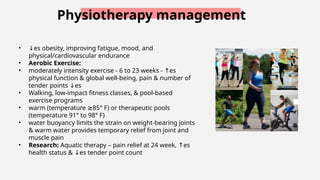
• ↓es obesity, improving fatigue, mood, and
physical/cardiovascular endurance
• Aerobic Exercise:
• moderately intensity exercise - 6 to 23 weeks - es
↑
physical function & global well-being, pain & number of
tender points es
↓
• Walking, low-impact fitness classes, & pool-based
exercise programs
• warm (temperature 85° F) or therapeutic pools
≥
(temperature 91° to 98° F)
• water buoyancy limits the strain on weight-bearing joints
& warm water provides temporary relief from joint and
muscle pain
• Research: Aquatic therapy – pain relief at 24 week, es
↑
health status & es
↓ tender point count
Physiotherapy management
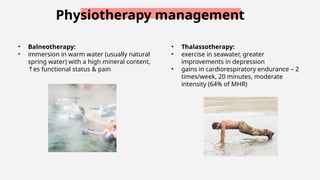
• Balneotherapy:
• immersion in warm water (usually natural
spring water) with a high mineral content,
es
↑ functional status & pain
• Thalassotherapy:
• exercise in seawater, greater
improvements in depression
• gains in cardiorespiratory endurance – 2
times/week, 20 minutes, moderate
intensity (64% of MHR)
Physiotherapy management
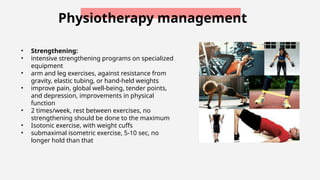
• Strengthening:
• intensive strengthening programs on specialized
equipment
• arm and leg exercises, against resistance from
gravity, elastic tubing, or hand-held weights
• improve pain, global well-being, tender points,
and depression, improvements in physical
function
• 2 times/week, rest between exercises, no
strengthening should be done to the maximum
• Isotonic exercise, with weight cuffs
• submaximal isometric exercise, 5-10 sec, no
longer hold than that
Physiotherapy management
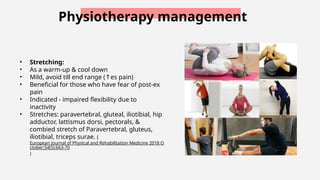
• Stretching:
• As a warm-up & cool down
• Mild, avoid till end range ( es pain)
↑
• Beneficial for those who have fear of post-ex
pain
• Indicated - impaired flexibility due to
inactivity
• Stretches: paravertebral, gluteal, iliotibial, hip
adductor, lattismus dorsi, pectorals, &
combied stretch of Paravertebral, gluteus,
iliotibial, triceps surae. (
European Journal of Physical and Rehabilitation Medicine 2018 O
ctober;54(5):663-70
)
Physiotherapy management
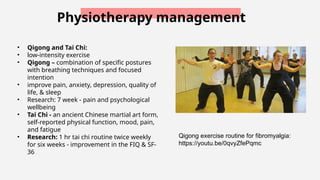
• Qigong and Tai Chi:
• low-intensity exercise
• Qigong – combination of specific postures
with breathing techniques and focused
intention
• improve pain, anxiety, depression, quality of
life, & sleep
• Research: 7 week - pain and psychological
wellbeing
• Tai Chi - an ancient Chinese martial art form,
self-reported physical function, mood, pain,
and fatigue
• Research: 1 hr tai chi routine twice weekly
for six weeks - improvement in the FIQ & SF-
36
Qigong exercise routine for fibromyalgia:
https://youtu.be/0qvyZfePqmc
Physiotherapy management
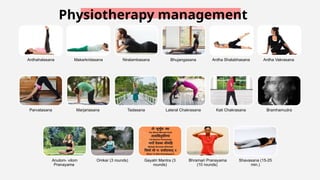
• Yoga –
• With emphasizing stretching, breathing, and relaxing
• All the asanas were maintained for 30 sec to 1 min
• muscle fatigue, pain, and improvement in quality of life and sleep
• (Verma, Anita & Shete, Sanjay & D, Dr Gururaj. (2020). Yoga therapy for fibromyalgia syndrome: A case report.
Journal of Family Medicine and Primary Care. 9. 435. 10.4103/jfmpc.jfmpc_816_19.)
Physiotherapy management
Ardhahalasana Makarkridasana Niralambasana Bhujangasana Ardha Shalabhasana Ardha Vakrasana
Parvatasana Marjariasana Tadasana Lateral Chakrasana Kati Chakrasana Bramhamudra
Anulom vilom
‑
Pranayama
Omkar (3 rounds) Gayatri Mantra (3
rounds)
Bhramari Pranayama
(10 rounds)
Shavasana (15 25
‑
min.)
Alternative management
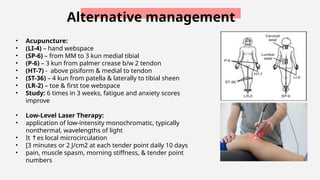
• Acupuncture:
• (LI-4) – hand webspace
• (SP-6) – from MM to 3 kun medial tibial
• (P-6) – 3 kun from palmer crease b/w 2 tendon
• (HT-7) - above pisiform & medial to tendon
• (ST-36) – 4 kun from patella & laterally to tibial sheen
• (LR-2) – toe & first toe webspace
• Study: 6 times in 3 weeks, fatigue and anxiety scores
improve
• Low-Level Laser Therapy:
• application of low-intensity monochromatic, typically
nonthermal, wavelengths of light
• It es
↑ local microcirculation
• [3 minutes or 2 J/cm2 at each tender point daily 10 days
• pain, muscle spasm, morning stiffness, & tender point
numbers
Alternative management
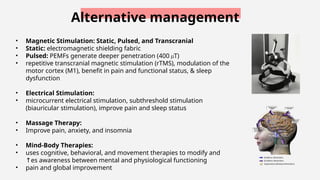
• Magnetic Stimulation: Static, Pulsed, and Transcranial
• Static: electromagnetic shielding fabric
• Pulsed: PEMFs generate deeper penetration (400 µT)
• repetitive transcranial magnetic stimulation (rTMS), modulation of the
motor cortex (M1), benefit in pain and functional status, & sleep
dysfunction
• Electrical Stimulation:
• microcurrent electrical stimulation, subthreshold stimulation
(biauricular stimulation), improve pain and sleep status
• Massage Therapy:
• Improve pain, anxiety, and insomnia
• Mind-Body Therapies:
• uses cognitive, behavioral, and movement therapies to modify and
es awareness between mental and physiological functioning
↑
• pain and global improvement
Alternative management
• Education/Self-Guided Treatments:
• Because the etiology, diagnosis, and treatment of FM are often
misunderstood, proper education and self-management are essential
• FM Self-Help Course (FSHC)
• Cognitive-Behavioral Therapies:
• beliefs, thoughts, and perceptions – how these affect condition
• restructuring, prioritization, and goal setting are utilized to repattern
behavior
• Biofeedback:
• Pt have - autonomic dysfunction
• techniques or sensors to es mind-body awareness - muscle tension
↑
(sEMG) or autonomic tone [peripheral temperature, heart rate
variability (HRV), galvanic skin response] – can be modified, es
↑
awareness and es autonomic overarousal
↓
• depression and pain, functional status - es
↑
Alternative management
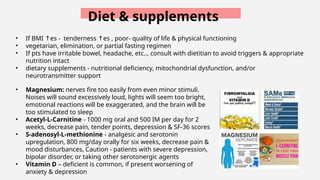
• Guided Imagery:
• simple, active treatment, using
pleasant imagery - es
↑ self-efficacy
and functional status, es
↓ pain &
FIQ symptoms
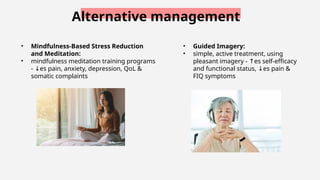
• Mindfulness-Based Stress Reduction
and Meditation:
• mindfulness meditation training programs
- es pain, anxiety, depression, QoL &
↓
somatic complaints
Diet & supplements
• If BMI es -
↑ tenderness es
↑ , poor- quality of life & physical functioning
• vegetarian, elimination, or partial fasting regimen
• If pts have irritable bowel, headache, etc.., consult with dietitian to avoid triggers & appropriate
nutrition intact
• dietary supplements - nutritional deficiency, mitochondrial dysfunction, and/or
neurotransmitter support
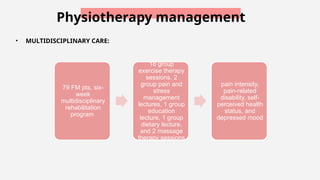
• Magnesium: nerves fire too easily from even minor stimuli.
Noises will sound excessively loud, lights will seem too bright,
emotional reactions will be exaggerated, and the brain will be
too stimulated to sleep
• Acetyl-L-Carnitine - 1000 mg oral and 500 IM per day for 2
weeks, decrease pain, tender points, depression & SF-36 scores
• S-adenosyl-L-methionine - analgesic and serotonin
upregulation, 800 mg/day orally for six weeks, decrease pain &
mood disturbances, Caution - patients with severe depression,
bipolar disorder, or taking other serotonergic agents
• Vitamin D – deficient is common, if present worsening of
anxiety & depression
Physiotherapy management
• MULTIDISCIPLINARY CARE:
79 FM pts, six-
week
multidisciplinary
rehabilitation
program
18 group
exercise therapy
sessions, 2
group pain and
stress
management
lectures, 1 group
education
lecture, 1 group
dietary lecture,
and 2 massage
therapy sessions
pain intensity,
pain-related
disability, self-
perceived health
status, and
depressed mood
Guidelines
• American Physical Therapy Association (APTA):
• Research: es pain and improve function, general health, and sleep
↓
• Aerobic conditioning.
• Aquatic exercise.
• Stretching.
• Strengthening exercise.
• Yoga.
• Tai chi.
• Deep breathing.
• Recreational activities.
• Manual therapy
• how to incorporate :
• Start slow.
• Pace yourself.
• Set realistic goals for exercise and physical activity.
• Modify your program in times of stress
• (https://www.choosept.com/guide/physical-therapy-guide-fibromyalgia)
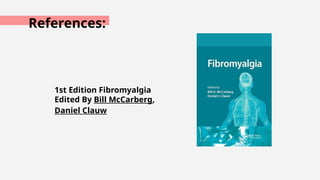
1st Edition Fibromyalgia
Edited By Bill McCarberg,
Daniel Clauw
References:
Thank you !

Fibromyalgia introduction, assessment & physiotherapy management.pptx

  • 1.
  • 2.
    Contents Introduction • Introduction about condition •Epidemiology • Etiology • Pathophysiology Clinical presentation • Symptoms • Associated conditions • Diagnostic criteria • Impact on quality of life Physiotherapy assessment • History • Pain assessment • Physical examination • Strength & flexibility testing • Functional assessment Physiotherapy management • Pt education • Aerobic exs • Hydrotherapy • Strength exs • Flexibility exs • Relaxation exercise • Alterative approaches • Diet & supplimets • Guidelies
  • 3.
    Introduction ● chronic condition- widespread pain, without damage/ inflammation in tissue ● rheumatic diseases - higher risk of fibromyalgia. ● It is not an inflammatory or autoimmune disease. Research - nervous system is involved. Brain chemicals (serotonin and norepinephrine) may be off balance, changing reactions to painful stimuli. (Hyperalgesia and allodynia) ● Fibromyalgia may cause tender points, fatigue, poor sleep, and mood problems (anxiety/stress). It does not cause any signs on x-rays or blood tests. Management - Medications, exercise, and therapy help. (Updated February 2023 by Karmela Chan, MD, and reviewed by the American College of Rheumatology Committee on Communications and Marketing.) ● Etiology: genetic factor & environmental factor
  • 4.
    Epidemiology ● 5.0% ofthe world’s population ● Women > men, 80–96% women got affected. (Ruschak I, Montesó-Curto P, Rosselló L, Aguilar Martín C, Sánchez-Montesó L, Toussaint L. Fibromyalgia Syndrome Pain in Men and Women: A Scoping Review. Healthcare (Basel). 2023 Jan 11;11(2):223. doi: 10.3390/healthcare11020223. PMID: 36673591; PMCID: PMC9859454.) ● In urban area - 0.7 and 11.4% and in rural area - 0.1 and 5.2%. (Marques, A. P., et al. (2017). "Prevalence of fibromyalgia: literature review update." Revista Brasileira de Reumatologia (English Edition) 57(4): 356- 363.) ● Prevalence in India - 15%. (Malgutte D, Upadhyaya S, Handa R, et al. AB0281 THE 2016 REVISED ACR FIBROMYALGIA CRITERIA IDENTIFY A HIGHER PREVALENCE OF FIBROMYALGIA IN RHEUMATOID ARTHRITIS PATIENTS: A CROSS-SECTIONAL STUDY FROM INDIA. Annals of the Rheumatic Diseases 2022;81:1267.)
  • 5.
    Etiology • Exact etiologyof FM is still being researched: • Several trigger factors of FM – • ↑ed sensitivity to different stimuli ex, heat & cold, mechanical & ischemic pressure • Condition characterized by persistent or recurring pain and emotional distress ex, IBS, TMD, anxiety, & chronic inflammatory disease, etc… • BIOLOGIC ABNORMALITIES IN FIBROMYALGIA: • Neuroendocrine System - Abnormal functioning In the hypothalamic-pituitary-adrenal (HPA) axis, which results in the inability to suppress cortisol • Autonomic Nervous System - es BP, es production of GF ↑ ↓ • GENETIC AND FAMILY INFLUENCE ON FIBROMYALGIA: • Candidate Genes - 5-HTT gene ( es pain sensitivity), ↑ COMT • ENVIRONMENTAL TRIGGERS: • Physical Stressors - in the workplace, manual work (heavy lifting, repetitive motions, or squatting for extended periods of time) • Psychosocial Stressors - dissatisfaction with social support from colleagues & monotonous work. (Bradley LA. Pathophysiology of fibromyalgia. Am J Med. 2009 Dec;122(12 Suppl):S22-30. doi: 10.1016/j.amjmed.2009.09.008. PMID: 19962493; PMCID: PMC2821819)
  • 6.
    Pathophysiology • ABNORMAL PAINSENSITIVITY AND PAIN INHIBITION IN FIBROMYALGIA: • Mechanism of pain perception:
  • 7.
    Chronic, widespread pain- arms, legs, head, chest, abdomen, back, and buttocks. Type of pain (aching, burning, or throbbing), Tenderness Fatigue Trouble sleeping Muscle and joint stiffness Numbness or tingling in the arms and legs Problems with concentrating, thinking clearly, and memory (sometimes called “fibro fog”) Increased sensitivity to light, noise, odors, and temperature Digestive issues, such as bloating or constipation Sign & symptoms
  • 8.
    Irritable bowel syndrome Chronic fatigue syndrome Migraineand other types of headaches Interstitial cystitis or painful bladder syndrome Associated conditions Temporomandibular joint disorders Anxiety Depression Postural tachycardia syndrome
  • 9.
    Diagnostic criteria • TheAmerican College of Rheumatology 2010 criteria • does not require - tender point count • Patients are assessed by • Widespread pain index (WPI) – divides the body into 19 regions & scores how many regions are reported painful • Symptom severity score (SSS) – assesses severity of fatigue, unrefreshing sleep & cognitive symptoms • diagnostic criteria: • WPI 7 & SSS 5 or WPI 3-6 & SSS 9 ≥ ≥ ≥ • Symptoms have been present 3 months ≥ • Patient does not have a disorder that would otherwise explain the pain
  • 10.
  • 11.
    Impact on qualityof life • Quality of life in patients with fibromyalgia: Contributions of disease symptoms, lifestyle and multi-medication: • most important variable – mood (anxiety/ depression), low – HADS score • others - sleep dysfunction, self-reported pain intensity, and lifestyle/medication • SF-36 scores indicated a very poor QoL • activities of daily life, participation in society, work & reducing the positive mental state • sleep quality - Pittsburgh Sleep Quality Index, sleep disturbance - >90% , difficult for body to recover after a day, poorer performance and greater fatigue, as well as in higher pain perception and lower QoL • smoking - associated with psychological factors (depression, anxiety, and fatigue) • Tobacco use – worse QoL • regular exercise – high QoL • social function - physical or emotional health problems less if regular exercise, group exercise helped - to improve social life (Fernandez-Feijoo F, Samartin-Veiga N, Carrillo-de-la-Peña MT. Quality of life in patients with fibromyalgia: Contributions of disease symptoms, lifestyle and multi-medication. Front Psychol. 2022 Oct 3;13:924405. doi: 10.3389/fpsyg.2022.924405. PMID: 36262444; PMCID: PMC9574370.)
  • 12.
    Physiotherapy assessment (Santos MRdos, Moro CMC, Vosgerau DSR. Protocolo para avaliação física em portadores de síndrome de fibromialgia. Rev Bras Reumatol [Internet]. 2014Mar;54(2):117–23. Available from: https://doi.org/10.1016/j.rbr.2014.03.006 ) History & pain assessment Body composition: BMI and bioimpedance Cardiorespiratory capacity: 6- minute walk. Muscular strength and endurance: Grip strength (dynamometer), isometric force apparatus, 30-second sit to stand from a chair test, and 1 RM test Flexibility: sit and reach test and shoulder flexibility. Balance and agility: Up and Go test (dynamic balance and motor agility) and flamingo balance (static balance)
  • 13.
    Physiotherapy management • ↓esobesity, improving fatigue, mood, and physical/cardiovascular endurance • Aerobic Exercise: • moderately intensity exercise - 6 to 23 weeks - es ↑ physical function & global well-being, pain & number of tender points es ↓ • Walking, low-impact fitness classes, & pool-based exercise programs • warm (temperature 85° F) or therapeutic pools ≥ (temperature 91° to 98° F) • water buoyancy limits the strain on weight-bearing joints & warm water provides temporary relief from joint and muscle pain • Research: Aquatic therapy – pain relief at 24 week, es ↑ health status & es ↓ tender point count
  • 14.
    Physiotherapy management • Balneotherapy: •immersion in warm water (usually natural spring water) with a high mineral content, es ↑ functional status & pain • Thalassotherapy: • exercise in seawater, greater improvements in depression • gains in cardiorespiratory endurance – 2 times/week, 20 minutes, moderate intensity (64% of MHR)
  • 15.
    Physiotherapy management • Strengthening: •intensive strengthening programs on specialized equipment • arm and leg exercises, against resistance from gravity, elastic tubing, or hand-held weights • improve pain, global well-being, tender points, and depression, improvements in physical function • 2 times/week, rest between exercises, no strengthening should be done to the maximum • Isotonic exercise, with weight cuffs • submaximal isometric exercise, 5-10 sec, no longer hold than that
  • 16.
    Physiotherapy management • Stretching: •As a warm-up & cool down • Mild, avoid till end range ( es pain) ↑ • Beneficial for those who have fear of post-ex pain • Indicated - impaired flexibility due to inactivity • Stretches: paravertebral, gluteal, iliotibial, hip adductor, lattismus dorsi, pectorals, & combied stretch of Paravertebral, gluteus, iliotibial, triceps surae. ( European Journal of Physical and Rehabilitation Medicine 2018 O ctober;54(5):663-70 )
  • 17.
    Physiotherapy management • Qigongand Tai Chi: • low-intensity exercise • Qigong – combination of specific postures with breathing techniques and focused intention • improve pain, anxiety, depression, quality of life, & sleep • Research: 7 week - pain and psychological wellbeing • Tai Chi - an ancient Chinese martial art form, self-reported physical function, mood, pain, and fatigue • Research: 1 hr tai chi routine twice weekly for six weeks - improvement in the FIQ & SF- 36 Qigong exercise routine for fibromyalgia: https://youtu.be/0qvyZfePqmc
  • 18.
    Physiotherapy management • Yoga– • With emphasizing stretching, breathing, and relaxing • All the asanas were maintained for 30 sec to 1 min • muscle fatigue, pain, and improvement in quality of life and sleep • (Verma, Anita & Shete, Sanjay & D, Dr Gururaj. (2020). Yoga therapy for fibromyalgia syndrome: A case report. Journal of Family Medicine and Primary Care. 9. 435. 10.4103/jfmpc.jfmpc_816_19.)
  • 19.
    Physiotherapy management Ardhahalasana MakarkridasanaNiralambasana Bhujangasana Ardha Shalabhasana Ardha Vakrasana Parvatasana Marjariasana Tadasana Lateral Chakrasana Kati Chakrasana Bramhamudra Anulom vilom ‑ Pranayama Omkar (3 rounds) Gayatri Mantra (3 rounds) Bhramari Pranayama (10 rounds) Shavasana (15 25 ‑ min.)
  • 20.
    Alternative management • Acupuncture: •(LI-4) – hand webspace • (SP-6) – from MM to 3 kun medial tibial • (P-6) – 3 kun from palmer crease b/w 2 tendon • (HT-7) - above pisiform & medial to tendon • (ST-36) – 4 kun from patella & laterally to tibial sheen • (LR-2) – toe & first toe webspace • Study: 6 times in 3 weeks, fatigue and anxiety scores improve • Low-Level Laser Therapy: • application of low-intensity monochromatic, typically nonthermal, wavelengths of light • It es ↑ local microcirculation • [3 minutes or 2 J/cm2 at each tender point daily 10 days • pain, muscle spasm, morning stiffness, & tender point numbers
  • 21.
    Alternative management • MagneticStimulation: Static, Pulsed, and Transcranial • Static: electromagnetic shielding fabric • Pulsed: PEMFs generate deeper penetration (400 µT) • repetitive transcranial magnetic stimulation (rTMS), modulation of the motor cortex (M1), benefit in pain and functional status, & sleep dysfunction • Electrical Stimulation: • microcurrent electrical stimulation, subthreshold stimulation (biauricular stimulation), improve pain and sleep status • Massage Therapy: • Improve pain, anxiety, and insomnia • Mind-Body Therapies: • uses cognitive, behavioral, and movement therapies to modify and es awareness between mental and physiological functioning ↑ • pain and global improvement
  • 22.
    Alternative management • Education/Self-GuidedTreatments: • Because the etiology, diagnosis, and treatment of FM are often misunderstood, proper education and self-management are essential • FM Self-Help Course (FSHC) • Cognitive-Behavioral Therapies: • beliefs, thoughts, and perceptions – how these affect condition • restructuring, prioritization, and goal setting are utilized to repattern behavior • Biofeedback: • Pt have - autonomic dysfunction • techniques or sensors to es mind-body awareness - muscle tension ↑ (sEMG) or autonomic tone [peripheral temperature, heart rate variability (HRV), galvanic skin response] – can be modified, es ↑ awareness and es autonomic overarousal ↓ • depression and pain, functional status - es ↑
  • 23.
    Alternative management • GuidedImagery: • simple, active treatment, using pleasant imagery - es ↑ self-efficacy and functional status, es ↓ pain & FIQ symptoms • Mindfulness-Based Stress Reduction and Meditation: • mindfulness meditation training programs - es pain, anxiety, depression, QoL & ↓ somatic complaints
  • 24.
    Diet & supplements •If BMI es - ↑ tenderness es ↑ , poor- quality of life & physical functioning • vegetarian, elimination, or partial fasting regimen • If pts have irritable bowel, headache, etc.., consult with dietitian to avoid triggers & appropriate nutrition intact • dietary supplements - nutritional deficiency, mitochondrial dysfunction, and/or neurotransmitter support • Magnesium: nerves fire too easily from even minor stimuli. Noises will sound excessively loud, lights will seem too bright, emotional reactions will be exaggerated, and the brain will be too stimulated to sleep • Acetyl-L-Carnitine - 1000 mg oral and 500 IM per day for 2 weeks, decrease pain, tender points, depression & SF-36 scores • S-adenosyl-L-methionine - analgesic and serotonin upregulation, 800 mg/day orally for six weeks, decrease pain & mood disturbances, Caution - patients with severe depression, bipolar disorder, or taking other serotonergic agents • Vitamin D – deficient is common, if present worsening of anxiety & depression
  • 25.
    Physiotherapy management • MULTIDISCIPLINARYCARE: 79 FM pts, six- week multidisciplinary rehabilitation program 18 group exercise therapy sessions, 2 group pain and stress management lectures, 1 group education lecture, 1 group dietary lecture, and 2 massage therapy sessions pain intensity, pain-related disability, self- perceived health status, and depressed mood
  • 26.
    Guidelines • American PhysicalTherapy Association (APTA): • Research: es pain and improve function, general health, and sleep ↓ • Aerobic conditioning. • Aquatic exercise. • Stretching. • Strengthening exercise. • Yoga. • Tai chi. • Deep breathing. • Recreational activities. • Manual therapy • how to incorporate : • Start slow. • Pace yourself. • Set realistic goals for exercise and physical activity. • Modify your program in times of stress • (https://www.choosept.com/guide/physical-therapy-guide-fibromyalgia)
  • 27.
    1st Edition Fibromyalgia EditedBy Bill McCarberg, Daniel Clauw References:
  • 28.

Editor's Notes

  • #3 Genetic factor: central sensitivity syndrome, symptoms (fatigue, pain, memory difficulty, mood disturbances), genes- serotonin 5-HT2A receptor Environmental factor: stressors (trauma, infection, lyme disease, emotional stress)
  • #4 hgyghg
  • #5 HPA axis – hypothalamus –CRH, pituitary – ACTH, adrenal glad- cortisol
  • #11 HADA - Hospital Anxiety and Depression Scale
  • #12 Bioimpedance: low electrical current pass threw body(calculate- fat, lea body mass & hydration) 6 mi walk test- 30 m walkway, similar to ADL walking Dynamometer- for grip strength, & muscle groups, 30 sec sit to stand – check strength of LE, 1 RM – for resistance training Sit & reach – lower body flexibility, shoulder flexibility – abductor, adductor, & rotators Up & go test- 2.4 m distance, flamingo- hold for 1 min
  • #13 MHR – 220-age Moderate intensity aerobics – walking, running, dancing(Zumba), step aerobics, cycling
  • #15 Check RM first- then start exercise
  • #17 Obesity –(QOL ↓, pain ↑)
  • #20 (LI-4) – hand webspace, (SP-6) – from MM to 3 kun medial tibial, (P-6) – 3 kun from palmer crease b/w 2 tendon, (HT-7) - above pisiform & medial to tendon, (ST-36) – 4 kun from patella & laterally to tibial sheen, (LR-2) – toe & first toe webspace
  • #21 PEMF- pulsed electromagnetic fields
  • #22 PEMF- pulsed electromagnetic fields
  • #23 PEMF- pulsed electromagnetic fields
  • #25 Obesity –(QOL ↓, pain ↑)
  • #28 PEMF- pulsed electromagnetic fields