Rabbits, Rabbits
Everywhere
Laura Estévez, Ana Díaz, Adriana
Jaén and Daniel Paniagua.
HELLO! WE ARE GOING
TO TELL YOU SOMETHING
ABOUT...
INDEX
● Summary
● Fibonacci’s biography
● Explanation of Fibonacci sequence
● Rabbits explanation
● Practical explanations
● Flowers
● Conclusion
● Bibliography
SUMMARY
The book tells the story of the town of Chee,where the
Pied Piper settled after he got the rats out of Hamelin.
The town of Chee is protected by a wizard and in
exchange for this protection the villagers give him food.
One day,the piper decides not to give food to the wizard
any more, instead he wants to keep it for himself.The
next day , 1 pair of rabbits Knot and Fibb show up in the
village fields.
The next day , they have a pair of babies.The
day after that , they have another pair of
babies and the first pair are adults.The next
day there are 5 pairs of rabbits ; the next 8 ;
the next 13 ; and so on , until there are so
many rabbits that they’re eating all the town's
vegetables.
The piper tries to pipe the rabbits away , but
he fails.While he’s doing that , one little girl
figures out the pattern of how many rabbits
there are by drawing it out in a triangle on the
ground.The girl goes to the wizard to ask him
to help the town before they starve , and
shows him that she’s figured out the pattern.
He replies that by understanding the pattern,
she can solve the problem: recognizing
patterns gives you a way to figure out to solve
them.And he gives her a flute which she can
use to lead the rabbits away from the town.
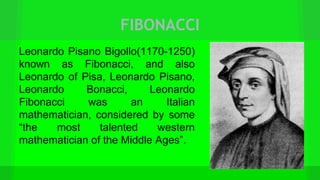
FIBONACCI
Leonardo Pisano Bigollo(1170-1250)
known as Fibonacci, and also
Leonardo of Pisa, Leonardo Pisano,
Leonardo Bonacci, Leonardo
Fibonacci was an Italian
mathematician, considered by some
“the most talented western
mathematician of the Middle Ages”.
FIBONACCI
Fibonacci is best known to the modern world for the
spreading of the hindu-Arabic numeral system in Europe,
primary through his composition in 1202 of Liber Abaci
(Book of Calculation), and for a number sequence named
the Fibonacci numbers after him, which he did not
discover but used as an example in the Liber Abaci.
EXPLANATION OF THE
SEQUENCE
The Fibonacci sequence is a very interesting
sequence of numbers. It starts with the
numbers 0 and 1, and then each number is the
sum of the other two ones before it.
Example: 0, 1, 1, 2, 3, 5, 8, 13, 21, 34, 55,
89...
EXPLANATION OF THE RABBITS
We are going to explain the
sequence of the rabbits.
BEGINNING AND MONTH ONE
At the beginning of the year we only have one
pair of rabbits.
After the first month, the rabbits haven’t got
any baby rabbits, so we only have one pair
MONTH TWO AND THREE
After two months, the pair of rabbits have
another pair of baby rabbits. So, we have two
pairs of rabbits.
After three months, the first pair and the
second pair have different pairs, so we have
three pairs.
MONTH FOUR AND FIVE
After four months, the tree pairs have
differents babies and we have five pairs
After five months, all the pairs have another
pairs of rabbits and after the five months we
have eight pairs.
At the end of the year we have 144 pairs.
DAISY
What can you see if you look carefully at a
daisy are spirals , running both clockwise and
anticlockwise.If you count the number of
spirals in either direction you will find that
the total is not any number , but a sequence:
1,1,2,3,5,8,13… , where the three dots
indicate that the series continues indefinitely.
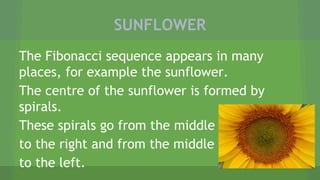
SUNFLOWER
The Fibonacci sequence appears in many
places, for example the sunflower.
The centre of the sunflower is formed by
spirals.
These spirals go from the middle
to the right and from the middle
to the left.
There are 21 spirals that go from the middle
to the right and 34 from the middle to the
left.
These two numbers are in the Fibonacci
sequence and that’s why the sunflower is
related to it.
CONCLUSION
For this project we have read a book about the sequence
of Fibonacci and we have learned different things:
● The Fibonacci sequence
● Who was Fibonacci
● That the Fibonacci sequence is in many things,
especially in flowers
● How the rabbits reproduce
BIBLIOGRAPHY
-Wikipedia
-”Rabbits Rabbits Everywhere”
-Google images
v

Fibonacci Sequence 1

  • 1.
    Rabbits, Rabbits Everywhere Laura Estévez,Ana Díaz, Adriana Jaén and Daniel Paniagua.
  • 2.
    HELLO! WE AREGOING TO TELL YOU SOMETHING ABOUT...
  • 3.
    INDEX ● Summary ● Fibonacci’sbiography ● Explanation of Fibonacci sequence ● Rabbits explanation ● Practical explanations ● Flowers ● Conclusion ● Bibliography
  • 4.
    SUMMARY The book tellsthe story of the town of Chee,where the Pied Piper settled after he got the rats out of Hamelin. The town of Chee is protected by a wizard and in exchange for this protection the villagers give him food. One day,the piper decides not to give food to the wizard any more, instead he wants to keep it for himself.The next day , 1 pair of rabbits Knot and Fibb show up in the village fields.
  • 5.
    The next day, they have a pair of babies.The day after that , they have another pair of babies and the first pair are adults.The next day there are 5 pairs of rabbits ; the next 8 ; the next 13 ; and so on , until there are so many rabbits that they’re eating all the town's vegetables.
  • 6.
    The piper triesto pipe the rabbits away , but he fails.While he’s doing that , one little girl figures out the pattern of how many rabbits there are by drawing it out in a triangle on the ground.The girl goes to the wizard to ask him to help the town before they starve , and shows him that she’s figured out the pattern.
  • 7.
    He replies thatby understanding the pattern, she can solve the problem: recognizing patterns gives you a way to figure out to solve them.And he gives her a flute which she can use to lead the rabbits away from the town.
  • 8.
    FIBONACCI Leonardo Pisano Bigollo(1170-1250) knownas Fibonacci, and also Leonardo of Pisa, Leonardo Pisano, Leonardo Bonacci, Leonardo Fibonacci was an Italian mathematician, considered by some “the most talented western mathematician of the Middle Ages”.
  • 9.
    FIBONACCI Fibonacci is bestknown to the modern world for the spreading of the hindu-Arabic numeral system in Europe, primary through his composition in 1202 of Liber Abaci (Book of Calculation), and for a number sequence named the Fibonacci numbers after him, which he did not discover but used as an example in the Liber Abaci.
  • 10.
    EXPLANATION OF THE SEQUENCE TheFibonacci sequence is a very interesting sequence of numbers. It starts with the numbers 0 and 1, and then each number is the sum of the other two ones before it. Example: 0, 1, 1, 2, 3, 5, 8, 13, 21, 34, 55, 89...
  • 11.
    EXPLANATION OF THERABBITS We are going to explain the sequence of the rabbits.
  • 12.
    BEGINNING AND MONTHONE At the beginning of the year we only have one pair of rabbits. After the first month, the rabbits haven’t got any baby rabbits, so we only have one pair
  • 13.
    MONTH TWO ANDTHREE After two months, the pair of rabbits have another pair of baby rabbits. So, we have two pairs of rabbits. After three months, the first pair and the second pair have different pairs, so we have three pairs.
  • 14.
    MONTH FOUR ANDFIVE After four months, the tree pairs have differents babies and we have five pairs After five months, all the pairs have another pairs of rabbits and after the five months we have eight pairs. At the end of the year we have 144 pairs.
  • 15.
    DAISY What can yousee if you look carefully at a daisy are spirals , running both clockwise and anticlockwise.If you count the number of spirals in either direction you will find that the total is not any number , but a sequence: 1,1,2,3,5,8,13… , where the three dots indicate that the series continues indefinitely.
  • 16.
    SUNFLOWER The Fibonacci sequenceappears in many places, for example the sunflower. The centre of the sunflower is formed by spirals. These spirals go from the middle to the right and from the middle to the left.
  • 17.
    There are 21spirals that go from the middle to the right and 34 from the middle to the left. These two numbers are in the Fibonacci sequence and that’s why the sunflower is related to it.
  • 18.
    CONCLUSION For this projectwe have read a book about the sequence of Fibonacci and we have learned different things: ● The Fibonacci sequence ● Who was Fibonacci ● That the Fibonacci sequence is in many things, especially in flowers ● How the rabbits reproduce
  • 19.
  • 20.