Indian Financial System
Structure of our country’s financial system, role and importance of
financial regulators, intermediaries, etc
2
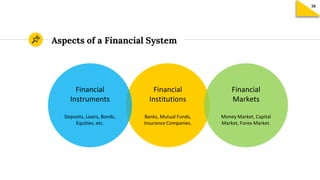
Aspects of a Financial System
Financial
Institutions
Banks, Mutual Funds,
Insurance Companies.
Financial
Instruments
Deposits, Loans, Bonds,
Equities, etc.
Financial
Markets
Money Market, Capital
Market, Forex Market.
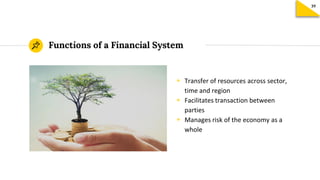
Functions of a Financial System
◉ Transfer of resources across sector,
time and region
◉ Facilitates transaction between
parties
◉ Manages risk of the economy as a
whole
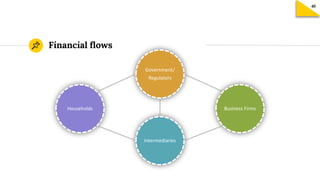
Financial flows
Government/
Regulators
Business Firms
Intermediaries
Households
Regulation
is an important aspect of any financial sysytem.
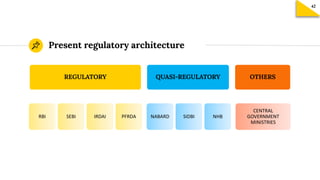
Present regulatory architecture
REGULATORY
RBIRBI SEBISEBI IRDAIIRDAI PFRDAPFRDA
QUASI-REGULATORY
NABARD SIDBI NHB
OTHERS
CENTRAL
GOVERNMENT
MINISTRIES
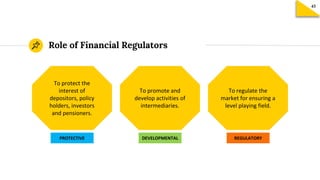
Role of Financial Regulators
To protect the
interest of
depositors, policy
holders, investors
and pensioners.
PROTECTIVE
To promote and
develop activities of
intermediaries.
To regulate the
market for ensuring a
level playing field.
DEVELOPMENTAL REGULATORY
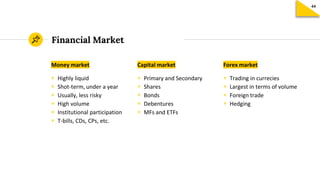
Financial Market
Money market
◉ Highly liquid
◉ Shot-term, under a year
◉ Usually, less risky
◉ High volume
◉ Institutional participation
◉ T-bills, CDs, CPs, etc.
Capital market
◉ Primary and Secondary
◉ Shares
◉ Bonds
◉ Debentures
◉ MFs and ETFs
Forex market
◉ Trading in currecies
◉ Largest in terms of volume
◉ Foreign trade
◉ Hedging
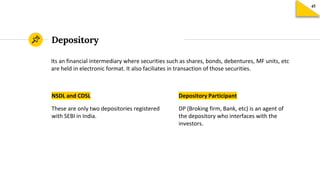
NSDL and CDSL
These are only two depositories registered
with SEBI in India.
Depository
Depository Participant
DP (Broking firm, Bank, etc) is an agent of
the depository who interfaces with the
investors.
Its an financial intermediary where securities such as shares, bonds, debentures, MF units, etc
are held in electronic format. It also faciliates in transaction of those securities.
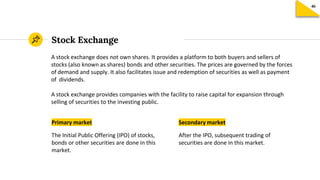
Primary market
The Initial Public Offering (IPO) of stocks,
bonds or other securities are done in this
market.
Stock Exchange
Secondary market
After the IPO, subsequent trading of
securities are done in this market.
A stock exchange does not own shares. It provides a platform to both buyers and sellers of
stocks (also known as shares) bonds and other securities. The prices are governed by the forces
of demand and supply. It also facilitates issue and redemption of securities as well as payment
of dividends.
A stock exchange provides companies with the facility to raise capital for expansion through
selling of securities to the investing public.

FETP Session 2 - Indian Financial System

  • 1.
    Indian Financial System Structureof our country’s financial system, role and importance of financial regulators, intermediaries, etc 2
  • 2.
    Aspects of aFinancial System Financial Institutions Banks, Mutual Funds, Insurance Companies. Financial Instruments Deposits, Loans, Bonds, Equities, etc. Financial Markets Money Market, Capital Market, Forex Market.
  • 3.
    Functions of aFinancial System ◉ Transfer of resources across sector, time and region ◉ Facilitates transaction between parties ◉ Manages risk of the economy as a whole
  • 4.
  • 5.
    Regulation is an importantaspect of any financial sysytem.
  • 6.
    Present regulatory architecture REGULATORY RBIRBISEBISEBI IRDAIIRDAI PFRDAPFRDA QUASI-REGULATORY NABARD SIDBI NHB OTHERS CENTRAL GOVERNMENT MINISTRIES
  • 7.
    Role of FinancialRegulators To protect the interest of depositors, policy holders, investors and pensioners. PROTECTIVE To promote and develop activities of intermediaries. To regulate the market for ensuring a level playing field. DEVELOPMENTAL REGULATORY
  • 8.
    Financial Market Money market ◉Highly liquid ◉ Shot-term, under a year ◉ Usually, less risky ◉ High volume ◉ Institutional participation ◉ T-bills, CDs, CPs, etc. Capital market ◉ Primary and Secondary ◉ Shares ◉ Bonds ◉ Debentures ◉ MFs and ETFs Forex market ◉ Trading in currecies ◉ Largest in terms of volume ◉ Foreign trade ◉ Hedging
  • 9.
    NSDL and CDSL Theseare only two depositories registered with SEBI in India. Depository Depository Participant DP (Broking firm, Bank, etc) is an agent of the depository who interfaces with the investors. Its an financial intermediary where securities such as shares, bonds, debentures, MF units, etc are held in electronic format. It also faciliates in transaction of those securities.
  • 10.
    Primary market The InitialPublic Offering (IPO) of stocks, bonds or other securities are done in this market. Stock Exchange Secondary market After the IPO, subsequent trading of securities are done in this market. A stock exchange does not own shares. It provides a platform to both buyers and sellers of stocks (also known as shares) bonds and other securities. The prices are governed by the forces of demand and supply. It also facilitates issue and redemption of securities as well as payment of dividends. A stock exchange provides companies with the facility to raise capital for expansion through selling of securities to the investing public.