CAPITAL MARKET
INSTRUMENTS
INTRODUCTION
Today we are here with our presentation to help you give a clearer picture about the
capital market and its various instruments, in todays world market is very volatile and in
country like India there is a huge demand for funds, and this account that there should
be a good financial structure that operate in the country so that funds are available at the
right time, right place, right quantity and right cost.
There are various avenues by which we can generate funds but when it comes to raising
long term funds at economical prices we tend to look towards issuing of equity shares,
debentures etc.
So now, let us move forward with our presentation to give you a clear picture of all of
these instruments
FINANCIAL MARKET
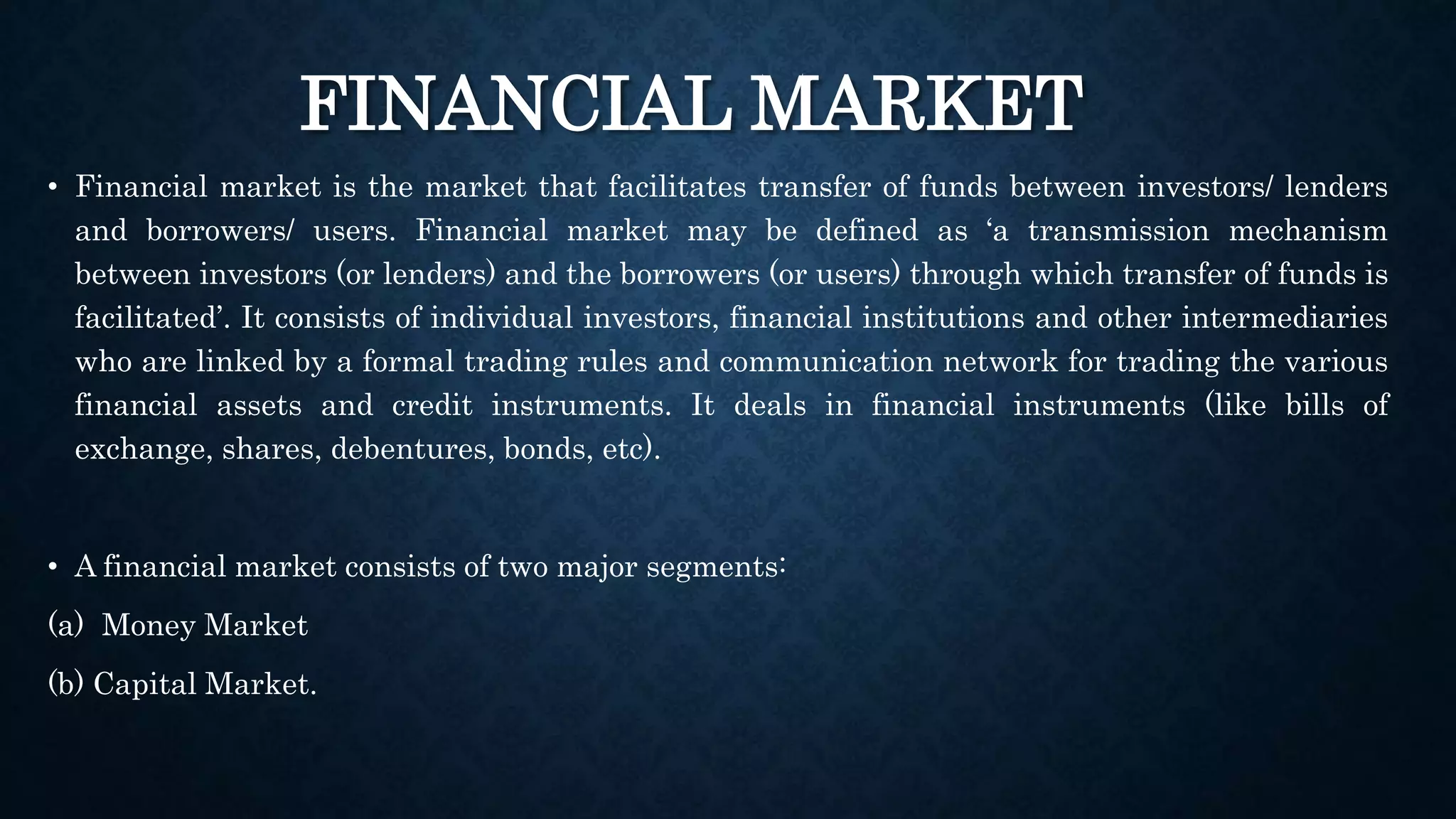
• Financial market is the market that facilitates transfer of funds between investors/ lenders
and borrowers/ users. Financial market may be defined as ‘a transmission mechanism
between investors (or lenders) and the borrowers (or users) through which transfer of funds is
facilitated’. It consists of individual investors, financial institutions and other intermediaries
who are linked by a formal trading rules and communication network for trading the various
financial assets and credit instruments. It deals in financial instruments (like bills of
exchange, shares, debentures, bonds, etc).
• A financial market consists of two major segments:
(a) Money Market
(b) Capital Market.
Money Market-
• The money market is a market for short-term funds, which deals in financial assets
whose period of maturity is upto one year. It should be noted that money market does not
deal in cash or money as such but simply provides a market for credit instruments such as
bills of exchange, promissory notes, commercial paper, treasury bills, etc. These
financial instruments are close substitute of money. These instruments help the business
units, other organisations and the Government to borrow the funds to meet their short-
term requirement.
• The Indian money market consists of Reserve Bank of India, Commercial banks, Co-
operative banks, and other specialised financial institutions. The Reserve Bank of India is
the leader of the money market in India. Some Non-Banking Financial Companies
(NBFCs) and financial institutions like LIC, GIC, UTI, etc. also operate in the Indian
money market.
Capital Market
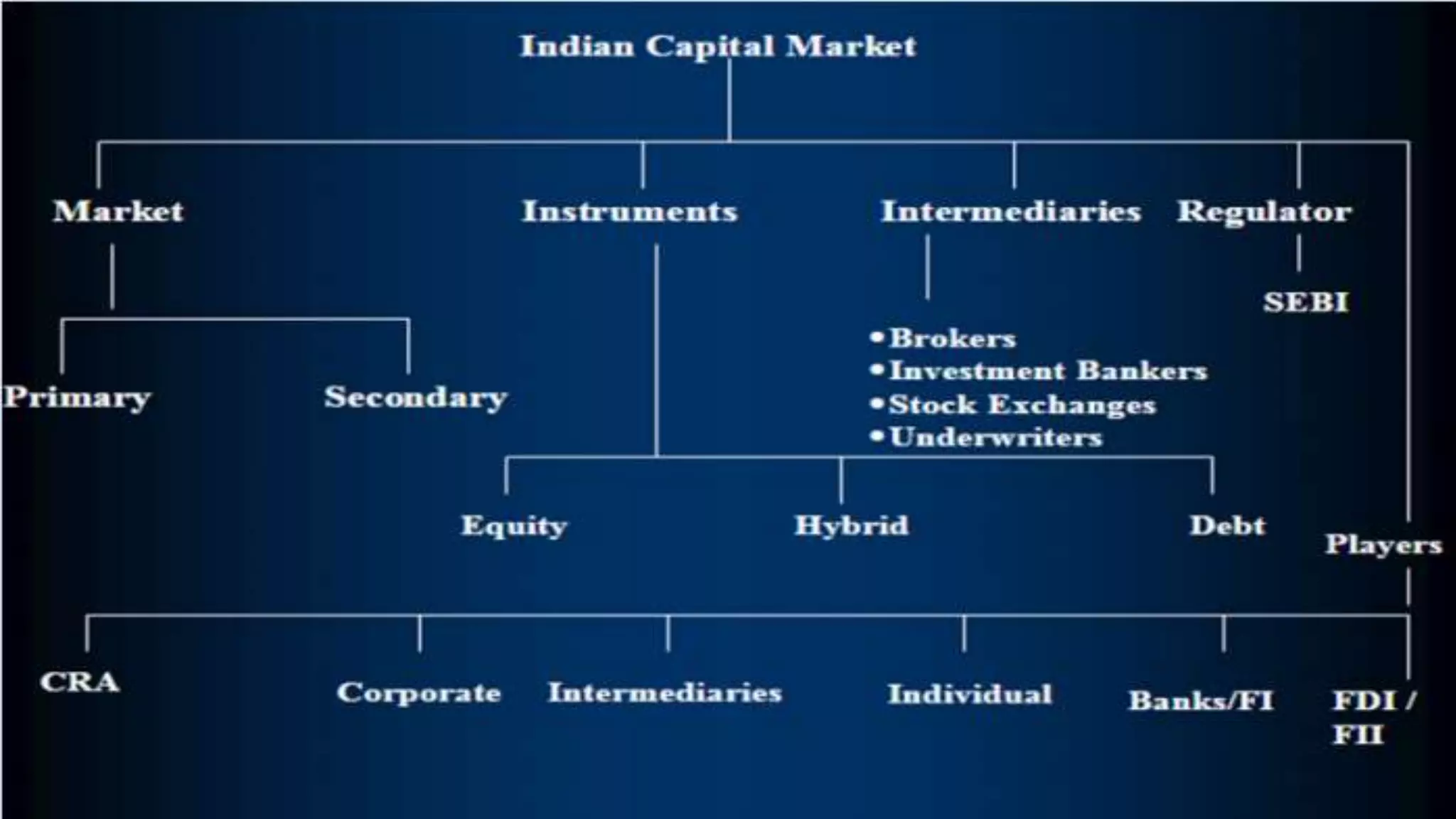
Capital Market is an institutional arrangement for borrowing medium and long-term funds
and which provides facilities for marketing and trading of securities. So it constitutes all long-
term borrowings from banks and financial institutions, borrowings from foreign markets and
raising of capital by issue various securities such as shares, debentures, bonds, etc. The
securities market has two different segments namely primary and secondary market.
• Primary Market and Secondary Market :
The primary market consists of arrangements for procurement of long-term funds by
companies by fresh issue of shares and debentures.
The secondary market or stock exchange provides a ready market for existing long term
securities. Stock exchange is the secondary market, which provides a place for regular sale and
purchase of different types of securities like shares, debentures, bonds & government
securities. It is an organised market where all transactions are regulated by the rules and
laws of the concerned stock exchanges.
Point of Distinction Money Market Capital Market
1. Time period / Term Deals in short-term funds. Long term funds.
2. Instrument Dealt In
Deals in securities like treasury bills,
commercial paper, bills of exchange,
certificate of deposits etc.
Deals in securities like
shares, debentures,
bonds and
government securities.
3. Participants
Commercial banks,
NBFS, chit funds etc.
Stock brokers,
under writers,
mutual funds,
individual investors,
financial institutions
4. Regulatory body RBI SEBI
HISTORY OF INDIAN CAPITAL MARKET
The history of the capital market in India dates back to the eighteenth century when
East India Company securities were traded in the country. Until the end of the
nineteenth century securities trading was unorganized and the main trading centers
were Bombay (now Mumbai) and Calcutta (now Kolkata). Of the two, Bombay was the
chief trading center wherein bank shares were the major trading stock During the
American Civil War (1860-61). Bombay was an important source of supply for cotton.
Hence, trading activities flourished during the period, resulting in a boom in share
prices. This boom, the first in the history of the Indian capital market lasted for a half
a decade. The bubble burst on July 1, 1865 when there was tremendous slump in share
prices.
Trading was at that time limited to a dozen brokers; their trading place was under a
banyan tree in front of the Town hall in Bombay. These stock brokers organized
informal association in 1897 – Native Shares and Stock Brokers Association, Bombay.
The Stock exchanges in Calcutta ad Ahmedabad also industrial and trading centers,
came up later. The Bombay Stock Exchange was recognized in May 1927 under the
Bombay Securities Contracts Control Act, 1925.
PRIMARY ROLE OF CAPITAL MARKET-
• The primary role of capital market is to raise long term funds for governments, banks and
corporations while providing platforms for trading of securities.
• This fund raising is regulated by the performance of stocks and bonds market within the
capital market .
• The member or organization of capital market may issue stocks in bonds in order to raise
funds. Investors can then invest in the capital market by purchasing the stocks and bonds.
•NATURE OF CAPITAL MARKET-
• It has two segments i.e that the capital market is divided into two types primary market and
secondary market.
• It deals with long term securities.
• It helps in capital formation.
• It helps in creating liquidity by dealing with capital market you can create liquidity of your
assets easily.
• It performs trade off functions.
• Its creates dispersion in business ownerships.
FACTORS AFFECTING THE CAPITAL
MARKET
• Economy of the country.
• Money supply.
• Interest rates.
• Corporate results.
• Global capital market scenario.
• Foreign funds inflow.
• Strength /weakness of the local currency.
REGULATION OF CAPITAL MARKET
• Every capital market in the world is monitored by financial regulators and their
respective governance organization.
• The purpose of such regulations is to protect investors from fraud and deception.
• Financial regulatory bodies are also charged with minimizing financial losses , issuing
losses to financial service providers and enforcing applicable laws.
• The Ministry of Finance (MoF), the Securities & Exchange Board of India (SEBI) and the
Reserve Bank of India (RBI) are the three regulatory authorities governing Indian capital
markets
SECURITIES EXCHANGE BOARD OF INDIA
• SEBI protects the interest of investors in securities and promotes the development of the
security market.
• The board helps in making registrations and regulate the functioning.
• SEBI conducts inspection and thus prohibits fraudulent practices.
RESERVE BANK OF INDIA
• RBI is the apex bank of India.
• It is the banker’s bank.
• Maintains price stability.
• Provides cost effective banking services to the public.
• Gives the public adequate quantity of supplies of currency notes and coins.
• Formulates , implements and monitor the monetary policy.
FUNCTIONS OF CAPITAL MARKET
• The growth of Economy: The capital market reflects the condition of the economy
and also accelerates the economic growth. It allocates the resources from the people
who have surplus capital to who require capital. By this, we can conclude that
capital market helps in the growth of the economy as well as the trade of both
public and private sectors. This leads to balanced economic growth in the country.
• Encourage people to save: Development of capital markets has helped the banking
institutes to provide facilities and provisions to encourage people to save more.
People might have just invested in land or gold in the non-existence of a capital
market
• Stabilizing stock prices: Capital Markets has reduced speculation activities and also
provided capital to the borrowers at the lowest interest rate as possible. This helped
in keeping away the prices of stocks from fluctuating.
• Proper Allocation of Funds: Capital Market is an important platform for allocating idle
savings from the people to productive channels of an economy. It puts the idle funds in
proper investment.
• Formation of capital: Capital market helps in the formation of capital by adding capital to
the existing capital in the economy. This helps in the expansion of capital in the economy
• Platform for Investment: Capital market raises resources for longer periods of time. Thus it
provides an investment avenue for people who wish to invest resources for a long period of
time. It provides suitable interest rate returns also to investors. Instruments such as bonds,
equities etc. definitely provide diverse investment avenue for the public.
• Accelerates Economic Development: The financial requirements of the businesses are met
by the capital market as it makes funds available for the longer period. Capital market also
helps in the research and development. This results in increasing the productivity of the
economy.
• Provides Service: Capital Market provides various services like medium and long-term
loans consultancy services. export finance etc.
RECENT DEVELOPMENT IN CAPITAL
MARKET
• Establishment of SEBI : The Securities and Exchange Board of India (SEBI) was established in
1988. It got a legal status in 1992. SEBI was primarily set up to regulate the activities of the
merchant banks, to control the operations of mutual funds, to work as a promoter of the stock
exchange activities and to act as a regulatory authority of new issue activities of companies. The
SEBI was set up with the fundamental objective, "to protect the interest of investors in
securities market and for matters connected therewith or incidental thereto.“
• Establishment of Creditors Rating Agencies : Three creditors rating agencies viz. The Credit
Rating Information Services of India Limited (CRISIL - 1988), the Investment Information and
Credit Rating Agency of India Limited (ICRA - 1991) and Credit Analysis and Research Limited
(CARE) were set up in order to assess the financial health of different financial institutions and
agencies related to the stock market activities. It is a guide for the investors also in evaluating
the risk of their investments.
• Increasing of Merchant Banking Activities : Many Indian and foreign commercial banks have set
up their merchant banking divisions in the last few years. These divisions provide financial
services such as underwriting facilities, issue organising, consultancy services, etc. It has proved
as a helping hand to factors related to the capital market.
• Candid Performance of Indian Economy : In the last few years, Indian economy is growing at a good
speed. It has attracted a huge inflow of Foreign Institutional Investments (FII). The massive entry
of FIIs in the Indian capital market has given good appreciation for the Indian investors in recent
times. Similarly many new companies are emerging on the horizon of the Indian capital market to
raise capital for their expansions.
• Rising Electronic Transactions : Due to technological development in the last few years. The
physical transaction with more paper work is reduced. Now paperless transactions are increasing
at a rapid rate. It saves money, time and energy of investors. Thus it has made investing safer and
hassle free encouraging more people to join the capital market.
• Growing Mutual Fund Industry : The growing of mutual funds in India has certainly helped the
capital market to grow. Public sector banks, foreign banks, financial institutions and joint mutual
funds between the Indian and foreign firms have launched many new funds. A big diversification in
terms of schemes, maturity, etc. has taken place in mutual funds in India. It has given a wide
choice for the common investors to enter the capital market.
• Growing Stock Exchanges : The numbers of various Stock Exchanges in India are increasing.
Initially the BSE was the main exchange, but now after the setting up of the NSE and the OTCEI,
stock exchanges have spread across the country. Recently a new Inter-connected Stock Exchange of
India has joined the existing stock exchanges
• Investor's Protection : Under the purview of the SEBI the Central Government of India has set
up the Investors Education and Protection Fund (IEPF) in 2001. It works in educating and
guiding investors. It tries to protect the interest of the small investors from frauds and
malpractices in the capital market.
• Growth of Derivative Transactions : Since June 2000, the NSE has introduced the derivatives
trading in the equities. In November 2001 it also introduced the future and options
transactions. These innovative products have given variety for the investment leading to the
expansion of the capital market.
• Insurance Sector Reforms : Indian insurance sector has also witnessed massive reforms in last
few years. The Insurance Regulatory and Development Authority (IRDA) was set up in 2000. It
paved the entry of the private insurance firms in India. As many insurance companies invest
their money in the capital market, it has expanded.
• Commodity Trading : Along with the trading of ordinary securities, the trading in commodities
is also recently encouraged. The Multi Commodity Exchange (MCX) is set up. The volume of
such transactions is growing at a splendid rate.
MAJOR SUPPLIERS OF FUNDS-
COMMERCIAL BANKS
INSURANCE COMAPNIES
BUSINESS CORPORATIONS
RETIREMENT FUNDS
CAPITAL MARKET
INSTRUMENTS
TYPES OF CAPITAL MARKET
INSTRUMENTS
There are two types of instruments that are traded in the capital market. They are
as follows:
• Bonds: bonds are basic debt securities that are traded in the capital market.
Companies issue bonds to raise capital as investors subscribe to them. Issuing
bonds helps the company raise capital for the growth and expansion of the
business at cheaper rates than banks and lending institutions. The bond issuer
pays interest and returns the principal at the end of the duration. The
government also issues bonds to raise money for government projects.
• Stocks: stocks are the right of ownership in a Company. The buyer of the shares is
known as a shareholder. Investors buy and sell shares over a stock exchange
like NSE and BSE.
DIFFERENCE BETWEEN STOCKS AND BONDS
SHARES
TYPES OF CAPITAL MARKET
INSTRUMENTS
SHARES-
Share is the share in the share capital of the company. Share is one of the units into which
the capital of company is divided. A person having the shares of the company is called as
shareholder of that company, He is regarded as the part of owner of the company. A share is
an indivisible unit of capital, expressing the ownership relationship between the company
and the shareholder. The denominated value of a share is its face value, and the total of the
face value of issued shares represent the capital of a company, which may not reflect the
market value of those shares. The income received from the ownership of shares is
a dividend.
There are 2 types of shares:
• Equity shares
• Preference shares
• EQUITY SHARES-
Equity Shares are the ordinary shares of a limited company. It is an instrument, a contract, which
guarantees a residual interest in the assets of an enterprise after deducting all its liabilities-
including dividends on preference shares. Equity shares constitute the ownership capital of a
company. Equity holders are the legal owners of a company. Equity shares are regarded as the
cornerstones of the capital structure of a company. They are the source of permanent capital which
does not have a maturity date. As the owners of equity shares, the equity shareholders participate in
the management of the company through the elected board of directors, and through the voting rights
in important decisions. They share the profits and assets in proportion to their holding in the net
assets of the company.
• Advantages of Equity Shares:
1. Permanent Capital: It provides permanent capital to the company. The capital need not be repaid
as long as the company is a going concern.
2. No Fixed Charge on Income: Payment of dividend is a management policy. Company is not legally
bound to declare dividend even if there is sufficient earnings. Dividend payment can be postponed.
This adds flexibility.
3. Base for Further Borrowings: Lenders generally lend on the basis of paid up capital and reserve.
This is the net worth of the company. A higher net worth increases financial capability.
4. Trading on Equity is Possible: When borrowing becomes cheaper, company can borrow money and
invest. The whole earnings after the interest belongs to the shareholders.
5. Voting Rights: As the owners of capital equity shareholders can express their opinion on all important
matters through their voting right.
• BLUE CHIP SHARES:
• These are shares of Blue Chip Companies. Blue Chip Companies are growth oriented companies
showing signs of expansion, diversification, modernization of technology etc. They have consistent
profitability and profit margins to sustain consistent dividend distribution. Colgate, Hindustan Lever,
L&T, Reliance etc. are some examples of blue Ship companies. Thus, blue chips are common stock in a
company known nationally for the quality and wide acceptance of its products or services.
• Blue chips are of two types viz. emerging blue chip and established blue chips. Emerging blue chip
companies are those which are turn-around companies and exhibit potentiality to grow and expand in
sales and in net profit. Established blue chips are those companies who are leaders in the Industry
like Reliance, Raymonds, TISCO etc. They have a strong capital base and net worth, organized and
professionalized management etc. There are uninterrupted dividends, bonus issues, right issues for
investors. Such companies’, shares are worth holding for long and are recommended in all portfolios
on investors.
• EQUITY SHARES WITH DETACHABLE WARRANTS:
Fully paid up shares can be issued with detachable warrants. This will enable the
warrant holder to apply for specified number of equity shares at determined price.
Detachable warrants are registered separately with the stock exchange and
traded separately.
• SWEAT EQUITY SHARES:
These are equity shares issued by the company to employees or directors at a
discount or for consideration other than cash.
PREFRENCE SHARES-
The Companies Act (Sec, 85), 1956 describes preference shares as those which Carry a
preferential right to payment of dividend during the life time of the company and Carry a
preferential right for repayment of capital in the event of winding up of the company.
Preference shares have the features of equity capital and features of fixed income like
debentures. They are paid a fixed dividend before any dividend is declared to the equity
holders.
Features of Preference Shares-
1. Priority to Dividend: Preference share dividend is payable on a fixed rate. Usually the
dividend is a percentage of the par value of the share. It must be paid before any equity
dividend is paid.
2. Cumulative Nature: Cumulative nature means that when dividends are not paid in a
particular year they will be accumulated in the coming years. No dividend can be paid on
equity shares until all arrears on preference stock are paid up. However, there are non-
cumulative preference stock also. In this case, there is no guarantee that the unpaid dividend
will be paid in future even if the profitability of the concern improves. Hence, the cumulative
feature is necessary to project the right of preference shareholders.
3. Non-Participatory: This means that the holders of such shares are not entitled for a share in
the extra profit earned by the company. Their return will remain at the agreed rate whatever be
the profit level of the company. There are, however, occasional issues of participating preferences
shares also.
4. Preference as to Assets on Winding Up: Preference shares are given preference in liquidation.
Where the company dissolved, the funds from the sale of the assets go first to the various classes
of creditors according to the seniority of their claims. The preference shareholders get the next
priority.
5. Convertibility: Convertible preferences shareholders are allowed to convert their preferential
holdings, fully or partly into equity shares at a specified conversion rate during a given period of
time. This right of conversion is exercised by preference shareholders mostly to participate in the
excess earnings of the company or to gain ownership control.
6. Non-Voting: Preference shareholders have no voting right on ordinary matters of corporate
policy.
TYPES OF PREFRENCE SHARES
1. Redeemable Preference Shares:
a. The shares must be fully paid up.
b. It must be redeemed either out of profit or out of reserve fund for the purpose.
c. The premium must be paid if any.
A company may opt for redeemable preference shares to avoid fixed liability of payment, increase
the earnings of equity shares, to make the capital structure simple or such other reasons.
2. Irredeemable Preference Shares:
These shares are not redeemable except on the liquidation of the company.
3. Convertible Preference Shares:
Such shares can be converted to equity shares at the option of the holder. Hence,
these shares are also known as quasi equity shares. Conversion of preference
shares in to bonds or debentures is permitted if company wishes. The conversion
feature makes preference shares more acceptable to investors. Even though the
market for preference shares is not good at a point of time, the convertibility will
make it attractive.
4. Participating Preference Shares:
These kinds of shares are entitled to get regular dividend at fixed rate. Moreover,
they have a right for surplus of the company beyond a certain limit.
5. Cumulative Preference Shares:
The dividend payable for such shares is fixed at 10%. The dividend not paid in a
particular year can be cumulated for the next year in this case.
6. Preference Shares with Warrants:
This instrument has certain number of warrants. The holder of such warrants can
apply for equity shares at premium. The application should be made between the
third and fifth year from the date of allotment.
7. Fully Convertible Cumulative Preference Shares:
Part of such shares, are automatically converted into equity shares on the date of
allotment. The rest of the shares will be redeemed at par or converted in to equity
after a lock in period at the option of the investors.
DIFFERENCE BETWEEN PREFRENCE SHARE AND EQUITY SHARE
DEBENTURES
DEBENTURES-
• Debenture is an instrument under seal evidencing debt. The essence of debenture is admission of
indebtedness. It is a debt instrument issued by a company with a promise to pay interest and repay
the principal on maturity. Debenture holders are creditors of the company. Sec 2 (12) of the
Companies Act, 1956 states that debenture includes debenture stock, bonds and other securities of a
company. It is customary to appoint a trustee, usually an investment bank- to protect the interests of
the debenture holders. This is necessary as debenture deed would specify the rights of the debenture
holders and the obligations of the company. These are also the capital market instruments which are
used to raise the medium and long-term capital funds in the public. These are the debt instruments
which acknowledges a loan to the company and is executed under the common seal of the company
and the deed shows the amount of loan and date of repayment.
Types of debentures:
• On point of view of record:
1. Registered Debentures: These debentures are registered with the company and the amount is
payable only to those debentures holders whose names are registered with the company.
2. Bearer Debentures: These debentures are not registered with the company, these are transferable
merely by delivery and the debenture holder will get the interest.
• On the basis of security:
1. Secured or Mortgaged Debentures: These are secured by a charge on the assets of a company. The principal
amount and the unpaid interest could be recovered by the holder out of the assets mortgaged by the company.
2. Unsecured Debentures: They do not get any security in reference to the principal amount or unpaid interest.
They are simple debentures.
• On the basis of Redemption:
1. Redeemable Debentures: They are issued for a fixed period and the principal amount is paid off only at the
expiry of that period or at the maturity.
2. Non-Redeemable Debentures: They are matured only after the liquidation or closing down or winding up of the
company.
• On the basis of convertibility:
1. Convertible Debentures: These can be converted to shares after the expiry of the period i.e. on their maturity.
2. Non- Convertible Debentures: These cannot be converted into shares on their maturity.
• On the basis of priority:
1. First Debentures: These are redeemed before other debentures.
2. Second Debentures: These are redeemed after the redemption of the first debenture.
ADVANTAGES OF DEBENTURES-
• Debentures ensure a higher position in the ‘pecking order’ for repayment as a creditor.
Otherwise, the loan is unsecured - the position of unsecured creditors near the bottom of
the payment hierarchy means a significantly lower chance of recovering any money.
• Valuable financial protection and reassurance is provided for directors as regards their
personal funds.
• The use of debentures can encourage long-term funding to grow a business. It is also cost-
effective when compared with other forms of lending.
• Debentures usually provide a fixed rate of interest for the lender, and this has to be paid
before any dividends are issued to shareholders.
• Control of the company by existing shareholders is not reduced, and profit-sharing
remains in the same proportion.
BONDS
BONDS-
• Bonds are debt instruments that are issued by companies/governments to raise funds for financing
their capital requirements. By purchasing a bond, an investor lends money for a fixed period of time
at a predetermined interest (coupon) rate. Bonds have a fixed face value, which is the amount to be
returned to the investor upon maturity of the bond.
• During this period, the investors receive a regular payment of interest, semi-annually or annually,
which is calculated as a certain percentage of the face value and known as a ‘coupon payment.’
Bonds can be issued at par, at discount or at premium. A bond, whether issued by a government or a
corporation, has a specific maturity date, which can range from a few days to 20-30 years or even
more.
• Both debentures and bonds mean the same. In Indian parlance, debentures are issued by corporates
and bonds by government or semi-government bodies. But now, corporates are also issuing bonds
which carry comparatively lower interest rates and preference in repayment at the time of winding
up, comparing to debentures.
• The government, public sector units and corporates are the dominant issuers in the bond market.
Bonds issued by corporates and the Government of India can be traded in the secondary market.
• Basically there are two types of bonds viz.:
• 1. Government Bonds – are fixed income debt instruments issued by the government to finance
their capital requirements (fiscal deficit) or development projects.
• 2. Corporate Bonds – are debt securities issued by public or private corporations that need to
raise money for working capital or for capital expenditure needs.
• The other different types of bonds are:
i. Zero Coupon Bonds: Zero Coupon Bonds are issued at a discount to their face value and at the
time of maturity, the principal/face value is repaid to the holders. No interest (coupon) is paid to
the holders. The difference between issue price (discounted price) and redeemable price (face
value) itself acts as interest to holders. These types of bonds are also known as Deep Discount
Bonds.
ii. Mortgage Bonds: This is the common type of bond issued by the corporates. Mortgage bonds
are secured by physical assets of the corporation such as their building or equipment.
iii. Convertible Bonds: This type of bond allows the bond holder to convert their bonds into
shares of stock of the issuing corporation. Conversion ratio (number of equity shares in lieu of a
convertible bond) and the conversion price (determined at the time of conversion) are pre-
specified at the time of bonds issue.
iv. Step-Up Bonds: A bond that pays a lower coupon rate for an initial period which, then
increases to a higher coupon rate.
v. Callable and Non-Callable Bonds: If a bond can be called (redeemed) prior to maturity, the
bond is said to be callable. If a bond cannot be called prior to maturity, it is said to be non-
callable.
vi. Option Bonds: In this type, the investors have the option to choose between cumulative or
non-cumulative bonds. In the case of cumulative bonds interest is accumulated and is payable on
maturity only. In non-cumulative type interest is paid periodically.
vii. Bonds with Warrants: A warrant allows the holder to buy a number of equity shares at a pre-
specified price in future. Bonds are issued with warrants to make it more attractive.
viii. Floating Rate Bonds: Floating rate bonds are bonds wherein the interest rate is not fixed
and is linked to a benchmark rate.
ADVANTAGES OF BONDS-
• Bonds have a clear advantage over other securities. The volatility of bonds (especially short and
medium dated bonds) is lower than that of equities (stocks). Thus bonds are generally viewed as safer
investments than stocks. In addition, bonds do suffer from less day-to-day volatility than stocks, and
the interest payments of bonds are sometimes higher than the general level of dividend payments.
• Bonds are often liquid. It is often fairly easy for an institution to sell a large quantity of bonds
without affecting the price much, which may be more difficult for equities. In effect, bonds are
attractive because of the comparative certainty of a fixed interest payment twice a year and a fixed
lump sum at maturity.
• Bondholders also enjoy a measure of legal protection: under the law of most countries, if a company
goes bankrupt, its bondholders will often receive some money back (the recovery amount), whereas
the company’s equity stock often ends up valueless. Furthermore, bonds come with indentures (an
indenture is a formal debt agreement that establishes the terms of a bond issue) and covenants (the
clauses of such an agreement). Covenants specify the rights of bondholders and the duties of issuers,
such as actions that the issuer is obligated to perform or is prohibited from performing.
• There are also a variety of bonds to fit different needs of investors, including fixed rated bonds,
floating rate bonds, zero coupon bonds, convertible bonds, and inflation linked bonds.
DIFFERENCE BETWEEN BONDS AND
DEBENTURES
DERIVATIVES
DERIVATIVES-
• Derivative is a contract or a product whose value is derived from the value of some other asset
known as underlying. Derivatives are based on a wide range of underlying assets. These include:
• Metals such as Gold, Silver, Aluminium, Copper, Zinc, Nickel, Tin, Lead etc.
• Energy resources such as Oil (crude oil, products, cracks), Coal, Electricity, Natural Gas etc.
• Agri commodities such as wheat, Sugar, Coffee, Cotton, Pulses, etc.
• Financial assets such as Shares, Bonds and Foreign Exchange.
• Products in Derivatives Market
1. Forwards-It is a contractual agreement between two parties to buy/sell an underlying asset at a
certain future date for a particular price that is pre‐decided on the date of the contract. Both
the contracting parties are committed and are obliged to honour the transaction irrespective of
the price of the underlying asset at the time of delivery. Since forwards are negotiated between
two parties, the terms and conditions of contracts are customized. These are Over‐the‐counter
(OTC) contracts.
2.Futures-A futures contract is similar to a forward, except that the deal is made through an
organized and regulated exchange rather than being negotiated directly between two parties.
Indeed, we may say futures are exchange-traded forward contracts.
3.Options-An Option is a contract that gives the right, but not an obligation, to buy or sell the
underlying on or before a stated date and at a stated price. While buyer of the option pays the
premium and buys the right, writer/seller of the option receives the premium with an
obligation to sell/ buy the underlying asset if the buyer exercises his right.
4.Swaps-A swap is an agreement made between two parties to exchange cash flows in the
future according to a prearranged formula. Swaps are, broadly speaking, series of forward
contracts. Swaps help market participants manage the risk associated with volatile interest
rates, currency exchange rates, and commodity prices.
ADVANTAGES AND DISADVANTAGES OF DERIVATIVES-
ADVANTAGES-
• Since all transactions related to derivatives take place in future it provides
individuals with better opportunities because an individual who want to short
some stock for long time can do it only in futures or options hence the biggest
benefit of this is that it gives numerous options to an investor or trader to execute
all sorts of strategies.
• In derivatives market people can transact huge transactions with small amounts
and therefore it gives the benefit of leverage and hence even people who have less
amount of money can enter into this market.
• Intraday traders get the benefit of liquidity as these contracts are very liquid and
also the costs such as basis expense, brokerage are less as compared to cash
market.
• It is a great risk management tool and if applied judiciously it can produce good
results and benefit its user.
DISADVANTAGES-
• Leverage is a double edged sword and therefore if you do not get it right chances
are you wound end up losing huge amount of money because these contracts
have specific maturities and on that date they get expired unlike cash market
where you can hold on to stocks for long period of time.
• Since its inception many critics have been blaming derivatives for huge fall
which keeps happening frequently after the introduction of derivatives and many
people say that it increases unnecessary speculation in the market which is not
good for the small retail investors who are the backbone of stock market.
• It is quite complex and various strategies of derivatives can be implemented only
by an expert and therefore for a layman it is difficult to use this and therefore it
limits its usefulness.
OTHER IMPORTANT CAPITAL MARKET
INSTRUMENTS
1.FIXED DEPOSIT
• Fixed Deposit is that kind of bank account, where the amount of deposit is fixed for a
specified period of time. All Commercial banks are given these opportunities to their
customers for opening a fixed account in their bank. In a Fixed account, the amount of
deposit is fixed, which means we cannot withdraw an unlimited amount from this account,
therefore it is also called a Fixed Deposit.
• If an account holder wants to withdraw a small amount of money from their account, then
he will require closing of the Fixed deposit account. The main purpose of account holders to
open this account, is to earn interest money from their actual money, which is given by the
banks during a specified period of time.
2.FOREIGN EXCHANGE MARKET (FOREX MARKET)
• Forex is one of the most biggest investment markets in the world and it is a huge platform
for investors for their investment. There are various forms of currencies included for trading
on international level. The investors invest their money on the value of currencies
fluctuation because of variation in the economic position of countries and entire world
economy.
• In the Forex market, we are dealing with different currencies of countries. We are not
dealing with only one currency at one time, we have to deal with a couple of currencies at
one time, for example USD/INR. In the example, the left side currency is called a Base
currency and the right side currency is called a Quote/Counter currency.
• A price of one currency expressed in terms of the currency of another country is called as the
exchange rate. For example, the ratio of both currencies is 53.9, which implies that one unit
of US Dollar can buy or equals 53.9 Rupees of India. In that case, the US Dollar is a base
currency and the Indian Rupee is quote currency.
3.GOLD ETF-
Gold ETF is one of the most popular funds as it does not get influenced due to stock
fluctuations or inflation. Gold ETF fund is a fiscal instrument which works as a mutual
fund and whose prices are depending upon the market price of gold. When the market price
of gold increases, gold ETF prices also increase.
The services of Gold ETF fund transfers is available in few stock exchanges, such as
Mumbai, Paris, Zurich and New York. Gold ETF fund provides a variety of advantages to
their holders, such as Low cost, Tax advantage, Gold purity, there is no need to worry about
safety, Issue of selling gold bars and also beneficial in short term investments.
CONCLUSION
Thus we can conclude by saying that capital market is a market where long
term funds are borrowed and lent for the primary purpose to direct the flow
of savings into long term investments.
The lack of an advanced and vibrant capital market can lead to
underutilization of financial resources. The developed capital market also
provides access to the foreign capital for domestic industry. Thus capital
market definitely plays a constructive role in the overall development of the
economy.

Capital Market Instruments (1).pptx

  • 1.
  • 2.
    INTRODUCTION Today we arehere with our presentation to help you give a clearer picture about the capital market and its various instruments, in todays world market is very volatile and in country like India there is a huge demand for funds, and this account that there should be a good financial structure that operate in the country so that funds are available at the right time, right place, right quantity and right cost. There are various avenues by which we can generate funds but when it comes to raising long term funds at economical prices we tend to look towards issuing of equity shares, debentures etc. So now, let us move forward with our presentation to give you a clear picture of all of these instruments
  • 3.
    FINANCIAL MARKET • Financialmarket is the market that facilitates transfer of funds between investors/ lenders and borrowers/ users. Financial market may be defined as ‘a transmission mechanism between investors (or lenders) and the borrowers (or users) through which transfer of funds is facilitated’. It consists of individual investors, financial institutions and other intermediaries who are linked by a formal trading rules and communication network for trading the various financial assets and credit instruments. It deals in financial instruments (like bills of exchange, shares, debentures, bonds, etc). • A financial market consists of two major segments: (a) Money Market (b) Capital Market.
  • 4.
    Money Market- • Themoney market is a market for short-term funds, which deals in financial assets whose period of maturity is upto one year. It should be noted that money market does not deal in cash or money as such but simply provides a market for credit instruments such as bills of exchange, promissory notes, commercial paper, treasury bills, etc. These financial instruments are close substitute of money. These instruments help the business units, other organisations and the Government to borrow the funds to meet their short- term requirement. • The Indian money market consists of Reserve Bank of India, Commercial banks, Co- operative banks, and other specialised financial institutions. The Reserve Bank of India is the leader of the money market in India. Some Non-Banking Financial Companies (NBFCs) and financial institutions like LIC, GIC, UTI, etc. also operate in the Indian money market.
  • 5.
    Capital Market Capital Marketis an institutional arrangement for borrowing medium and long-term funds and which provides facilities for marketing and trading of securities. So it constitutes all long- term borrowings from banks and financial institutions, borrowings from foreign markets and raising of capital by issue various securities such as shares, debentures, bonds, etc. The securities market has two different segments namely primary and secondary market. • Primary Market and Secondary Market : The primary market consists of arrangements for procurement of long-term funds by companies by fresh issue of shares and debentures. The secondary market or stock exchange provides a ready market for existing long term securities. Stock exchange is the secondary market, which provides a place for regular sale and purchase of different types of securities like shares, debentures, bonds & government securities. It is an organised market where all transactions are regulated by the rules and laws of the concerned stock exchanges.
  • 6.
    Point of DistinctionMoney Market Capital Market 1. Time period / Term Deals in short-term funds. Long term funds. 2. Instrument Dealt In Deals in securities like treasury bills, commercial paper, bills of exchange, certificate of deposits etc. Deals in securities like shares, debentures, bonds and government securities. 3. Participants Commercial banks, NBFS, chit funds etc. Stock brokers, under writers, mutual funds, individual investors, financial institutions 4. Regulatory body RBI SEBI
  • 7.
    HISTORY OF INDIANCAPITAL MARKET The history of the capital market in India dates back to the eighteenth century when East India Company securities were traded in the country. Until the end of the nineteenth century securities trading was unorganized and the main trading centers were Bombay (now Mumbai) and Calcutta (now Kolkata). Of the two, Bombay was the chief trading center wherein bank shares were the major trading stock During the American Civil War (1860-61). Bombay was an important source of supply for cotton. Hence, trading activities flourished during the period, resulting in a boom in share prices. This boom, the first in the history of the Indian capital market lasted for a half a decade. The bubble burst on July 1, 1865 when there was tremendous slump in share prices. Trading was at that time limited to a dozen brokers; their trading place was under a banyan tree in front of the Town hall in Bombay. These stock brokers organized informal association in 1897 – Native Shares and Stock Brokers Association, Bombay. The Stock exchanges in Calcutta ad Ahmedabad also industrial and trading centers, came up later. The Bombay Stock Exchange was recognized in May 1927 under the Bombay Securities Contracts Control Act, 1925.
  • 9.
    PRIMARY ROLE OFCAPITAL MARKET- • The primary role of capital market is to raise long term funds for governments, banks and corporations while providing platforms for trading of securities. • This fund raising is regulated by the performance of stocks and bonds market within the capital market . • The member or organization of capital market may issue stocks in bonds in order to raise funds. Investors can then invest in the capital market by purchasing the stocks and bonds.
  • 10.
    •NATURE OF CAPITALMARKET- • It has two segments i.e that the capital market is divided into two types primary market and secondary market. • It deals with long term securities. • It helps in capital formation. • It helps in creating liquidity by dealing with capital market you can create liquidity of your assets easily. • It performs trade off functions. • Its creates dispersion in business ownerships.
  • 11.
    FACTORS AFFECTING THECAPITAL MARKET • Economy of the country. • Money supply. • Interest rates. • Corporate results. • Global capital market scenario. • Foreign funds inflow. • Strength /weakness of the local currency.
  • 12.
    REGULATION OF CAPITALMARKET • Every capital market in the world is monitored by financial regulators and their respective governance organization. • The purpose of such regulations is to protect investors from fraud and deception. • Financial regulatory bodies are also charged with minimizing financial losses , issuing losses to financial service providers and enforcing applicable laws. • The Ministry of Finance (MoF), the Securities & Exchange Board of India (SEBI) and the Reserve Bank of India (RBI) are the three regulatory authorities governing Indian capital markets
  • 13.
    SECURITIES EXCHANGE BOARDOF INDIA • SEBI protects the interest of investors in securities and promotes the development of the security market. • The board helps in making registrations and regulate the functioning. • SEBI conducts inspection and thus prohibits fraudulent practices. RESERVE BANK OF INDIA • RBI is the apex bank of India. • It is the banker’s bank. • Maintains price stability. • Provides cost effective banking services to the public. • Gives the public adequate quantity of supplies of currency notes and coins. • Formulates , implements and monitor the monetary policy.
  • 14.
    FUNCTIONS OF CAPITALMARKET • The growth of Economy: The capital market reflects the condition of the economy and also accelerates the economic growth. It allocates the resources from the people who have surplus capital to who require capital. By this, we can conclude that capital market helps in the growth of the economy as well as the trade of both public and private sectors. This leads to balanced economic growth in the country. • Encourage people to save: Development of capital markets has helped the banking institutes to provide facilities and provisions to encourage people to save more. People might have just invested in land or gold in the non-existence of a capital market • Stabilizing stock prices: Capital Markets has reduced speculation activities and also provided capital to the borrowers at the lowest interest rate as possible. This helped in keeping away the prices of stocks from fluctuating.
  • 15.
    • Proper Allocationof Funds: Capital Market is an important platform for allocating idle savings from the people to productive channels of an economy. It puts the idle funds in proper investment. • Formation of capital: Capital market helps in the formation of capital by adding capital to the existing capital in the economy. This helps in the expansion of capital in the economy • Platform for Investment: Capital market raises resources for longer periods of time. Thus it provides an investment avenue for people who wish to invest resources for a long period of time. It provides suitable interest rate returns also to investors. Instruments such as bonds, equities etc. definitely provide diverse investment avenue for the public. • Accelerates Economic Development: The financial requirements of the businesses are met by the capital market as it makes funds available for the longer period. Capital market also helps in the research and development. This results in increasing the productivity of the economy. • Provides Service: Capital Market provides various services like medium and long-term loans consultancy services. export finance etc.
  • 16.
    RECENT DEVELOPMENT INCAPITAL MARKET • Establishment of SEBI : The Securities and Exchange Board of India (SEBI) was established in 1988. It got a legal status in 1992. SEBI was primarily set up to regulate the activities of the merchant banks, to control the operations of mutual funds, to work as a promoter of the stock exchange activities and to act as a regulatory authority of new issue activities of companies. The SEBI was set up with the fundamental objective, "to protect the interest of investors in securities market and for matters connected therewith or incidental thereto.“ • Establishment of Creditors Rating Agencies : Three creditors rating agencies viz. The Credit Rating Information Services of India Limited (CRISIL - 1988), the Investment Information and Credit Rating Agency of India Limited (ICRA - 1991) and Credit Analysis and Research Limited (CARE) were set up in order to assess the financial health of different financial institutions and agencies related to the stock market activities. It is a guide for the investors also in evaluating the risk of their investments. • Increasing of Merchant Banking Activities : Many Indian and foreign commercial banks have set up their merchant banking divisions in the last few years. These divisions provide financial services such as underwriting facilities, issue organising, consultancy services, etc. It has proved as a helping hand to factors related to the capital market.
  • 17.
    • Candid Performanceof Indian Economy : In the last few years, Indian economy is growing at a good speed. It has attracted a huge inflow of Foreign Institutional Investments (FII). The massive entry of FIIs in the Indian capital market has given good appreciation for the Indian investors in recent times. Similarly many new companies are emerging on the horizon of the Indian capital market to raise capital for their expansions. • Rising Electronic Transactions : Due to technological development in the last few years. The physical transaction with more paper work is reduced. Now paperless transactions are increasing at a rapid rate. It saves money, time and energy of investors. Thus it has made investing safer and hassle free encouraging more people to join the capital market. • Growing Mutual Fund Industry : The growing of mutual funds in India has certainly helped the capital market to grow. Public sector banks, foreign banks, financial institutions and joint mutual funds between the Indian and foreign firms have launched many new funds. A big diversification in terms of schemes, maturity, etc. has taken place in mutual funds in India. It has given a wide choice for the common investors to enter the capital market. • Growing Stock Exchanges : The numbers of various Stock Exchanges in India are increasing. Initially the BSE was the main exchange, but now after the setting up of the NSE and the OTCEI, stock exchanges have spread across the country. Recently a new Inter-connected Stock Exchange of India has joined the existing stock exchanges
  • 18.
    • Investor's Protection: Under the purview of the SEBI the Central Government of India has set up the Investors Education and Protection Fund (IEPF) in 2001. It works in educating and guiding investors. It tries to protect the interest of the small investors from frauds and malpractices in the capital market. • Growth of Derivative Transactions : Since June 2000, the NSE has introduced the derivatives trading in the equities. In November 2001 it also introduced the future and options transactions. These innovative products have given variety for the investment leading to the expansion of the capital market. • Insurance Sector Reforms : Indian insurance sector has also witnessed massive reforms in last few years. The Insurance Regulatory and Development Authority (IRDA) was set up in 2000. It paved the entry of the private insurance firms in India. As many insurance companies invest their money in the capital market, it has expanded. • Commodity Trading : Along with the trading of ordinary securities, the trading in commodities is also recently encouraged. The Multi Commodity Exchange (MCX) is set up. The volume of such transactions is growing at a splendid rate.
  • 19.
    MAJOR SUPPLIERS OFFUNDS- COMMERCIAL BANKS INSURANCE COMAPNIES BUSINESS CORPORATIONS RETIREMENT FUNDS
  • 20.
  • 21.
    TYPES OF CAPITALMARKET INSTRUMENTS There are two types of instruments that are traded in the capital market. They are as follows: • Bonds: bonds are basic debt securities that are traded in the capital market. Companies issue bonds to raise capital as investors subscribe to them. Issuing bonds helps the company raise capital for the growth and expansion of the business at cheaper rates than banks and lending institutions. The bond issuer pays interest and returns the principal at the end of the duration. The government also issues bonds to raise money for government projects. • Stocks: stocks are the right of ownership in a Company. The buyer of the shares is known as a shareholder. Investors buy and sell shares over a stock exchange like NSE and BSE.
  • 22.
  • 23.
  • 24.
    TYPES OF CAPITALMARKET INSTRUMENTS SHARES- Share is the share in the share capital of the company. Share is one of the units into which the capital of company is divided. A person having the shares of the company is called as shareholder of that company, He is regarded as the part of owner of the company. A share is an indivisible unit of capital, expressing the ownership relationship between the company and the shareholder. The denominated value of a share is its face value, and the total of the face value of issued shares represent the capital of a company, which may not reflect the market value of those shares. The income received from the ownership of shares is a dividend. There are 2 types of shares: • Equity shares • Preference shares
  • 25.
    • EQUITY SHARES- EquityShares are the ordinary shares of a limited company. It is an instrument, a contract, which guarantees a residual interest in the assets of an enterprise after deducting all its liabilities- including dividends on preference shares. Equity shares constitute the ownership capital of a company. Equity holders are the legal owners of a company. Equity shares are regarded as the cornerstones of the capital structure of a company. They are the source of permanent capital which does not have a maturity date. As the owners of equity shares, the equity shareholders participate in the management of the company through the elected board of directors, and through the voting rights in important decisions. They share the profits and assets in proportion to their holding in the net assets of the company. • Advantages of Equity Shares: 1. Permanent Capital: It provides permanent capital to the company. The capital need not be repaid as long as the company is a going concern. 2. No Fixed Charge on Income: Payment of dividend is a management policy. Company is not legally bound to declare dividend even if there is sufficient earnings. Dividend payment can be postponed. This adds flexibility. 3. Base for Further Borrowings: Lenders generally lend on the basis of paid up capital and reserve. This is the net worth of the company. A higher net worth increases financial capability.
  • 26.
    4. Trading onEquity is Possible: When borrowing becomes cheaper, company can borrow money and invest. The whole earnings after the interest belongs to the shareholders. 5. Voting Rights: As the owners of capital equity shareholders can express their opinion on all important matters through their voting right. • BLUE CHIP SHARES: • These are shares of Blue Chip Companies. Blue Chip Companies are growth oriented companies showing signs of expansion, diversification, modernization of technology etc. They have consistent profitability and profit margins to sustain consistent dividend distribution. Colgate, Hindustan Lever, L&T, Reliance etc. are some examples of blue Ship companies. Thus, blue chips are common stock in a company known nationally for the quality and wide acceptance of its products or services. • Blue chips are of two types viz. emerging blue chip and established blue chips. Emerging blue chip companies are those which are turn-around companies and exhibit potentiality to grow and expand in sales and in net profit. Established blue chips are those companies who are leaders in the Industry like Reliance, Raymonds, TISCO etc. They have a strong capital base and net worth, organized and professionalized management etc. There are uninterrupted dividends, bonus issues, right issues for investors. Such companies’, shares are worth holding for long and are recommended in all portfolios on investors.
  • 27.
    • EQUITY SHARESWITH DETACHABLE WARRANTS: Fully paid up shares can be issued with detachable warrants. This will enable the warrant holder to apply for specified number of equity shares at determined price. Detachable warrants are registered separately with the stock exchange and traded separately. • SWEAT EQUITY SHARES: These are equity shares issued by the company to employees or directors at a discount or for consideration other than cash.
  • 28.
    PREFRENCE SHARES- The CompaniesAct (Sec, 85), 1956 describes preference shares as those which Carry a preferential right to payment of dividend during the life time of the company and Carry a preferential right for repayment of capital in the event of winding up of the company. Preference shares have the features of equity capital and features of fixed income like debentures. They are paid a fixed dividend before any dividend is declared to the equity holders. Features of Preference Shares- 1. Priority to Dividend: Preference share dividend is payable on a fixed rate. Usually the dividend is a percentage of the par value of the share. It must be paid before any equity dividend is paid. 2. Cumulative Nature: Cumulative nature means that when dividends are not paid in a particular year they will be accumulated in the coming years. No dividend can be paid on equity shares until all arrears on preference stock are paid up. However, there are non- cumulative preference stock also. In this case, there is no guarantee that the unpaid dividend will be paid in future even if the profitability of the concern improves. Hence, the cumulative feature is necessary to project the right of preference shareholders.
  • 29.
    3. Non-Participatory: Thismeans that the holders of such shares are not entitled for a share in the extra profit earned by the company. Their return will remain at the agreed rate whatever be the profit level of the company. There are, however, occasional issues of participating preferences shares also. 4. Preference as to Assets on Winding Up: Preference shares are given preference in liquidation. Where the company dissolved, the funds from the sale of the assets go first to the various classes of creditors according to the seniority of their claims. The preference shareholders get the next priority. 5. Convertibility: Convertible preferences shareholders are allowed to convert their preferential holdings, fully or partly into equity shares at a specified conversion rate during a given period of time. This right of conversion is exercised by preference shareholders mostly to participate in the excess earnings of the company or to gain ownership control. 6. Non-Voting: Preference shareholders have no voting right on ordinary matters of corporate policy.
  • 30.
    TYPES OF PREFRENCESHARES 1. Redeemable Preference Shares: a. The shares must be fully paid up. b. It must be redeemed either out of profit or out of reserve fund for the purpose. c. The premium must be paid if any. A company may opt for redeemable preference shares to avoid fixed liability of payment, increase the earnings of equity shares, to make the capital structure simple or such other reasons. 2. Irredeemable Preference Shares: These shares are not redeemable except on the liquidation of the company.
  • 31.
    3. Convertible PreferenceShares: Such shares can be converted to equity shares at the option of the holder. Hence, these shares are also known as quasi equity shares. Conversion of preference shares in to bonds or debentures is permitted if company wishes. The conversion feature makes preference shares more acceptable to investors. Even though the market for preference shares is not good at a point of time, the convertibility will make it attractive. 4. Participating Preference Shares: These kinds of shares are entitled to get regular dividend at fixed rate. Moreover, they have a right for surplus of the company beyond a certain limit. 5. Cumulative Preference Shares: The dividend payable for such shares is fixed at 10%. The dividend not paid in a particular year can be cumulated for the next year in this case.
  • 32.
    6. Preference Shareswith Warrants: This instrument has certain number of warrants. The holder of such warrants can apply for equity shares at premium. The application should be made between the third and fifth year from the date of allotment. 7. Fully Convertible Cumulative Preference Shares: Part of such shares, are automatically converted into equity shares on the date of allotment. The rest of the shares will be redeemed at par or converted in to equity after a lock in period at the option of the investors.
  • 33.
    DIFFERENCE BETWEEN PREFRENCESHARE AND EQUITY SHARE
  • 34.
  • 35.
    DEBENTURES- • Debenture isan instrument under seal evidencing debt. The essence of debenture is admission of indebtedness. It is a debt instrument issued by a company with a promise to pay interest and repay the principal on maturity. Debenture holders are creditors of the company. Sec 2 (12) of the Companies Act, 1956 states that debenture includes debenture stock, bonds and other securities of a company. It is customary to appoint a trustee, usually an investment bank- to protect the interests of the debenture holders. This is necessary as debenture deed would specify the rights of the debenture holders and the obligations of the company. These are also the capital market instruments which are used to raise the medium and long-term capital funds in the public. These are the debt instruments which acknowledges a loan to the company and is executed under the common seal of the company and the deed shows the amount of loan and date of repayment. Types of debentures: • On point of view of record: 1. Registered Debentures: These debentures are registered with the company and the amount is payable only to those debentures holders whose names are registered with the company. 2. Bearer Debentures: These debentures are not registered with the company, these are transferable merely by delivery and the debenture holder will get the interest.
  • 36.
    • On thebasis of security: 1. Secured or Mortgaged Debentures: These are secured by a charge on the assets of a company. The principal amount and the unpaid interest could be recovered by the holder out of the assets mortgaged by the company. 2. Unsecured Debentures: They do not get any security in reference to the principal amount or unpaid interest. They are simple debentures. • On the basis of Redemption: 1. Redeemable Debentures: They are issued for a fixed period and the principal amount is paid off only at the expiry of that period or at the maturity. 2. Non-Redeemable Debentures: They are matured only after the liquidation or closing down or winding up of the company. • On the basis of convertibility: 1. Convertible Debentures: These can be converted to shares after the expiry of the period i.e. on their maturity. 2. Non- Convertible Debentures: These cannot be converted into shares on their maturity. • On the basis of priority: 1. First Debentures: These are redeemed before other debentures. 2. Second Debentures: These are redeemed after the redemption of the first debenture.
  • 37.
    ADVANTAGES OF DEBENTURES- •Debentures ensure a higher position in the ‘pecking order’ for repayment as a creditor. Otherwise, the loan is unsecured - the position of unsecured creditors near the bottom of the payment hierarchy means a significantly lower chance of recovering any money. • Valuable financial protection and reassurance is provided for directors as regards their personal funds. • The use of debentures can encourage long-term funding to grow a business. It is also cost- effective when compared with other forms of lending. • Debentures usually provide a fixed rate of interest for the lender, and this has to be paid before any dividends are issued to shareholders. • Control of the company by existing shareholders is not reduced, and profit-sharing remains in the same proportion.
  • 38.
  • 39.
    BONDS- • Bonds aredebt instruments that are issued by companies/governments to raise funds for financing their capital requirements. By purchasing a bond, an investor lends money for a fixed period of time at a predetermined interest (coupon) rate. Bonds have a fixed face value, which is the amount to be returned to the investor upon maturity of the bond. • During this period, the investors receive a regular payment of interest, semi-annually or annually, which is calculated as a certain percentage of the face value and known as a ‘coupon payment.’ Bonds can be issued at par, at discount or at premium. A bond, whether issued by a government or a corporation, has a specific maturity date, which can range from a few days to 20-30 years or even more. • Both debentures and bonds mean the same. In Indian parlance, debentures are issued by corporates and bonds by government or semi-government bodies. But now, corporates are also issuing bonds which carry comparatively lower interest rates and preference in repayment at the time of winding up, comparing to debentures. • The government, public sector units and corporates are the dominant issuers in the bond market. Bonds issued by corporates and the Government of India can be traded in the secondary market.
  • 40.
    • Basically thereare two types of bonds viz.: • 1. Government Bonds – are fixed income debt instruments issued by the government to finance their capital requirements (fiscal deficit) or development projects. • 2. Corporate Bonds – are debt securities issued by public or private corporations that need to raise money for working capital or for capital expenditure needs. • The other different types of bonds are: i. Zero Coupon Bonds: Zero Coupon Bonds are issued at a discount to their face value and at the time of maturity, the principal/face value is repaid to the holders. No interest (coupon) is paid to the holders. The difference between issue price (discounted price) and redeemable price (face value) itself acts as interest to holders. These types of bonds are also known as Deep Discount Bonds. ii. Mortgage Bonds: This is the common type of bond issued by the corporates. Mortgage bonds are secured by physical assets of the corporation such as their building or equipment.
  • 41.
    iii. Convertible Bonds:This type of bond allows the bond holder to convert their bonds into shares of stock of the issuing corporation. Conversion ratio (number of equity shares in lieu of a convertible bond) and the conversion price (determined at the time of conversion) are pre- specified at the time of bonds issue. iv. Step-Up Bonds: A bond that pays a lower coupon rate for an initial period which, then increases to a higher coupon rate. v. Callable and Non-Callable Bonds: If a bond can be called (redeemed) prior to maturity, the bond is said to be callable. If a bond cannot be called prior to maturity, it is said to be non- callable. vi. Option Bonds: In this type, the investors have the option to choose between cumulative or non-cumulative bonds. In the case of cumulative bonds interest is accumulated and is payable on maturity only. In non-cumulative type interest is paid periodically. vii. Bonds with Warrants: A warrant allows the holder to buy a number of equity shares at a pre- specified price in future. Bonds are issued with warrants to make it more attractive. viii. Floating Rate Bonds: Floating rate bonds are bonds wherein the interest rate is not fixed and is linked to a benchmark rate.
  • 42.
    ADVANTAGES OF BONDS- •Bonds have a clear advantage over other securities. The volatility of bonds (especially short and medium dated bonds) is lower than that of equities (stocks). Thus bonds are generally viewed as safer investments than stocks. In addition, bonds do suffer from less day-to-day volatility than stocks, and the interest payments of bonds are sometimes higher than the general level of dividend payments. • Bonds are often liquid. It is often fairly easy for an institution to sell a large quantity of bonds without affecting the price much, which may be more difficult for equities. In effect, bonds are attractive because of the comparative certainty of a fixed interest payment twice a year and a fixed lump sum at maturity. • Bondholders also enjoy a measure of legal protection: under the law of most countries, if a company goes bankrupt, its bondholders will often receive some money back (the recovery amount), whereas the company’s equity stock often ends up valueless. Furthermore, bonds come with indentures (an indenture is a formal debt agreement that establishes the terms of a bond issue) and covenants (the clauses of such an agreement). Covenants specify the rights of bondholders and the duties of issuers, such as actions that the issuer is obligated to perform or is prohibited from performing. • There are also a variety of bonds to fit different needs of investors, including fixed rated bonds, floating rate bonds, zero coupon bonds, convertible bonds, and inflation linked bonds.
  • 43.
  • 44.
  • 45.
    DERIVATIVES- • Derivative isa contract or a product whose value is derived from the value of some other asset known as underlying. Derivatives are based on a wide range of underlying assets. These include: • Metals such as Gold, Silver, Aluminium, Copper, Zinc, Nickel, Tin, Lead etc. • Energy resources such as Oil (crude oil, products, cracks), Coal, Electricity, Natural Gas etc. • Agri commodities such as wheat, Sugar, Coffee, Cotton, Pulses, etc. • Financial assets such as Shares, Bonds and Foreign Exchange. • Products in Derivatives Market 1. Forwards-It is a contractual agreement between two parties to buy/sell an underlying asset at a certain future date for a particular price that is pre‐decided on the date of the contract. Both the contracting parties are committed and are obliged to honour the transaction irrespective of the price of the underlying asset at the time of delivery. Since forwards are negotiated between two parties, the terms and conditions of contracts are customized. These are Over‐the‐counter (OTC) contracts.
  • 46.
    2.Futures-A futures contractis similar to a forward, except that the deal is made through an organized and regulated exchange rather than being negotiated directly between two parties. Indeed, we may say futures are exchange-traded forward contracts. 3.Options-An Option is a contract that gives the right, but not an obligation, to buy or sell the underlying on or before a stated date and at a stated price. While buyer of the option pays the premium and buys the right, writer/seller of the option receives the premium with an obligation to sell/ buy the underlying asset if the buyer exercises his right. 4.Swaps-A swap is an agreement made between two parties to exchange cash flows in the future according to a prearranged formula. Swaps are, broadly speaking, series of forward contracts. Swaps help market participants manage the risk associated with volatile interest rates, currency exchange rates, and commodity prices.
  • 47.
    ADVANTAGES AND DISADVANTAGESOF DERIVATIVES- ADVANTAGES- • Since all transactions related to derivatives take place in future it provides individuals with better opportunities because an individual who want to short some stock for long time can do it only in futures or options hence the biggest benefit of this is that it gives numerous options to an investor or trader to execute all sorts of strategies. • In derivatives market people can transact huge transactions with small amounts and therefore it gives the benefit of leverage and hence even people who have less amount of money can enter into this market. • Intraday traders get the benefit of liquidity as these contracts are very liquid and also the costs such as basis expense, brokerage are less as compared to cash market. • It is a great risk management tool and if applied judiciously it can produce good results and benefit its user.
  • 48.
    DISADVANTAGES- • Leverage isa double edged sword and therefore if you do not get it right chances are you wound end up losing huge amount of money because these contracts have specific maturities and on that date they get expired unlike cash market where you can hold on to stocks for long period of time. • Since its inception many critics have been blaming derivatives for huge fall which keeps happening frequently after the introduction of derivatives and many people say that it increases unnecessary speculation in the market which is not good for the small retail investors who are the backbone of stock market. • It is quite complex and various strategies of derivatives can be implemented only by an expert and therefore for a layman it is difficult to use this and therefore it limits its usefulness.
  • 49.
    OTHER IMPORTANT CAPITALMARKET INSTRUMENTS 1.FIXED DEPOSIT • Fixed Deposit is that kind of bank account, where the amount of deposit is fixed for a specified period of time. All Commercial banks are given these opportunities to their customers for opening a fixed account in their bank. In a Fixed account, the amount of deposit is fixed, which means we cannot withdraw an unlimited amount from this account, therefore it is also called a Fixed Deposit. • If an account holder wants to withdraw a small amount of money from their account, then he will require closing of the Fixed deposit account. The main purpose of account holders to open this account, is to earn interest money from their actual money, which is given by the banks during a specified period of time.
  • 50.
    2.FOREIGN EXCHANGE MARKET(FOREX MARKET) • Forex is one of the most biggest investment markets in the world and it is a huge platform for investors for their investment. There are various forms of currencies included for trading on international level. The investors invest their money on the value of currencies fluctuation because of variation in the economic position of countries and entire world economy. • In the Forex market, we are dealing with different currencies of countries. We are not dealing with only one currency at one time, we have to deal with a couple of currencies at one time, for example USD/INR. In the example, the left side currency is called a Base currency and the right side currency is called a Quote/Counter currency. • A price of one currency expressed in terms of the currency of another country is called as the exchange rate. For example, the ratio of both currencies is 53.9, which implies that one unit of US Dollar can buy or equals 53.9 Rupees of India. In that case, the US Dollar is a base currency and the Indian Rupee is quote currency.
  • 51.
    3.GOLD ETF- Gold ETFis one of the most popular funds as it does not get influenced due to stock fluctuations or inflation. Gold ETF fund is a fiscal instrument which works as a mutual fund and whose prices are depending upon the market price of gold. When the market price of gold increases, gold ETF prices also increase. The services of Gold ETF fund transfers is available in few stock exchanges, such as Mumbai, Paris, Zurich and New York. Gold ETF fund provides a variety of advantages to their holders, such as Low cost, Tax advantage, Gold purity, there is no need to worry about safety, Issue of selling gold bars and also beneficial in short term investments.
  • 52.
    CONCLUSION Thus we canconclude by saying that capital market is a market where long term funds are borrowed and lent for the primary purpose to direct the flow of savings into long term investments. The lack of an advanced and vibrant capital market can lead to underutilization of financial resources. The developed capital market also provides access to the foreign capital for domestic industry. Thus capital market definitely plays a constructive role in the overall development of the economy.