Hematopoietic Stem Cell
Transplantation for Sickle Cell Disease
Disclosures: None
Shalini Shenoy, MD
Professor of Pediatrics
Director, Stem Cell Transplant Program
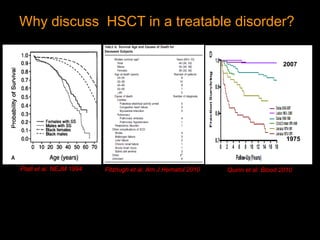
Why discuss HSCT in a treatable disorder?
Quinn et al. Blood 2010Platt et al. NEJM 1994 Fitzhugh et al. Am J Hematol 2010
2007
1975
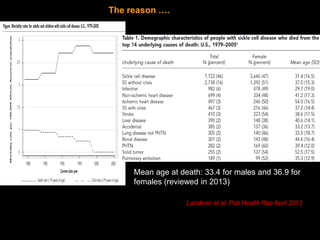
Mean age at death: 33.4 for males and 36.9 for
females (reviewed in 2013)
Lanzkron et al. Pub Health Rep April 2013
The reason ….
It is not fun to live with SCD
• Stroke, cerebral vasculopathy – moyamoya disease,
high TCD, poor performance score
(20% recur with overt stroke; 28% with silent strokes;
30% have a third stroke)
• Recurrent acute chest syndrome
• Chronic pain and narcotic dependence
• Osteonecrosis; avascular necrosis; nephropathy;
retinopathy
• Red cell allo-immunization
• Prolonged hospitalization
Scothorn J et al. Pediatr 2002; Hulbert M et al. Blood 2011
Transplant is curative (CNS, lung, spleen, kidney)
Can we fulfill this wish list?
• Low TRM, low organ toxicity, High DFS
• Low or NO GVHD (especially chronic)
• Minimal toxicities and late side effects
• Fertility preservation
• Early immune reconstitution
• Low graft rejection
• QOL, QOL, QOL
Eapen et al Lancet 2007
Outcomes based on donor selection of unrelated product
6/6 matched UCB
5/6 matched UCB
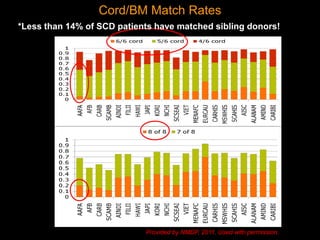
Cord/BM Match Rates
Provided by NMDP, 2011. Used with permission.
*Less than 14% of SCD patients have matched sibling donors!
Ruggeri et al BBMT 2011Locatelli et al Blood 2013
URD UCBT - Graft rejection and mortality are the
problem
Variables we have to work with
Immunosuppresssion
MMUD-GVHDMUD-GVHDSib-GVHD
Stem cell source
Intensity of Conditioning
Focus: Reducing toxicity of conditioning in UCBT
• Hypogonadism (60%), ovarian failure (71%),
sterility
• Neurocognitive – 20% with memory problems,
32% with neuro events, 25% seizures, 10%
cognitive impairment
• Height impaired in pubertal recipient
Myeloablative transplants for SCD
Walters BBMT 2010; Fitzhugh Blood 2008; Eggleston Br J Haematol 2007
“Perhaps less is better” – the case for reducing
intensity of conditioning – alemtuzumab,
fludarabine & melphalan
Rationale
• Early host immune suppression (day -21)
• Some continued T cell depletion due to long
half-life of alemtuzumab - ?GVHD benefit
• Early immune reconstitution
• Offset risk for PTLD (T and B cell depletion)
• Early infection risk
• Potentially lower incidence of irreversible
organ damage and late effects
Food for thought
(for a prospective transplant consideration with RIC )
• The transplanter’s ability to accept a change of
paradigm from myeloablative conditioning where
most children will recover from early toxicities
• All RICs not equal; one failure is not applicable to all
• Acceptance of “stable long-term mixed chimerism”
for non-malignant disorders
• A change of definition of “acceptable” – in some
situations, graft rejection is perhaps more
acceptable than major transplant related toxicities
• A second transplant is feasible following RIT
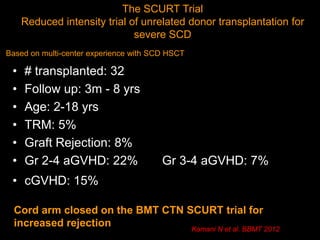
Based on multi-center experience with SCD HSCT
• # transplanted: 32
• Follow up: 3m - 8 yrs
• Age: 2-18 yrs
• TRM: 5%
• Graft Rejection: 8%
• Gr 2-4 aGVHD: 22% Gr 3-4 aGVHD: 7%
• cGVHD: 15%
Cord arm closed on the BMT CTN SCURT trial for
increased rejection Kamani N et al. BBMT 2012
The SCURT Trial
Reduced intensity trial of unrelated donor transplantation for
severe SCD
Bednarski J et al…Tandem 2013
Late Effects - > 2 years post
Madden L, et al……2013
Fertility
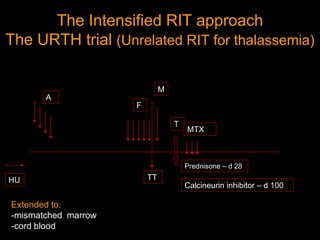
The Intensified RIT approach
The URTH trial (Unrelated RIT for thalassemia)
Prednisone – d 28
Calcineurin inhibitor – d 100
A
F
M
T
MTX
TTHU
Extended to:
-mismatched marrow
-cord blood
Enhancing outcomes
• Size of cord product: > 4 x 10E7 TNC/Kg
• Renal function, HYPERTENSION, fluid
balance
• Seizure prophylaxis
• Maintain platelet counts – risk of ICH
• Weekly infection surveillance – CMV,
adeno, RSV, paraflu, flu - All
• Bacterial and fungal infection prophylaxis
• Anti-HLA antibodies; non-inherited maternal
ags; cord product CFUs
Early experience
• Enrolling on phase I design
• Eligible: 5-6/6 matched cords with target
cell dose
• 13 transplants
• 1 rejection
• 1 death – GVHD
• All non-malignant disorders
Additional avenues of research
• Mesenchymal stem cell infusion with UCB
• Ex-vivo expansion of cord products using
proliferative signaling molecules
• Haplo-identical cell infusion with cord
blood transplant following RIC
• “Reduced toxicity” transplants
• Notch-mediated expansion of cord
progenitors for myeloid reconstitution
Cellular anti-viral therapy
• Dual antigen specific third party T cells – anti
EBV, CMV, adenovirus ( over 2 weeks)
• No GVHD risk
• Developed from peripheral blood
mononuclear cells
Hanley PJ et al. Cytotherapy 2011
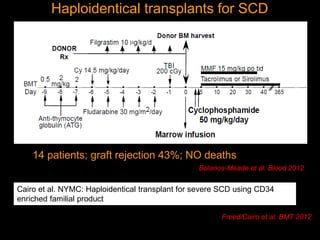
Bolanos-Meade et al. Blood 2012
Haploidentical transplants for SCD
14 patients; graft rejection 43%; NO deaths
Cairo et al. NYMC: Haploidentical transplant for severe SCD using CD34
enriched familial product
Freed/Cairo et al. BMT 2012
Summary
• Transplantation for SCD is evolving and
improving
• New frontiers in conditioning, optimizing
stem cell source, supportive care, and
GVHD therapy is helping the field advance
• Our definitions of success must now be
based not just on OS/DFS but on short and
long term toxicities and QOL
• The ONLY way of moving the field forward
is developing, cooperating with and
participating in formal trials designed to
improve and track outcomes
Acknowledgement
• M. Pulsipher – Utah
• K. Schultz – Vancouver
• D. Wall; K. Chan – San Antonio
• M. Nieder; G.Hale – Tampa
• M. Andreansky – Miami
• S. Chaudhry – Chicago
• M. Bhatia – New York
• R. Adams – Phoenix
• J. Brochstein – New York
• N. Bunin – Philadelphia
• L. Yu – New Orleans
• A. Gilman – Charlotte
• K. Kasow – Chapel Hill
• D. Jacobsohn – Washington DC
• P. Haut – Indianapolis
• J. Dalal – Kansas City
• J. Fort – Miami
• E. Anderson – San Diego
• BMT Team – St. Louis Children’s
Hospital, Washington University
• DSMB for the various trials
• BMT CTN, CIBMTR, SCD CRN,
PBMTC, TCRN
• Participating patients
and their families

Hematopoietic Stem Cell Transplantation for Sickle Cell Disease

  • 1.
    Hematopoietic Stem Cell Transplantationfor Sickle Cell Disease Disclosures: None Shalini Shenoy, MD Professor of Pediatrics Director, Stem Cell Transplant Program
  • 2.
    Why discuss HSCTin a treatable disorder? Quinn et al. Blood 2010Platt et al. NEJM 1994 Fitzhugh et al. Am J Hematol 2010 2007 1975
  • 3.
    Mean age atdeath: 33.4 for males and 36.9 for females (reviewed in 2013) Lanzkron et al. Pub Health Rep April 2013 The reason ….
  • 4.
    It is notfun to live with SCD • Stroke, cerebral vasculopathy – moyamoya disease, high TCD, poor performance score (20% recur with overt stroke; 28% with silent strokes; 30% have a third stroke) • Recurrent acute chest syndrome • Chronic pain and narcotic dependence • Osteonecrosis; avascular necrosis; nephropathy; retinopathy • Red cell allo-immunization • Prolonged hospitalization Scothorn J et al. Pediatr 2002; Hulbert M et al. Blood 2011
  • 5.
    Transplant is curative(CNS, lung, spleen, kidney) Can we fulfill this wish list? • Low TRM, low organ toxicity, High DFS • Low or NO GVHD (especially chronic) • Minimal toxicities and late side effects • Fertility preservation • Early immune reconstitution • Low graft rejection • QOL, QOL, QOL
  • 6.
    Eapen et alLancet 2007 Outcomes based on donor selection of unrelated product 6/6 matched UCB 5/6 matched UCB
  • 7.
    Cord/BM Match Rates Providedby NMDP, 2011. Used with permission. *Less than 14% of SCD patients have matched sibling donors!
  • 8.
    Ruggeri et alBBMT 2011Locatelli et al Blood 2013 URD UCBT - Graft rejection and mortality are the problem
  • 9.
    Variables we haveto work with Immunosuppresssion MMUD-GVHDMUD-GVHDSib-GVHD Stem cell source Intensity of Conditioning Focus: Reducing toxicity of conditioning in UCBT
  • 10.
    • Hypogonadism (60%),ovarian failure (71%), sterility • Neurocognitive – 20% with memory problems, 32% with neuro events, 25% seizures, 10% cognitive impairment • Height impaired in pubertal recipient Myeloablative transplants for SCD Walters BBMT 2010; Fitzhugh Blood 2008; Eggleston Br J Haematol 2007 “Perhaps less is better” – the case for reducing intensity of conditioning – alemtuzumab, fludarabine & melphalan
  • 11.
    Rationale • Early hostimmune suppression (day -21) • Some continued T cell depletion due to long half-life of alemtuzumab - ?GVHD benefit • Early immune reconstitution • Offset risk for PTLD (T and B cell depletion) • Early infection risk • Potentially lower incidence of irreversible organ damage and late effects
  • 12.
    Food for thought (fora prospective transplant consideration with RIC ) • The transplanter’s ability to accept a change of paradigm from myeloablative conditioning where most children will recover from early toxicities • All RICs not equal; one failure is not applicable to all • Acceptance of “stable long-term mixed chimerism” for non-malignant disorders • A change of definition of “acceptable” – in some situations, graft rejection is perhaps more acceptable than major transplant related toxicities • A second transplant is feasible following RIT
  • 13.
    Based on multi-centerexperience with SCD HSCT • # transplanted: 32 • Follow up: 3m - 8 yrs • Age: 2-18 yrs • TRM: 5% • Graft Rejection: 8% • Gr 2-4 aGVHD: 22% Gr 3-4 aGVHD: 7% • cGVHD: 15% Cord arm closed on the BMT CTN SCURT trial for increased rejection Kamani N et al. BBMT 2012 The SCURT Trial Reduced intensity trial of unrelated donor transplantation for severe SCD
  • 14.
    Bednarski J etal…Tandem 2013
  • 15.
    Late Effects -> 2 years post Madden L, et al……2013
  • 16.
  • 17.
    The Intensified RITapproach The URTH trial (Unrelated RIT for thalassemia) Prednisone – d 28 Calcineurin inhibitor – d 100 A F M T MTX TTHU Extended to: -mismatched marrow -cord blood
  • 18.
    Enhancing outcomes • Sizeof cord product: > 4 x 10E7 TNC/Kg • Renal function, HYPERTENSION, fluid balance • Seizure prophylaxis • Maintain platelet counts – risk of ICH • Weekly infection surveillance – CMV, adeno, RSV, paraflu, flu - All • Bacterial and fungal infection prophylaxis • Anti-HLA antibodies; non-inherited maternal ags; cord product CFUs
  • 19.
    Early experience • Enrollingon phase I design • Eligible: 5-6/6 matched cords with target cell dose • 13 transplants • 1 rejection • 1 death – GVHD • All non-malignant disorders
  • 20.
    Additional avenues ofresearch • Mesenchymal stem cell infusion with UCB • Ex-vivo expansion of cord products using proliferative signaling molecules • Haplo-identical cell infusion with cord blood transplant following RIC • “Reduced toxicity” transplants • Notch-mediated expansion of cord progenitors for myeloid reconstitution
  • 21.
    Cellular anti-viral therapy •Dual antigen specific third party T cells – anti EBV, CMV, adenovirus ( over 2 weeks) • No GVHD risk • Developed from peripheral blood mononuclear cells Hanley PJ et al. Cytotherapy 2011
  • 22.
    Bolanos-Meade et al.Blood 2012 Haploidentical transplants for SCD 14 patients; graft rejection 43%; NO deaths Cairo et al. NYMC: Haploidentical transplant for severe SCD using CD34 enriched familial product Freed/Cairo et al. BMT 2012
  • 23.
    Summary • Transplantation forSCD is evolving and improving • New frontiers in conditioning, optimizing stem cell source, supportive care, and GVHD therapy is helping the field advance • Our definitions of success must now be based not just on OS/DFS but on short and long term toxicities and QOL • The ONLY way of moving the field forward is developing, cooperating with and participating in formal trials designed to improve and track outcomes
  • 24.
    Acknowledgement • M. Pulsipher– Utah • K. Schultz – Vancouver • D. Wall; K. Chan – San Antonio • M. Nieder; G.Hale – Tampa • M. Andreansky – Miami • S. Chaudhry – Chicago • M. Bhatia – New York • R. Adams – Phoenix • J. Brochstein – New York • N. Bunin – Philadelphia • L. Yu – New Orleans • A. Gilman – Charlotte • K. Kasow – Chapel Hill • D. Jacobsohn – Washington DC • P. Haut – Indianapolis • J. Dalal – Kansas City • J. Fort – Miami • E. Anderson – San Diego • BMT Team – St. Louis Children’s Hospital, Washington University • DSMB for the various trials • BMT CTN, CIBMTR, SCD CRN, PBMTC, TCRN • Participating patients and their families