
Thrombotic disorders in
Pregnancy
ByBy
Ahmed NofalAhmed Nofal
Objectives
1.1. Facts about VTE in pregnancyFacts about VTE in pregnancy
2.2. VTE diagnostic modalities in pregnancyVTE diagnostic modalities in pregnancy
3.3. Treatment of VTE in pregnancyTreatment of VTE in pregnancy
4.4. Thrombophilia in pregnancy?Thrombophilia in pregnancy?
5.5. Thromboprophylaxis during pregnancy?Thromboprophylaxis during pregnancy?
VTE in pregnancy
 Pregnant women are at an increased risk for venousPregnant women are at an increased risk for venous
thromboembolic disease (VTE)thromboembolic disease (VTE)
 1 in 1000 pregnancies1 in 1000 pregnancies
 2-4 fold increase compared to non-pregnant state2-4 fold increase compared to non-pregnant state
 Cesarian delivery > vaginal deliveryCesarian delivery > vaginal delivery
 2/3 of DVT occur antepartum (equally distributed2/3 of DVT occur antepartum (equally distributed
among all three trimesters)among all three trimesters)
 43-60% of PE occur 4-6 weeks after delivery43-60% of PE occur 4-6 weeks after delivery
 PE is the major non-obstetric cause of maternalPE is the major non-obstetric cause of maternal
mortalitymortality
 2/100 000 pregnancies2/100 000 pregnancies
 90% of DVT during pregnancy occurs on90% of DVT during pregnancy occurs on
the left side.the left side.
 A significant proportion of DVT inA significant proportion of DVT in
pregnancy occurs in the pelvic veins andpregnancy occurs in the pelvic veins and
therefore, may not be picked up by routinetherefore, may not be picked up by routine
testing.testing.
 Ovarian vein thrombosis can also occur.Ovarian vein thrombosis can also occur.
DVT facts
Why is the risk greater in
pregnancy?
 PathopsysiologyPathopsysiology
 Increased plasma volumeIncreased plasma volume
 Compression of IVCCompression of IVC
 Increased levels of coagulation factorsIncreased levels of coagulation factors
(fibrinogen, factor VII)(fibrinogen, factor VII)
 Decreased levels of natural anticoagulantsDecreased levels of natural anticoagulants
(protein S)(protein S)
 Acquired protein C resistanceAcquired protein C resistance
Independent risk factors of a
higher VTE risk in pregnancy?
 Bed restBed rest
 MultipartyMultiparty
 Advanced maternal age (>35 y)Advanced maternal age (>35 y)
 OverweightOverweight
 Personal or family history of VTEPersonal or family history of VTE
 PreeclampsiaPreeclampsia
VTE presentation in
pregnancy
 Leg symptoms, chest pain, and dyspnea areLeg symptoms, chest pain, and dyspnea are
common in pregnancy.common in pregnancy.
Swelling, tenderness, skin discoloration, warm toSwelling, tenderness, skin discoloration, warm to
touch, unusual firmness/hardness, cord, pain ontouch, unusual firmness/hardness, cord, pain on
dorsiflexiondorsiflexion
 Tachycardia may be a normal physiologicTachycardia may be a normal physiologic
response.response.

Diagnosis of VTE in
pregnancy: challenges
 Clinical diagnosis by itself is unreliable.Clinical diagnosis by itself is unreliable.
 In symptomatic pregnant patients, DVT and PE areIn symptomatic pregnant patients, DVT and PE are
less prevalent than in non-pregnant patients.less prevalent than in non-pregnant patients.
 Anticoagulant treatment is highly effective but carriesAnticoagulant treatment is highly effective but carries
risks.risks.
 Untreated VTE can result in fatal and non fatal PE.Untreated VTE can result in fatal and non fatal PE.
 Hence, when VTE is suspected, it is essential toHence, when VTE is suspected, it is essential to
diagnose it when present and exclude it when absent.diagnose it when present and exclude it when absent.
Diagnosis of VTE in
pregnancy: challenges
 The common diagnostic tests have not been studiedThe common diagnostic tests have not been studied
in pregnant women, and hence not appropriatelyin pregnant women, and hence not appropriately
validated for this populationvalidated for this population
 D-dimer assays and DVT/PE clinical prediction rulesD-dimer assays and DVT/PE clinical prediction rules
have not been validated in the pregnant populationhave not been validated in the pregnant population
 ……..and what about the issue of both radiation..and what about the issue of both radiation
exposure to the fetus with diagnostic testing???exposure to the fetus with diagnostic testing???
Diagnosis of VTE in
pregnancy: challenges
 It is important to avoid ionizing radiationIt is important to avoid ionizing radiation
exposure whenever possible duringexposure whenever possible during
pregnancy, but the risks of undiagnosed PEpregnancy, but the risks of undiagnosed PE
are much greater than any theoretical risk toare much greater than any theoretical risk to
the fetus from diagnostic testingthe fetus from diagnostic testing
DVT and PE - Investigation
 venography can be done safely and with reliable resultsvenography can be done safely and with reliable results
in pregnancy.in pregnancy.
 Ventilation perfusion scans and pulmonary angiogramsVentilation perfusion scans and pulmonary angiograms
can be done safely during pregnancy.can be done safely during pregnancy.
 Pelvic vein ultrasound, CT scan and MRI are all tests thatPelvic vein ultrasound, CT scan and MRI are all tests that
can be used to look for pelvic clot.can be used to look for pelvic clot.
 CT angiography can be done in pregnancy (risk ofCT angiography can be done in pregnancy (risk of
congenital hypothyroidism in first trimester)congenital hypothyroidism in first trimester)
 IVC filters can be placed in pregnancy.IVC filters can be placed in pregnancy.
Risk of radiologic procedures to the
fetus
 Radiation exposure of up to 0.05 Gy (5 rad) inRadiation exposure of up to 0.05 Gy (5 rad) in
utero:utero:
 OncogenicityOncogenicity
 Relative risks of 1.2-2.4Relative risks of 1.2-2.4
 Absolute risk of malignancy (baseline) in fetusAbsolute risk of malignancy (baseline) in fetus
is estimated to be 0.1%.is estimated to be 0.1%.
 TetratogenicityTetratogenicity
 No increase in pregnancy loss, growth orNo increase in pregnancy loss, growth or
mental retardationmental retardation
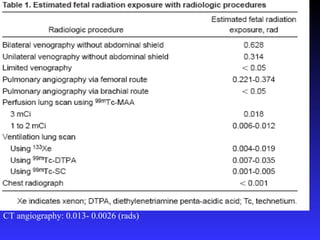
CT angiography: 0.013- 0.0026 (rads)
Techniques to lower radiation
exposure
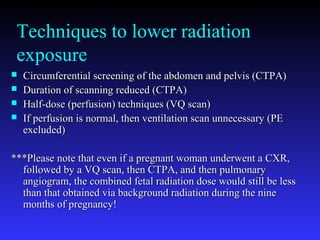
 Circumferential screening of the abdomen and pelvis (CTPA)Circumferential screening of the abdomen and pelvis (CTPA)
 Duration of scanning reduced (CTPA)Duration of scanning reduced (CTPA)
 Half-dose (perfusion) techniques (VQ scan)Half-dose (perfusion) techniques (VQ scan)
 If perfusion is normal, then ventilation scan unnecessary (PEIf perfusion is normal, then ventilation scan unnecessary (PE
excluded)excluded)
***Please note that even if a pregnant woman underwent a CXR,***Please note that even if a pregnant woman underwent a CXR,
followed by a VQ scan, then CTPA, and then pulmonaryfollowed by a VQ scan, then CTPA, and then pulmonary
angiogram, the combined fetal radiation dose would still be lessangiogram, the combined fetal radiation dose would still be less
than that obtained via background radiation during the ninethan that obtained via background radiation during the nine
months of pregnancy!months of pregnancy!
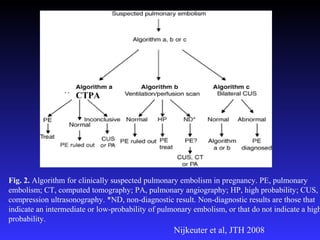
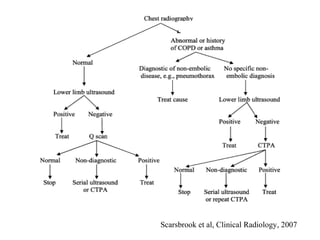
Fig. 2. Algorithm for clinically suspected pulmonary embolism in pregnancy. PE, pulmonary
embolism; CT, computed tomography; PA, pulmonary angiography; HP, high probability; CUS,
compression ultrasonography. *ND, non-diagnostic result. Non-diagnostic results are those that
indicate an intermediate or low-probability of pulmonary embolism, or that do not indicate a high
probability.
CTPA
Nijkeuter et al, JTH 2008
Scarsbrook et al, Clinical Radiology, 2007
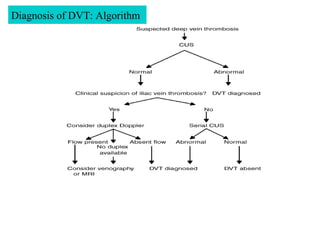
Diagnosis of DVT: Algorithm
VTE Treatment
VTE treatment
 LMWHLMWH preferredpreferred based on better safety profile,based on better safety profile,
reliable pharmacokinetics, more practical, and asreliable pharmacokinetics, more practical, and as
effective as UFHeffective as UFH
 Largely based on studies in non-pregnant populationLargely based on studies in non-pregnant population
 Widespread use over the last 10-15 years in pregnant womenWidespread use over the last 10-15 years in pregnant women
have shown that LMWHs are as effective and safer than UFHhave shown that LMWHs are as effective and safer than UFH
(less HIT and less osteoporosis than UFH)(less HIT and less osteoporosis than UFH)
 Does not cross placenta!Does not cross placenta!
VTE treatments: other options
 UFHUFH
 Initial IV UFH therapy followed by UFH bid sc dosingInitial IV UFH therapy followed by UFH bid sc dosing
(adjusted weekly to achieve target PTT (60-80 sec) 6H after(adjusted weekly to achieve target PTT (60-80 sec) 6H after
injection). Weekly surveillanceinjection). Weekly surveillance
 WARFARINWARFARIN
 TeratogenicityTeratogenicity (coumarin embryonopathy: nasal hypoplasia and/or stippled(coumarin embryonopathy: nasal hypoplasia and/or stippled
epiphyses); observed only duirng 6-12 weeks of gestation (Chan et al, studied 549epiphyses); observed only duirng 6-12 weeks of gestation (Chan et al, studied 549
live births; VKA through out preg vs. UFH 6-12 weeks then VKA vs. UFHlive births; VKA through out preg vs. UFH 6-12 weeks then VKA vs. UFH
throughout pregnancy)throughout pregnancy)
 CNS abnormalitiesCNS abnormalities during any trimester (corpus callosum agenesis; midlineduring any trimester (corpus callosum agenesis; midline
cerebellar atrophy); very rare and questionable associationcerebellar atrophy); very rare and questionable association
 Fetal hemorrhagic complicationsFetal hemorrhagic complications especially at delivery due to prolongedespecially at delivery due to prolonged
anticoagulant effect of warfarin as a result of fetal liver being immature and henceanticoagulant effect of warfarin as a result of fetal liver being immature and hence
fetal levels of vit K dependent coag factors are low.fetal levels of vit K dependent coag factors are low.
 ?role in pregnant women with mechanical prosthetic valves at high risk for?role in pregnant women with mechanical prosthetic valves at high risk for
embolization (i.e. previous CVA)embolization (i.e. previous CVA)
DVT and PE – Treatment
 CHEST 2008 recommendations:CHEST 2008 recommendations:
 Treatment of acute DVT/PE in pregnancyTreatment of acute DVT/PE in pregnancy
 Adjusted doseAdjusted dose LMWH thru pregnancyLMWH thru pregnancy
OR (but less preferred)OR (but less preferred)
 weight-based intravenous UFH protocol for 5weight-based intravenous UFH protocol for 5
days, then adjusted dose UFH (PTT mid-intervaldays, then adjusted dose UFH (PTT mid-interval
of 60-80 secs; weekly surveillance).of 60-80 secs; weekly surveillance).
LMWH: adjust dose during pregnancy?
 LMWH requirements may alter as pregnancy progresses ( volume ofLMWH requirements may alter as pregnancy progresses ( volume of
distribution of LMWH changes and GFR increases in second trimester)distribution of LMWH changes and GFR increases in second trimester)
 Hence, some suggest that dose should change as weight changesHence, some suggest that dose should change as weight changes
(based on small studies that support dose escalation to achieve(based on small studies that support dose escalation to achieve
“therapeutic anti Xa levels”)“therapeutic anti Xa levels”)
 Adjusted doseAdjusted dose LMWH thru pregnancyLMWH thru pregnancy
 adjust as weightadjust as weight ↑↑, or adjust to anti Xa level 0.5-1.2 U/ml (every 1-3, or adjust to anti Xa level 0.5-1.2 U/ml (every 1-3
months blood test, 4 hrs after last dose) (bid vs qd dosing)months blood test, 4 hrs after last dose) (bid vs qd dosing)
 Others have demonstrated that few women require dose adjustmentOthers have demonstrated that few women require dose adjustment
when therapeutic LMWH doses are givenwhen therapeutic LMWH doses are given
At time of delivery
 D/C LMWH (or UFH sc) 24 hrs. prior to electiveD/C LMWH (or UFH sc) 24 hrs. prior to elective
inductioninduction
 If very high risk of recurrence ( PE or DVT within 2-4If very high risk of recurrence ( PE or DVT within 2-4
weeks of expected delivery), IV UFH can be initiatedweeks of expected delivery), IV UFH can be initiated
and d/c 4-6 hours prior to delivery; in addition, aand d/c 4-6 hours prior to delivery; in addition, a
temporary IVC filter can be insertedtemporary IVC filter can be inserted
 If spontaneous labour occurs while receivingIf spontaneous labour occurs while receiving adjusted-adjusted-
dose SC UFHdose SC UFH, monitor PTT and if prolonged give, monitor PTT and if prolonged give
protamineprotamine
 If spontaneous labor occurs whileIf spontaneous labor occurs while receiving LMWHreceiving LMWH,,
anticoagulant effect depends on timing of last dose.anticoagulant effect depends on timing of last dose.
 Avoid epiduralAvoid epidural
 Protamine can be consideredProtamine can be considered
Postpartum management
 Re-start anticoagulation within 8-12Re-start anticoagulation within 8-12
hours of delivery .hours of delivery .
 LMWH or coumadin for 6 weeks afterLMWH or coumadin for 6 weeks after
deliverydelivery
 For a minimum total duration of 6For a minimum total duration of 6
monthsmonths
Foetal complications during
pregnancy
 Heparins and LMWHHeparins and LMWH
 Heparins and UFH do not cross placentaHeparins and UFH do not cross placenta
 Uteroplacental bleeding possible but very rareUteroplacental bleeding possible but very rare
 WarfarinWarfarin
 Risk of embryopathy (nasal hypoplasia) (6-12Risk of embryopathy (nasal hypoplasia) (6-12
weeks of gestation)weeks of gestation)
 CNS abnormalities in any trimesterCNS abnormalities in any trimester
 Anticoagulant effect in fetus (**at delivery)Anticoagulant effect in fetus (**at delivery)
Maternal complications of
anticoagulant therapy
 BleedingBleeding
 2% risk with UFH2% risk with UFH
 Very uncommon with LMWHVery uncommon with LMWH
 Heparin induced osteoporosisHeparin induced osteoporosis
 2.2% incidence of vertebral fracture with UFH (>12.2% incidence of vertebral fracture with UFH (>1
month)month)
 Uncommon with LMWHUncommon with LMWH
 HITHIT
 3% risk with UFH3% risk with UFH
 suspect HIT if platelets <100 or 50% of baselinesuspect HIT if platelets <100 or 50% of baseline
value 5-15 days after commencing UFHvalue 5-15 days after commencing UFH
 Uncommon with LMWHUncommon with LMWH
Nursing mother
 Heparin and warfarinHeparin and warfarin not secreted into breast milk.not secreted into breast milk.
 LMWHLMWH: small amounts may be secreted into breast milk but not: small amounts may be secreted into breast milk but not
absorbed by infant and no anticoagulant effect in breast-fedabsorbed by infant and no anticoagulant effect in breast-fed
infantinfant
 DanaproidDanaproid: case reports +/- passage into breast milk; no: case reports +/- passage into breast milk; no
anticoagulant effect in infantanticoagulant effect in infant
 Fondaparinux and DTIsFondaparinux and DTIs: unknown: unknown
Prevention of VTE during
pregnancy
 How do we evaluate women with anHow do we evaluate women with an
increased risk of VTE?increased risk of VTE?
 Prior history of VTEPrior history of VTE
 Thrombophilia without a prior history ofThrombophilia without a prior history of
VTEVTE
Thromboprophylaxis during
pregnancy and postpartum
How we manage pregnant women who
have a high risk of VTE
 Women with a history of VTE have a higher risk of recurrence withWomen with a history of VTE have a higher risk of recurrence with
subsequent pregnancy (1-13% risk of recurrence)subsequent pregnancy (1-13% risk of recurrence)
 Risk dependent onRisk dependent on naturenature of VTE risk factor, presence or absence ofof VTE risk factor, presence or absence of
thrombophiliathrombophilia, and (, and (numbernumber of previous VTEs).of previous VTEs).
 N=125 women with a single previous VTE who only receivedN=125 women with a single previous VTE who only received
prophylaxis in ppp for 4-6 weeks (Brill-Edwards, NEJM 2000)prophylaxis in ppp for 4-6 weeks (Brill-Edwards, NEJM 2000)
 3/125 had antepartum recurrence (2.4%, 95% CI 0.2-6.9%) and3/125 had antepartum recurrence (2.4%, 95% CI 0.2-6.9%) and
3/125 had ppp VTE recurrence3/125 had ppp VTE recurrence
 Post hoc analysis: women without thrombophilia and a VTEPost hoc analysis: women without thrombophilia and a VTE
associated with a temporary risk factor were at low risk forassociated with a temporary risk factor were at low risk for
recurrence (0%)recurrence (0%)
Single prior VTE
1.1. VTE associated withVTE associated with transient risk factortransient risk factor: clinical: clinical
surveillance and pp prophylaxis for 6 weekssurveillance and pp prophylaxis for 6 weeks
2.2. VTE associated withVTE associated with pregnancy or estrogen-relatedpregnancy or estrogen-related oror
there are additional risk factors (eg. obesity) clinicalthere are additional risk factors (eg. obesity) clinical
surveillance and pp prophylaxis for 6 weeks OR antenatalsurveillance and pp prophylaxis for 6 weeks OR antenatal
with pp prophylaxis for 6 weekswith pp prophylaxis for 6 weeks
 LMWH (dalteparin 5000u q24 hrs or enoxaparin 40mg sc q24hrs)LMWH (dalteparin 5000u q24 hrs or enoxaparin 40mg sc q24hrs)
 Mini-dose UFH SC (5000 U SC bid) vs intermediate dose UFHMini-dose UFH SC (5000 U SC bid) vs intermediate dose UFH
SC (10 000 sc bid)SC (10 000 sc bid)
Single prior VTE
3.3. Idiopathic VTEIdiopathic VTE: antenatal and pp prophylaxis (4-6 weeks pp): antenatal and pp prophylaxis (4-6 weeks pp)
OR clinical surveillance and pp prophylaxisOR clinical surveillance and pp prophylaxis
 Prophylactic dose LMWHProphylactic dose LMWH
 Mini- or moderate-dose UFH SCMini- or moderate-dose UFH SC
4.4. With thrombophiliaWith thrombophilia: antenatal and pp prophylaxis (4-6: antenatal and pp prophylaxis (4-6
weeks pp) OR clinical surveillance and pp prophylaxisweeks pp) OR clinical surveillance and pp prophylaxis
 Prophylactic dose LMWH (eg. dalteparin 5000u q12Prophylactic dose LMWH (eg. dalteparin 5000u q12
hours)hours)
 Mini- or moderate-dose UFH SCMini- or moderate-dose UFH SC
Single prior VTE
5.5. With “higher risk” thrombophiliaWith “higher risk” thrombophilia: antenatal and pp: antenatal and pp
prophylaxis (4-6 weeks pp)prophylaxis (4-6 weeks pp)
 Prophylactic dose LMWH (eg. dalteparin 5000u q12Prophylactic dose LMWH (eg. dalteparin 5000u q12
hours)hours)
 Mini- or moderate-dose UFH SCMini- or moderate-dose UFH SC
APLA, ATIII deficiency, compound heterozygote PT/FVL,APLA, ATIII deficiency, compound heterozygote PT/FVL,
or homozygosity for FVL or PTor homozygosity for FVL or PT
Multiple episodes of VTE
(or those on long-term anticoagulation)(or those on long-term anticoagulation)
 Prophylactic, vs. intermediate, vs. adjusted doseProphylactic, vs. intermediate, vs. adjusted dose
LMWH (or UFH)LMWH (or UFH)
 PP prophylaxis for 6 weeks, consider long-termPP prophylaxis for 6 weeks, consider long-term
anticoagulants, or resumption of long-termanticoagulants, or resumption of long-term
anticoagulantsanticoagulants
For all women with prior DVT..
 Consider compression stockings duringConsider compression stockings during
pregnancy and ppppregnancy and ppp
 reduce risk of PTSreduce risk of PTS
Do you adjust LMWH prophylaxis
dosing in pregnancy?
 The need to adjust according to anti-Xa levels isThe need to adjust according to anti-Xa levels is
very controversialvery controversial
 Appropriate “therapeutic range” forAppropriate “therapeutic range” for
prophylaxis is not knownprophylaxis is not known
 It has not been shown that dose adjustment toIt has not been shown that dose adjustment to
attain specific anti-Xa level increases safety orattain specific anti-Xa level increases safety or
efficacy.efficacy.
Thrombophilia with no history
of prior VTE
 50% of gestational VTEs occur in women with an underlying50% of gestational VTEs occur in women with an underlying
thrombophilic disorderthrombophilic disorder
 AT 3 deficient: OR = 8-13.1AT 3 deficient: OR = 8-13.1
 FVL Homozygote: OR = 6.9-8.7FVL Homozygote: OR = 6.9-8.7
 PT Homozygote: OR 1.8-9.5PT Homozygote: OR 1.8-9.5
 Double FVL/PT mutations: OR=15Double FVL/PT mutations: OR=15
 Antenatal and pp prophylaxis is recommended in womenAntenatal and pp prophylaxis is recommended in women
without a prior VTE and with any of the above disorders.without a prior VTE and with any of the above disorders.
 For women without prior VTE and who have lessFor women without prior VTE and who have less
thrombogenic thrombophilias, clinical surveillance and ppthrombogenic thrombophilias, clinical surveillance and pp
prophylaxisprophylaxis
Antiphospholipid Antibodies
 Lupus anticoagulant/non-specific inhibitorLupus anticoagulant/non-specific inhibitor
 Anticardiolipin antibodiesAnticardiolipin antibodies
 Convincing evidence of an association with increasedConvincing evidence of an association with increased
risk of thrombosis and pregnancy loss (less so withrisk of thrombosis and pregnancy loss (less so with
preeclampsia, abruptio, IUGR)preeclampsia, abruptio, IUGR)
 But how to manage during pregnancy…not clear?But how to manage during pregnancy…not clear?
 Prednisone not usefulPrednisone not useful
 ASA with LMWH (UFH) is likely the bestASA with LMWH (UFH) is likely the best
combination (outcomes: fetal loss, pregnancycombination (outcomes: fetal loss, pregnancy
complications, VTE)complications, VTE)
Management of pregnant women with
APLAs
 Positive APLAs and hx of 2 or more early pregnancy losses orPositive APLAs and hx of 2 or more early pregnancy losses or
one or more late pregnancy losses, IUGR, preeclampsia, orone or more late pregnancy losses, IUGR, preeclampsia, or
abruptioabruptio
 Antepartum ASA plus prophylactic LMWHAntepartum ASA plus prophylactic LMWH
 Antepartum ASA plus minidose or moderate dose UFHAntepartum ASA plus minidose or moderate dose UFH
 Positive APLAs and hx of VTE are usually receiving long-termPositive APLAs and hx of VTE are usually receiving long-term
anticoagulation bc of high risk of recurrenceanticoagulation bc of high risk of recurrence
 Antepartum adjusted dose LMWH (or UFH) plus ASAAntepartum adjusted dose LMWH (or UFH) plus ASA
 Long-term oral anticoagulation postpartumLong-term oral anticoagulation postpartum
 Positive APLAs and no hx of pregnancy complications or VTEPositive APLAs and no hx of pregnancy complications or VTE
 Clinical surveillanceClinical surveillance
 Minidose UFHMinidose UFH
 Prophylactic LMWHProphylactic LMWH
and/or asa?
Prevention of pregnancy complications in
women with non-APLA thrombophilia?
 Data support weak associations betweenData support weak associations between
thrombophilias (FVL, PT mutation) and adversethrombophilias (FVL, PT mutation) and adverse
pregnancy outcomes (early (recurrent) preg loss,pregnancy outcomes (early (recurrent) preg loss,
preeclampsia, IUGR)preeclampsia, IUGR)
 But, clinical studies with LMWH or UFH vs. placeboBut, clinical studies with LMWH or UFH vs. placebo
(no drug) in women with a history of adverse(no drug) in women with a history of adverse
pregnancy outcomes and non-APLA thrombophilias dopregnancy outcomes and non-APLA thrombophilias do
not show improved pregnancy outcomes.not show improved pregnancy outcomes.
C-section and the risk of VTE?
 Risk 0.4/1000 (c-section) vs. 0.2/1000 (vaginalRisk 0.4/1000 (c-section) vs. 0.2/1000 (vaginal
delivery)delivery)
 Not standard of care to thromboprophylaxNot standard of care to thromboprophylax
 Thrombosis risk assessment to determine need forThrombosis risk assessment to determine need for
prophylaxis (grade 2C)prophylaxis (grade 2C)
 If no additional thrombosis risk factor, no prophylaxisIf no additional thrombosis risk factor, no prophylaxis
 If additional risk factors (eg. prior VTE, lower limbIf additional risk factors (eg. prior VTE, lower limb
paralysis, thrombophilia, extended surgery such asparalysis, thrombophilia, extended surgery such as
hysterectomy, preeclampsia, obesity, increased age,hysterectomy, preeclampsia, obesity, increased age,
heart failure), then…heart failure), then…
C-section and the risk of VTE?
 Prophylaxis doses of LMWH or UFH +/-Prophylaxis doses of LMWH or UFH +/-
stockings while in hospital followingstockings while in hospital following
delivery (grade 2C) and perhaps for 6delivery (grade 2C) and perhaps for 6
weeks pp if important risk factors persistweeks pp if important risk factors persist
(grade 2C).(grade 2C).

,n l

  • 1.
  • 2.
    Objectives 1.1. Facts aboutVTE in pregnancyFacts about VTE in pregnancy 2.2. VTE diagnostic modalities in pregnancyVTE diagnostic modalities in pregnancy 3.3. Treatment of VTE in pregnancyTreatment of VTE in pregnancy 4.4. Thrombophilia in pregnancy?Thrombophilia in pregnancy? 5.5. Thromboprophylaxis during pregnancy?Thromboprophylaxis during pregnancy?
  • 3.
    VTE in pregnancy Pregnant women are at an increased risk for venousPregnant women are at an increased risk for venous thromboembolic disease (VTE)thromboembolic disease (VTE)  1 in 1000 pregnancies1 in 1000 pregnancies  2-4 fold increase compared to non-pregnant state2-4 fold increase compared to non-pregnant state  Cesarian delivery > vaginal deliveryCesarian delivery > vaginal delivery  2/3 of DVT occur antepartum (equally distributed2/3 of DVT occur antepartum (equally distributed among all three trimesters)among all three trimesters)  43-60% of PE occur 4-6 weeks after delivery43-60% of PE occur 4-6 weeks after delivery  PE is the major non-obstetric cause of maternalPE is the major non-obstetric cause of maternal mortalitymortality  2/100 000 pregnancies2/100 000 pregnancies
  • 4.
     90% ofDVT during pregnancy occurs on90% of DVT during pregnancy occurs on the left side.the left side.  A significant proportion of DVT inA significant proportion of DVT in pregnancy occurs in the pelvic veins andpregnancy occurs in the pelvic veins and therefore, may not be picked up by routinetherefore, may not be picked up by routine testing.testing.  Ovarian vein thrombosis can also occur.Ovarian vein thrombosis can also occur. DVT facts
  • 5.
    Why is therisk greater in pregnancy?  PathopsysiologyPathopsysiology  Increased plasma volumeIncreased plasma volume  Compression of IVCCompression of IVC  Increased levels of coagulation factorsIncreased levels of coagulation factors (fibrinogen, factor VII)(fibrinogen, factor VII)  Decreased levels of natural anticoagulantsDecreased levels of natural anticoagulants (protein S)(protein S)  Acquired protein C resistanceAcquired protein C resistance
  • 6.
    Independent risk factorsof a higher VTE risk in pregnancy?  Bed restBed rest  MultipartyMultiparty  Advanced maternal age (>35 y)Advanced maternal age (>35 y)  OverweightOverweight  Personal or family history of VTEPersonal or family history of VTE  PreeclampsiaPreeclampsia
  • 7.
    VTE presentation in pregnancy Leg symptoms, chest pain, and dyspnea areLeg symptoms, chest pain, and dyspnea are common in pregnancy.common in pregnancy. Swelling, tenderness, skin discoloration, warm toSwelling, tenderness, skin discoloration, warm to touch, unusual firmness/hardness, cord, pain ontouch, unusual firmness/hardness, cord, pain on dorsiflexiondorsiflexion  Tachycardia may be a normal physiologicTachycardia may be a normal physiologic response.response. 
  • 8.
    Diagnosis of VTEin pregnancy: challenges  Clinical diagnosis by itself is unreliable.Clinical diagnosis by itself is unreliable.  In symptomatic pregnant patients, DVT and PE areIn symptomatic pregnant patients, DVT and PE are less prevalent than in non-pregnant patients.less prevalent than in non-pregnant patients.  Anticoagulant treatment is highly effective but carriesAnticoagulant treatment is highly effective but carries risks.risks.  Untreated VTE can result in fatal and non fatal PE.Untreated VTE can result in fatal and non fatal PE.  Hence, when VTE is suspected, it is essential toHence, when VTE is suspected, it is essential to diagnose it when present and exclude it when absent.diagnose it when present and exclude it when absent.
  • 9.
    Diagnosis of VTEin pregnancy: challenges  The common diagnostic tests have not been studiedThe common diagnostic tests have not been studied in pregnant women, and hence not appropriatelyin pregnant women, and hence not appropriately validated for this populationvalidated for this population  D-dimer assays and DVT/PE clinical prediction rulesD-dimer assays and DVT/PE clinical prediction rules have not been validated in the pregnant populationhave not been validated in the pregnant population  ……..and what about the issue of both radiation..and what about the issue of both radiation exposure to the fetus with diagnostic testing???exposure to the fetus with diagnostic testing???
  • 10.
    Diagnosis of VTEin pregnancy: challenges  It is important to avoid ionizing radiationIt is important to avoid ionizing radiation exposure whenever possible duringexposure whenever possible during pregnancy, but the risks of undiagnosed PEpregnancy, but the risks of undiagnosed PE are much greater than any theoretical risk toare much greater than any theoretical risk to the fetus from diagnostic testingthe fetus from diagnostic testing
  • 11.
    DVT and PE- Investigation  venography can be done safely and with reliable resultsvenography can be done safely and with reliable results in pregnancy.in pregnancy.  Ventilation perfusion scans and pulmonary angiogramsVentilation perfusion scans and pulmonary angiograms can be done safely during pregnancy.can be done safely during pregnancy.  Pelvic vein ultrasound, CT scan and MRI are all tests thatPelvic vein ultrasound, CT scan and MRI are all tests that can be used to look for pelvic clot.can be used to look for pelvic clot.  CT angiography can be done in pregnancy (risk ofCT angiography can be done in pregnancy (risk of congenital hypothyroidism in first trimester)congenital hypothyroidism in first trimester)  IVC filters can be placed in pregnancy.IVC filters can be placed in pregnancy.
  • 12.
    Risk of radiologicprocedures to the fetus  Radiation exposure of up to 0.05 Gy (5 rad) inRadiation exposure of up to 0.05 Gy (5 rad) in utero:utero:  OncogenicityOncogenicity  Relative risks of 1.2-2.4Relative risks of 1.2-2.4  Absolute risk of malignancy (baseline) in fetusAbsolute risk of malignancy (baseline) in fetus is estimated to be 0.1%.is estimated to be 0.1%.  TetratogenicityTetratogenicity  No increase in pregnancy loss, growth orNo increase in pregnancy loss, growth or mental retardationmental retardation
  • 13.
  • 14.
    Techniques to lowerradiation exposure  Circumferential screening of the abdomen and pelvis (CTPA)Circumferential screening of the abdomen and pelvis (CTPA)  Duration of scanning reduced (CTPA)Duration of scanning reduced (CTPA)  Half-dose (perfusion) techniques (VQ scan)Half-dose (perfusion) techniques (VQ scan)  If perfusion is normal, then ventilation scan unnecessary (PEIf perfusion is normal, then ventilation scan unnecessary (PE excluded)excluded) ***Please note that even if a pregnant woman underwent a CXR,***Please note that even if a pregnant woman underwent a CXR, followed by a VQ scan, then CTPA, and then pulmonaryfollowed by a VQ scan, then CTPA, and then pulmonary angiogram, the combined fetal radiation dose would still be lessangiogram, the combined fetal radiation dose would still be less than that obtained via background radiation during the ninethan that obtained via background radiation during the nine months of pregnancy!months of pregnancy!
  • 15.
    Fig. 2. Algorithm forclinically suspected pulmonary embolism in pregnancy. PE, pulmonary embolism; CT, computed tomography; PA, pulmonary angiography; HP, high probability; CUS, compression ultrasonography. *ND, non-diagnostic result. Non-diagnostic results are those that indicate an intermediate or low-probability of pulmonary embolism, or that do not indicate a high probability. CTPA Nijkeuter et al, JTH 2008
  • 16.
    Scarsbrook et al,Clinical Radiology, 2007
  • 17.
  • 18.
  • 19.
    VTE treatment  LMWHLMWHpreferredpreferred based on better safety profile,based on better safety profile, reliable pharmacokinetics, more practical, and asreliable pharmacokinetics, more practical, and as effective as UFHeffective as UFH  Largely based on studies in non-pregnant populationLargely based on studies in non-pregnant population  Widespread use over the last 10-15 years in pregnant womenWidespread use over the last 10-15 years in pregnant women have shown that LMWHs are as effective and safer than UFHhave shown that LMWHs are as effective and safer than UFH (less HIT and less osteoporosis than UFH)(less HIT and less osteoporosis than UFH)  Does not cross placenta!Does not cross placenta!
  • 20.
    VTE treatments: otheroptions  UFHUFH  Initial IV UFH therapy followed by UFH bid sc dosingInitial IV UFH therapy followed by UFH bid sc dosing (adjusted weekly to achieve target PTT (60-80 sec) 6H after(adjusted weekly to achieve target PTT (60-80 sec) 6H after injection). Weekly surveillanceinjection). Weekly surveillance  WARFARINWARFARIN  TeratogenicityTeratogenicity (coumarin embryonopathy: nasal hypoplasia and/or stippled(coumarin embryonopathy: nasal hypoplasia and/or stippled epiphyses); observed only duirng 6-12 weeks of gestation (Chan et al, studied 549epiphyses); observed only duirng 6-12 weeks of gestation (Chan et al, studied 549 live births; VKA through out preg vs. UFH 6-12 weeks then VKA vs. UFHlive births; VKA through out preg vs. UFH 6-12 weeks then VKA vs. UFH throughout pregnancy)throughout pregnancy)  CNS abnormalitiesCNS abnormalities during any trimester (corpus callosum agenesis; midlineduring any trimester (corpus callosum agenesis; midline cerebellar atrophy); very rare and questionable associationcerebellar atrophy); very rare and questionable association  Fetal hemorrhagic complicationsFetal hemorrhagic complications especially at delivery due to prolongedespecially at delivery due to prolonged anticoagulant effect of warfarin as a result of fetal liver being immature and henceanticoagulant effect of warfarin as a result of fetal liver being immature and hence fetal levels of vit K dependent coag factors are low.fetal levels of vit K dependent coag factors are low.  ?role in pregnant women with mechanical prosthetic valves at high risk for?role in pregnant women with mechanical prosthetic valves at high risk for embolization (i.e. previous CVA)embolization (i.e. previous CVA)
  • 21.
    DVT and PE– Treatment  CHEST 2008 recommendations:CHEST 2008 recommendations:  Treatment of acute DVT/PE in pregnancyTreatment of acute DVT/PE in pregnancy  Adjusted doseAdjusted dose LMWH thru pregnancyLMWH thru pregnancy OR (but less preferred)OR (but less preferred)  weight-based intravenous UFH protocol for 5weight-based intravenous UFH protocol for 5 days, then adjusted dose UFH (PTT mid-intervaldays, then adjusted dose UFH (PTT mid-interval of 60-80 secs; weekly surveillance).of 60-80 secs; weekly surveillance).
  • 22.
    LMWH: adjust doseduring pregnancy?  LMWH requirements may alter as pregnancy progresses ( volume ofLMWH requirements may alter as pregnancy progresses ( volume of distribution of LMWH changes and GFR increases in second trimester)distribution of LMWH changes and GFR increases in second trimester)  Hence, some suggest that dose should change as weight changesHence, some suggest that dose should change as weight changes (based on small studies that support dose escalation to achieve(based on small studies that support dose escalation to achieve “therapeutic anti Xa levels”)“therapeutic anti Xa levels”)  Adjusted doseAdjusted dose LMWH thru pregnancyLMWH thru pregnancy  adjust as weightadjust as weight ↑↑, or adjust to anti Xa level 0.5-1.2 U/ml (every 1-3, or adjust to anti Xa level 0.5-1.2 U/ml (every 1-3 months blood test, 4 hrs after last dose) (bid vs qd dosing)months blood test, 4 hrs after last dose) (bid vs qd dosing)  Others have demonstrated that few women require dose adjustmentOthers have demonstrated that few women require dose adjustment when therapeutic LMWH doses are givenwhen therapeutic LMWH doses are given
  • 23.
    At time ofdelivery  D/C LMWH (or UFH sc) 24 hrs. prior to electiveD/C LMWH (or UFH sc) 24 hrs. prior to elective inductioninduction  If very high risk of recurrence ( PE or DVT within 2-4If very high risk of recurrence ( PE or DVT within 2-4 weeks of expected delivery), IV UFH can be initiatedweeks of expected delivery), IV UFH can be initiated and d/c 4-6 hours prior to delivery; in addition, aand d/c 4-6 hours prior to delivery; in addition, a temporary IVC filter can be insertedtemporary IVC filter can be inserted  If spontaneous labour occurs while receivingIf spontaneous labour occurs while receiving adjusted-adjusted- dose SC UFHdose SC UFH, monitor PTT and if prolonged give, monitor PTT and if prolonged give protamineprotamine  If spontaneous labor occurs whileIf spontaneous labor occurs while receiving LMWHreceiving LMWH,, anticoagulant effect depends on timing of last dose.anticoagulant effect depends on timing of last dose.  Avoid epiduralAvoid epidural  Protamine can be consideredProtamine can be considered
  • 24.
    Postpartum management  Re-startanticoagulation within 8-12Re-start anticoagulation within 8-12 hours of delivery .hours of delivery .  LMWH or coumadin for 6 weeks afterLMWH or coumadin for 6 weeks after deliverydelivery  For a minimum total duration of 6For a minimum total duration of 6 monthsmonths
  • 25.
    Foetal complications during pregnancy Heparins and LMWHHeparins and LMWH  Heparins and UFH do not cross placentaHeparins and UFH do not cross placenta  Uteroplacental bleeding possible but very rareUteroplacental bleeding possible but very rare  WarfarinWarfarin  Risk of embryopathy (nasal hypoplasia) (6-12Risk of embryopathy (nasal hypoplasia) (6-12 weeks of gestation)weeks of gestation)  CNS abnormalities in any trimesterCNS abnormalities in any trimester  Anticoagulant effect in fetus (**at delivery)Anticoagulant effect in fetus (**at delivery)
  • 26.
    Maternal complications of anticoagulanttherapy  BleedingBleeding  2% risk with UFH2% risk with UFH  Very uncommon with LMWHVery uncommon with LMWH  Heparin induced osteoporosisHeparin induced osteoporosis  2.2% incidence of vertebral fracture with UFH (>12.2% incidence of vertebral fracture with UFH (>1 month)month)  Uncommon with LMWHUncommon with LMWH  HITHIT  3% risk with UFH3% risk with UFH  suspect HIT if platelets <100 or 50% of baselinesuspect HIT if platelets <100 or 50% of baseline value 5-15 days after commencing UFHvalue 5-15 days after commencing UFH  Uncommon with LMWHUncommon with LMWH
  • 27.
    Nursing mother  Heparinand warfarinHeparin and warfarin not secreted into breast milk.not secreted into breast milk.  LMWHLMWH: small amounts may be secreted into breast milk but not: small amounts may be secreted into breast milk but not absorbed by infant and no anticoagulant effect in breast-fedabsorbed by infant and no anticoagulant effect in breast-fed infantinfant  DanaproidDanaproid: case reports +/- passage into breast milk; no: case reports +/- passage into breast milk; no anticoagulant effect in infantanticoagulant effect in infant  Fondaparinux and DTIsFondaparinux and DTIs: unknown: unknown
  • 28.
    Prevention of VTEduring pregnancy  How do we evaluate women with anHow do we evaluate women with an increased risk of VTE?increased risk of VTE?  Prior history of VTEPrior history of VTE  Thrombophilia without a prior history ofThrombophilia without a prior history of VTEVTE
  • 29.
  • 30.
    How we managepregnant women who have a high risk of VTE  Women with a history of VTE have a higher risk of recurrence withWomen with a history of VTE have a higher risk of recurrence with subsequent pregnancy (1-13% risk of recurrence)subsequent pregnancy (1-13% risk of recurrence)  Risk dependent onRisk dependent on naturenature of VTE risk factor, presence or absence ofof VTE risk factor, presence or absence of thrombophiliathrombophilia, and (, and (numbernumber of previous VTEs).of previous VTEs).  N=125 women with a single previous VTE who only receivedN=125 women with a single previous VTE who only received prophylaxis in ppp for 4-6 weeks (Brill-Edwards, NEJM 2000)prophylaxis in ppp for 4-6 weeks (Brill-Edwards, NEJM 2000)  3/125 had antepartum recurrence (2.4%, 95% CI 0.2-6.9%) and3/125 had antepartum recurrence (2.4%, 95% CI 0.2-6.9%) and 3/125 had ppp VTE recurrence3/125 had ppp VTE recurrence  Post hoc analysis: women without thrombophilia and a VTEPost hoc analysis: women without thrombophilia and a VTE associated with a temporary risk factor were at low risk forassociated with a temporary risk factor were at low risk for recurrence (0%)recurrence (0%)
  • 31.
    Single prior VTE 1.1.VTE associated withVTE associated with transient risk factortransient risk factor: clinical: clinical surveillance and pp prophylaxis for 6 weekssurveillance and pp prophylaxis for 6 weeks 2.2. VTE associated withVTE associated with pregnancy or estrogen-relatedpregnancy or estrogen-related oror there are additional risk factors (eg. obesity) clinicalthere are additional risk factors (eg. obesity) clinical surveillance and pp prophylaxis for 6 weeks OR antenatalsurveillance and pp prophylaxis for 6 weeks OR antenatal with pp prophylaxis for 6 weekswith pp prophylaxis for 6 weeks  LMWH (dalteparin 5000u q24 hrs or enoxaparin 40mg sc q24hrs)LMWH (dalteparin 5000u q24 hrs or enoxaparin 40mg sc q24hrs)  Mini-dose UFH SC (5000 U SC bid) vs intermediate dose UFHMini-dose UFH SC (5000 U SC bid) vs intermediate dose UFH SC (10 000 sc bid)SC (10 000 sc bid)
  • 32.
    Single prior VTE 3.3.Idiopathic VTEIdiopathic VTE: antenatal and pp prophylaxis (4-6 weeks pp): antenatal and pp prophylaxis (4-6 weeks pp) OR clinical surveillance and pp prophylaxisOR clinical surveillance and pp prophylaxis  Prophylactic dose LMWHProphylactic dose LMWH  Mini- or moderate-dose UFH SCMini- or moderate-dose UFH SC 4.4. With thrombophiliaWith thrombophilia: antenatal and pp prophylaxis (4-6: antenatal and pp prophylaxis (4-6 weeks pp) OR clinical surveillance and pp prophylaxisweeks pp) OR clinical surveillance and pp prophylaxis  Prophylactic dose LMWH (eg. dalteparin 5000u q12Prophylactic dose LMWH (eg. dalteparin 5000u q12 hours)hours)  Mini- or moderate-dose UFH SCMini- or moderate-dose UFH SC
  • 33.
    Single prior VTE 5.5.With “higher risk” thrombophiliaWith “higher risk” thrombophilia: antenatal and pp: antenatal and pp prophylaxis (4-6 weeks pp)prophylaxis (4-6 weeks pp)  Prophylactic dose LMWH (eg. dalteparin 5000u q12Prophylactic dose LMWH (eg. dalteparin 5000u q12 hours)hours)  Mini- or moderate-dose UFH SCMini- or moderate-dose UFH SC APLA, ATIII deficiency, compound heterozygote PT/FVL,APLA, ATIII deficiency, compound heterozygote PT/FVL, or homozygosity for FVL or PTor homozygosity for FVL or PT
  • 34.
    Multiple episodes ofVTE (or those on long-term anticoagulation)(or those on long-term anticoagulation)  Prophylactic, vs. intermediate, vs. adjusted doseProphylactic, vs. intermediate, vs. adjusted dose LMWH (or UFH)LMWH (or UFH)  PP prophylaxis for 6 weeks, consider long-termPP prophylaxis for 6 weeks, consider long-term anticoagulants, or resumption of long-termanticoagulants, or resumption of long-term anticoagulantsanticoagulants
  • 35.
    For all womenwith prior DVT..  Consider compression stockings duringConsider compression stockings during pregnancy and ppppregnancy and ppp  reduce risk of PTSreduce risk of PTS
  • 36.
    Do you adjustLMWH prophylaxis dosing in pregnancy?  The need to adjust according to anti-Xa levels isThe need to adjust according to anti-Xa levels is very controversialvery controversial  Appropriate “therapeutic range” forAppropriate “therapeutic range” for prophylaxis is not knownprophylaxis is not known  It has not been shown that dose adjustment toIt has not been shown that dose adjustment to attain specific anti-Xa level increases safety orattain specific anti-Xa level increases safety or efficacy.efficacy.
  • 37.
    Thrombophilia with nohistory of prior VTE  50% of gestational VTEs occur in women with an underlying50% of gestational VTEs occur in women with an underlying thrombophilic disorderthrombophilic disorder  AT 3 deficient: OR = 8-13.1AT 3 deficient: OR = 8-13.1  FVL Homozygote: OR = 6.9-8.7FVL Homozygote: OR = 6.9-8.7  PT Homozygote: OR 1.8-9.5PT Homozygote: OR 1.8-9.5  Double FVL/PT mutations: OR=15Double FVL/PT mutations: OR=15  Antenatal and pp prophylaxis is recommended in womenAntenatal and pp prophylaxis is recommended in women without a prior VTE and with any of the above disorders.without a prior VTE and with any of the above disorders.  For women without prior VTE and who have lessFor women without prior VTE and who have less thrombogenic thrombophilias, clinical surveillance and ppthrombogenic thrombophilias, clinical surveillance and pp prophylaxisprophylaxis
  • 38.
    Antiphospholipid Antibodies  Lupusanticoagulant/non-specific inhibitorLupus anticoagulant/non-specific inhibitor  Anticardiolipin antibodiesAnticardiolipin antibodies  Convincing evidence of an association with increasedConvincing evidence of an association with increased risk of thrombosis and pregnancy loss (less so withrisk of thrombosis and pregnancy loss (less so with preeclampsia, abruptio, IUGR)preeclampsia, abruptio, IUGR)  But how to manage during pregnancy…not clear?But how to manage during pregnancy…not clear?  Prednisone not usefulPrednisone not useful  ASA with LMWH (UFH) is likely the bestASA with LMWH (UFH) is likely the best combination (outcomes: fetal loss, pregnancycombination (outcomes: fetal loss, pregnancy complications, VTE)complications, VTE)
  • 39.
    Management of pregnantwomen with APLAs  Positive APLAs and hx of 2 or more early pregnancy losses orPositive APLAs and hx of 2 or more early pregnancy losses or one or more late pregnancy losses, IUGR, preeclampsia, orone or more late pregnancy losses, IUGR, preeclampsia, or abruptioabruptio  Antepartum ASA plus prophylactic LMWHAntepartum ASA plus prophylactic LMWH  Antepartum ASA plus minidose or moderate dose UFHAntepartum ASA plus minidose or moderate dose UFH  Positive APLAs and hx of VTE are usually receiving long-termPositive APLAs and hx of VTE are usually receiving long-term anticoagulation bc of high risk of recurrenceanticoagulation bc of high risk of recurrence  Antepartum adjusted dose LMWH (or UFH) plus ASAAntepartum adjusted dose LMWH (or UFH) plus ASA  Long-term oral anticoagulation postpartumLong-term oral anticoagulation postpartum  Positive APLAs and no hx of pregnancy complications or VTEPositive APLAs and no hx of pregnancy complications or VTE  Clinical surveillanceClinical surveillance  Minidose UFHMinidose UFH  Prophylactic LMWHProphylactic LMWH and/or asa?
  • 40.
    Prevention of pregnancycomplications in women with non-APLA thrombophilia?  Data support weak associations betweenData support weak associations between thrombophilias (FVL, PT mutation) and adversethrombophilias (FVL, PT mutation) and adverse pregnancy outcomes (early (recurrent) preg loss,pregnancy outcomes (early (recurrent) preg loss, preeclampsia, IUGR)preeclampsia, IUGR)  But, clinical studies with LMWH or UFH vs. placeboBut, clinical studies with LMWH or UFH vs. placebo (no drug) in women with a history of adverse(no drug) in women with a history of adverse pregnancy outcomes and non-APLA thrombophilias dopregnancy outcomes and non-APLA thrombophilias do not show improved pregnancy outcomes.not show improved pregnancy outcomes.
  • 41.
    C-section and therisk of VTE?  Risk 0.4/1000 (c-section) vs. 0.2/1000 (vaginalRisk 0.4/1000 (c-section) vs. 0.2/1000 (vaginal delivery)delivery)  Not standard of care to thromboprophylaxNot standard of care to thromboprophylax  Thrombosis risk assessment to determine need forThrombosis risk assessment to determine need for prophylaxis (grade 2C)prophylaxis (grade 2C)  If no additional thrombosis risk factor, no prophylaxisIf no additional thrombosis risk factor, no prophylaxis  If additional risk factors (eg. prior VTE, lower limbIf additional risk factors (eg. prior VTE, lower limb paralysis, thrombophilia, extended surgery such asparalysis, thrombophilia, extended surgery such as hysterectomy, preeclampsia, obesity, increased age,hysterectomy, preeclampsia, obesity, increased age, heart failure), then…heart failure), then…
  • 42.
    C-section and therisk of VTE?  Prophylaxis doses of LMWH or UFH +/-Prophylaxis doses of LMWH or UFH +/- stockings while in hospital followingstockings while in hospital following delivery (grade 2C) and perhaps for 6delivery (grade 2C) and perhaps for 6 weeks pp if important risk factors persistweeks pp if important risk factors persist (grade 2C).(grade 2C).

Editor's Notes

  • #5 in part due to compression of the left iliac vein by the right iliac artery as they cross; When pregnant in supine position, blood flow velocity decreases, esp in left leg VTE occurs with similar frequency in each of the 3 trimesters
  • #12 IPG is the only diagnostic test that has been assessed in a sizable cohort of pregnant patients and has been shown to be accurate in exluding DVT. |Venongraphy is limited due to its invasive nature and radiation exposure
  • #13 -absolute risk is about 0.1% and hence even with a doubling effect, the absolute risk would be 0.2% -in utero vs. true fetal radiation; no account of transpalcental transfer of radioisotope.
  • #14 The amount of radioisotope used for the perfusion scan be reduced and the duration of scanning extended If pulmonary angiographyis used, the brachial approcah with abdominal screening is preferred to reduce radiation exposure. Safety data on helical CT in pregnancy is lacking, and so its use is discouraged. Shielding is also done., The concern is iodine administration and risk of contrast induced hypothyroidism.
  • #17 A normal CUS does not exclude a DVT, so the test should be repeated 1 to 2 days after referral and if normal, again 1 week later to exclude the possibility of extending calf vein thrombosis. Now repeated CUS may not be necessary of d-dimer are normal also. Note is CUS is normal and suspect iliac DVT (back pain and swelling of entire leg) then 3 options are available. The safety of withholding therapy in nonpregnant patients with normal serial US has been shown.
  • #18 A normal CUS does not exclude a DVT, so the test should be repeated 1 to 2 days after referral and if normal, again 1 week later to exclude the possibility of extending calf vein thrombosis. Now repeated CUS may not be necessary of d-dimer are normal also. Note is CUS is normal and suspect iliac DVT (back pain and swelling of entire leg) then 3 options are available. The safety of withholding therapy in nonpregnant patients with normal serial US has been shown.
  • #22 If the woman is deemed to have a very high risk of recurrent VTE (eg. proximal DVT within 2 weeks of delivery), therapeutic IV UFH can be initiated and discontinued 4 to 6h prior to expected time of delivery in order to limit the duration of time without therapeutic anticoagualtion. In addition or alternatively, a temprorary IVC filter can be inserted within a week of elective induction or C/S and removed psotaprtum.
  • #23 If the woman is deemed to have a very high risk of recurrent VTE (eg. proximal DVT within 2 weeks of delivery), therapeutic IV UFH can be initiated and discontinued 4 to 6h prior to expected time of delivery in order to limit the duration of time without therapeutic anticoagualtion. In addition or alternatively, a temprorary IVC filter can be inserted within a week of elective induction or C/S and removed psotaprtum.
  • #27 In animal studies: UFH has been shown to cause dose-dependent loss of cancellous bone through decreasing rates of bonce formation and increased bone resorption.
  • #32 500 units SC bid in doses adjusted to target an anti-Xa level of 0.1 to 0.3 U/ml