Presented by: M Saffi Ullah
What is feminism?
Types of feminism
 Waves of feminism
Improvements
Assumptions about Human Nature
Gender role?
FEMINISM
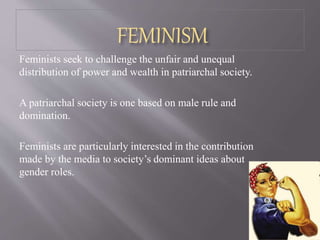
Feminists seek to challenge the unfair and unequal
distribution of power and wealth in patriarchal society.
A patriarchal society is one based on male rule and
domination.
Feminists are particularly interested in the contribution
made by the media to society’s dominant ideas about
gender roles.
 Eco feminism.
 Socialist feminism.
 Cultural feminism
 Liberal feminism.
 Radical feminism.
 Eco-feminism is a social and political
movement which unites environmentalism and
feminism.
Eco-feminists believe that these connections are
illustrated through traditionally "female"
values such as reciprocity, nurturing and
cooperation, which are present both among
women and in nature.
 Socialist feminists reject radical feminism’s
main claim that patriarchy is the only or
primary source of oppression of women.
Rather, socialist feminists assert that women
are unable to be free due to their financial
dependence on males in society.
 It is developed from radical feminism, although they hold
many opposing views. It is also a feminist theory of
difference that praises the positive aspect of women. As
radical feminism died out as a movement, cultural feminism
got rolling.
Cultural feminism believes in encouraging feminine
behavior rather than masculine behavior.
For example, the belief that "women are kinder and gentler
than men," prompts cultural feminists call for an invasion of
women's culture into the male-dominated world, which
would presumably result in less violence and fewer wars.
 Feminists strive for sexual equality via down
to earth political and legal reform. Liberal
feminism is a form of feminism that argues that
equality for women can be achieved through
legal means and social reform.
 Radical feminism is a movement that believes
sexism is so deeply rooted in society that the only
cure is to eliminate the concept of gender
completely. How would this be possible?
 Radical feminists suggest changes, such as finding
technology that will allow babies to be grown
outside of a woman's body, to promote more
equality between men and women. This will allow
women to avoid missing work for maternity leave,
which radical feminists argue is one reason women
aren't promoted as quickly as men
first wave feminism
 Mid 19th – early 20th century.
 Fight for social and political
equality.
 Struggle for women’s
suffrage (right to vote)
 Key concerns included
education, employment and
marriage laws.
 Successes – higher education
for women, married women’s
property rights and the
widening of access to
professions such as medicine.
 Liberation movement of 1960s and 1970s.
 Characterised by struggles for equal pay, equal
rights at work and better representation in
public bodies such as Parliament.
 Access to contraception.
 Highly publicised activism.
 Miss America 1968
 Stereotype of humourless, dowdy, man-hating
feminist.
 1980s and 1990s
 Less emphasis on battles for equality
 More emphasis on the positive nature of
ambiguity and difference (not all women are
the same, it doesn’t matter)
 Spice girls and girl power
 Empowering heroines – Buffy and Xena.
 We exist in a political and social system that is male
dominated: Patriarchy
 In order for women to experience changes in personal
lives, political changes (to social institutions) must
occur
 Gender schemas/sex-role stereotypes limit
development
• In society, men have more power than women
• Women are taught to rely on men
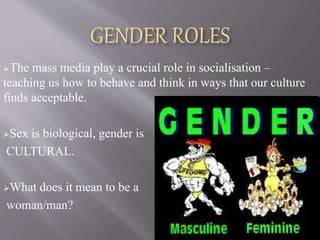
GENDER ROLES
The mass media play a crucial role in socialisation –
teaching us how to behave and think in ways that our culture
finds acceptable.
Sex is biological, gender is
CULTURAL.
What does it mean to be a
woman/man?

Feminism

  • 2.
    Presented by: MSaffi Ullah
  • 3.
    What is feminism? Typesof feminism  Waves of feminism Improvements Assumptions about Human Nature Gender role?
  • 4.
    FEMINISM Feminists seek tochallenge the unfair and unequal distribution of power and wealth in patriarchal society. A patriarchal society is one based on male rule and domination. Feminists are particularly interested in the contribution made by the media to society’s dominant ideas about gender roles.
  • 5.
     Eco feminism. Socialist feminism.  Cultural feminism  Liberal feminism.  Radical feminism.
  • 6.
     Eco-feminism isa social and political movement which unites environmentalism and feminism. Eco-feminists believe that these connections are illustrated through traditionally "female" values such as reciprocity, nurturing and cooperation, which are present both among women and in nature.
  • 7.
     Socialist feministsreject radical feminism’s main claim that patriarchy is the only or primary source of oppression of women. Rather, socialist feminists assert that women are unable to be free due to their financial dependence on males in society.
  • 8.
     It isdeveloped from radical feminism, although they hold many opposing views. It is also a feminist theory of difference that praises the positive aspect of women. As radical feminism died out as a movement, cultural feminism got rolling. Cultural feminism believes in encouraging feminine behavior rather than masculine behavior. For example, the belief that "women are kinder and gentler than men," prompts cultural feminists call for an invasion of women's culture into the male-dominated world, which would presumably result in less violence and fewer wars.
  • 9.
     Feminists strivefor sexual equality via down to earth political and legal reform. Liberal feminism is a form of feminism that argues that equality for women can be achieved through legal means and social reform.
  • 10.
     Radical feminismis a movement that believes sexism is so deeply rooted in society that the only cure is to eliminate the concept of gender completely. How would this be possible?  Radical feminists suggest changes, such as finding technology that will allow babies to be grown outside of a woman's body, to promote more equality between men and women. This will allow women to avoid missing work for maternity leave, which radical feminists argue is one reason women aren't promoted as quickly as men
  • 11.
    first wave feminism Mid 19th – early 20th century.  Fight for social and political equality.  Struggle for women’s suffrage (right to vote)  Key concerns included education, employment and marriage laws.  Successes – higher education for women, married women’s property rights and the widening of access to professions such as medicine.
  • 12.
     Liberation movementof 1960s and 1970s.  Characterised by struggles for equal pay, equal rights at work and better representation in public bodies such as Parliament.  Access to contraception.  Highly publicised activism.  Miss America 1968  Stereotype of humourless, dowdy, man-hating feminist.
  • 13.
     1980s and1990s  Less emphasis on battles for equality  More emphasis on the positive nature of ambiguity and difference (not all women are the same, it doesn’t matter)  Spice girls and girl power  Empowering heroines – Buffy and Xena.
  • 14.
     We existin a political and social system that is male dominated: Patriarchy  In order for women to experience changes in personal lives, political changes (to social institutions) must occur  Gender schemas/sex-role stereotypes limit development • In society, men have more power than women • Women are taught to rely on men
  • 15.
    GENDER ROLES The massmedia play a crucial role in socialisation – teaching us how to behave and think in ways that our culture finds acceptable. Sex is biological, gender is CULTURAL. What does it mean to be a woman/man?