FEMALE REPRODUCTIVE SYSTEM
GROSS ANATOMY OF THE FEMALE
REPRODUCTIVE
SYSTEM
 The ovaries are solid,
ovoid structures, about
2 cm in length and 1
cm in width.
 Like the testes, they
develop from
embryonic tissue.
 Accessory organs
include the uterine
tubes, uterus, and
vagina.
3
UTERINE
TUBES(FALLOPIAN TUBES)
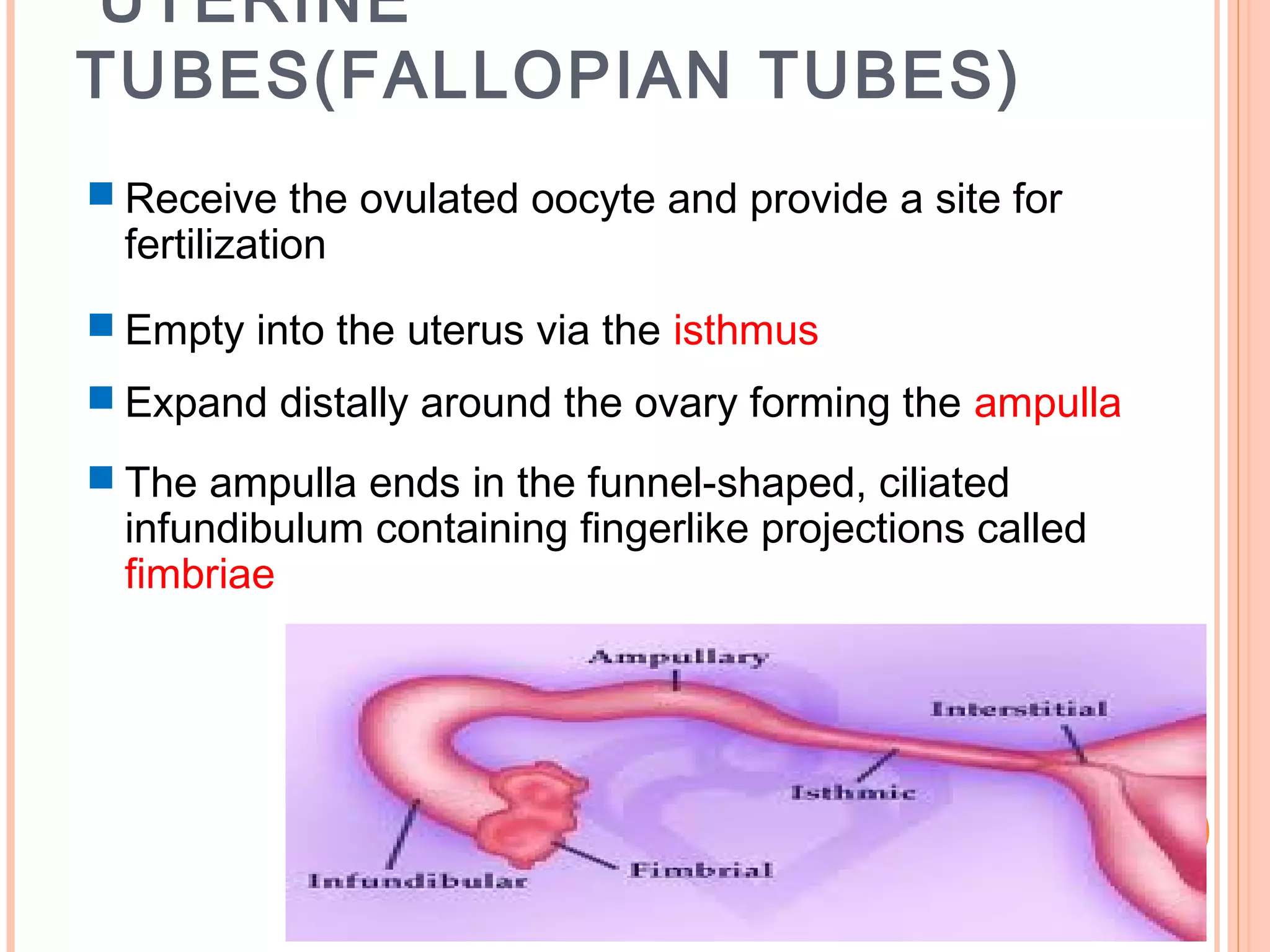
 Receive the ovulated oocyte and provide a site for
fertilization
 Empty into the uterus via the isthmus
 Expand distally around the ovary forming the ampulla
 The ampulla ends in the funnel-shaped, ciliated
infundibulum containing fingerlike projections called
fimbriae
4
UTERINE TUBES (FALLOPIAN
TUBES)
 Function: events occurring in the uterine tube
●Fimbriae sweep oocyte into tube, cilia &
peristalsis move it along, sperm
reaches oocyte in ampulla,
fertilization occurs within 24 hours after
ovulation & zygote reaches uterus
about 7 days after ovulation
5
FALLOPIAN TUBE
HISTOLOGY
Cilia sweep egg/zygote toward the uterus
6
UTERUS
● Hollow, thick-walled organ located in the pelvis
anterior to the rectum and posterosuperior to the
bladder
● Body: Major portion of the uterus
● Fundus: Rounded region superior to the entrance of
the uterine tubes
● Isthmus: Narrowed region between the body and
cervix
7
UTERUS
8
UTERINE HISTOLOGY
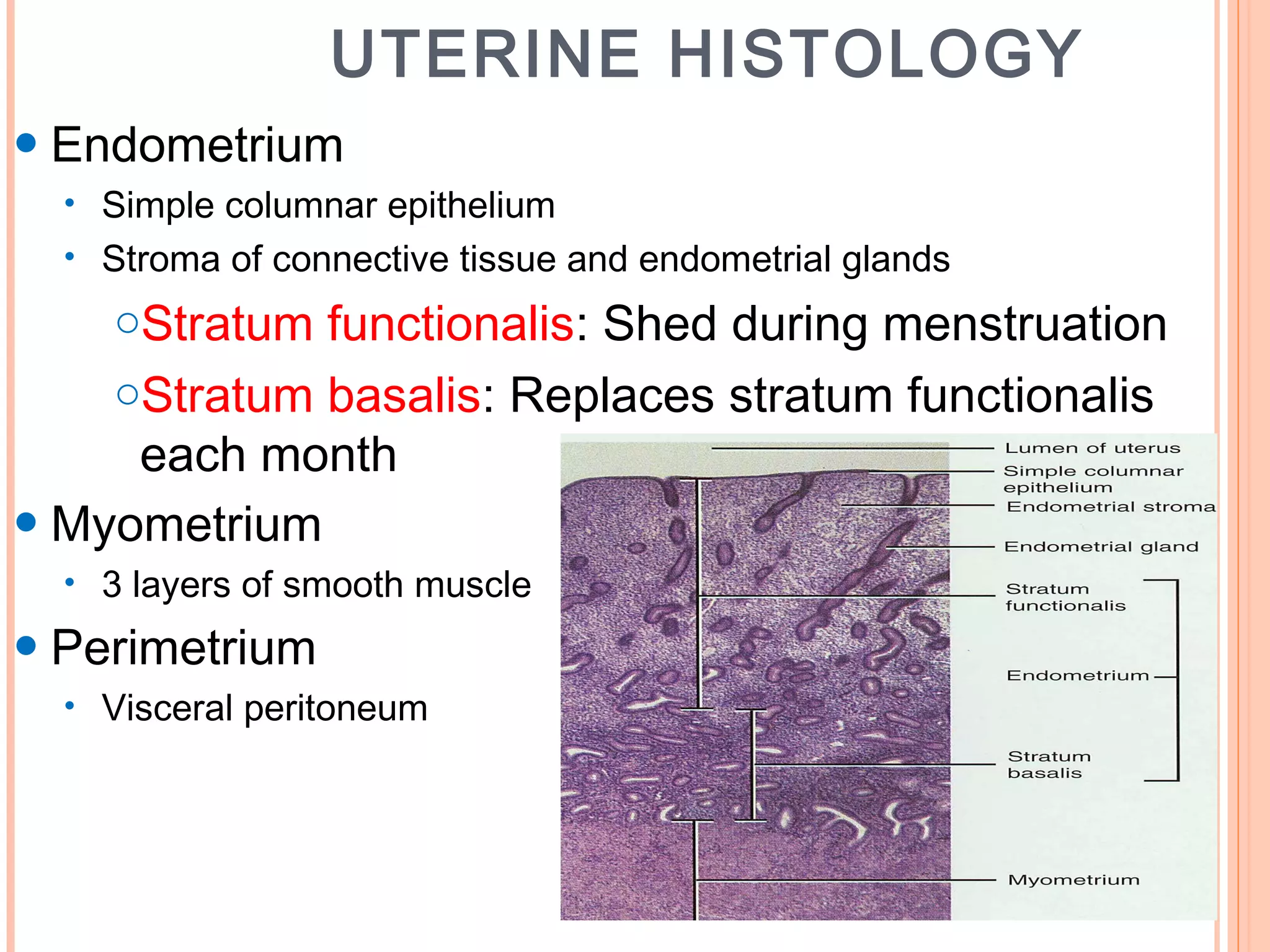
● Endometrium
• Simple columnar epithelium
• Stroma of connective tissue and endometrial glands
oStratum functionalis: Shed during menstruation
oStratum basalis: Replaces stratum functionalis
each month
● Myometrium
• 3 layers of smooth muscle
● Perimetrium
• Visceral peritoneum
9
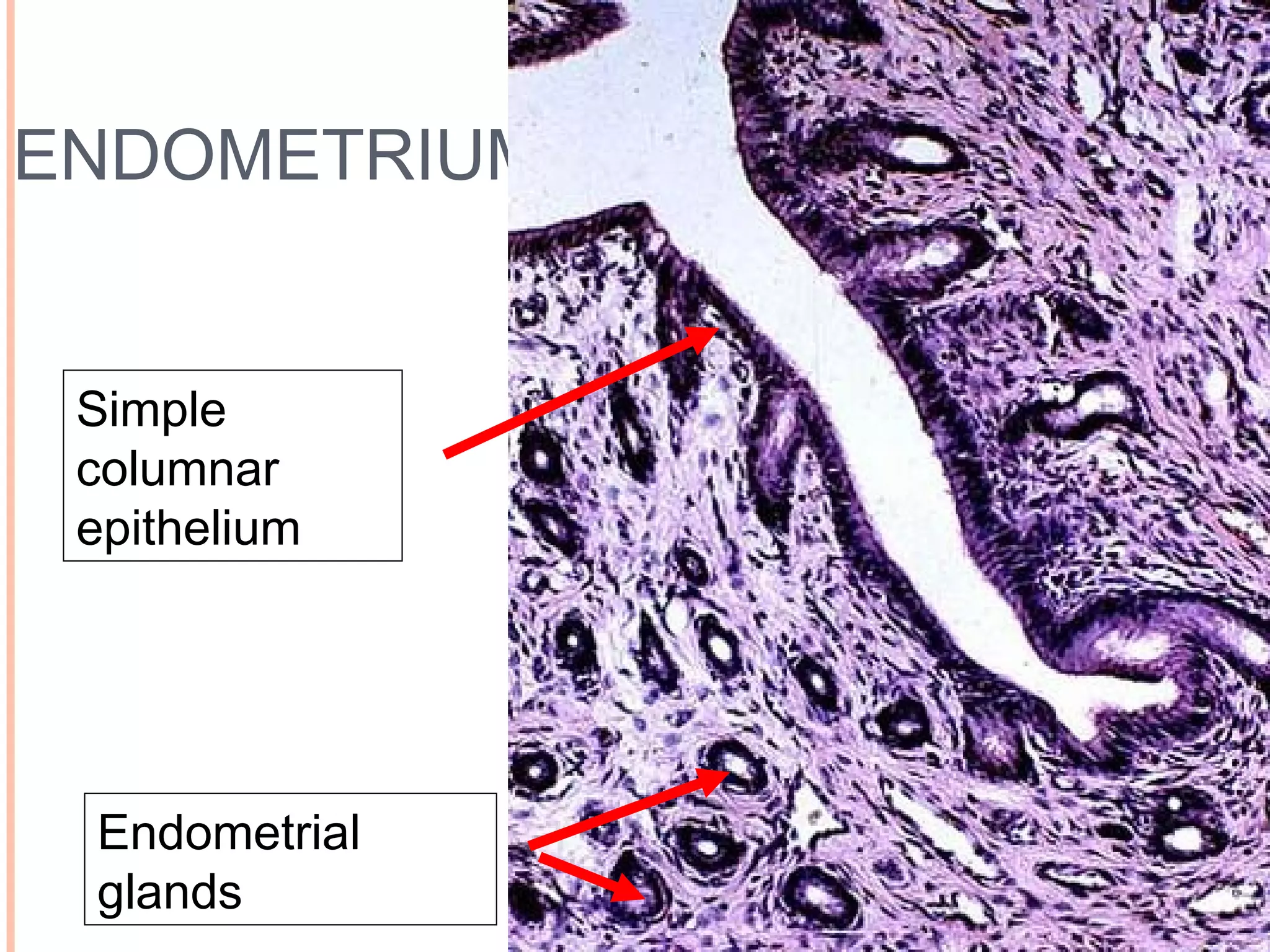
ENDOMETRIUM
Simple
columnar
epithelium
Endometrial
glands
ENDOMETRIUM
● Proliferative phase:
glands and blood vessels
scattered throughout the
functional zone with little
or no branching.
● New glands form and
endometrium thickens.
● Secretory phase:
glands are enlarged and
have branches.
Preparing the
endometrium for
implantation
● If no implantation then
endometrium breaks
down and menstruation
begins.
11
12
CERVIX
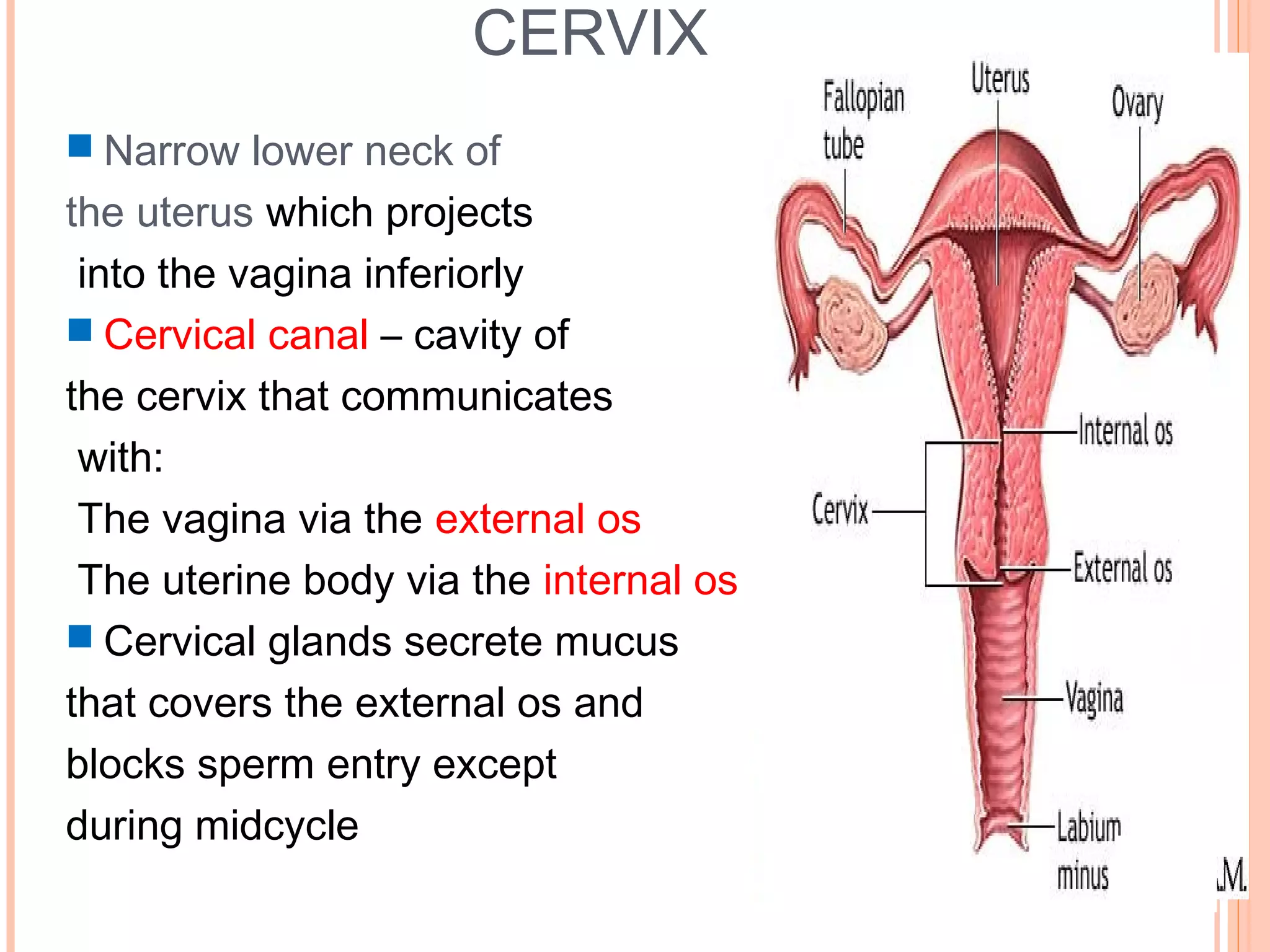
 Narrow lower neck of
the uterus which projects
into the vagina inferiorly
 Cervical canal – cavity of
the cervix that communicates
with:
The vagina via the external os
The uterine body via the internal os
 Cervical glands secrete mucus
that covers the external os and
blocks sperm entry except
during midcycle
13
VAGINA
● Thin-walled tube lying between the bladder and the
rectum, extending from the cervix to the exterior of the
body
● Wall consists of three coats: fibroelastic adventitia,
smooth muscle muscularis, and a stratified squamous
mucosa
● Mucosa near the vaginal orifice forms an incomplete
partition called the hymen
● Vaginal fornix: upper end of the vagina surrounding
the cervix
14
FEMALE EXTERNAL
GENITALIA
 Mons pubis: fatty pad over the pubic symphysis
 Labia majora & minora: folds of skin encircling vestibule
where find urethral and vaginal openings
 Clitoris: small mass of erectile tissue
 Bulb of vestibule: masses of erectile tissue just deep to
the labia on either side of the vaginal orifice
 Perineum: Area between the vagina and anus
15
OVARIES
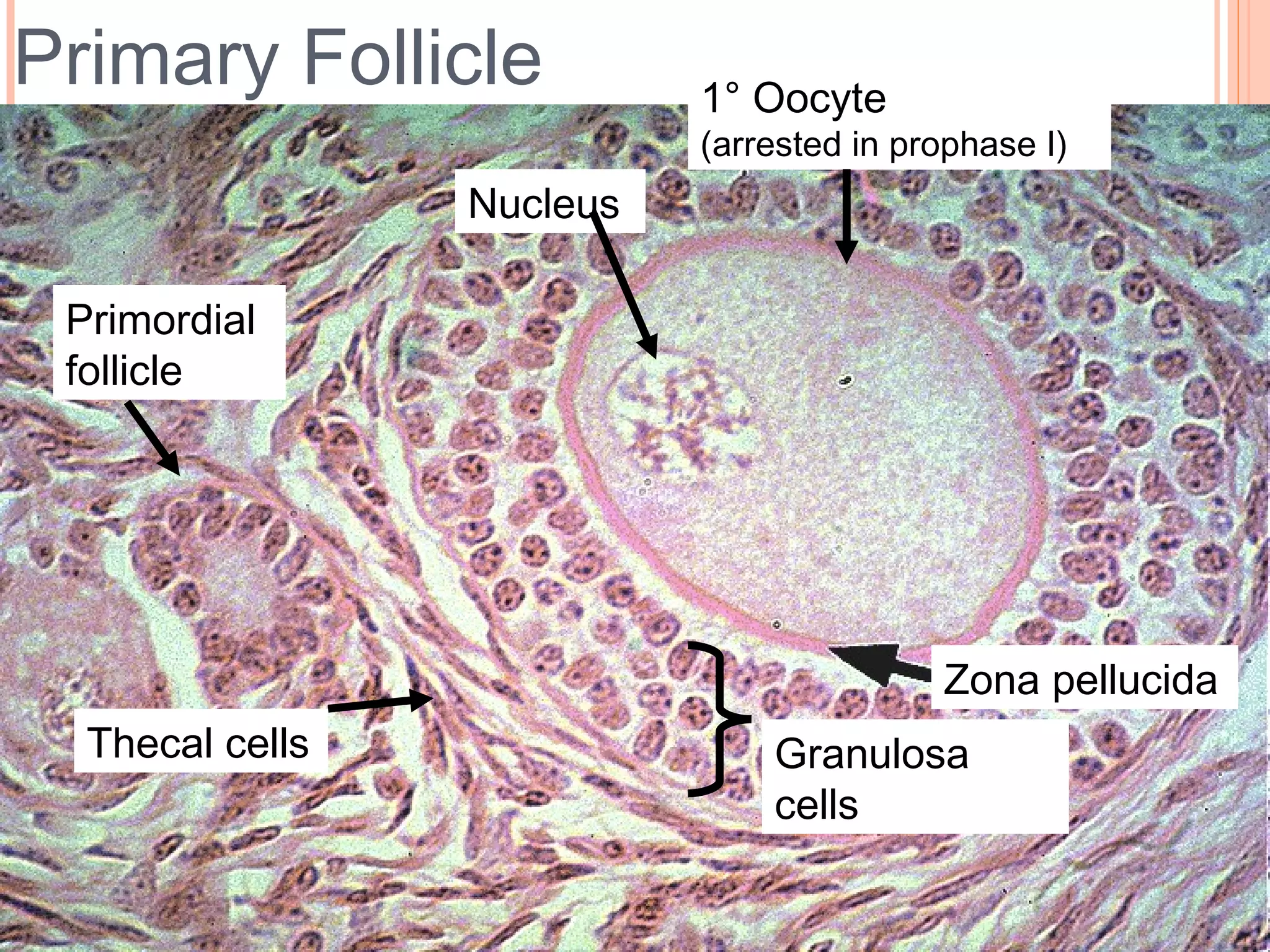
 Each follicle consists of an immature egg called an
oocyte
 Cells around the oocyte are called:
● Follicle cells (one cell layer thick)
● Stimulated to mature by FSH from the pituitary gland
● Granulosa cells (when more than one layer is present)
● Thecal cells: Cells in the ovarian stroma
 Thecal & granulosa cells work together to produce
estrogen
 A protective layer of glycoprotein forms around the
egg called the zona pellucida
16
OVARY HISTOLOGY
17
Zona pellucida
1° Oocyte
(arrested in prophase I)
Granulosa
cells
Thecal cells
Nucleus
Primordial
follicle
Primary Follicle
18
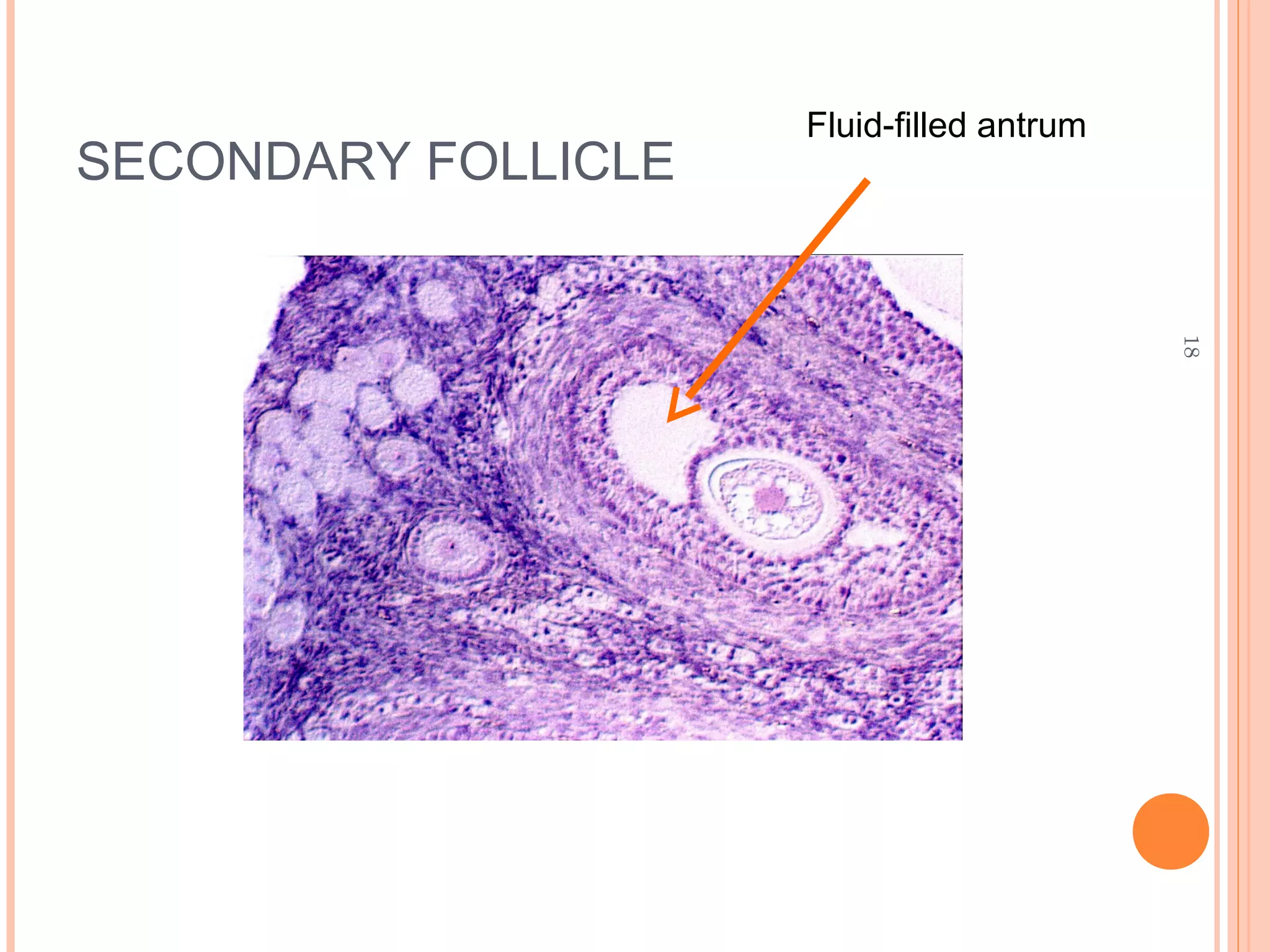
SECONDARY FOLLICLE
Fluid-filled antrum
19
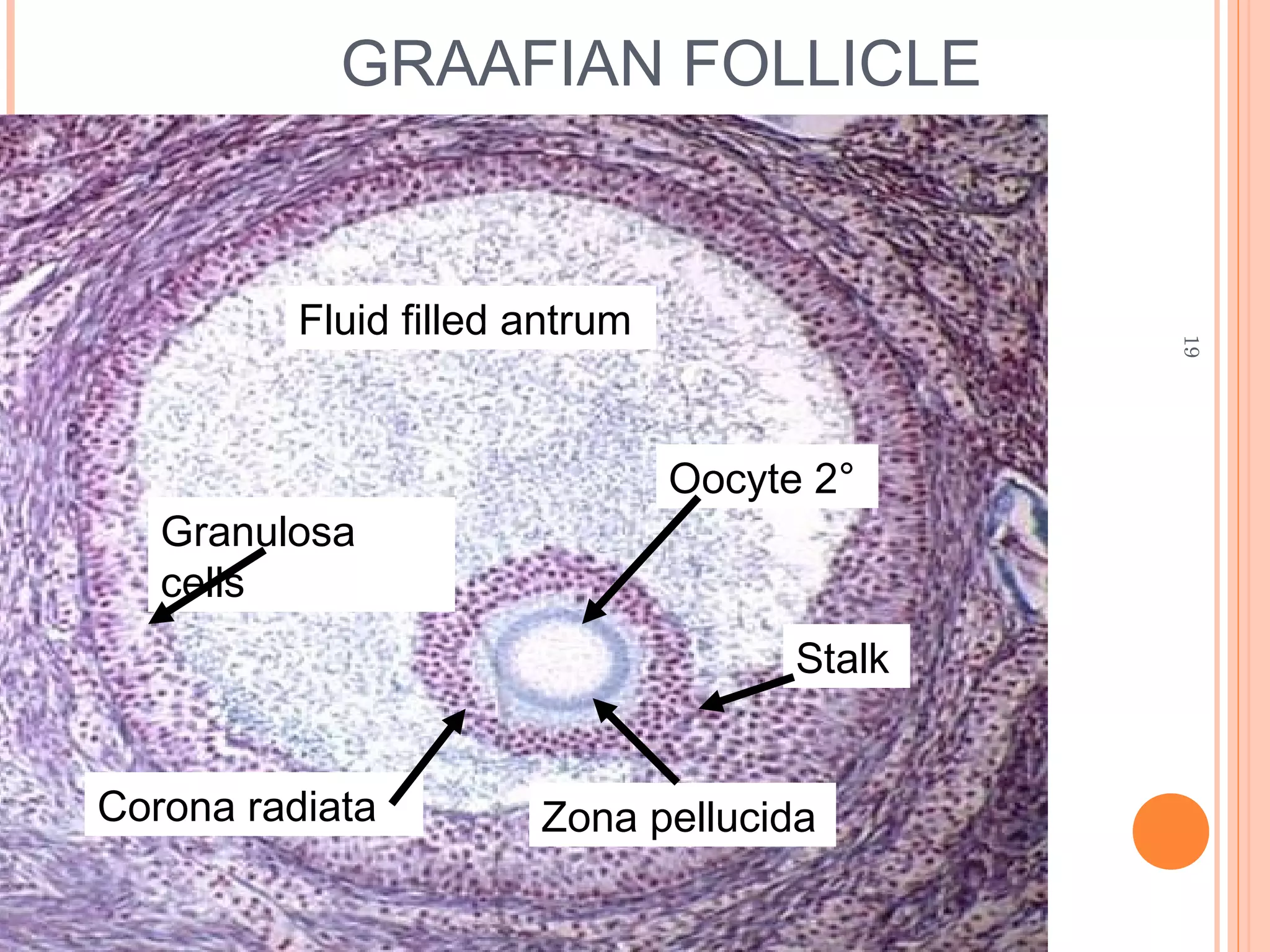
GRAAFIAN FOLLICLE
Fluid filled antrum
Granulosa
cells
Oocyte 2°
Corona radiata
Stalk
Zona pellucida
CORPUS LUTEUM
● After ovulation, the
remains of the follicle
are transformed into a
structure called the
corpus luteum.
● If a pregnancy occurs,
it produces
progesterone to
maintain the wall of the
uterus during the early
period of development.
CORPUS ALBICANS
● If fertilization does not
occur, the corpus
luteum will begin to
break down about 2
weeks after ovulation.
● Degeneration occurs
when fibroblasts enter
the corpus luteum and
a clump of scar tissue
forms called the
corpus albicans.
FEMALE
REPRODUCTION
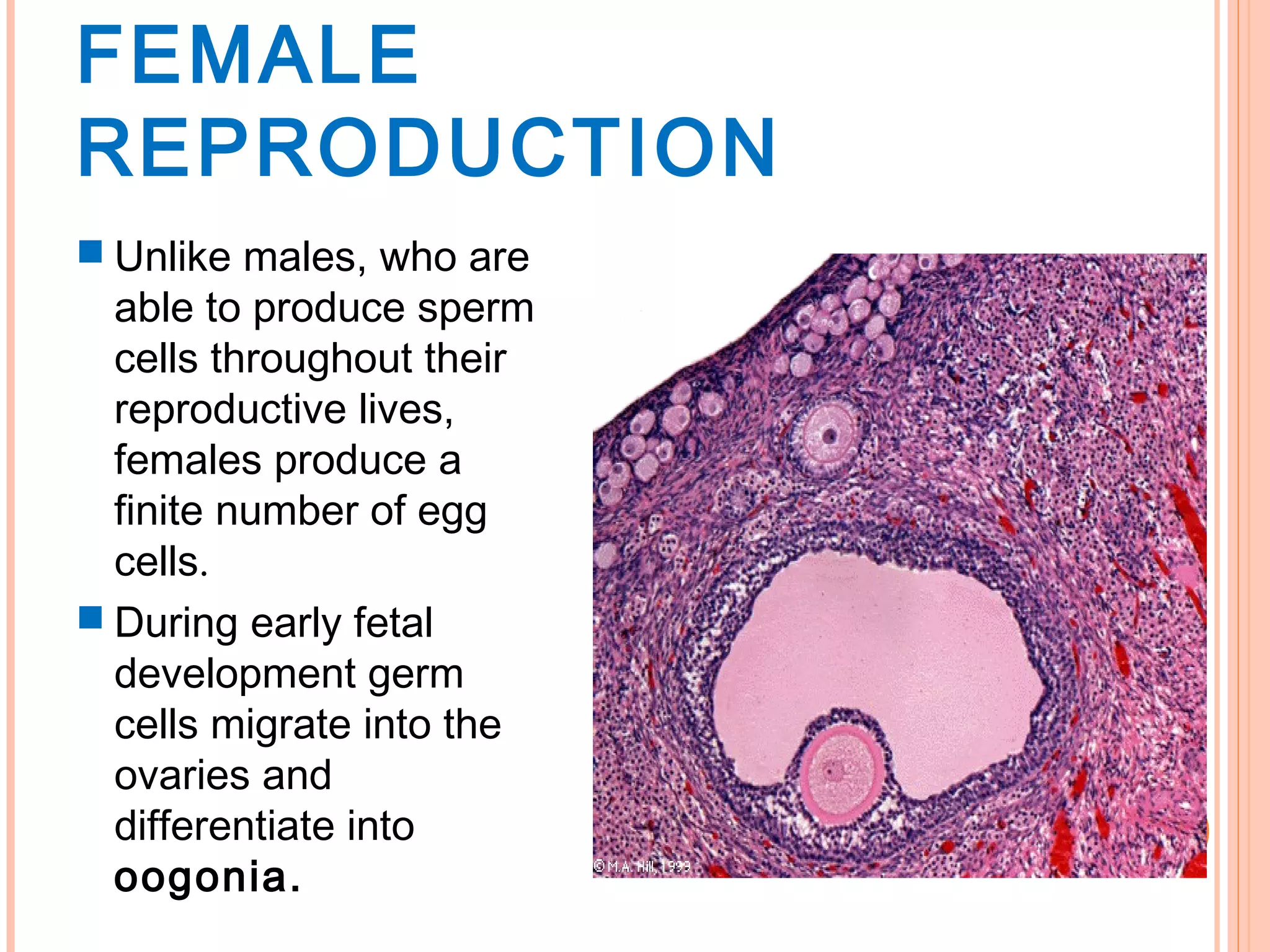
 Unlike males, who are
able to produce sperm
cells throughout their
reproductive lives,
females produce a
finite number of egg
cells.
 During early fetal
development germ
cells migrate into the
ovaries and
differentiate into
oogonia.
TODAY’S
ASSIGNMENT
 View female reproductive organs on the models.
 View slides of ovaries, fallopian tubes, uterus.
& Attention
Menstrual cycle:-
 The cyclic changes that occur in the
reproductive organs of primate
females(monkeys, apes , human beings
, constitute the menstrual cycle).
 The cycle of events starts from one
menstruation till the onset of the next
and lasts for about 28 or 29 days(a
mensem, means a month).
 The peculiar feature of this cycle is the
periodic vaginal bleeding called
menstruation which lasts for about
3-5 days.
 The menstruation in human female
begins at puberty and is called
menarche.
 In females successive cycles may vary
in length by 1-2 days.
 It is absent during pregnancy, may be
suppressed during lactation and
permanantely stops at menopause
What is the menstrual cycle?
 The process in which females ripen or
release one mature egg.
 The average menstrual cycle will repeat
itself about every 28 days, but normal
menstrual cycles can range from 21 to 40
days.
 The menstrual cycle is the regular natural
change that occurs in the female
reproductive system (specifically the
uterus and ovaries).
 The cycle is required for the production of
ovocytes,and for the preparation of the
uterus for pregnancy.
 Up to 80% of woman report having
some symptoms during the one to two
weeks prior to menstruation.
 Common symptoms include ace, tender
breasts, bloating, feeling tired, irritability
and mood changes. These symptoms
interfere in normal life.
 The first period usually begins between
twelve and fifteen years of age, a point
of time known as menarche.
 They may occasionally start as early as
eight, and this onset may still be
normal.
 Next period may occur in 21-45 days in
young women and 21-35 days in adults.
 The menstrual cycle is governed by
hormonal changes.
 This changes can be altered by using
hormonal birth control to prevent
pregnancy.
 Each cycle can be divided into three
phases based on events in the ovary or
in the uterus.
 The ovarian cycle consists of the
follicular phase, ovulation and luteal
phase.
 The uterine cycle is divided into
menstruation, proliferative phase, and
secretory phase.
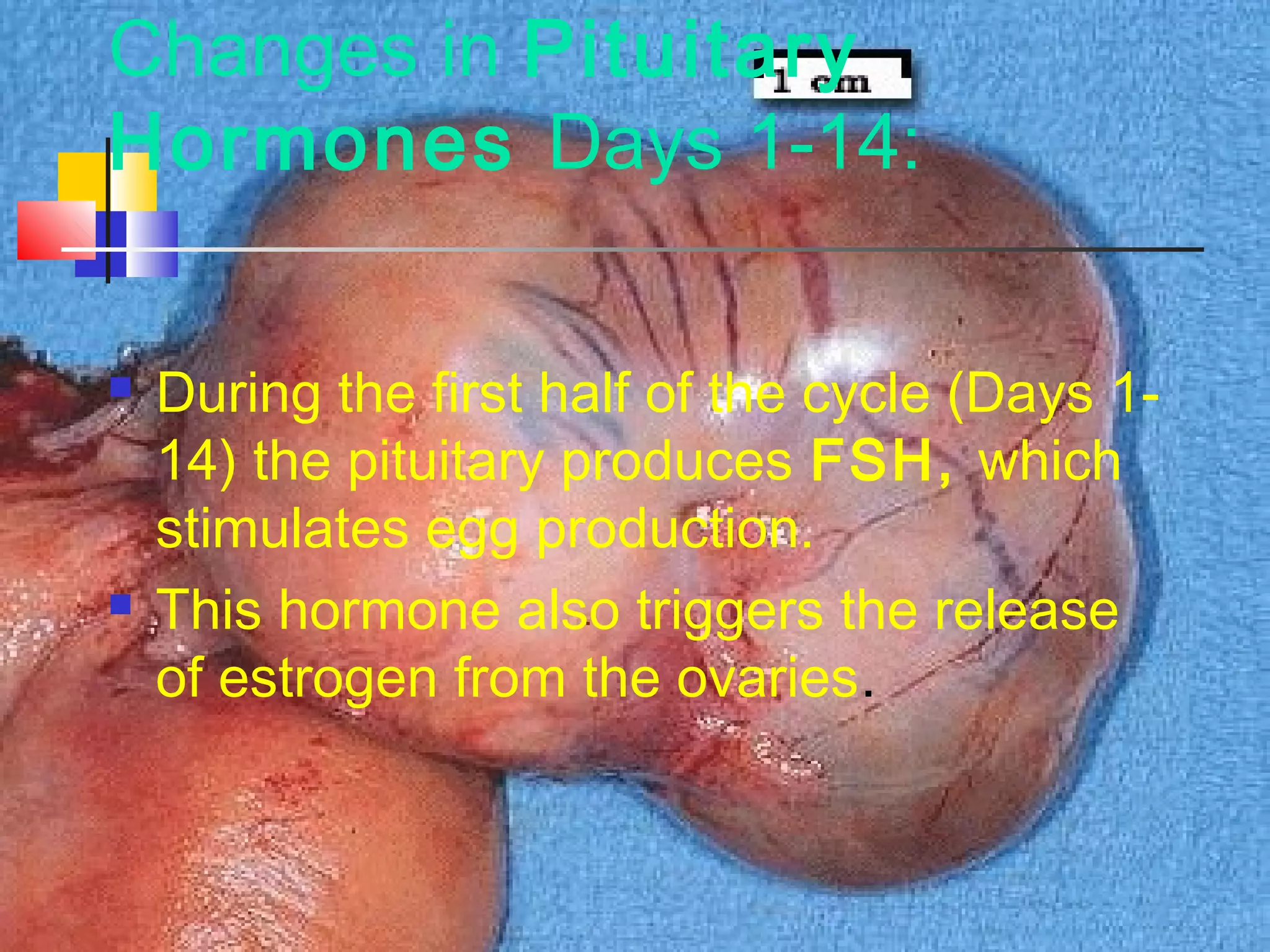
Changes in Pituitary
Hormones Days 1-14:
 During the first half of the cycle (Days 1-
14) the pituitary produces FSH, which
stimulates egg production.
 This hormone also triggers the release
of estrogen from the ovaries.
Changes in Pituitary Hormones
Days 14-28:
 On the 14th day the pituitary begins releasing
LH causing ovulation.
 LH also directs the production of
progesterone which maintains the growth of
the endometrium.
 If the egg is not fertilized upon arrival in the
uterus progesterone levels drop causing
estrogen levels to drop leading to
menstruation.
Pituitary Hormones
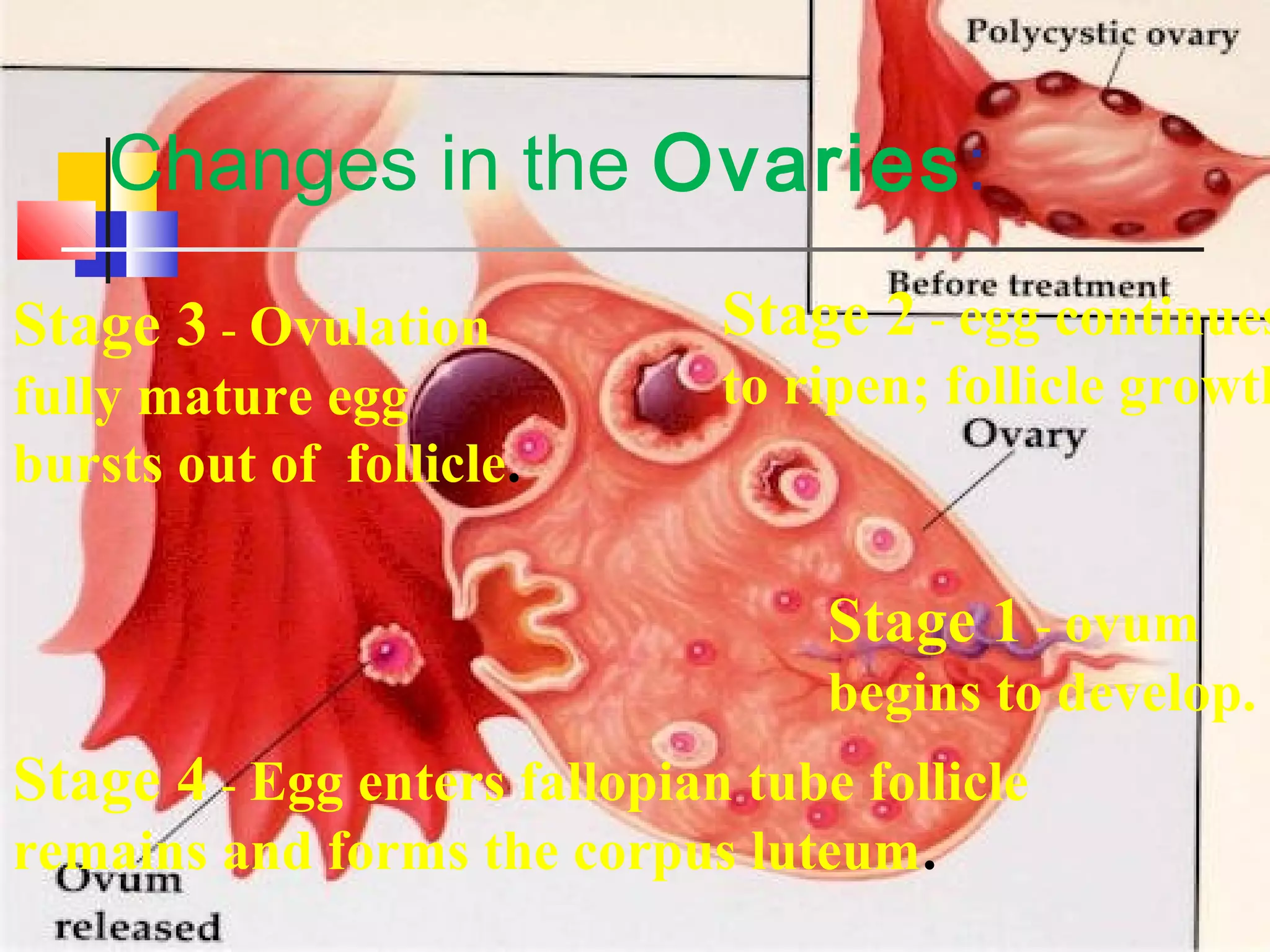
Changes in the Ovaries:
Stage 1 - ovum
begins to develop.
Stage 2 - egg continues
to ripen; follicle growth
Stage 3 - Ovulation
fully mature egg
bursts out of follicle.
Stage 4 - Egg enters fallopian tube follicle
remains and forms the corpus luteum.
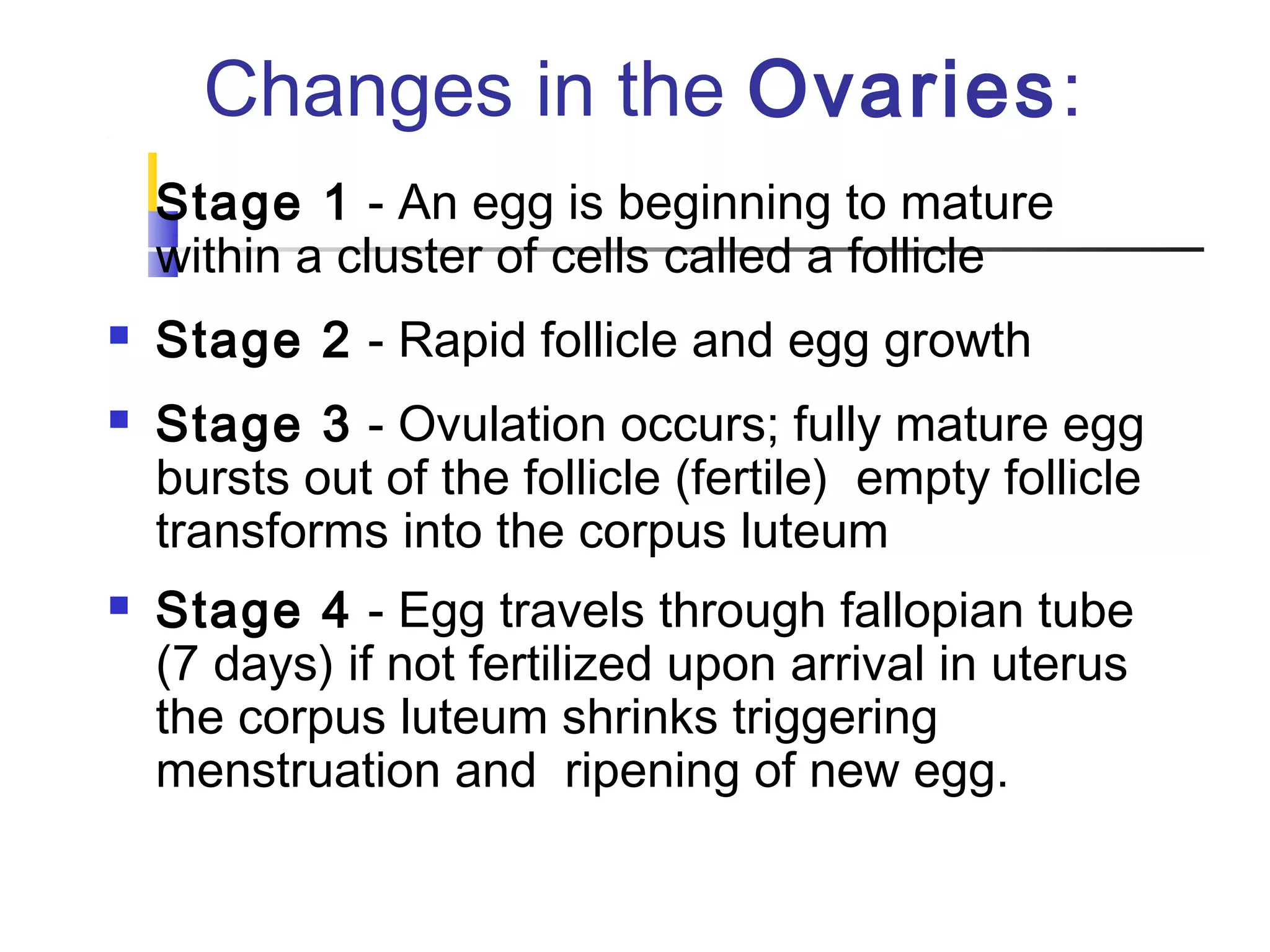
Changes in the Ovaries:
 Stage 1 - An egg is beginning to mature
within a cluster of cells called a follicle
 Stage 2 - Rapid follicle and egg growth
 Stage 3 - Ovulation occurs; fully mature egg
bursts out of the follicle (fertile) empty follicle
transforms into the corpus luteum
 Stage 4 - Egg travels through fallopian tube
(7 days) if not fertilized upon arrival in uterus
the corpus luteum shrinks triggering
menstruation and ripening of new egg.
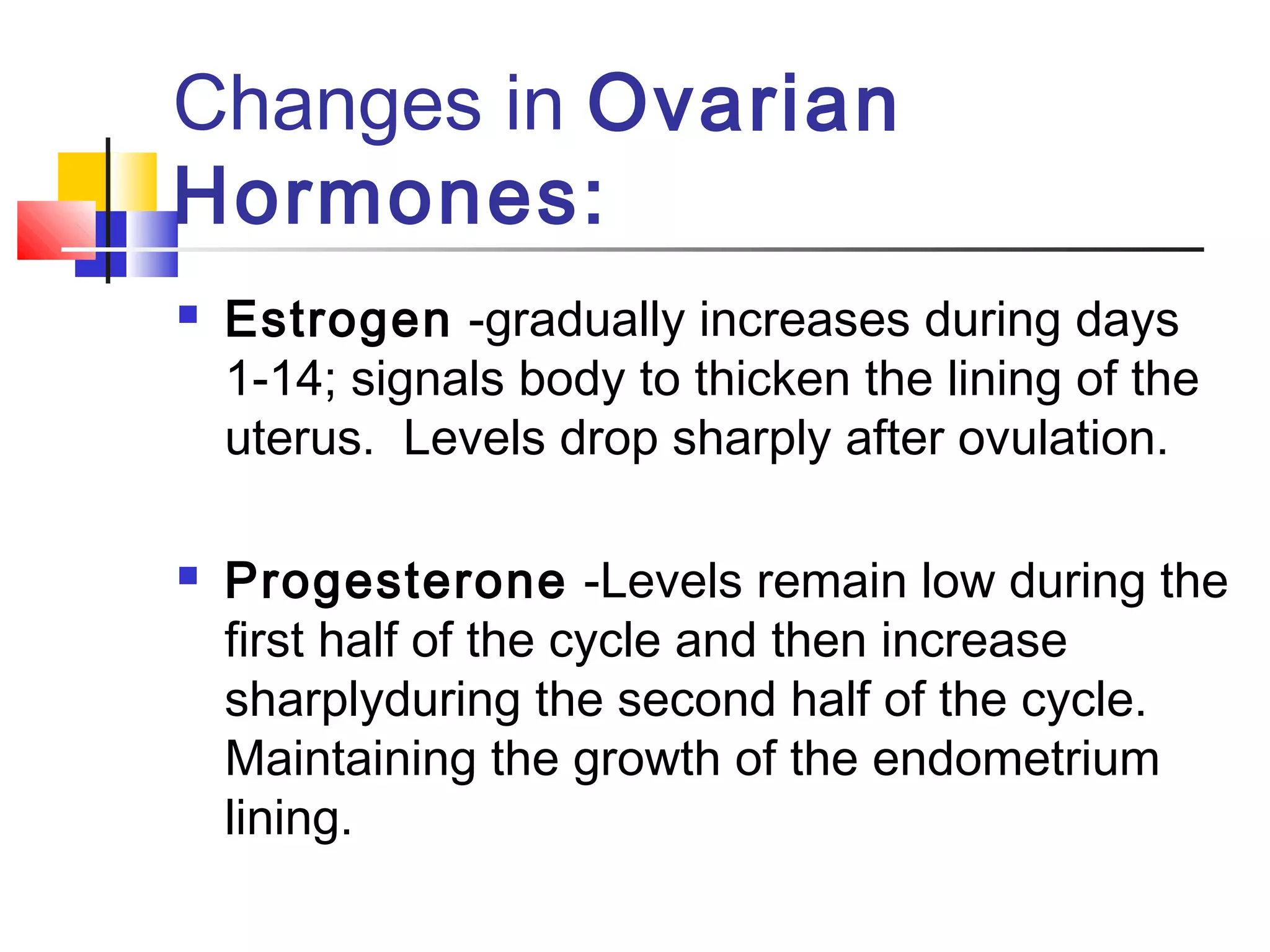
Changes in Ovarian
Hormones:
 Estrogen -gradually increases during days
1-14; signals body to thicken the lining of the
uterus. Levels drop sharply after ovulation.
 Progesterone -Levels remain low during the
first half of the cycle and then increase
sharplyduring the second half of the cycle.
Maintaining the growth of the endometrium
lining.
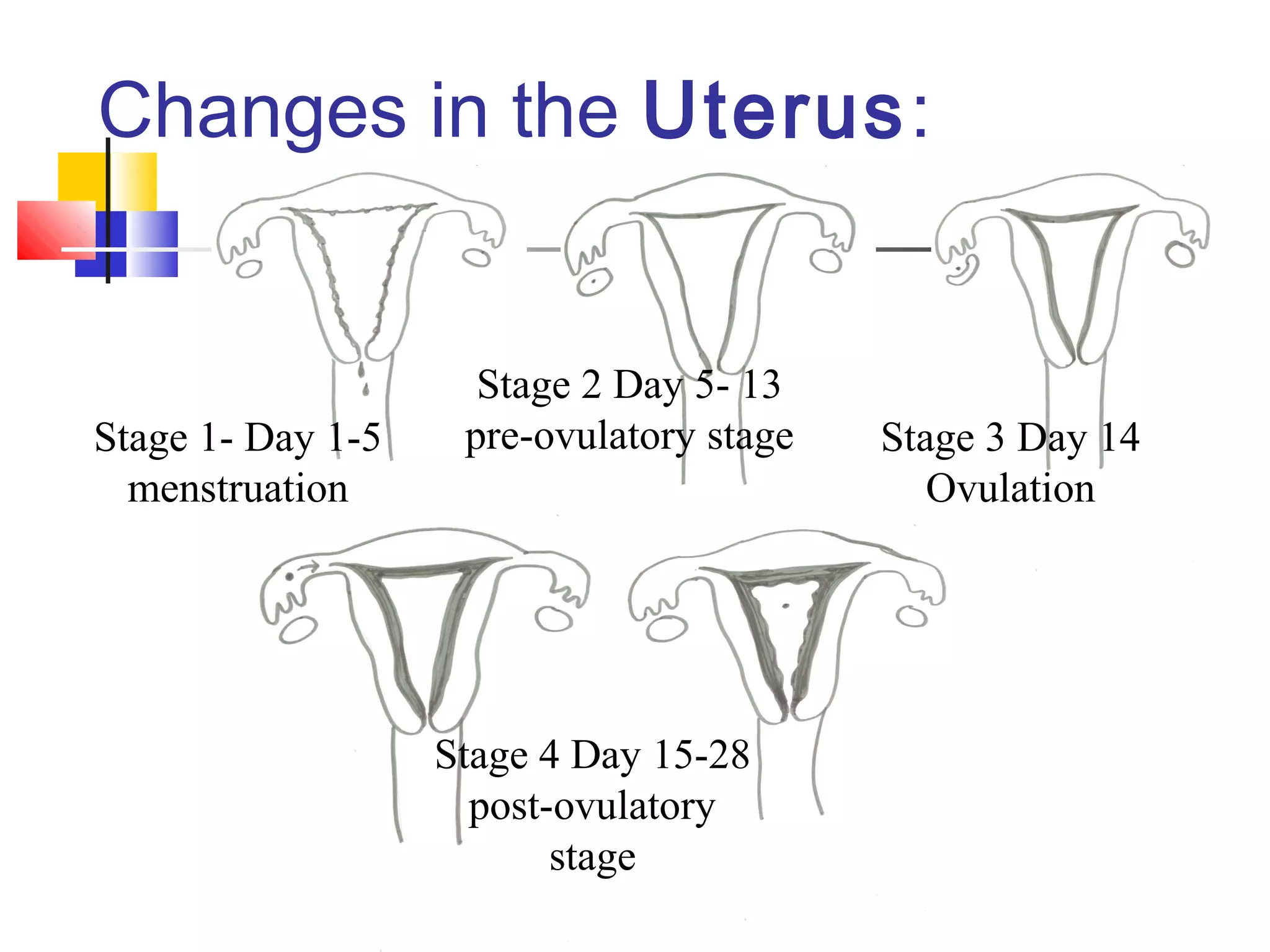
Changes in the Uterus:
Stage 1- Day 1-5
menstruation
Stage 2 Day 5- 13
pre-ovulatory stage Stage 3 Day 14
Ovulation
Stage 4 Day 15-28
post-ovulatory
stage
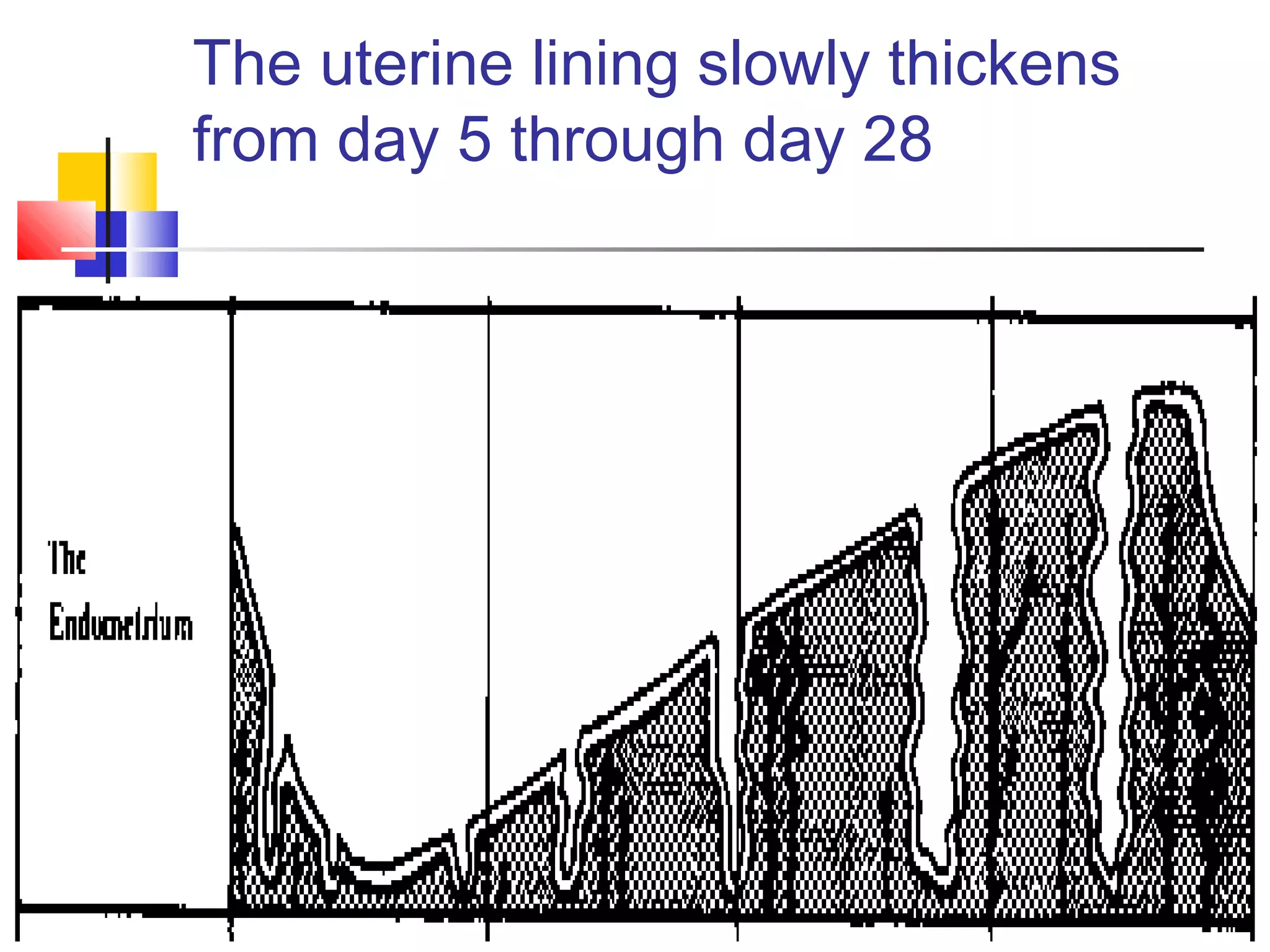
The uterine lining slowly thickens
from day 5 through day 28
Changes in the Uterus:
 Stage 1- Menstruation- Endometrium
breaks down and blood, mucus, tissue,
and the egg are shed through the
vagina.
 Stage 2- Menstrual flow stops &
endometrium begins to thicken.
 Stage 3- Endometrium continues to
thicken.
 Stage 4- The endometrium is at it’s
thickest point.
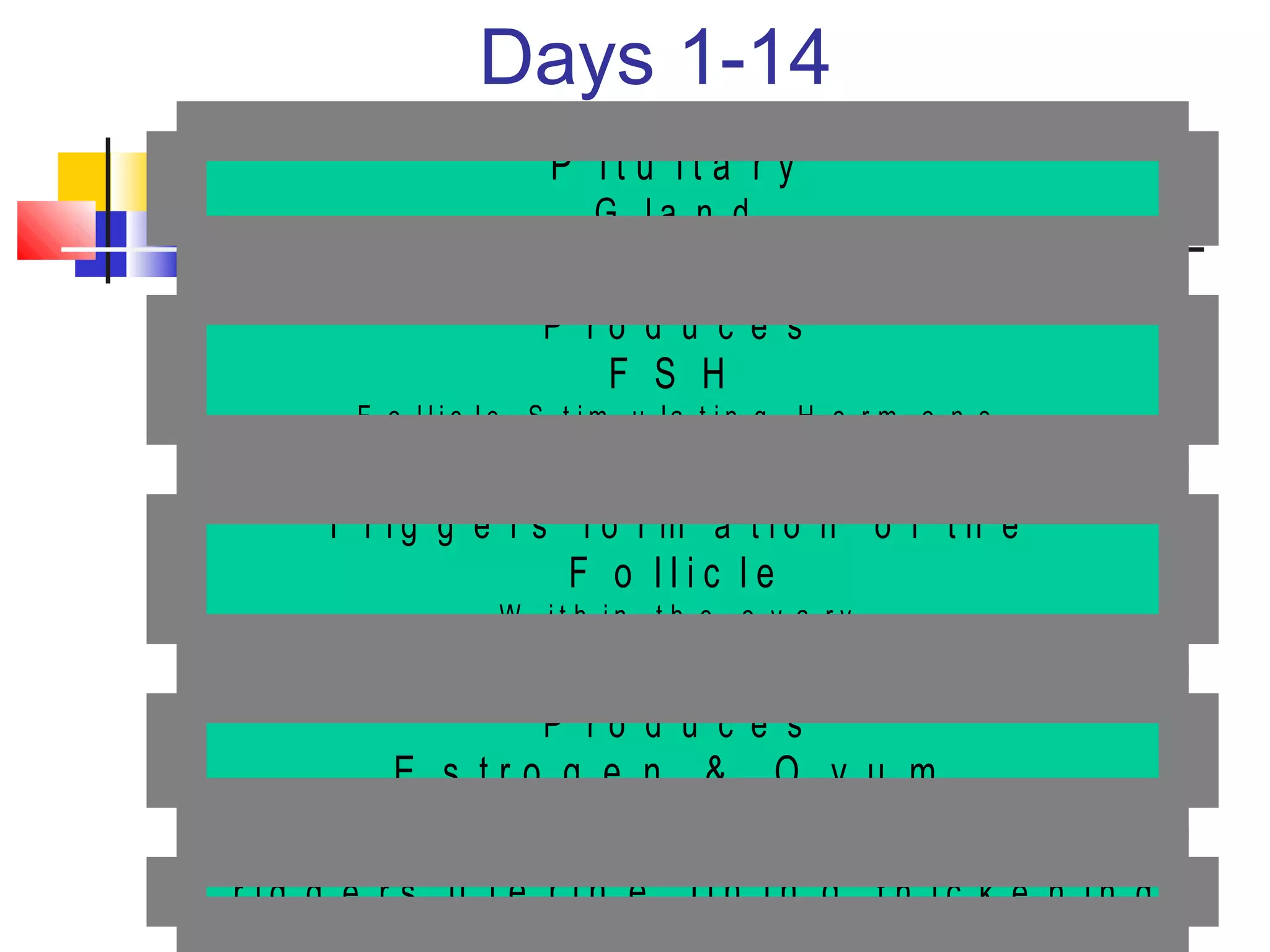
Ovarian Hormones
Days 1-14
T r i g g e r s u t e r i n e l i n i n g t h i c k e n i n g
P r o d u c e s
E s t r o g e n & O v u m
T r i g g e r s f o r m a t i o n o f t h e
F o l l i c l e
W i t h i n t h e o v a r y
P r o d u c e s
F S H
F o l l i c l e S t i m u la t i n g H o r m o n e
P i t u i t a r y
G l a n d
Days 14 - 28
C o n t i n u e s u t e r i n e l i n i n g t h i c k e n i n g
P r o d u c e s
P r o g e s t e r o n e
T r i g g e r s O v u l a t i o n
a n d t h e f o r m a t i o n o f t h e
C o r p u s L u t i u m
W i t h i n t h e o v a r y
P r o d u c e s
L H
L u t i n i z i n g H o r m o n e
P i t u i t a r y
G l a n d
Female reprod sys.ppt

Female reprod sys.ppt

  • 1.
  • 2.
    GROSS ANATOMY OFTHE FEMALE REPRODUCTIVE SYSTEM  The ovaries are solid, ovoid structures, about 2 cm in length and 1 cm in width.  Like the testes, they develop from embryonic tissue.  Accessory organs include the uterine tubes, uterus, and vagina.
  • 3.
    3 UTERINE TUBES(FALLOPIAN TUBES)  Receivethe ovulated oocyte and provide a site for fertilization  Empty into the uterus via the isthmus  Expand distally around the ovary forming the ampulla  The ampulla ends in the funnel-shaped, ciliated infundibulum containing fingerlike projections called fimbriae
  • 4.
    4 UTERINE TUBES (FALLOPIAN TUBES) Function: events occurring in the uterine tube ●Fimbriae sweep oocyte into tube, cilia & peristalsis move it along, sperm reaches oocyte in ampulla, fertilization occurs within 24 hours after ovulation & zygote reaches uterus about 7 days after ovulation
  • 5.
    5 FALLOPIAN TUBE HISTOLOGY Cilia sweepegg/zygote toward the uterus
  • 6.
    6 UTERUS ● Hollow, thick-walledorgan located in the pelvis anterior to the rectum and posterosuperior to the bladder ● Body: Major portion of the uterus ● Fundus: Rounded region superior to the entrance of the uterine tubes ● Isthmus: Narrowed region between the body and cervix
  • 7.
  • 8.
    8 UTERINE HISTOLOGY ● Endometrium •Simple columnar epithelium • Stroma of connective tissue and endometrial glands oStratum functionalis: Shed during menstruation oStratum basalis: Replaces stratum functionalis each month ● Myometrium • 3 layers of smooth muscle ● Perimetrium • Visceral peritoneum
  • 9.
  • 10.
    ENDOMETRIUM ● Proliferative phase: glandsand blood vessels scattered throughout the functional zone with little or no branching. ● New glands form and endometrium thickens. ● Secretory phase: glands are enlarged and have branches. Preparing the endometrium for implantation ● If no implantation then endometrium breaks down and menstruation begins.
  • 11.
  • 12.
    12 CERVIX  Narrow lowerneck of the uterus which projects into the vagina inferiorly  Cervical canal – cavity of the cervix that communicates with: The vagina via the external os The uterine body via the internal os  Cervical glands secrete mucus that covers the external os and blocks sperm entry except during midcycle
  • 13.
    13 VAGINA ● Thin-walled tubelying between the bladder and the rectum, extending from the cervix to the exterior of the body ● Wall consists of three coats: fibroelastic adventitia, smooth muscle muscularis, and a stratified squamous mucosa ● Mucosa near the vaginal orifice forms an incomplete partition called the hymen ● Vaginal fornix: upper end of the vagina surrounding the cervix
  • 14.
    14 FEMALE EXTERNAL GENITALIA  Monspubis: fatty pad over the pubic symphysis  Labia majora & minora: folds of skin encircling vestibule where find urethral and vaginal openings  Clitoris: small mass of erectile tissue  Bulb of vestibule: masses of erectile tissue just deep to the labia on either side of the vaginal orifice  Perineum: Area between the vagina and anus
  • 15.
    15 OVARIES  Each follicleconsists of an immature egg called an oocyte  Cells around the oocyte are called: ● Follicle cells (one cell layer thick) ● Stimulated to mature by FSH from the pituitary gland ● Granulosa cells (when more than one layer is present) ● Thecal cells: Cells in the ovarian stroma  Thecal & granulosa cells work together to produce estrogen  A protective layer of glycoprotein forms around the egg called the zona pellucida
  • 16.
  • 17.
    17 Zona pellucida 1° Oocyte (arrestedin prophase I) Granulosa cells Thecal cells Nucleus Primordial follicle Primary Follicle
  • 18.
  • 19.
    19 GRAAFIAN FOLLICLE Fluid filledantrum Granulosa cells Oocyte 2° Corona radiata Stalk Zona pellucida
  • 20.
    CORPUS LUTEUM ● Afterovulation, the remains of the follicle are transformed into a structure called the corpus luteum. ● If a pregnancy occurs, it produces progesterone to maintain the wall of the uterus during the early period of development.
  • 21.
    CORPUS ALBICANS ● Iffertilization does not occur, the corpus luteum will begin to break down about 2 weeks after ovulation. ● Degeneration occurs when fibroblasts enter the corpus luteum and a clump of scar tissue forms called the corpus albicans.
  • 22.
    FEMALE REPRODUCTION  Unlike males,who are able to produce sperm cells throughout their reproductive lives, females produce a finite number of egg cells.  During early fetal development germ cells migrate into the ovaries and differentiate into oogonia.
  • 23.
    TODAY’S ASSIGNMENT  View femalereproductive organs on the models.  View slides of ovaries, fallopian tubes, uterus.
  • 24.
  • 25.
    Menstrual cycle:-  Thecyclic changes that occur in the reproductive organs of primate females(monkeys, apes , human beings , constitute the menstrual cycle).  The cycle of events starts from one menstruation till the onset of the next and lasts for about 28 or 29 days(a mensem, means a month).
  • 26.
     The peculiarfeature of this cycle is the periodic vaginal bleeding called menstruation which lasts for about 3-5 days.  The menstruation in human female begins at puberty and is called menarche.  In females successive cycles may vary in length by 1-2 days.  It is absent during pregnancy, may be suppressed during lactation and permanantely stops at menopause
  • 27.
    What is themenstrual cycle?  The process in which females ripen or release one mature egg.  The average menstrual cycle will repeat itself about every 28 days, but normal menstrual cycles can range from 21 to 40 days.  The menstrual cycle is the regular natural change that occurs in the female reproductive system (specifically the uterus and ovaries).  The cycle is required for the production of ovocytes,and for the preparation of the uterus for pregnancy.
  • 28.
     Up to80% of woman report having some symptoms during the one to two weeks prior to menstruation.  Common symptoms include ace, tender breasts, bloating, feeling tired, irritability and mood changes. These symptoms interfere in normal life.  The first period usually begins between twelve and fifteen years of age, a point of time known as menarche.  They may occasionally start as early as eight, and this onset may still be normal.
  • 29.
     Next periodmay occur in 21-45 days in young women and 21-35 days in adults.  The menstrual cycle is governed by hormonal changes.  This changes can be altered by using hormonal birth control to prevent pregnancy.  Each cycle can be divided into three phases based on events in the ovary or in the uterus.
  • 30.
     The ovariancycle consists of the follicular phase, ovulation and luteal phase.  The uterine cycle is divided into menstruation, proliferative phase, and secretory phase.
  • 33.
    Changes in Pituitary HormonesDays 1-14:  During the first half of the cycle (Days 1- 14) the pituitary produces FSH, which stimulates egg production.  This hormone also triggers the release of estrogen from the ovaries.
  • 34.
    Changes in PituitaryHormones Days 14-28:  On the 14th day the pituitary begins releasing LH causing ovulation.  LH also directs the production of progesterone which maintains the growth of the endometrium.  If the egg is not fertilized upon arrival in the uterus progesterone levels drop causing estrogen levels to drop leading to menstruation.
  • 35.
  • 36.
    Changes in theOvaries: Stage 1 - ovum begins to develop. Stage 2 - egg continues to ripen; follicle growth Stage 3 - Ovulation fully mature egg bursts out of follicle. Stage 4 - Egg enters fallopian tube follicle remains and forms the corpus luteum.
  • 37.
    Changes in theOvaries:  Stage 1 - An egg is beginning to mature within a cluster of cells called a follicle  Stage 2 - Rapid follicle and egg growth  Stage 3 - Ovulation occurs; fully mature egg bursts out of the follicle (fertile) empty follicle transforms into the corpus luteum  Stage 4 - Egg travels through fallopian tube (7 days) if not fertilized upon arrival in uterus the corpus luteum shrinks triggering menstruation and ripening of new egg.
  • 38.
    Changes in Ovarian Hormones: Estrogen -gradually increases during days 1-14; signals body to thicken the lining of the uterus. Levels drop sharply after ovulation.  Progesterone -Levels remain low during the first half of the cycle and then increase sharplyduring the second half of the cycle. Maintaining the growth of the endometrium lining.
  • 39.
    Changes in theUterus: Stage 1- Day 1-5 menstruation Stage 2 Day 5- 13 pre-ovulatory stage Stage 3 Day 14 Ovulation Stage 4 Day 15-28 post-ovulatory stage
  • 40.
    The uterine liningslowly thickens from day 5 through day 28
  • 41.
    Changes in theUterus:  Stage 1- Menstruation- Endometrium breaks down and blood, mucus, tissue, and the egg are shed through the vagina.  Stage 2- Menstrual flow stops & endometrium begins to thicken.  Stage 3- Endometrium continues to thicken.  Stage 4- The endometrium is at it’s thickest point.
  • 42.
  • 43.
    Days 1-14 T ri g g e r s u t e r i n e l i n i n g t h i c k e n i n g P r o d u c e s E s t r o g e n & O v u m T r i g g e r s f o r m a t i o n o f t h e F o l l i c l e W i t h i n t h e o v a r y P r o d u c e s F S H F o l l i c l e S t i m u la t i n g H o r m o n e P i t u i t a r y G l a n d
  • 44.
    Days 14 -28 C o n t i n u e s u t e r i n e l i n i n g t h i c k e n i n g P r o d u c e s P r o g e s t e r o n e T r i g g e r s O v u l a t i o n a n d t h e f o r m a t i o n o f t h e C o r p u s L u t i u m W i t h i n t h e o v a r y P r o d u c e s L H L u t i n i z i n g H o r m o n e P i t u i t a r y G l a n d