Digital Technology and the impact
on Institutions and Audiences
The Impact of Digital Technology
 Revolutionised the modern world (not just film)
 Revolutionising production, distribution, marketing,
exhibition (consumption of film)
 Films are now cheaper and easier to make, cheaper
to distribute, and 3D/Imax Cinemas are enhancing
the viewing experience
NDT and the Audience
 NDT has allowed audiences to become ‘produser’ –
producers/uses of media
 “Conventional research methods are replace – or at
least supplemented by new methods which recognise
and make use of people’s own creativity, and brush
aside outmoded notions of ‘receiver’ audiences and
elite ‘producers’.”
 Gauntlett
 What is NDT from an audience point of view?
 Web2.0
 Social Media
The NDT Audience
 Active users of the media
 Audience ‘Fragmentation’ – this makes it hard to
reach everyone (360 degree branding is to surround
us with the produce across all form of media – eg)
 The need to use convergence –
 A) - technologies coming together, eg, a mobile phone
 B), media industries are diversifying so they produce and
distribute across several media eg newspaper
Audiences and Institutions
 The relationship has changed
 Rather than keeping the audience together
institutions are trying to ‘trigger engagement’ in a
variety of ways
 Push Media vs Pull Media
 Push = institutions push media at us
 Pull = we choose want media we what and in what
form
The Long Tail and the The Film Industry
The Long Tail theory can be applied to the film industry in terms of
how films are distributed.
i.e. The Head is a high street film retailer such as Blockbuster.
The Long Tail is an online film distribution service such as
Amazon.
The Film Industry
This means that high street shops (the Head) that sell films are gradually
becoming less popular due to the restrictions they experience in terms of
shelf-space.
Internet retailers (the Long Tail) do not experience this as they do not have a
physical shop. Their unlimited space shelf allows them to provide for niche
markets, increasing their customers as they have a wider variety of products.
For example…
The Head may contain: Cinema chains such as Cineworld, Odeon; film retailers such
as HMV, Blockbuster etc.
The Long Tail may contain: Internet sites such as Netflix, YouTube, LOVEFiLM etc.;
iTunes etc.
Due to the growing accessibility of the Internet, more and more films are being
downloaded online rather than bought in the shops.
Head Long Tail
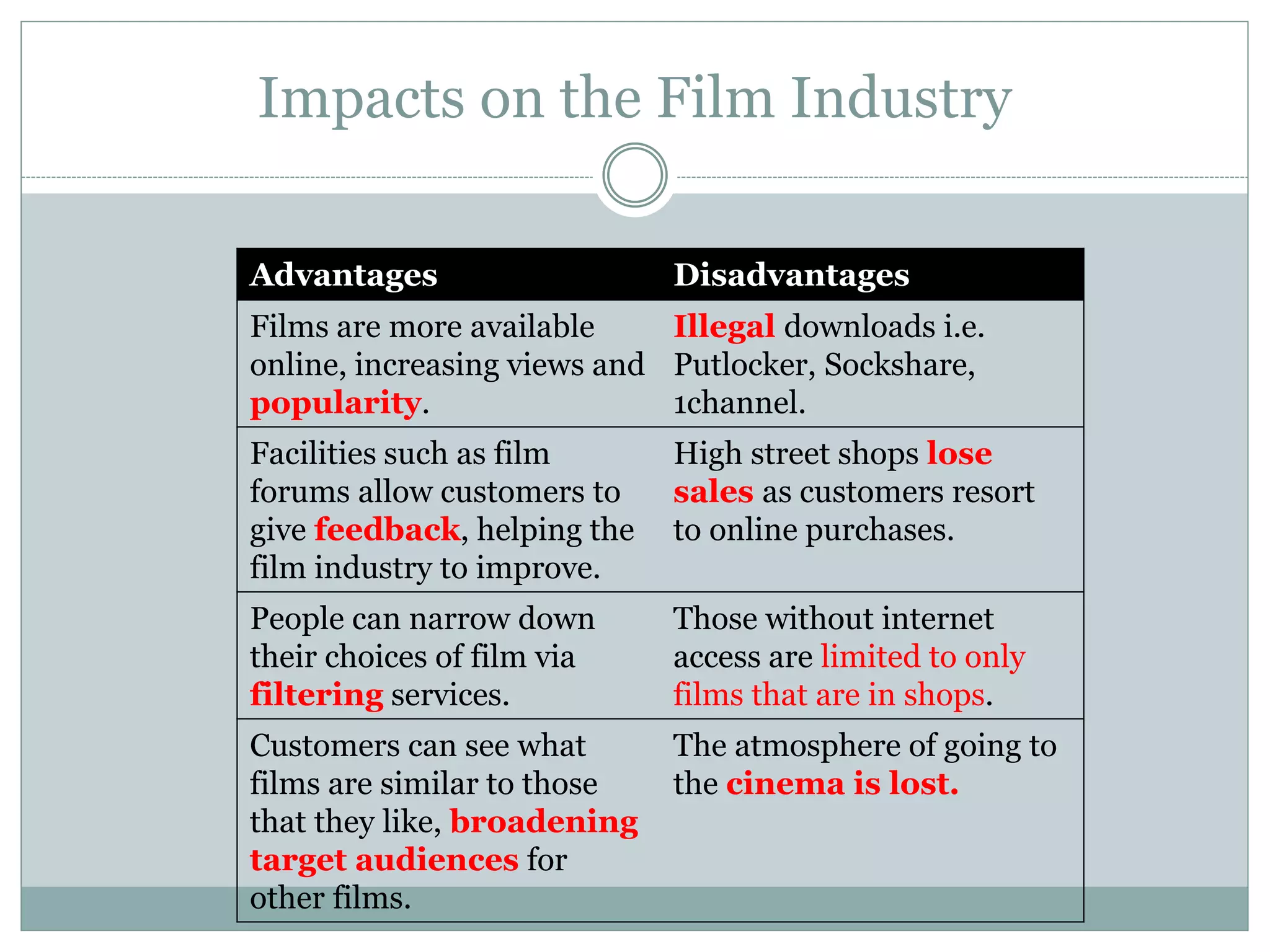
Impacts on the Film Industry
Advantages Disadvantages
Films are more available
online, increasing views and
popularity.
Illegal downloads i.e.
Putlocker, Sockshare,
1channel.
Facilities such as film
forums allow customers to
give feedback, helping the
film industry to improve.
High street shops lose
sales as customers resort
to online purchases.
People can narrow down
their choices of film via
filtering services.
Those without internet
access are limited to only
films that are in shops.
Customers can see what
films are similar to those
that they like, broadening
target audiences for
other films.
The atmosphere of going to
the cinema is lost.
NDT and Production
 New technology used in Avatar
 The Hobbit? Frozen? Other case studies?
 Digital Cameras – cheaper, cleaner, easier to manipulate
but????
 HD – higher quality
 3D – spectacle, hard to pirate, hard to produce at home,
new
 Imax - spectacle, hard to pirate, hard to produce at
home, new
 CGI – achieve the impossible, exciting, creative
 Synthespians? (term coined by Randle and Culkin – used
for extras which are costly)
NDT and Distribution
 Digital Distribution will transform the film industry
more than any other technological advancement
 Key Point
 Cheaper
 Quicker
 Simultaneous global release (cuts down piracy)
 Great Potential and Great Danger
Advantages
 Digital Data Files can be broadcast/downloaded by
satellite (fast)
 Via satellite reduces the risk of film prints ‘going
astray’, reduce piracy
 Film stock is heavy, hard to work with and fragile
 Film needs specialist handling, digital does not
 Quality remains consistent over multiple screening
 Multiple copies for the price of one!
Disadvantages
 Audience attitude to the internet being ‘free’ (think
Napster, LimeWire, BitTorrent)
 Marketing becomes way more important
 Quality?
 The ‘Experience’
 Production Companies are always one step behind
technology so could they lose total control of their
product?
NDT and Marketing
 The use of NDT in marketing has made a huge
difference to society.
 There are now viral advertisements to promote
products.
 Apps on phones for games or latest information –
the possibilities are endless
 The internet- you can find anything.
 http://www.youtube.com/watch?v=R55e-uHQna0
NDT and Exhibition
 Better quality of image because it is digital (???)
 More flexibility for Exhibition and for the audience
 Cheaper to run
 Disadvantage – change over to digital, 3D, HD,
iMax is very expensive!!!!
 The Digital Screen Network is helping British
cinemas change over
What do we mean by proliferation of
hardware or content?
 What does proliferation mean?
So how does this
relate to the film
industry?
‘. . . a rapid and often excessive spread or
increase’ (Dictionary.com)
Examples of growth as a result of NDT . . .
Hardware
A wide range of devices for
playback and exhibition –
MP4 players, DVD, Blu-Ray,
mobiles, computers, digital
video and digital projection
These technologies also offer
opportunities in terms of
marketing and
distribution
Content
There is a wider range of
content available largely
due to the proliferation of
new technologies that have
enabled easier film
production and distribution
e.g. ‘You Tube’/’Love Film’
This content is now much
more accessible to
audiences.
I N S M A L L G R O U P S C O M E U P W I T H T H E T O P
T E N W A Y S N D T H A S A F F E C T E D T H E
A U D I E N C E A N D I N S T I T U T I O N S .
How has technology affected
the audience and institutions?
Task
 What technologies were used and important for our
case study films?
 Did the use/lack of use of these new technologies
make the films better/worse and/or more
successful?
 Frozen
 71’
 The Fifth Estate

Impactofdigitaltechnology2016

  • 1.
    Digital Technology andthe impact on Institutions and Audiences
  • 2.
    The Impact ofDigital Technology  Revolutionised the modern world (not just film)  Revolutionising production, distribution, marketing, exhibition (consumption of film)  Films are now cheaper and easier to make, cheaper to distribute, and 3D/Imax Cinemas are enhancing the viewing experience
  • 3.
    NDT and theAudience  NDT has allowed audiences to become ‘produser’ – producers/uses of media  “Conventional research methods are replace – or at least supplemented by new methods which recognise and make use of people’s own creativity, and brush aside outmoded notions of ‘receiver’ audiences and elite ‘producers’.”  Gauntlett  What is NDT from an audience point of view?  Web2.0  Social Media
  • 4.
    The NDT Audience Active users of the media  Audience ‘Fragmentation’ – this makes it hard to reach everyone (360 degree branding is to surround us with the produce across all form of media – eg)  The need to use convergence –  A) - technologies coming together, eg, a mobile phone  B), media industries are diversifying so they produce and distribute across several media eg newspaper
  • 5.
    Audiences and Institutions The relationship has changed  Rather than keeping the audience together institutions are trying to ‘trigger engagement’ in a variety of ways  Push Media vs Pull Media  Push = institutions push media at us  Pull = we choose want media we what and in what form
  • 6.
    The Long Tailand the The Film Industry The Long Tail theory can be applied to the film industry in terms of how films are distributed. i.e. The Head is a high street film retailer such as Blockbuster. The Long Tail is an online film distribution service such as Amazon.
  • 7.
    The Film Industry Thismeans that high street shops (the Head) that sell films are gradually becoming less popular due to the restrictions they experience in terms of shelf-space. Internet retailers (the Long Tail) do not experience this as they do not have a physical shop. Their unlimited space shelf allows them to provide for niche markets, increasing their customers as they have a wider variety of products.
  • 8.
    For example… The Headmay contain: Cinema chains such as Cineworld, Odeon; film retailers such as HMV, Blockbuster etc. The Long Tail may contain: Internet sites such as Netflix, YouTube, LOVEFiLM etc.; iTunes etc. Due to the growing accessibility of the Internet, more and more films are being downloaded online rather than bought in the shops. Head Long Tail
  • 9.
    Impacts on theFilm Industry Advantages Disadvantages Films are more available online, increasing views and popularity. Illegal downloads i.e. Putlocker, Sockshare, 1channel. Facilities such as film forums allow customers to give feedback, helping the film industry to improve. High street shops lose sales as customers resort to online purchases. People can narrow down their choices of film via filtering services. Those without internet access are limited to only films that are in shops. Customers can see what films are similar to those that they like, broadening target audiences for other films. The atmosphere of going to the cinema is lost.
  • 10.
    NDT and Production New technology used in Avatar  The Hobbit? Frozen? Other case studies?  Digital Cameras – cheaper, cleaner, easier to manipulate but????  HD – higher quality  3D – spectacle, hard to pirate, hard to produce at home, new  Imax - spectacle, hard to pirate, hard to produce at home, new  CGI – achieve the impossible, exciting, creative  Synthespians? (term coined by Randle and Culkin – used for extras which are costly)
  • 11.
    NDT and Distribution Digital Distribution will transform the film industry more than any other technological advancement  Key Point  Cheaper  Quicker  Simultaneous global release (cuts down piracy)  Great Potential and Great Danger
  • 12.
    Advantages  Digital DataFiles can be broadcast/downloaded by satellite (fast)  Via satellite reduces the risk of film prints ‘going astray’, reduce piracy  Film stock is heavy, hard to work with and fragile  Film needs specialist handling, digital does not  Quality remains consistent over multiple screening  Multiple copies for the price of one!
  • 13.
    Disadvantages  Audience attitudeto the internet being ‘free’ (think Napster, LimeWire, BitTorrent)  Marketing becomes way more important  Quality?  The ‘Experience’  Production Companies are always one step behind technology so could they lose total control of their product?
  • 14.
    NDT and Marketing The use of NDT in marketing has made a huge difference to society.  There are now viral advertisements to promote products.  Apps on phones for games or latest information – the possibilities are endless  The internet- you can find anything.  http://www.youtube.com/watch?v=R55e-uHQna0
  • 15.
    NDT and Exhibition Better quality of image because it is digital (???)  More flexibility for Exhibition and for the audience  Cheaper to run  Disadvantage – change over to digital, 3D, HD, iMax is very expensive!!!!  The Digital Screen Network is helping British cinemas change over
  • 16.
    What do wemean by proliferation of hardware or content?  What does proliferation mean? So how does this relate to the film industry? ‘. . . a rapid and often excessive spread or increase’ (Dictionary.com)
  • 17.
    Examples of growthas a result of NDT . . . Hardware A wide range of devices for playback and exhibition – MP4 players, DVD, Blu-Ray, mobiles, computers, digital video and digital projection These technologies also offer opportunities in terms of marketing and distribution Content There is a wider range of content available largely due to the proliferation of new technologies that have enabled easier film production and distribution e.g. ‘You Tube’/’Love Film’ This content is now much more accessible to audiences.
  • 18.
    I N SM A L L G R O U P S C O M E U P W I T H T H E T O P T E N W A Y S N D T H A S A F F E C T E D T H E A U D I E N C E A N D I N S T I T U T I O N S . How has technology affected the audience and institutions?
  • 19.
    Task  What technologieswere used and important for our case study films?  Did the use/lack of use of these new technologies make the films better/worse and/or more successful?  Frozen  71’  The Fifth Estate

Editor's Notes

  • #5 First, technologies coming together, for example, a mobile phone you can use as a still and moving image camera, download and watch moving images on, use as an MP3 player and recorder and access the internet with. Second, media industries are diversifying so they produce and distribute across several media—for example, a newspaper with an online version and audio podcasts or the coming together of videogames with films.