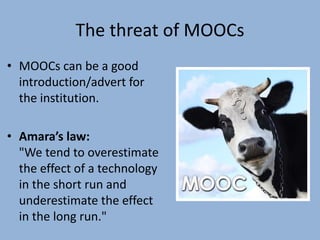
The threat of MOOCs
• MOOCs can be a good
introduction/advert for
the institution.
• Amara’s law:
"We tend to overestimate
the effect of a technology
in the short run and
underestimate the effect
in the long run."
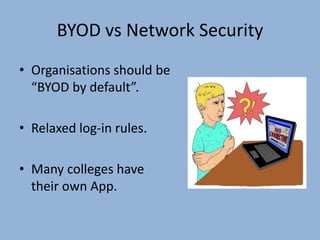
BYOD vs Network Security
• Organisations should be
“BYOD by default”.
• Relaxed log-in rules.
• Many colleges have
their own App.
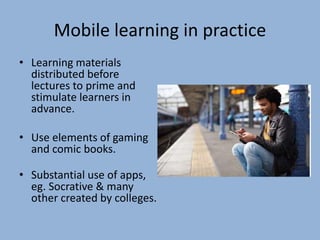
Mobile learning in practice
• Learning materials
distributed before
lectures to prime and
stimulate learners in
advance.
• Use elements of gaming
and comic books.
• Substantial use of apps,
eg. Socrative & many
other created by colleges.
Using Augmented Reality to promote
mental health awareness
• 16-19 students were very
reluctant to read traditional
wall posters
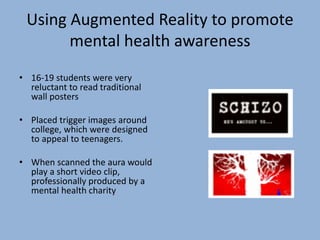
• Placed trigger images around
college, which were designed
to appeal to teenagers.
• When scanned the aura would
play a short video clip,
professionally produced by a
mental health charity
How Learning Technology can prepare
learners for the world of work
• College leavers often lack
the softer skills (aka
“enterprise skills”) necessary
to make them ‘employable’.
• Examples:
– University of London MOOC
– ‘virtual patients’ for medical
students
– ‘video voices’ of employers
– sharing of e-portfolios with
employers
Google Apps for Education
• Used by millions of
students and
organisations worldwide
• Focussed on collaborative
learning
• Basic suite includes:
Gmail, Calendar, Groups,
Docs
• NEW content (all free):
Classroom, Drive, Vault,
Hangouts
• And finally … all presentations were made
available via “slideshare”
• Could we use this for TMC events ?

Feedback

  • 2.
    The threat ofMOOCs • MOOCs can be a good introduction/advert for the institution. • Amara’s law: "We tend to overestimate the effect of a technology in the short run and underestimate the effect in the long run."
  • 3.
    BYOD vs NetworkSecurity • Organisations should be “BYOD by default”. • Relaxed log-in rules. • Many colleges have their own App.
  • 4.
    Mobile learning inpractice • Learning materials distributed before lectures to prime and stimulate learners in advance. • Use elements of gaming and comic books. • Substantial use of apps, eg. Socrative & many other created by colleges.
  • 6.
    Using Augmented Realityto promote mental health awareness • 16-19 students were very reluctant to read traditional wall posters • Placed trigger images around college, which were designed to appeal to teenagers. • When scanned the aura would play a short video clip, professionally produced by a mental health charity
  • 7.
    How Learning Technologycan prepare learners for the world of work • College leavers often lack the softer skills (aka “enterprise skills”) necessary to make them ‘employable’. • Examples: – University of London MOOC – ‘virtual patients’ for medical students – ‘video voices’ of employers – sharing of e-portfolios with employers
  • 8.
    Google Apps forEducation • Used by millions of students and organisations worldwide • Focussed on collaborative learning • Basic suite includes: Gmail, Calendar, Groups, Docs • NEW content (all free): Classroom, Drive, Vault, Hangouts
  • 9.
    • And finally… all presentations were made available via “slideshare” • Could we use this for TMC events ?