Arsalan
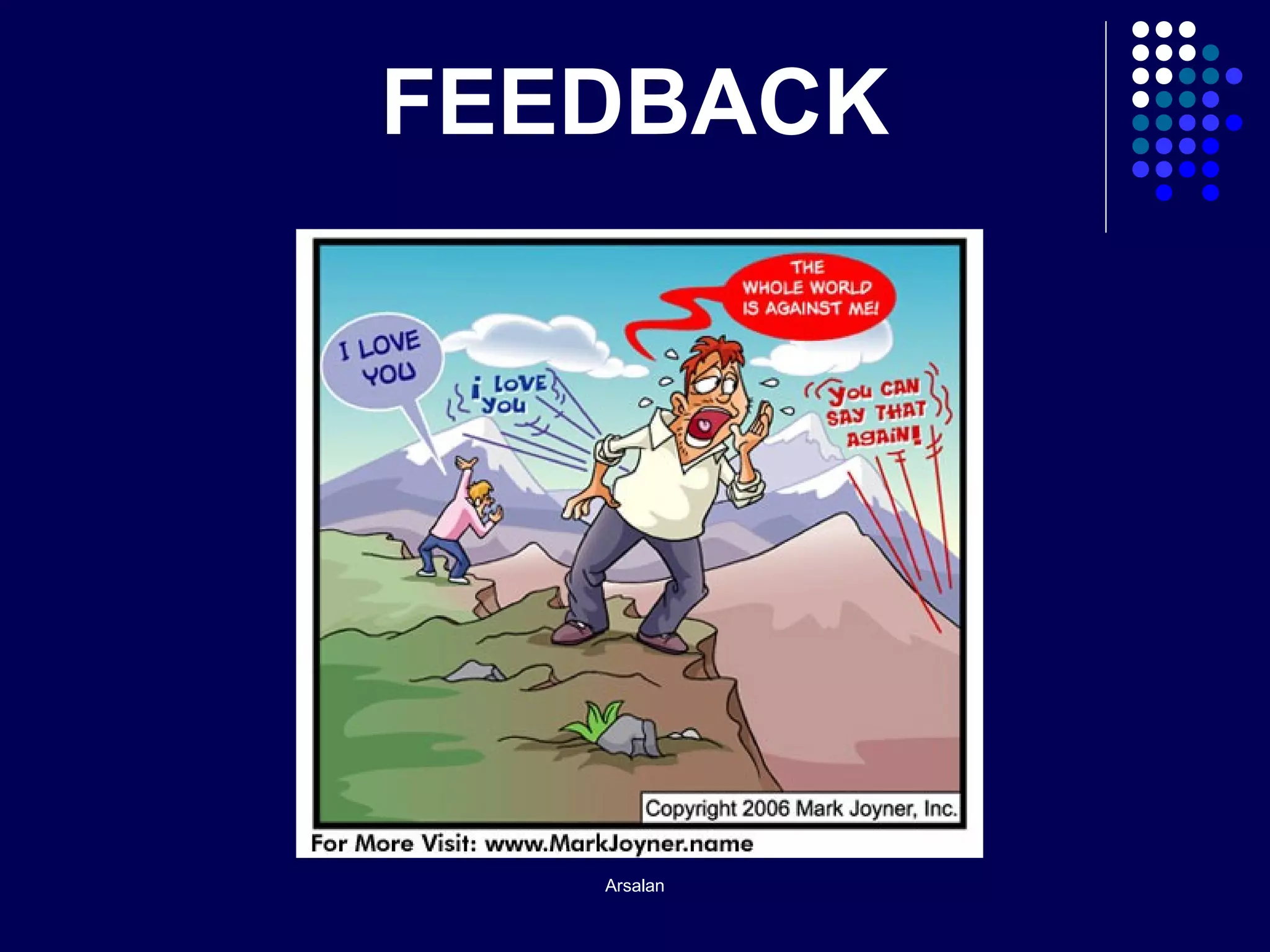
FEEDBACK
Arsalan
Feedback
“DEFINITION”
“It is an informed, unbiased, constructive, candid, but
an objective appraisal of “overall student’s
performance” that is aimed at “improving clinical skills”
rather than estimating a student’s personal worth.”
Ende J. Feedback in clinical medical education
JAMA 1983; 250: 778-81.
Arsalan
Feedback
“A GENUINE SKILL”
At the end of presentation the participants should
be able to:
 define feedback
 enumerate components of feedback
 describe the main principles of a good feedback
Arsalan
Feedback
What does it do?
 Helps improve performance
 Motivates
 Facilitates change
 Generates new and better ideas
 Encourages teacher-trainee dialogue/ communication
 Facilitates development of metacognition (self
assessment & reflection)
 Provides high quality info to students about their learning
 Helps the teacher and student realize where they stand.
Arsalan
How to Give Feedback
 When the other person has indicated
a willingness to receive it
 Use terms that accurately describes
the state of affairs
 Be timely
Arsalan
Feedback: Do’s
 Do your homework/ be prepared
 Be constructive
 Sit next to student and avoid backing or standing over.
 Mention things that you like
 Keep track of time
 Bring out both negatives (Change) and positives
(Shouldn’t change)
 Be ‘constructive’
 Keep objectives in your mind
 Ask others involved in the system to provide feedback
also
Education planning and evaluation handout.
CPSP,.
Arsalan
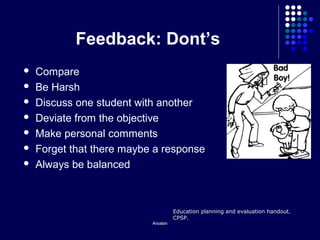
Feedback: Dont’s
 Compare
 Be Harsh
 Discuss one student with another
 Deviate from the objective
 Make personal comments
 Forget that there maybe a response
 Always be balanced
Education planning and evaluation handout.
CPSP.
Arsalan
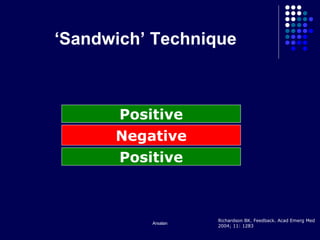
SANDWICH TECHNIQUE
 It helps the people focus on their weaknesses and lapses
without being degraded and humiliated.
 Rather it infuses confidence and at the same time it helps
one realize his or her shortcomings.
 SAY SOMETHING POSITIVE (COMMEND)
 SAY SOMETHING NEGATIVE IN A POSITVE MANNER
 SAY SOMETHING POSITIVE (COMMEND)
Arsalan
‘Sandwich’ Technique
Positive
Positive
Negative
Richardson BK. Feedback. Acad Emerg Med
2004; 11: 1283
Arsalan
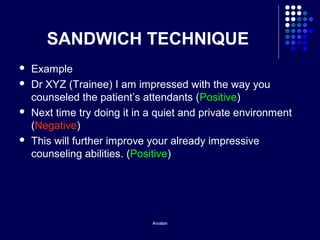
SANDWICH TECHNIQUE
 Example
 Dr XYZ (Trainee) I am impressed with the way you
counseled the patient’s attendants (Positive)
 Next time try doing it in a quiet and private environment
(Negative)
 This will further improve your already impressive
counseling abilities. (Positive)
Arsalan
When is Feedback Productive?
 Discover the strengths and weaknesses of the trainees
 Instruct with a goal in mind during the feedback session.
 Be a leader and induce confidence.
 All the people in the system should contribute in
feedback .
Arsalan
Five steps
 What you think you did well?
 We think you did lot of things well.
 If you did this again, what will you change?
 We think you may improve the performance if you did
this….
 Summarise the good points, and main suggestions for
improvement
Mackway-Jones K, Walker M (eds). Pocket guide to teaching
for medical instructors. London: BMJ books; 1999.
Arsalan
Some problems!
 Learners may not want to say what they felt went well.
 Group may concentrate on the ‘wrongs’
 Too many suggestions may only confirm the learner’s
sense of inadequacy
 May give the wrong impression that only ‘nice’ things are
to be told
 Some cultural hurdles
 Overemphasis on positives may undermine appreciation
for attention to the deficiency
Arsalan
Summary
 The primary purpose of feedback is to improve
performance
 To guide and encourage effective and appropriate
learning
 Feedback should be specific & balanced
 Be objective, don’t compare or be personal
 ‘Five steps’ is an effective method
Arsalan
Arsalan
END SESSION PRACTICE
 Please make 5 groups.
 Practice feedback on topics given according
to the principles of feedback

Feedback

  • 1.
  • 2.
    Arsalan Feedback “DEFINITION” “It is aninformed, unbiased, constructive, candid, but an objective appraisal of “overall student’s performance” that is aimed at “improving clinical skills” rather than estimating a student’s personal worth.” Ende J. Feedback in clinical medical education JAMA 1983; 250: 778-81.
  • 3.
    Arsalan Feedback “A GENUINE SKILL” Atthe end of presentation the participants should be able to:  define feedback  enumerate components of feedback  describe the main principles of a good feedback
  • 4.
    Arsalan Feedback What does itdo?  Helps improve performance  Motivates  Facilitates change  Generates new and better ideas  Encourages teacher-trainee dialogue/ communication  Facilitates development of metacognition (self assessment & reflection)  Provides high quality info to students about their learning  Helps the teacher and student realize where they stand.
  • 5.
    Arsalan How to GiveFeedback  When the other person has indicated a willingness to receive it  Use terms that accurately describes the state of affairs  Be timely
  • 6.
    Arsalan Feedback: Do’s  Doyour homework/ be prepared  Be constructive  Sit next to student and avoid backing or standing over.  Mention things that you like  Keep track of time  Bring out both negatives (Change) and positives (Shouldn’t change)  Be ‘constructive’  Keep objectives in your mind  Ask others involved in the system to provide feedback also Education planning and evaluation handout. CPSP,.
  • 7.
    Arsalan Feedback: Dont’s  Compare Be Harsh  Discuss one student with another  Deviate from the objective  Make personal comments  Forget that there maybe a response  Always be balanced Education planning and evaluation handout. CPSP.
  • 8.
    Arsalan SANDWICH TECHNIQUE  Ithelps the people focus on their weaknesses and lapses without being degraded and humiliated.  Rather it infuses confidence and at the same time it helps one realize his or her shortcomings.  SAY SOMETHING POSITIVE (COMMEND)  SAY SOMETHING NEGATIVE IN A POSITVE MANNER  SAY SOMETHING POSITIVE (COMMEND)
  • 9.
  • 10.
    Arsalan SANDWICH TECHNIQUE  Example Dr XYZ (Trainee) I am impressed with the way you counseled the patient’s attendants (Positive)  Next time try doing it in a quiet and private environment (Negative)  This will further improve your already impressive counseling abilities. (Positive)
  • 11.
    Arsalan When is FeedbackProductive?  Discover the strengths and weaknesses of the trainees  Instruct with a goal in mind during the feedback session.  Be a leader and induce confidence.  All the people in the system should contribute in feedback .
  • 12.
    Arsalan Five steps  Whatyou think you did well?  We think you did lot of things well.  If you did this again, what will you change?  We think you may improve the performance if you did this….  Summarise the good points, and main suggestions for improvement Mackway-Jones K, Walker M (eds). Pocket guide to teaching for medical instructors. London: BMJ books; 1999.
  • 13.
    Arsalan Some problems!  Learnersmay not want to say what they felt went well.  Group may concentrate on the ‘wrongs’  Too many suggestions may only confirm the learner’s sense of inadequacy  May give the wrong impression that only ‘nice’ things are to be told  Some cultural hurdles  Overemphasis on positives may undermine appreciation for attention to the deficiency
  • 14.
    Arsalan Summary  The primarypurpose of feedback is to improve performance  To guide and encourage effective and appropriate learning  Feedback should be specific & balanced  Be objective, don’t compare or be personal  ‘Five steps’ is an effective method
  • 15.
  • 16.
    Arsalan END SESSION PRACTICE Please make 5 groups.  Practice feedback on topics given according to the principles of feedback

Editor's Notes

  • #5 Questions : What is the feedback on.. In a training scenario…..on trainee performance It encourages not only the teacher trainee dialogue but also facilitates metacognition.. Any other improvement: not only the teaching methods, training, but also the teacher..
  • #6 Give feedback when the other person has indicated willingness to receive it from you. (1) You may sometimes need to check first, then give the feedback, e.g., “I’d like to tell you how I felt about what you did. Okay?” (2) Sometimes the earlier agreements (either explicit or implicit) in your relationship give general permission for feedback. (3) Being a participant in a Small Group Instruction setting constitutes a preliminary agreement to be open to feedback. Give feedback in terms that describe the other’s behavior with the least amount of interpretation you can manage, and describe as accurately as you can the effects of the behavior. (1) An example may be: “I noticed early in the meeting you and Harry were having something of an argument, but when you raised the pitch and tempo of your voice he stopped arguing the point. Then later he kept pointing out possible weaknesses in the proposal you offered for our future work. Do you think there is a connection?” As opposed to: “No wonder Harry tried to torpedo your idea. You asked for it when you shouted him down at the beginning of the meeting.” (2) More descriptive feedback is less likely to be affected by your own biases, more likely to be heard rather than resisted defensively, and more readily assimilated as data for personal understanding and planning. Be timely in giving feedback. (1) The sooner the feedback is given, the fresher is the experience and its data both for you and for the person receiving the feedback. That freshness will make it easier to use the feedback. (2) Second, the setting should cause as little distraction as possible from dealing with the feedback. There are certain guidelines that should be adhered to when giving feedback:
  • #13 Give example of the lecture before this and ask the participants what was wrong with the lecture.. Our immediate instinct is to point out the bad points immediately.. While actually he did lots of good things before actually only a few which needed improvement