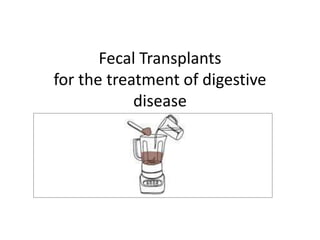
Fecal Transplants
for the treatment of digestive
disease
My Story
• Diagnosed with Ulcerative Colitis in 1999
• Depression, diet and a potential bacterial infection while
traveling appeared to be contributing factors.
• Anti-biotics appeared to help bring about remission more
than once.
• Otherwise cancelled surgery days before my date in March
2011 when I discovered that fecal transplants had been
successfully used for Ulcerative Colitis.
• Now over two years after using self-administered fecal
transplants combined with medications and dietary
supplements I am still symptom-free.
Problem: Clostridium Difficile
• Anti-biotic resistant strains of
Clostridium Difficile bacteria is
becoming more of a problem.
• Over 14,000 people die in the
U.S. from c. diff complications.
• Anti-biotics don’t work to
permanently treat this
condition because the bacteria
comes back from spores.
• C. diff comes back because
anti-biotics wiped out the
“good” bacteria to prevent it
from growing out of control.
Problem: Chronic Inflamatory Bowel Disease
• Over 1.4 million Americans are estimated to suffer from
Crohn’s Disease and Ulcerative Colitis.
• worldwide incidence rate of ulcerative colitis varies greatly
between 0.5–24.5/100,000 persons.
• Crohn’s disease varies between 0.1–16/100,000 persons
worldwide, with the prevalence rate of IBD reaching up to
396/100,000 persons
• While the cause is unknown it is usually treated as an
autoimmune disease.
Impact of Ulcerative Colitis and Crohn’s
Disease
Impact of Inflammatory Bowel Disease
• Overall health care cost of more than $1.7 billion in the U.S.
• 700,000 Dr visits
• 100,000 hospitalizations, and disability in 119,000 patients.
Over the long term, up to 75% of patients with Crohn’s
disease and 25% of those with ulcerative colitis will require
surgery.3
Why Fecal Transplants for c diff
• Highly effective for patients with Clostridium Difficile with
success rates of 90-100% depending on the study.
• Symptoms improve almost immediately often with just one
treatment using a colonoscope or less than a week of self-
administered enemas.
• Fights bad bacteria with a mix of stronger, more dominant,
good bacteria.
• Safe, with a healthy donor, there are no published cases of a
person contracting an incurable disease.
• Keeps the infection from coming back as it often does with
anti-biotics, by restoring a healthy balance of bacteria.
Why aren’t Fecal Transplant being
used more often?
• FDA regulation as an Investigational New Drug (IND.) Stated purpose is to protect
patients, however the result has been to strongly discourage doctors from doing it.
• “Ick” factor and a lack of
understanding about how this
works.
• Lack of awareness among doctors
and patients that this is a
treatment option.
Why Fecal Transplants for UC
• Existing treatments often do not continue to work for patients
over an extended period of time.
• Anti-inflammatory and immune suppressing drugs have
significant side effects, including bone density loss, risk of
cancer, liver or kidney damage and elevated risk of secondary
infections.
• 25% of Ulcerative Colitis patients and 75% of Crohn’s Disease
patients will have surgery to remove some of all of their
intestines.
Why Fecal Transplants for Ulcerative
Colitis and Crohn’s Disease?
• Bacterial imbalance or presence of bacteria that release
inflammatory toxins may be the root cause of inflammation.
• This seems possible since stomach ulcers were linked to h
pylori bacteria within the last 20 years.
• Traveler’s diarrhea from bacterial infections and also c diff are
known to be caused by bacterial infections and cause similar
symptoms.
• While a specific bacteria has not been identified yet,
researchers are still mapping the human biome.
Success of Fecal Transplants
• “Treatment of Ulcerative Colitis using Fecal Bacteriotherapy”
published article in which Dr. Borody’s 6 patients who achieved
prolonged remission as long as 13 years without continued
treatment with drugs, he suggests it could be considered a “cure”
• Self-reported patient stories including myself continue to mount.
• However other patient reports have not been so promising.
• Success of Fecal Transplants is complicated by several other factors
involved in healing the illness.
– Depression / anxiety Irritable Bowel Syndrome
– Damage to the intestinal walls from chronic inflammation
– Possible food intolerance or allergies
More challenges for fecal transplants
• Effective treatment could involve addressing several different factors to ensure
that an optimal bacterial balance is established and all pathogenic bacteria are
eliminated or rendered harmless.
• Immune-suppressing drugs may be necessary so that the immune system does
not attack new, helpful bacteria and to treat existing inflammation.
• This may include pre-treating with a course of
anti-biotics before fecal transplants.
• Drugs to calm muscle spasms and diarrhea.
• If used for Crohn’s Disease, a top down method
(nasal gastric tube or swallowing capsules) might
be more effective since bacterial might have a
hard time making their way through the illeal
cecal valve.
Keys to success for fecal transplants
• Find a healthy donor.
– Younger to middle aged adult with “normal” bowel habits for their
whole life would be ideal.
– Infants may not have fully developed fecal flora just yet.
– Older people in their 60s and older might be a higher risk for having c
diff and there intestinal flora might be diminishing as they age.
– Free of risk factors for disease
Keys to successful Fecal Transplants
• Have a knowledgeable supportive doctor and/or at least one
mentor who has successfully done this before to help guide
you and let you know what to expect.
• There may be some ups and downs in terms of symptoms as
part of the process of fecal transplants working.
Key to successful Fecal Transplants
• Use over-the-counter anti-diarrhea and anti-gas drugs to treat
symptoms from the fecal transplants and help in retaining the
enemas.
• Anti-depressants, anti-anxiety drugs or other herbal or
medicinal treatments for IBS to limit urgency and diarrhea
from muscle spasms.
• Drugs like Bupropion could have anti-inflammatory effects
too.
Keys to Successful Fecal Transplants
• Provide added nutrition to help the body heal using protein
shakes.
– Other supplements like L-Glutamine can be helpful. High amounts of
this are found in most over-the-counter body builder’s protein shakes
including Muscle Milk.
– Pre-digested meal replacement shakes can help calm a flare in
inflammation by helping “rest” the bowels. Another one specifically
made for the treatment of digestive disease is Absorb Plus.
Keys to Successful Fecal Transplants
• Be prepared to continue through some ups and downs.
– A flare of symptoms is possible, followed by continued mini-flares as
the “good” bacteria continue to kill off remaining “bad” bacteria.
– Fever, bloating and diarrhea may be part of the process of the new
bacteria becoming established.
• Keep your foot on the gas: continue your combination of
drugs and supplements for weeks and even several months
past the time when you have stopped doing the enemas.
Keys to Successful Fecal Transplants
• Continue to control inflammation and immune response by
continuing to take existing medications until some time after
significant improvement or full remission.
– This is because bacteria could continue to come back from spores
embedded in the intestinal walls.
– Also limiting diarrhea and inflammation will further help the newly
transplants bacteria to help you heal.
More Resources
• My website: http://www.FecalTransplant.org with articles,
videos and more detail on my own experience
– My book: Fecal Transplants Cured Ulcerative Colitis For Me
• PowerofPoo.blogspot.com
– Contact the site owner for access to a Facebook discussion group
• http://www.cdd.com.au
– Website for Centre for Digestive Diseases in Australia with Dr. Borody
• IHaveUC.com
– Great source of information and active discussions amongst patients.
• HealingWell.com
– Another large patient discussion forum

Fecal Transplants for treatment of Clostridium Difficile, Ulcerative Colitis and other digestive disease

  • 1.
    Fecal Transplants for thetreatment of digestive disease
  • 2.
    My Story • Diagnosedwith Ulcerative Colitis in 1999 • Depression, diet and a potential bacterial infection while traveling appeared to be contributing factors. • Anti-biotics appeared to help bring about remission more than once. • Otherwise cancelled surgery days before my date in March 2011 when I discovered that fecal transplants had been successfully used for Ulcerative Colitis. • Now over two years after using self-administered fecal transplants combined with medications and dietary supplements I am still symptom-free.
  • 3.
    Problem: Clostridium Difficile •Anti-biotic resistant strains of Clostridium Difficile bacteria is becoming more of a problem. • Over 14,000 people die in the U.S. from c. diff complications. • Anti-biotics don’t work to permanently treat this condition because the bacteria comes back from spores. • C. diff comes back because anti-biotics wiped out the “good” bacteria to prevent it from growing out of control.
  • 4.
    Problem: Chronic InflamatoryBowel Disease • Over 1.4 million Americans are estimated to suffer from Crohn’s Disease and Ulcerative Colitis. • worldwide incidence rate of ulcerative colitis varies greatly between 0.5–24.5/100,000 persons. • Crohn’s disease varies between 0.1–16/100,000 persons worldwide, with the prevalence rate of IBD reaching up to 396/100,000 persons • While the cause is unknown it is usually treated as an autoimmune disease.
  • 5.
    Impact of UlcerativeColitis and Crohn’s Disease
  • 6.
    Impact of InflammatoryBowel Disease • Overall health care cost of more than $1.7 billion in the U.S. • 700,000 Dr visits • 100,000 hospitalizations, and disability in 119,000 patients. Over the long term, up to 75% of patients with Crohn’s disease and 25% of those with ulcerative colitis will require surgery.3
  • 7.
    Why Fecal Transplantsfor c diff • Highly effective for patients with Clostridium Difficile with success rates of 90-100% depending on the study. • Symptoms improve almost immediately often with just one treatment using a colonoscope or less than a week of self- administered enemas. • Fights bad bacteria with a mix of stronger, more dominant, good bacteria. • Safe, with a healthy donor, there are no published cases of a person contracting an incurable disease. • Keeps the infection from coming back as it often does with anti-biotics, by restoring a healthy balance of bacteria.
  • 8.
    Why aren’t FecalTransplant being used more often? • FDA regulation as an Investigational New Drug (IND.) Stated purpose is to protect patients, however the result has been to strongly discourage doctors from doing it. • “Ick” factor and a lack of understanding about how this works. • Lack of awareness among doctors and patients that this is a treatment option.
  • 9.
    Why Fecal Transplantsfor UC • Existing treatments often do not continue to work for patients over an extended period of time. • Anti-inflammatory and immune suppressing drugs have significant side effects, including bone density loss, risk of cancer, liver or kidney damage and elevated risk of secondary infections. • 25% of Ulcerative Colitis patients and 75% of Crohn’s Disease patients will have surgery to remove some of all of their intestines.
  • 10.
    Why Fecal Transplantsfor Ulcerative Colitis and Crohn’s Disease? • Bacterial imbalance or presence of bacteria that release inflammatory toxins may be the root cause of inflammation. • This seems possible since stomach ulcers were linked to h pylori bacteria within the last 20 years. • Traveler’s diarrhea from bacterial infections and also c diff are known to be caused by bacterial infections and cause similar symptoms. • While a specific bacteria has not been identified yet, researchers are still mapping the human biome.
  • 11.
    Success of FecalTransplants • “Treatment of Ulcerative Colitis using Fecal Bacteriotherapy” published article in which Dr. Borody’s 6 patients who achieved prolonged remission as long as 13 years without continued treatment with drugs, he suggests it could be considered a “cure” • Self-reported patient stories including myself continue to mount. • However other patient reports have not been so promising. • Success of Fecal Transplants is complicated by several other factors involved in healing the illness. – Depression / anxiety Irritable Bowel Syndrome – Damage to the intestinal walls from chronic inflammation – Possible food intolerance or allergies
  • 12.
    More challenges forfecal transplants • Effective treatment could involve addressing several different factors to ensure that an optimal bacterial balance is established and all pathogenic bacteria are eliminated or rendered harmless. • Immune-suppressing drugs may be necessary so that the immune system does not attack new, helpful bacteria and to treat existing inflammation. • This may include pre-treating with a course of anti-biotics before fecal transplants. • Drugs to calm muscle spasms and diarrhea. • If used for Crohn’s Disease, a top down method (nasal gastric tube or swallowing capsules) might be more effective since bacterial might have a hard time making their way through the illeal cecal valve.
  • 13.
    Keys to successfor fecal transplants • Find a healthy donor. – Younger to middle aged adult with “normal” bowel habits for their whole life would be ideal. – Infants may not have fully developed fecal flora just yet. – Older people in their 60s and older might be a higher risk for having c diff and there intestinal flora might be diminishing as they age. – Free of risk factors for disease
  • 14.
    Keys to successfulFecal Transplants • Have a knowledgeable supportive doctor and/or at least one mentor who has successfully done this before to help guide you and let you know what to expect. • There may be some ups and downs in terms of symptoms as part of the process of fecal transplants working.
  • 15.
    Key to successfulFecal Transplants • Use over-the-counter anti-diarrhea and anti-gas drugs to treat symptoms from the fecal transplants and help in retaining the enemas. • Anti-depressants, anti-anxiety drugs or other herbal or medicinal treatments for IBS to limit urgency and diarrhea from muscle spasms. • Drugs like Bupropion could have anti-inflammatory effects too.
  • 16.
    Keys to SuccessfulFecal Transplants • Provide added nutrition to help the body heal using protein shakes. – Other supplements like L-Glutamine can be helpful. High amounts of this are found in most over-the-counter body builder’s protein shakes including Muscle Milk. – Pre-digested meal replacement shakes can help calm a flare in inflammation by helping “rest” the bowels. Another one specifically made for the treatment of digestive disease is Absorb Plus.
  • 17.
    Keys to SuccessfulFecal Transplants • Be prepared to continue through some ups and downs. – A flare of symptoms is possible, followed by continued mini-flares as the “good” bacteria continue to kill off remaining “bad” bacteria. – Fever, bloating and diarrhea may be part of the process of the new bacteria becoming established. • Keep your foot on the gas: continue your combination of drugs and supplements for weeks and even several months past the time when you have stopped doing the enemas.
  • 18.
    Keys to SuccessfulFecal Transplants • Continue to control inflammation and immune response by continuing to take existing medications until some time after significant improvement or full remission. – This is because bacteria could continue to come back from spores embedded in the intestinal walls. – Also limiting diarrhea and inflammation will further help the newly transplants bacteria to help you heal.
  • 19.
    More Resources • Mywebsite: http://www.FecalTransplant.org with articles, videos and more detail on my own experience – My book: Fecal Transplants Cured Ulcerative Colitis For Me • PowerofPoo.blogspot.com – Contact the site owner for access to a Facebook discussion group • http://www.cdd.com.au – Website for Centre for Digestive Diseases in Australia with Dr. Borody • IHaveUC.com – Great source of information and active discussions amongst patients. • HealingWell.com – Another large patient discussion forum