














a good background in ...
successful
application
development...
... in a mobile world
some controversy to start...
here's the problem...

7
... it's us
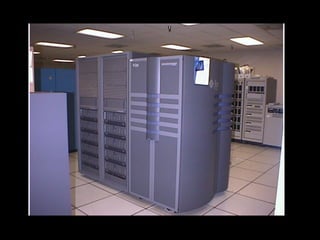
a little digression on servers
a little bit of history ...
(not too) long ago
"front side bus"

13
any access to ... anything
CPU capped
why ?
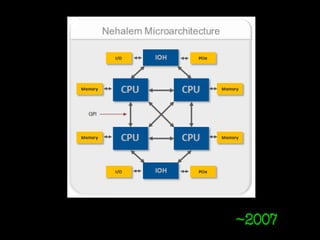
hypertransport
memory access direct from CPU

22
"everyone wanted opteron"

25
~2007
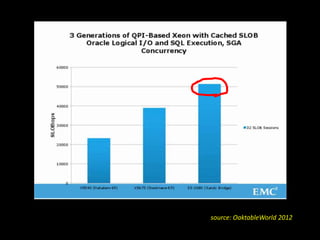
"Simply put, x86 systems are a
lot more powerful than you think"
- EMC presentation
source: OaktableWorld 2012
50,000 SQL statements
per second !
source: OaktableWorld 2012
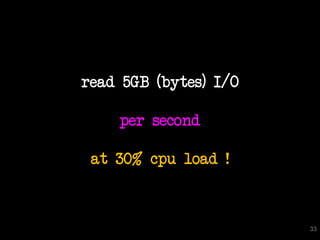
read 5GB (bytes) I/O
per second
at 30% cpu load !

33
source: twitter
write 500MB redo
per second !
probably all you ever need

37
"why do I care?"
you can't blame the server

39
if you can't get that performance ...
... it's you
43
44
all have their place...
"The sooner your company admits that you are not
Google, the sooner you can get down to some real work"
- Ted Dziuba

50
so what's holding you back ?
It all comes down to...
contention
and waste

54
this session ...
... common causes
Part 1
sql processing
terminology

58
cursors
delete from MY_TABLE;

drop table MY_TABLE;
select *
from
EMPLOYEE
where EMPNO > 1234;

cursors
declare
cursor C(p number) is
select * from DEPT
where DEPTNO = p;
begin
for rec in C loop
…
end loop;
end;

begin
MY_PROCEDURE(1,2,3);
end;
all of them !
3 phases
open
process
close

63
open
gimme some memory

process
close

64
open
gimme some memory

process
do some stuff using that memory,
probably access other memory

close

65
open
gimme some memory

process
do some stuff using that memory,
probably access other memory

close

here's your memory back

66
memory access = controlled access
woeful metaphor

61
70
same with memory

64
SGA
latches

66
serialised access

aka, someone waits
67

74
protected by
SGA
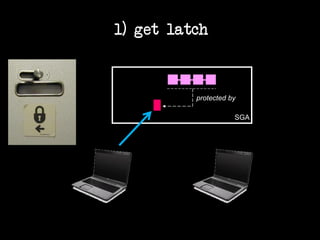
1) get latch

protected by
SGA
1) get latch

protected by
SGA
2) access memory

protected by
SGA
2) access memory

protected by
SGA
3) release latch

protected by
SGA

80
3) release latch

protected by
SGA

81
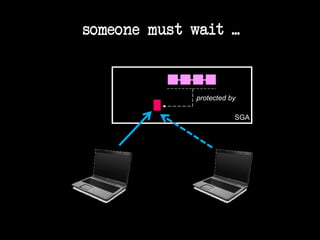
latch contention
someone must wait ...

protected by
SGA
active wait
spinning

85
can I have the latch ?
can I have the latch
can I have the latch ?

spinning

can I have the latch ?

can I have the latch ?

can I have the latch ?

can I have the latch ?
86
its importance to Oracle
early Oracle
2000 times !
(_spin_count)

90
Zzzzzzzzzz....
yield

mutex
nowadays...
posting

CAS

Good reading: http://andreynikolaev.wordpress.com/
latch contention....
hurts CPU...

94
hurts concurrency
you ... get ... nothing ... done
How Oracle runs your SQL
Syntax
Validity
Optimization
Rowsourcing
Execution
(Fetch)

98
Syntax
Validity
Optimization
SQL>
Rowsourcing select *
2 frmo emp;
Executionfrmo emp
*
ERROR at line 2:
(Fetch)
ORA-00923: FROM keyword

not found where expected

99
Syntax
Validity
Optimization
Rowsourcing
Execution
(Fetch)

SQL> select empnoo
2 from
emp;
select empnoo
*
ERROR at line 1:
ORA-00904: invalid column name
Syntax
Validity
Optimization
Rowsourcing
Execution
(Fetch)

PLAN
------------------------------------SELECT STATEMENT
TABLE ACCESS BY INDEX ROWID EMP
INDEX RANGE SCAN EMP_PK
Syntax
Validity
Optimization
Rowsourcing
Execution
(Fetch)
EMP_PK

EMP
Syntax
Validity
Optimization
Rowsourcing
Execution
(Fetch)

103
Syntax
Validity
Optimization
Rowsourcing
Execution
(Fetch)
lots of preliminaries
“parsing”
dominant factor

107
execution time
CPU consumption
lots of memory access...
lots of latching !

111
SQL> select name, gets
2 from v$latch
3 where name like 'library%' or name like 'shared%';
NAME
GETS
------------------------------ ---------shared pool
333937
library cache load lock
0
shared pool simulator
7191
shared pool sim alloc
133
shared server configuration
6
shared server info
1
SQL> select name, gets
2 from v$latch
3 where name like 'library%' or name like 'shared%';
NAME
GETS
------------------------------ ---------shared pool
333937
library cache load lock
0
shared pool simulator
7191
shared pool sim alloc
133
shared server configuration
6
shared server info
1

SQL> select 0 from dual;

0
---------0
SQL> select name, gets
2 from v$latch
3 where name like 'library%' or name like 'shared%';
NAME
GETS
------------------------------ ---------shared pool
333937
library cache load lock
0
shared pool simulator
7191
shared pool sim alloc
133
shared server configuration
6
shared server info
1

GETS
---------333991
0
7196
135
6
1

= 54
= 5
= 2

SQL> select 0 from dual;

0
---------0

total = 945 !
impossible to avoid ?
library cache
previously
executed statements

117
parse statement
already in library cache ?
reuse optimizer info
reuse row source info
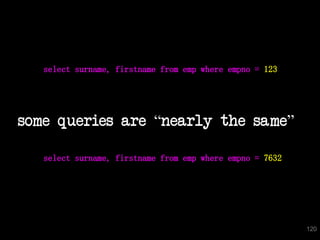
select surname, firstname from emp where empno = 123

probability of reuse low ?
select * from dept where dname = ‘SALES’
select surname, firstname from emp where empno = 123

some queries are “nearly the same”
select surname, firstname from emp where empno = 7632

120
binding
parse this...
select surname, firstname from emp where empno = ?

binding
parse this...
select surname, firstname from emp where empno = ?

binding

now run it with ? = 7362
now run it with ? = 123
library
cache
select surname, firstname from emp where empno = ?
select * from dept where deptno = ?
select * from customer where locality = ?
select prno from property where reference = ?
select * from dept where deptno = ?
select surname, firstname from emp where empno = ?
select * from customer where locality = ?
select * from organisation where officer = ?
select surname, firstname from emp where empno = ?
select * from dept where deptno = ?
select offender from crimes where crno = ?
library
cache
select surname, firstname from emp where empno = ?
select * from dept where deptno = ?
select * from customer where locality = ?
select prno from property where reference = ?
select * from dept where deptno = ?
select surname, firstname from emp where empno = ?
select * from customer where locality = ?
select * from organisation where officer = ?
select surname, firstname from emp where empno = ?
select * from dept where deptno = ?
select offender from crimes where crno = ?

Five full parses avoided
demo

demo1
wow!

127
more complex = more parsing
SQL> declare
2
c number := dbms_sql.open_cursor;
3 begin
4
for i in 1 .. 10000 loop
5
dbms_sql.parse(c,'
6
select * from dba_objects o, dba_segments s
7
where object_id = '||i||'
8
and o.owner = s.owner
9
and o.object_name = s.segment_name' ,
10
dbms_sql.native);
12
end loop;
12
dbms_sql.close_cursor(c);
13 end;

more complex = more parsing
Elapsed: 00:36:07.71

we aren’t even running the thing !
so binding really matters

for high frequency SQL
SQL>
2
3
4
5
6
7
8
9
10
11
12

declare
c number := dbms_sql.open_cursor;
begin
for i in 1 .. 6000 loop
dbms_sql.parse(c,'select * from dba_objects
where object_id = :x' ,
dbms_sql.native);
dbms_sql.bind_variable(c,':x',i);
end loop;
dbms_sql.close_cursor(c);
end;
/

PL/SQL procedure successfully completed.
Elapsed: 00:00:00.57
we are STILL parsing

132
Syntax
Validity
Optimization
Rowsourcing
Execution
(Fetch)

Hard
Parse

not found
in lib cache

Soft
Parse

found
scott@mydb> select *
2
from
EMP
3
where EMPNO = :b1

mike@mydb> select *
2
from
EMP
3
where EMPNO = :b1
scott@mydb> select *
2
from
EMP
3
where EMPNO = :b1

mike@mydb> select *
2
from
EMP
3
where EMPNO = :b1
SQL> desc mike.emp
Name
Null?
----------------- -------EMPNO
NOT NULL
ENAME
JOB

Type
-----------NUMBER(4)
VARCHAR2(10)
VARCHAR2(9)
parsing =
memory access =
latching
SQL> declare
2
c number;
3 begin
4
c := dbms_sql.open_cursor;
5
for i in 1 .. 1000 loop
6
dbms_sql.parse(c,'select * from dba_objects
7
where object_id = :x' ,
8
dbms_sql.native);
9
dbms_sql.bind_variable(c,':x',i);
10
end loop;
12
dbms_sql.close_cursor(c);
12 end;

latching hurts concurrency
NAME
COUNT
------------------------------ ---------library cache
10675
library cache pin
8430
library cache pin allocation
4145
shared pool
4390
137
option 1

lazy way :-)
session_cached_cursors = ...
lib cache

select *
from emp

your SQL is always shared
lib cache

select *
from emp

cursor

your cursor points to it

141
lib cache

select *
from emp

close cursor = lose pointer
cached cursor
close "ignored"

3rd execution
can we do even better ?

145
open
gimme some memory

process
do some stuff using that memory,
probably access other memory

close

here's your memory back
don’t close the cursor
hang on to the memory
remember what cursors we’ve used
reuse whenever possible
don’t exhaust memory
don’t allow invalid cursor reuse
sounds complicated ...
a free solution exists

154
plsql
create procedure MY_PROC is

begin
select *
into

…

from

dba_objects

where

object_id = my_plsql_variable

...
end;
automatically uses
bind variables
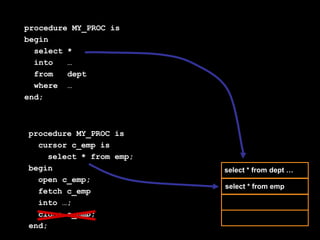
static SQL in stored PLSQL

hold’s cursors open
(even if you close)
better cursor caching

158
procedure MY_PROC is
begin
select *
into
…
from
dept
where …
end;

select * from dept …
procedure MY_PROC is
begin
select *
into
…
from
dept
where …
end;

procedure MY_PROC is
cursor c_emp is
select * from emp;
begin
open c_emp;
fetch c_emp
into …;
close c_emp;
end;

select * from dept …
procedure MY_PROC is
begin
select *
into
…
from
dept
where …
end;

procedure MY_PROC is
cursor c_emp is
select * from emp;
begin
open c_emp;
fetch c_emp
into …;
close c_emp;
end;

select * from dept …
select * from emp
the future looks bleak
Statement s = "select * from emp where empno = " + nEmpno
summary
avoid parsing costs
for high frequency SQL

164
binding
using PLSQL is a good idea...
Part 2
PLSQL
here's the odd thing

168
plsql
174
um ....
not true
packages
break the invalidation chain

178
proc A

proc B

proc C

proc D

pack A

pack B

pack C

pack D

body A

body B

body C

body D
proc A

proc B

proc C

proc D

pack A

pack B

pack C

pack D

body A

body B

body C

body D
proc A

proc B

proc C

proc D

pack A

pack B

pack C

pack D

body A

body B

body C

body D
11g and beyond
pack A

pack B

pack C

body A

body B

pack D

body C
body D
edition based redefinition

12c
184
maybe a little bit true
ott

since 9.2
client bind non-SQL datatypes

12.1
boolean
records
JPublisher / odp.net

arrays

189
true …
only if you're IT shop is ignorant
195
196
197
clone db

free !
multitenant snapshot

(not) free :-)
3rd party solutions
there are no more excuses

201
other benefits
free dependency analysis
DBA_DEPENDENCIES
definers / invokers

Whitelists (12c)

secure your data
role enabled procedure (12c)

encapsulation
Part 3
getting your data

205
efficient fetching
rows are stored in blocks
to read data, you read blocks...
from disk
to memory

to you

209
SQL> select *
2 from
EMP
3 /

Buffer Cache

/d01/ts/my_data1.dat
why ?
disks are slow
memory is fast
but memory access is complex

213
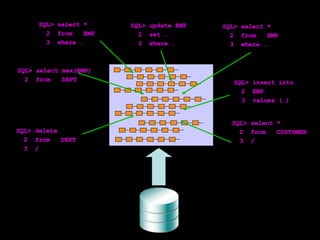
cache coherency
SQL> select *
2 from
EMP
3 where …

SQL> select max(EMP)
2 from
DEPT

SQL> delete
2 from
DEPT
3 /

SQL> update EMP
2 set …
3 where …

SQL> select *
2 from
EMP
3 where …

SQL> insert into
2 EMP
3 values (…)

SQL> select *
2 from
CUSTOMER
3 /
we have to latch !
"give me a row"

217
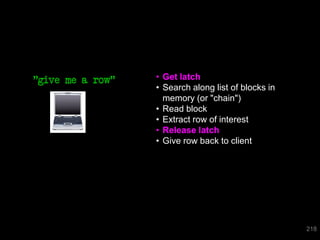
"give me a row"

• Get latch
• Search along list of blocks in
memory (or "chain")
• Read block
• Extract row of interest
• Release latch
• Give row back to client

218
lots of rows
lots of latching
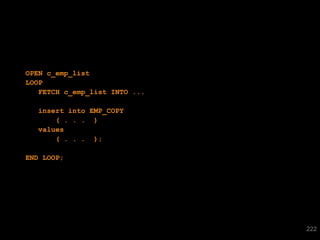
typical program
OPEN c_emp_list
LOOP
FETCH c_emp_list INTO ...
insert into EMP_COPY
( . . . )
values
( . . . );
END LOOP;

222
•
•
•
•
•
•

Get latch
Walk along chain
Get block
Extract single row
Release latch
Give row back to client

Row #1

OPEN c_emp_list
LOOP
FETCH c_emp_list INTO ...
insert into EMP_COPY
( . . . )
values
( . . . );
END LOOP;

223
•
•
•
•
•
•

OPEN c_emp_list
LOOP
FETCH c_emp_list INTO ...
insert into EMP_COPY
( . . . )
values
( . . . );

Get latch
Walk along chain
Get block
Extract single row
Release latch
Give row back to client

Row #1

•
•
•
•
•
•

Get latch (again)
Walk along chain (again)
Get block (again)
Extract single row
Release latch (again)
Give row back to client (again)

Row #2

END LOOP;

224
•
•
•
•
•
•

OPEN c_emp_list
LOOP
FETCH c_emp_list INTO ...
insert into EMP_COPY
( . . . )
values
( . . . );
END LOOP;

Get latch
Walk along chain
Get block
Extract single row
Release latch
Give row back to client

Row #1

•
•
•
•
•
•

Get latch (again)
Walk along chain (again)
Get block (again)
Extract single row
Release latch (again)
Give row back to client (again)

Row #2

•
•
•
•
•
•

Get latch (again)
Walk along chain (again)
Get block (again)
Extract single row
Release latch (again)
Give row back to client (again)

Row #3

etc
etc
etc
225
a better strategy.... “pinning”
"give me a row"
"give me a row"

“by the way, I’ll
be wanting
several rows
from this block”
"give me a row"

“by the way, I’ll
be wanting
several rows
from this block”

•
•
•
•
•
•
•
•
•
•
•
•

Get latch
Walk along chain
Get block
Pin the block
Release latch
Give row 1 back to client
Give row 2 back to client
…
Give row n to client
Get latch
Walk along chain
Remove my pin on the block
Release latch
how to convey
“I may want many rows”
SQL> set arraysize 10

231
PREFETCH=10
OCIAttrSet(…
(ub4)OCI_ATTR_PREFETCH_ROWS,
…)
FetchSize
odp.net
“relational”

not
“rowlational”

235
easy way to do this ?
let plsql do it
bulk collect
bulk bind
compare the performance

239
SQL>
2
3
4
5
6
7
8
9
10
11
12
13
14
15

declare
n number;
d date;
cursor c is
select empno, hiredate
from
big_emp;
begin
open c;
loop
fetch c into n,d;
exit when c%notfound;
end loop;
close c;
end;
/

1,000,000 rows

PL/SQL procedure successfully completed.
Elapsed: 00:01:15.06
SQL>
2
3
4
5
6
7
8
9
10
11
12
13

declare
cursor c is
select empno, hiredate
from
big_emp;
type c_list is table of c%rowtype;
r c_list;
begin
open c;
fetch c
bulk collect into r;
close c;
end;
/

PL/SQL procedure successfully completed.
Elapsed: 00:00:10.02
all that data goes somewhere

244
SQL> select * from v$mystats
2 where name like '%pga%'
3 /
NAME
VALUE
------------------------------ ---------session pga memory
101534672
session pga memory max
101534672
100m of memory !
law of diminishing returns
pin rows on a block (8k)

248
SQL> declare
. . .
9 begin
10
open c;
11
loop
12
fetch c
13
bulk collect
14
into r limit 100;
15
exit when c%notfound;
. . .
19 /

Elapsed: 00:00:08.03

NAME
VALUE
------------------------------ ---------session pga memory
225912
session pga memory max
225912
it works both ways
compare the performance
SQL> begin
2
for i in 1 .. 50000 loop
3
insert into t1 values ( i );
4
end loop;
5 end;
6 /
PL/SQL procedure successfully completed.
Elapsed: 00:00:11.03

252
SQL>
2
3
4
5
6
7
8
9
10
11
12

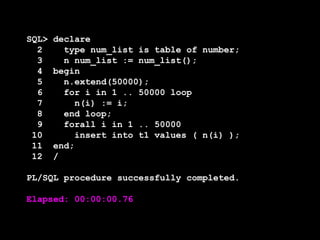
declare
type num_list is table of number;
n num_list := num_list();
begin
n.extend(50000);
for i in 1 .. 50000 loop
n(i) := i;
end loop;
forall i in 1 .. 50000
insert into t1 values ( n(i) );
end;
/

PL/SQL procedure successfully completed.

Elapsed: 00:00:00.76
remember our auditing trigger ?
SQL>
2
3
4

insert
select
from
where

into T
owner, object_name
all_objects
rownum <= 10000;

10000 rows created.

213
SQL> insert into T
2 select owner, object_name
insert into T
3 from
all_objects
select owner, object_name
4 all_objects rownum <= 10000;
where
from
where

rownum <= 10000

call
cpu
elapsed
10000 count ------- ---------rows created.
------- -----Parse
1
Execute
1
Fetch
0
------- -----total
2

disk
query
current
-------- --------- ---------0
0
0
88
123
10642
0
0
0
-------- --------- ---------88
123
10642

rows
---------0
10000
0
---------10000

cpu
elapsed
disk
query
current
------- ---------- -------- --------- ---------0.00
0.00
0
0
0
0.79
0.97
2
109
10845
0.00
0.00
0
0
0
------- ---------- -------- --------- ---------0.79
0.97
2
109
10845

rows
---------0
10000
0
---------10000

0.01
0.00
3.10
3.05
0.00
0.00
------- ---------3.12
3.06

INSERT INTO T_AUDIT
VALUES (SYSDATE ,:B3 ,:B1 ,:B2 )

call
count
------- -----Parse
1
Execute 10000
Fetch
0
------- -----total
10001

213
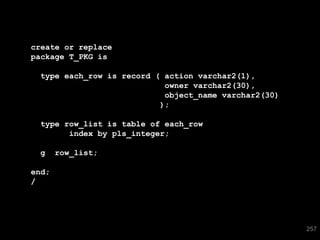
create or replace
package T_PKG is
type each_row is record ( action varchar2(1),
owner varchar2(30),
object_name varchar2(30)
);

type row_list is table of each_row
index by pls_integer;
g

row_list;

end;
/

214

257
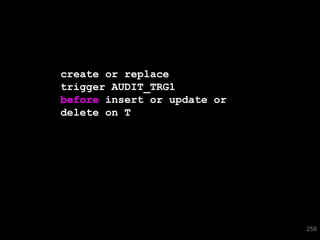
create or replace
trigger AUDIT_TRG1
before insert or update or
delete on T

215

258
create or replace
trigger AUDIT_TRG1
before insert or update or
delete on T
begin
t_pkg.g.delete;
end;
/

215

259
create or replace
trigger AUDIT_TRG2
after insert or update or delete on T
for each row

216
create or replace
trigger AUDIT_TRG2
after insert or update or delete on T
for each row
begin
if updating or inserting then
t_pkg.g(t_pkg.g.count+1).owner
t_pkg.g(t_pkg.g.count).object_name
else
t_pkg.g(t_pkg.g.count).owner
t_pkg.g(t_pkg.g.count).object_name
end if;
end;
/

:= :new.owner;
:= :new.object_name;
:= :old.owner;
:= :old.object_name;

216
create or replace
trigger AUDIT_TRG3
after insert or update or delete on T

217
create or replace
trigger AUDIT_TRG3
after insert or update or delete on T
declare
v_action varchar2(1) :=
case when updating then 'U'
when deleting then 'D'
else 'I' end;
begin
forall i in 1 .. t_pkg.g.count
insert into T_AUDIT
values (
sysdate,
v_action,
t_pkg.g(i).owner,
t_pkg.g(i).object_name);
t_pkg.g.delete;
end;
/

217
SQL>
2
3
4

insert
select
from
where

into T
owner, object_name
all_objects
rownum <= 10000;

10000 rows created.

218
SQL>
2
insert
3
select
4
from
where

insert into T
select owner, object_name
into T
from
all_objects
owner, object_name
where
all_objects rownum <= 10000;
rownum <= 10000

call
count
cpu
elapsed
10000 ------ ------- --------rows created.
------Parse
1
Execute
1
Fetch
0
------- -----total
2

disk
query
current
-------- ---------- ---------0
33
0
0
91
10653
0
0
0
-------- ---------- ---------0
124
10653

rows
---------0
10000
0
---------10000

cpu
elapsed
disk
query
current
------- --------- -------- ---------- ---------0.00
0.00
0
0
0
0.04
0.03
0
90
478
0.00
0.00
0
0
0
------- --------- -------- ---------- ---------0.04
0.03
0
90
478

rows
---------0
10000
0
---------10000
218

0.00
0.00
0.56
0.58
0.00
0.00
------- --------0.56
0.59

INSERT INTO T_AUDIT
VALUES
( SYSDATE, :B1 , :B2 , :B3 )

call
count
------- -----Parse
1
Execute
1
Fetch
0
------- -----total
2
summary
fetch data in sets not rows
use bulk collect / bulk bind

268
a little known fetch 'feature'
dont forget this bit
SQL> set autotrace traceonly stat
SQL> set arraysize 100
SQL> select object_type
2 from
T;
89405 rows selected.
Statistics
--------------------------------------------4 recursive calls
0 db block gets
2452 consistent gets
0 physical reads
0 redo size
1198478 bytes sent via SQL*Net to client

271
SQL> select object_type
2 from
T
3 order by object_type;
89405 rows selected.
Statistics
-------------------------------------------14 recursive calls
0 db block gets
1507 consistent gets
0 physical reads
0 redo size
618820 bytes sent via SQL*Net to client
SQL Net de-duplicate
ORDER BY matters !
Part 4
Read Consistency

275
“Readers don’t block writers"
“Writers don't block readers"
Maximum concurrency…
… very few locking worries
lack of understanding

279
corrupt your database
results are time consistent
“I’m a developer…
…who cares about all that?”
So many ways…
284
DIY replication
EMP

DWEMP
“every hour,
populate data warehouse,
copy of OLTP data”

demo1a/b
DIY data integrity

... true story
287
Manufacturer

Product
alter table add primary key
Manufacturer

Product

alter table add foreign key
Manufacturer

“ensure that every
product corresponds to
a valid manufacturer”
Product
create or replace
trigger PROD_MAN_CHECK
before insert or update on PRODUCT
for each row
declare
l_man_id number;
begin
select man_id
into
l_man_id
from
manufacturer
where man_id = :new.man_id;
exception
when no_data_found then
raise_application_error(-20000,
'Manufacturer is not valid');
end;
create or replace
trigger MAN_PROD_CHECK
before delete on MANUFACTURERS
for each row
declare
l_prd_cnt number;
begin
select count(*)
into
l_prd_cnt
from
product
where prd_id = :old.prd_id;
if l_prd_cnt > 0 then
raise_application_error(-20001,
'Manufacturer in use by product records');
end if;
end;
testing “works”

293
SQL> insert into PRODUCT (...,MAN_ID,...)
2 values (...,100, ...);

1 row created.
SQL> insert into PRODUCT (...,MAN_ID,...)
2 values (...,101,...);

ERROR at line 1:
ORA-20000: Manufacturer is not valid

SQL> delete from MANUFACTURER
2 where man_id = 5768;
ERROR at line 1:
ORA-20001: Manufacturer in use by product records
one month later…
An unexpected error has
occurred. Manufacturer
record not found
SQL> select count(*)
2 from
3
( select man_id from PRODUCT
4
minus
5
select man_id from MANUFACTURER )
6 /
COUNT(*)
---------86

297
DIY integrity =
no integrity
delete MAN=7
Trigger fires
- any PRD with MAN=7
- "No" (not yet)
- OK

commit

Time
create PRD with MAN=7
Trigger fires
- does MAN=7 exist?
- "Yes"
- OK

commit
referential integrity
seems simple…

“look up X before allowing Y”
300
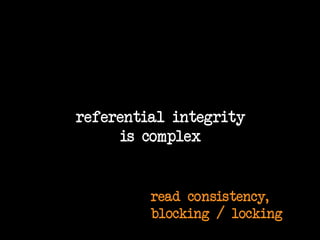
referential integrity
is complex

read consistency,
blocking / locking
“what percentage data integrity
do we have?”
- project manager

302
beware the module spec
"When creating a product...
validate registration date – ensure not in the future,
validate …
validate …
validate manufacturer ID – must exist in Manufacturer table"
concurrency testing vital

304
summary
Oracle consistency model is …
very very cool… and
very very complex !

308
(DIY) inter-table checking is
hard to do right
(DIY) intra-table checking is
hard to do right

310
let the database do it

311
Part 4
miscellaneous

312
excessive commit

313
"commits dont seem so bad"

314
SQL> begin
2
for i in 1 .. 30000 loop
3
insert into T1
4
values (i,i);
5
commit;
6
end loop;
7 end;
8 /
PL/SQL procedure successfully completed.
Elapsed: 00:00:05.40

315
another PLSQL trick

no sync
316
SQL> begin
2
for i in 1 .. 30000 loop
3
insert into T1
4
values (i,i);
5
commit write immediate wait;
6
end loop;
7 end;
8 /
PL/SQL procedure successfully completed.
Elapsed: 00:00:24.73

317
commit to requirement

318
SQL> begin
2
for i in 1 .. 30000 loop
3
insert into T1
4
values (i,i);
6
7
8

end loop;
end;
/

PL/SQL procedure successfully completed.
Elapsed: 00:00:01.58

319
"special" values

320
SQL> create table T ( processed date );
Table created.
SQL>
2
3
4
5
6
7
8
9

insert into T
select
case when mod(rownum,20) != 0 then
to_date('01-JAN-11')+rownum/10
else
null
end
from dual
connect by level <= 10000;

10000 rows created.
321
SQL> select min(processed), max(processed), count(*)
2 from t;
MIN(PROCE MAX(PROCE
COUNT(*)
--------- --------- ---------01-JAN-11 26-SEP-13
10000

10 rows per day
across ~3 years

322
SQL> select *
2 from
T
3 where processed between
4
'01-JUN-13' and '01-JUL-13';

-------------------------------------------| Id | Operation
| Name | Rows |
-------------------------------------------|
0 | SELECT STATEMENT
|
|
287 |
|* 1 | FILTER
|
|
|
|* 2 |
TABLE ACCESS FULL| T
|
287 |
--------------------------------------------

323
SQL> select *
2 from
T
3 where processed between
4
'01-JUN-13' and '01-JUL-13';

-------------------------------------------| Id | Operation
| Name | Rows |
-------------------------------------------|
0 | SELECT STATEMENT
|
|
287 |
|* 1 | FILTER
|
|
|
|* 2 |
TABLE ACCESS FULL| T
|
287 |
--------------------------------------------

reality = 285
324
"we don't like nulls"
SQL> truncate table T;
Table truncated.
SQL>
2
3
4
5
6
7
8
9

insert into T
select
case when mod(rownum,20) != 0 then
to_date('01-JAN-11')+rownum/10
else
to_date('31-DEC-3000')
end
from dual
connect by level <= 10000;

10000 rows created.
326
SQL> select *
2 from
T
3 where processed between
4
'01-JUN-13' and '01-JUL-13';

------------------------------------------| Id | Operation
| Name | Rows |
------------------------------------------|
0 | SELECT STATEMENT
|
|
3 |
|* 1 | FILTER
|
|
|
|* 2 |
TABLE ACCESS FULL| T
|
3 |
-------------------------------------------

uh oh...
if you're "stuck"

328
SQL> begin
2
dbms_stats.gather_table_stats('','T',
3
method_opt=>'for all columns size auto');
4 end;
5 /
PL/SQL procedure successfully completed.
SQL>
2
3
4

select
from
where
and

HISTOGRAM
user_tab_col_statistics
table_name = 'T'
column_name = 'PROCESSED';

HISTOGRAM
--------------HYBRID
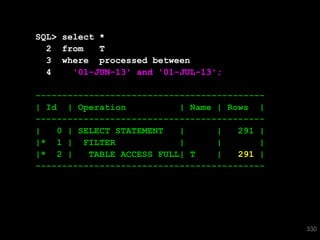
SQL> select *
2 from
T
3 where processed between
4
'01-JUN-13' and '01-JUL-13';

------------------------------------------| Id | Operation
| Name | Rows |
------------------------------------------|
0 | SELECT STATEMENT
|
|
291 |
|* 1 | FILTER
|
|
|
|* 2 |
TABLE ACCESS FULL| T
|
291 |
-------------------------------------------

330
lots of stuff we didn’t get to
cover

331
wrap up

332
the hardware allows

333
"web scale"

334
minimise parsing
intelligent commit

as long as you are too
set processing
plsql
335
ORA-00041
“active time limit exceeded - session terminated”

connormcdonald.wordpress.com

319

Feb14 successful development