
















Copyright © 2018, Oracle and/or its affiliates. All rights reserved.
Connor McDonald
Copyright © 2018, Oracle and/or its affiliates. All rights reserved.
2
Copyright © 2018, Oracle and/or its affiliates. All rights reserved.
3
Copyright © 2018, Oracle and/or its affiliates. All rights reserved.
4
Getting in touch is easy...
connor-mcdonald.com
https://linktr.ee/connor
Copyright © 2018, Oracle and/or its affiliates. All rights reserved.
6https://asktom.oracle.com
Copyright © 2018, Oracle and/or its affiliates. All rights reserved.
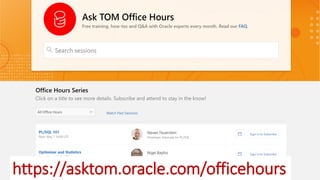
https://asktom.oracle.com/officehours
Copyright © 2017, Oracle and/or its affiliates. All rights reserved.
200 hours free access so far
8
Copyright © 2018, Oracle and/or its affiliates. All rights reserved.
before we begin
Copyright © 2018, Oracle and/or its affiliates. All rights reserved.
let's look at real life ...
Copyright © 2018, Oracle and/or its affiliates. All rights reserved.
"We'd never do that .... that's stupid"
Copyright © 2018, Oracle and/or its affiliates. All rights reserved.
but everyone does ... :-(
Copyright © 2018, Oracle and/or its affiliates. All rights reserved.
the most common PLSQL program
Copyright © 2018, Oracle and/or its affiliates. All rights reserved.
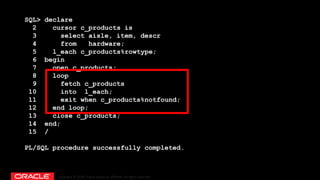
SQL> declare
2 cursor c_products is
3 select aisle, item, descr
4 from hardware;
5 l_each c_products%rowtype;
6 begin
7 open c_products;
8 loop
9 fetch c_products
10 into l_each;
11 exit when c_products%notfound;
12 end loop;
13 close c_products;
14 end;
15 /
PL/SQL procedure successfully completed.
Copyright © 2018, Oracle and/or its affiliates. All rights reserved.
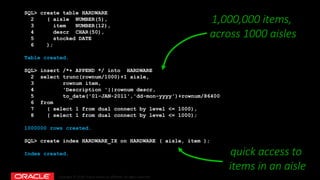
our setup for this session
Copyright © 2018, Oracle and/or its affiliates. All rights reserved.
SQL> create table HARDWARE
2 ( aisle NUMBER(5),
3 item NUMBER(12),
4 descr CHAR(50),
5 stocked DATE
6 );
Table created.
SQL> insert /*+ APPEND */ into HARDWARE
2 select trunc(rownum/1000)+1 aisle,
3 rownum item,
4 'Description '||rownum descr,
5 to_date('01-JAN-2011','dd-mon-yyyy')+rownum/86400
6 from
7 ( select 1 from dual connect by level <= 1000),
8 ( select 1 from dual connect by level <= 1000);
1000000 rows created.
SQL> create index HARDWARE_IX on HARDWARE ( aisle, item );
Index created.
1,000,000 items,
across 1000 aisles
quick access to
items in an aisle
Copyright © 2018, Oracle and/or its affiliates. All rights reserved.
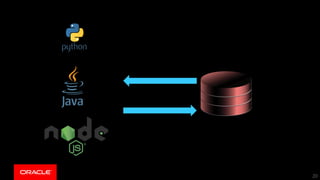
no matter what platform
18
Copyright © 2018, Oracle and/or its affiliates. All rights reserved.
no matter what direction
20
Copyright © 2018, Oracle and/or its affiliates. All rights reserved.
row by row :-(
Copyright © 2018, Oracle and/or its affiliates. All rights reserved.
"The database is slow"
Part 1
reading data
23
querying data
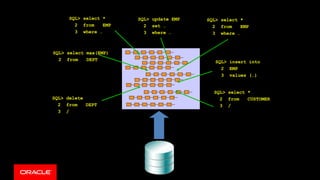
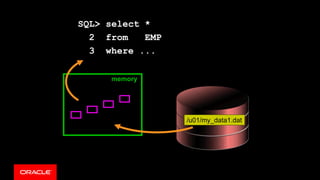
data is stored in blocks | pages
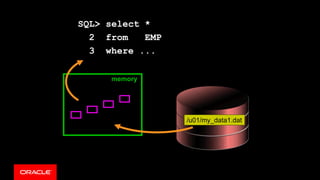
to read data, you read blocks...
SQL> select *
2 from EMP
3 where ...
/u01/my_data1.dat
memory
memory access = controlled access
SQL> select *
2 from EMP
3 where …
SQL> update EMP
2 set …
3 where …
SQL> select *
2 from EMP
3 where …
SQL> insert into
2 EMP
3 values (…)
SQL> select *
2 from CUSTOMER
3 /
SQL> select max(EMP)
2 from DEPT
SQL> delete
2 from DEPT
3 /
a quick primer on (database) memory
32
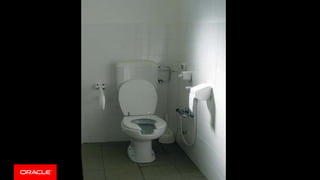
metaphor
35
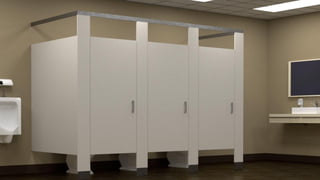
limited resource
lots of people want it
concurrent access causes problems
it's a complex system
37
same with memory
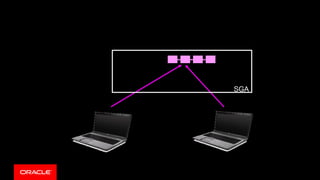
SGA
SGA
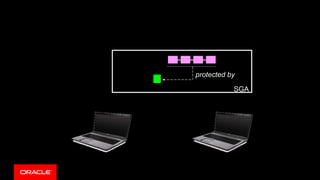
protected by
SGA
protected by
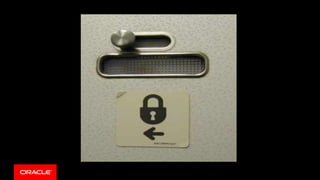
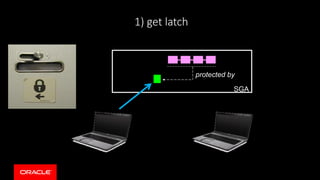
1) get latch
SGA
protected by
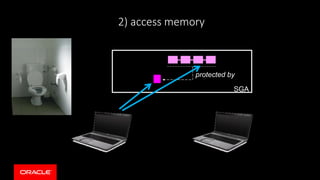
2) access memory
SGA
protected by
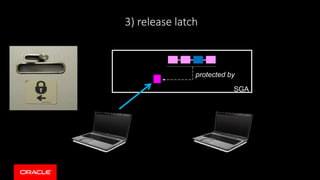
3) release latch
latch contention
SGA
protected by
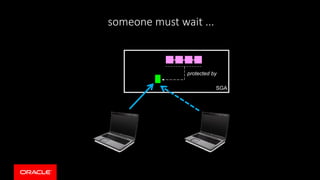
someone must wait ...
active wait
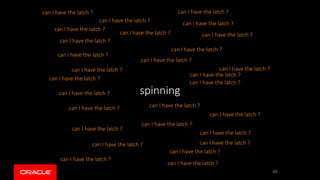
spinning
can I have the latch ?
46
latch contention....
hurts CPU...
49
hurts concurrency
YOU
GET
NOTHING
DONE
back to reading data
SQL> select *
2 from EMP
3 where ...
/u01/my_data1.dat
memory
we have to latch !
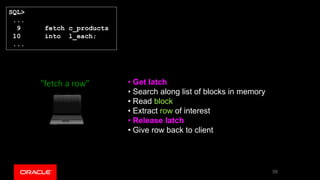
• Get latch
• Search along list of blocks in memory
• Read block
• Extract row of interest
• Release latch
• Give row back to client
"fetch a row"
58
SQL>
...
9 fetch c_products
10 into l_each;
...
lots of rows
lots of latching
typical program
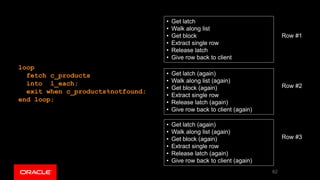
• Get latch
• Walk along list
• Get block
• Extract single row
• Release latch
• Give row back to client
• Get latch (again)
• Walk along list (again)
• Get block (again)
• Extract single row
• Release latch (again)
• Give row back to client (again)
Row #1
Row #2
• Get latch (again)
• Walk along list (again)
• Get block (again)
• Extract single row
• Release latch (again)
• Give row back to client (again)
Row #3
62
loop
fetch c_products
into l_each;
exit when c_products%notfound;
end loop;
a better strategy.... “pinning”
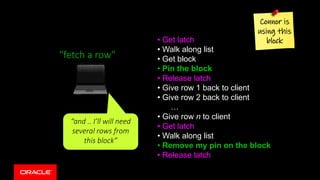
"fetch a row"
• Get latch
• Walk along list
• Get block
• Pin the block
• Release latch
• Give row 1 back to client
• Give row 2 back to client
…
• Give row n to client
• Get latch
• Walk along list
• Remove my pin on the block
• Release latch
“and .. I’ll will need
several rows from
this block”
Connor is
using this
block
how do you say
“I may want many rows” ?
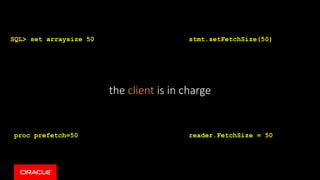
the client is in charge
SQL> set arraysize 50 stmt.setFetchSize(50)
proc prefetch=50 reader.FetchSize = 50
plsql = bulk collect | bulk bind
Copyright © 2018, Oracle and/or its affiliates. All rights reserved.
quick revision
68
Copyright © 2018, Oracle and/or its affiliates. All rights reserved.
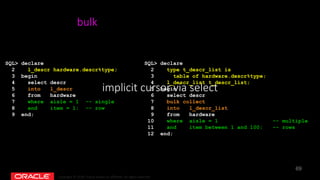
implicit cursor via select
69
SQL> declare
2 l_descr hardware.descr%type;
3 begin
4 select descr
5 into l_descr
6 from hardware
7 where aisle = 1 -- single
8 and item = 1; -- row
9 end;
bulk
SQL> declare
2 type t_descr_list is
3 table of hardware.descr%type;
4 l_descr_list t_descr_list;
5 begin
6 select descr
7 bulk collect
8 into l_descr_list
9 from hardware
10 where aisle = 1 -- multiple
11 and item between 1 and 100; -- rows
12 end;
Copyright © 2018, Oracle and/or its affiliates. All rights reserved.
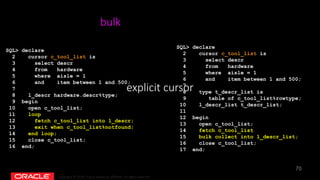
explicit cursor
70
SQL> declare
2 cursor c_tool_list is
3 select descr
4 from hardware
5 where aisle = 1
6 and item between 1 and 500;
7
8 l_descr hardware.descr%type;
9 begin
10 open c_tool_list;
11 loop
12 fetch c_tool_list into l_descr;
13 exit when c_tool_list%notfound;
14 end loop;
15 close c_tool_list;
16 end;
bulk
SQL> declare
2 cursor c_tool_list is
3 select descr
4 from hardware
5 where aisle = 1
6 and item between 1 and 500;
7
8 type t_descr_list is
9 table of c_tool_list%rowtype;
10 l_descr_list t_descr_list;
11
12 begin
13 open c_tool_list;
14 fetch c_tool_list
15 bulk collect into l_descr_list;
16 close c_tool_list;
17 end;
Copyright © 2018, Oracle and/or its affiliates. All rights reserved.
implicit cursor
71
SQL> begin
2 for i in (
3 select descr
4 from hardware
5 where aisle = 1
6 and item between 1 and 500 )
7 loop
8 [processing]
9 end loop;
10 end;
bulk
SQL> begin
2 for i in (
3 select descr
4 from hardware
5 where aisle = 1
6 and item between 1 and 500 )
7 loop
8 [processing]
9 end loop;
10 end;
SQL> select value
2 from v$parameter
3 where name = 'plsql_optimize_level';
VALUE
-----
2
Copyright © 2018, Oracle and/or its affiliates. All rights reserved.
"But why bother?"
bulk1.sql
Copyright © 2018, Oracle and/or its affiliates. All rights reserved.
wow !
Copyright © 2018, Oracle and/or its affiliates. All rights reserved.
it's more than just elapsed time
Copyright © 2018, Oracle and/or its affiliates. All rights reserved.
SQL> exec dbms_monitor.session_trace_enable;
[repeat the demo]
SQL> exec dbms_monitor.session_trace_disable;
SQL ID: frmas27snufjy Plan Hash: 652399433
SELECT DESCR
FROM HARDWARE
call count cpu elapsed disk query current rows
------- ------- -------- ---------- ---------- ---------- ---------- ----------
Parse 1 0.00 0.00 0 0 0 0
Execute 1 0.00 0.00 0 0 0 0
Fetch 1000001 4.56 3.70 0 1000011 0 1000000
------- ------- -------- ---------- ---------- ---------- ---------- ----------
total 1000003 4.56 3.70 0 1000011 0 1000000
SQL ID: frmas27snufjy Plan Hash: 652399433
SELECT DESCR
FROM HARDWARE
call count cpu elapsed disk query current rows
------- ------ -------- ---------- ---------- ---------- ---------- ----------
Parse 1 0.00 0.00 0 0 0 0
Execute 1 0.00 0.00 0 0 0 0
Fetch 1 0.00 0.34 0 10100 0 1000000
------- ------ -------- ---------- ---------- ---------- ---------- ----------
total 3 0.00 0.34 0 10100 0 1000000
Copyright © 2018, Oracle and/or its affiliates. All rights reserved.
but ...
Copyright © 2018, Oracle and/or its affiliates. All rights reserved.
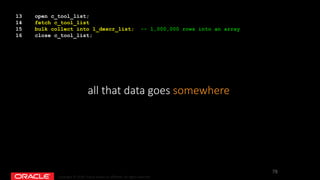
all that data goes somewhere
78
13 open c_tool_list;
14 fetch c_tool_list
15 bulk collect into l_descr_list; -- 1,000,000 rows into an array
16 close c_tool_list;
Copyright © 2018, Oracle and/or its affiliates. All rights reserved.
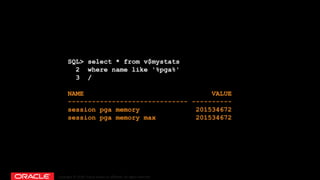
SQL> select * from v$mystats
2 where name like '%pga%'
3 /
NAME VALUE
------------------------------ ----------
session pga memory 201534672
session pga memory max 201534672
Copyright © 2018, Oracle and/or its affiliates. All rights reserved.
200m of memory !
per session
Copyright © 2018, Oracle and/or its affiliates. All rights reserved.
law of diminishing returns
Copyright © 2018, Oracle and/or its affiliates. All rights reserved.
this was about pinning
82
Copyright © 2018, Oracle and/or its affiliates. All rights reserved.
typical block is 8KB
83
Copyright © 2018, Oracle and/or its affiliates. All rights reserved.
NAME VALUE
------------------------------ ----------
session pga memory 2127112
session pga memory max 2155912
SQL> declare
2 cursor c_tool_list is
3 select descr
4 from hardware;
5
6 type t_descr_list is table of c_tool_list%rowtype;
7 l_descr_list t_descr_list;
8
9 begin
10 open c_tool_list;
11 loop
12 fetch c_tool_list
13 bulk collect
14 into l_descr_list limit 500;
15 exit when c_tool_list%notfound;
16 end loop;
17 close c_tool_list;
18 end;
19 /
PL/SQL procedure successfully completed.
Elapsed: 00:00:00.10
Copyright © 2018, Oracle and/or its affiliates. All rights reserved.
important !
85
Copyright © 2018, Oracle and/or its affiliates. All rights reserved.
SQL> declare
2 cursor c_tool_list is
3 select descr
4 from hardware;
5
6 type t_descr_list is table of c_tool_list%rowtype;
7 l_descr_list t_descr_list;
8
9 begin
10 open c_tool_list;
11 loop
12 fetch c_tool_list
13 bulk collect
14 into l_descr_list limit 500;
1) array is replaced
15 exit when c_tool_list%notfound;
16 end loop;
17 close c_tool_list;
18 end;
19 /
2) < 500 = "not found"
[processing here!]
for i in 1 .. l_descr_list.count
Copyright © 2018, Oracle and/or its affiliates. All rights reserved.
even easier ...
87
Copyright © 2018, Oracle and/or its affiliates. All rights reserved.
implicit cursor
88
SQL> begin
2 for i in (
3 select descr
4 from hardware
5 where aisle = 1
6 and item between 1 and 500 )
7 loop
8 [processing]
9 end loop;
10 end;
bulk
SQL> begin
2 for i in (
3 select descr
4 from hardware
5 where aisle = 1
6 and item between 1 and 500 )
7 loop
8 [processing]
9 end loop;
10 end;
Copyright © 2018, Oracle and/or its affiliates. All rights reserved.
guidelines
89
Copyright © 2018, Oracle and/or its affiliates. All rights reserved.
1) single row
no change
Copyright © 2018, Oracle and/or its affiliates. All rights reserved.
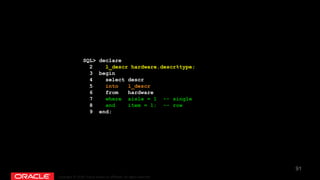
91
SQL> declare
2 l_descr hardware.descr%type;
3 begin
4 select descr
5 into l_descr
6 from hardware
7 where aisle = 1 -- single
8 and item = 1; -- row
9 end;
Copyright © 2018, Oracle and/or its affiliates. All rights reserved.
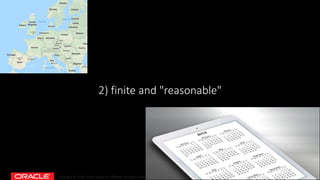
2) finite and "reasonable"
Copyright © 2018, Oracle and/or its affiliates. All rights reserved.
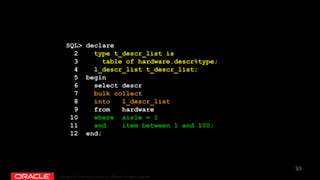
93
SQL> declare
2 type t_descr_list is
3 table of hardware.descr%type;
4 l_descr_list t_descr_list;
5 begin
6 select descr
7 bulk collect
8 into l_descr_list
9 from hardware
10 where aisle = 1
11 and item between 1 and 100;
12 end;
Copyright © 2018, Oracle and/or its affiliates. All rights reserved.
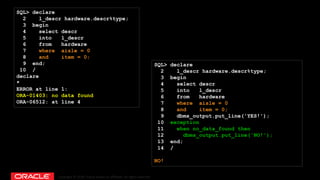
note: subtle differences
94
Copyright © 2018, Oracle and/or its affiliates. All rights reserved.
SQL> declare
2 l_descr hardware.descr%type;
3 begin
4 select descr
5 into l_descr
6 from hardware
7 where aisle = 0
8 and item = 0;
9 end;
10 /
declare
*
ERROR at line 1:
ORA-01403: no data found
ORA-06512: at line 4
SQL> declare
2 l_descr hardware.descr%type;
3 begin
4 select descr
5 into l_descr
6 from hardware
7 where aisle = 0
8 and item = 0;
9 dbms_output.put_line('YES!');
10 exception
11 when no_data_found then
12 dbms_output.put_line('NO!');
13 end;
14 /
NO!
Copyright © 2018, Oracle and/or its affiliates. All rights reserved.
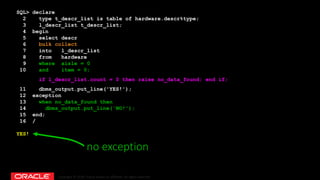
SQL> declare
2 type t_descr_list is table of hardware.descr%type;
3 l_descr_list t_descr_list;
4 begin
5 select descr
6 bulk collect
7 into l_descr_list
8 from hardware
9 where aisle = 0
10 and item = 0;
11 dbms_output.put_line('YES!');
12 exception
13 when no_data_found then
14 dbms_output.put_line('NO!');
15 end;
16 /
YES!
no exception
if l_descr_list.count = 0 then raise no_data_found; end if;
Copyright © 2018, Oracle and/or its affiliates. All rights reserved.
3) unknown number of rows
97
Copyright © 2018, Oracle and/or its affiliates. All rights reserved.
98
SQL> begin
2 for i in (
3 select descr
4 from hardware
5 where aisle = 1
6 and item between 1 and 500 )
7 loop
8 [processing]
9 end loop;
10 end;
Copyright © 2018, Oracle and/or its affiliates. All rights reserved.
special case #1
99
Copyright © 2018, Oracle and/or its affiliates. All rights reserved.
100
SQL> begin
2 for i in (
3 select descr
4 from hardware
5 where aisle = 1
6 and item between 1 and 500 )
7 loop
8
...
...
exit [early] when [some condition];
...
..
19 end loop;
20 end;
Copyright © 2018, Oracle and/or its affiliates. All rights reserved.
special case #2
101
Copyright © 2018, Oracle and/or its affiliates. All rights reserved.
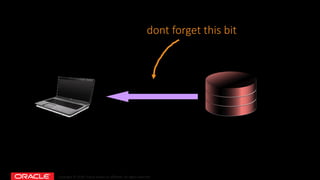
dont forget this bit
Copyright © 2018, Oracle and/or its affiliates. All rights reserved.
reduce network roundtrips
103
larger array sizes
Copyright © 2018, Oracle and/or its affiliates. All rights reserved.
sidebar: SQL as well
104
Copyright © 2018, Oracle and/or its affiliates. All rights reserved.
a little known feature
Copyright © 2018, Oracle and/or its affiliates. All rights reserved.
SQL Net de-duplicate
Copyright © 2018, Oracle and/or its affiliates. All rights reserved.
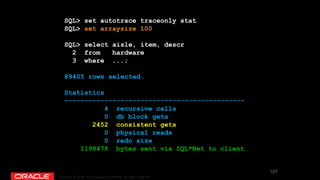
SQL> set autotrace traceonly stat
SQL> set arraysize 100
SQL> select aisle, item, descr
2 from hardware
3 where ...;
89405 rows selected.
Statistics
---------------------------------------------
4 recursive calls
0 db block gets
2452 consistent gets
0 physical reads
0 redo size
1198478 bytes sent via SQL*Net to client
107
Copyright © 2018, Oracle and/or its affiliates. All rights reserved.
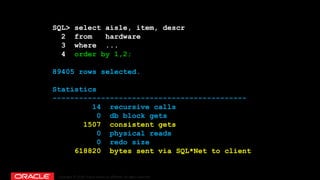
SQL> select aisle, item, descr
2 from hardware
3 where ...
4 order by 1,2;
89405 rows selected.
Statistics
--------------------------------------------
14 recursive calls
0 db block gets
1507 consistent gets
0 physical reads
0 redo size
618820 bytes sent via SQL*Net to client
Copyright © 2018, Oracle and/or its affiliates. All rights reserved.
focus on blocks
109
Copyright © 2018, Oracle and/or its affiliates. All rights reserved.
focus on roundtrips
110
Copyright © 2018, Oracle and/or its affiliates. All rights reserved.
Part 2
writing data
111
Copyright © 2018, Oracle and/or its affiliates. All rights reserved.
the same rules apply
112
Copyright © 2018, Oracle and/or its affiliates. All rights reserved.
conventional DML in PLSQL
113
Copyright © 2018, Oracle and/or its affiliates. All rights reserved.
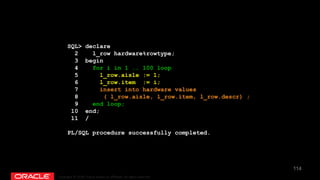
114
SQL> declare
2 l_row hardware%rowtype;
3 begin
4 for i in 1 .. 100 loop
5 l_row.aisle := 1;
6 l_row.item := i;
7 insert into hardware values
8 ( l_row.aisle, l_row.item, l_row.descr) ;
9 end loop;
10 end;
11 /
PL/SQL procedure successfully completed.
Copyright © 2018, Oracle and/or its affiliates. All rights reserved.
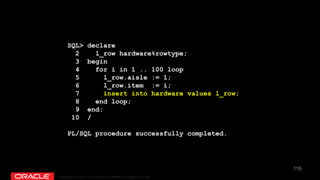
or even nicer (PLSQL only)
115
Copyright © 2018, Oracle and/or its affiliates. All rights reserved.
116
SQL> declare
2 l_row hardware%rowtype;
3 begin
4 for i in 1 .. 100 loop
5 l_row.aisle := 1;
6 l_row.item := i;
7 insert into hardware values l_row;
8 end loop;
9 end;
10 /
PL/SQL procedure successfully completed.
Copyright © 2018, Oracle and/or its affiliates. All rights reserved.
DML bulk = "bulk bind / FORALL"
117
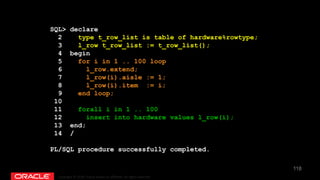
Copyright © 2018, Oracle and/or its affiliates. All rights reserved.
118
SQL> declare
2 type t_row_list is table of hardware%rowtype;
3 l_row t_row_list := t_row_list();
4 begin
5 for i in 1 .. 100 loop
6 l_row.extend;
7 l_row(i).aisle := 1;
8 l_row(i).item := i;
9 end loop;
10
11 forall i in 1 .. 100
12 insert into hardware values l_row(i);
13 end;
14 /
PL/SQL procedure successfully completed.
Copyright © 2018, Oracle and/or its affiliates. All rights reserved.
"Is it worth the extra code?"
bulk2.sql
Copyright © 2018, Oracle and/or its affiliates. All rights reserved.
it's better than that
bulk3.sql
Copyright © 2018, Oracle and/or its affiliates. All rights reserved.
but ...
Copyright © 2018, Oracle and/or its affiliates. All rights reserved.
... the same rules apply
Copyright © 2018, Oracle and/or its affiliates. All rights reserved.
all the data is somewhere
PGA memory
Copyright © 2018, Oracle and/or its affiliates. All rights reserved.
law of diminishing returns
bulk4.sql
Copyright © 2018, Oracle and/or its affiliates. All rights reserved.
no auto option :-(
Copyright © 2018, Oracle and/or its affiliates. All rights reserved.
100-1000 typically fine
Copyright © 2018, Oracle and/or its affiliates. All rights reserved.
one special case
Copyright © 2018, Oracle and/or its affiliates. All rights reserved.
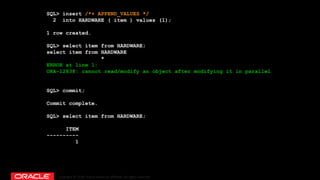
SQL> insert /*+ APPEND_VALUES */
2 into HARDWARE ( item ) values (1);
1 row created.
SQL> select item from HARDWARE;
select item from HARDWARE
*
ERROR at line 1:
ORA-12838: cannot read/modify an object after modifying it in parallel
SQL> commit;
Commit complete.
SQL> select item from HARDWARE;
ITEM
----------
1
Copyright © 2018, Oracle and/or its affiliates. All rights reserved.
direct load
Copyright © 2018, Oracle and/or its affiliates. All rights reserved.
high speed, massive data loads
bulk7.sql
Copyright © 2018, Oracle and/or its affiliates. All rights reserved.
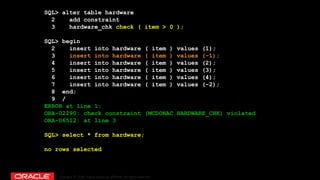
challenges with multi-row DML
Copyright © 2018, Oracle and/or its affiliates. All rights reserved.
SQL> alter table hardware
2 add constraint
3 hardware_chk check ( item > 0 );
SQL> begin
2 insert into hardware ( item ) values (1);
3 insert into hardware ( item ) values (-1);
4 insert into hardware ( item ) values (2);
5 insert into hardware ( item ) values (3);
6 insert into hardware ( item ) values (4);
7 insert into hardware ( item ) values (-2);
8 end;
9 /
ERROR at line 1:
ORA-02290: check constraint (MCDONAC.HARDWARE_CHK) violated
ORA-06512: at line 3
SQL> select * from hardware;
no rows selected
Copyright © 2018, Oracle and/or its affiliates. All rights reserved.
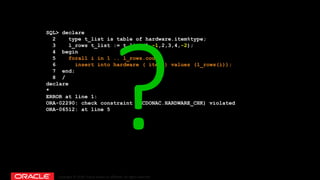
SQL> declare
2 type t_list is table of hardware.item%type;
3 l_rows t_list := t_list(1,-1,2,3,4,-2);
4 begin
5 forall i in 1 .. l_rows.count
6 insert into hardware ( item ) values (l_rows(i));
7 end;
8 /
declare
*
ERROR at line 1:
ORA-02290: check constraint (MCDONAC.HARDWARE_CHK) violated
ORA-06512: at line 5
Copyright © 2018, Oracle and/or its affiliates. All rights reserved.
issue #1: which row cause the problem
Copyright © 2018, Oracle and/or its affiliates. All rights reserved.
issue #2: none of the rows were stored
Copyright © 2018, Oracle and/or its affiliates. All rights reserved.
SAVE EXCEPTIONS clause
bulk5.sql
Copyright © 2018, Oracle and/or its affiliates. All rights reserved.
also consider error logging
bulk6.sql
Copyright © 2018, Oracle and/or its affiliates. All rights reserved.
issue #3: sparseness
Copyright © 2018, Oracle and/or its affiliates. All rights reserved.
SQL> declare
2 type t_num_list is table of hardware.item%type index by pls_integer;
3
4 val t_num_list;
5 begin
6
7 val(10) := 10;
8 val(11) := 20;
9 val(12) := 20;
10
11 forall i in 1 .. val.count
12 insert into hardware ( item ) values (val(i));
13
14 end;
15 /
declare
*
ERROR at line 1:
ORA-22160: element at index [1] does not exist
ORA-06512: at line 11
Copyright © 2018, Oracle and/or its affiliates. All rights reserved.
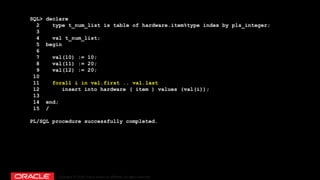
SQL> declare
2 type t_num_list is table of hardware.item%type index by pls_integer;
3
4 val t_num_list;
5 begin
6
7 val(10) := 10;
8 val(11) := 20;
9 val(12) := 20;
10
11 forall i in val.first .. val.last
12 insert into hardware ( item ) values (val(i));
13
14 end;
15 /
PL/SQL procedure successfully completed.
Copyright © 2018, Oracle and/or its affiliates. All rights reserved.
but ... contiguous is assumed
141
Copyright © 2018, Oracle and/or its affiliates. All rights reserved.
SQL> declare
2 type t_num_list is table of hardware.item%type index by pls_integer;
3
4 val t_num_list;
5 begin
6
7 val(10) := 10;
8 -- val(11) := 20;
9 val(12) := 20;
10
11 forall i in val.first .. val.last
12 insert into hardware ( item ) values (val(i));
13
14 end;
15 /
declare
*
ERROR at line 1:
ORA-22160: element at index [11] does not exist
ORA-06512: at line 11
Copyright © 2018, Oracle and/or its affiliates. All rights reserved.
INDICES OF clause
143
Copyright © 2018, Oracle and/or its affiliates. All rights reserved.
SQL> declare
2 type t_num_list is table of hardware.item%type index by pls_integer;
3
4 val t_num_list;
5 begin
6
7 val(10) := 10;
8 -- val(11) := 20;
9 val(12) := 20;
10
11 forall i in indices of val
12 insert into hardware ( item ) values (val(i));
13
14 end;
15 /
PL/SQL procedure successfully completed.
Copyright © 2018, Oracle and/or its affiliates. All rights reserved.
homework :-)
145
Copyright © 2018, Oracle and/or its affiliates. All rights reserved.
VALUES OF clause
146
Copyright © 2018, Oracle and/or its affiliates. All rights reserved.
"How to get array benefits with SQL?"
Copyright © 2018, Oracle and/or its affiliates. All rights reserved.
SQL does this automatically...
Copyright © 2018, Oracle and/or its affiliates. All rights reserved.
full table scans
index range scans
prefetch
Copyright © 2018, Oracle and/or its affiliates. All rights reserved.
use SQL in preference to PLSQL where possible
150
for another day
Copyright © 2018, Oracle and/or its affiliates. All rights reserved.
wrap up
151
Copyright © 2018, Oracle and/or its affiliates. All rights reserved.
“relational”
not
“rowlational”
Copyright © 2018, Oracle and/or its affiliates. All rights reserved.
process data in sets not rows
Copyright © 2018, Oracle and/or its affiliates. All rights reserved.
use bulk collect / bulk bind where appropriate
Enjoy the rest of the conference!
https://linktr.ee/connor

APEX Connect 2019 - array/bulk processing in PLSQL

  • 1.
    Copyright © 2018,Oracle and/or its affiliates. All rights reserved. Connor McDonald
  • 2.
    Copyright © 2018,Oracle and/or its affiliates. All rights reserved. 2
  • 3.
    Copyright © 2018,Oracle and/or its affiliates. All rights reserved. 3
  • 4.
    Copyright © 2018,Oracle and/or its affiliates. All rights reserved. 4
  • 5.
    Getting in touchis easy... connor-mcdonald.com https://linktr.ee/connor
  • 6.
    Copyright © 2018,Oracle and/or its affiliates. All rights reserved. 6https://asktom.oracle.com
  • 7.
    Copyright © 2018,Oracle and/or its affiliates. All rights reserved. https://asktom.oracle.com/officehours
  • 8.
    Copyright © 2017,Oracle and/or its affiliates. All rights reserved. 200 hours free access so far 8
  • 9.
    Copyright © 2018,Oracle and/or its affiliates. All rights reserved. before we begin
  • 10.
    Copyright © 2018,Oracle and/or its affiliates. All rights reserved. let's look at real life ...
  • 11.
    Copyright © 2018,Oracle and/or its affiliates. All rights reserved. "We'd never do that .... that's stupid"
  • 12.
    Copyright © 2018,Oracle and/or its affiliates. All rights reserved. but everyone does ... :-(
  • 13.
    Copyright © 2018,Oracle and/or its affiliates. All rights reserved. the most common PLSQL program
  • 14.
    Copyright © 2018,Oracle and/or its affiliates. All rights reserved. SQL> declare 2 cursor c_products is 3 select aisle, item, descr 4 from hardware; 5 l_each c_products%rowtype; 6 begin 7 open c_products; 8 loop 9 fetch c_products 10 into l_each; 11 exit when c_products%notfound; 12 end loop; 13 close c_products; 14 end; 15 / PL/SQL procedure successfully completed.
  • 15.
    Copyright © 2018,Oracle and/or its affiliates. All rights reserved. our setup for this session
  • 16.
    Copyright © 2018,Oracle and/or its affiliates. All rights reserved. SQL> create table HARDWARE 2 ( aisle NUMBER(5), 3 item NUMBER(12), 4 descr CHAR(50), 5 stocked DATE 6 ); Table created. SQL> insert /*+ APPEND */ into HARDWARE 2 select trunc(rownum/1000)+1 aisle, 3 rownum item, 4 'Description '||rownum descr, 5 to_date('01-JAN-2011','dd-mon-yyyy')+rownum/86400 6 from 7 ( select 1 from dual connect by level <= 1000), 8 ( select 1 from dual connect by level <= 1000); 1000000 rows created. SQL> create index HARDWARE_IX on HARDWARE ( aisle, item ); Index created. 1,000,000 items, across 1000 aisles quick access to items in an aisle
  • 17.
    Copyright © 2018,Oracle and/or its affiliates. All rights reserved. no matter what platform
  • 18.
  • 19.
    Copyright © 2018,Oracle and/or its affiliates. All rights reserved. no matter what direction
  • 20.
  • 21.
    Copyright © 2018,Oracle and/or its affiliates. All rights reserved. row by row :-(
  • 22.
    Copyright © 2018,Oracle and/or its affiliates. All rights reserved. "The database is slow"
  • 23.
  • 24.
  • 25.
    data is storedin blocks | pages
  • 26.
    to read data,you read blocks...
  • 27.
    SQL> select * 2from EMP 3 where ... /u01/my_data1.dat memory
  • 28.
    memory access =controlled access
  • 29.
    SQL> select * 2from EMP 3 where … SQL> update EMP 2 set … 3 where … SQL> select * 2 from EMP 3 where … SQL> insert into 2 EMP 3 values (…) SQL> select * 2 from CUSTOMER 3 / SQL> select max(EMP) 2 from DEPT SQL> delete 2 from DEPT 3 /
  • 30.
    a quick primeron (database) memory
  • 32.
  • 35.
    35 limited resource lots ofpeople want it concurrent access causes problems it's a complex system
  • 37.
  • 38.
  • 39.
  • 40.
  • 41.
  • 42.
  • 43.
  • 44.
  • 45.
  • 46.
    spinning can I havethe latch ? can I have the latch ? can I have the latch ? can I have the latch ? can I have the latch ? can I have the latch ? can I have the latch ? can I have the latch ? can I have the latch ? can I have the latch ? can I have the latch ? can I have the latch ? can I have the latch ? can I have the latch ? can I have the latch ? can I have the latch ? can I have the latch ? can I have the latch ? can I have the latch ? can I have the latch ? can I have the latch ? can I have the latch ? can I have the latch ? can I have the latch ? can I have the latch ? can I have the latch ? can I have the latch ? can I have the latch ? 46
  • 48.
  • 49.
  • 50.
  • 51.
  • 52.
  • 53.
  • 54.
  • 55.
  • 56.
    SQL> select * 2from EMP 3 where ... /u01/my_data1.dat memory
  • 57.
    we have tolatch !
  • 58.
    • Get latch •Search along list of blocks in memory • Read block • Extract row of interest • Release latch • Give row back to client "fetch a row" 58 SQL> ... 9 fetch c_products 10 into l_each; ...
  • 59.
  • 60.
  • 61.
  • 62.
    • Get latch •Walk along list • Get block • Extract single row • Release latch • Give row back to client • Get latch (again) • Walk along list (again) • Get block (again) • Extract single row • Release latch (again) • Give row back to client (again) Row #1 Row #2 • Get latch (again) • Walk along list (again) • Get block (again) • Extract single row • Release latch (again) • Give row back to client (again) Row #3 62 loop fetch c_products into l_each; exit when c_products%notfound; end loop;
  • 63.
    a better strategy....“pinning”
  • 64.
    "fetch a row" •Get latch • Walk along list • Get block • Pin the block • Release latch • Give row 1 back to client • Give row 2 back to client … • Give row n to client • Get latch • Walk along list • Remove my pin on the block • Release latch “and .. I’ll will need several rows from this block” Connor is using this block
  • 65.
    how do yousay “I may want many rows” ?
  • 66.
    the client isin charge SQL> set arraysize 50 stmt.setFetchSize(50) proc prefetch=50 reader.FetchSize = 50
  • 67.
    plsql = bulkcollect | bulk bind
  • 68.
    Copyright © 2018,Oracle and/or its affiliates. All rights reserved. quick revision 68
  • 69.
    Copyright © 2018,Oracle and/or its affiliates. All rights reserved. implicit cursor via select 69 SQL> declare 2 l_descr hardware.descr%type; 3 begin 4 select descr 5 into l_descr 6 from hardware 7 where aisle = 1 -- single 8 and item = 1; -- row 9 end; bulk SQL> declare 2 type t_descr_list is 3 table of hardware.descr%type; 4 l_descr_list t_descr_list; 5 begin 6 select descr 7 bulk collect 8 into l_descr_list 9 from hardware 10 where aisle = 1 -- multiple 11 and item between 1 and 100; -- rows 12 end;
  • 70.
    Copyright © 2018,Oracle and/or its affiliates. All rights reserved. explicit cursor 70 SQL> declare 2 cursor c_tool_list is 3 select descr 4 from hardware 5 where aisle = 1 6 and item between 1 and 500; 7 8 l_descr hardware.descr%type; 9 begin 10 open c_tool_list; 11 loop 12 fetch c_tool_list into l_descr; 13 exit when c_tool_list%notfound; 14 end loop; 15 close c_tool_list; 16 end; bulk SQL> declare 2 cursor c_tool_list is 3 select descr 4 from hardware 5 where aisle = 1 6 and item between 1 and 500; 7 8 type t_descr_list is 9 table of c_tool_list%rowtype; 10 l_descr_list t_descr_list; 11 12 begin 13 open c_tool_list; 14 fetch c_tool_list 15 bulk collect into l_descr_list; 16 close c_tool_list; 17 end;
  • 71.
    Copyright © 2018,Oracle and/or its affiliates. All rights reserved. implicit cursor 71 SQL> begin 2 for i in ( 3 select descr 4 from hardware 5 where aisle = 1 6 and item between 1 and 500 ) 7 loop 8 [processing] 9 end loop; 10 end; bulk SQL> begin 2 for i in ( 3 select descr 4 from hardware 5 where aisle = 1 6 and item between 1 and 500 ) 7 loop 8 [processing] 9 end loop; 10 end; SQL> select value 2 from v$parameter 3 where name = 'plsql_optimize_level'; VALUE ----- 2
  • 72.
    Copyright © 2018,Oracle and/or its affiliates. All rights reserved. "But why bother?" bulk1.sql
  • 73.
    Copyright © 2018,Oracle and/or its affiliates. All rights reserved. wow !
  • 74.
    Copyright © 2018,Oracle and/or its affiliates. All rights reserved. it's more than just elapsed time
  • 75.
    Copyright © 2018,Oracle and/or its affiliates. All rights reserved. SQL> exec dbms_monitor.session_trace_enable; [repeat the demo] SQL> exec dbms_monitor.session_trace_disable; SQL ID: frmas27snufjy Plan Hash: 652399433 SELECT DESCR FROM HARDWARE call count cpu elapsed disk query current rows ------- ------- -------- ---------- ---------- ---------- ---------- ---------- Parse 1 0.00 0.00 0 0 0 0 Execute 1 0.00 0.00 0 0 0 0 Fetch 1000001 4.56 3.70 0 1000011 0 1000000 ------- ------- -------- ---------- ---------- ---------- ---------- ---------- total 1000003 4.56 3.70 0 1000011 0 1000000 SQL ID: frmas27snufjy Plan Hash: 652399433 SELECT DESCR FROM HARDWARE call count cpu elapsed disk query current rows ------- ------ -------- ---------- ---------- ---------- ---------- ---------- Parse 1 0.00 0.00 0 0 0 0 Execute 1 0.00 0.00 0 0 0 0 Fetch 1 0.00 0.34 0 10100 0 1000000 ------- ------ -------- ---------- ---------- ---------- ---------- ---------- total 3 0.00 0.34 0 10100 0 1000000
  • 76.
    Copyright © 2018,Oracle and/or its affiliates. All rights reserved. but ...
  • 78.
    Copyright © 2018,Oracle and/or its affiliates. All rights reserved. all that data goes somewhere 78 13 open c_tool_list; 14 fetch c_tool_list 15 bulk collect into l_descr_list; -- 1,000,000 rows into an array 16 close c_tool_list;
  • 79.
    Copyright © 2018,Oracle and/or its affiliates. All rights reserved. SQL> select * from v$mystats 2 where name like '%pga%' 3 / NAME VALUE ------------------------------ ---------- session pga memory 201534672 session pga memory max 201534672
  • 80.
    Copyright © 2018,Oracle and/or its affiliates. All rights reserved. 200m of memory ! per session
  • 81.
    Copyright © 2018,Oracle and/or its affiliates. All rights reserved. law of diminishing returns
  • 82.
    Copyright © 2018,Oracle and/or its affiliates. All rights reserved. this was about pinning 82
  • 83.
    Copyright © 2018,Oracle and/or its affiliates. All rights reserved. typical block is 8KB 83
  • 84.
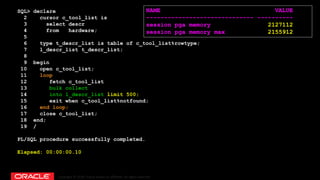
    Copyright © 2018,Oracle and/or its affiliates. All rights reserved. NAME VALUE ------------------------------ ---------- session pga memory 2127112 session pga memory max 2155912 SQL> declare 2 cursor c_tool_list is 3 select descr 4 from hardware; 5 6 type t_descr_list is table of c_tool_list%rowtype; 7 l_descr_list t_descr_list; 8 9 begin 10 open c_tool_list; 11 loop 12 fetch c_tool_list 13 bulk collect 14 into l_descr_list limit 500; 15 exit when c_tool_list%notfound; 16 end loop; 17 close c_tool_list; 18 end; 19 / PL/SQL procedure successfully completed. Elapsed: 00:00:00.10
  • 85.
    Copyright © 2018,Oracle and/or its affiliates. All rights reserved. important ! 85
  • 86.
    Copyright © 2018,Oracle and/or its affiliates. All rights reserved. SQL> declare 2 cursor c_tool_list is 3 select descr 4 from hardware; 5 6 type t_descr_list is table of c_tool_list%rowtype; 7 l_descr_list t_descr_list; 8 9 begin 10 open c_tool_list; 11 loop 12 fetch c_tool_list 13 bulk collect 14 into l_descr_list limit 500; 1) array is replaced 15 exit when c_tool_list%notfound; 16 end loop; 17 close c_tool_list; 18 end; 19 / 2) < 500 = "not found" [processing here!] for i in 1 .. l_descr_list.count
  • 87.
    Copyright © 2018,Oracle and/or its affiliates. All rights reserved. even easier ... 87
  • 88.
    Copyright © 2018,Oracle and/or its affiliates. All rights reserved. implicit cursor 88 SQL> begin 2 for i in ( 3 select descr 4 from hardware 5 where aisle = 1 6 and item between 1 and 500 ) 7 loop 8 [processing] 9 end loop; 10 end; bulk SQL> begin 2 for i in ( 3 select descr 4 from hardware 5 where aisle = 1 6 and item between 1 and 500 ) 7 loop 8 [processing] 9 end loop; 10 end;
  • 89.
    Copyright © 2018,Oracle and/or its affiliates. All rights reserved. guidelines 89
  • 90.
    Copyright © 2018,Oracle and/or its affiliates. All rights reserved. 1) single row no change
  • 91.
    Copyright © 2018,Oracle and/or its affiliates. All rights reserved. 91 SQL> declare 2 l_descr hardware.descr%type; 3 begin 4 select descr 5 into l_descr 6 from hardware 7 where aisle = 1 -- single 8 and item = 1; -- row 9 end;
  • 92.
    Copyright © 2018,Oracle and/or its affiliates. All rights reserved. 2) finite and "reasonable"
  • 93.
    Copyright © 2018,Oracle and/or its affiliates. All rights reserved. 93 SQL> declare 2 type t_descr_list is 3 table of hardware.descr%type; 4 l_descr_list t_descr_list; 5 begin 6 select descr 7 bulk collect 8 into l_descr_list 9 from hardware 10 where aisle = 1 11 and item between 1 and 100; 12 end;
  • 94.
    Copyright © 2018,Oracle and/or its affiliates. All rights reserved. note: subtle differences 94
  • 95.
    Copyright © 2018,Oracle and/or its affiliates. All rights reserved. SQL> declare 2 l_descr hardware.descr%type; 3 begin 4 select descr 5 into l_descr 6 from hardware 7 where aisle = 0 8 and item = 0; 9 end; 10 / declare * ERROR at line 1: ORA-01403: no data found ORA-06512: at line 4 SQL> declare 2 l_descr hardware.descr%type; 3 begin 4 select descr 5 into l_descr 6 from hardware 7 where aisle = 0 8 and item = 0; 9 dbms_output.put_line('YES!'); 10 exception 11 when no_data_found then 12 dbms_output.put_line('NO!'); 13 end; 14 / NO!
  • 96.
    Copyright © 2018,Oracle and/or its affiliates. All rights reserved. SQL> declare 2 type t_descr_list is table of hardware.descr%type; 3 l_descr_list t_descr_list; 4 begin 5 select descr 6 bulk collect 7 into l_descr_list 8 from hardware 9 where aisle = 0 10 and item = 0; 11 dbms_output.put_line('YES!'); 12 exception 13 when no_data_found then 14 dbms_output.put_line('NO!'); 15 end; 16 / YES! no exception if l_descr_list.count = 0 then raise no_data_found; end if;
  • 97.
    Copyright © 2018,Oracle and/or its affiliates. All rights reserved. 3) unknown number of rows 97
  • 98.
    Copyright © 2018,Oracle and/or its affiliates. All rights reserved. 98 SQL> begin 2 for i in ( 3 select descr 4 from hardware 5 where aisle = 1 6 and item between 1 and 500 ) 7 loop 8 [processing] 9 end loop; 10 end;
  • 99.
    Copyright © 2018,Oracle and/or its affiliates. All rights reserved. special case #1 99
  • 100.
    Copyright © 2018,Oracle and/or its affiliates. All rights reserved. 100 SQL> begin 2 for i in ( 3 select descr 4 from hardware 5 where aisle = 1 6 and item between 1 and 500 ) 7 loop 8 ... ... exit [early] when [some condition]; ... .. 19 end loop; 20 end;
  • 101.
    Copyright © 2018,Oracle and/or its affiliates. All rights reserved. special case #2 101
  • 102.
    Copyright © 2018,Oracle and/or its affiliates. All rights reserved. dont forget this bit
  • 103.
    Copyright © 2018,Oracle and/or its affiliates. All rights reserved. reduce network roundtrips 103 larger array sizes
  • 104.
    Copyright © 2018,Oracle and/or its affiliates. All rights reserved. sidebar: SQL as well 104
  • 105.
    Copyright © 2018,Oracle and/or its affiliates. All rights reserved. a little known feature
  • 106.
    Copyright © 2018,Oracle and/or its affiliates. All rights reserved. SQL Net de-duplicate
  • 107.
    Copyright © 2018,Oracle and/or its affiliates. All rights reserved. SQL> set autotrace traceonly stat SQL> set arraysize 100 SQL> select aisle, item, descr 2 from hardware 3 where ...; 89405 rows selected. Statistics --------------------------------------------- 4 recursive calls 0 db block gets 2452 consistent gets 0 physical reads 0 redo size 1198478 bytes sent via SQL*Net to client 107
  • 108.
    Copyright © 2018,Oracle and/or its affiliates. All rights reserved. SQL> select aisle, item, descr 2 from hardware 3 where ... 4 order by 1,2; 89405 rows selected. Statistics -------------------------------------------- 14 recursive calls 0 db block gets 1507 consistent gets 0 physical reads 0 redo size 618820 bytes sent via SQL*Net to client
  • 109.
    Copyright © 2018,Oracle and/or its affiliates. All rights reserved. focus on blocks 109
  • 110.
    Copyright © 2018,Oracle and/or its affiliates. All rights reserved. focus on roundtrips 110
  • 111.
    Copyright © 2018,Oracle and/or its affiliates. All rights reserved. Part 2 writing data 111
  • 112.
    Copyright © 2018,Oracle and/or its affiliates. All rights reserved. the same rules apply 112
  • 113.
    Copyright © 2018,Oracle and/or its affiliates. All rights reserved. conventional DML in PLSQL 113
  • 114.
    Copyright © 2018,Oracle and/or its affiliates. All rights reserved. 114 SQL> declare 2 l_row hardware%rowtype; 3 begin 4 for i in 1 .. 100 loop 5 l_row.aisle := 1; 6 l_row.item := i; 7 insert into hardware values 8 ( l_row.aisle, l_row.item, l_row.descr) ; 9 end loop; 10 end; 11 / PL/SQL procedure successfully completed.
  • 115.
    Copyright © 2018,Oracle and/or its affiliates. All rights reserved. or even nicer (PLSQL only) 115
  • 116.
    Copyright © 2018,Oracle and/or its affiliates. All rights reserved. 116 SQL> declare 2 l_row hardware%rowtype; 3 begin 4 for i in 1 .. 100 loop 5 l_row.aisle := 1; 6 l_row.item := i; 7 insert into hardware values l_row; 8 end loop; 9 end; 10 / PL/SQL procedure successfully completed.
  • 117.
    Copyright © 2018,Oracle and/or its affiliates. All rights reserved. DML bulk = "bulk bind / FORALL" 117
  • 118.
    Copyright © 2018,Oracle and/or its affiliates. All rights reserved. 118 SQL> declare 2 type t_row_list is table of hardware%rowtype; 3 l_row t_row_list := t_row_list(); 4 begin 5 for i in 1 .. 100 loop 6 l_row.extend; 7 l_row(i).aisle := 1; 8 l_row(i).item := i; 9 end loop; 10 11 forall i in 1 .. 100 12 insert into hardware values l_row(i); 13 end; 14 / PL/SQL procedure successfully completed.
  • 119.
    Copyright © 2018,Oracle and/or its affiliates. All rights reserved. "Is it worth the extra code?" bulk2.sql
  • 120.
    Copyright © 2018,Oracle and/or its affiliates. All rights reserved. it's better than that bulk3.sql
  • 121.
    Copyright © 2018,Oracle and/or its affiliates. All rights reserved. but ...
  • 122.
    Copyright © 2018,Oracle and/or its affiliates. All rights reserved. ... the same rules apply
  • 123.
    Copyright © 2018,Oracle and/or its affiliates. All rights reserved. all the data is somewhere PGA memory
  • 124.
    Copyright © 2018,Oracle and/or its affiliates. All rights reserved. law of diminishing returns bulk4.sql
  • 125.
    Copyright © 2018,Oracle and/or its affiliates. All rights reserved. no auto option :-(
  • 126.
    Copyright © 2018,Oracle and/or its affiliates. All rights reserved. 100-1000 typically fine
  • 127.
    Copyright © 2018,Oracle and/or its affiliates. All rights reserved. one special case
  • 128.
    Copyright © 2018,Oracle and/or its affiliates. All rights reserved. SQL> insert /*+ APPEND_VALUES */ 2 into HARDWARE ( item ) values (1); 1 row created. SQL> select item from HARDWARE; select item from HARDWARE * ERROR at line 1: ORA-12838: cannot read/modify an object after modifying it in parallel SQL> commit; Commit complete. SQL> select item from HARDWARE; ITEM ---------- 1
  • 129.
    Copyright © 2018,Oracle and/or its affiliates. All rights reserved. direct load
  • 130.
    Copyright © 2018,Oracle and/or its affiliates. All rights reserved. high speed, massive data loads bulk7.sql
  • 131.
    Copyright © 2018,Oracle and/or its affiliates. All rights reserved. challenges with multi-row DML
  • 132.
    Copyright © 2018,Oracle and/or its affiliates. All rights reserved. SQL> alter table hardware 2 add constraint 3 hardware_chk check ( item > 0 ); SQL> begin 2 insert into hardware ( item ) values (1); 3 insert into hardware ( item ) values (-1); 4 insert into hardware ( item ) values (2); 5 insert into hardware ( item ) values (3); 6 insert into hardware ( item ) values (4); 7 insert into hardware ( item ) values (-2); 8 end; 9 / ERROR at line 1: ORA-02290: check constraint (MCDONAC.HARDWARE_CHK) violated ORA-06512: at line 3 SQL> select * from hardware; no rows selected
  • 133.
    Copyright © 2018,Oracle and/or its affiliates. All rights reserved. SQL> declare 2 type t_list is table of hardware.item%type; 3 l_rows t_list := t_list(1,-1,2,3,4,-2); 4 begin 5 forall i in 1 .. l_rows.count 6 insert into hardware ( item ) values (l_rows(i)); 7 end; 8 / declare * ERROR at line 1: ORA-02290: check constraint (MCDONAC.HARDWARE_CHK) violated ORA-06512: at line 5
  • 134.
    Copyright © 2018,Oracle and/or its affiliates. All rights reserved. issue #1: which row cause the problem
  • 135.
    Copyright © 2018,Oracle and/or its affiliates. All rights reserved. issue #2: none of the rows were stored
  • 136.
    Copyright © 2018,Oracle and/or its affiliates. All rights reserved. SAVE EXCEPTIONS clause bulk5.sql
  • 137.
    Copyright © 2018,Oracle and/or its affiliates. All rights reserved. also consider error logging bulk6.sql
  • 138.
    Copyright © 2018,Oracle and/or its affiliates. All rights reserved. issue #3: sparseness
  • 139.
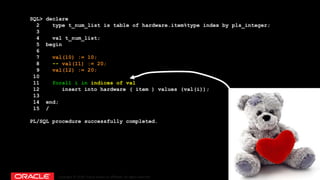
    Copyright © 2018,Oracle and/or its affiliates. All rights reserved. SQL> declare 2 type t_num_list is table of hardware.item%type index by pls_integer; 3 4 val t_num_list; 5 begin 6 7 val(10) := 10; 8 val(11) := 20; 9 val(12) := 20; 10 11 forall i in 1 .. val.count 12 insert into hardware ( item ) values (val(i)); 13 14 end; 15 / declare * ERROR at line 1: ORA-22160: element at index [1] does not exist ORA-06512: at line 11
  • 140.
    Copyright © 2018,Oracle and/or its affiliates. All rights reserved. SQL> declare 2 type t_num_list is table of hardware.item%type index by pls_integer; 3 4 val t_num_list; 5 begin 6 7 val(10) := 10; 8 val(11) := 20; 9 val(12) := 20; 10 11 forall i in val.first .. val.last 12 insert into hardware ( item ) values (val(i)); 13 14 end; 15 / PL/SQL procedure successfully completed.
  • 141.
    Copyright © 2018,Oracle and/or its affiliates. All rights reserved. but ... contiguous is assumed 141
  • 142.
    Copyright © 2018,Oracle and/or its affiliates. All rights reserved. SQL> declare 2 type t_num_list is table of hardware.item%type index by pls_integer; 3 4 val t_num_list; 5 begin 6 7 val(10) := 10; 8 -- val(11) := 20; 9 val(12) := 20; 10 11 forall i in val.first .. val.last 12 insert into hardware ( item ) values (val(i)); 13 14 end; 15 / declare * ERROR at line 1: ORA-22160: element at index [11] does not exist ORA-06512: at line 11
  • 143.
    Copyright © 2018,Oracle and/or its affiliates. All rights reserved. INDICES OF clause 143
  • 144.
    Copyright © 2018,Oracle and/or its affiliates. All rights reserved. SQL> declare 2 type t_num_list is table of hardware.item%type index by pls_integer; 3 4 val t_num_list; 5 begin 6 7 val(10) := 10; 8 -- val(11) := 20; 9 val(12) := 20; 10 11 forall i in indices of val 12 insert into hardware ( item ) values (val(i)); 13 14 end; 15 / PL/SQL procedure successfully completed.
  • 145.
    Copyright © 2018,Oracle and/or its affiliates. All rights reserved. homework :-) 145
  • 146.
    Copyright © 2018,Oracle and/or its affiliates. All rights reserved. VALUES OF clause 146
  • 147.
    Copyright © 2018,Oracle and/or its affiliates. All rights reserved. "How to get array benefits with SQL?"
  • 148.
    Copyright © 2018,Oracle and/or its affiliates. All rights reserved. SQL does this automatically...
  • 149.
    Copyright © 2018,Oracle and/or its affiliates. All rights reserved. full table scans index range scans prefetch
  • 150.
    Copyright © 2018,Oracle and/or its affiliates. All rights reserved. use SQL in preference to PLSQL where possible 150 for another day
  • 151.
    Copyright © 2018,Oracle and/or its affiliates. All rights reserved. wrap up 151
  • 152.
    Copyright © 2018,Oracle and/or its affiliates. All rights reserved. “relational” not “rowlational”
  • 153.
    Copyright © 2018,Oracle and/or its affiliates. All rights reserved. process data in sets not rows
  • 154.
    Copyright © 2018,Oracle and/or its affiliates. All rights reserved. use bulk collect / bulk bind where appropriate
  • 155.
    Enjoy the restof the conference! https://linktr.ee/connor