



Feature Selection Algorithms for
Learning to Rank
Andrea Gigli Email
Slides: http://www.slideshare.net/andrgig
March-2016
Outline
 Machine Learning for Ranking
 Proposed Feature Selection Algorithms (FSA)
and Feature Selection Protocol
 Application to Public Available Web Search Data
Outline
 Machine Learning for Ranking
 Proposed Feature Selection Algorithms (FSA)
and Feature Selection Protocol
 Application to Public Available Web Search Data
Information Retrieval and Ranking
Systems
 Information Retrieval is the activity of providing
information offers relevant to an information need from
a collection of information resources.
 Ranking consists in sorting the information offers
according to some criterion, so that the "best" results
appear early in the provided list.
Information Retrieval and Ranking
Systems
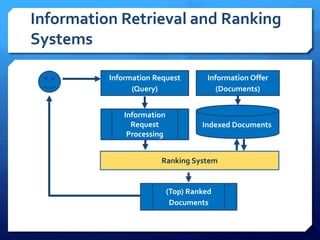
Ranking System
Information Request
(Query)
Information Offer
(Documents)
Indexed Documents
Information
Request
Processing
(Top) Ranked
Documents
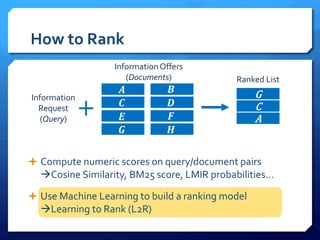
 Compute numeric scores on query/document pairs
Cosine Similarity, BM25 score, LMIR probabilities…
 Use Machine Learning to build a ranking model
Learning to Rank (L2R)
How to Rank
𝑨
𝑪
𝑩 G
C
A
𝑫
Information Offers
(Documents) Ranked List
Information
Request
(Query) 𝑬
𝑮
𝑭
𝑯
…
…
...
...
Learning
System
Ranking
System
Indexed
Documents
...
Training
Prediction
How to Rank using Supervised
Learning
...
...
𝑑1,1 𝑑1,2
ℓ1,1
𝑑1,𝑁1
ℓ1,2 ℓ1,𝑁1
…
…
𝑑M,1 𝑑M,2
ℓ 𝑀,1
𝑑M,𝑁 𝑀
ℓ 𝑀,2 ℓ 𝑀,𝑁2
𝑞1
𝑞 𝑀 𝑓(𝑞, 𝑑)
𝑞 𝑀+1
𝑓(𝑞 𝑀+1, 𝑑 𝑁1
)
𝑓(𝑞 𝑀+1, 𝑑 𝑁 𝑀
)
𝑞𝑖: i-th query
𝑑𝑖,𝑗: j-th document
associated to the i-th
query
ℓ𝑖,𝑗: observed score
of the j-th document
associated to the i-th
query
𝑓(𝒒, 𝒐): scoring
function
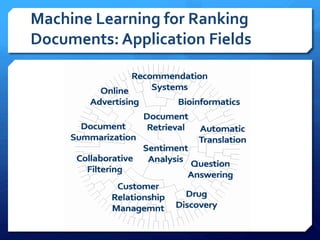
Machine Learning for Ranking
Documents: Application Fields
Machine Learning for Ranking
Documents: Business Cases
Outline
 Machine Learning for Ranking
 Proposed Feature Selection Algorithms (FSA)
and Feature Selection Protocol
 Application to Public Available Web Search Data
Query & Information Offer
Features
𝑑𝑖,1 𝑑𝑖,2 𝑑𝑖,𝑁 𝑖𝑞𝑖
… …ℓ𝑖,1 ℓ𝑖,2 ℓ𝑖,𝑁 𝑖
𝑥𝑖,1
(1)
𝑥𝑖,1
(2)
𝑥𝑖,1
(3)
⋮
𝑥𝑖,1
(𝐹)
𝑥𝑖,2
(1)
𝑥𝑖,2
(2)
𝑥𝑖,2
(3)
⋮
𝑥𝑖,2
(𝐹)
𝑥𝑖,𝑁 𝑖
(1)
𝑥𝑖,𝑁 𝑖
(2)
𝑥𝑖,𝑁 𝑖
(3)
⋮
𝑥𝑖,𝑁 𝑖
(𝐹)
…
Documents Query/Documents LabelsQuery
 𝑓 𝒒, 𝒐 → 𝑓(𝒙)
 F is of the order
of hundreds,
thousands
Which features
Case Feature examples
Web Search Query-URL matching features: number of occurrences of query
terms in the document, BM25, N-gram BM25,Tf-Idf,…
Importance of Url: PageRank , Number of in-links, Number of
clicks, Browse Rank, Spam Score, Page Quality Score…………..
Online
Advertisement
User features: last page visited, time from the last visit, last
advertisement clicked, products queried… Product features:
product description, product category, price… User-product
matching feature: tf-idf, expected rating,… Page-Product
matching feature: topic, category, tf-idf, …
Collaborative
Filtering
User features: age, gender, consumption history, … Product
characteristics: category, price, description, … Context -
Product matching: tag-matching, tf-idf, …
… …
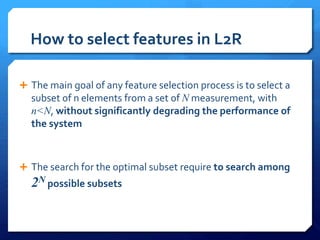
How to select features in L2R
 The main goal of any feature selection process is to select a
subset of n elements from a set of N measurement, with
n<N, without significantly degrading the performance of
the system
 The search for the optimal subset require to search among
2N possible subsets
How to select features in L2R
0
1,000,000
2,000,000
3,000,000
4,000,000
5,000,000
6,000,000
7,000,000
8,000,000
9,000,000
0 5 10 15 20 25
Number of
possible
feature subsets
Number of Features
A suboptimal
criteria is
needed
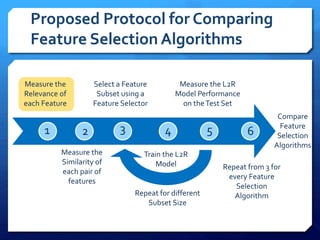
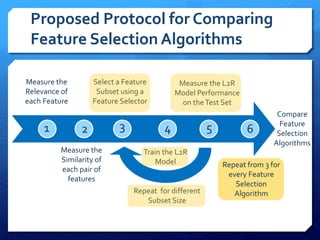
Proposed Protocol for Comparing
Feature Selection Algorithms
Measure the
Relevance of
each Feature
Measure the
Similarity of
each pair of
features
Select a Feature
Subset using a
Feature Selector
Train the L2R
Model
Measure the L2R
Model Performance
on theTest Set
Compare
Feature
Selection
Algorithms
Repeat for different
Subset Size
1 2 3 4 5 6
Repeat from 3 for
every Feature
Selection
Algorithm
Competing Algorithms for feature
selection
We developed the following algorithms
 Naïve Greedy searchAlgorithm for feature Selection
(NGAS)
 Naïve Greedy searchAlgorithm for feature Selection -
Extended (NGAS-E)
 Hierarchical Clustering search Algorithm for feature
Selection (HCAS)
Competing Algorithms for feature
selection
We developed the following algorithms
 Naïve Greedy searchAlgorithm for feature Selection
(NGAS)
 Naïve Greedy searchAlgorithm for feature Selection -
Extended (NGAS-E)
 Hierarchical Clustering search Algorithm for feature
Selection (HCAS)
Competing Algorithm for feature
selection #1: NGAS
The undirect graph is built and the set S of
selected features is initialized.
Competing Algorithm for feature
selection #1: NGAS
Assuming node 1 has the highest relevance, add it
to S.
Competing Algorithm for feature
selection #1: NGAS
Select the node with the lowest similarity to Node
1, say Node 7, and the one with the highest
similarity to Node 7, say Node 5.
Competing Algorithm for feature
selection #1: NGAS
Remove Node 1. Node 5 is the one with the highest
relevance between 5 and 7, add it to S.
Competing Algorithm for feature
selection #1: NGAS
Select the node with the lowest similarity to Node
5, say Node 2, and the one with the highest
similarity to Node 2, say Node 3.
Competing Algorithm for feature
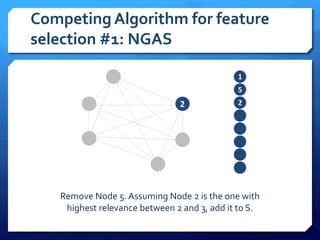
selection #1: NGAS
Remove Node 5. Assuming Node 2 is the one with
highest relevance between 2 and 3, add it to S.
Competing Algorithm for feature
selection #1: NGAS
Select the node with the lowest similarity to Node
2, say Node 4, and the one with the highest
similarity to Node 4, say Node 8.
Competing Algorithm for feature
selection #1: NGAS
Remove Node 2. Assuming Node 4 is the one with
highest relevance between 4 and 8, add it to S.
Competing Algorithm for feature
selection #1: NGAS
Select the node with the lowest similarity to Node
4, say Node 6, and the one with the highest
similarity to Node 6, say Node 7.
Competing Algorithm for feature
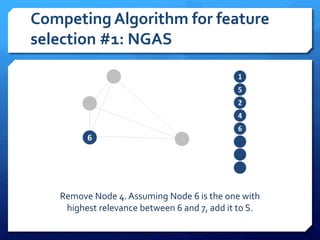
selection #1: NGAS
Remove Node 4. Assuming Node 6 is the one with
highest relevance between 6 and 7, add it to S.
Competing Algorithm for feature
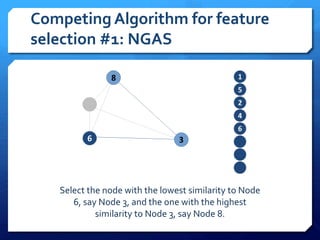
selection #1: NGAS
Select the node with the lowest similarity to Node
6, say Node 3, and the one with the highest
similarity to Node 3, say Node 8.
Competing Algorithm for feature
selection #1: NGAS
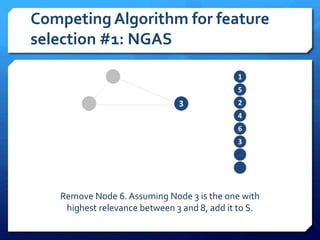
Remove Node 6. Assuming Node 3 is the one with
highest relevance between 3 and 8, add it to S.
Competing Algorithm for feature
selection #1: NGAS
Select the node with the lowest similarity to Node
3, say Node 8, and the one with the highest
similarity to Node 8, say Node 7.
Competing Algorithm for feature
selection #1: NGAS
Remove Node 3. Assuming Node 8 is the one with
highest relevance between 8 and 7, add it to S.
Competing Algorithm for feature
selection #1: NGAS
Add the last node, 7, to S.
We developed the following algorithms
 Naïve Greedy searchAlgorithm for feature Selection
(NGAS)
 Naïve Greedy searchAlgorithm for feature Selection -
Extended (NGAS-E)
 Hierarchical Clustering search Algorithm for feature
Selection (HCAS)
Competing Algorithms for feature
selection
Competing Algorithm for feature
selection #2: NGAS-E (p=50%)
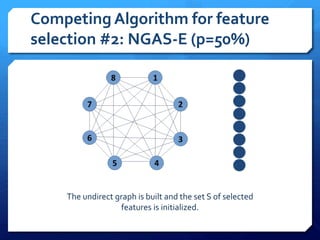
The undirect graph is built and the set S of selected
features is initialized.
Competing Algorithm for feature
selection #2: NGAS-E (p=50%)
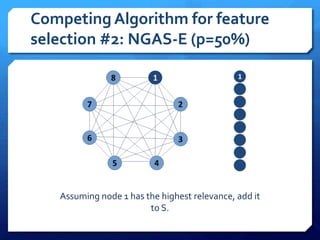
Assuming node 1 has the highest relevance, add it
to S.
Competing Algorithm for feature
selection #2: NGAS-E (p=50%)
Select 7 ∗ 50% nodes less similar to 1.
Competing Algorithm for feature
selection #2: NGAS-E (p=50%)
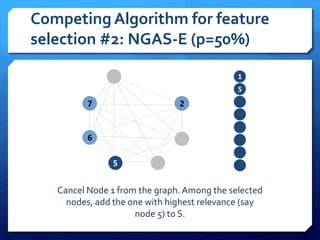
Cancel Node 1 from the graph. Among the selected
nodes, add the one with highest relevance (say
node 5) to S.
Competing Algorithm for feature
selection #2: NGAS-E (p=50%)
Select ⌈6*50% ⌉ nodes less similar to node 5.
Competing Algorithm for feature
selection #2: NGAS-E (p=50%)
Cancel Node 5 from the graph. Among the selected
nodes, add the one with highest relevance (say
Node 3) to S.
Competing Algorithm for feature
selection #2: NGAS-E (p=50%)
Select ⌈5*50% ⌉ nodes less similar to node 3.
Competing Algorithm for feature
selection #2: NGAS-E (p=50%)
Cancel node 3 from the graph. Among the selected
nodes, add the one with highest relevance (say
node 4) to S.
Competing Algorithm for feature
selection #2: NGAS-E (p=50%)
Select ⌈4*50% ⌉ nodes less similar to node 4.
Competing Algorithm for feature
selection #2: NGAS-E (p=50%)
Cancel node 4 from the graph. Among the selected
nodes, add the one with highest relevance (say
node 6) to S.
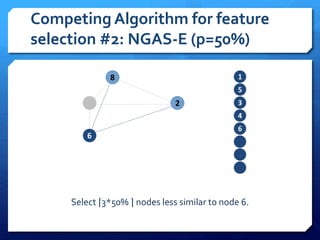
Competing Algorithm for feature
selection #2: NGAS-E (p=50%)
Select ⌈3*50% ⌉ nodes less similar to node 6.
Competing Algorithm for feature
selection #2: NGAS-E (p=50%)
Cancel node 6 from the graph. Among the selected
nodes, add the one with highest relevance (say
node 2) to S.
Competing Algorithm for feature
selection #2: NGAS-E (p=50%)
Select ⌈2*50% ⌉nodes less similar to node 2.
Competing Algorithm for feature
selection #2: NGAS-E (p=50%)
Node 2 is cancelled from the graph and node 8 is
added to S.
Competing Algorithm for feature
selection #2: NGAS-E (p=50%)
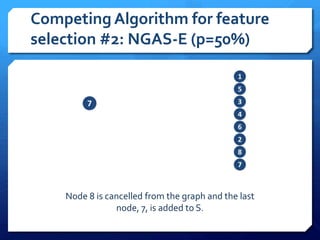
Node 8 is cancelled from the graph and the last
node, 7, is added to S.
Competing Algorithm for feature
selection #2: NGAS-E (p=50%)
Node 8 is cancelled from the graph and the last
node, 7, is added to S.
We developed the following algorithms
 Naïve Greedy searchAlgorithm for feature Selection
(NGAS)
 Naïve Greedy searchAlgorithm for feature Selection -
Extended (NGAS-E)
 Hierarchical Clustering search Algorithm for feature
Selection (HCAS)
Competing Algorithms for feature
selection
Competing Algorithm for feature
selection #3: HCAS
23
11
5
3
Outline
 Machine Learning for Ranking
 Proposed Feature Selection Algorithms (FSA)
and Feature Selection Protocol
 Application to Public Available Web Search
Data
Application to Web Search
Engine Data
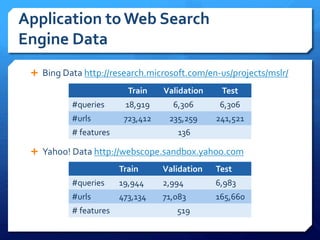
 Bing Data http://research.microsoft.com/en-us/projects/mslr/
 Yahoo! Data http://webscope.sandbox.yahoo.com
Train Validation Test
#queries 19,944 2,994 6,983
#urls 473,134 71,083 165,660
# features 519
Train Validation Test
#queries 18,919 6,306 6,306
#urls 723,412 235,259 241,521
# features 136
Proposed Protocol for Comparing
Feature Selection Algorithms
Measure the
Relevance of
each Feature
Measure the
Similarity of
each pair of
features
Select a Feature
Subset using a
Feature Selector
Train the L2R
Model
Measure the L2R
Model Performance
on theTest Set
Compare
Feature
Selection
Algorithms
Repeat for different
Subset Size
1 2 3 4 5 6
Repeat from 3 for
every Feature
Selection
Algorithm
Learning to Rank Algorithms: a
timeline of major contributions
LambdaMART
LambdaRank
CRR
IntervalRank
GBlend
NDCG Boost
BayesRank
BoltzRank
MPBoost
SortNet
SSRankBoost
RR
SoftRank
PermuRank
ListMLE
SVMmap
RankRLS
RankGP
RankCosine
QBRank
McRank
ListNet
GBRank
AdaRank
IR-SVM
RankNet
RankBoost
Pranking
RankSVM
2000 2002 2003 2005 2006 2007
FRank
2008 2009 2010
Pointwise
Pairwise
Listwise
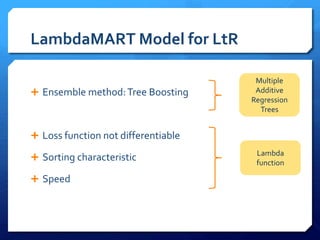
Multiple
Additive
Regression
Trees
LambdaMART Model for LtR
Lambda
function
 Ensemble method:Tree Boosting
 Loss function not differentiable
 Sorting characteristic
 Speed
Proposed Protocol for Comparing
Feature Selection Algorithms
Measure the
Relevance of
each Feature
Measure the
Similarity of
each pair of
features
Select a Feature
Subset using a
Feature Selector
Train the L2R
Model
Measure the L2R
Model Performance
on theTest Set
Compare
Feature
Selection
Algorithms
Repeat for different
Subset Size
1 2 3 4 5 6
Repeat from 3 for
every Feature
Selection
Algorithm
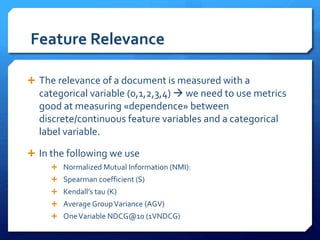
Feature Relevance
 The relevance of a document is measured with a
categorical variable (0,1,2,3,4)  we need to use metrics
good at measuring «dependence» between
discrete/continuous feature variables and a categorical
label variable.
 In the following we use
 Normalized Mutual Information (NMI):
 Spearman coefficient (S)
 Kendall’s tau (K)
 Average GroupVariance (AGV)
 OneVariable NDCG@10 (1VNDCG)
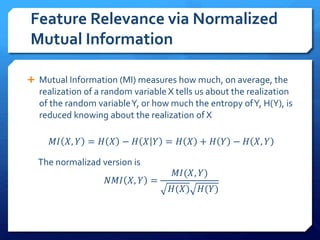
Feature Relevance via Normalized
Mutual Information
 Mutual Information (MI) measures how much, on average, the
realization of a random variable X tells us about the realization
of the random variableY, or how much the entropy ofY, H(Y), is
reduced knowing about the realization of X
𝑀𝐼 𝑋, 𝑌 = 𝐻 𝑋 − 𝐻 𝑋 𝑌 = 𝐻 𝑋 + 𝐻 𝑌 − 𝐻 𝑋, 𝑌
The normalizad version is
𝑁𝑀𝐼 𝑋, 𝑌 =
𝑀𝐼(𝑋, 𝑌)
𝐻(𝑋) 𝐻(𝑌)
Feature Relevance via Spearman’s
coefficient
 Spearman’s rank correlation coefficient is a non-parametric
measure of statistical dependence between two random
variables.
It is given by
𝜌 = 1 −
6 𝑑𝑖
2
𝑛(𝑛2 − 1)
where n is the sample size and
𝑑𝑖 = 𝑟𝑎𝑛𝑘 𝑥𝑖 − 𝑟𝑎𝑛𝑘 𝑦𝑖
Feature Relevance via Kendall’s tau
 Kendall’sTau is a measure of association defined on two
ranking lists of length n. It is defined as
τ =
𝑛 𝑐 − 𝑛 𝑑
𝑛(𝑛 − 1)
2
− 𝑛1
𝑛(𝑛 − 1)
2
− 𝑛2
where 𝑛 𝑐 denotes the number of concordant pairs between the
two lists, 𝑛 𝑑 denotes the number of discordant pairs, 𝑛1 =
𝑡𝑖(𝑡𝑖 − 1)/2, 𝑛2 = 𝑢𝑗(𝑢𝑗 − 1)/2, 𝑡𝑖 is the number of tied
values in the i-th group of ties for the first list and 𝑢𝑗 is the
number of tied values in the j-th group of ties for the second list.
Feature Relevance via Average
GroupVariance
 Average GroupVariance measure the discrimination power of a
feature.The intuitive justification is that a feature is useful if it is
capable of discriminating a small portion of the ordered scale
from the rest, and that features with a small variance are
those which satisfy this property.
𝐴𝐺𝑉 = 1 −
𝑔=1
5
𝑛 𝑔 𝑥 𝑔 − 𝑥
2
𝑖 𝑥𝑖 − 𝑥 2
where 𝑛 𝑔be the size of group g, 𝑥 𝑔 the sample mean of feature 𝑥
in the g-th group and 𝑥 whole sample mean.
Feature Relevance via single
feature LambdaMART scoring
 For each feature i we run LambdaMART and compute
the 𝑁𝐷𝐶𝐺𝑖,𝑞@10 for each query q
 The i-th feature relevance is measured averaging
𝑁𝐷𝐶𝐺𝑖,𝑞@10 over the whole query set
𝑁𝐷𝐶𝐺𝑖@10 =
1
𝑄
𝑞∈𝑄
𝑁𝐷𝐶𝐺𝑖,𝑞@10
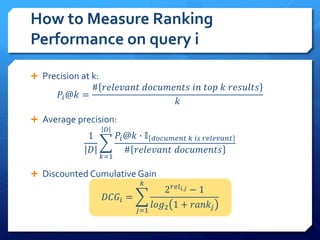
 Precision at k:
𝑃𝑖@𝑘 =
# 𝑟𝑒𝑙𝑒𝑣𝑎𝑛𝑡 𝑑𝑜𝑐𝑢𝑚𝑒𝑛𝑡𝑠 𝑖𝑛 𝑡𝑜𝑝 𝑘 𝑟𝑒𝑠𝑢𝑙𝑡𝑠
𝑘
 Average precision:
1
𝐷
𝑘=1
𝐷
𝑃𝑖@𝑘 ∙ 𝕀 𝑑𝑜𝑐𝑢𝑚𝑒𝑛𝑡 𝑘 𝑖𝑠 𝑟𝑒𝑙𝑒𝑣𝑎𝑛𝑡
# 𝑟𝑒𝑙𝑒𝑣𝑎𝑛𝑡 𝑑𝑜𝑐𝑢𝑚𝑒𝑛𝑡𝑠
 Discounted Cumulative Gain
𝐷𝐶𝐺𝑖 =
𝑗=1
𝑘
2 𝑟𝑒𝑙 𝑖,𝑗 − 1
𝑙𝑜𝑔2 1 + 𝑟𝑎𝑛𝑘𝑗
How to Measure Ranking
Performance on query i
How to Measure Ranking
Performance: Normalized DCG
Document Gain
Cumulative
Gain
Document 1 31 31
Document 2 3 34
Document 3 7 41
Document 4 31 72
Discounted
31x1=31
31+3x0.63=32.9
32.9+7x0.5=36.4
36.4+31x0.4=48.8
Normalization: divide
DCG by the ideal DCG
Document Gain
Cumulative
Gain
Document 1 31 31
Document 4 31 62
Document 3 7 69
Document 2 3 72
Discounted
31x1=31
31+31x0.63=50.53
50.53+7x0.5=54.03
54.03+3x0.4=57.07
Relevance
Rating
Gain
Perfect 25-1=31
Excellent 24-1=15
Good 23-1=7
Fair 22-1=3
Bad 21-1=1
Feature Relevance
Feature Relevance
Choosing the Relevance Measure
(1/2)
FSA performance is measured using the Average NDCG@10
obtaind from LambdaMART on the test set.
NDCG@10 on Yahoo Test Set
Feature Subset
Dimension
5% 10% 20% 30% 40% 50% 75% 100%
NMI 0.73398 0.75952 0.76241 0.7678 0.76912 0.769 0.77015 0.76935
AVG 0.7524 0.7548 0.76168 0.76493 0.76498 0.76717 0.76971 0.76935
S 0.74963 0.75396 0.76099 0.76398 0.7649 0.76753 0.77002 0.76935
K 0.75225 0.75291 0.76145 0.76304 0.7648 0.76673 0.76972 0.76935
1VNDCG 0.75246 0.75768 0.76452 0.76672 0.76823 0.77008 0.77027 0.76935
NDCG@10 on Bing Test Set
Feature Subset
Dimension
5% 10% 20% 30% 40% 50% 75% 100%
NMI 0.38927 0.3978 0.41347 0.41539 0.44785 0.44966 0.45083 0.46336
AVG 0.32682 0.33168 0.36043 0.36976 0.37383 0.37612 0.43444 0.46336
S 0.32969 0.3346 0.3428 0.34592 0.36711 0.42475 0.42809 0.46336
K 0.32917 0.3346 0.34356 0.42124 0.42071 0.4245 0.42706 0.46336
1VNDCG 0.41633 0.42571 0.42413 0.42601 0.42757 0.43795 0.46222 0.46336
Choosing the Relevance Measure
(2/2)
Proposed Protocol for Comparing
Feature Selection Algorithms
Measure the
Relevance of
each Feature
Measure the
Similarity of
each pair of
features
Select a Feature
Subset using a
Feature Selector
Train the L2R
Model
Measure the Model
Performance on
theTest Set
Compare
Feature
Selection
Algorithms
Repeat for different
Subset Size
1 2 3 4 5 6
Repeat from 3 for
every Feature
Selection
Algorithm
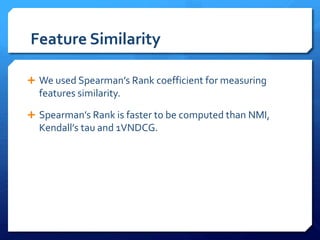
Feature Similarity
 We used Spearman’s Rank coefficient for measuring
features similarity.
 Spearman’s Rank is faster to be computed than NMI,
Kendall’s tau and 1VNDCG.
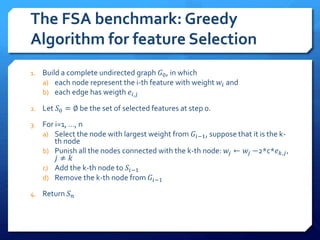
The FSA benchmark: Greedy
Algorithm for feature Selection
1. Build a complete undirected graph 𝐺0, in which
a) each node represent the i-th feature with weight 𝑤𝑖 and
b) each edge has weigth 𝑒𝑖,𝑗
2. Let 𝑆0 = ∅ be the set of selected features at step 0.
3. For i=1, …, n
a) Select the node with largest weight from 𝐺𝑖−1, suppose that it is the k-
th node
b) Punish all the nodes connected with the k-th node: 𝑤𝑗 ← 𝑤𝑗 −2*c*𝑒 𝑘,𝑗,
𝑗 ≠ 𝑘
c) Add the k-th node to 𝑆𝑖−1
d) Remove the k-th node from 𝐺𝑖−1
4. Return 𝑆 𝑛
Train the L2R
Model
Proposed Protocol for Comparing
Feature Selection Algorithms
Measure the
Relevance of
each Feature
Measure the
Similarity of
each pair of
features
Select a Feature
Subset using a
Feature Selector
Compare
Feature
Selection
Algorithms
Repeat for different
Subset Size
1 2 3 4 5 6
Repeat from 3 for
every Feature
Selection
Algorithm
Measure the L2R
Model Performance
on theTest Set
Proposed Protocol for Comparing
Feature Selection Algorithms
Measure the
Relevance of
each Feature
Measure the
Similarity of
each pair of
features
Select a Feature
Subset using a
Feature Selector
Train the L2R
Model
Measure the L2R
Model Performance
on theTest Set
Compare
Feature
Selection
Algorithms
1 2 3 4 5 6
Repeat from 3 for
every Feature
Selection
AlgorithmRepeat for different
Subset Size
Proposed Protocol for Comparing
Feature Selection Algorithms
Measure the
Relevance of
each Feature
Measure the
Similarity of
each pair of
features
Select a Feature
Subset using a
Feature Selector
Train the L2R
Model
Compare
Feature
Selection
Algorithms
Repeat for different
Subset Size
1 2 3 4 5 6
Repeat from 3 for
every Feature
Selection
Algorithm
Measure the Model
Performance on
theTest Set
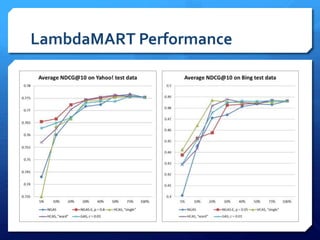
LambdaMART Performance
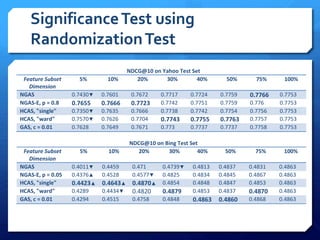
SignificanceTest using
RandomizationTest
NDCG@10 on Yahoo Test Set
Feature Subset
Dimension
5% 10% 20% 30% 40% 50% 75% 100%
NGAS 0.7430▼ 0.7601 0.7672 0.7717 0.7724 0.7759 0.7766 0.7753
NGAS-E, p = 0.8 0.7655 0.7666 0.7723 0.7742 0.7751 0.7759 0.776 0.7753
HCAS, "single" 0.7350▼ 0.7635 0.7666 0.7738 0.7742 0.7754 0.7756 0.7753
HCAS, "ward" 0.7570▼ 0.7626 0.7704 0.7743 0.7755 0.7763 0.7757 0.7753
GAS, c = 0.01 0.7628 0.7649 0.7671 0.773 0.7737 0.7737 0.7758 0.7753
NDCG@10 on Bing Test Set
Feature Subset
Dimension
5% 10% 20% 30% 40% 50% 75% 100%
NGAS 0.4011▼ 0.4459 0.471 0.4739▼ 0.4813 0.4837 0.4831 0.4863
NGAS-E, p = 0.05 0.4376▲ 0.4528 0.4577▼ 0.4825 0.4834 0.4845 0.4867 0.4863
HCAS, "single" 0.4423▲ 0.4643▲ 0.4870▲ 0.4854 0.4848 0.4847 0.4853 0.4863
HCAS, "ward" 0.4289 0.4434▼ 0.4820 0.4879 0.4853 0.4837 0.4870 0.4863
GAS, c = 0.01 0.4294 0.4515 0.4758 0.4848 0.4863 0.4860 0.4868 0.4863
LambdaMART Performance
Conclusions
 We designed 3 FSAs and we applied them to the Web Search Pages
Ranking problem.
 NGAS-E e HCAS have a performance equal or greater than the
benchmark model.
 HCAS and NGAS are very
 The proposed FSAs can be implemented independently of the L2R
model.
 The proposed FSAs can be applied to other ML contexts, to
Sorting problems and to Model Ensambling.
Thanks!
Andrea Gigli
Slides: http://www.slideshare.net/andrgig

Feature Selection for Document Ranking

  • 1.
    Feature Selection Algorithmsfor Learning to Rank Andrea Gigli Email Slides: http://www.slideshare.net/andrgig March-2016
  • 2.
    Outline  Machine Learningfor Ranking  Proposed Feature Selection Algorithms (FSA) and Feature Selection Protocol  Application to Public Available Web Search Data
  • 3.
    Outline  Machine Learningfor Ranking  Proposed Feature Selection Algorithms (FSA) and Feature Selection Protocol  Application to Public Available Web Search Data
  • 4.
    Information Retrieval andRanking Systems  Information Retrieval is the activity of providing information offers relevant to an information need from a collection of information resources.  Ranking consists in sorting the information offers according to some criterion, so that the "best" results appear early in the provided list.
  • 5.
    Information Retrieval andRanking Systems Ranking System Information Request (Query) Information Offer (Documents) Indexed Documents Information Request Processing (Top) Ranked Documents
  • 6.
     Compute numericscores on query/document pairs Cosine Similarity, BM25 score, LMIR probabilities…  Use Machine Learning to build a ranking model Learning to Rank (L2R) How to Rank 𝑨 𝑪 𝑩 G C A 𝑫 Information Offers (Documents) Ranked List Information Request (Query) 𝑬 𝑮 𝑭 𝑯
  • 7.
    … … ... ... Learning System Ranking System Indexed Documents ... Training Prediction How to Rankusing Supervised Learning ... ... 𝑑1,1 𝑑1,2 ℓ1,1 𝑑1,𝑁1 ℓ1,2 ℓ1,𝑁1 … … 𝑑M,1 𝑑M,2 ℓ 𝑀,1 𝑑M,𝑁 𝑀 ℓ 𝑀,2 ℓ 𝑀,𝑁2 𝑞1 𝑞 𝑀 𝑓(𝑞, 𝑑) 𝑞 𝑀+1 𝑓(𝑞 𝑀+1, 𝑑 𝑁1 ) 𝑓(𝑞 𝑀+1, 𝑑 𝑁 𝑀 ) 𝑞𝑖: i-th query 𝑑𝑖,𝑗: j-th document associated to the i-th query ℓ𝑖,𝑗: observed score of the j-th document associated to the i-th query 𝑓(𝒒, 𝒐): scoring function
  • 8.
    Machine Learning forRanking Documents: Application Fields
  • 9.
    Machine Learning forRanking Documents: Business Cases
  • 10.
    Outline  Machine Learningfor Ranking  Proposed Feature Selection Algorithms (FSA) and Feature Selection Protocol  Application to Public Available Web Search Data
  • 11.
    Query & InformationOffer Features 𝑑𝑖,1 𝑑𝑖,2 𝑑𝑖,𝑁 𝑖𝑞𝑖 … …ℓ𝑖,1 ℓ𝑖,2 ℓ𝑖,𝑁 𝑖 𝑥𝑖,1 (1) 𝑥𝑖,1 (2) 𝑥𝑖,1 (3) ⋮ 𝑥𝑖,1 (𝐹) 𝑥𝑖,2 (1) 𝑥𝑖,2 (2) 𝑥𝑖,2 (3) ⋮ 𝑥𝑖,2 (𝐹) 𝑥𝑖,𝑁 𝑖 (1) 𝑥𝑖,𝑁 𝑖 (2) 𝑥𝑖,𝑁 𝑖 (3) ⋮ 𝑥𝑖,𝑁 𝑖 (𝐹) … Documents Query/Documents LabelsQuery  𝑓 𝒒, 𝒐 → 𝑓(𝒙)  F is of the order of hundreds, thousands
  • 12.
    Which features Case Featureexamples Web Search Query-URL matching features: number of occurrences of query terms in the document, BM25, N-gram BM25,Tf-Idf,… Importance of Url: PageRank , Number of in-links, Number of clicks, Browse Rank, Spam Score, Page Quality Score………….. Online Advertisement User features: last page visited, time from the last visit, last advertisement clicked, products queried… Product features: product description, product category, price… User-product matching feature: tf-idf, expected rating,… Page-Product matching feature: topic, category, tf-idf, … Collaborative Filtering User features: age, gender, consumption history, … Product characteristics: category, price, description, … Context - Product matching: tag-matching, tf-idf, … … …
  • 13.
    How to selectfeatures in L2R  The main goal of any feature selection process is to select a subset of n elements from a set of N measurement, with n<N, without significantly degrading the performance of the system  The search for the optimal subset require to search among 2N possible subsets
  • 14.
    How to selectfeatures in L2R 0 1,000,000 2,000,000 3,000,000 4,000,000 5,000,000 6,000,000 7,000,000 8,000,000 9,000,000 0 5 10 15 20 25 Number of possible feature subsets Number of Features A suboptimal criteria is needed
  • 15.
    Proposed Protocol forComparing Feature Selection Algorithms Measure the Relevance of each Feature Measure the Similarity of each pair of features Select a Feature Subset using a Feature Selector Train the L2R Model Measure the L2R Model Performance on theTest Set Compare Feature Selection Algorithms Repeat for different Subset Size 1 2 3 4 5 6 Repeat from 3 for every Feature Selection Algorithm
  • 16.
    Competing Algorithms forfeature selection We developed the following algorithms  Naïve Greedy searchAlgorithm for feature Selection (NGAS)  Naïve Greedy searchAlgorithm for feature Selection - Extended (NGAS-E)  Hierarchical Clustering search Algorithm for feature Selection (HCAS)
  • 17.
    Competing Algorithms forfeature selection We developed the following algorithms  Naïve Greedy searchAlgorithm for feature Selection (NGAS)  Naïve Greedy searchAlgorithm for feature Selection - Extended (NGAS-E)  Hierarchical Clustering search Algorithm for feature Selection (HCAS)
  • 18.
    Competing Algorithm forfeature selection #1: NGAS The undirect graph is built and the set S of selected features is initialized.
  • 19.
    Competing Algorithm forfeature selection #1: NGAS Assuming node 1 has the highest relevance, add it to S.
  • 20.
    Competing Algorithm forfeature selection #1: NGAS Select the node with the lowest similarity to Node 1, say Node 7, and the one with the highest similarity to Node 7, say Node 5.
  • 21.
    Competing Algorithm forfeature selection #1: NGAS Remove Node 1. Node 5 is the one with the highest relevance between 5 and 7, add it to S.
  • 22.
    Competing Algorithm forfeature selection #1: NGAS Select the node with the lowest similarity to Node 5, say Node 2, and the one with the highest similarity to Node 2, say Node 3.
  • 23.
    Competing Algorithm forfeature selection #1: NGAS Remove Node 5. Assuming Node 2 is the one with highest relevance between 2 and 3, add it to S.
  • 24.
    Competing Algorithm forfeature selection #1: NGAS Select the node with the lowest similarity to Node 2, say Node 4, and the one with the highest similarity to Node 4, say Node 8.
  • 25.
    Competing Algorithm forfeature selection #1: NGAS Remove Node 2. Assuming Node 4 is the one with highest relevance between 4 and 8, add it to S.
  • 26.
    Competing Algorithm forfeature selection #1: NGAS Select the node with the lowest similarity to Node 4, say Node 6, and the one with the highest similarity to Node 6, say Node 7.
  • 27.
    Competing Algorithm forfeature selection #1: NGAS Remove Node 4. Assuming Node 6 is the one with highest relevance between 6 and 7, add it to S.
  • 28.
    Competing Algorithm forfeature selection #1: NGAS Select the node with the lowest similarity to Node 6, say Node 3, and the one with the highest similarity to Node 3, say Node 8.
  • 29.
    Competing Algorithm forfeature selection #1: NGAS Remove Node 6. Assuming Node 3 is the one with highest relevance between 3 and 8, add it to S.
  • 30.
    Competing Algorithm forfeature selection #1: NGAS Select the node with the lowest similarity to Node 3, say Node 8, and the one with the highest similarity to Node 8, say Node 7.
  • 31.
    Competing Algorithm forfeature selection #1: NGAS Remove Node 3. Assuming Node 8 is the one with highest relevance between 8 and 7, add it to S.
  • 32.
    Competing Algorithm forfeature selection #1: NGAS Add the last node, 7, to S.
  • 33.
    We developed thefollowing algorithms  Naïve Greedy searchAlgorithm for feature Selection (NGAS)  Naïve Greedy searchAlgorithm for feature Selection - Extended (NGAS-E)  Hierarchical Clustering search Algorithm for feature Selection (HCAS) Competing Algorithms for feature selection
  • 34.
    Competing Algorithm forfeature selection #2: NGAS-E (p=50%) The undirect graph is built and the set S of selected features is initialized.
  • 35.
    Competing Algorithm forfeature selection #2: NGAS-E (p=50%) Assuming node 1 has the highest relevance, add it to S.
  • 36.
    Competing Algorithm forfeature selection #2: NGAS-E (p=50%) Select 7 ∗ 50% nodes less similar to 1.
  • 37.
    Competing Algorithm forfeature selection #2: NGAS-E (p=50%) Cancel Node 1 from the graph. Among the selected nodes, add the one with highest relevance (say node 5) to S.
  • 38.
    Competing Algorithm forfeature selection #2: NGAS-E (p=50%) Select ⌈6*50% ⌉ nodes less similar to node 5.
  • 39.
    Competing Algorithm forfeature selection #2: NGAS-E (p=50%) Cancel Node 5 from the graph. Among the selected nodes, add the one with highest relevance (say Node 3) to S.
  • 40.
    Competing Algorithm forfeature selection #2: NGAS-E (p=50%) Select ⌈5*50% ⌉ nodes less similar to node 3.
  • 41.
    Competing Algorithm forfeature selection #2: NGAS-E (p=50%) Cancel node 3 from the graph. Among the selected nodes, add the one with highest relevance (say node 4) to S.
  • 42.
    Competing Algorithm forfeature selection #2: NGAS-E (p=50%) Select ⌈4*50% ⌉ nodes less similar to node 4.
  • 43.
    Competing Algorithm forfeature selection #2: NGAS-E (p=50%) Cancel node 4 from the graph. Among the selected nodes, add the one with highest relevance (say node 6) to S.
  • 44.
    Competing Algorithm forfeature selection #2: NGAS-E (p=50%) Select ⌈3*50% ⌉ nodes less similar to node 6.
  • 45.
    Competing Algorithm forfeature selection #2: NGAS-E (p=50%) Cancel node 6 from the graph. Among the selected nodes, add the one with highest relevance (say node 2) to S.
  • 46.
    Competing Algorithm forfeature selection #2: NGAS-E (p=50%) Select ⌈2*50% ⌉nodes less similar to node 2.
  • 47.
    Competing Algorithm forfeature selection #2: NGAS-E (p=50%) Node 2 is cancelled from the graph and node 8 is added to S.
  • 48.
    Competing Algorithm forfeature selection #2: NGAS-E (p=50%) Node 8 is cancelled from the graph and the last node, 7, is added to S.
  • 49.
    Competing Algorithm forfeature selection #2: NGAS-E (p=50%) Node 8 is cancelled from the graph and the last node, 7, is added to S.
  • 50.
    We developed thefollowing algorithms  Naïve Greedy searchAlgorithm for feature Selection (NGAS)  Naïve Greedy searchAlgorithm for feature Selection - Extended (NGAS-E)  Hierarchical Clustering search Algorithm for feature Selection (HCAS) Competing Algorithms for feature selection
  • 51.
    Competing Algorithm forfeature selection #3: HCAS 23 11 5 3
  • 52.
    Outline  Machine Learningfor Ranking  Proposed Feature Selection Algorithms (FSA) and Feature Selection Protocol  Application to Public Available Web Search Data
  • 53.
    Application to WebSearch Engine Data  Bing Data http://research.microsoft.com/en-us/projects/mslr/  Yahoo! Data http://webscope.sandbox.yahoo.com Train Validation Test #queries 19,944 2,994 6,983 #urls 473,134 71,083 165,660 # features 519 Train Validation Test #queries 18,919 6,306 6,306 #urls 723,412 235,259 241,521 # features 136
  • 54.
    Proposed Protocol forComparing Feature Selection Algorithms Measure the Relevance of each Feature Measure the Similarity of each pair of features Select a Feature Subset using a Feature Selector Train the L2R Model Measure the L2R Model Performance on theTest Set Compare Feature Selection Algorithms Repeat for different Subset Size 1 2 3 4 5 6 Repeat from 3 for every Feature Selection Algorithm
  • 55.
    Learning to RankAlgorithms: a timeline of major contributions LambdaMART LambdaRank CRR IntervalRank GBlend NDCG Boost BayesRank BoltzRank MPBoost SortNet SSRankBoost RR SoftRank PermuRank ListMLE SVMmap RankRLS RankGP RankCosine QBRank McRank ListNet GBRank AdaRank IR-SVM RankNet RankBoost Pranking RankSVM 2000 2002 2003 2005 2006 2007 FRank 2008 2009 2010 Pointwise Pairwise Listwise
  • 56.
    Multiple Additive Regression Trees LambdaMART Model forLtR Lambda function  Ensemble method:Tree Boosting  Loss function not differentiable  Sorting characteristic  Speed
  • 57.
    Proposed Protocol forComparing Feature Selection Algorithms Measure the Relevance of each Feature Measure the Similarity of each pair of features Select a Feature Subset using a Feature Selector Train the L2R Model Measure the L2R Model Performance on theTest Set Compare Feature Selection Algorithms Repeat for different Subset Size 1 2 3 4 5 6 Repeat from 3 for every Feature Selection Algorithm
  • 58.
    Feature Relevance  Therelevance of a document is measured with a categorical variable (0,1,2,3,4)  we need to use metrics good at measuring «dependence» between discrete/continuous feature variables and a categorical label variable.  In the following we use  Normalized Mutual Information (NMI):  Spearman coefficient (S)  Kendall’s tau (K)  Average GroupVariance (AGV)  OneVariable NDCG@10 (1VNDCG)
  • 59.
    Feature Relevance viaNormalized Mutual Information  Mutual Information (MI) measures how much, on average, the realization of a random variable X tells us about the realization of the random variableY, or how much the entropy ofY, H(Y), is reduced knowing about the realization of X 𝑀𝐼 𝑋, 𝑌 = 𝐻 𝑋 − 𝐻 𝑋 𝑌 = 𝐻 𝑋 + 𝐻 𝑌 − 𝐻 𝑋, 𝑌 The normalizad version is 𝑁𝑀𝐼 𝑋, 𝑌 = 𝑀𝐼(𝑋, 𝑌) 𝐻(𝑋) 𝐻(𝑌)
  • 60.
    Feature Relevance viaSpearman’s coefficient  Spearman’s rank correlation coefficient is a non-parametric measure of statistical dependence between two random variables. It is given by 𝜌 = 1 − 6 𝑑𝑖 2 𝑛(𝑛2 − 1) where n is the sample size and 𝑑𝑖 = 𝑟𝑎𝑛𝑘 𝑥𝑖 − 𝑟𝑎𝑛𝑘 𝑦𝑖
  • 61.
    Feature Relevance viaKendall’s tau  Kendall’sTau is a measure of association defined on two ranking lists of length n. It is defined as τ = 𝑛 𝑐 − 𝑛 𝑑 𝑛(𝑛 − 1) 2 − 𝑛1 𝑛(𝑛 − 1) 2 − 𝑛2 where 𝑛 𝑐 denotes the number of concordant pairs between the two lists, 𝑛 𝑑 denotes the number of discordant pairs, 𝑛1 = 𝑡𝑖(𝑡𝑖 − 1)/2, 𝑛2 = 𝑢𝑗(𝑢𝑗 − 1)/2, 𝑡𝑖 is the number of tied values in the i-th group of ties for the first list and 𝑢𝑗 is the number of tied values in the j-th group of ties for the second list.
  • 62.
    Feature Relevance viaAverage GroupVariance  Average GroupVariance measure the discrimination power of a feature.The intuitive justification is that a feature is useful if it is capable of discriminating a small portion of the ordered scale from the rest, and that features with a small variance are those which satisfy this property. 𝐴𝐺𝑉 = 1 − 𝑔=1 5 𝑛 𝑔 𝑥 𝑔 − 𝑥 2 𝑖 𝑥𝑖 − 𝑥 2 where 𝑛 𝑔be the size of group g, 𝑥 𝑔 the sample mean of feature 𝑥 in the g-th group and 𝑥 whole sample mean.
  • 63.
    Feature Relevance viasingle feature LambdaMART scoring  For each feature i we run LambdaMART and compute the 𝑁𝐷𝐶𝐺𝑖,𝑞@10 for each query q  The i-th feature relevance is measured averaging 𝑁𝐷𝐶𝐺𝑖,𝑞@10 over the whole query set 𝑁𝐷𝐶𝐺𝑖@10 = 1 𝑄 𝑞∈𝑄 𝑁𝐷𝐶𝐺𝑖,𝑞@10
  • 64.
     Precision atk: 𝑃𝑖@𝑘 = # 𝑟𝑒𝑙𝑒𝑣𝑎𝑛𝑡 𝑑𝑜𝑐𝑢𝑚𝑒𝑛𝑡𝑠 𝑖𝑛 𝑡𝑜𝑝 𝑘 𝑟𝑒𝑠𝑢𝑙𝑡𝑠 𝑘  Average precision: 1 𝐷 𝑘=1 𝐷 𝑃𝑖@𝑘 ∙ 𝕀 𝑑𝑜𝑐𝑢𝑚𝑒𝑛𝑡 𝑘 𝑖𝑠 𝑟𝑒𝑙𝑒𝑣𝑎𝑛𝑡 # 𝑟𝑒𝑙𝑒𝑣𝑎𝑛𝑡 𝑑𝑜𝑐𝑢𝑚𝑒𝑛𝑡𝑠  Discounted Cumulative Gain 𝐷𝐶𝐺𝑖 = 𝑗=1 𝑘 2 𝑟𝑒𝑙 𝑖,𝑗 − 1 𝑙𝑜𝑔2 1 + 𝑟𝑎𝑛𝑘𝑗 How to Measure Ranking Performance on query i
  • 65.
    How to MeasureRanking Performance: Normalized DCG Document Gain Cumulative Gain Document 1 31 31 Document 2 3 34 Document 3 7 41 Document 4 31 72 Discounted 31x1=31 31+3x0.63=32.9 32.9+7x0.5=36.4 36.4+31x0.4=48.8 Normalization: divide DCG by the ideal DCG Document Gain Cumulative Gain Document 1 31 31 Document 4 31 62 Document 3 7 69 Document 2 3 72 Discounted 31x1=31 31+31x0.63=50.53 50.53+7x0.5=54.03 54.03+3x0.4=57.07 Relevance Rating Gain Perfect 25-1=31 Excellent 24-1=15 Good 23-1=7 Fair 22-1=3 Bad 21-1=1
  • 66.
  • 67.
  • 68.
    Choosing the RelevanceMeasure (1/2) FSA performance is measured using the Average NDCG@10 obtaind from LambdaMART on the test set. NDCG@10 on Yahoo Test Set Feature Subset Dimension 5% 10% 20% 30% 40% 50% 75% 100% NMI 0.73398 0.75952 0.76241 0.7678 0.76912 0.769 0.77015 0.76935 AVG 0.7524 0.7548 0.76168 0.76493 0.76498 0.76717 0.76971 0.76935 S 0.74963 0.75396 0.76099 0.76398 0.7649 0.76753 0.77002 0.76935 K 0.75225 0.75291 0.76145 0.76304 0.7648 0.76673 0.76972 0.76935 1VNDCG 0.75246 0.75768 0.76452 0.76672 0.76823 0.77008 0.77027 0.76935 NDCG@10 on Bing Test Set Feature Subset Dimension 5% 10% 20% 30% 40% 50% 75% 100% NMI 0.38927 0.3978 0.41347 0.41539 0.44785 0.44966 0.45083 0.46336 AVG 0.32682 0.33168 0.36043 0.36976 0.37383 0.37612 0.43444 0.46336 S 0.32969 0.3346 0.3428 0.34592 0.36711 0.42475 0.42809 0.46336 K 0.32917 0.3346 0.34356 0.42124 0.42071 0.4245 0.42706 0.46336 1VNDCG 0.41633 0.42571 0.42413 0.42601 0.42757 0.43795 0.46222 0.46336
  • 69.
  • 70.
    Proposed Protocol forComparing Feature Selection Algorithms Measure the Relevance of each Feature Measure the Similarity of each pair of features Select a Feature Subset using a Feature Selector Train the L2R Model Measure the Model Performance on theTest Set Compare Feature Selection Algorithms Repeat for different Subset Size 1 2 3 4 5 6 Repeat from 3 for every Feature Selection Algorithm
  • 71.
    Feature Similarity  Weused Spearman’s Rank coefficient for measuring features similarity.  Spearman’s Rank is faster to be computed than NMI, Kendall’s tau and 1VNDCG.
  • 72.
    The FSA benchmark:Greedy Algorithm for feature Selection 1. Build a complete undirected graph 𝐺0, in which a) each node represent the i-th feature with weight 𝑤𝑖 and b) each edge has weigth 𝑒𝑖,𝑗 2. Let 𝑆0 = ∅ be the set of selected features at step 0. 3. For i=1, …, n a) Select the node with largest weight from 𝐺𝑖−1, suppose that it is the k- th node b) Punish all the nodes connected with the k-th node: 𝑤𝑗 ← 𝑤𝑗 −2*c*𝑒 𝑘,𝑗, 𝑗 ≠ 𝑘 c) Add the k-th node to 𝑆𝑖−1 d) Remove the k-th node from 𝐺𝑖−1 4. Return 𝑆 𝑛
  • 73.
    Train the L2R Model ProposedProtocol for Comparing Feature Selection Algorithms Measure the Relevance of each Feature Measure the Similarity of each pair of features Select a Feature Subset using a Feature Selector Compare Feature Selection Algorithms Repeat for different Subset Size 1 2 3 4 5 6 Repeat from 3 for every Feature Selection Algorithm Measure the L2R Model Performance on theTest Set
  • 74.
    Proposed Protocol forComparing Feature Selection Algorithms Measure the Relevance of each Feature Measure the Similarity of each pair of features Select a Feature Subset using a Feature Selector Train the L2R Model Measure the L2R Model Performance on theTest Set Compare Feature Selection Algorithms 1 2 3 4 5 6 Repeat from 3 for every Feature Selection AlgorithmRepeat for different Subset Size
  • 75.
    Proposed Protocol forComparing Feature Selection Algorithms Measure the Relevance of each Feature Measure the Similarity of each pair of features Select a Feature Subset using a Feature Selector Train the L2R Model Compare Feature Selection Algorithms Repeat for different Subset Size 1 2 3 4 5 6 Repeat from 3 for every Feature Selection Algorithm Measure the Model Performance on theTest Set
  • 76.
  • 77.
    SignificanceTest using RandomizationTest NDCG@10 onYahoo Test Set Feature Subset Dimension 5% 10% 20% 30% 40% 50% 75% 100% NGAS 0.7430▼ 0.7601 0.7672 0.7717 0.7724 0.7759 0.7766 0.7753 NGAS-E, p = 0.8 0.7655 0.7666 0.7723 0.7742 0.7751 0.7759 0.776 0.7753 HCAS, "single" 0.7350▼ 0.7635 0.7666 0.7738 0.7742 0.7754 0.7756 0.7753 HCAS, "ward" 0.7570▼ 0.7626 0.7704 0.7743 0.7755 0.7763 0.7757 0.7753 GAS, c = 0.01 0.7628 0.7649 0.7671 0.773 0.7737 0.7737 0.7758 0.7753 NDCG@10 on Bing Test Set Feature Subset Dimension 5% 10% 20% 30% 40% 50% 75% 100% NGAS 0.4011▼ 0.4459 0.471 0.4739▼ 0.4813 0.4837 0.4831 0.4863 NGAS-E, p = 0.05 0.4376▲ 0.4528 0.4577▼ 0.4825 0.4834 0.4845 0.4867 0.4863 HCAS, "single" 0.4423▲ 0.4643▲ 0.4870▲ 0.4854 0.4848 0.4847 0.4853 0.4863 HCAS, "ward" 0.4289 0.4434▼ 0.4820 0.4879 0.4853 0.4837 0.4870 0.4863 GAS, c = 0.01 0.4294 0.4515 0.4758 0.4848 0.4863 0.4860 0.4868 0.4863
  • 78.
  • 79.
    Conclusions  We designed3 FSAs and we applied them to the Web Search Pages Ranking problem.  NGAS-E e HCAS have a performance equal or greater than the benchmark model.  HCAS and NGAS are very  The proposed FSAs can be implemented independently of the L2R model.  The proposed FSAs can be applied to other ML contexts, to Sorting problems and to Model Ensambling.
  • 80.