Symposium on Geometry Processing
                   17th July 2009 - Berlin


      Feature preserving
  Delaunay mesh generation
from 3D multi-material images

Dobrina Boltcheva, Mariette Yvinec, Jean-Daniel Boissonnat
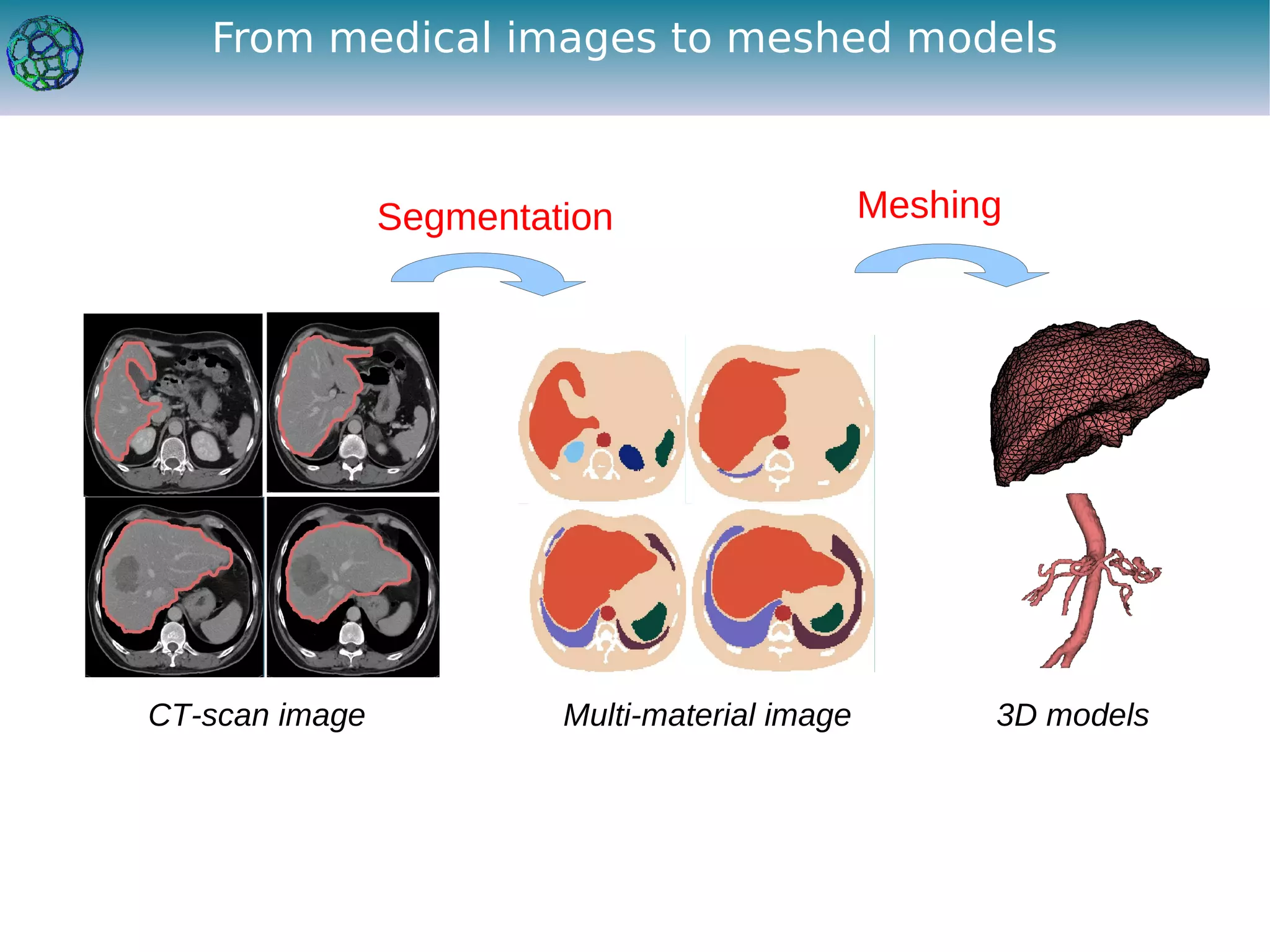
From medical images to meshed models


                Segmentation                    Meshing


CT-scan image            Multi-material image         3D models
Motivations and Applications

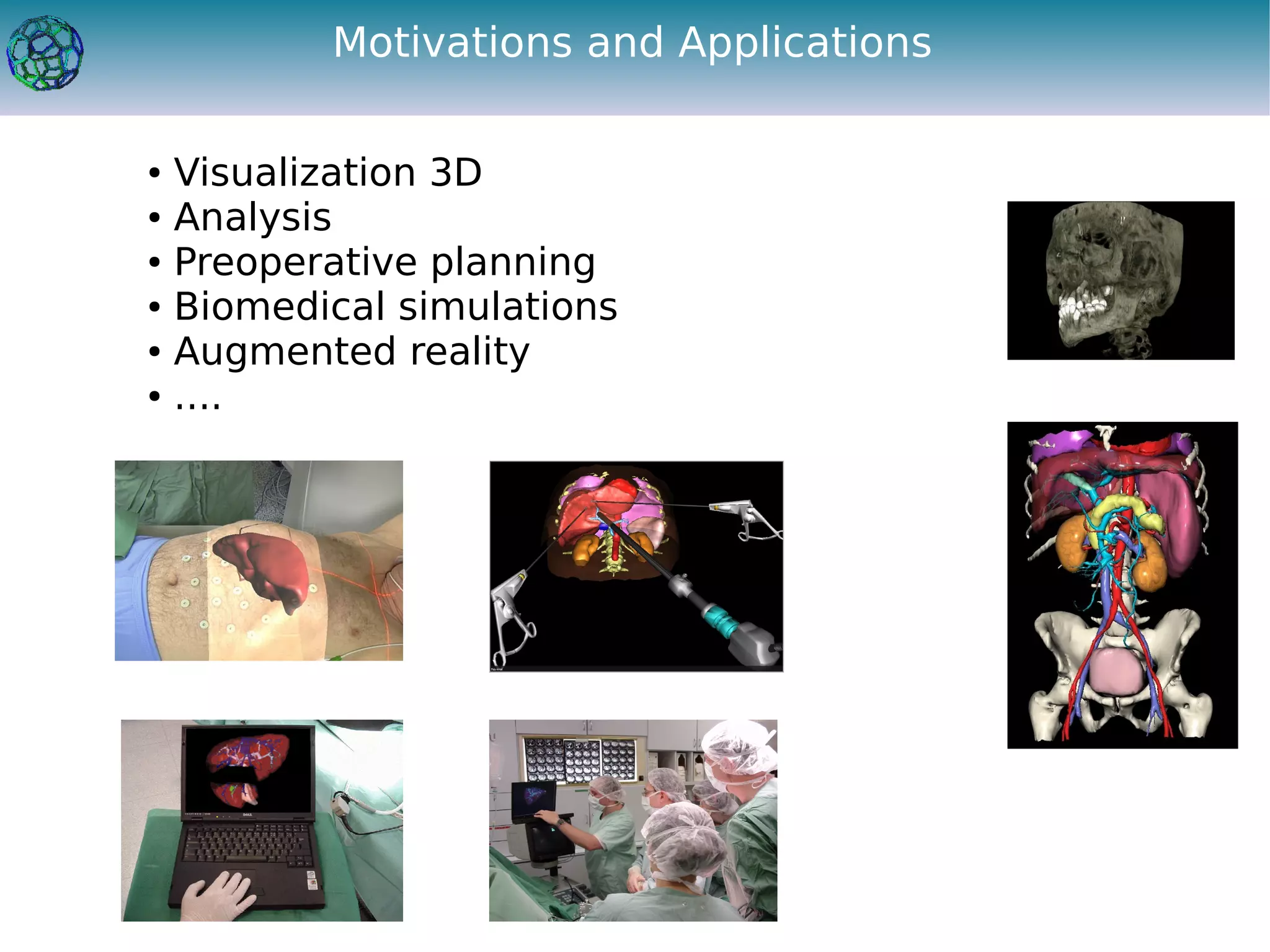
●   Visualization 3D
●   Analysis
●   Preoperative planning
●   Biomedical simulations
●   Augmented reality
●   ....
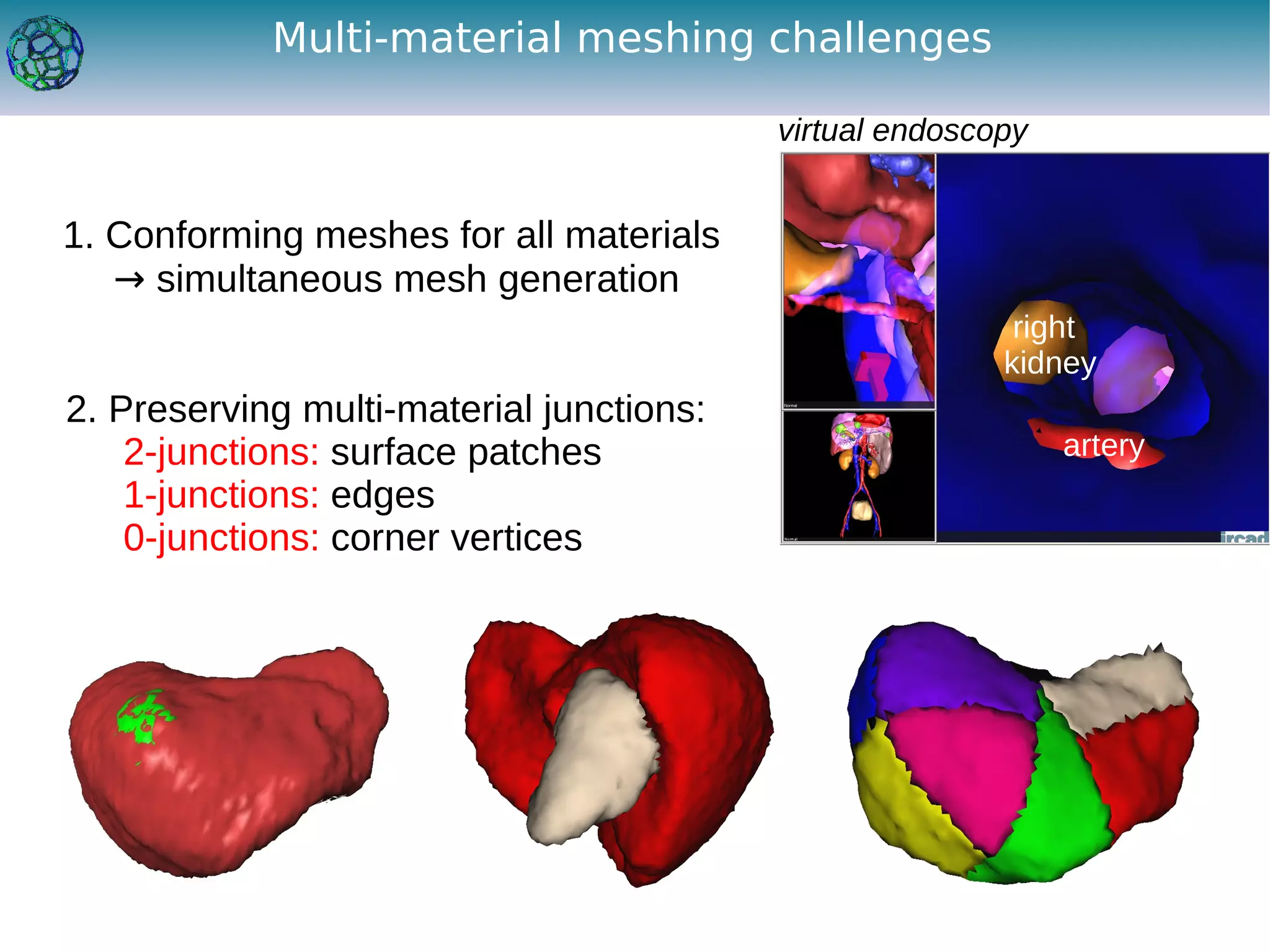
Multi-material meshing challenges

                                          virtual endoscopy


1. Conforming meshes for all materials
   → simultaneous mesh generation
                                                          right
                                                         kidney
2. Preserving multi-material junctions:
    2-junctions: surface patches                              artery
    1-junctions: edges
    0-junctions: corner vertices
Previous work
                     Surface mesh generation

 Marching Cubes extensions [Hege97,
  Wu03, …]


 Dual Marching Cubes extensions [Gibson98, Nielson04,
  Bertram05, Reitinger05, Kobbelt06…]


 Delaunay based methods [Amenta01, Boissonnat03, Meyer08…]
Previous work
                       Volume mesh generation

 Grid/Octree based methods [Nielson97, Hartman98, Bajaj07, …]


 Delaunay refinement based methods [Oudot05, Rineau06,
  Yvinec07, Pons07…]
Delaunay refinement strategy
                Advantages


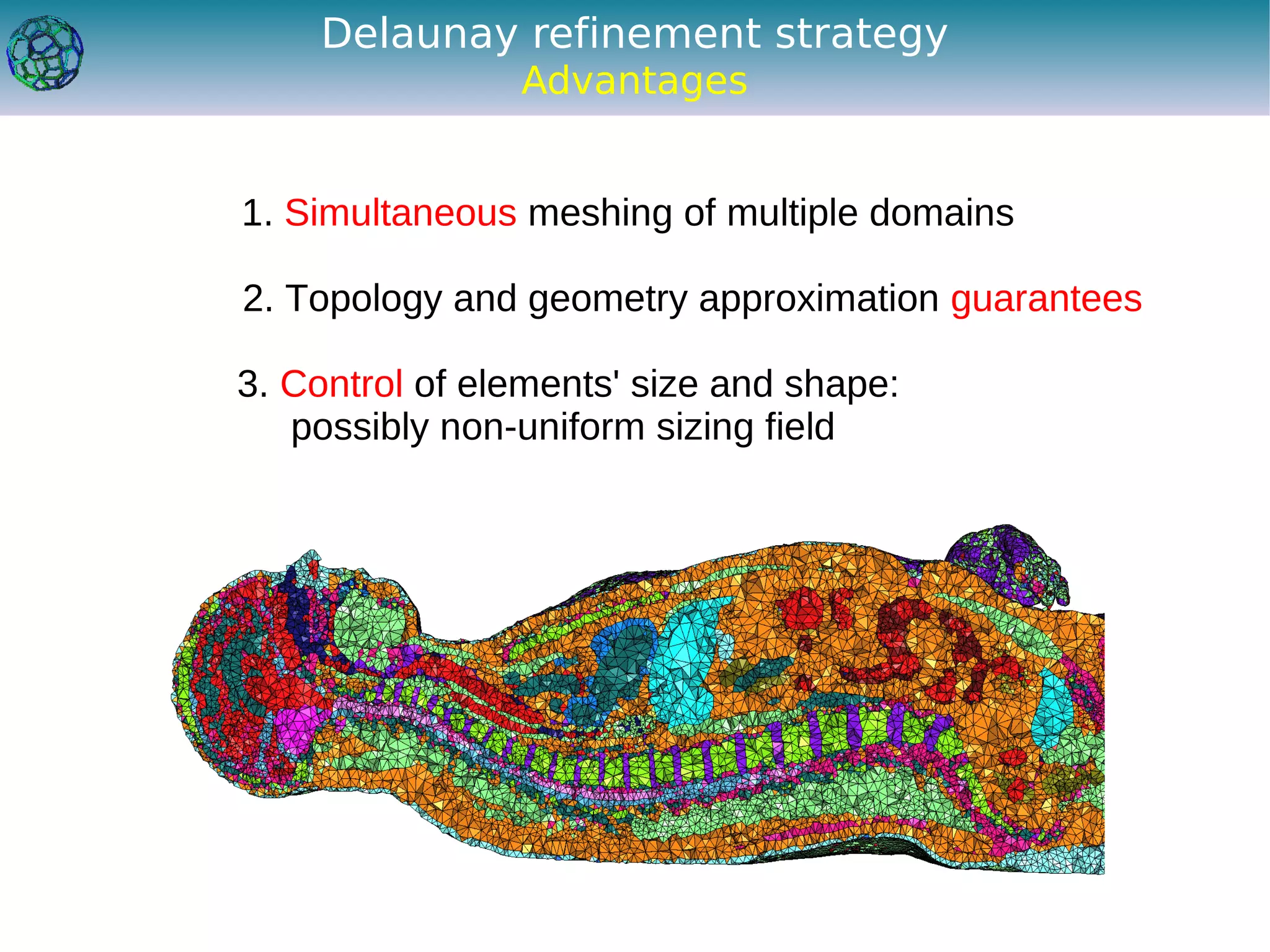
1. Simultaneous meshing of multiple domains

2. Topology and geometry approximation guarantees

3. Control of elements' size and shape:
   possibly non-uniform sizing field
Delaunay refinement strategy
               Drawbacks


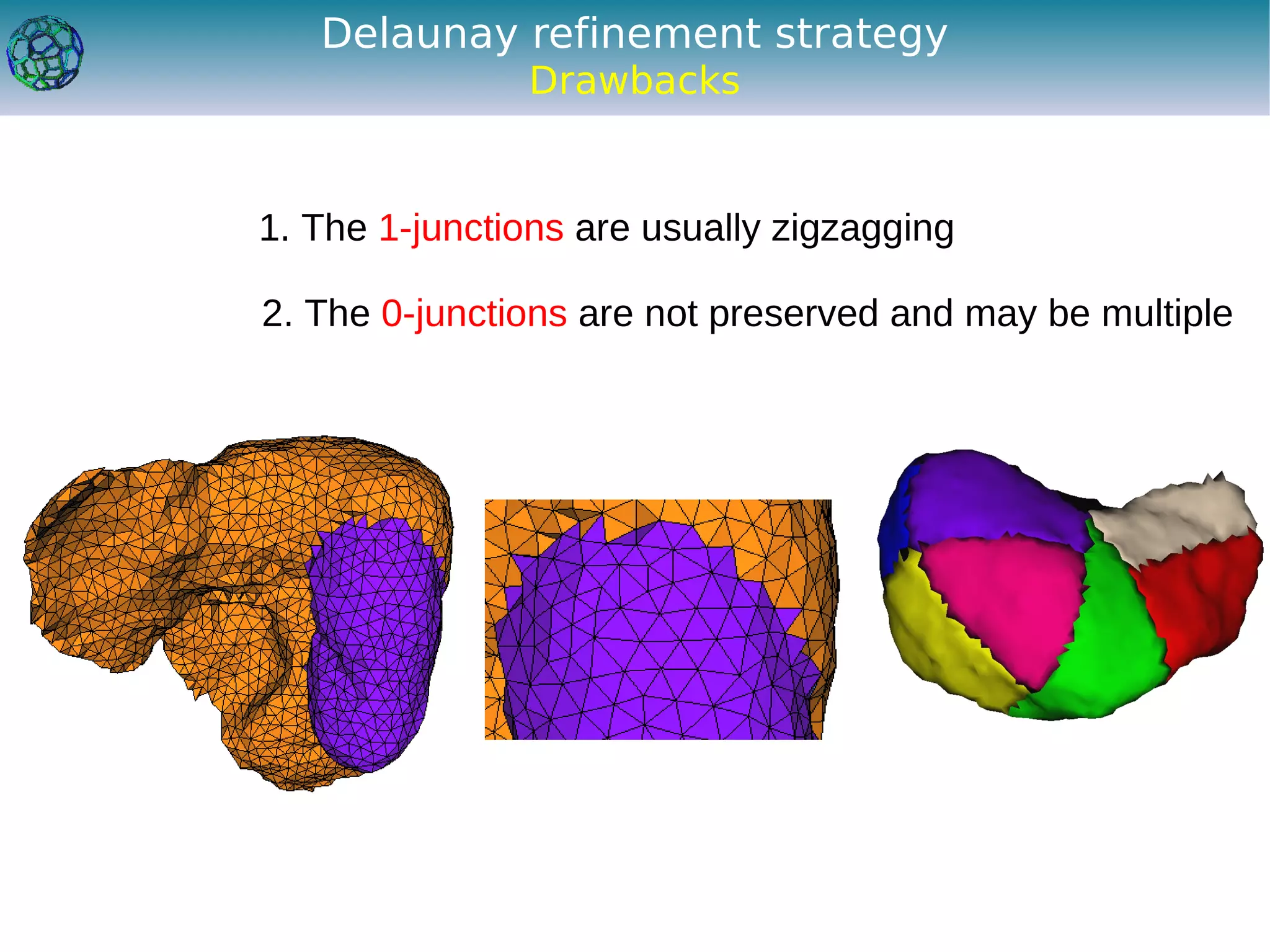
1. The 1-junctions are usually zigzagging

2. The 0-junctions are not preserved and may be multiple
Feature preserving Delaunay refinement algorithm
                          Overview

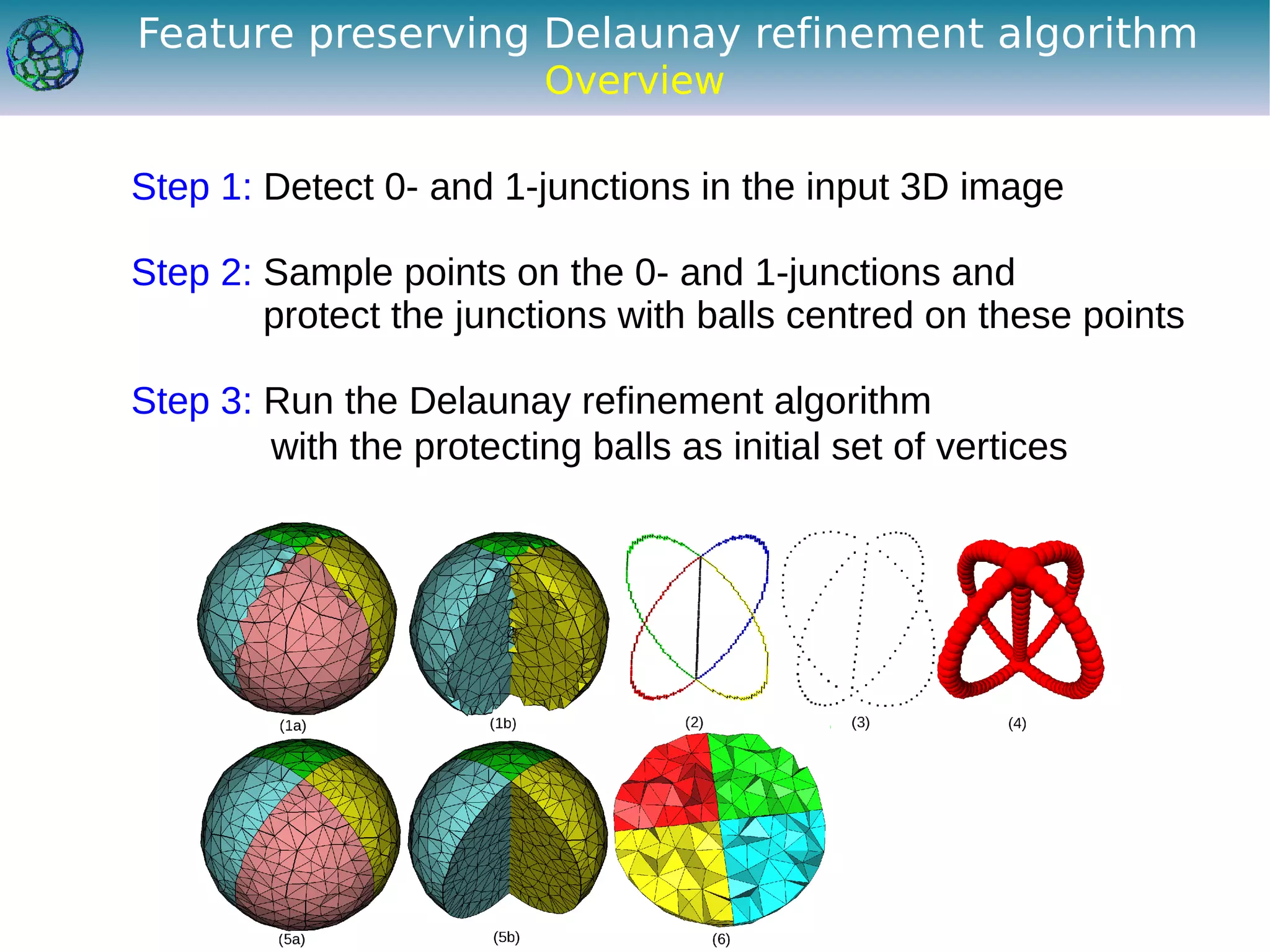
Step 1: Detect 0- and 1-junctions in the input 3D image

Step 2: Sample points on the 0- and 1-junctions and
        protect the junctions with balls centred on these points

Step 3: Run the Delaunay refinement algorithm
        with the protecting balls as initial set of vertices
Restricted Delaunay triangulation
                         Background 2D


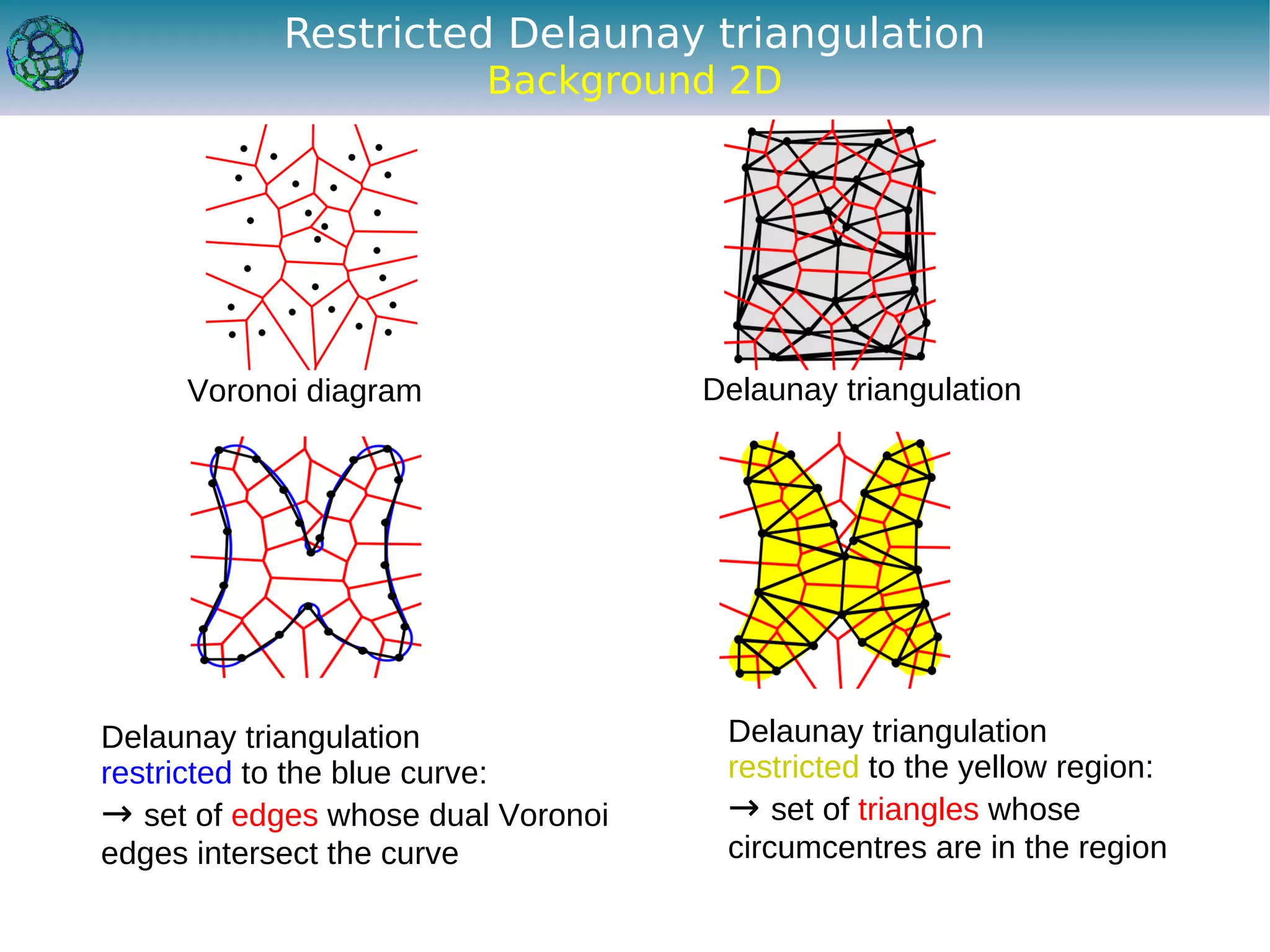
     Voronoi diagram                Delaunay triangulation


Delaunay triangulation               Delaunay triangulation
restricted to the blue curve:        restricted to the yellow region:
→ set of edges whose dual Voronoi    → set of triangles whose
edges intersect the curve            circumcentres are in the region
Restricted Delaunay triangulation
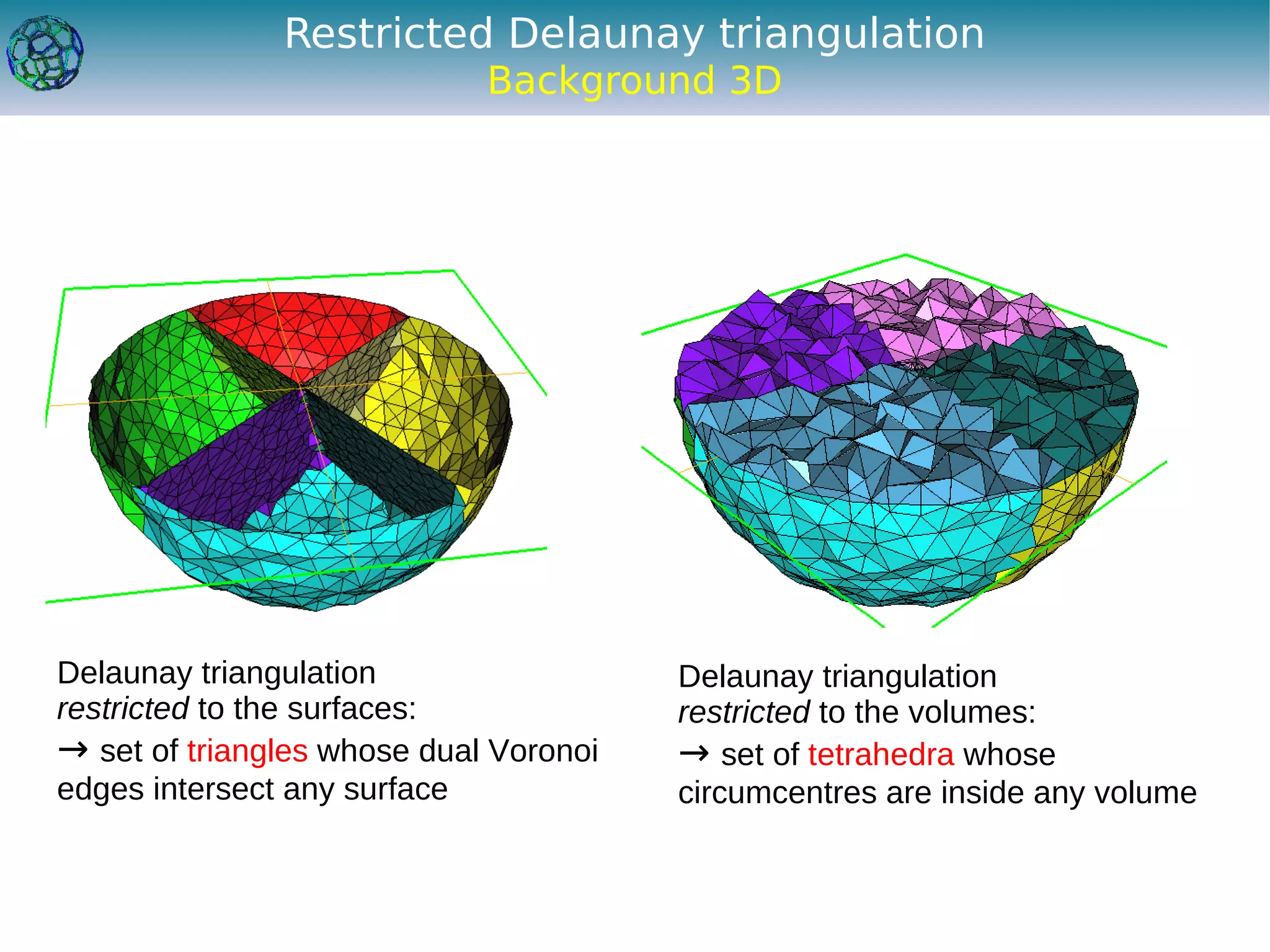
                             Background 3D


Delaunay triangulation                  Delaunay triangulation
restricted to the surfaces:             restricted to the volumes:
→ set of triangles whose dual Voronoi   → set of tetrahedra whose
edges intersect any surface             circumcentres are inside any volume
Delaunay refinement algorithm
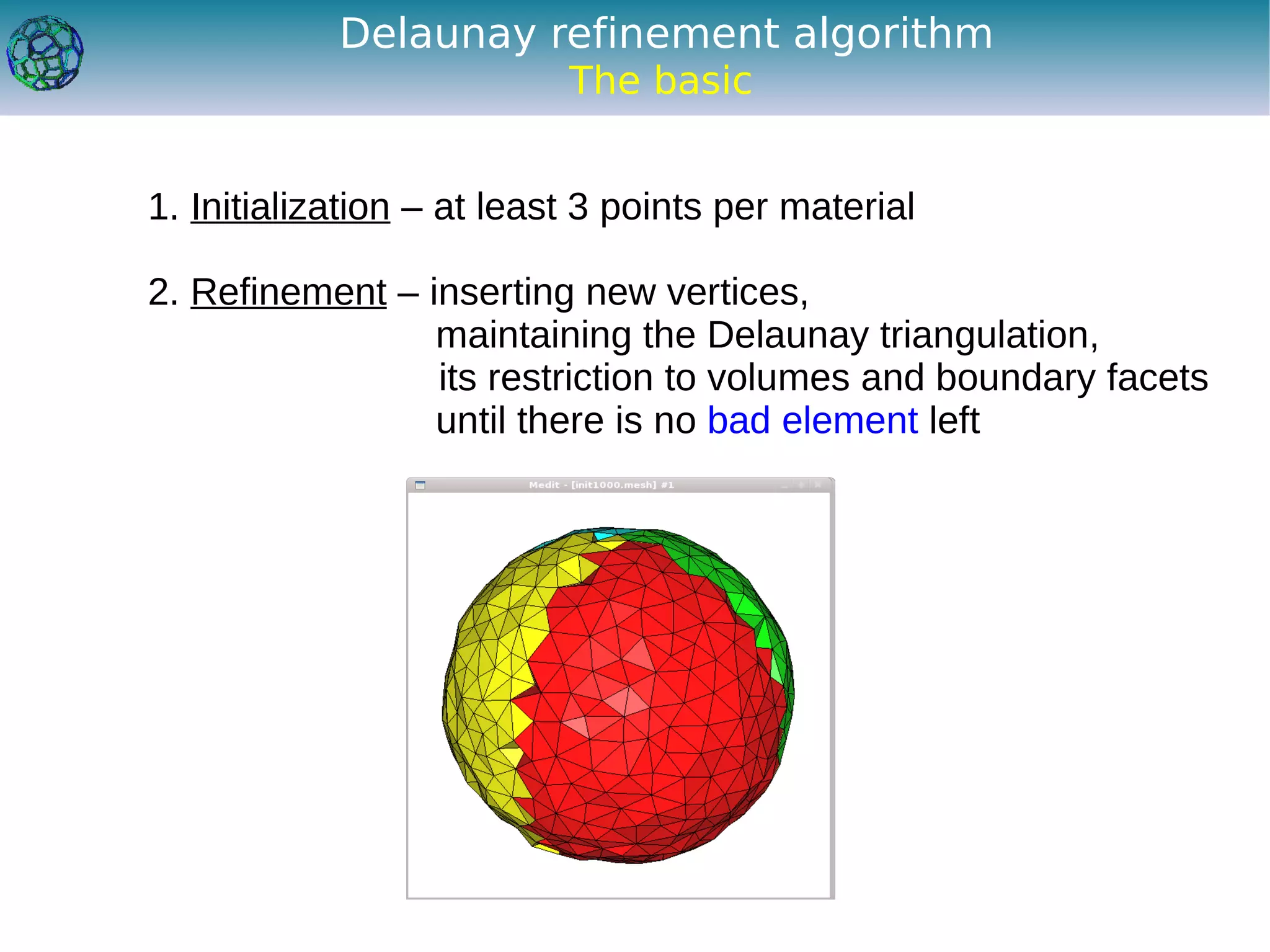
                           The basic


1. Initialization – at least 3 points per material

2. Refinement – inserting new vertices,
                 maintaining the Delaunay triangulation,
                 its restriction to volumes and boundary facets
                 until there is no bad element left
Delaunay refinement algorithm
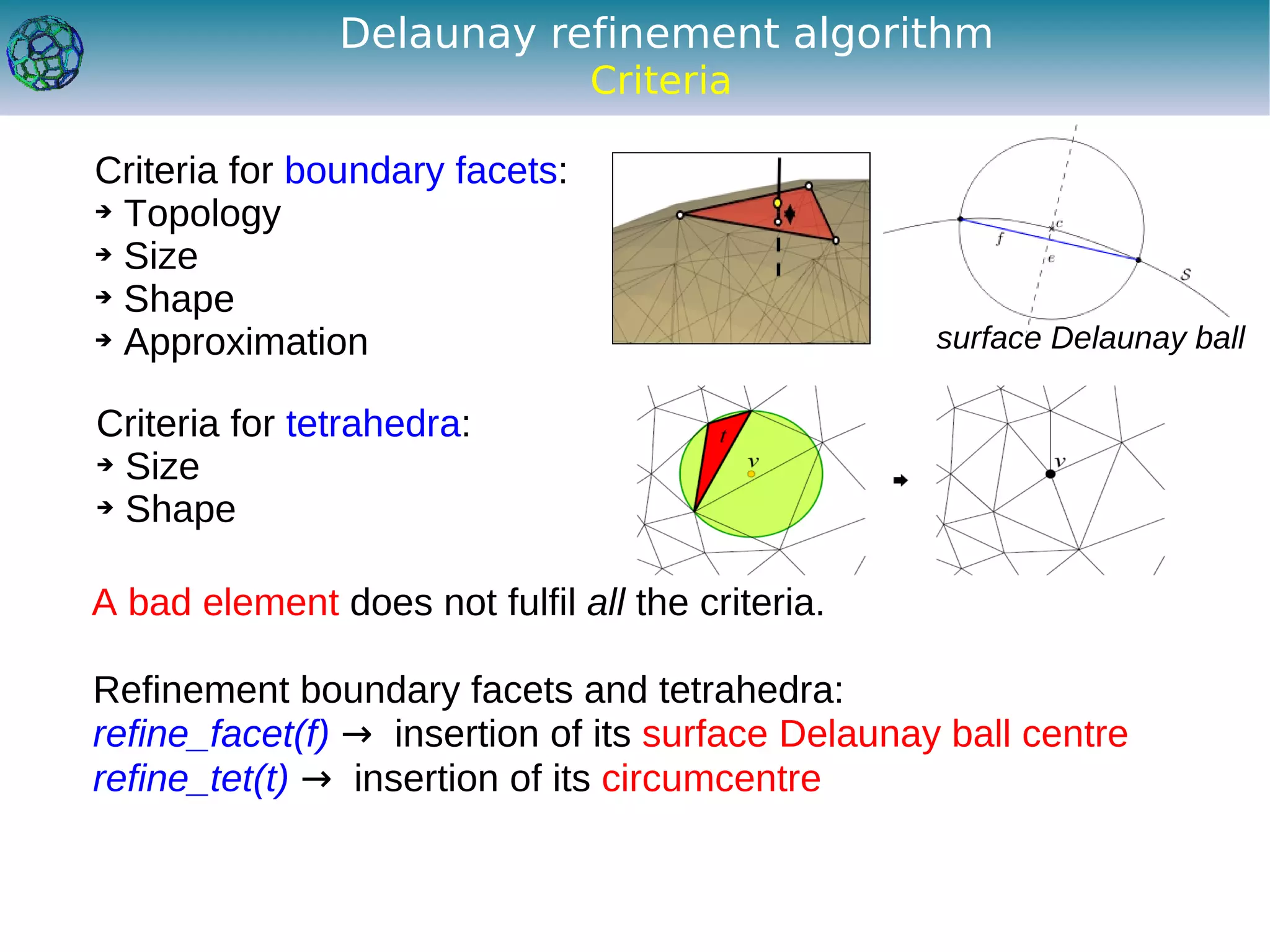
                                Criteria

Criteria for boundary facets:
➔ Topology

➔ Size

➔ Shape

➔ Approximation                                    surface Delaunay ball

Criteria for tetrahedra:
➔ Size

➔ Shape


A bad element does not fulfil all the criteria.

Refinement boundary facets and tetrahedra:
refine_facet(f) → insertion of its surface Delaunay ball centre
refine_tet(t) → insertion of its circumcentre
Delaunay refinement algorithm
                      The algorithm


1. Initialization – at least 3 points per material

2. Refinement
    a) If there is a bad boundary facet f
             then refine_facet(f)
    b) If there is a bad tetrahedron t
        - compute the circumcentre c
        - if c is included in a surface Delaunay ball
                 of some boundary facet f
        - then refine_facet(f)
        - else refine_tet(t)

3. Sliver exudation
Delaunay refinement algorithm
                         Results


●   The algorithm terminates

●   If the resulting sampling is dense enough,
    every image material is represented by
    a submesh of tetrahedra

      → boundary facets provide a good and
       watertight approximation of the surface,
       free of self intersections

      → tetrahedra form a good approximation
       of the volume
Delaunay refinement algorithm
                        Results

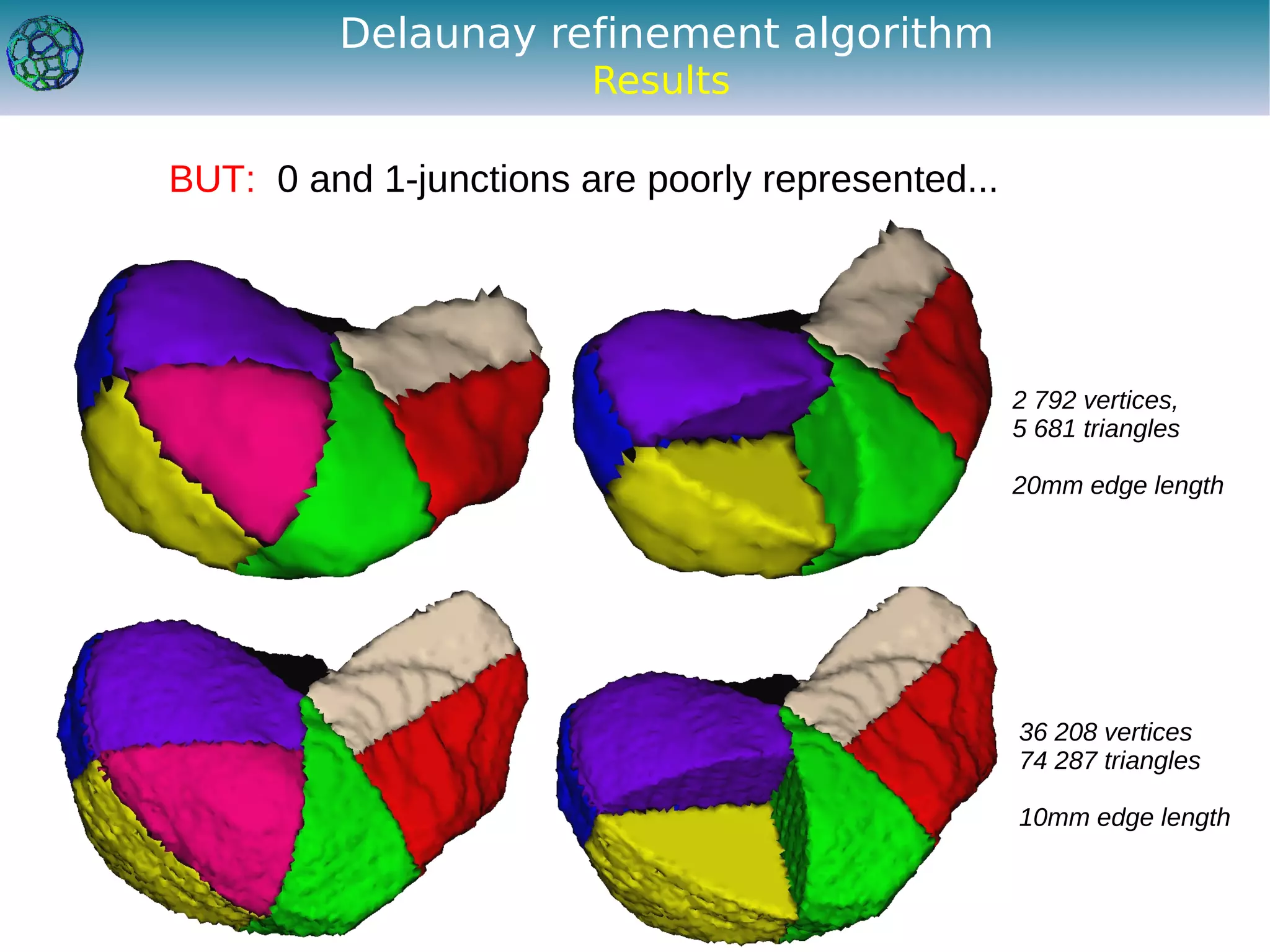
BUT: 0 and 1-junctions are poorly represented...


                                                   2 792 vertices,
                                                   5 681 triangles

                                                   20mm edge length


                                                   36 208 vertices
                                                   74 287 triangles

                                                   10mm edge length
Feature preserving extension


Step 1: Multi-material junction extraction

Step 2: Junction protection

Step 3: Adaptation of the algorithm
Feature preserving extension
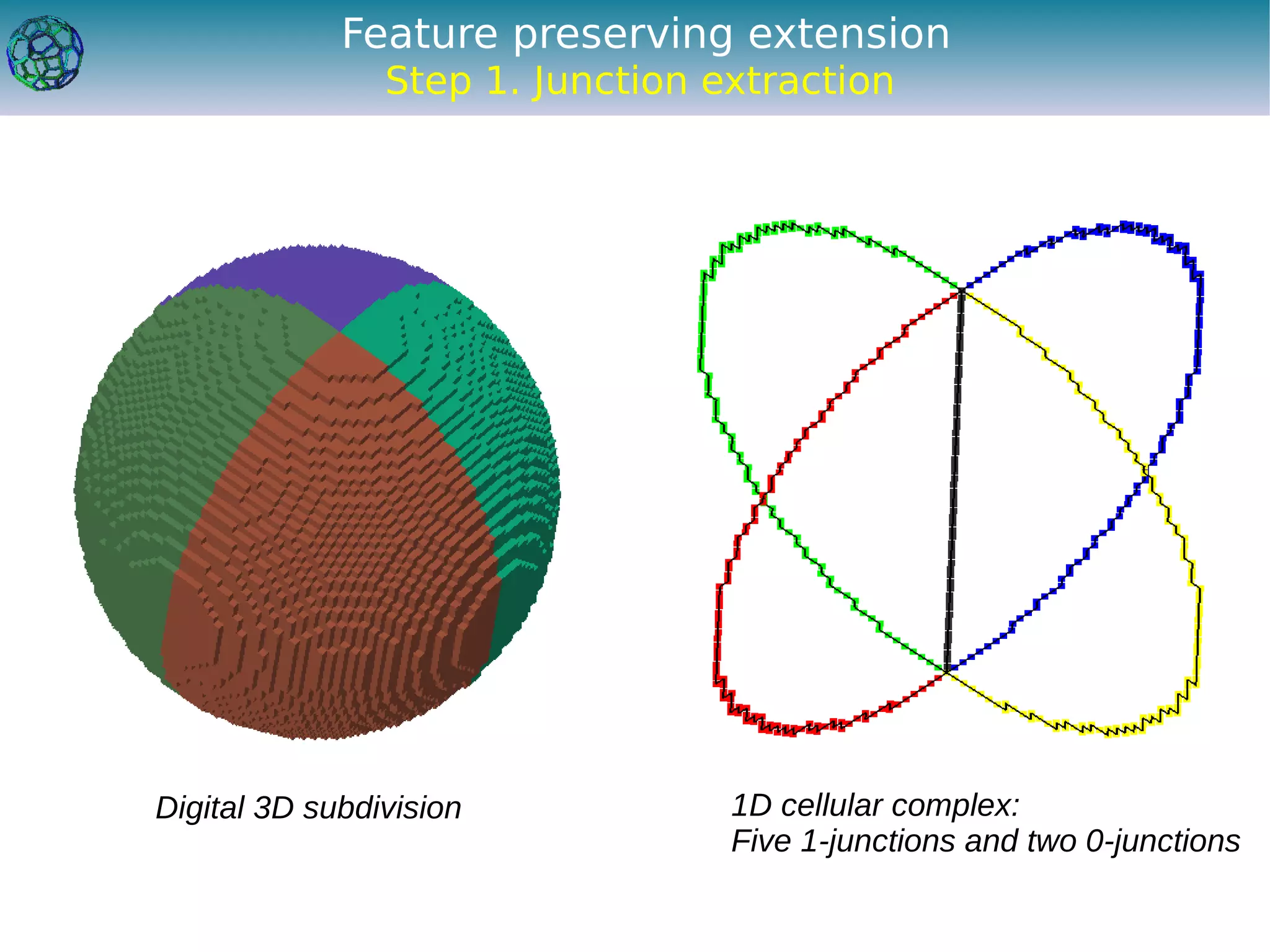
                    Step 1. Junction extraction


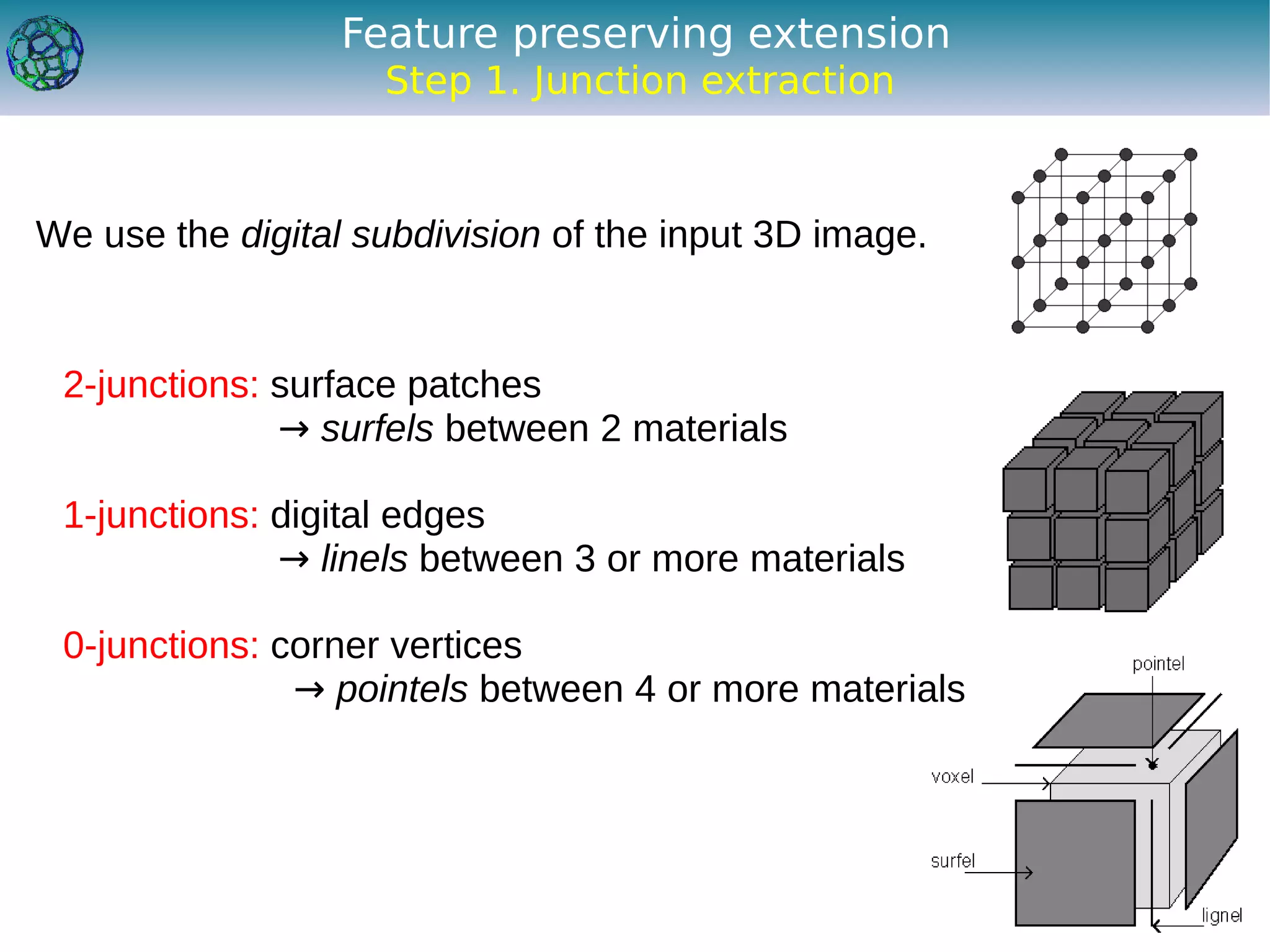
We use the digital subdivision of the input 3D image.


 2-junctions: surface patches
              → surfels between 2 materials

 1-junctions: digital edges
              → linels between 3 or more materials

 0-junctions: corner vertices
               → pointels between 4 or more materials
Feature preserving extension
                Step 1. Junction extraction


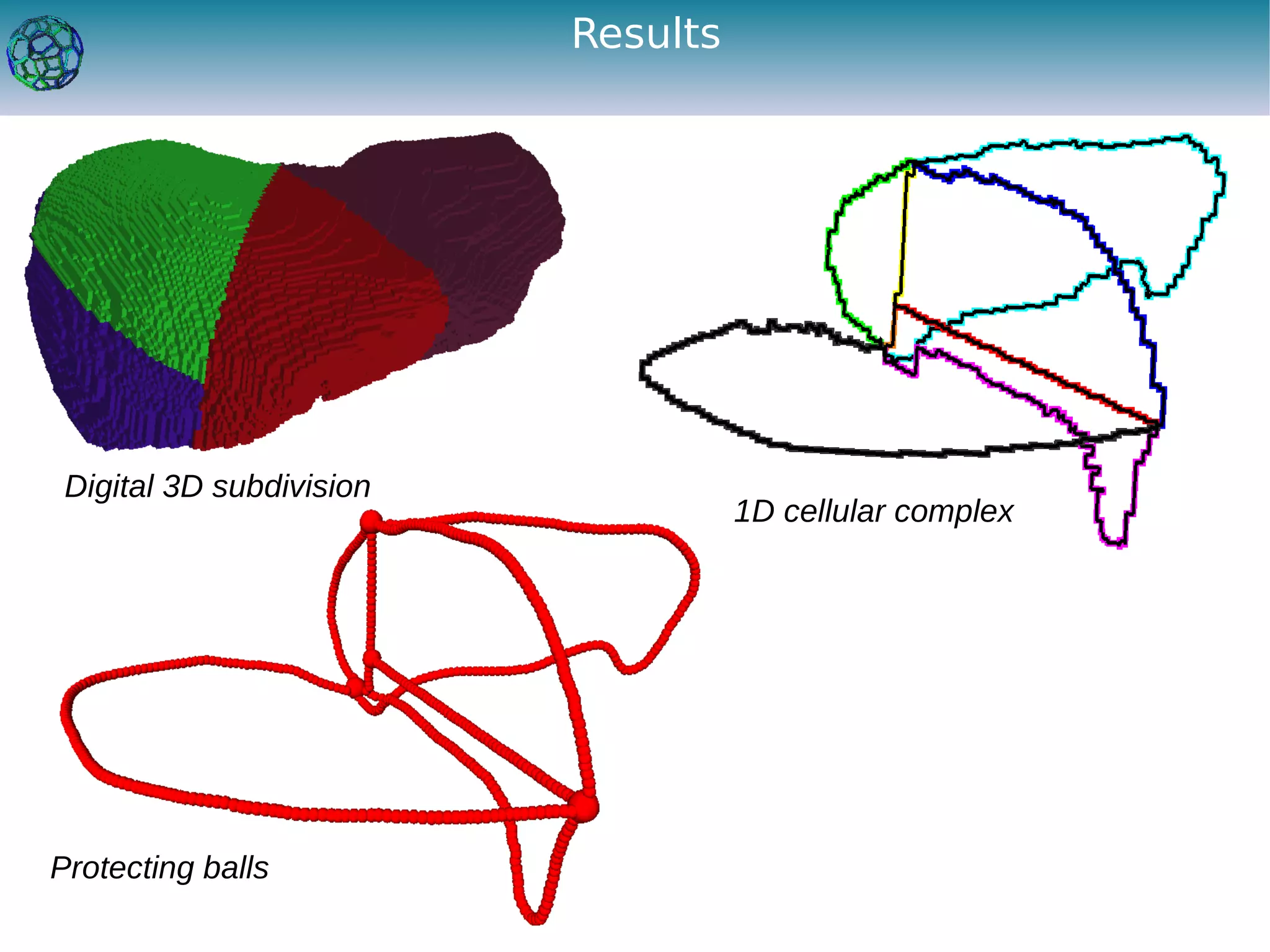
Digital 3D subdivision            1D cellular complex:
                                  Five 1-junctions and two 0-junctions
Feature preserving extension
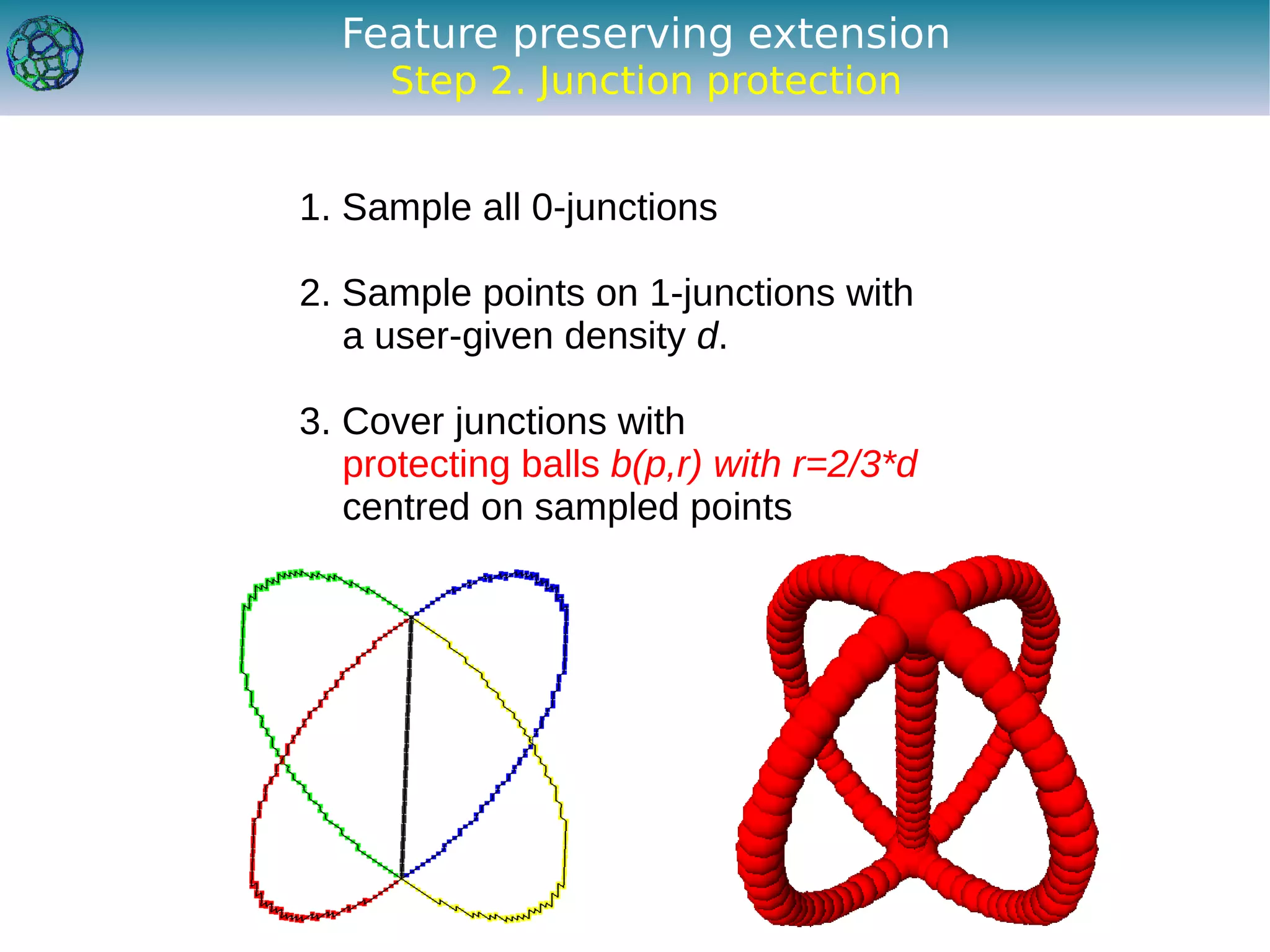
     Step 2. Junction protection


1. Sample all 0-junctions

2. Sample points on 1-junctions with
   a user-given density d.

3. Cover junctions with
   protecting balls b(p,r) with r=2/3*d
   centred on sampled points
Feature preserving extension
                      Step 2. Junction protection

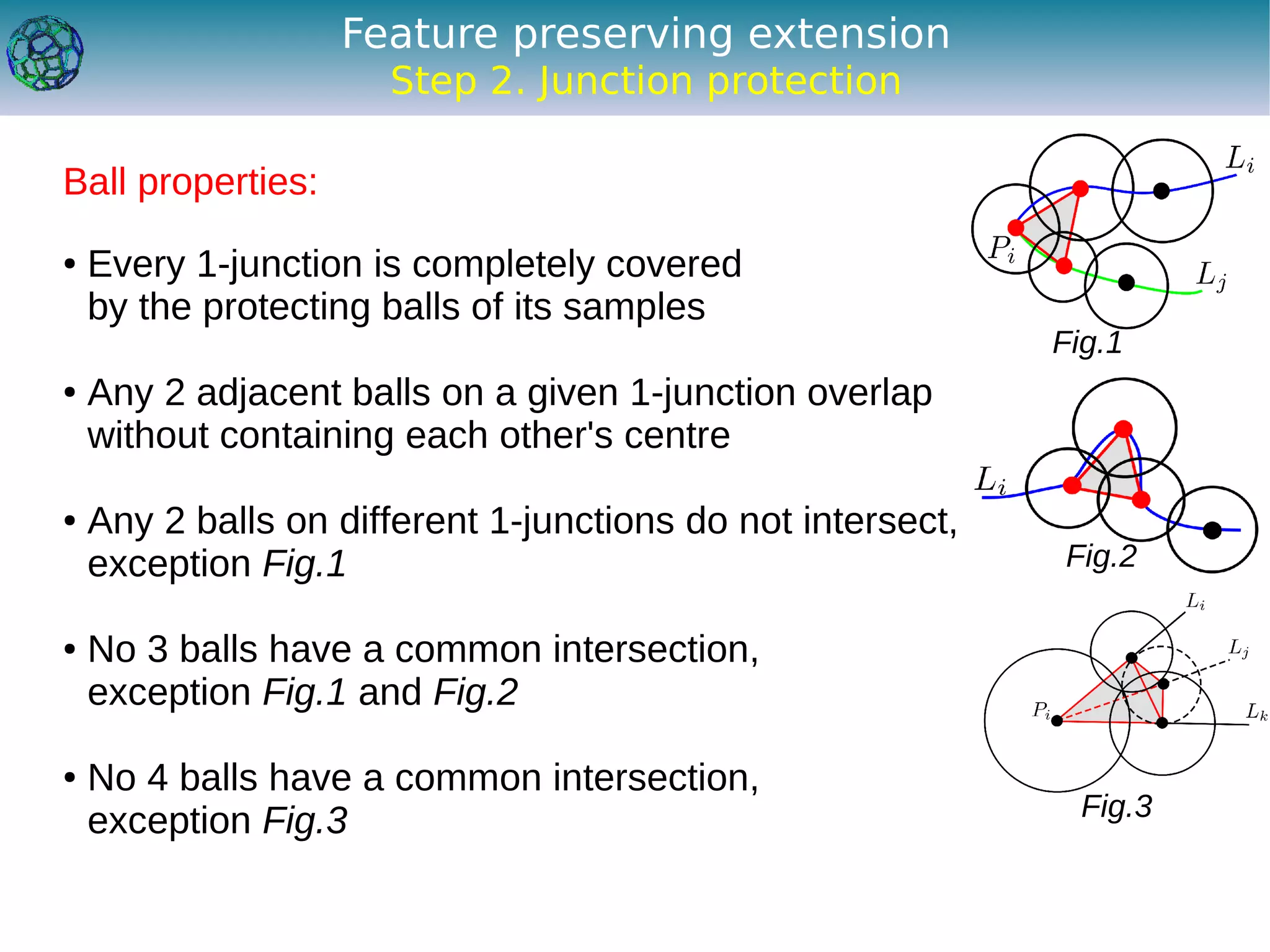
Ball properties:
●   Every 1-junction is completely covered
    by the protecting balls of its samples
                                                             Fig.1
●   Any 2 adjacent balls on a given 1-junction overlap
    without containing each other's centre

●   Any 2 balls on different 1-junctions do not intersect,
    exception Fig.1                                          Fig.2

●   No 3 balls have a common intersection,
    exception Fig.1 and Fig.2

●   No 4 balls have a common intersection,
                                                               Fig.3
    exception Fig.3
Feature preserving extension
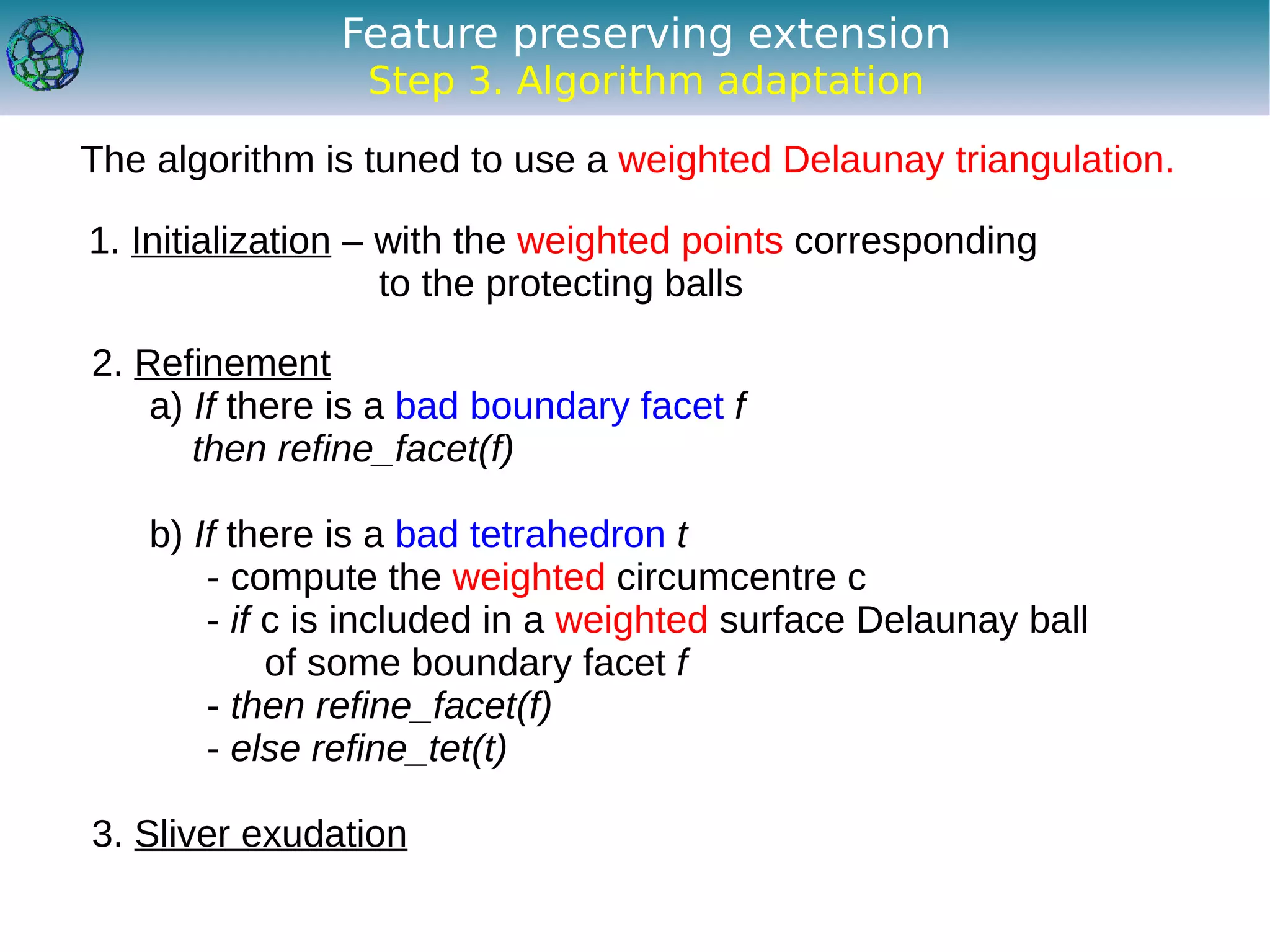
                 Step 3. Algorithm adaptation

The algorithm is tuned to use a weighted Delaunay triangulation.

1. Initialization – with the weighted points corresponding
                    to the protecting balls

2. Refinement
    a) If there is a bad boundary facet f
       then refine_facet(f)

    b) If there is a bad tetrahedron t
        - compute the weighted circumcentre c
        - if c is included in a weighted surface Delaunay ball
             of some boundary facet f
        - then refine_facet(f)
        - else refine_tet(t)

3. Sliver exudation
Feature preserving extension
                   Step 3. Criteria adaptation

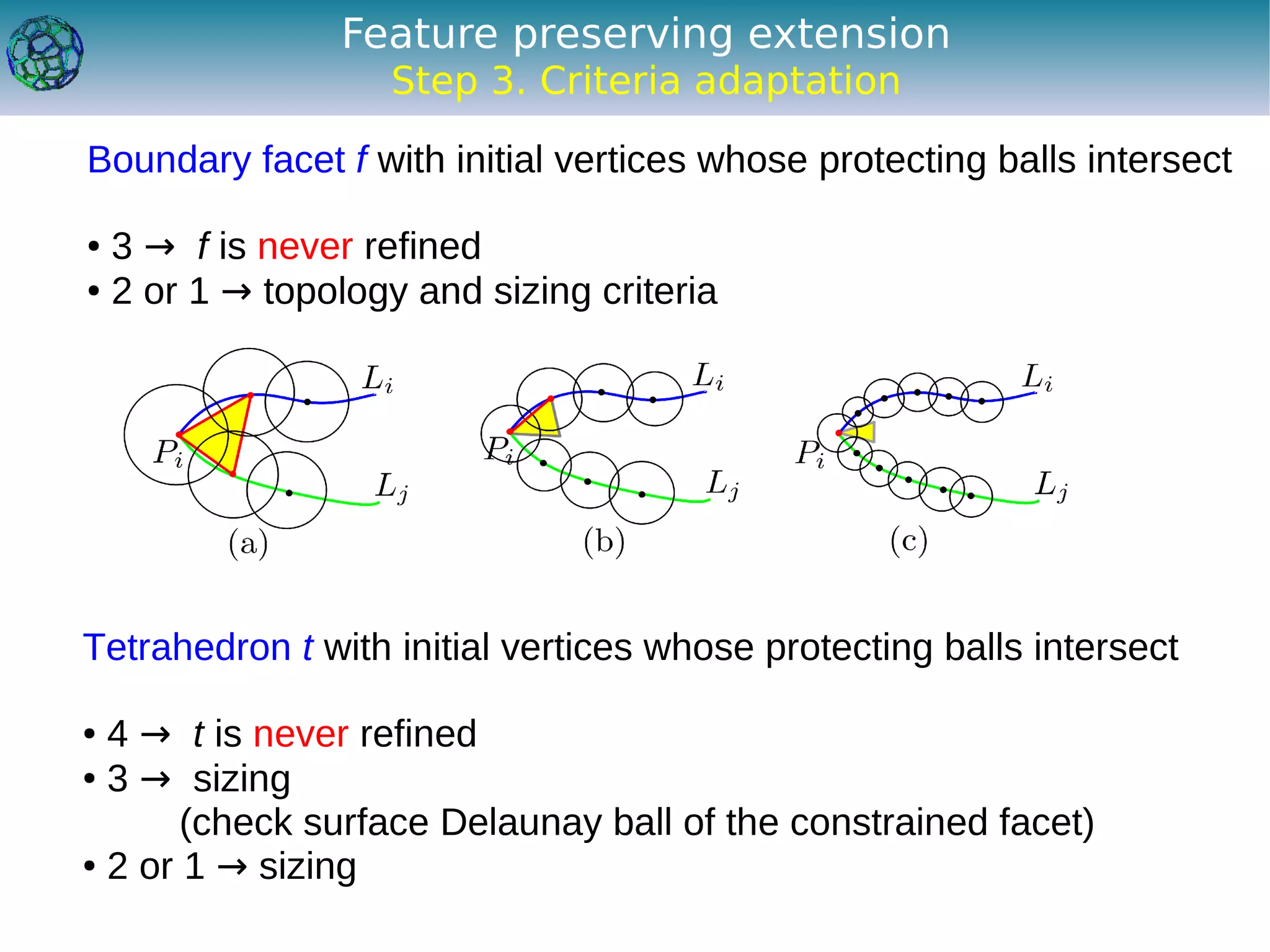
Boundary facet f with initial vertices whose protecting balls intersect

● 3 → f is never refined
● 2 or 1 → topology and sizing criteria


Tetrahedron t with initial vertices whose protecting balls intersect

● 4 → t is never refined
● 3 → sizing


       (check surface Delaunay ball of the constrained facet)
● 2 or 1 → sizing
Feature preserving extension
                         Why does it work?

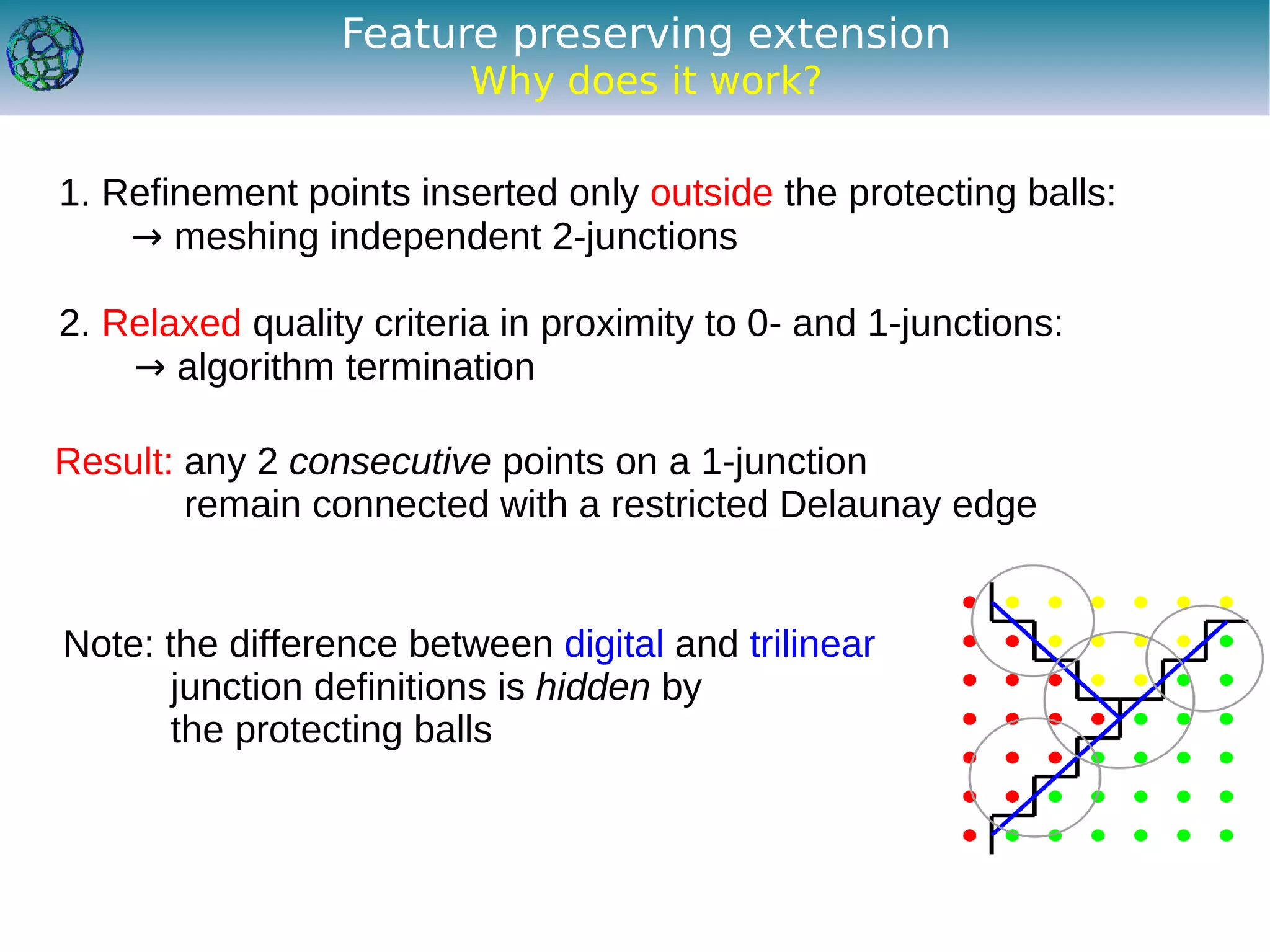
1. Refinement points inserted only outside the protecting balls:
    → meshing independent 2-junctions

2. Relaxed quality criteria in proximity to 0- and 1-junctions:
    → algorithm termination

Result: any 2 consecutive points on a 1-junction
        remain connected with a restricted Delaunay edge


Note: the difference between digital and trilinear
       junction definitions is hidden by
       the protecting balls
Results

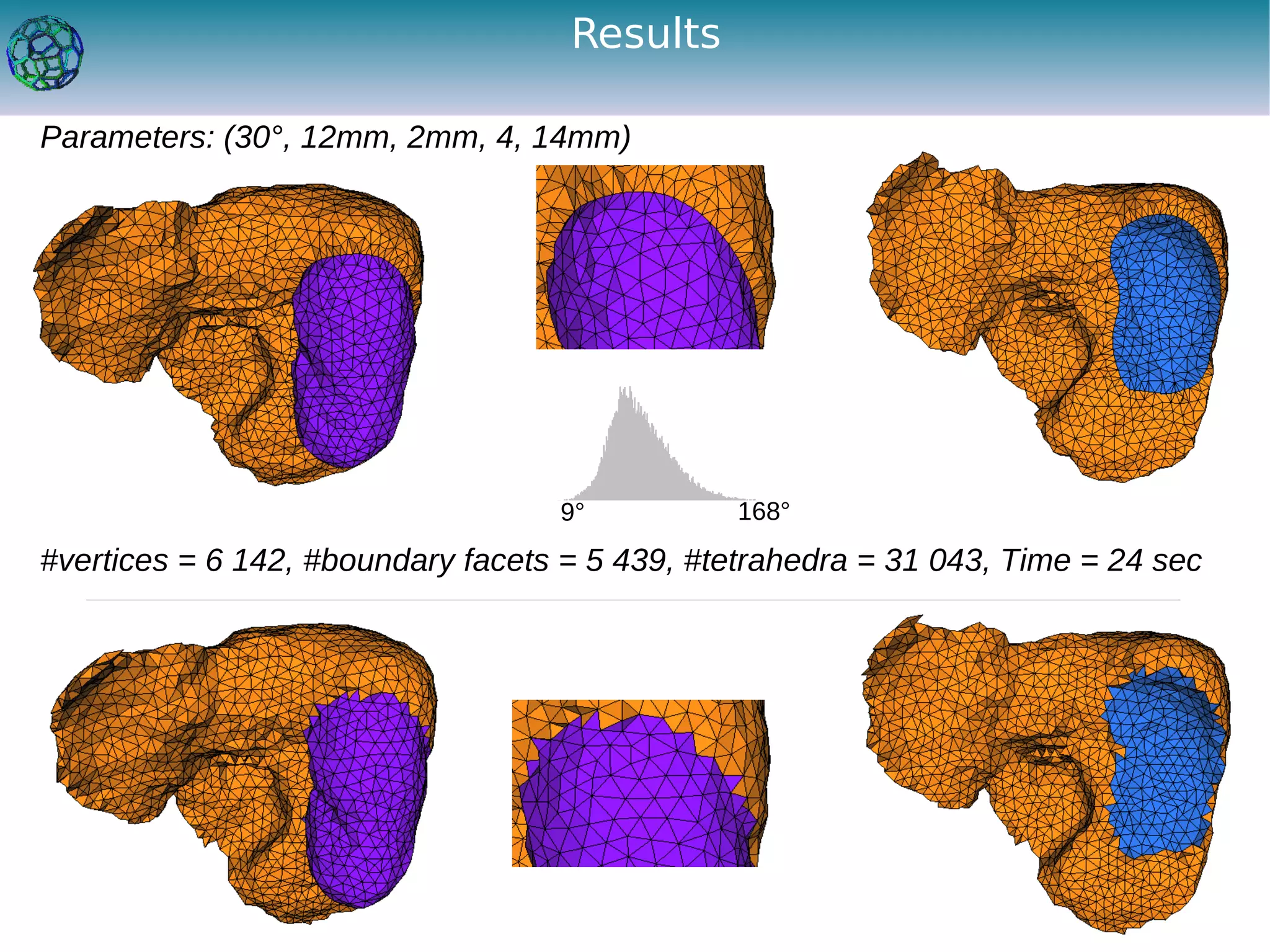
Parameters: (30°, 12mm, 2mm, 4, 14mm)


                                   9°           168°
#vertices = 6 142, #boundary facets = 5 439, #tetrahedra = 31 043, Time = 24 sec
Results


 Digital 3D subdivision
                                    1D cellular complex


Protecting balls
Results

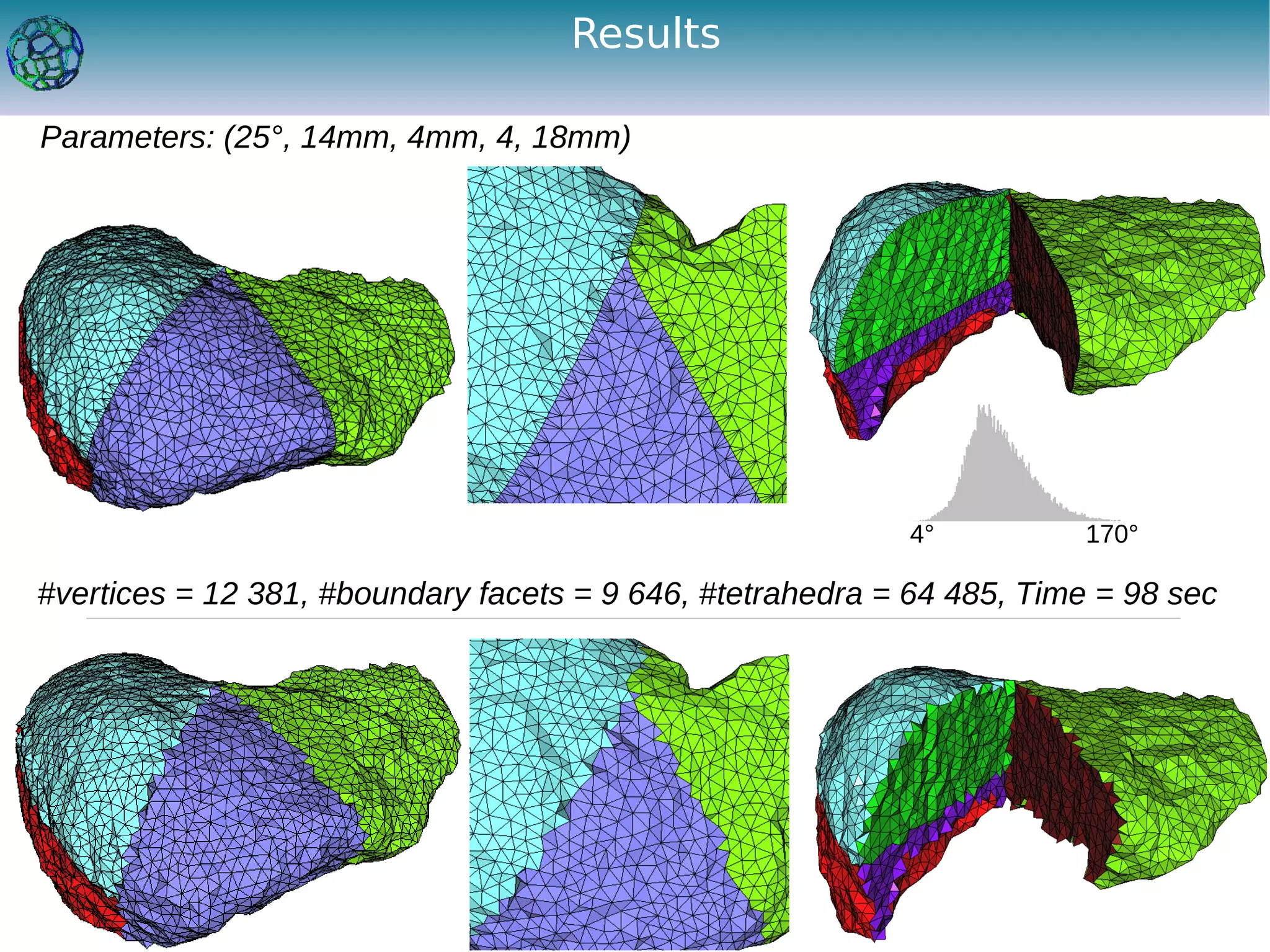
Parameters: (25°, 14mm, 4mm, 4, 18mm)


                                                           4°          170°

#vertices = 12 381, #boundary facets = 9 646, #tetrahedra = 64 485, Time = 98 sec
Acknowledgements


Thank you for your attention !

Feature preserving Delaunay mesh generation from 3D multi-material images

  • 1.
    Symposium on GeometryProcessing 17th July 2009 - Berlin Feature preserving Delaunay mesh generation from 3D multi-material images Dobrina Boltcheva, Mariette Yvinec, Jean-Daniel Boissonnat
  • 2.
    From medical imagesto meshed models Segmentation Meshing CT-scan image Multi-material image 3D models
  • 3.
    Motivations and Applications ● Visualization 3D ● Analysis ● Preoperative planning ● Biomedical simulations ● Augmented reality ● ....
  • 4.
    Multi-material meshing challenges virtual endoscopy 1. Conforming meshes for all materials → simultaneous mesh generation right kidney 2. Preserving multi-material junctions: 2-junctions: surface patches artery 1-junctions: edges 0-junctions: corner vertices
  • 5.
    Previous work Surface mesh generation  Marching Cubes extensions [Hege97, Wu03, …]  Dual Marching Cubes extensions [Gibson98, Nielson04, Bertram05, Reitinger05, Kobbelt06…]  Delaunay based methods [Amenta01, Boissonnat03, Meyer08…]
  • 6.
    Previous work Volume mesh generation  Grid/Octree based methods [Nielson97, Hartman98, Bajaj07, …]  Delaunay refinement based methods [Oudot05, Rineau06, Yvinec07, Pons07…]
  • 7.
    Delaunay refinement strategy Advantages 1. Simultaneous meshing of multiple domains 2. Topology and geometry approximation guarantees 3. Control of elements' size and shape: possibly non-uniform sizing field
  • 8.
    Delaunay refinement strategy Drawbacks 1. The 1-junctions are usually zigzagging 2. The 0-junctions are not preserved and may be multiple
  • 9.
    Feature preserving Delaunayrefinement algorithm Overview Step 1: Detect 0- and 1-junctions in the input 3D image Step 2: Sample points on the 0- and 1-junctions and protect the junctions with balls centred on these points Step 3: Run the Delaunay refinement algorithm with the protecting balls as initial set of vertices
  • 10.
    Restricted Delaunay triangulation Background 2D Voronoi diagram Delaunay triangulation Delaunay triangulation Delaunay triangulation restricted to the blue curve: restricted to the yellow region: → set of edges whose dual Voronoi → set of triangles whose edges intersect the curve circumcentres are in the region
  • 11.
    Restricted Delaunay triangulation Background 3D Delaunay triangulation Delaunay triangulation restricted to the surfaces: restricted to the volumes: → set of triangles whose dual Voronoi → set of tetrahedra whose edges intersect any surface circumcentres are inside any volume
  • 12.
    Delaunay refinement algorithm The basic 1. Initialization – at least 3 points per material 2. Refinement – inserting new vertices, maintaining the Delaunay triangulation, its restriction to volumes and boundary facets until there is no bad element left
  • 13.
    Delaunay refinement algorithm Criteria Criteria for boundary facets: ➔ Topology ➔ Size ➔ Shape ➔ Approximation surface Delaunay ball Criteria for tetrahedra: ➔ Size ➔ Shape A bad element does not fulfil all the criteria. Refinement boundary facets and tetrahedra: refine_facet(f) → insertion of its surface Delaunay ball centre refine_tet(t) → insertion of its circumcentre
  • 14.
    Delaunay refinement algorithm The algorithm 1. Initialization – at least 3 points per material 2. Refinement a) If there is a bad boundary facet f then refine_facet(f) b) If there is a bad tetrahedron t - compute the circumcentre c - if c is included in a surface Delaunay ball of some boundary facet f - then refine_facet(f) - else refine_tet(t) 3. Sliver exudation
  • 15.
    Delaunay refinement algorithm Results ● The algorithm terminates ● If the resulting sampling is dense enough, every image material is represented by a submesh of tetrahedra → boundary facets provide a good and watertight approximation of the surface, free of self intersections → tetrahedra form a good approximation of the volume
  • 16.
    Delaunay refinement algorithm Results BUT: 0 and 1-junctions are poorly represented... 2 792 vertices, 5 681 triangles 20mm edge length 36 208 vertices 74 287 triangles 10mm edge length
  • 17.
    Feature preserving extension Step1: Multi-material junction extraction Step 2: Junction protection Step 3: Adaptation of the algorithm
  • 18.
    Feature preserving extension Step 1. Junction extraction We use the digital subdivision of the input 3D image. 2-junctions: surface patches → surfels between 2 materials 1-junctions: digital edges → linels between 3 or more materials 0-junctions: corner vertices → pointels between 4 or more materials
  • 19.
    Feature preserving extension Step 1. Junction extraction Digital 3D subdivision 1D cellular complex: Five 1-junctions and two 0-junctions
  • 20.
    Feature preserving extension Step 2. Junction protection 1. Sample all 0-junctions 2. Sample points on 1-junctions with a user-given density d. 3. Cover junctions with protecting balls b(p,r) with r=2/3*d centred on sampled points
  • 21.
    Feature preserving extension Step 2. Junction protection Ball properties: ● Every 1-junction is completely covered by the protecting balls of its samples Fig.1 ● Any 2 adjacent balls on a given 1-junction overlap without containing each other's centre ● Any 2 balls on different 1-junctions do not intersect, exception Fig.1 Fig.2 ● No 3 balls have a common intersection, exception Fig.1 and Fig.2 ● No 4 balls have a common intersection, Fig.3 exception Fig.3
  • 22.
    Feature preserving extension Step 3. Algorithm adaptation The algorithm is tuned to use a weighted Delaunay triangulation. 1. Initialization – with the weighted points corresponding to the protecting balls 2. Refinement a) If there is a bad boundary facet f then refine_facet(f) b) If there is a bad tetrahedron t - compute the weighted circumcentre c - if c is included in a weighted surface Delaunay ball of some boundary facet f - then refine_facet(f) - else refine_tet(t) 3. Sliver exudation
  • 23.
    Feature preserving extension Step 3. Criteria adaptation Boundary facet f with initial vertices whose protecting balls intersect ● 3 → f is never refined ● 2 or 1 → topology and sizing criteria Tetrahedron t with initial vertices whose protecting balls intersect ● 4 → t is never refined ● 3 → sizing (check surface Delaunay ball of the constrained facet) ● 2 or 1 → sizing
  • 24.
    Feature preserving extension Why does it work? 1. Refinement points inserted only outside the protecting balls: → meshing independent 2-junctions 2. Relaxed quality criteria in proximity to 0- and 1-junctions: → algorithm termination Result: any 2 consecutive points on a 1-junction remain connected with a restricted Delaunay edge Note: the difference between digital and trilinear junction definitions is hidden by the protecting balls
  • 25.
    Results Parameters: (30°, 12mm,2mm, 4, 14mm) 9° 168° #vertices = 6 142, #boundary facets = 5 439, #tetrahedra = 31 043, Time = 24 sec
  • 26.
    Results Digital 3Dsubdivision 1D cellular complex Protecting balls
  • 27.
    Results Parameters: (25°, 14mm,4mm, 4, 18mm) 4° 170° #vertices = 12 381, #boundary facets = 9 646, #tetrahedra = 64 485, Time = 98 sec
  • 28.