AWG CAD/CAE and Virtual Product Modeling


                            Pedro Santos,
                          Fraunhofer IGD,
                                Germany
3D and knowledge in CAD/CAE and
Virtual Product Modeling
    What do we currently do with 3D shapes ?
        Currently 3D shapes come as geometry – most of
        the times as CAD model or triangle mesh
        3D shapes are modeled, modified and visualized.
        We use them for simulation (virtual wind tunnels,
        structural analysis, clash and clearance, …)
    What is the next step of evolution ?
        Semantic Recognition and Interpretation of shapes
        Self-awareness of shapes
        More than “just’’ geometry
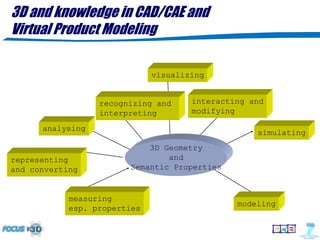
3D and knowledge in CAD/CAE and
Virtual Product Modeling

                              visualizing


                  recognizing and     interacting and
                  interpreting        modifying

      analysing
                                                   simulating
                            3D Geometry
representing                    and
and converting          Semantic Properties


            measuring
                                               modeling
            esp. properties
3D and knowledge in CAD/CAE and
Virtual Product Modeling
    The evolution of 3D shapes – the next level
       Semantic technologies can help 3D shapes
       becoming more than “just’’ geometry
       3D shapes become self-aware of their function in a
       model
       A model becomes an entity on which reasoning
       may be performed
       3D shapes do no longer just contain a geometric
       description (CAD, mesh) but also contain meta
       information (such as kinematic constraints,
       function in the model, performance factors,
       parametric dependencies)
3D and knowledge in CAD/CAE and
Virtual Product Modeling
    How do we retrieve and embed additional meta
    information on 3D shapes ?
       Alternative 1: Semantic meta-information is
       gathered from the raw data of the model
       capturing process, which analyses the structure of
       the model and identifies inter-dependencies such
       as constraints in a semi-automatic process
       Alternative 2: Existing models are analysed for
       characteristic structures or patterns. Meta-
       information is extracted from perceived inter-
       dependencies and additional user-provided
       information
Geometry & Knowledge: synergies

    GML - Generative Modeling Language
       Traditionally, 3D objects and virtual worlds are
       defined by lists of geometric primitives as can be
       found in CAD or mesh models.
       GML is a paradigm change in shape description
       => the generalization from objects to operations.
       A shape is described by a sequence of processing
       steps, rather than just the end result of applying
       these operations.
       Shape design becomes rule design.
Geometry & Knowledge: synergies
    GML - Generative Modeling Language
       High-level shape operators can be gained from
       low-level shape operators.
       Any sequence of processing steps can be grouped
       together to create a new combined operator.
       Concrete values can easily be replaced by
       parameters, which makes it possible to separate
       data from operations: The same processing
       sequence can be applied to different input data
       sets. The same data can be used to produce
       different shapes.
       This makes it possible to create very complex
       objects from only a few high-level input
       parameters, such as for instance a style library.
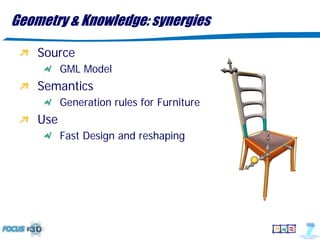
Geometry & Knowledge: synergies

    Source
          GML Model
    Semantics
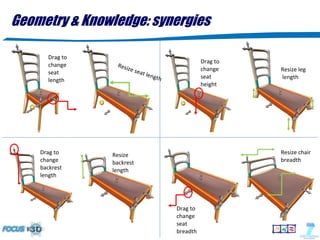
          Generation rules for Furniture
    Use
          Fast Design and reshaping
Geometry & Knowledge: synergies

      Drag to 
                                                        Drag to 
      change      Resi
                      ze se                             change     Resize leg
      seat                    at le
                                      ngth              seat       length
      length
                                                        height


    Drag to      Resize                                            Resize chair
    change       backrest                                          breadth
    backrest     length
    length


                                             Drag to 
                                             change 
                                             seat 
                                             breadth
Geometry & Knowledge: synergies

    Source
          GML Model
    Semantics
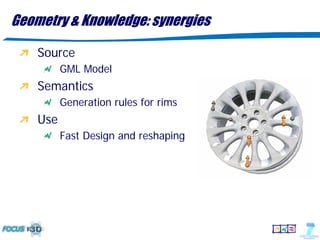
          Generation rules for rims
    Use
          Fast Design and reshaping
Geometry & Knowledge: synergies


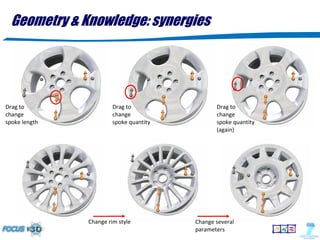
Drag to                 Drag to                 Drag to 
change                  change                  change 
spoke length            spoke quantity          spoke quantity
                                                (again)


               Change rim style          Change several
                                         parameters
Contacts and Key Players

    # Contacts: 53
    # Questionnaires: 25
    Categories
       Applications:
           e.g Industrial Design, Mechanical Engineering,
           Research Engineering, Simulation Engineering
       Methodology:
           Visualization, simulation, testing, analysis, optimization,
           verification of shapes, validation
       Integration
           Supplier Industry, Prototyping Service Provider, IT
           developer
Contacts and Key Players
    Volkswagen AG, Germany
    Siemens AG, Germany
    LogiTech, Switzerland
    Dassault Systems, USA
    Ceetron, Norway
    Technische Universität Darmstadt, Interactive
    Graphics Systems Group, Germany
    Think3, Italy
    AUTODESK, USA
    Lumiscaphe, France
    EDF Group – R&D Direction
    Pininfarina Extra S.r.l, Italy
Contacts and Key Players
    Jotne EPM Technology, Norway
    ItalDesign Giugiaro, Italy
    Institute of Computer Graphics, TU Graz, Austria
    Det Norske Veritas Industries, Norway
    Intergraph Deutschland, Germany
    Hella KgaA Hueck & Co, Germany
    Adam Opel GmbH, Germany
    ANSALDO RICERCHE, Italy
    ALESSI S.p.A, Italy
Scenarios in CAD/CAE and Virtual Product
Modeling
    FDMU – Functional Digital Mock-Up
        Industry sees a need for higher inter-operability
        and integration of simulation frameworks
        Modeling and Simulation of large electronical and
        mechanical components of a product within a
        single application overcoming format and I/O
        boundaries
        Seamless interfaces
        Better and faster visualization of potential hazards
        Mechatronics as a new field of research
Scenarios in CAD/CAE and Virtual Product
Modeling
    Specific problems
        Rapidly growing share of mechatronic systems in
        products
        Products getting increasingly complex
        Continuing competitive pressure
            Reduction of time and costs
            Increase in quality and reliability
            Time-to-market
Scenarios in CAD/CAE and Virtual Product
Modeling


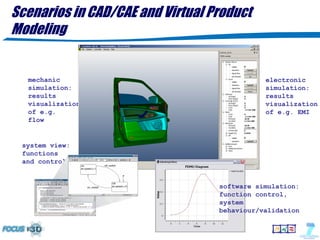
  mechanic                                   electronic
  simulation:                                simulation:
  results                                    results
  visualization                              visualization
  of e.g.                                    of e.g. EMI
  flow


 system view:
 functions
 and control


                                  software simulation:
                                  function control,
                                  system
                                  behaviour/validation
Scenarios in CAD/CAE and Virtual Product
Modeling
    Semantic procedural models - what is it?
    …are for 3D what pdf is for text pages

    Characteristics and potentials
        High reusabilbity
        Paradigm shift towards
        generic models
        Inherent semantics
        Rules and reasoning
        Procedural matching
Scenarios in CAD/CAE and Virtual Product
Modeling


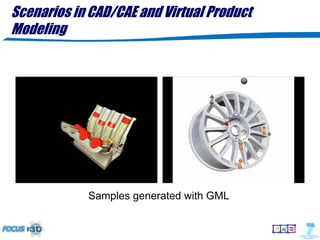
            Samples generated with GML
Conclusion

    Open issues / major problems
       Non-existent links between 3D models and product
       properties/characteristics/behaviour
       Re-use for geometric components
       Less knowledge about interfaces and kinematic of
       cybernetics
       Visualization of production technologies’ shape
       constraints
       Global shape modeling
       Creation/Re-use of surface/volume CAD models
       containing partitions
Conclusion

    More Open issues / major problems
       Unfold geometries for surface parametrization
       PDM for the whole product life cycle
       Effective similarity search methods
       Structural similarity as a concept
       Effective querying controls
       Contextualize 3D objects
Conclusion

    More Characteristics of a framework for
    handling 3D content:
       Scalable result visualization
       Powerful user interface for query specification
       Extensibility with respect to new shape
       representations

FOCUS K3D AWG CAD/CAE

  • 1.
    AWG CAD/CAE andVirtual Product Modeling Pedro Santos, Fraunhofer IGD, Germany
  • 2.
    3D and knowledgein CAD/CAE and Virtual Product Modeling What do we currently do with 3D shapes ? Currently 3D shapes come as geometry – most of the times as CAD model or triangle mesh 3D shapes are modeled, modified and visualized. We use them for simulation (virtual wind tunnels, structural analysis, clash and clearance, …) What is the next step of evolution ? Semantic Recognition and Interpretation of shapes Self-awareness of shapes More than “just’’ geometry
  • 3.
    3D and knowledgein CAD/CAE and Virtual Product Modeling visualizing recognizing and interacting and interpreting modifying analysing simulating 3D Geometry representing and and converting Semantic Properties measuring modeling esp. properties
  • 4.
    3D and knowledgein CAD/CAE and Virtual Product Modeling The evolution of 3D shapes – the next level Semantic technologies can help 3D shapes becoming more than “just’’ geometry 3D shapes become self-aware of their function in a model A model becomes an entity on which reasoning may be performed 3D shapes do no longer just contain a geometric description (CAD, mesh) but also contain meta information (such as kinematic constraints, function in the model, performance factors, parametric dependencies)
  • 5.
    3D and knowledgein CAD/CAE and Virtual Product Modeling How do we retrieve and embed additional meta information on 3D shapes ? Alternative 1: Semantic meta-information is gathered from the raw data of the model capturing process, which analyses the structure of the model and identifies inter-dependencies such as constraints in a semi-automatic process Alternative 2: Existing models are analysed for characteristic structures or patterns. Meta- information is extracted from perceived inter- dependencies and additional user-provided information
  • 6.
    Geometry & Knowledge:synergies GML - Generative Modeling Language Traditionally, 3D objects and virtual worlds are defined by lists of geometric primitives as can be found in CAD or mesh models. GML is a paradigm change in shape description => the generalization from objects to operations. A shape is described by a sequence of processing steps, rather than just the end result of applying these operations. Shape design becomes rule design.
  • 7.
    Geometry & Knowledge:synergies GML - Generative Modeling Language High-level shape operators can be gained from low-level shape operators. Any sequence of processing steps can be grouped together to create a new combined operator. Concrete values can easily be replaced by parameters, which makes it possible to separate data from operations: The same processing sequence can be applied to different input data sets. The same data can be used to produce different shapes. This makes it possible to create very complex objects from only a few high-level input parameters, such as for instance a style library.
  • 8.
    Geometry & Knowledge:synergies Source GML Model Semantics Generation rules for Furniture Use Fast Design and reshaping
  • 9.
    Geometry & Knowledge:synergies Drag to  Drag to  change  Resi ze se change  Resize leg seat  at le ngth seat  length length height Drag to  Resize  Resize chair change  backrest breadth backrest length length Drag to  change  seat  breadth
  • 10.
    Geometry & Knowledge:synergies Source GML Model Semantics Generation rules for rims Use Fast Design and reshaping
  • 11.
    Geometry & Knowledge:synergies Drag to  Drag to  Drag to  change  change  change  spoke length spoke quantity spoke quantity (again) Change rim style Change several parameters
  • 12.
    Contacts and KeyPlayers # Contacts: 53 # Questionnaires: 25 Categories Applications: e.g Industrial Design, Mechanical Engineering, Research Engineering, Simulation Engineering Methodology: Visualization, simulation, testing, analysis, optimization, verification of shapes, validation Integration Supplier Industry, Prototyping Service Provider, IT developer
  • 13.
    Contacts and KeyPlayers Volkswagen AG, Germany Siemens AG, Germany LogiTech, Switzerland Dassault Systems, USA Ceetron, Norway Technische Universität Darmstadt, Interactive Graphics Systems Group, Germany Think3, Italy AUTODESK, USA Lumiscaphe, France EDF Group – R&D Direction Pininfarina Extra S.r.l, Italy
  • 14.
    Contacts and KeyPlayers Jotne EPM Technology, Norway ItalDesign Giugiaro, Italy Institute of Computer Graphics, TU Graz, Austria Det Norske Veritas Industries, Norway Intergraph Deutschland, Germany Hella KgaA Hueck & Co, Germany Adam Opel GmbH, Germany ANSALDO RICERCHE, Italy ALESSI S.p.A, Italy
  • 15.
    Scenarios in CAD/CAEand Virtual Product Modeling FDMU – Functional Digital Mock-Up Industry sees a need for higher inter-operability and integration of simulation frameworks Modeling and Simulation of large electronical and mechanical components of a product within a single application overcoming format and I/O boundaries Seamless interfaces Better and faster visualization of potential hazards Mechatronics as a new field of research
  • 16.
    Scenarios in CAD/CAEand Virtual Product Modeling Specific problems Rapidly growing share of mechatronic systems in products Products getting increasingly complex Continuing competitive pressure Reduction of time and costs Increase in quality and reliability Time-to-market
  • 17.
    Scenarios in CAD/CAEand Virtual Product Modeling mechanic electronic simulation: simulation: results results visualization visualization of e.g. of e.g. EMI flow system view: functions and control software simulation: function control, system behaviour/validation
  • 18.
    Scenarios in CAD/CAEand Virtual Product Modeling Semantic procedural models - what is it? …are for 3D what pdf is for text pages Characteristics and potentials High reusabilbity Paradigm shift towards generic models Inherent semantics Rules and reasoning Procedural matching
  • 19.
    Scenarios in CAD/CAEand Virtual Product Modeling Samples generated with GML
  • 20.
    Conclusion Open issues / major problems Non-existent links between 3D models and product properties/characteristics/behaviour Re-use for geometric components Less knowledge about interfaces and kinematic of cybernetics Visualization of production technologies’ shape constraints Global shape modeling Creation/Re-use of surface/volume CAD models containing partitions
  • 21.
    Conclusion More Open issues / major problems Unfold geometries for surface parametrization PDM for the whole product life cycle Effective similarity search methods Structural similarity as a concept Effective querying controls Contextualize 3D objects
  • 22.
    Conclusion More Characteristics of a framework for handling 3D content: Scalable result visualization Powerful user interface for query specification Extensibility with respect to new shape representations