1
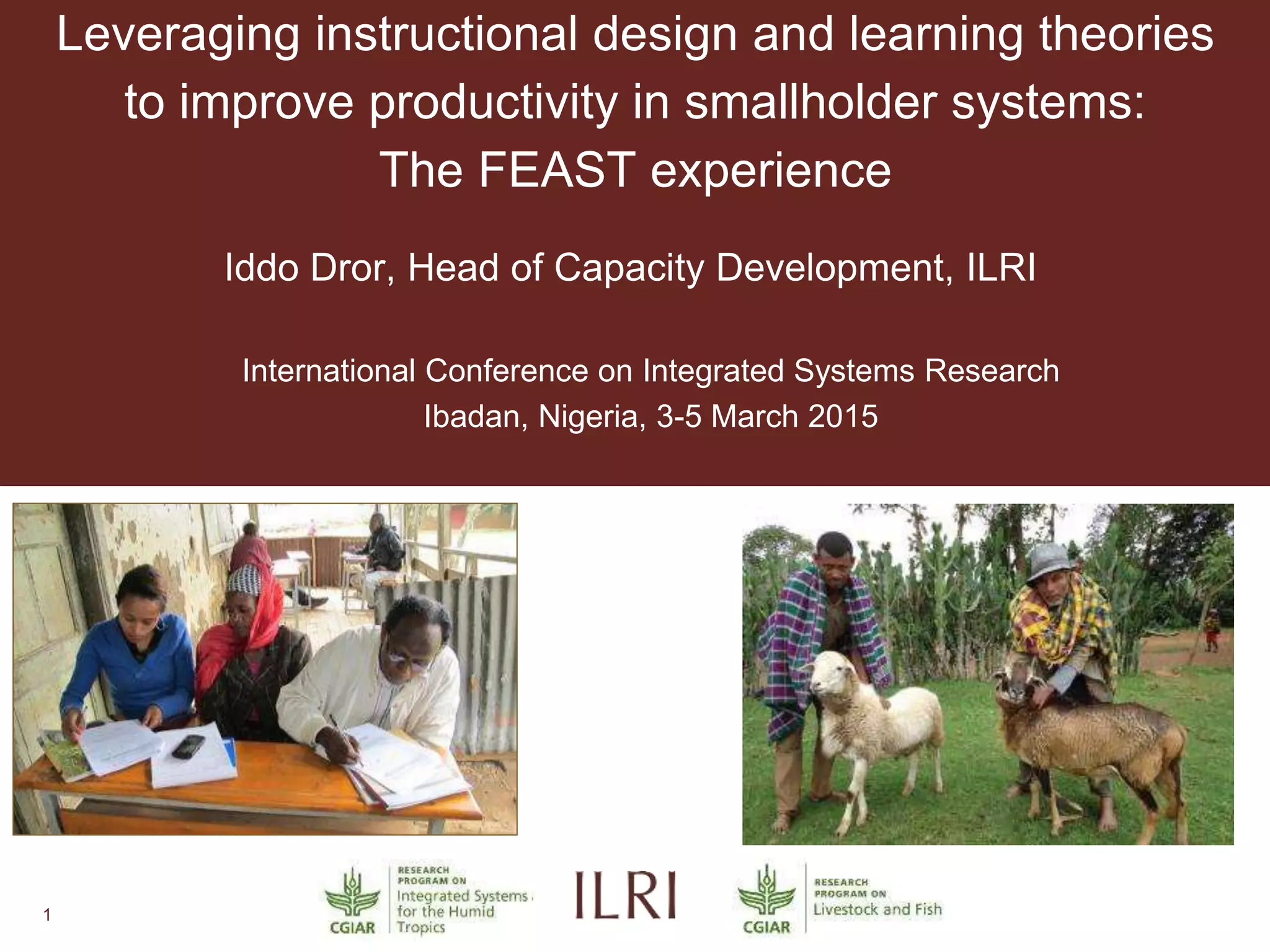
Leveraging instructional design and learning theories
to improve productivity in smallholder systems:
The FEAST experience
Iddo Dror, Head of Capacity Development, ILRI
International Conference on Integrated Systems Research
Ibadan, Nigeria, 3-5 March 2015
2
The Problem – some context:
FEAST Learning Development:
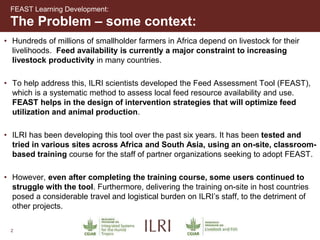
• Hundreds of millions of smallholder farmers in Africa depend on livestock for their
livelihoods. Feed availability is currently a major constraint to increasing
livestock productivity in many countries.
• To help address this, ILRI scientists developed the Feed Assessment Tool (FEAST),
which is a systematic method to assess local feed resource availability and use.
FEAST helps in the design of intervention strategies that will optimize feed
utilization and animal production.
• ILRI has been developing this tool over the past six years. It has been tested and
tried in various sites across Africa and South Asia, using an on-site, classroom-
based training course for the staff of partner organizations seeking to adopt FEAST.
• However, even after completing the training course, some users continued to
struggle with the tool. Furthermore, delivering the training on-site in host countries
posed a considerable travel and logistical burden on ILRI’s staff, to the detriment of
other projects.
3
Our solution: (whiteboard animation summary)
FEAST Learning Development:
4
Strategic Objectives
FEAST Learning Development:
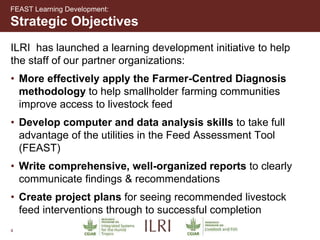
ILRI has launched a learning development initiative to help
the staff of our partner organizations:
• More effectively apply the Farmer-Centred Diagnosis
methodology to help smallholder farming communities
improve access to livestock feed
• Develop computer and data analysis skills to take full
advantage of the utilities in the Feed Assessment Tool
(FEAST)
• Write comprehensive, well-organized reports to clearly
communicate findings & recommendations
• Create project plans for seeing recommended livestock
feed interventions through to successful completion
5
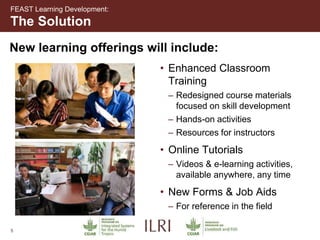
New learning offerings will include:
• Enhanced Classroom
Training
– Redesigned course materials
focused on skill development
– Hands-on activities
– Resources for instructors
• Online Tutorials
– Videos & e-learning activities,
available anywhere, any time
• New Forms & Job Aids
– For reference in the field
The Solution
FEAST Learning Development:
6
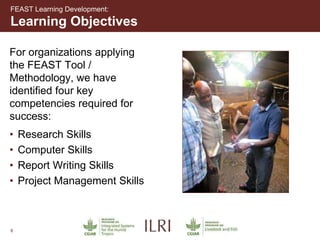
For organizations applying
the FEAST Tool /
Methodology, we have
identified four key
competencies required for
success:
• Research Skills
• Computer Skills
• Report Writing Skills
• Project Management Skills
Learning Objectives
FEAST Learning Development:
7
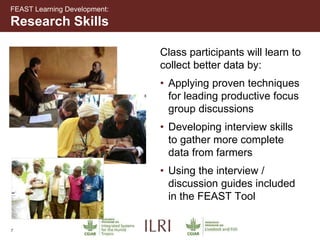
Class participants will learn to
collect better data by:
• Applying proven techniques
for leading productive focus
group discussions
• Developing interview skills
to gather more complete
data from farmers
• Using the interview /
discussion guides included
in the FEAST Tool
Research Skills
FEAST Learning Development:
8
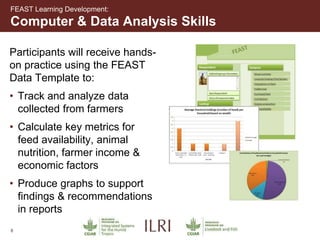
Participants will receive hands-
on practice using the FEAST
Data Template to:
• Track and analyze data
collected from farmers
• Calculate key metrics for
feed availability, animal
nutrition, farmer income &
economic factors
• Produce graphs to support
findings & recommendations
in reports
Computer & Data Analysis Skills
FEAST Learning Development:
9
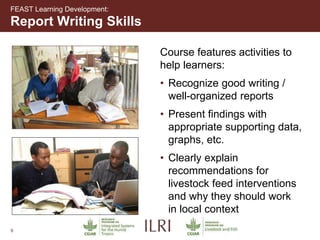
Course features activities to
help learners:
• Recognize good writing /
well-organized reports
• Present findings with
appropriate supporting data,
graphs, etc.
• Clearly explain
recommendations for
livestock feed interventions
and why they should work
in local context
Report Writing Skills
FEAST Learning Development:
10
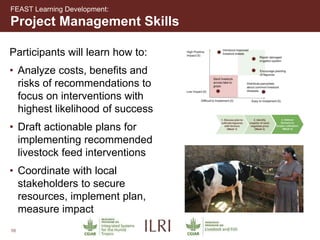
Participants will learn how to:
• Analyze costs, benefits and
risks of recommendations to
focus on interventions with
highest likelihood of success
• Draft actionable plans for
implementing recommended
livestock feed interventions
• Coordinate with local
stakeholders to secure
resources, implement plan,
measure impact
Project Management Skills
FEAST Learning Development:
11
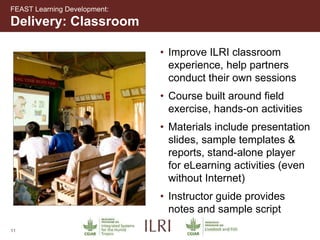
• Improve ILRI classroom
experience, help partners
conduct their own sessions
• Course built around field
exercise, hands-on activities
• Materials include presentation
slides, sample templates &
reports, stand-alone player
for eLearning activities (even
without Internet)
• Instructor guide provides
notes and sample script
Delivery: Classroom
FEAST Learning Development:
12
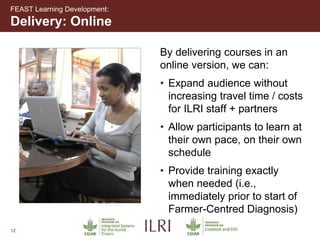
By delivering courses in an
online version, we can:
• Expand audience without
increasing travel time / costs
for ILRI staff + partners
• Allow participants to learn at
their own pace, on their own
schedule
• Provide training exactly
when needed (i.e.,
immediately prior to start of
Farmer-Centred Diagnosis)
Delivery: Online
FEAST Learning Development:
13
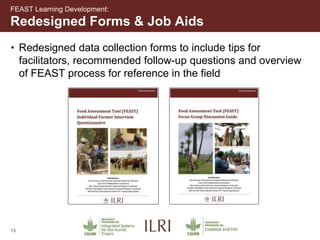
Redesigned Forms & Job Aids
FEAST Learning Development:
• Redesigned data collection forms to include tips for
facilitators, recommended follow-up questions and overview
of FEAST process for reference in the field
14
Instructional Design enabled the project to:
• Revise and expand classroom instruction
• Adapt course for online delivery
• Develop hands-on classroom and eLearning activities
• Design new FEAST forms and reference guides
• Work carried out in partnership with Sonata Learning,
a firm specialized in learning development.
Instructional Design Matters!
FEAST Learning Development:
15
Evaluation
FEAST Learning Development:
We plan to employ the following to help gauge the
effectiveness of the course:
• Pre- and post-assessment tests to compare immediate
improvement / retention
• Follow-up surveys / performance reviews to participants and
their supervisors
• Comparison of work products of course participants to those
from FCD’s carried out prior to initiative
16
Conclusion
FEAST Learning Development:
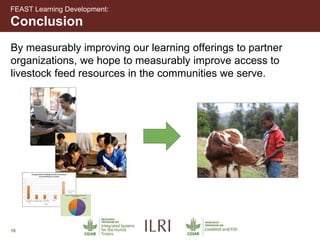
By measurably improving our learning offerings to partner
organizations, we hope to measurably improve access to
livestock feed resources in the communities we serve.
17
Online Resources Demo
FEAST Learning Development:
Review resources online.
18
Placing Instructional Design in the broader CGIAR context:
FEAST Learning Development:
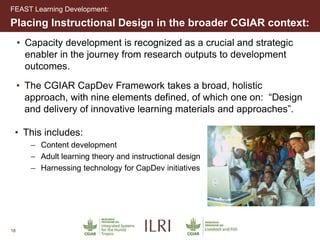
• Capacity development is recognized as a crucial and strategic
enabler in the journey from research outputs to development
outcomes.
• The CGIAR CapDev Framework takes a broad, holistic
approach, with nine elements defined, of which one on: “Design
and delivery of innovative learning materials and approaches”.
• This includes:
– Content development
– Adult learning theory and instructional design
– Harnessing technology for CapDev initiatives
19
That’s all folks!
Thank you for your attention!
Questions?
For more info contact i.dror@cgiar.org
FEAST Learning Development:
20
Discussion Question #1
Learning Development
Discuss the following question with one or more people seated
near you. Be ready to share your thoughts with the group:
• Which of the skill sets covered in the previous slides are
most needed in your organization?
• Are there any other skills not listed that you think would be
helpful to successful development and implement livestock
feed interventions?
21
Discussion Question #2
Learning Development
Discuss the following question with one or more people seated
near you. Be ready to share your thoughts with the group:
• What other possible methods / metrics could ILRI use to
evaluate the success of the learning development initiative?
• How could ILRI and its partners ensure that necessary data
is collected to track effectiveness of program?
The presentation has a Creative Commons license. You are free to re-use or distribute this work, provided credit is
given to ILRI.
better lives through livestock
ilri.org

Leveraging instructional design and learning theories to improve productivity in smallholder systems: The FEAST experience

  • 1.
    1 Leveraging instructional designand learning theories to improve productivity in smallholder systems: The FEAST experience Iddo Dror, Head of Capacity Development, ILRI International Conference on Integrated Systems Research Ibadan, Nigeria, 3-5 March 2015
  • 2.
    2 The Problem –some context: FEAST Learning Development: • Hundreds of millions of smallholder farmers in Africa depend on livestock for their livelihoods. Feed availability is currently a major constraint to increasing livestock productivity in many countries. • To help address this, ILRI scientists developed the Feed Assessment Tool (FEAST), which is a systematic method to assess local feed resource availability and use. FEAST helps in the design of intervention strategies that will optimize feed utilization and animal production. • ILRI has been developing this tool over the past six years. It has been tested and tried in various sites across Africa and South Asia, using an on-site, classroom- based training course for the staff of partner organizations seeking to adopt FEAST. • However, even after completing the training course, some users continued to struggle with the tool. Furthermore, delivering the training on-site in host countries posed a considerable travel and logistical burden on ILRI’s staff, to the detriment of other projects.
  • 3.
    3 Our solution: (whiteboardanimation summary) FEAST Learning Development:
  • 4.
    4 Strategic Objectives FEAST LearningDevelopment: ILRI has launched a learning development initiative to help the staff of our partner organizations: • More effectively apply the Farmer-Centred Diagnosis methodology to help smallholder farming communities improve access to livestock feed • Develop computer and data analysis skills to take full advantage of the utilities in the Feed Assessment Tool (FEAST) • Write comprehensive, well-organized reports to clearly communicate findings & recommendations • Create project plans for seeing recommended livestock feed interventions through to successful completion
  • 5.
    5 New learning offeringswill include: • Enhanced Classroom Training – Redesigned course materials focused on skill development – Hands-on activities – Resources for instructors • Online Tutorials – Videos & e-learning activities, available anywhere, any time • New Forms & Job Aids – For reference in the field The Solution FEAST Learning Development:
  • 6.
    6 For organizations applying theFEAST Tool / Methodology, we have identified four key competencies required for success: • Research Skills • Computer Skills • Report Writing Skills • Project Management Skills Learning Objectives FEAST Learning Development:
  • 7.
    7 Class participants willlearn to collect better data by: • Applying proven techniques for leading productive focus group discussions • Developing interview skills to gather more complete data from farmers • Using the interview / discussion guides included in the FEAST Tool Research Skills FEAST Learning Development:
  • 8.
    8 Participants will receivehands- on practice using the FEAST Data Template to: • Track and analyze data collected from farmers • Calculate key metrics for feed availability, animal nutrition, farmer income & economic factors • Produce graphs to support findings & recommendations in reports Computer & Data Analysis Skills FEAST Learning Development:
  • 9.
    9 Course features activitiesto help learners: • Recognize good writing / well-organized reports • Present findings with appropriate supporting data, graphs, etc. • Clearly explain recommendations for livestock feed interventions and why they should work in local context Report Writing Skills FEAST Learning Development:
  • 10.
    10 Participants will learnhow to: • Analyze costs, benefits and risks of recommendations to focus on interventions with highest likelihood of success • Draft actionable plans for implementing recommended livestock feed interventions • Coordinate with local stakeholders to secure resources, implement plan, measure impact Project Management Skills FEAST Learning Development:
  • 11.
    11 • Improve ILRIclassroom experience, help partners conduct their own sessions • Course built around field exercise, hands-on activities • Materials include presentation slides, sample templates & reports, stand-alone player for eLearning activities (even without Internet) • Instructor guide provides notes and sample script Delivery: Classroom FEAST Learning Development:
  • 12.
    12 By delivering coursesin an online version, we can: • Expand audience without increasing travel time / costs for ILRI staff + partners • Allow participants to learn at their own pace, on their own schedule • Provide training exactly when needed (i.e., immediately prior to start of Farmer-Centred Diagnosis) Delivery: Online FEAST Learning Development:
  • 13.
    13 Redesigned Forms &Job Aids FEAST Learning Development: • Redesigned data collection forms to include tips for facilitators, recommended follow-up questions and overview of FEAST process for reference in the field
  • 14.
    14 Instructional Design enabledthe project to: • Revise and expand classroom instruction • Adapt course for online delivery • Develop hands-on classroom and eLearning activities • Design new FEAST forms and reference guides • Work carried out in partnership with Sonata Learning, a firm specialized in learning development. Instructional Design Matters! FEAST Learning Development:
  • 15.
    15 Evaluation FEAST Learning Development: Weplan to employ the following to help gauge the effectiveness of the course: • Pre- and post-assessment tests to compare immediate improvement / retention • Follow-up surveys / performance reviews to participants and their supervisors • Comparison of work products of course participants to those from FCD’s carried out prior to initiative
  • 16.
    16 Conclusion FEAST Learning Development: Bymeasurably improving our learning offerings to partner organizations, we hope to measurably improve access to livestock feed resources in the communities we serve.
  • 17.
    17 Online Resources Demo FEASTLearning Development: Review resources online.
  • 18.
    18 Placing Instructional Designin the broader CGIAR context: FEAST Learning Development: • Capacity development is recognized as a crucial and strategic enabler in the journey from research outputs to development outcomes. • The CGIAR CapDev Framework takes a broad, holistic approach, with nine elements defined, of which one on: “Design and delivery of innovative learning materials and approaches”. • This includes: – Content development – Adult learning theory and instructional design – Harnessing technology for CapDev initiatives
  • 19.
    19 That’s all folks! Thankyou for your attention! Questions? For more info contact i.dror@cgiar.org FEAST Learning Development:
  • 20.
    20 Discussion Question #1 LearningDevelopment Discuss the following question with one or more people seated near you. Be ready to share your thoughts with the group: • Which of the skill sets covered in the previous slides are most needed in your organization? • Are there any other skills not listed that you think would be helpful to successful development and implement livestock feed interventions?
  • 21.
    21 Discussion Question #2 LearningDevelopment Discuss the following question with one or more people seated near you. Be ready to share your thoughts with the group: • What other possible methods / metrics could ILRI use to evaluate the success of the learning development initiative? • How could ILRI and its partners ensure that necessary data is collected to track effectiveness of program?
  • 22.
    The presentation hasa Creative Commons license. You are free to re-use or distribute this work, provided credit is given to ILRI. better lives through livestock ilri.org

Editor's Notes

  • #14 Emphasize that part of the effort was not only to help participants master the tasks, but to make tasks easier to master
  • #15 (1 minutes)
  • #20 Shouldn’t be many questions at this point (1 minute)