
Identity and Tourism
Emeritus Professor Harold Goodwin
WTM Responsible Tourism Advisor
Director Institute of Place Management at
Manchester Metropolitan University &
Director of the Responsible Tourism Partnership
1
Menu……..
1. Tourism
2. Responsibility
3. Responsible Tourism
4. Identity and Sense of Place
2
TOURISM
3
What about putting something back?
“Take only
photographs,
leave only
footprints”
Sir Colin Marshall,
British Airways 1994
Tourism and the travel industry “is
essentially the renting out for short-
term lets, of other people’s
environments, whether that is a
coastline, a city, a mountain range or a
rainforest. These ‘products’ must be
kept fresh and unsullied not just for the
next day, but for every tomorrow”
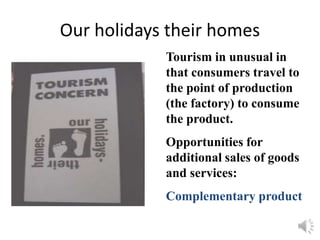
Our holidays their homes
Tourism in unusual in
that consumers travel to
the point of production
(the factory) to consume
the product.
Opportunities for
additional sales of goods
and services:
Complementary product
Culture & Tourism
“Your everyday
life is someone
else’s
adventure”
Swedish NGO fly-posting in
Ljubljana, Summer 1997
Tourism is a social construct
• Tourism is what we –
consumers and
producers make it.
• We can change it.
• “every individual tourist
builds up or destroys
human values while
travelling.”
• “rebellious tourists and
rebellious locals”
• “Orders and
prohibitions will not do
the job – because it is
not a bad conscience
that we need to make
progress but positive
experience, not the
feeling of compulsion
but that of
responsibility.”
8
Jost Krippendorf
RESPONSIBILITY
9
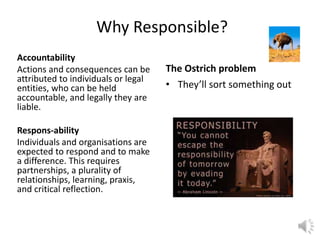
Why Responsible?
Accountability
Actions and consequences can be
attributed to individuals or legal
entities, who can be held
accountable, and legally they are
liable.
Respons-ability
Individuals and organisations are
expected to respond and to make
a difference. This requires
partnerships, a plurality of
relationships, learning, praxis,
and critical reflection.
The Ostrich problem
• They’ll sort something out
Why Responsibility?
• to respond, to act,
• responsibility implies and requires action.
• critical to creating change is acknowledging
and owning up to problems, and taking
responsibility for making changes.
• Responsibility is free – you can take as much
of it as you can handle
• 責任を取る is to take responsibility (actively)
• 責任を負う is to bear responsibility (with a
negative, burdensome connotation)
• 責任を持つ is to carry responsibility (more
neutral than bearing responsibility)
• 責任がある is to have responsibility (objective
fact of having an obligation, e.g. legally)
• 君は本当に無責任だな You really have no sense
of responsibility.
12
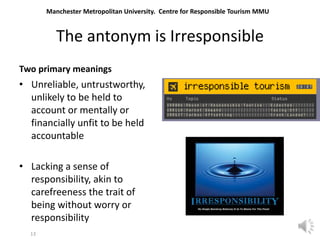
The antonym is Irresponsible
Two primary meanings
• Unreliable, untrustworthy,
unlikely to be held to
account or mentally or
financially unfit to be held
accountable
• Lacking a sense of
responsibility, akin to
carefreeness the trait of
being without worry or
responsibility
Manchester Metropolitan University. Centre for Responsible Tourism MMU
13
RESPONSIBLE TOURISM
An attitude of mind..
harold@haroldgoodwin.info 14
“Sustainable and Responsible”
• Sustainable Tourism and Responsible Tourism
are not the same thing
• Responsible Tourism is about taking
responsibility for achieving sustainable
development through tourism.
Tour Operator Inbound Operator Hotelier/
Accommodation
Local/
National
Government
Attraction
Managers
National Parks/
Heritage
Local
Community
Tourists
Travellers
Holidaymakers
Taking and Exercising Responsibility
Economic, Social & Environmental
Principle of Sustainablity
WTO Global Code of Ethics
Taking responsibility
You cannot outsource responsibility ..
Whose responsibility? Everyone’s
Nobody’s
Responsible Travel takes a variety of forms, it is
characterised by travel and tourism which
1. minimises negative environmental, social and
cultural impacts;
2. generates greater economic benefits for local
people and enhances the wellbeing of host
communities, by improving working conditions
and access to the industry;
3. involves local people in decisions that affect their
lives and life chances.
Cape Town Declaration 2002
Better places for people to live in,
better places for people to visit
4. makes positive contributions to the conservation of
natural and cultural heritage and to the maintenance
of the world’s diversity;
5. provides more enjoyable experiences for tourists
through more meaningful connections with local
people, and a greater understanding of local cultural
and environmental issues;
6. provides access for people with disabilities and socially
disadvantaged people; and
7. is culturally sensitive and engenders respect between
tourists and hosts.
19
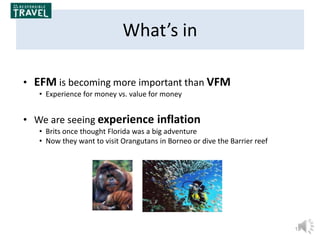
What’s in
• EFM is becoming more important than VFM
• Experience for money vs. value for money
• We are seeing experience inflation
• Brits once thought Florida was a big adventure
• Now they want to visit Orangutans in Borneo or dive the Barrier reef
20
A better way to travel
Fairtrade Tea tastes the same
as ordinary tea
Responsible tourism provides more
authentic experiences that meet the
trends for more real and experiential travel
Both offer a more responsible alternative, but
only responsible tourism has product advantages
21
Responsible
Responsible tourism
More authentic experiences
that create better places
to live in and to visit
Tourism is a cultural process.
Memories of a place are jointly produced by the tourists, the locals and the place –
the physical space and the human activity that takes place there.
“the destination of the tourist and the inhabited landscape of local culture are …
inseparable” Ringer (1998)
IDENTITY
22
Successful tourist destinations
• offer the visitor something
unique
• they create a sense of place, an
identity which is different from
their competitors….
• no two communities are ever
exactly the same…
Numbers => yield
Seasonality & extending length of stay
Destinations
• “destinations are ….social and cultural
constructions whose meanings and values are
negotiated and redefined by diverse people,
and mediated by factors often related only
tangentially to a particular tourist setting.”
Squire 1998
24
25
Globalisation
1. It is not just tourists that circulate and travel.
2. Importance of popular media – films,
fashion, popular music and internet.
3. Objects mediate – technologies construct
places.
4. Place and performance
26
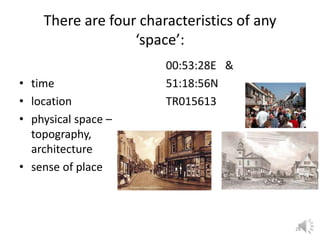
There are four characteristics of any
‘space’:
• time
• location
• physical space –
topography,
architecture
• sense of place
00:53:28E &
51:18:56N
TR015613
Faversham
27
A place is defined by
its meaning in human experience. In fact,
the peculiarities of a place are a
consequence of the
1. interaction between the people who live and
visit there and
2. the land and its habitats.
28
29
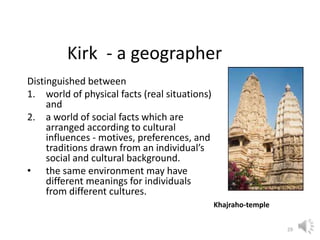
Kirk - a geographer
Distinguished between
1. world of physical facts (real situations)
and
2. a world of social facts which are
arranged according to cultural
influences - motives, preferences, and
traditions drawn from an individual’s
social and cultural background.
• the same environment may have
different meanings for individuals
from different cultures.
Khajraho-temple
30
Resource Uniqueness
“Generally, the less unique a destination or
the weaker its sense of place, the harder it
will be both to draw people in and compete
in the tourism market place. Indeed, if
every tourism destination offered virtually
the same set of [experiences] tourism
would become somewhat meaningless.”
Godfrey & Clarke The Tourism Development Handbook
Relph (1976) argues that ‘place’ is interesting as an
expression of man’s involvement in the world,
1. Improved knowledge of the nature of place can
contribute to the maintenance and manipulation of
existing places
2. Relph distinguishes space from place – because
places have “insides” – to be inside a place is to
belong to it and to identify with it.
3. To be inside a place you need to travel to it and
experience it – contrasts this with “vicarious
insidedness”
31
32
Cultural landscapes
• The “socially constructed landscape that
develops locally as a direct result of the
influence of human institutions and values
on the physical environment over
time.”Ringer:7.
• Landscapes “the visible structure of a place
expresses the the emotional attachments
held by both its residents and its visitors”:6
33
“Tourism both establishes and falsifies
local reality” Ringer
Places are constructed
• rooted in time and
space
• must be able to change
“on going social
construction of their
place”
• cannot be “frozen” as
vignettes.
“people… have unique
views and feelings,
people develop values,
and based on these
values they make
choices. These choices
affect the earth and
change the landscape”.
Kaplan & Kaplan 1989
harold@haroldgoodwin.info 34
http://haroldgoodwin.info/links/

Identity and Tourism

  • 1.
    Identity and Tourism EmeritusProfessor Harold Goodwin WTM Responsible Tourism Advisor Director Institute of Place Management at Manchester Metropolitan University & Director of the Responsible Tourism Partnership 1
  • 2.
    Menu…….. 1. Tourism 2. Responsibility 3.Responsible Tourism 4. Identity and Sense of Place 2
  • 3.
  • 4.
    What about puttingsomething back? “Take only photographs, leave only footprints”
  • 5.
    Sir Colin Marshall, BritishAirways 1994 Tourism and the travel industry “is essentially the renting out for short- term lets, of other people’s environments, whether that is a coastline, a city, a mountain range or a rainforest. These ‘products’ must be kept fresh and unsullied not just for the next day, but for every tomorrow”
  • 6.
    Our holidays theirhomes Tourism in unusual in that consumers travel to the point of production (the factory) to consume the product. Opportunities for additional sales of goods and services: Complementary product
  • 7.
    Culture & Tourism “Youreveryday life is someone else’s adventure” Swedish NGO fly-posting in Ljubljana, Summer 1997
  • 8.
    Tourism is asocial construct • Tourism is what we – consumers and producers make it. • We can change it. • “every individual tourist builds up or destroys human values while travelling.” • “rebellious tourists and rebellious locals” • “Orders and prohibitions will not do the job – because it is not a bad conscience that we need to make progress but positive experience, not the feeling of compulsion but that of responsibility.” 8 Jost Krippendorf
  • 9.
  • 10.
    Why Responsible? Accountability Actions andconsequences can be attributed to individuals or legal entities, who can be held accountable, and legally they are liable. Respons-ability Individuals and organisations are expected to respond and to make a difference. This requires partnerships, a plurality of relationships, learning, praxis, and critical reflection. The Ostrich problem • They’ll sort something out
  • 11.
    Why Responsibility? • torespond, to act, • responsibility implies and requires action. • critical to creating change is acknowledging and owning up to problems, and taking responsibility for making changes. • Responsibility is free – you can take as much of it as you can handle
  • 12.
    • 責任を取る isto take responsibility (actively) • 責任を負う is to bear responsibility (with a negative, burdensome connotation) • 責任を持つ is to carry responsibility (more neutral than bearing responsibility) • 責任がある is to have responsibility (objective fact of having an obligation, e.g. legally) • 君は本当に無責任だな You really have no sense of responsibility. 12
  • 13.
    The antonym isIrresponsible Two primary meanings • Unreliable, untrustworthy, unlikely to be held to account or mentally or financially unfit to be held accountable • Lacking a sense of responsibility, akin to carefreeness the trait of being without worry or responsibility Manchester Metropolitan University. Centre for Responsible Tourism MMU 13
  • 14.
    RESPONSIBLE TOURISM An attitudeof mind.. harold@haroldgoodwin.info 14
  • 15.
    “Sustainable and Responsible” •Sustainable Tourism and Responsible Tourism are not the same thing • Responsible Tourism is about taking responsibility for achieving sustainable development through tourism.
  • 16.
    Tour Operator InboundOperator Hotelier/ Accommodation Local/ National Government Attraction Managers National Parks/ Heritage Local Community Tourists Travellers Holidaymakers Taking and Exercising Responsibility Economic, Social & Environmental Principle of Sustainablity WTO Global Code of Ethics Taking responsibility You cannot outsource responsibility .. Whose responsibility? Everyone’s Nobody’s
  • 17.
    Responsible Travel takesa variety of forms, it is characterised by travel and tourism which 1. minimises negative environmental, social and cultural impacts; 2. generates greater economic benefits for local people and enhances the wellbeing of host communities, by improving working conditions and access to the industry; 3. involves local people in decisions that affect their lives and life chances. Cape Town Declaration 2002
  • 18.
    Better places forpeople to live in, better places for people to visit 4. makes positive contributions to the conservation of natural and cultural heritage and to the maintenance of the world’s diversity; 5. provides more enjoyable experiences for tourists through more meaningful connections with local people, and a greater understanding of local cultural and environmental issues; 6. provides access for people with disabilities and socially disadvantaged people; and 7. is culturally sensitive and engenders respect between tourists and hosts.
  • 19.
    19 What’s in • EFMis becoming more important than VFM • Experience for money vs. value for money • We are seeing experience inflation • Brits once thought Florida was a big adventure • Now they want to visit Orangutans in Borneo or dive the Barrier reef
  • 20.
    20 A better wayto travel Fairtrade Tea tastes the same as ordinary tea Responsible tourism provides more authentic experiences that meet the trends for more real and experiential travel Both offer a more responsible alternative, but only responsible tourism has product advantages
  • 21.
    21 Responsible Responsible tourism More authenticexperiences that create better places to live in and to visit Tourism is a cultural process. Memories of a place are jointly produced by the tourists, the locals and the place – the physical space and the human activity that takes place there. “the destination of the tourist and the inhabited landscape of local culture are … inseparable” Ringer (1998)
  • 22.
  • 23.
    Successful tourist destinations •offer the visitor something unique • they create a sense of place, an identity which is different from their competitors…. • no two communities are ever exactly the same… Numbers => yield Seasonality & extending length of stay
  • 24.
    Destinations • “destinations are….social and cultural constructions whose meanings and values are negotiated and redefined by diverse people, and mediated by factors often related only tangentially to a particular tourist setting.” Squire 1998 24
  • 25.
    25 Globalisation 1. It isnot just tourists that circulate and travel. 2. Importance of popular media – films, fashion, popular music and internet. 3. Objects mediate – technologies construct places. 4. Place and performance
  • 26.
    26 There are fourcharacteristics of any ‘space’: • time • location • physical space – topography, architecture • sense of place 00:53:28E & 51:18:56N TR015613
  • 27.
  • 28.
    A place isdefined by its meaning in human experience. In fact, the peculiarities of a place are a consequence of the 1. interaction between the people who live and visit there and 2. the land and its habitats. 28
  • 29.
    29 Kirk - ageographer Distinguished between 1. world of physical facts (real situations) and 2. a world of social facts which are arranged according to cultural influences - motives, preferences, and traditions drawn from an individual’s social and cultural background. • the same environment may have different meanings for individuals from different cultures. Khajraho-temple
  • 30.
    30 Resource Uniqueness “Generally, theless unique a destination or the weaker its sense of place, the harder it will be both to draw people in and compete in the tourism market place. Indeed, if every tourism destination offered virtually the same set of [experiences] tourism would become somewhat meaningless.” Godfrey & Clarke The Tourism Development Handbook
  • 31.
    Relph (1976) arguesthat ‘place’ is interesting as an expression of man’s involvement in the world, 1. Improved knowledge of the nature of place can contribute to the maintenance and manipulation of existing places 2. Relph distinguishes space from place – because places have “insides” – to be inside a place is to belong to it and to identify with it. 3. To be inside a place you need to travel to it and experience it – contrasts this with “vicarious insidedness” 31
  • 32.
    32 Cultural landscapes • The“socially constructed landscape that develops locally as a direct result of the influence of human institutions and values on the physical environment over time.”Ringer:7. • Landscapes “the visible structure of a place expresses the the emotional attachments held by both its residents and its visitors”:6
  • 33.
    33 “Tourism both establishesand falsifies local reality” Ringer Places are constructed • rooted in time and space • must be able to change “on going social construction of their place” • cannot be “frozen” as vignettes. “people… have unique views and feelings, people develop values, and based on these values they make choices. These choices affect the earth and change the landscape”. Kaplan & Kaplan 1989
  • 34.