




Fast Close
Why and How
1
2
3
Fast Close Ground Rules
• It is not an IT project
• You don’t need external consultants
• It is not very useful on its own, unless your
ambition is simply reduced wages
• It is important or essential for a modernised
finance team
4
What is “fast close”?
• When is it fast enough?
• How do we know we achieved it?
• How much money and effort should be spent on it?
But … Why are we doing it?
5
About your speaker
Tim Richardson, CPA
Career in IT & senior Finance roles in South East
Asia and Europe. Major transformation projects.
Founded GrowthPath in 2011, works mainly with
SMEs $10m to $50m
6
Play Presenter Bingo!
I like to talk about Competitive
Difference, Diminishing Returns
and Opportunity Cost.
Finance Transformation
Fast Close is interesting to profit engineering
because it enables finance transformation
• It frees time
• It builds stronger links to the business
• It forces closing and reporting to be more
relevant and useful
7
About this presentation
“tasks ”: guidance for doing a fast close project.
“Toolkit” slides are key ideas
8
What we discuss today
• Technical steps
• The link to finance transformation
• How to define what you want from fast close
• The project team
9
Three possible outcomes of a
technically successful fast close
1. Finance team moves ‘up the food chain’
2. Finance team gets more compliance and
control activities (scale up)
3. Finance team is down-sized
10
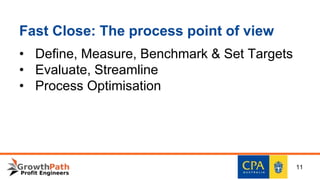
Fast Close: The process point of view
• Define, Measure, Benchmark & Set Targets
• Evaluate, Streamline
• Process Optimisation
11
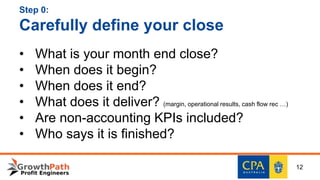
Step 0:
Carefully define your close
• What is your month end close?
• When does it begin?
• When does it end?
• What does it deliver? (margin, operational results, cash flow rec …)
• Are non-accounting KPIs included?
• Who says it is finished?
12
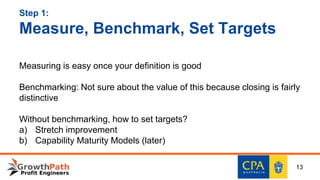
Step 1:
Measure, Benchmark, Set Targets
Measuring is easy once your definition is good
Benchmarking: Not sure about the value of this because closing is fairly
distinctive
Without benchmarking, how to set targets?
a) Stretch improvement
b) Capability Maturity Models (later)
13
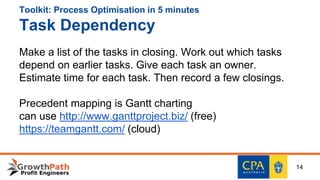
Toolkit: Process Optimisation in 5 minutes
Task Dependency
Make a list of the tasks in closing. Work out which tasks
depend on earlier tasks. Give each task an owner.
Estimate time for each task. Then record a few closings.
Precedent mapping is Gantt charting
can use http://www.ganttproject.biz/ (free)
https://teamgantt.com/ (cloud)
14
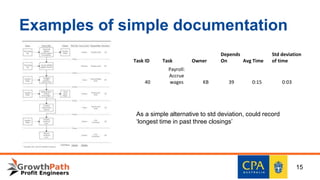
Examples of simple documentation
15
Task ID Task Owner
Depends
On Avg Time
Std deviation
of time
40
Payroll:
Accrue
wages KB 39 0:15 0:03
As a simple alternative to std deviation, could record
‘longest time in past three closings’
Step 2:
Reduce the scope
• Task: Split the outcomes of your closing
process into Must Haves, Should Haves and
Nice to Haves.
16
Toolkit: Process Optimisation
Faster vs Sooner
It’s not quite about doing it faster. Rather, it’s about finishing sooner.
How to make any step finish sooner:
1. Start sooner. Finding what inputs can be done earlier, even mid month
2. Speed up the process itself though more capacity, more automation or more
efficiency
3. Make the process more reliable by looking for variations in how long it takes over
different closings. High-variance steps need attention.
17
Toolkit: Process Optimisation
Measure Quality (errors and variation)
A key insight from advanced process optimisation is that your Fast
Close project should measure quality:
• Number of errors (e.g. nbr of journals/rebookings after closing is
“finished”, BAS corrections)
• Variations in the time to complete key steps.
18
Toolkit: Process Optimisation
Reduce variation by valuing reliability first
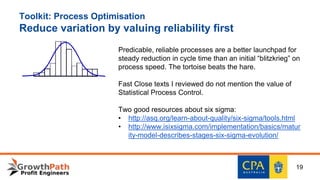
Predicable, reliable processes are a better launchpad for
steady reduction in cycle time than an initial “blitzkrieg” on
process speed. The tortoise beats the hare.
Fast Close texts I reviewed do not mention the value of
Statistical Process Control.
Two good resources about six sigma:
• http://asq.org/learn-about-quality/six-sigma/tools.html
• http://www.isixsigma.com/implementation/basics/matur
ity-model-describes-stages-six-sigma-evolution/
19
Toolkit: Process Optimisation
Some common sources of error
20
Discussion?
Toolkit: Process Optimisation
Some common sources of error
21
• Too much unimportant or subtle choice
(COA)
• Manual entry (poor system integration)
• Intercompany
• Cost variances
• Badly documented processes/bad training
Step 3:
Who does closing depend on?
• Task:
What are the key steps outside the Finance
team which have to completed and handed-
over before closing can begin, or before it
can finish
22
Fast Close:
the bigger
picture
23
Step 4:
How is closing linked to budgeting,
forecasting, business reviews and
bonus targets?
Task: How is your closing effort “burdened” by
comparatives and measurements from other financial or
management processes?
24
Step 4:
Capability Maturity Models
A good alternative to benchmarking
A comprehensive, non-vendor tool:
http://www.nao.org.uk/wp-content/uploads/2013/02/financial_management_maturity_model.pdf
This covers many areas, including influencing
25
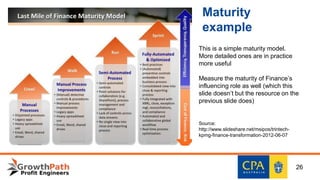
Maturity
example
This is a simple maturity model.
More detailed ones are in practice
more useful
Measure the maturity of Finance’s
influencing role as well (which this
slide doesn’t but the resource on the
previous slide does)
Source:
http://www.slideshare.net/msipos/trintech-
kpmg-finance-transformation-2012-06-07
26
Fast Close:
Making the
Business
Case…
27
A fast close project should combine these
elements
1. Process Optimisation
Where the goal is to be faster, justified by
operational reasons linked to the finance
function
2. Transformative: as part of a project to
change the finance function
28
Fast Close: Easy to sell benefits
• Faster access to key information
• Fewer errors due to better controlled process
• A more scalable finance team: delay the need for head
count increases in a growing business
• (or) Headcount reductions in the finance team
29
Fast Close: transformation
Fast Close will always mean faster information.
But it doesn’t guarantee better information.
Strong business cases behind a fast close
project are mostly based on better use of the
freed-up capacity of the Finance team.
30
Fast Close Toolkit:
About information & reporting
• Useful information is information which influences useful decisions.
• The importance of information is a function of two things:
its influence on a decision, and how important the decision is.
• Information needs change, and they change quickly.
Compare with traditional “report pack”
31
32
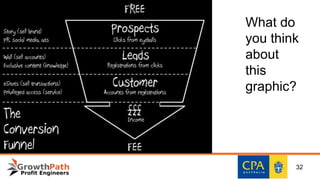
What do
you think
about
this
graphic?
What is “Finance Transformation”?
Metaphors of “navigators”, “co-pilots”, “internal consultants”, “profit engineers”
Influencing the future: defined as commercial decision making
How: finance core skills -> define leading indicators and KPIs -> competitive
difference and business drivers
Core skills: business models, analytical skills.
Fast Close frees up Finance team firepower
33
Step 5
Opportunity cost
In other words, the higher the opportunity cost of the finance team, the
stronger the business case of a fast close.
Task: define the opportunity cost of a day of your finance team
Think about the commercial decisions your business makes. What’s the
value of 5% more GM on a typical deal? What’s the value in improving
the product mix to shift to more profitable products? Etc.
34
Opportunity Cost: Test Yourself
Review the funnel slide.
Assign conversion percentages to each step.
Assign an average customer value (contribution
margin) over three years of $5000.
Assume there are 10000 ‘prospects’ per year.
Tweak your percentages to explore improvements
35
Transformation boosts a Fast Close project
1. It sets goals that are not arbitrary
2. It gets resourcing and senior support
3. It motivates people for change (rather than
scaring them that it’s about headcount
reduction)
4. It is cross-functional
36
Step 6:
Push your goals beyond a “2 day close”
When proposing a business case, you need to combine
“transformation benefit” with pure and simple process improvement.
Transformation benefits are much more $ but take more convincing
arguments
Tip: aim high with transformation (what you will do with the saved
time) and less on how much time you save
37
Step 7:
Your credibility capital
Finance needs high credibility in delivering its core
function before doing a fast close project.
Task: Decide via internal discussions if you have
the support for a fast close project. If not, what are
the starting conditions?
Tip: justification for a fast close project can be quality improvement
in the process
38
Change management & resistance
A fast close means doing things differently.
For example:
• More accruals to estimate unknown expenses.
• A reduced reporting pack.
• Higher IT/automation skills expected of staff
• Much stronger discipline about deadlines and
administrative processes
39
The Finance Team after a fast close project
Less dominated by transactional work. Less rigidly
functional. Better with IT. More embedded in the business.
Fast Close does not always mean headcount reductions,
but it should always mean a different finance team.
Not everyone will be comfortable with this.
40
The Fast Close project team
Representatives or mentors:
IT, Senior finance, HR, Supply Chain, compliance
Skills:
Accounting Process, reporting, system, change
management, process analysis
41
When is a fast close project finished?
Never: It is a classic case of continuous
improvement
But effort spent must be tempered by …
42
Toolkit
The law of diminishing returns
What is it? How is it relevant to a fast close
project?
43
The law of diminishing returns
Don’t over invest in a fast close project if there
are easy wins elsewhere on the road to finance
transformation
The budgeting, forecasting and business
review process are key suspects.
44
Think again about
3 to 4 desirable
outcomes of a fast
close project.
Have they
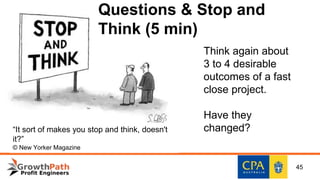
changed?“It sort of makes you stop and think, doesn't
it?”
© New Yorker Magazine
Questions & Stop and
Think (5 min)
45
More…
Send your email to
tim@growthpath.com.au for updated slides and
other resources
Books:
• Fast Close: A Guide to Closing the Books Quickly,
Steven Bragg
• Winning CFOs, with Website: Implementing and
Applying Better Practices, David Parmenter
Tim is presenting Simplified Forecasting
Masterclass at 2015 CPA Australia Congress
(Oct 16)
46

Fast close slides

  • 1.
  • 2.
  • 3.
  • 4.
    Fast Close GroundRules • It is not an IT project • You don’t need external consultants • It is not very useful on its own, unless your ambition is simply reduced wages • It is important or essential for a modernised finance team 4
  • 5.
    What is “fastclose”? • When is it fast enough? • How do we know we achieved it? • How much money and effort should be spent on it? But … Why are we doing it? 5
  • 6.
    About your speaker TimRichardson, CPA Career in IT & senior Finance roles in South East Asia and Europe. Major transformation projects. Founded GrowthPath in 2011, works mainly with SMEs $10m to $50m 6 Play Presenter Bingo! I like to talk about Competitive Difference, Diminishing Returns and Opportunity Cost.
  • 7.
    Finance Transformation Fast Closeis interesting to profit engineering because it enables finance transformation • It frees time • It builds stronger links to the business • It forces closing and reporting to be more relevant and useful 7
  • 8.
    About this presentation “tasks”: guidance for doing a fast close project. “Toolkit” slides are key ideas 8
  • 9.
    What we discusstoday • Technical steps • The link to finance transformation • How to define what you want from fast close • The project team 9
  • 10.
    Three possible outcomesof a technically successful fast close 1. Finance team moves ‘up the food chain’ 2. Finance team gets more compliance and control activities (scale up) 3. Finance team is down-sized 10
  • 11.
    Fast Close: Theprocess point of view • Define, Measure, Benchmark & Set Targets • Evaluate, Streamline • Process Optimisation 11
  • 12.
    Step 0: Carefully defineyour close • What is your month end close? • When does it begin? • When does it end? • What does it deliver? (margin, operational results, cash flow rec …) • Are non-accounting KPIs included? • Who says it is finished? 12
  • 13.
    Step 1: Measure, Benchmark,Set Targets Measuring is easy once your definition is good Benchmarking: Not sure about the value of this because closing is fairly distinctive Without benchmarking, how to set targets? a) Stretch improvement b) Capability Maturity Models (later) 13
  • 14.
    Toolkit: Process Optimisationin 5 minutes Task Dependency Make a list of the tasks in closing. Work out which tasks depend on earlier tasks. Give each task an owner. Estimate time for each task. Then record a few closings. Precedent mapping is Gantt charting can use http://www.ganttproject.biz/ (free) https://teamgantt.com/ (cloud) 14
  • 15.
    Examples of simpledocumentation 15 Task ID Task Owner Depends On Avg Time Std deviation of time 40 Payroll: Accrue wages KB 39 0:15 0:03 As a simple alternative to std deviation, could record ‘longest time in past three closings’
  • 16.
    Step 2: Reduce thescope • Task: Split the outcomes of your closing process into Must Haves, Should Haves and Nice to Haves. 16
  • 17.
    Toolkit: Process Optimisation Fastervs Sooner It’s not quite about doing it faster. Rather, it’s about finishing sooner. How to make any step finish sooner: 1. Start sooner. Finding what inputs can be done earlier, even mid month 2. Speed up the process itself though more capacity, more automation or more efficiency 3. Make the process more reliable by looking for variations in how long it takes over different closings. High-variance steps need attention. 17
  • 18.
    Toolkit: Process Optimisation MeasureQuality (errors and variation) A key insight from advanced process optimisation is that your Fast Close project should measure quality: • Number of errors (e.g. nbr of journals/rebookings after closing is “finished”, BAS corrections) • Variations in the time to complete key steps. 18
  • 19.
    Toolkit: Process Optimisation Reducevariation by valuing reliability first Predicable, reliable processes are a better launchpad for steady reduction in cycle time than an initial “blitzkrieg” on process speed. The tortoise beats the hare. Fast Close texts I reviewed do not mention the value of Statistical Process Control. Two good resources about six sigma: • http://asq.org/learn-about-quality/six-sigma/tools.html • http://www.isixsigma.com/implementation/basics/matur ity-model-describes-stages-six-sigma-evolution/ 19
  • 20.
    Toolkit: Process Optimisation Somecommon sources of error 20 Discussion?
  • 21.
    Toolkit: Process Optimisation Somecommon sources of error 21 • Too much unimportant or subtle choice (COA) • Manual entry (poor system integration) • Intercompany • Cost variances • Badly documented processes/bad training
  • 22.
    Step 3: Who doesclosing depend on? • Task: What are the key steps outside the Finance team which have to completed and handed- over before closing can begin, or before it can finish 22
  • 23.
  • 24.
    Step 4: How isclosing linked to budgeting, forecasting, business reviews and bonus targets? Task: How is your closing effort “burdened” by comparatives and measurements from other financial or management processes? 24
  • 25.
    Step 4: Capability MaturityModels A good alternative to benchmarking A comprehensive, non-vendor tool: http://www.nao.org.uk/wp-content/uploads/2013/02/financial_management_maturity_model.pdf This covers many areas, including influencing 25
  • 26.
    Maturity example This is asimple maturity model. More detailed ones are in practice more useful Measure the maturity of Finance’s influencing role as well (which this slide doesn’t but the resource on the previous slide does) Source: http://www.slideshare.net/msipos/trintech- kpmg-finance-transformation-2012-06-07 26
  • 27.
  • 28.
    A fast closeproject should combine these elements 1. Process Optimisation Where the goal is to be faster, justified by operational reasons linked to the finance function 2. Transformative: as part of a project to change the finance function 28
  • 29.
    Fast Close: Easyto sell benefits • Faster access to key information • Fewer errors due to better controlled process • A more scalable finance team: delay the need for head count increases in a growing business • (or) Headcount reductions in the finance team 29
  • 30.
    Fast Close: transformation FastClose will always mean faster information. But it doesn’t guarantee better information. Strong business cases behind a fast close project are mostly based on better use of the freed-up capacity of the Finance team. 30
  • 31.
    Fast Close Toolkit: Aboutinformation & reporting • Useful information is information which influences useful decisions. • The importance of information is a function of two things: its influence on a decision, and how important the decision is. • Information needs change, and they change quickly. Compare with traditional “report pack” 31
  • 32.
  • 33.
    What is “FinanceTransformation”? Metaphors of “navigators”, “co-pilots”, “internal consultants”, “profit engineers” Influencing the future: defined as commercial decision making How: finance core skills -> define leading indicators and KPIs -> competitive difference and business drivers Core skills: business models, analytical skills. Fast Close frees up Finance team firepower 33
  • 34.
    Step 5 Opportunity cost Inother words, the higher the opportunity cost of the finance team, the stronger the business case of a fast close. Task: define the opportunity cost of a day of your finance team Think about the commercial decisions your business makes. What’s the value of 5% more GM on a typical deal? What’s the value in improving the product mix to shift to more profitable products? Etc. 34
  • 35.
    Opportunity Cost: TestYourself Review the funnel slide. Assign conversion percentages to each step. Assign an average customer value (contribution margin) over three years of $5000. Assume there are 10000 ‘prospects’ per year. Tweak your percentages to explore improvements 35
  • 36.
    Transformation boosts aFast Close project 1. It sets goals that are not arbitrary 2. It gets resourcing and senior support 3. It motivates people for change (rather than scaring them that it’s about headcount reduction) 4. It is cross-functional 36
  • 37.
    Step 6: Push yourgoals beyond a “2 day close” When proposing a business case, you need to combine “transformation benefit” with pure and simple process improvement. Transformation benefits are much more $ but take more convincing arguments Tip: aim high with transformation (what you will do with the saved time) and less on how much time you save 37
  • 38.
    Step 7: Your credibilitycapital Finance needs high credibility in delivering its core function before doing a fast close project. Task: Decide via internal discussions if you have the support for a fast close project. If not, what are the starting conditions? Tip: justification for a fast close project can be quality improvement in the process 38
  • 39.
    Change management &resistance A fast close means doing things differently. For example: • More accruals to estimate unknown expenses. • A reduced reporting pack. • Higher IT/automation skills expected of staff • Much stronger discipline about deadlines and administrative processes 39
  • 40.
    The Finance Teamafter a fast close project Less dominated by transactional work. Less rigidly functional. Better with IT. More embedded in the business. Fast Close does not always mean headcount reductions, but it should always mean a different finance team. Not everyone will be comfortable with this. 40
  • 41.
    The Fast Closeproject team Representatives or mentors: IT, Senior finance, HR, Supply Chain, compliance Skills: Accounting Process, reporting, system, change management, process analysis 41
  • 42.
    When is afast close project finished? Never: It is a classic case of continuous improvement But effort spent must be tempered by … 42
  • 43.
    Toolkit The law ofdiminishing returns What is it? How is it relevant to a fast close project? 43
  • 44.
    The law ofdiminishing returns Don’t over invest in a fast close project if there are easy wins elsewhere on the road to finance transformation The budgeting, forecasting and business review process are key suspects. 44
  • 45.
    Think again about 3to 4 desirable outcomes of a fast close project. Have they changed?“It sort of makes you stop and think, doesn't it?” © New Yorker Magazine Questions & Stop and Think (5 min) 45
  • 46.
    More… Send your emailto tim@growthpath.com.au for updated slides and other resources Books: • Fast Close: A Guide to Closing the Books Quickly, Steven Bragg • Winning CFOs, with Website: Implementing and Applying Better Practices, David Parmenter Tim is presenting Simplified Forecasting Masterclass at 2015 CPA Australia Congress (Oct 16) 46

Editor's Notes

  • #4 Freeze time
  • #5 It is not an IT project You don’t need external consultants It is not very useful on its own, unless your ambition is simply wage-bill It is important or essential for a modernised finance team
  • #6 When is it fast enough? How do we know we achieved it? How much money and effort should be spent on it? These questions mean we need an objective behind “fast close”. Why are we doing it?
  • #7 Tim Richardson, CPA Presentation bingo: Opportunity Cost, Law of diminishing returns, points of difference Career in IT & senior Finance roles in South East Asia and Europe. Major transformation projects. Founded GrowthPath in 2011, works mainly with SMEs $10m to $50m
  • #8  Fast Close is interesting to profit engineering because it enables finance transformation It frees time It builds stronger links to the business It forces closing and reporting to be more relevant and useful
  • #9 “tasks ”: guidance for doing a fast close project. “Toolkit” slides are key ideas
  • #10 Technical steps The link to finance transformation How to define what you want from fast close The project team
  • #11 Finance team moves ‘up the food chain’ Finance team gets more compliance and control activities Finance team is down-sized or absorbs more scale These are all compatible with a successful project. Agree with project sponsors as part of the project definition.
  • #12 Define, Measure, Benchmark & Set Targets Evaluate, Streamline Process Optimisation
  • #13 What is your month end close? When does it begin? When does it end? What does it deliver? (margin, operational results, cash flow rec …) Are non-accounting KPIs included? Who says it is finished?
  • #14 Measure: see next slide Benchmark: this is harder than it seems Target: Ultimately, you have to start from where you are and choose a level of ambition balancing stretch and reality
  • #15 Make a list of the tasks in closing. Work out which tasks depend on earlier tasks. Give each task an owner. Estimate time for each task. Then record a few closings. Tip: Owners sign-off completed steps on whiteboard/poster visible to all.
  • #17 Task: Split the outcomes of your closing process into Must Haves, Should Haves and Nice to Haves. Then Process optimisation
  • #18 It’s not quite about doing it faster. Rather, it’s about finishing sooner. And having processes which take a predictable amount of time. (less risk) How to make any step finish sooner: Start sooner. Finding what inputs can be done earlier, even mid month Speed up the process itself though more capacity, more automation or more efficiency Make the process more reliable by looking for variations in how long it takes over different closings. High-variance steps need attention.
  • #19 A key insight from advanced process optimisation is that your Fast Close project should measure quality: Number of errors (e.g. nbr of journals/rebookings after closing is “finished”) Variations in the time taken to finish, or better, in the time to complete key steps. Errors and unpredictable durations are the signs of broken processes
  • #20 Predicable, reliable processes are a better launchpad for steady reduction in cycle time than an initial “blitzkrieg” on process speed. The tortoise beats the hare. Read more …six sigma ‘Black Belt’ (pioneered by GE). Six sigma is beloved by consultants, but it is not rocket science. Use it to supplement common sense. It combines some good ways to describe processes with some basic statistical tools to iteratively improve. A good starting point http://asq.org/learn-about-quality/six-sigma/tools.html
  • #23 Task: What are the key steps outside the Finance team which have to completed and handed-over before closing can begin, or before it can finish
  • #25 Task: How is your closing effort “burdened” by comparatives and measurements from other financial or management processes?
  • #26 Task: How is your closing effort “burdened” by comparatives and measurements from other financial or management processes?
  • #29 Process Optimisation Where the goal is to be faster, justified by operational reasons linked to the finance function Transformative: as part of a project to change the finance function
  • #30 Faster access to key information Fewer errors due to better controlled process A more scalable finance team: delay the need for head count increases in a growing business (or) Headcount reductions in the finance team
  • #31 Fast Close will always mean faster information. But it doesn’t guarantee better information. Strong business cases behind a fast close project are mostly based on better use of the freed-up capacity of the Finance team.
  • #32 Useful information is information which influences useful decisions. The importance of information is a function of two things: its influence, and how important the decision is. Information needs change, and they change quickly. Compare with traditional “report pack”
  • #33 Metaphors of “navigators”, “co-pilots”, “internal consultants”, “profit engineers” What: Influencing the future: defined as commercial decision making How: use finance core skills to define leading indicators and KPIs based on competitive difference and business drivers, build business models and apply analytical skills … If you have a CFO than wants to do this, Fast Close frees up Finance team firepower to realise the vision. Because closing happens each month, it is an obvious source of capacity.
  • #34 Metaphors of “navigators”, “co-pilots”, “internal consultants”, “profit engineers” What: Influencing the future: defined as commercial decision making How: use finance core skills to define leading indicators and KPIs based on competitive difference and business drivers, build business models and apply analytical skills … If you have a CFO than wants to do this, Fast Close frees up Finance team firepower to realise the vision. Because closing happens each month, it is an obvious source of capacity.
  • #35 In other words, the higher the opportunity cost of the finance team, the stronger the business case of a fast close. Task: define the opportunity cost of a day of your finance team
  • #37 It sets goals that are not arbitrary It gets resourcing and senior support It motivates people for change (rather than scaring them that it’s about headcount reduction) It is cross-functional
  • #38 You need to weight “transformation” vs pure and simple process improvement. When proposing a business case, you need to combine “transformation benefit” with pure and simple process improvement. Transformation benefits are much more $ but take more convincing arguments Tip: aim high with transformation (what you will do with the saved time) and less on how much time you save
  • #39 Finance needs high credibility in delivering its core function before doing a fast close project. Task: Decide via internal discussions if you have the support for a fast close project. If not, what are the starting conditions? Tip: justification for a fast close project can be quality improvement in the process
  • #40 Think about how you would overcome these? A fast close means doing things differently. For example: More accruals to estimate unknown expenses. A reduced reporting pack. Higher IT/automation skills expected of staff Much stronger discipline about deadlines and administrative processes
  • #41 Different can mean different people, or the same people doing different things. Less dominated by transactional work. Less rigidly functional. Better with IT. More embedded in the business. Fast Close does not always mean headcount reductions, but it should always mean a different finance team. Not everyone will be comfortable with this.
  • #42 Representatives or resources: IT, Senior finance, HR, Supply Chain, compliance Skills: Accounting Process, reporting, system, change management, process analysis
  • #43 Never: It is a classic case of continuous improvement But effort spent must be tempered by … (next slide)
  • #45 Don’t over invest in a fast close project if there are easy wins elsewhere on the road to finance transformation The budgeting, forecasting and business review process are key suspects.